The Physics of Photosynthesis Ellen Hatch PHYS 212

- Slides: 12
The Physics of Photosynthesis Ellen Hatch PHYS 212 Professor Newman Fall 2009
Why study photosynthesis? • It captures solar energy and converts it into carbon form to create the base of the food chain • It provides a source of fuels, fibers, energy, and has promising medical and technological lessons for human use • It represents the most abundant and common biochemical pathway on Earth http: //bioenergy. asu. edu/photosyn/study. html
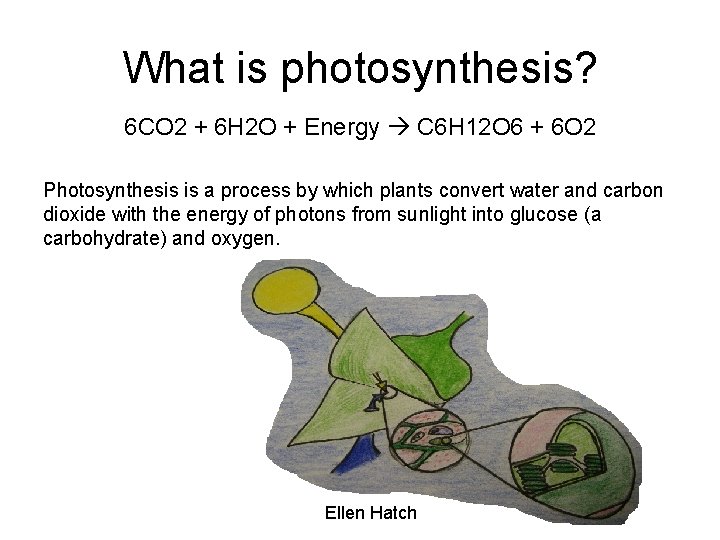
What is photosynthesis? 6 CO 2 + 6 H 2 O + Energy C 6 H 12 O 6 + 6 O 2 Photosynthesis is a process by which plants convert water and carbon dioxide with the energy of photons from sunlight into glucose (a carbohydrate) and oxygen. Ellen Hatch
The Key to Efficient Photosynthesis • Spectral Quality • Solar Energy Amount • Solar Energy Direction First, a “light” overview….
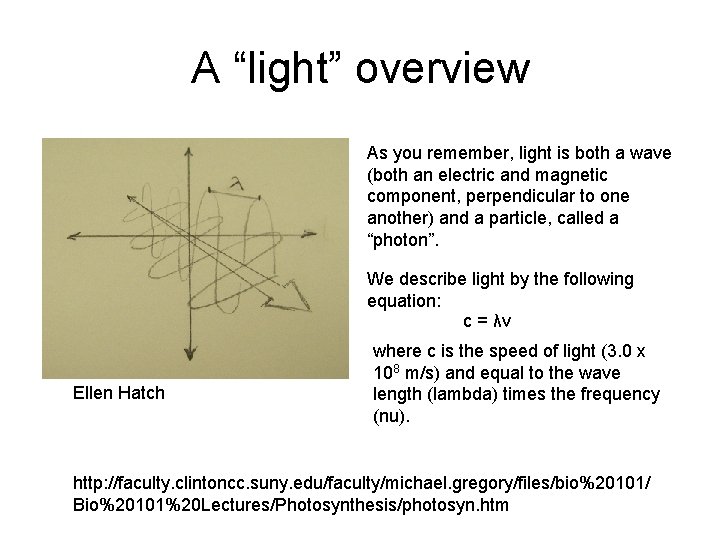
A “light” overview As you remember, light is both a wave (both an electric and magnetic component, perpendicular to one another) and a particle, called a “photon”. We describe light by the following equation: c = λν Ellen Hatch where c is the speed of light (3. 0 x 108 m/s) and equal to the wave length (lambda) times the frequency (nu). http: //faculty. clintoncc. suny. edu/faculty/michael. gregory/files/bio%20101/ Bio%20101%20 Lectures/Photosynthesis/photosyn. htm
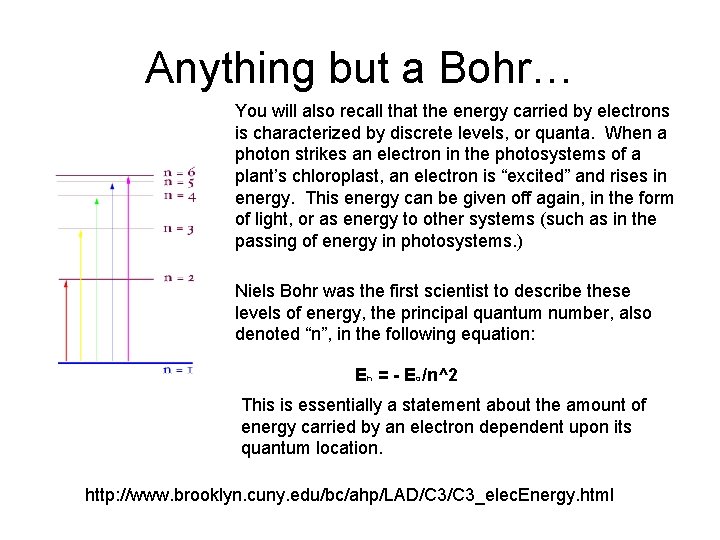
Anything but a Bohr… You will also recall that the energy carried by electrons is characterized by discrete levels, or quanta. When a photon strikes an electron in the photosystems of a plant’s chloroplast, an electron is “excited” and rises in energy. This energy can be given off again, in the form of light, or as energy to other systems (such as in the passing of energy in photosystems. ) Niels Bohr was the first scientist to describe these levels of energy, the principal quantum number, also denoted “n”, in the following equation: En = - Eo/n^2 This is essentially a statement about the amount of energy carried by an electron dependent upon its quantum location. http: //www. brooklyn. cuny. edu/bc/ahp/LAD/C 3_elec. Energy. html
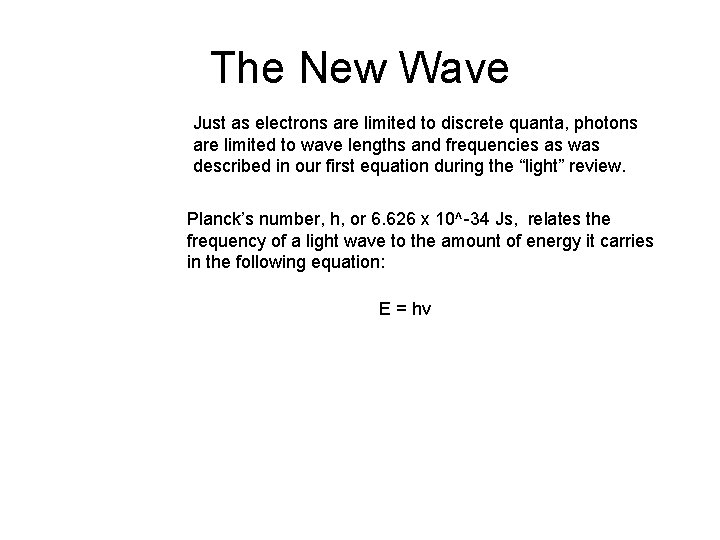
The New Wave Just as electrons are limited to discrete quanta, photons are limited to wave lengths and frequencies as was described in our first equation during the “light” review. Planck’s number, h, or 6. 626 x 10^-34 Js, relates the frequency of a light wave to the amount of energy it carries in the following equation: E = hv
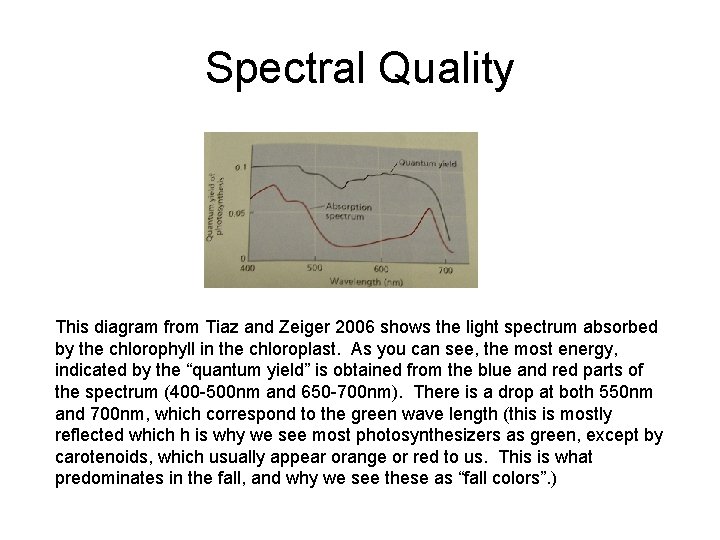
Spectral Quality This diagram from Tiaz and Zeiger 2006 shows the light spectrum absorbed by the chlorophyll in the chloroplast. As you can see, the most energy, indicated by the “quantum yield” is obtained from the blue and red parts of the spectrum (400 -500 nm and 650 -700 nm). There is a drop at both 550 nm and 700 nm, which correspond to the green wave length (this is mostly reflected which h is why we see most photosynthesizers as green, except by carotenoids, which usually appear orange or red to us. This is what predominates in the fall, and why we see these as “fall colors”. )
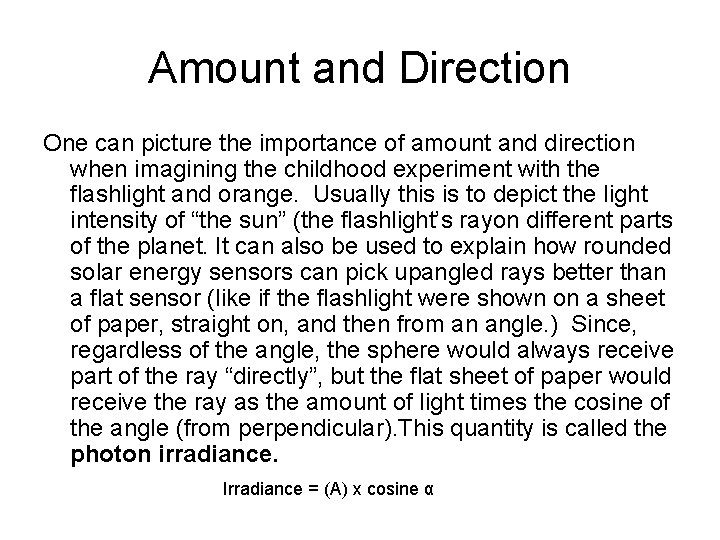
Amount and Direction One can picture the importance of amount and direction when imagining the childhood experiment with the flashlight and orange. Usually this is to depict the light intensity of “the sun” (the flashlight’s rayon different parts of the planet. It can also be used to explain how rounded solar energy sensors can pick upangled rays better than a flat sensor (like if the flashlight were shown on a sheet of paper, straight on, and then from an angle. ) Since, regardless of the angle, the sphere would always receive part of the ray “directly”, but the flat sheet of paper would receive the ray as the amount of light times the cosine of the angle (from perpendicular). This quantity is called the photon irradiance. Irradiance = (A) x cosine α
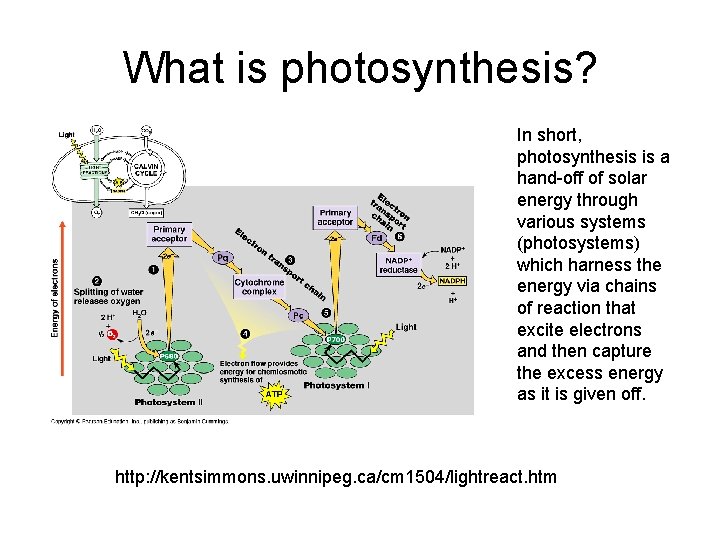
What is photosynthesis? In short, photosynthesis is a hand-off of solar energy through various systems (photosystems) which harness the energy via chains of reaction that excite electrons and then capture the excess energy as it is given off. http: //kentsimmons. uwinnipeg. ca/cm 1504/lightreact. htm
• So then what? • All this goes to create a p. H and ion gradient that allows the generation of ATP and GTP, often called “the energy currency of the cell”. The cell can use this energy in any number of other reactions to duplicate its genetic information for replication or RNA/protein synthesis, to create other macromolecules for growth or storage, and to maintain the production of energy via this cycle! • The Calvin Cycle follows these “light dependent” reactions, utilizing the energy captured to fix carbon into glucose.
Bibliography http: //bioenergy. asu. edu/photosyn/study. html http: //faculty. clintoncc. suny. edu/faculty/michael. gregory/file s/bio%20101/Bio%20101%20 Lectures/Photosynthesis/p hotosyn. htm http: //www. brooklyn. cuny. edu/bc/ahp/LAD/C 3_elec. Ener gy. html http: //www. sciencegateway. org/resources/biologytext/ps/ph ysics. html http: //kentsimmons. uwinnipeg. ca/cm 1504/lightreact. htm Taiz, L and Zeiger, E. Plant Physiology Fourth Ed. MA: Sinauer Associates, 2006.