HeavyFlavor Collectivity LightFlavor Thermalization at RHIC Kai Schweda
- Slides: 16
Heavy-Flavor Collectivity – Light-Flavor Thermalization at RHIC Kai Schweda, Berkeley Lab People: S. Blyth, X. Dong, Y. Lu, M. Oldenburg, H. G. Ritter, A. Rose, A. Shabetai, P. Sorensen, N. Xu, H. Zhang, Y. Zhang. THE Berkeley School, May 19 - 27, 2005
Outline 1) Motivation 2) Heavy-Flavor Physics - Heavy flavor (c, b) collectivity - Charm quark kinetic equilibration 3) A Heavy-Flavor Tracker for STAR 4) Summary THE Berkeley School, May 19 - 27, 2005
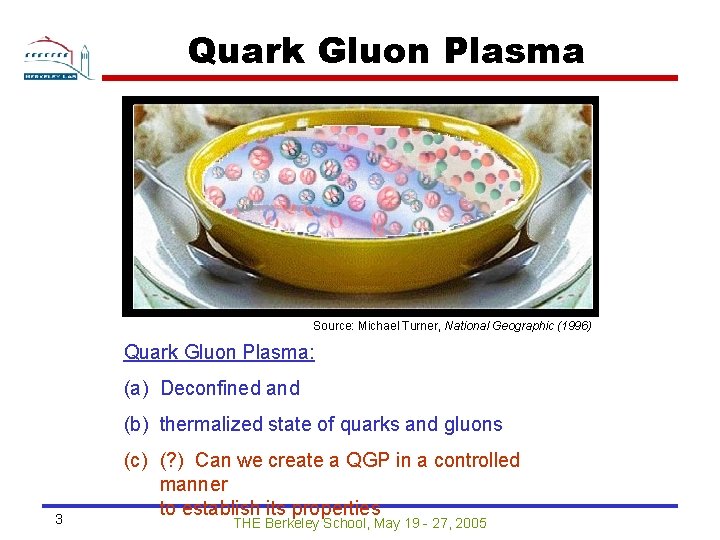
Quark Gluon Plasma Source: Michael Turner, National Geographic (1996) Quark Gluon Plasma: (a) Deconfined and (b) thermalized state of quarks and gluons 3 (c) (? ) Can we create a QGP in a controlled manner to establish its properties THE Berkeley School, May 19 - 27, 2005
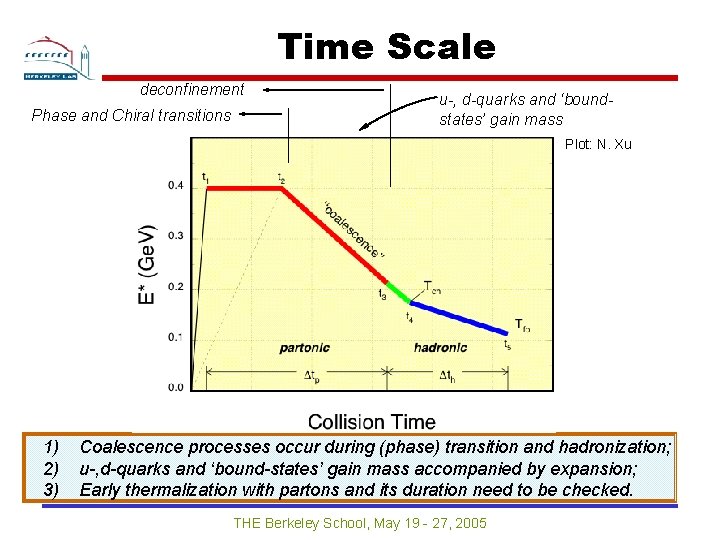
Time Scale deconfinement Phase and Chiral transitions u-, d-quarks and ‘boundstates’ gain mass Plot: N. Xu 1) 2) 3) Coalescence processes occur during (phase) transition and hadronization; u-, d-quarks and ‘bound-states’ gain mass accompanied by expansion; Early thermalization with partons and its duration need to be checked. THE Berkeley School, May 19 - 27, 2005
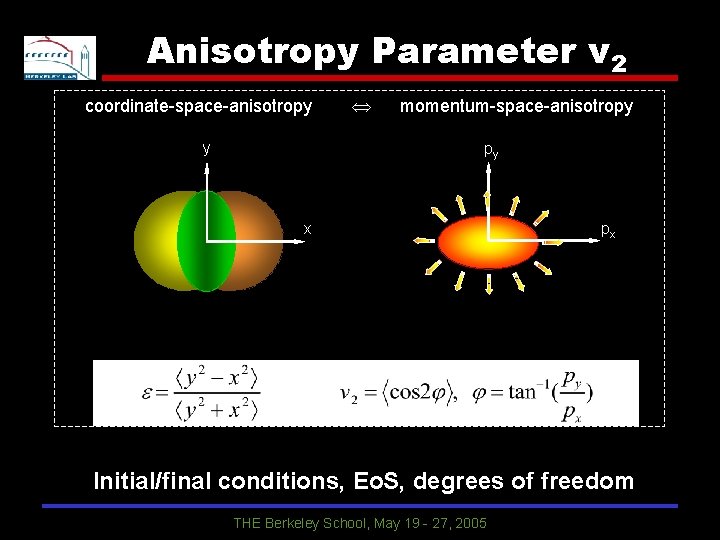
Anisotropy Parameter v 2 coordinate-space-anisotropy y momentum-space-anisotropy py x px Initial/final conditions, Eo. S, degrees of freedom THE Berkeley School, May 19 - 27, 2005
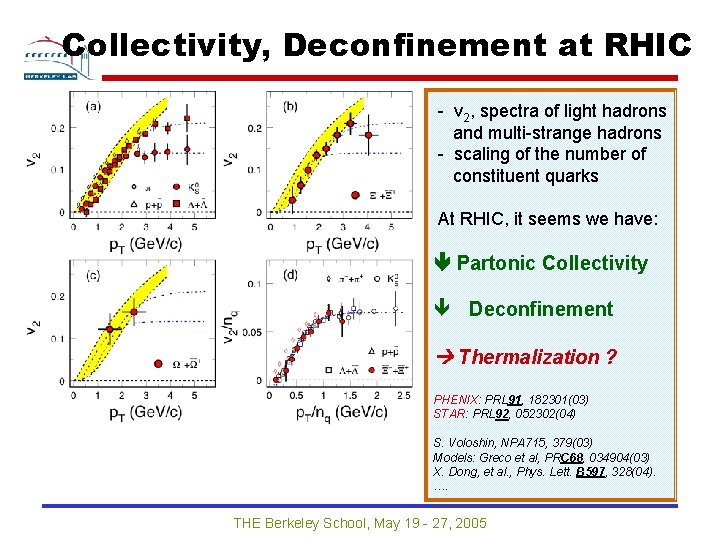
Collectivity, Deconfinement at RHIC - v 2, spectra of light hadrons and multi-strange hadrons - scaling of the number of constituent quarks At RHIC, it seems we have: Partonic Collectivity ê Deconfinement Thermalization ? PHENIX: PRL 91, 182301(03) STAR: PRL 92, 052302(04) S. Voloshin, NPA 715, 379(03) Models: Greco et al, PRC 68, 034904(03) X. Dong, et al. , Phys. Lett. B 597, 328(04). …. THE Berkeley School, May 19 - 27, 2005
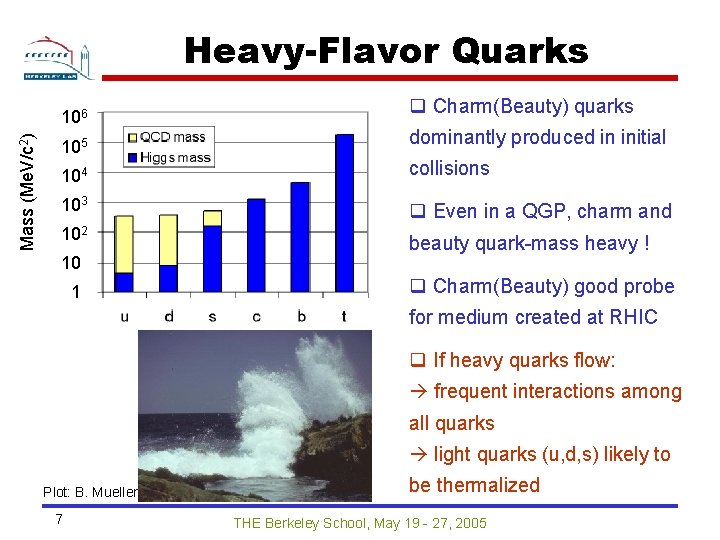
Heavy-Flavor Quarks q Charm(Beauty) quarks Mass (Me. V/c 2) 106 105 dominantly produced in initial 104 collisions 103 q Even in a QGP, charm and 102 beauty quark-mass heavy ! 10 q Charm(Beauty) good probe 1 for medium created at RHIC q If heavy quarks flow: frequent interactions among all quarks light quarks (u, d, s) likely to Plot: B. Mueller, nucl-th/0404015. 7 be thermalized THE Berkeley School, May 19 - 27, 2005
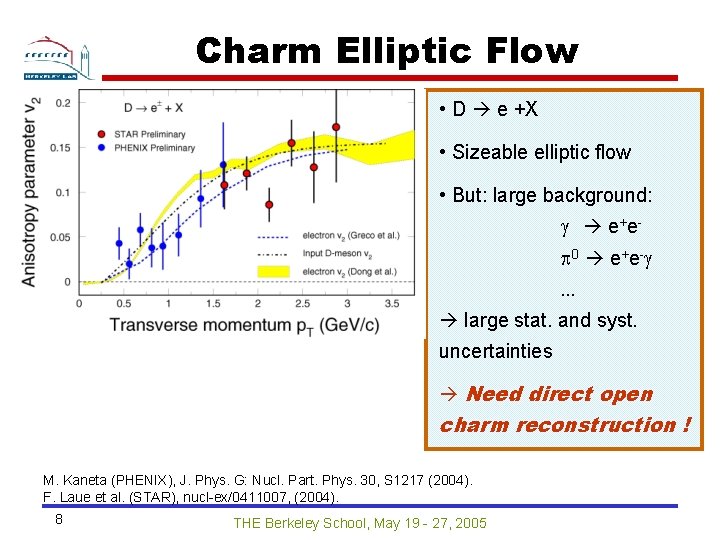
Charm Elliptic Flow • D e +X • Sizeable elliptic flow • But: large background: g e + ep 0 e+e-g. . . large stat. and syst. uncertainties Need direct open charm reconstruction ! M. Kaneta (PHENIX), J. Phys. G: Nucl. Part. Phys. 30, S 1217 (2004). F. Laue et al. (STAR), nucl-ex/0411007, (2004). 8 THE Berkeley School, May 19 - 27, 2005
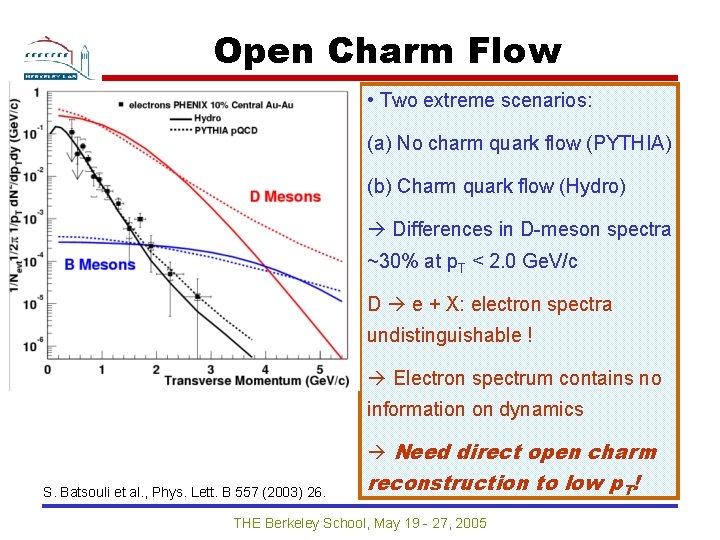
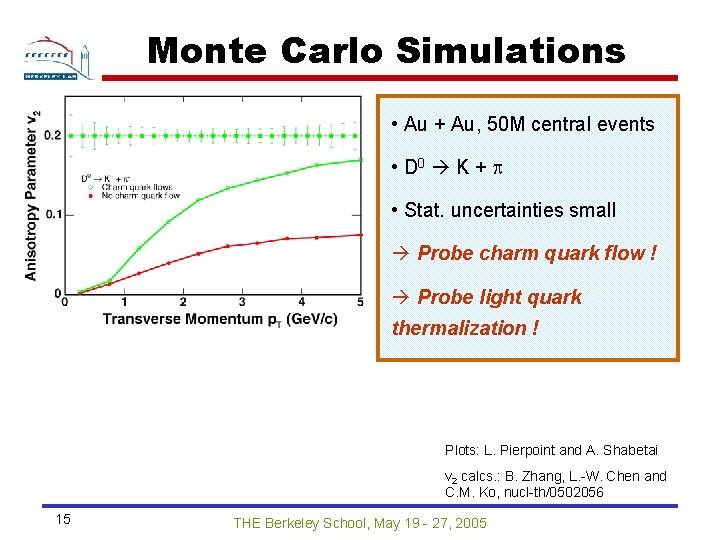
Open Charm Flow • Two extreme scenarios: (a) No charm quark flow (PYTHIA) (b) Charm quark flow (Hydro) Differences in D-meson spectra ~30% at p. T < 2. 0 Ge. V/c D e + X: electron spectra undistinguishable ! Electron spectrum contains no information on dynamics Need direct open charm S. Batsouli et al. , Phys. Lett. B 557 (2003) 26. reconstruction to low p. T! THE Berkeley School, May 19 - 27, 2005
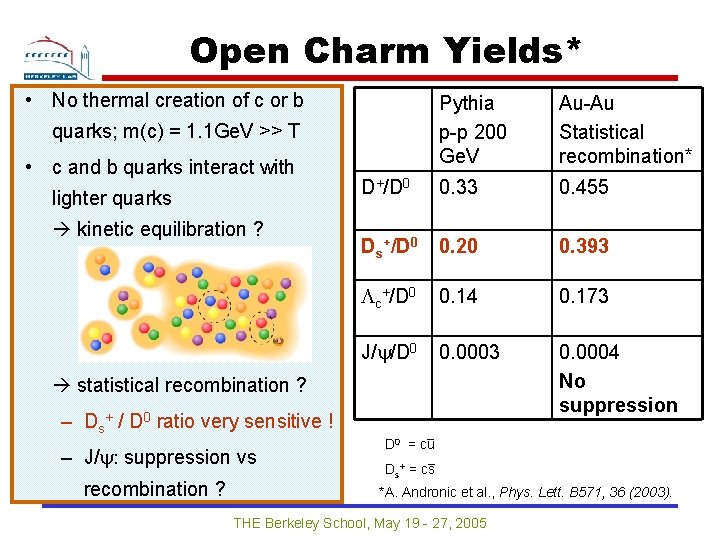
Open Charm Yields* • No thermal creation of c or b Pythia p-p 200 Ge. V Au-Au Statistical recombination* D+/D 0 0. 33 0. 455 Ds+/D 0 0. 20 0. 393 Lc+/D 0 0. 14 0. 173 J/y/D 0 0. 0003 0. 0004 No suppression quarks; m(c) = 1. 1 Ge. V >> T • c and b quarks interact with lighter quarks kinetic equilibration ? statistical recombination ? – Ds+ / D 0 ratio very sensitive ! – J/y: suppression vs recombination ? D 0 = cu Ds+ = cs *A. Andronic et al. , Phys. Lett. B 571, 36 (2003). THE Berkeley School, May 19 - 27, 2005
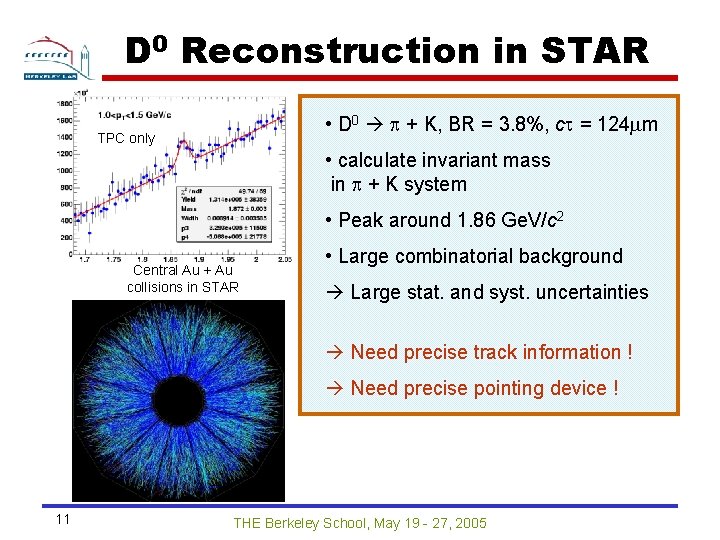
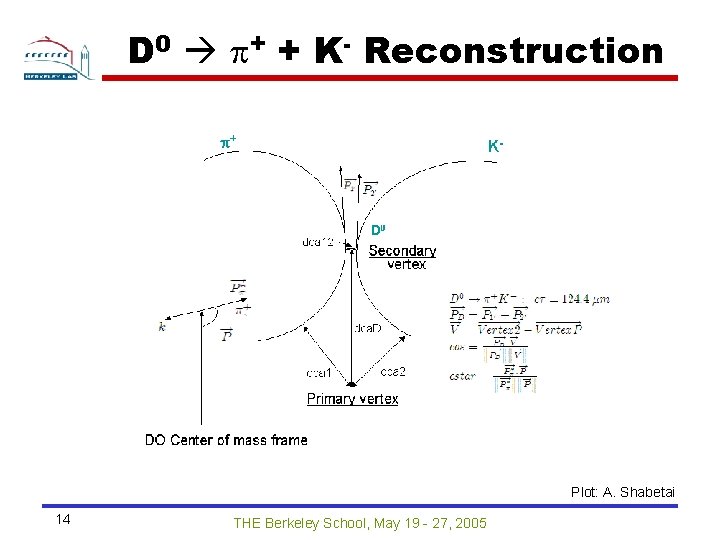
D 0 Reconstruction in STAR • D 0 p + K, BR = 3. 8%, ct = 124 mm TPC only • calculate invariant mass in p + K system • Peak around 1. 86 Ge. V/c 2 Central Au + Au collisions in STAR • Large combinatorial background Large stat. and syst. uncertainties Need precise track information ! Need precise pointing device ! 11 THE Berkeley School, May 19 - 27, 2005
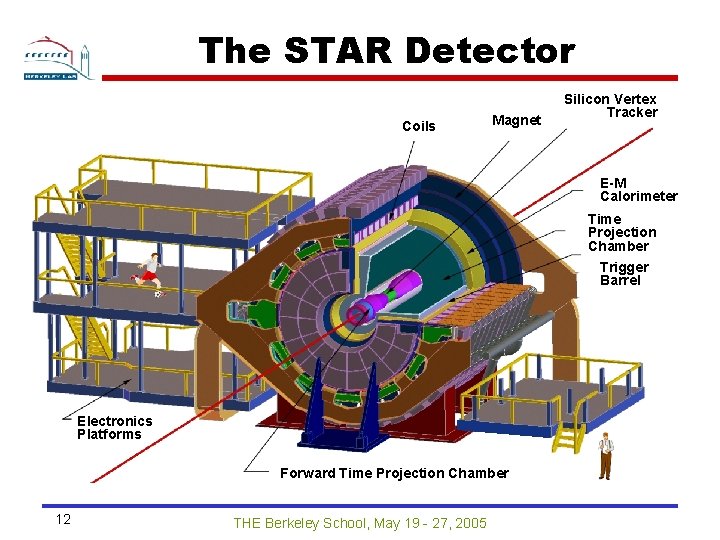
The STAR Detector Coils Magnet Silicon Vertex Tracker E-M Calorimeter Time Projection Chamber Trigger Barrel Electronics Platforms Forward Time Projection Chamber 12 THE Berkeley School, May 19 - 27, 2005
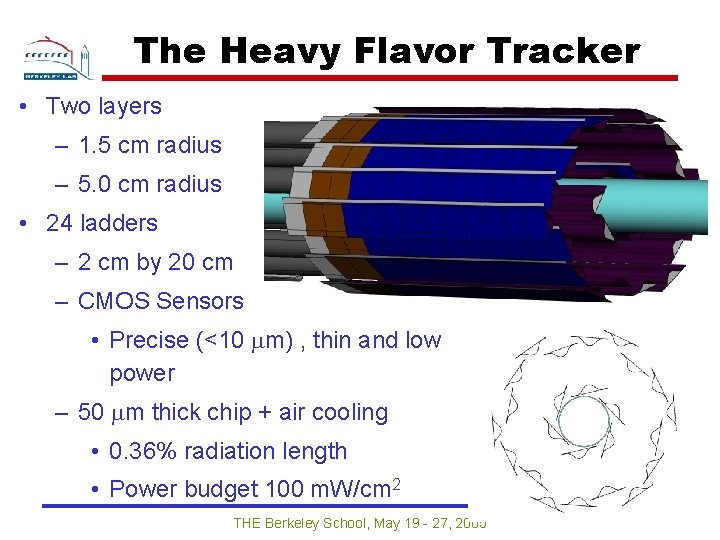
The Heavy Flavor Tracker • Two layers – 1. 5 cm radius – 5. 0 cm radius • 24 ladders – 2 cm by 20 cm – CMOS Sensors • Precise (<10 mm) , thin and low power – 50 mm thick chip + air cooling • 0. 36% radiation length • Power budget 100 m. W/cm 2 THE Berkeley School, May 19 - 27, 2005
D 0 p+ + K- Reconstruction Plot: A. Shabetai 14 THE Berkeley School, May 19 - 27, 2005
Monte Carlo Simulations • Au + Au, 50 M central events • D 0 K + p • Stat. uncertainties small Probe charm quark flow ! Probe light quark thermalization ! Plots: L. Pierpoint and A. Shabetai v 2 calcs. : B. Zhang, L. -W. Chen and C. M. Ko, nucl-th/0502056 15 THE Berkeley School, May 19 - 27, 2005
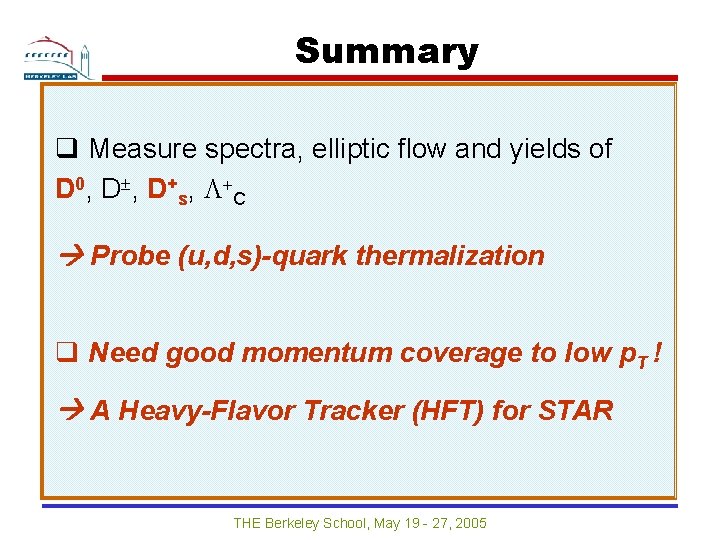
Summary q Measure spectra, elliptic flow and yields of D 0 , D + s , L+ C Probe (u, d, s)-quark thermalization q Need good momentum coverage to low p. T ! A Heavy-Flavor Tracker (HFT) for STAR THE Berkeley School, May 19 - 27, 2005