HEAPS PRIORITY QUEUES Lecture 13 CS 2110 Spring

- Slides: 41
HEAPS & PRIORITY QUEUES Lecture 13 CS 2110 Spring 2018
Announcements 2 A 4 goes out today! Prelim 1: regrades are open a few rubrics have changed No Recitations next week (Fall Break Mon & Tue) We’ll spend Fall Break taking care of loose ends
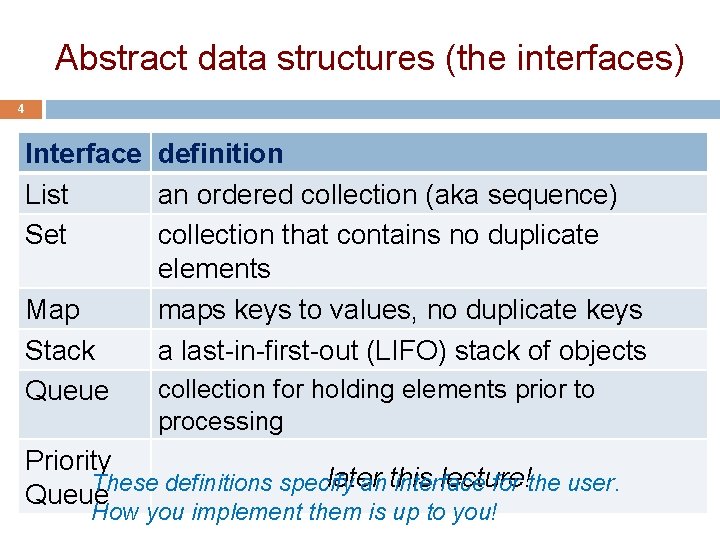
Abstract vs concrete data structures 3 Abstract data structures are interfaces specify only interface (method names and specs) not implementation (method bodies, fields, …) Have multiple possible implementations Concrete data structures are classes These are the multiple possible implementations
Abstract data structures (the interfaces) 4 Interface definition List an ordered collection (aka sequence) Set collection that contains no duplicate elements Map maps keys to values, no duplicate keys Stack a last-in-first-out (LIFO) stack of objects collection for holding elements prior to Queue processing Priority later lecture! These definitions specify an this interface for the user. Queue How you implement them is up to you!
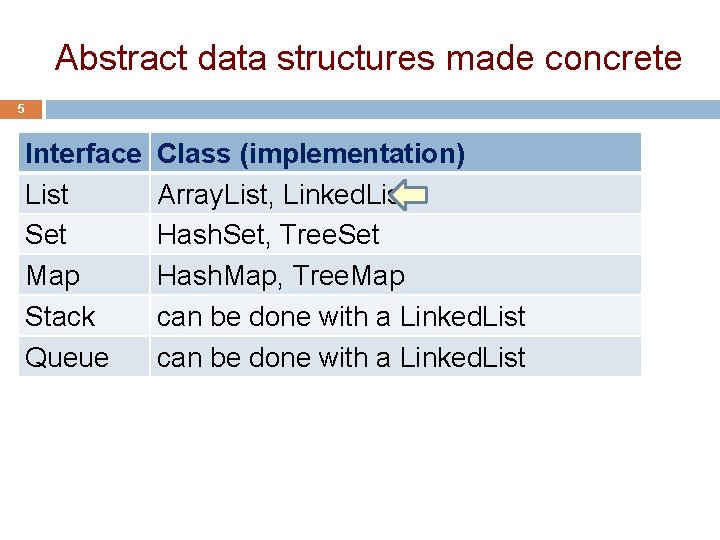
Abstract data structures made concrete 5 Interface List Set Map Stack Queue Class (implementation) Array. List, Linked. List Hash. Set, Tree. Set Hash. Map, Tree. Map can be done with a Linked. List
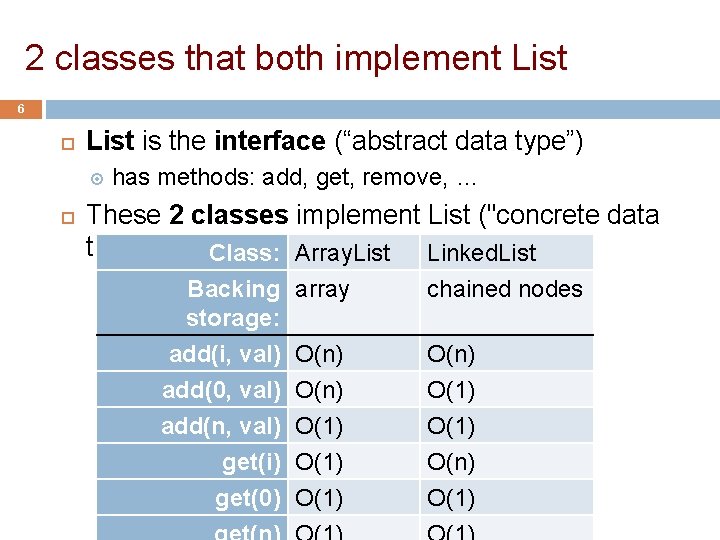
2 classes that both implement List 6 List is the interface (“abstract data type”) has methods: add, get, remove, … These 2 classes implement List ("concrete data types"): Class: Array. List Linked. List Backing array storage: add(i, val) add(0, val) add(n, val) get(i) get(0) O(n) O(1) chained nodes O(n) O(1)
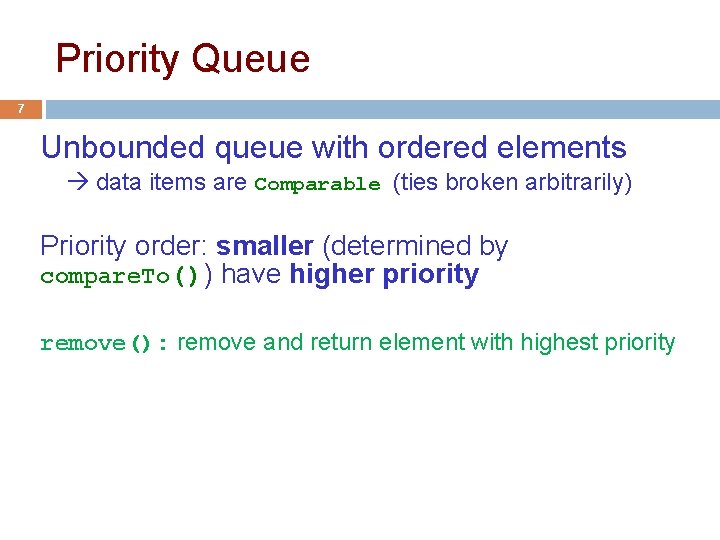
Priority Queue 7 Unbounded queue with ordered elements data items are Comparable (ties broken arbitrarily) Priority order: smaller (determined by compare. To()) have higher priority remove(): remove and return element with highest priority
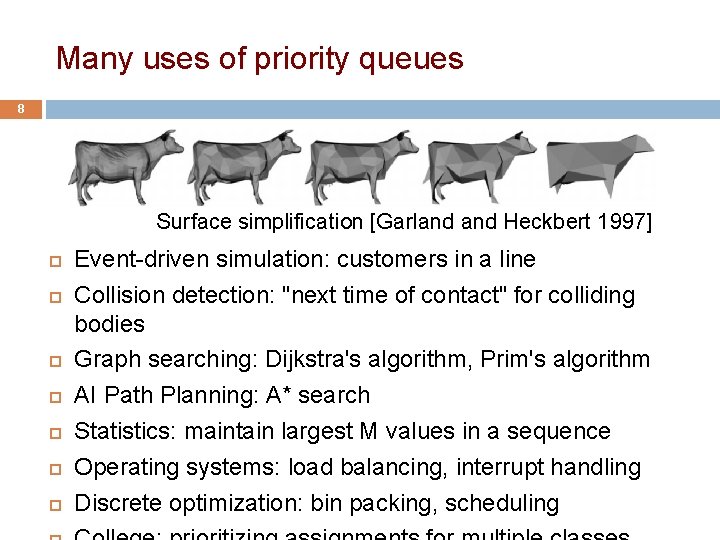
Many uses of priority queues 8 Surface simplification [Garland Heckbert 1997] Event-driven simulation: customers in a line Collision detection: "next time of contact" for colliding bodies Graph searching: Dijkstra's algorithm, Prim's algorithm AI Path Planning: A* search Statistics: maintain largest M values in a sequence Operating systems: load balancing, interrupt handling Discrete optimization: bin packing, scheduling
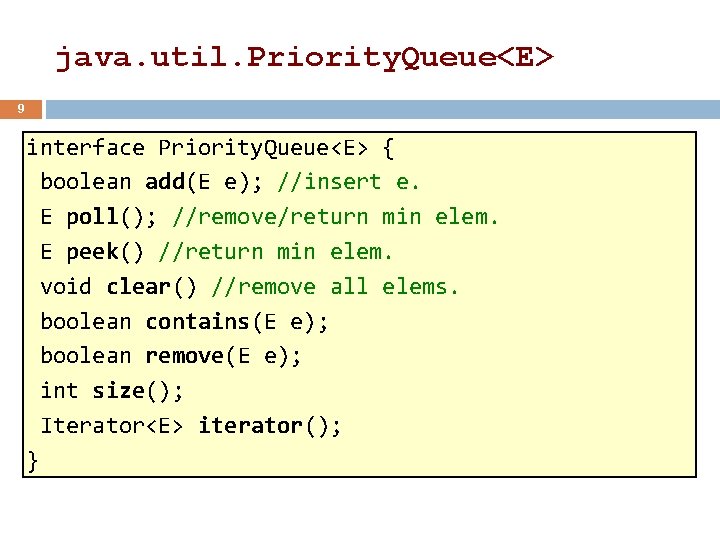
java. util. Priority. Queue<E> 9 interface Priority. Queue<E> { boolean add(E e); //insert e. E poll(); //remove/return min elem. E peek() //return min elem. void clear() //remove all elems. boolean contains(E e); boolean remove(E e); int size(); Iterator<E> iterator(); }
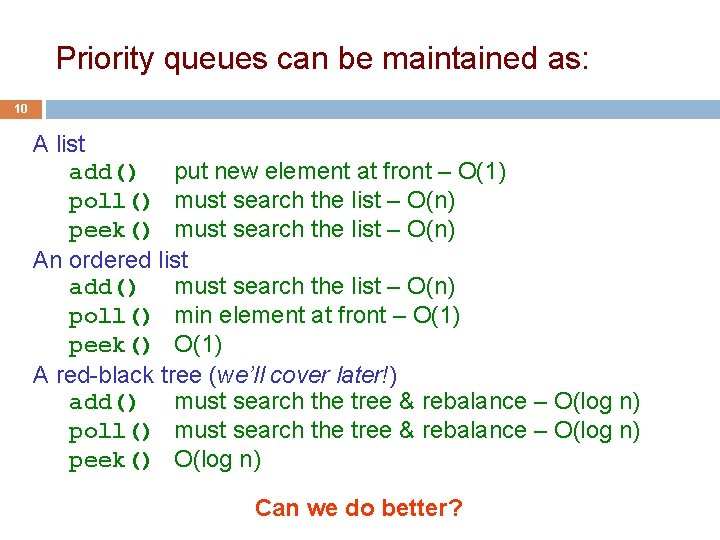
Priority queues can be maintained as: 10 A list add() put new element at front – O(1) poll() must search the list – O(n) peek() must search the list – O(n) An ordered list add() must search the list – O(n) poll() min element at front – O(1) peek() O(1) A red-black tree (we’ll cover later!) add() must search the tree & rebalance – O(log n) poll() must search the tree & rebalance – O(log n) peek() O(log n) Can we do better?
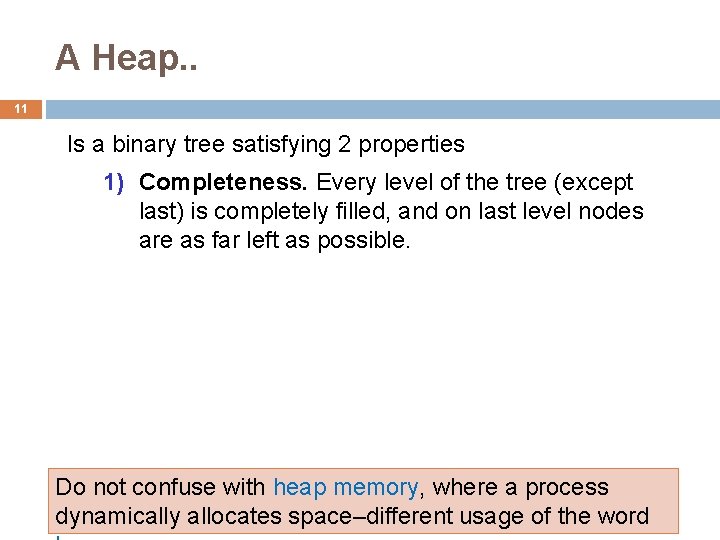
A Heap. . 11 Is a binary tree satisfying 2 properties 1) Completeness. Every level of the tree (except last) is completely filled, and on last level nodes are as far left as possible. Do not confuse with heap memory, where a process dynamically allocates space–different usage of the word
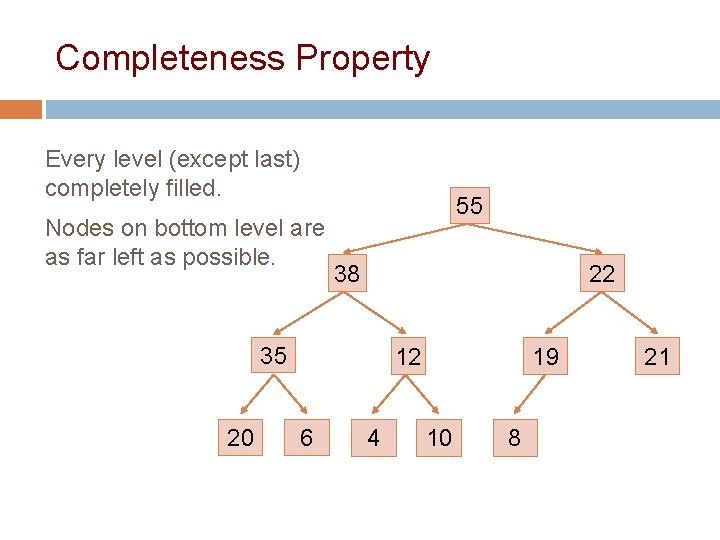
Completeness Property 12 Every level (except last) completely filled. Nodes on bottom level are as far left as possible. 55 38 22 35 20 12 6 4 19 10 8 21
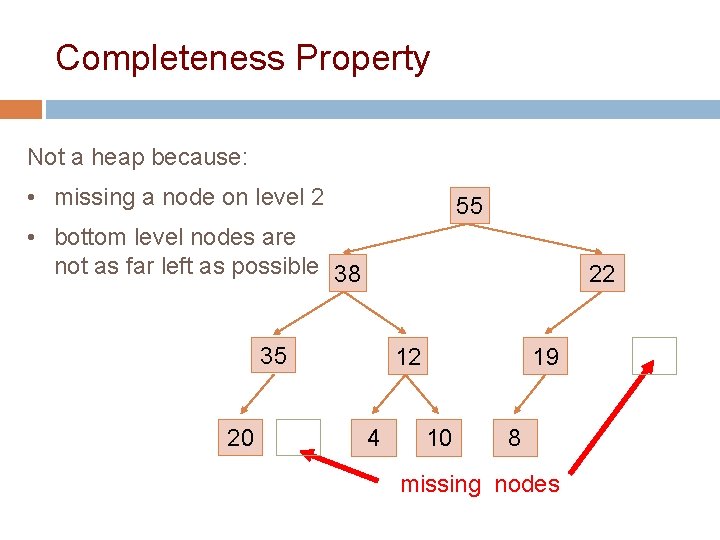
Completeness Property 13 Not a heap because: • missing a node on level 2 55 • bottom level nodes are not as far left as possible 38 22 35 20 12 4 19 10 8 missing nodes
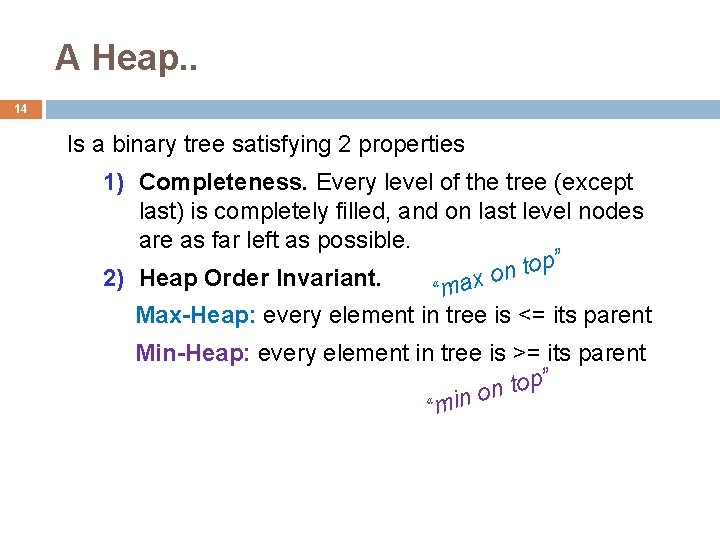
A Heap. . 14 Is a binary tree satisfying 2 properties 1) Completeness. Every level of the tree (except last) is completely filled, and on last level nodes are as far left as possible. p” o t n o 2) Heap Order Invariant. x a “m Max-Heap: every element in tree is <= its parent Min-Heap: every element in tree is >= its parent p” o t n o “min
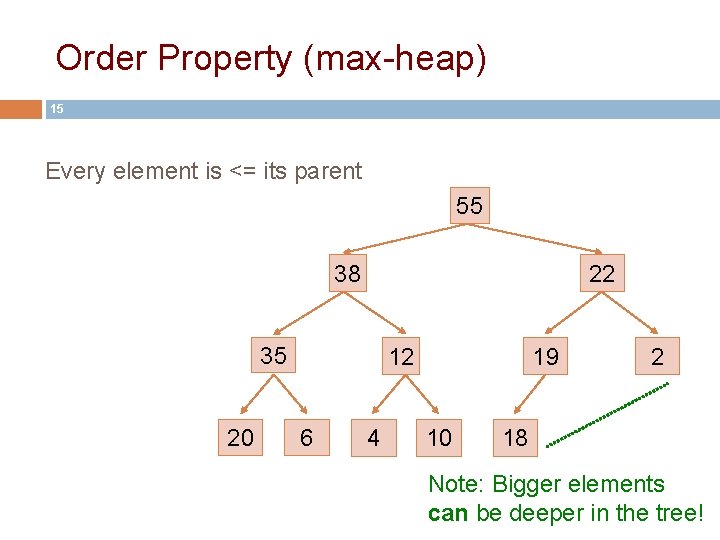
Order Property (max-heap) 15 Every element is <= its parent 55 38 22 35 20 12 6 4 19 10 2 18 Note: Bigger elements can be deeper in the tree!
Heap Quiz #1 16
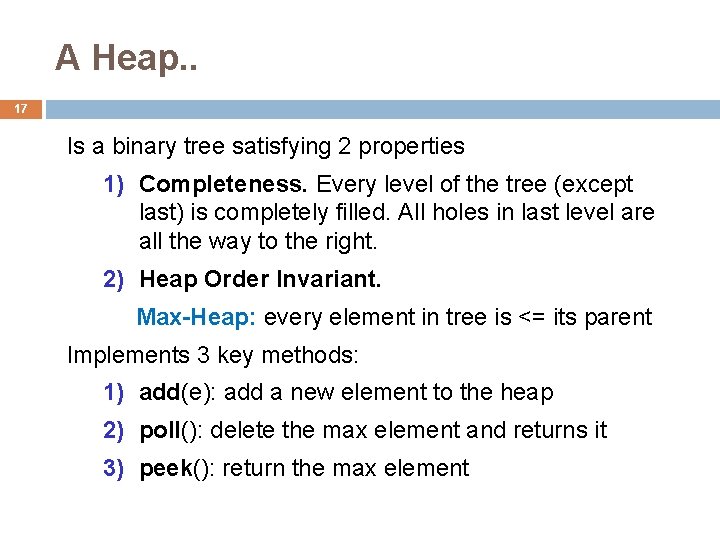
A Heap. . 17 Is a binary tree satisfying 2 properties 1) Completeness. Every level of the tree (except last) is completely filled. All holes in last level are all the way to the right. 2) Heap Order Invariant. Max-Heap: every element in tree is <= its parent Implements 3 key methods: 1) add(e): add a new element to the heap 2) poll(): delete the max element and returns it 3) peek(): return the max element
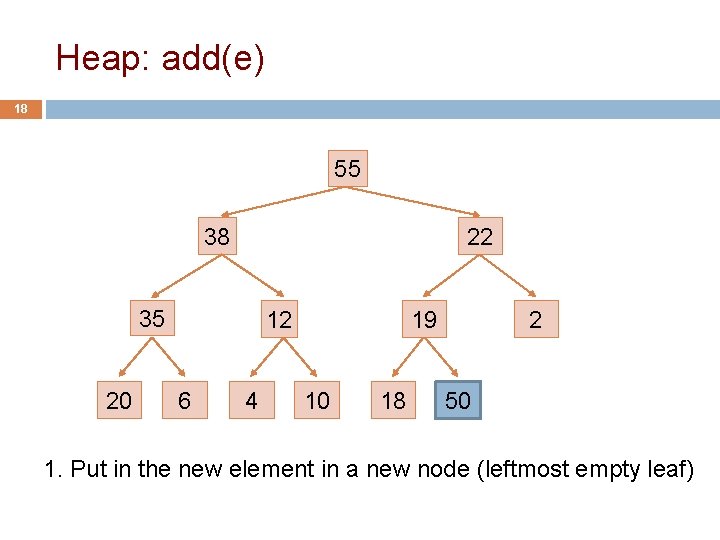
Heap: add(e) 18 55 38 22 35 20 12 6 4 19 10 18 2 50 1. Put in the new element in a new node (leftmost empty leaf)
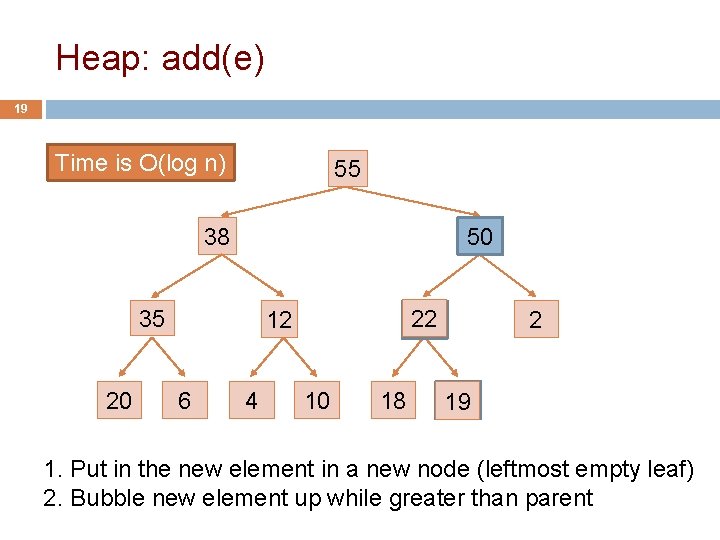
Heap: add(e) 19 Time is O(log n) 55 50 22 38 35 20 22 19 50 12 6 4 10 18 2 50 19 1. Put in the new element in a new node (leftmost empty leaf) 2. Bubble new element up while greater than parent
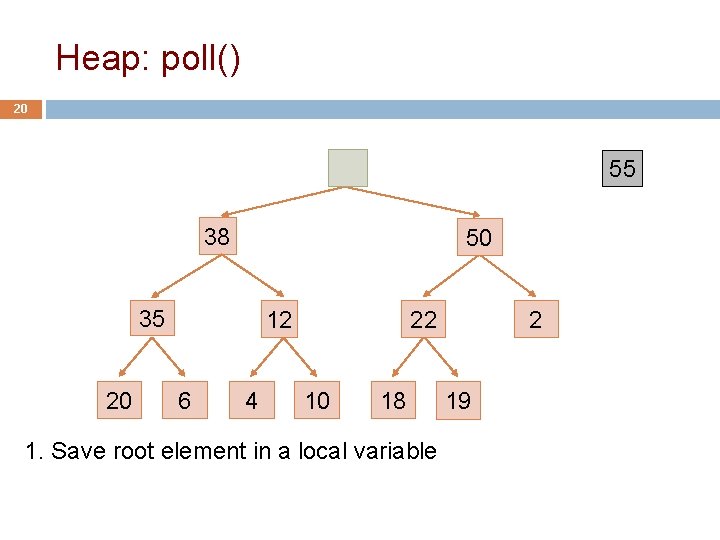
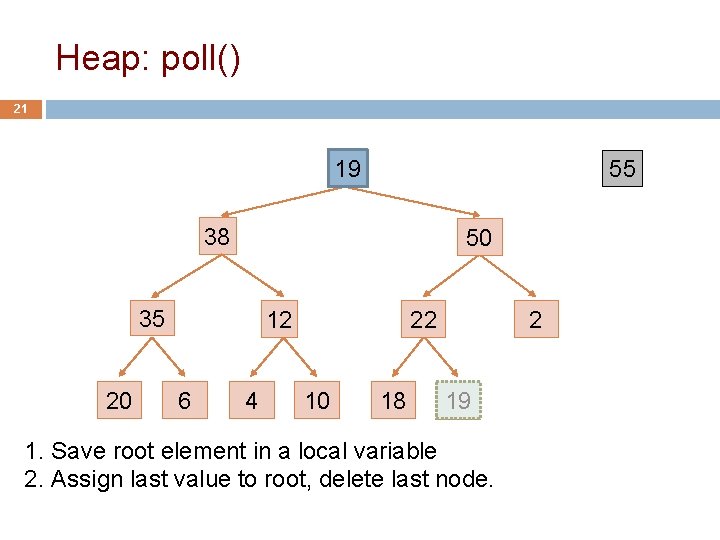
Heap: poll() 20 55 55 38 50 35 20 12 6 4 22 10 18 1. Save root element in a local variable 2 19
Heap: poll() 21 19 55 55 38 50 35 20 12 6 4 22 10 18 2 19 1. Save root element in a local variable 2. Assign last value to root, delete last node.
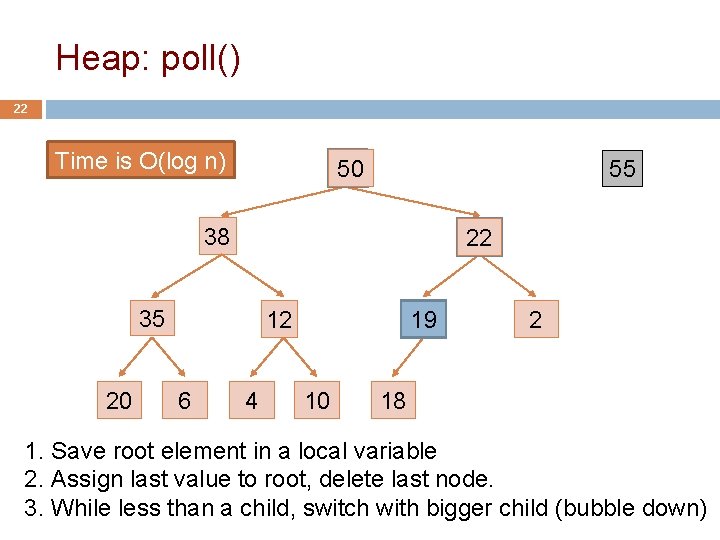
Heap: poll() 22 Time is O(log n) 50 19 55 55 38 50 22 19 35 20 12 6 4 22 19 10 2 18 1. Save root element in a local variable 2. Assign last value to root, delete last node. 3. While less than a child, switch with bigger child (bubble down)
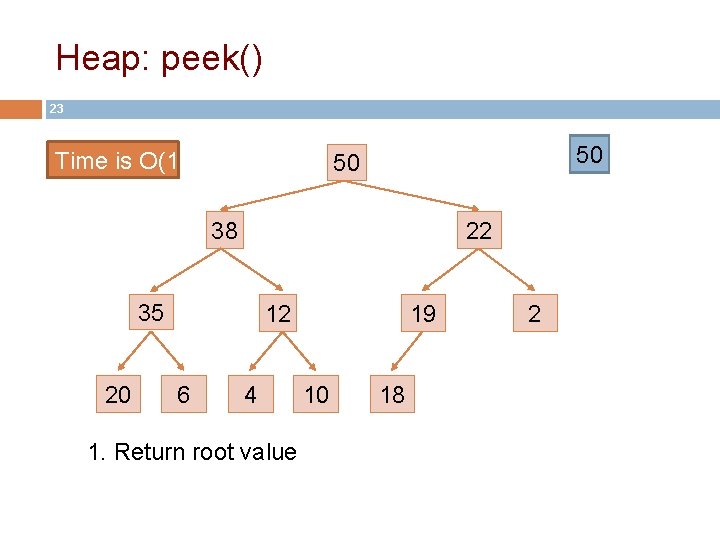
Heap: peek() 23 Time is O(1) 50 50 38 22 35 20 12 6 4 1. Return root value 19 10 18 2
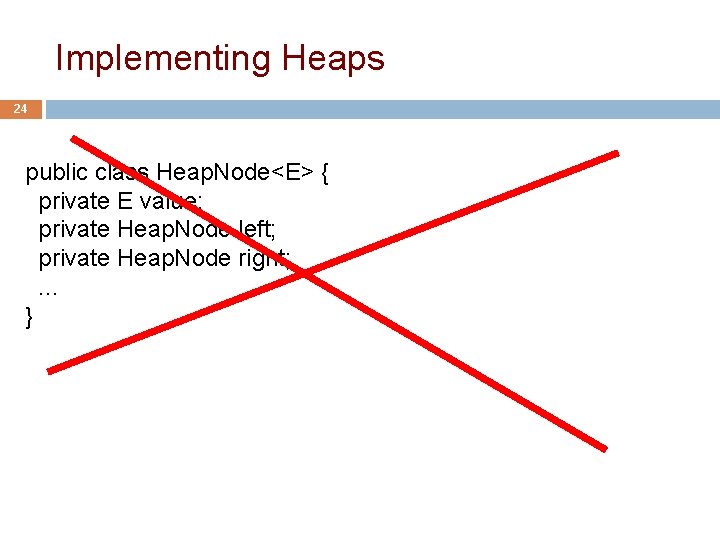
Implementing Heaps 24 public class Heap. Node<E> { private E value; private Heap. Node left; private Heap. Node right; . . . }
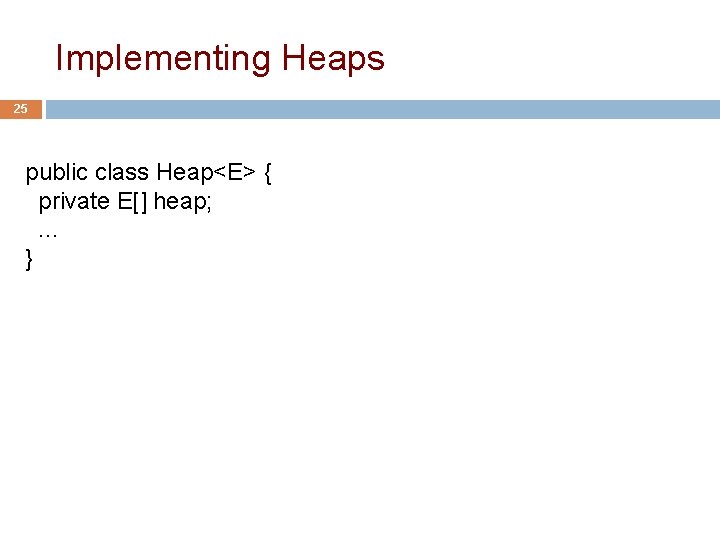
Implementing Heaps 25 public class Heap<E> { private E[] heap; . . . }
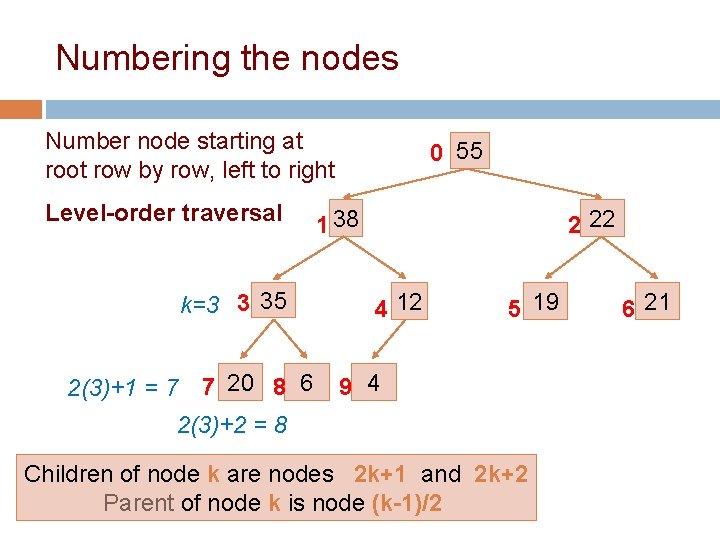
Numbering the nodes Number node starting at root row by row, left to right Level-order traversal k=3 3 35 2(3)+1 = 7 7 20 8 6 0 55 1 38 2 22 4 12 5 19 9 4 2(3)+2 = 8 Children of node k are nodes 2 k+1 and 2 k+2 Parent of node k is node (k-1)/2 6 21
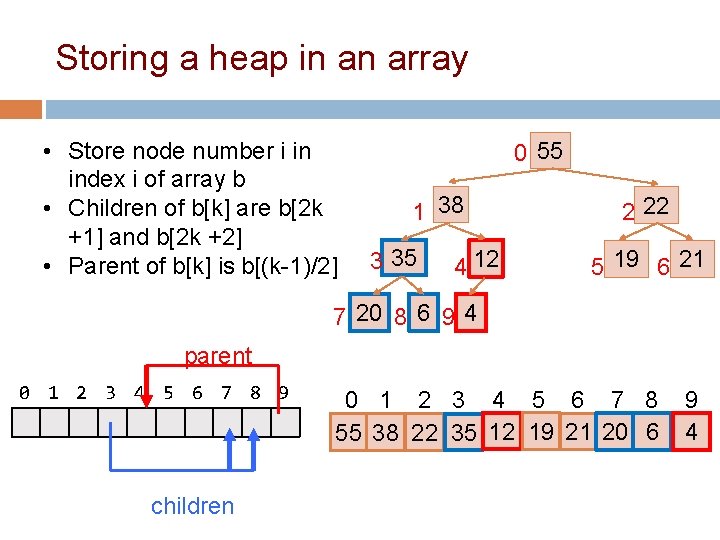
Storing a heap in an array • Store node number i in index i of array b • Children of b[k] are b[2 k +1] and b[2 k +2] • Parent of b[k] is b[(k-1)/2] 0 55 1 38 3 35 4 12 2 22 5 19 6 21 7 20 8 6 9 4 parent 0 1 2 3 4 5 6 7 8 9 children 0 1 2 3 4 5 6 7 8 55 38 22 35 12 19 21 20 6 9 4
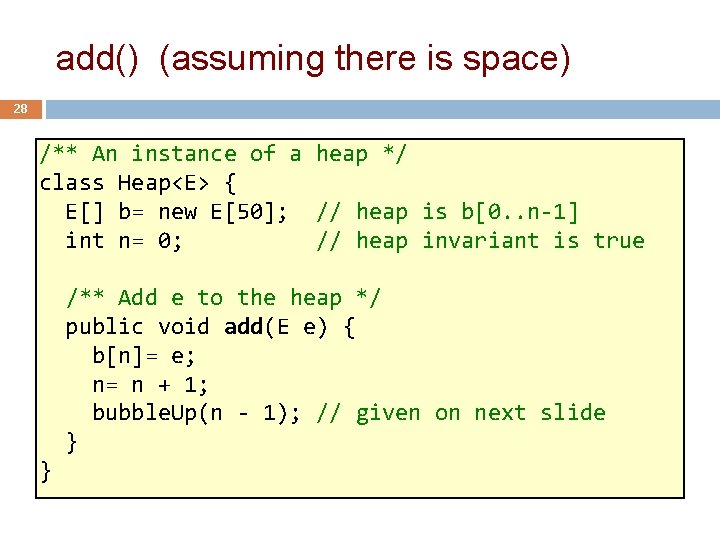
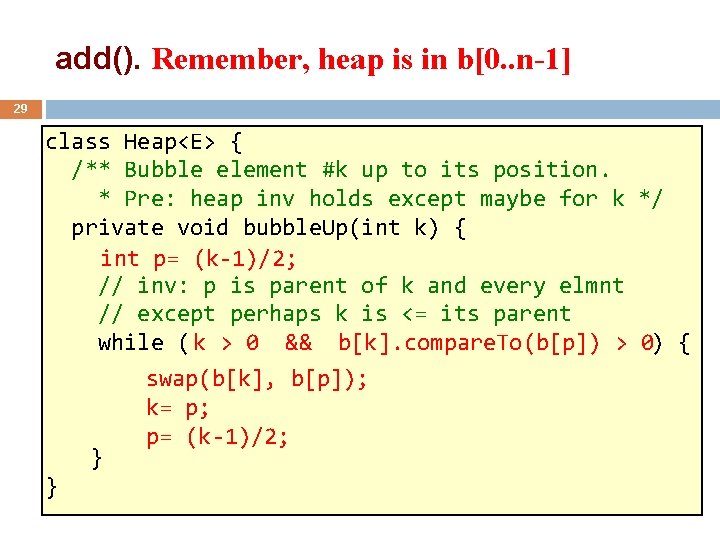
add() (assuming there is space) 28 /** An instance of a heap */ class Heap<E> { E[] b= new E[50]; // heap is b[0. . n-1] int n= 0; // heap invariant is true /** Add e to the heap */ public void add(E e) { b[n]= e; n= n + 1; bubble. Up(n - 1); // given on next slide } }
add(). Remember, heap is in b[0. . n-1] 29 class Heap<E> { /** Bubble element #k up to its position. * Pre: heap inv holds except maybe for k */ private void bubble. Up(int k) { int p= (k-1)/2; // inv: p is parent of k and every elmnt // except perhaps k is <= its parent k > 0 && b[k]. compare. To(b[p]) > 0 while ( ) { swap(b[k], b[p]); k= p; p= (k-1)/2; } }
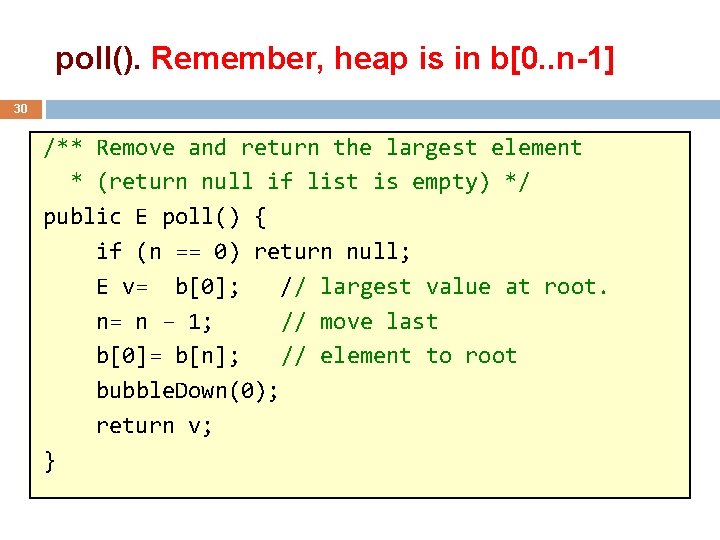
poll(). Remember, heap is in b[0. . n-1] 30 /** Remove and return the largest element * (return null if list is empty) */ public E poll() { if (n == 0) return null; E v= b[0]; // largest value at root. n= n – 1; // move last b[0]= b[n]; // element to root bubble. Down(0); return v; }
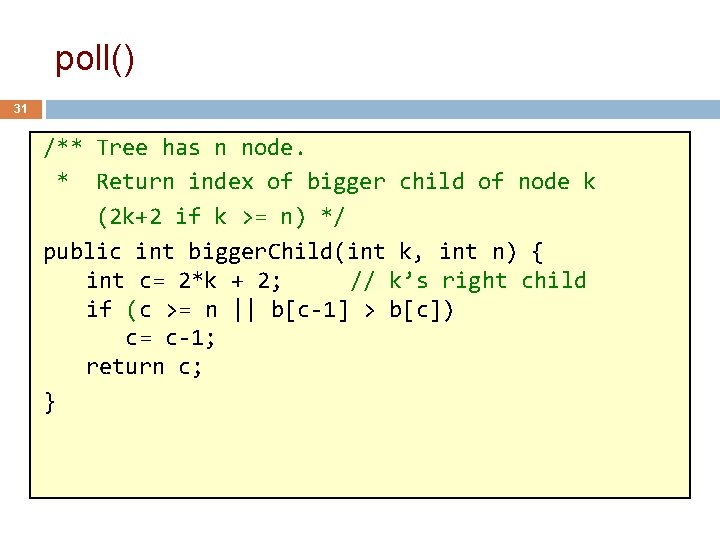
poll() 31 /** Tree has n node. * Return index of bigger child of node k (2 k+2 if k >= n) */ public int bigger. Child(int k, int n) { int c= 2*k + 2; // k’s right child if (c >= n || b[c-1] > b[c]) c= c-1; return c; }
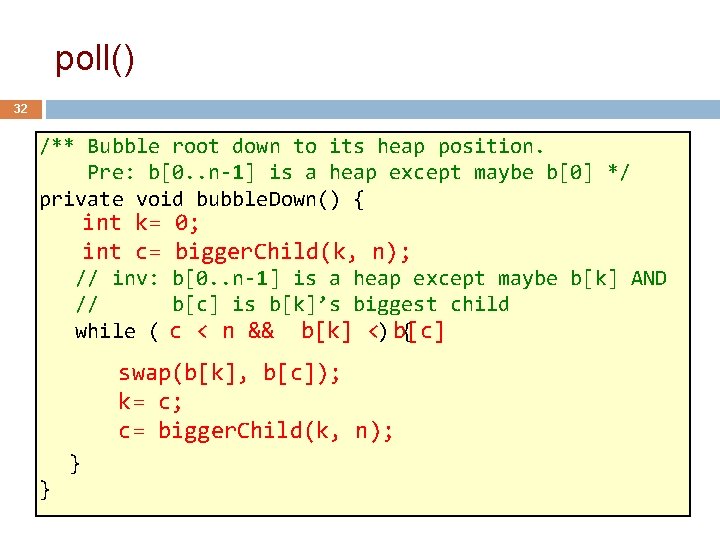
poll() 32 /** Bubble root down to its heap position. Pre: b[0. . n-1] is a heap except maybe b[0] */ private void bubble. Down() { int k= 0; int c= bigger. Child(k, n); // inv: b[0. . n-1] is a heap except maybe b[k] AND // b[c] is b[k]’s biggest child while ( ) { c < n && b[k] < b[c] swap(b[k], b[c]); k= c; c= bigger. Child(k, n); } }
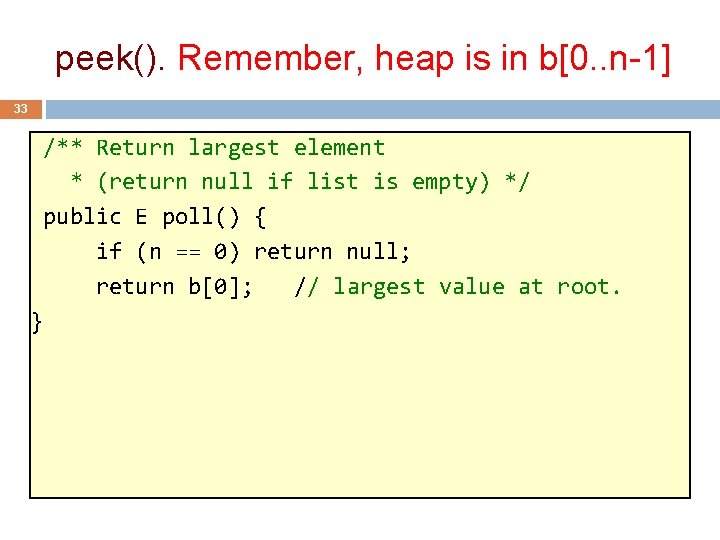
peek(). Remember, heap is in b[0. . n-1] 33 /** Return largest element * (return null if list is empty) */ public E poll() { if (n == 0) return null; return b[0]; // largest value at root. }
Heap Quiz #2 34
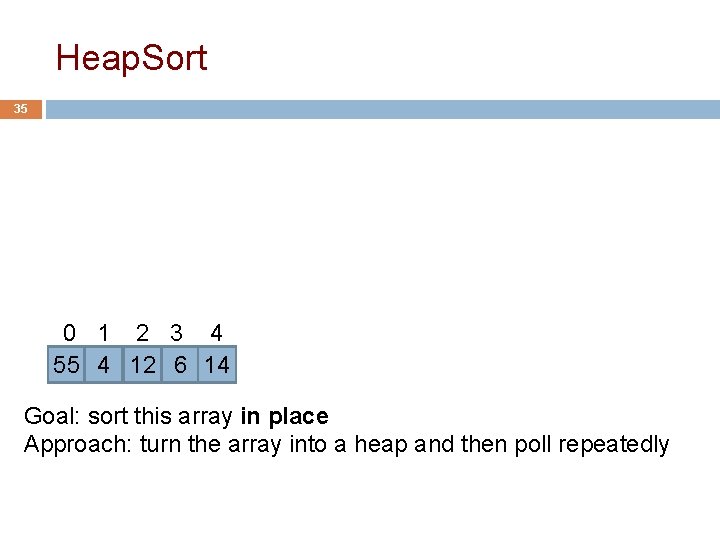
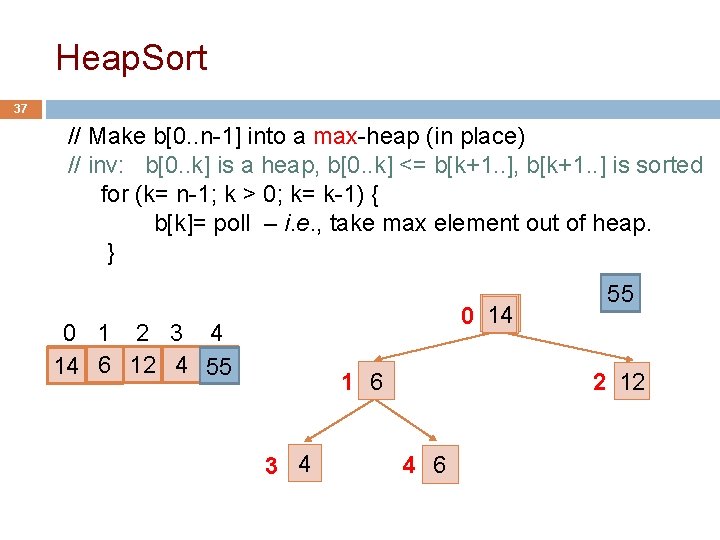
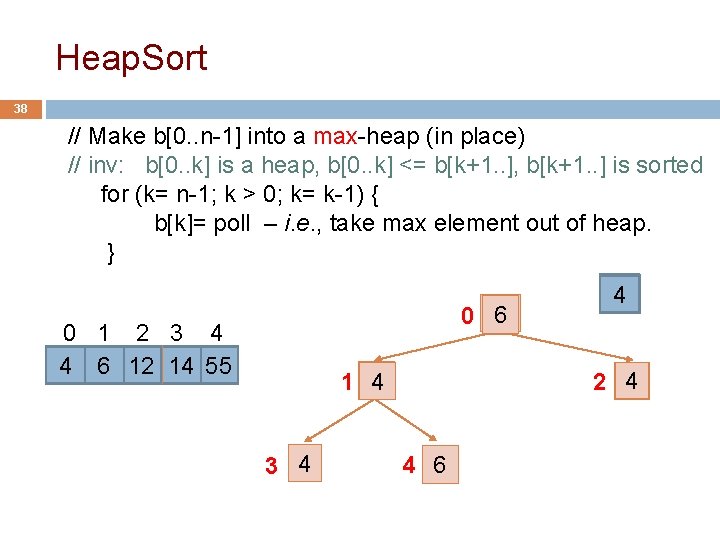
Heap. Sort 35 0 1 2 3 4 55 4 12 6 14 Goal: sort this array in place Approach: turn the array into a heap and then poll repeatedly
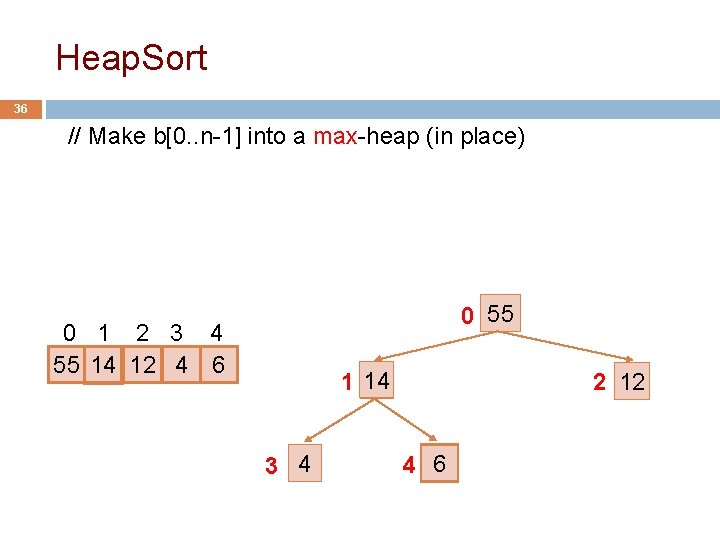
Heap. Sort 36 // Make b[0. . n-1] into a max-heap (in place) 0 55 0 1 2 3 4 55 14 6 4 12 6 6 4 1 14 4 3 6 2 12 6 4 14
Heap. Sort 37 // Make b[0. . n-1] into a max-heap (in place) // inv: b[0. . k] is a heap, b[0. . k] <= b[k+1. . ], b[k+1. . ] is sorted for (k= n-1; k > 0; k= k-1) { b[k]= poll – i. e. , take max element out of heap. } 55 6 0 14 0 1 2 3 4 6 14 6 4 12 4 55 55 14 6 6 4 1 14 4 3 6 55 2 12 4 14 6
Heap. Sort 38 // Make b[0. . n-1] into a max-heap (in place) // inv: b[0. . k] is a heap, b[0. . k] <= b[k+1. . ], b[k+1. . ] is sorted for (k= n-1; k > 0; k= k-1) { b[k]= poll – i. e. , take max element out of heap. } 12 6 0 14 4 0 1 2 3 4 12 14 55 6 14 6 4 14 4 55 6 4 4 12 6 4 1 14 4 3 6 14 4 12 6 4 2 12 4 14 6
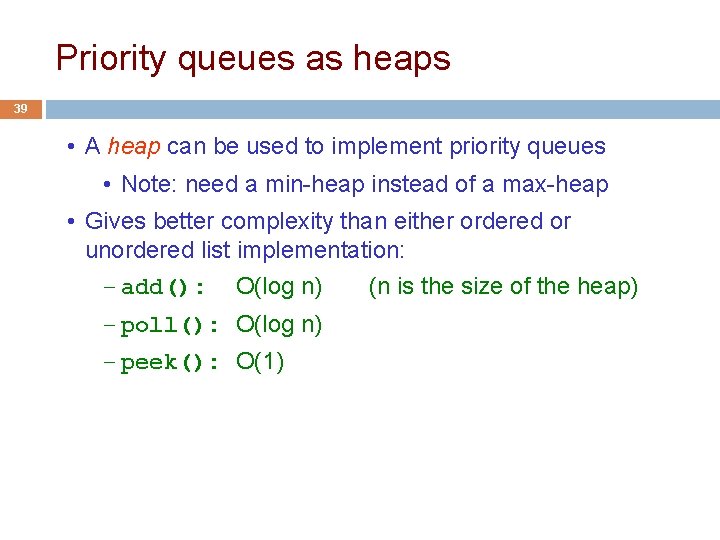
Priority queues as heaps 39 • A heap can be used to implement priority queues • Note: need a min-heap instead of a max-heap • Gives better complexity than either ordered or unordered list implementation: – add(): O(log n) (n is the size of the heap) – poll(): O(log n) – peek(): O(1)
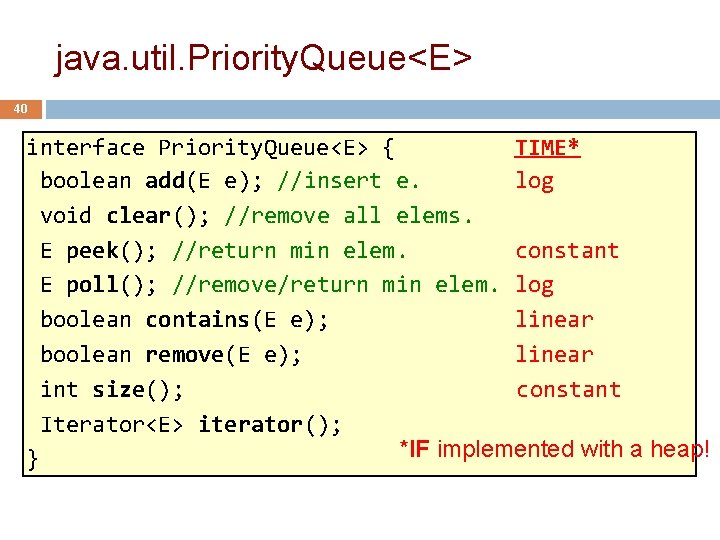
java. util. Priority. Queue<E> 40 interface Priority. Queue<E> { TIME* boolean add(E e); //insert e. log void clear(); //remove all elems. E peek(); //return min elem. constant E poll(); //remove/return min elem. log boolean contains(E e); linear boolean remove(E e); linear int size(); constant Iterator<E> iterator(); *IF implemented with a heap! }
What if priority is independent from the value? 41 Separate priority from value and do this: add(e, p); //add element e with priority p (a double) THIS IS EASY! Be able to change priority change(e, p); //change priority of e to p THIS IS HARD! Big question: How do we find e in the heap? Searching heap takes time proportional to its size! No good! Once found, change priority and bubble up or down. OKAY Assignment A 4: implement this heap! Use a second data structure to make change-priority expected log n time