GRAVITATIONAL SIGNATURE OF CORECOLLAPSE SUPERNOVAE Konstantin Yakunin Florida
- Slides: 15
GRAVITATIONAL SIGNATURE OF CORE-COLLAPSE SUPERNOVAE Konstantin Yakunin (Florida Atlantic University) In collaboration with S. Bruenn (FAU), P. Marronetti (FAU), A. Mezzacappa (ORNL-UTK) and the CHIMERA Team (ORNL-FAU-NCSU) GWPAW, Millowakee February 23, 2021
Bruenn Dirk Marronetti Yakunin Blondin Warren Fuller Budiardja Cardall Endeve Hix Lentz Messer Mezzacappa Parete-Koon Funded by Collaborators • Solvers: D’Azevedo • Data Management: Barreto, Canon, Klasky, Podhorszki • Networking: Beck, Moore, Rao • Visualization: Ahern, Daniel, Ma, Meredith, Pugmire, Toedte • Cray Center of Excellence: Levesque, Wichmann GWPAW, Millowakee February 23, 2021
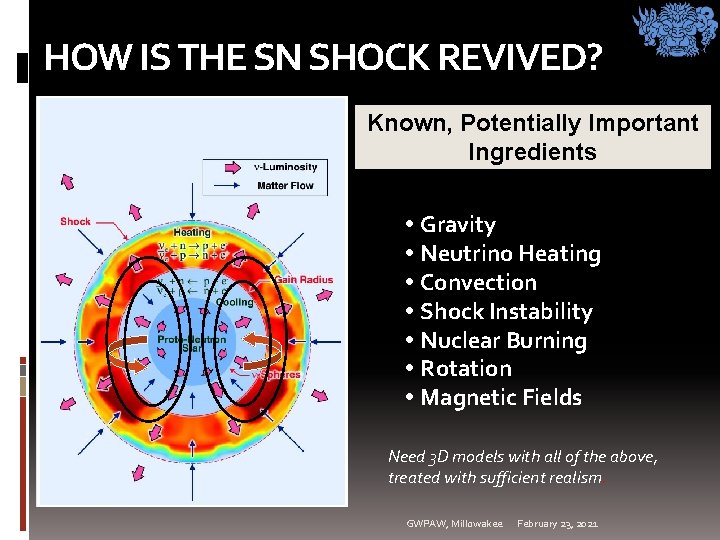
HOW IS THE SN SHOCK REVIVED? Known, Potentially Important Ingredients Gravity Neutrino Heating Convection Shock Instability Nuclear Burning Rotation Magnetic Fields Need 3 D models with all of the above, treated with sufficient realism. GWPAW, Millowakee February 23, 2021
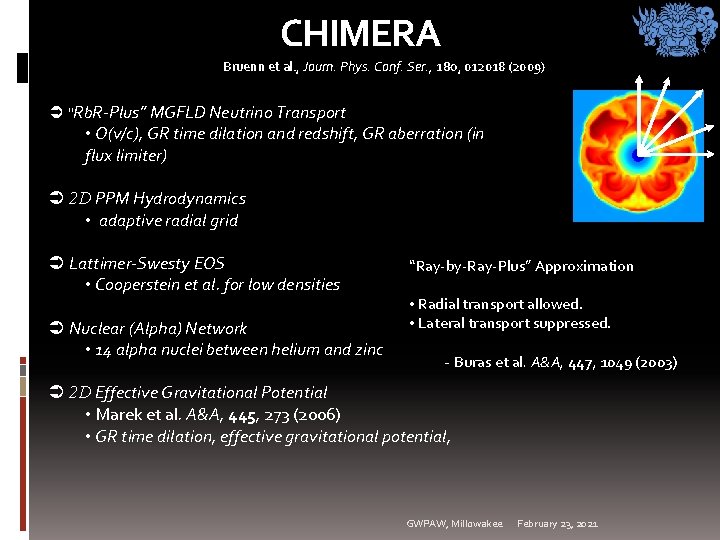
CHIMERA Bruenn et al. , Journ. Phys. Conf. Ser. , 180, 012018 (2009) “Rb. R-Plus” MGFLD Neutrino Transport • O(v/c), GR time dilation and redshift, GR aberration (in flux limiter) 2 D PPM Hydrodynamics • adaptive radial grid Lattimer-Swesty EOS • Cooperstein et al. for low densities Nuclear (Alpha) Network • 14 alpha nuclei between helium and zinc “Ray-by-Ray-Plus” Approximation • Radial transport allowed. • Lateral transport suppressed. - Buras et al. A&A, 447, 1049 (2003) 2 D Effective Gravitational Potential • Marek et al. A&A, 445, 273 (2006) • GR time dilation, effective gravitational potential, GWPAW, Millowakee February 23, 2021
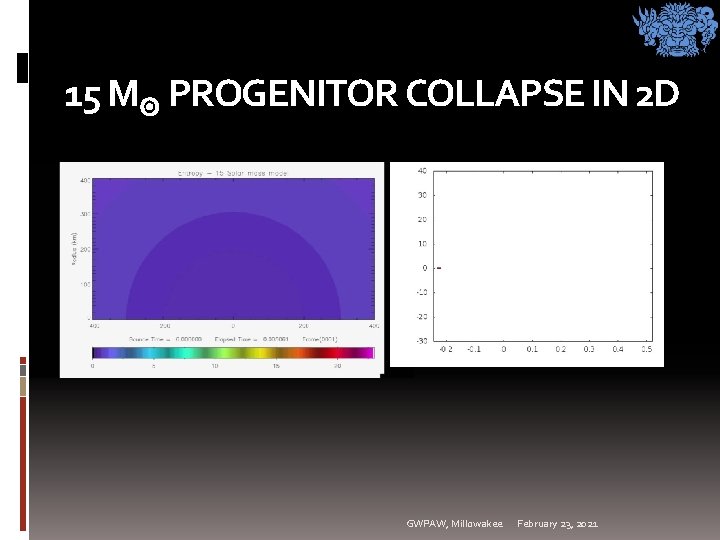
15 M PROGENITOR COLLAPSE IN 2 D GWPAW, Millowakee February 23, 2021
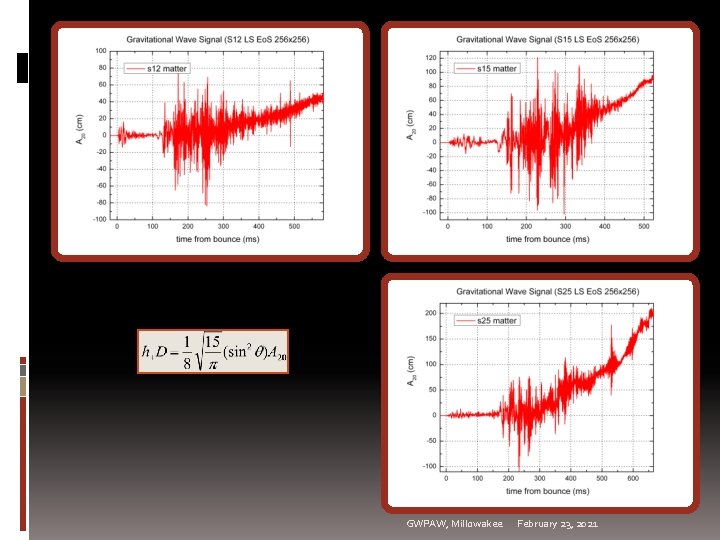
GWPAW, Millowakee February 23, 2021
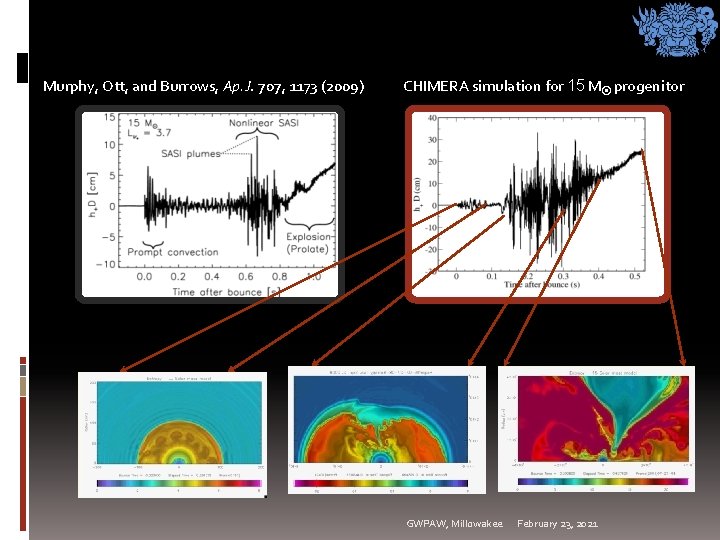
Murphy, Ott, and Burrows, Ap. J. 707, 1173 (2009) CHIMERA simulation for 15 M progenitor GWPAW, Millowakee February 23, 2021
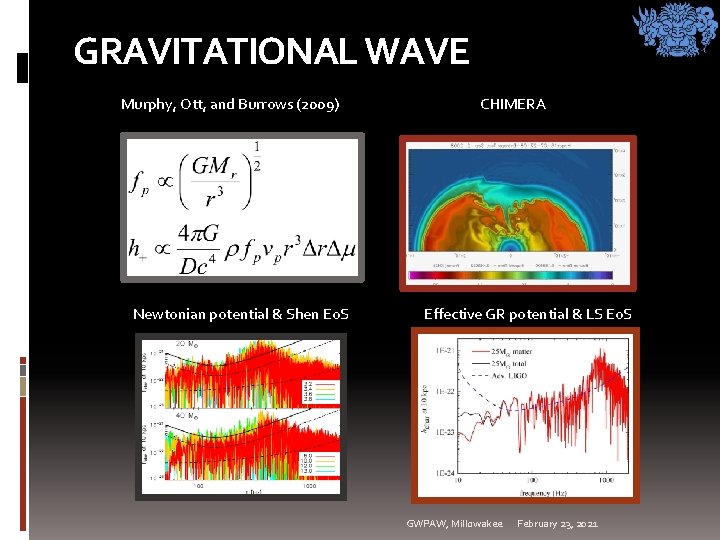
GRAVITATIONAL WAVE Murphy, Ott, and Burrows (2009) Newtonian potential & Shen Eo. S CHIMERA Effective GR potential & LS Eo. S GWPAW, Millowakee February 23, 2021
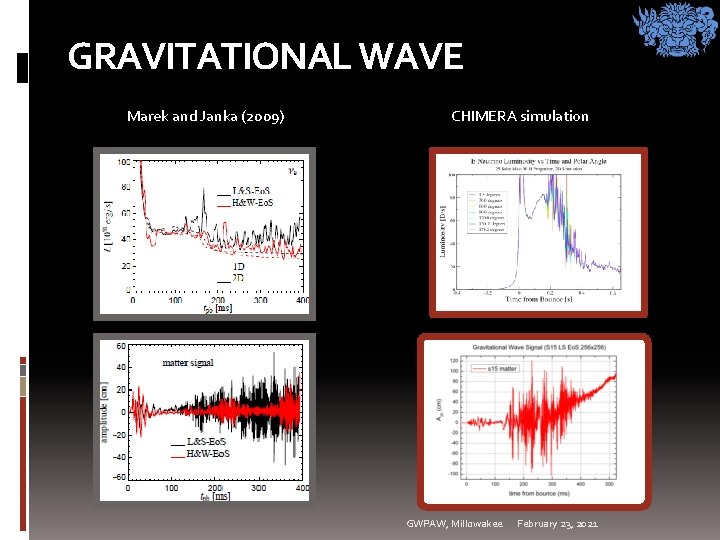
GRAVITATIONAL WAVE Marek and Janka (2009) CHIMERA simulation GWPAW, Millowakee February 23, 2021
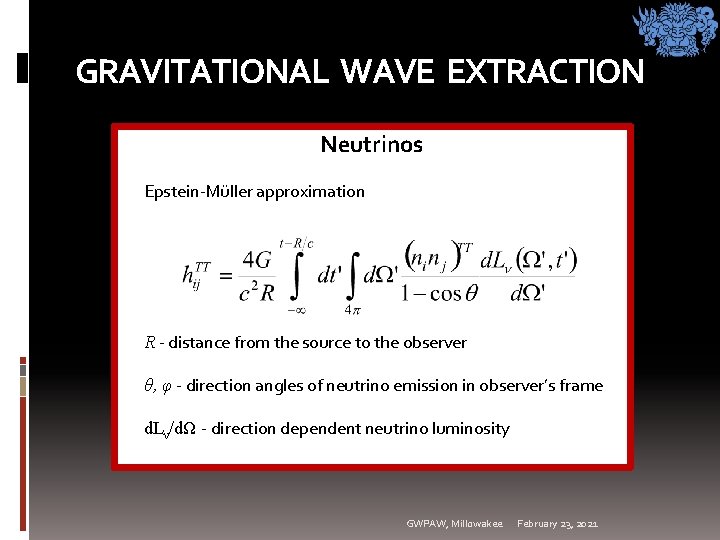
GRAVITATIONAL WAVE EXTRACTION Neutrinos Epstein-Müller approximation R - distance from the source to the observer θ, φ - direction angles of neutrino emission in observer’s frame d. Lν/dΩ - direction dependent neutrino luminosity GWPAW, Millowakee February 23, 2021
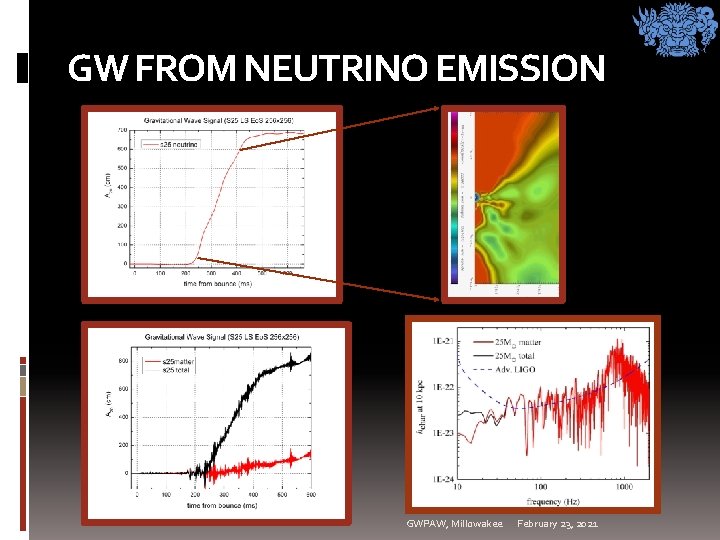
GW FROM NEUTRINO EMISSION GWPAW, Millowakee February 23, 2021
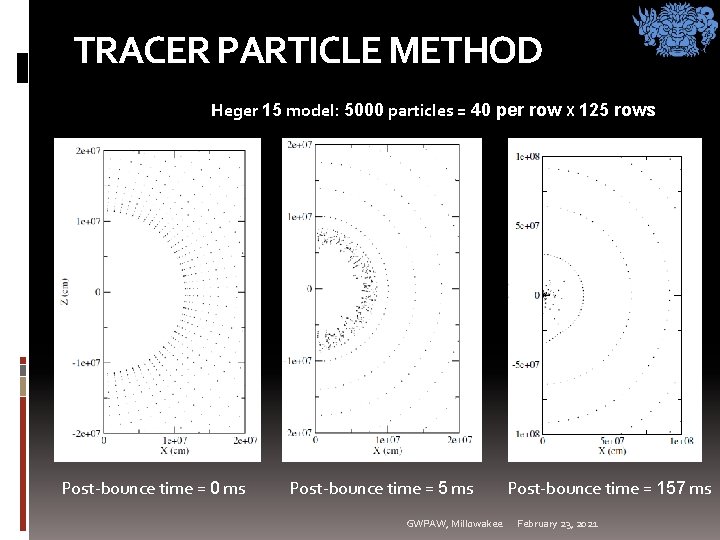
TRACER PARTICLE METHOD Heger 15 model: 5000 particles = 40 per row X 125 rows Post-bounce time = 0 ms Post-bounce time = 5 ms GWPAW, Millowakee Post-bounce time = 157 ms February 23, 2021
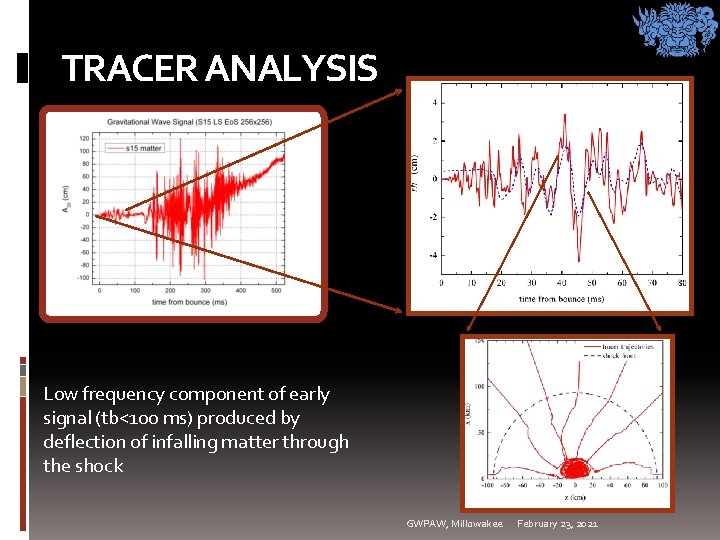
TRACER ANALYSIS Low frequency component of early signal (tb<100 ms) produced by deflection of infalling matter through the shock GWPAW, Millowakee February 23, 2021
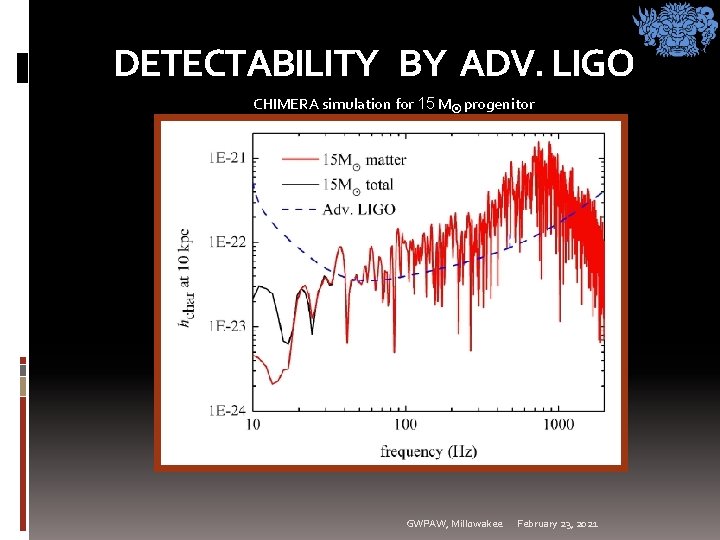
DETECTABILITY BY ADV. LIGO CHIMERA simulation for 15 M progenitor GWPAW, Millowakee February 23, 2021
CONCLUSIONS 2 D simulations of core-collapse SN show sustained explosions for a range of non-rotating progenitors There is qualitative agreement between several groups on the main characteristics of the GW signals from 2 D Core Collapse Supernovae simulations Galactic event detection by Adv. LIGO will provide unique insights of the collapse dynamics and proto-neutron star structure 3 D simulations are necessary for the complete realistic GW waveforms GWPAW, Millowakee February 23, 2021