Konstantin Zioutas Konstantin Zioutascern ch Theodoros Vafeiadiscern ch


- Slides: 15
Konstantin Zioutas Konstantin. Zioutas@cern. ch Theodoros. Vafeiadis@cern. ch Bld. : 20 -1 -004, Tuesday, 28 th January 2014 G. Cantatore (Uni. and INFN, Trieste) for the CAST Collaboration 111 th CERN SPSC meeting - 22/10/2013 1
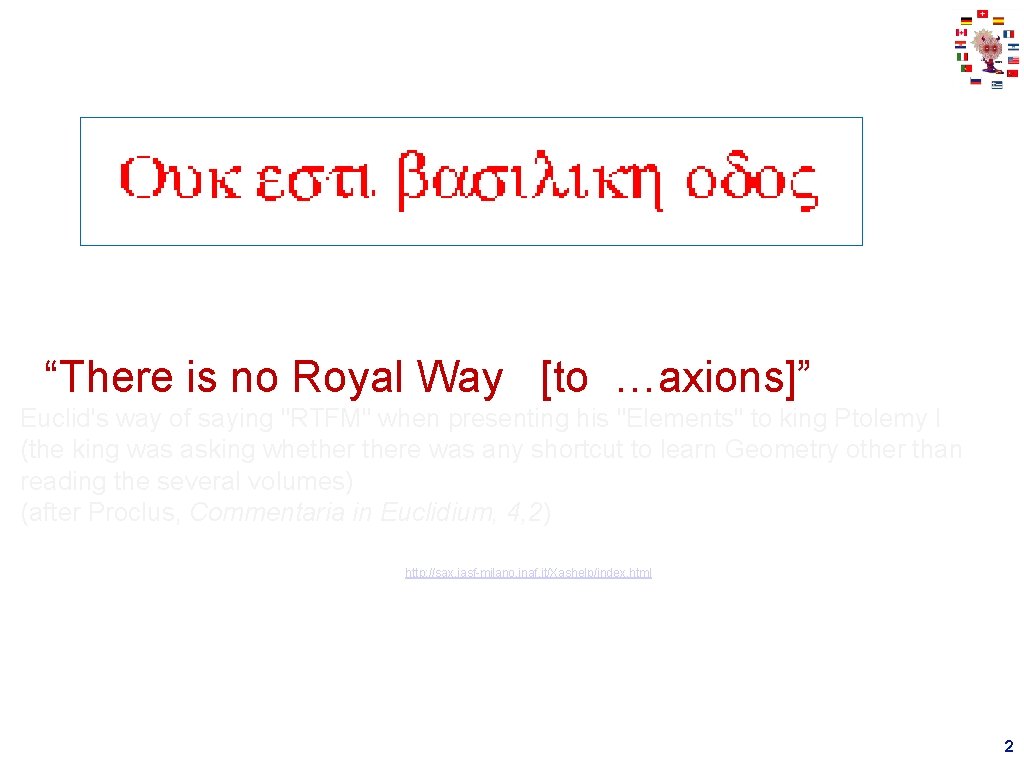
“There is no Royal Way [to …axions]” Euclid's way of saying "RTFM" when presenting his "Elements" to king Ptolemy I (the king was asking whethere was any shortcut to learn Geometry other than reading the several volumes) (after Proclus, Commentaria in Euclidium, 4, 2) http: //sax. iasf-milano. inaf. it/Xashelp/index. html G. Cantatore (Uni. and INFN, Trieste) for the CAST Collaboration 111 th CERN SPSC meeting - 22/10/2013 2
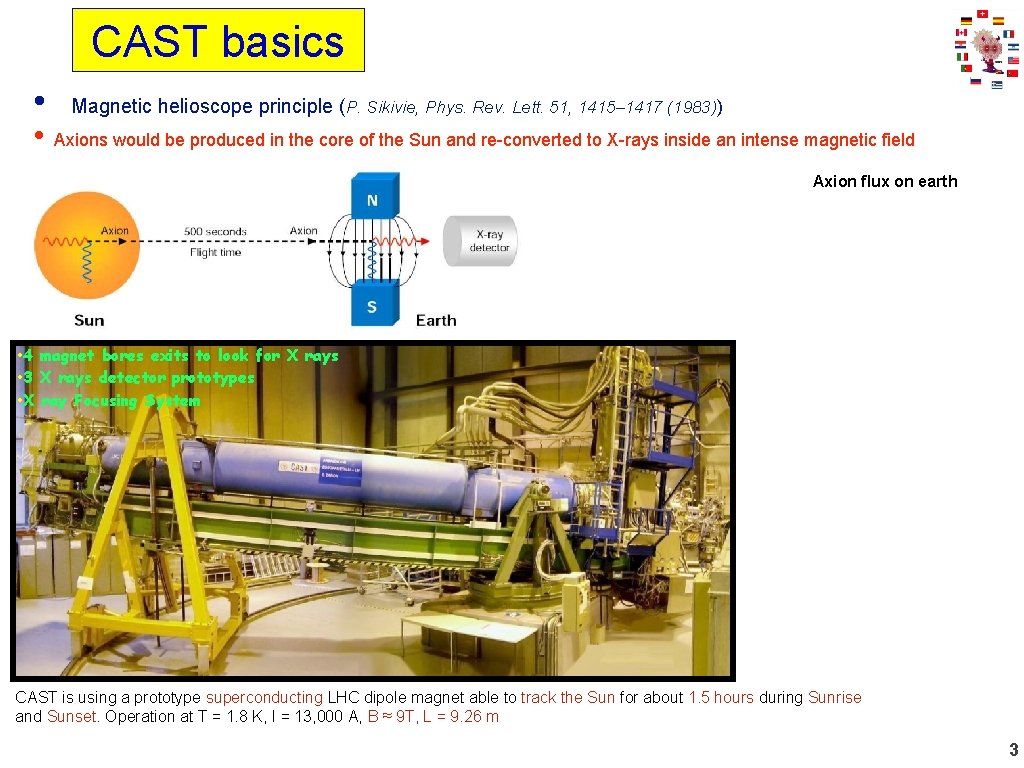
CAST basics • Magnetic helioscope principle (P. Sikivie, Phys. Rev. Lett. 51, 1415– 1417 (1983)) • Axions would be produced in the core of the Sun and re-converted to X-rays inside an intense magnetic field Axion flux on earth • 4 magnet bores exits to look for X rays • 3 X rays detector prototypes • X ray Focusing System CAST is using a prototype superconducting LHC dipole magnet able to track the Sun for about 1. 5 hours during Sunrise and Sunset. Operation at T = 1. 8 K, I = 13, 000 A, B ≈ 9 T, L = 9. 26 m 111 th CERN SPSC meeting - 22/10/2013 G. Cantatore (Uni. and INFN, Trieste) for the CAST Collaboration 3
Axions: strong CP-problem 111 th CERN SPSC meeting - 22/10/2013 >>> dark matter G. Cantatore (Uni. and INFN, Trieste) for the CAST Collaboration 4
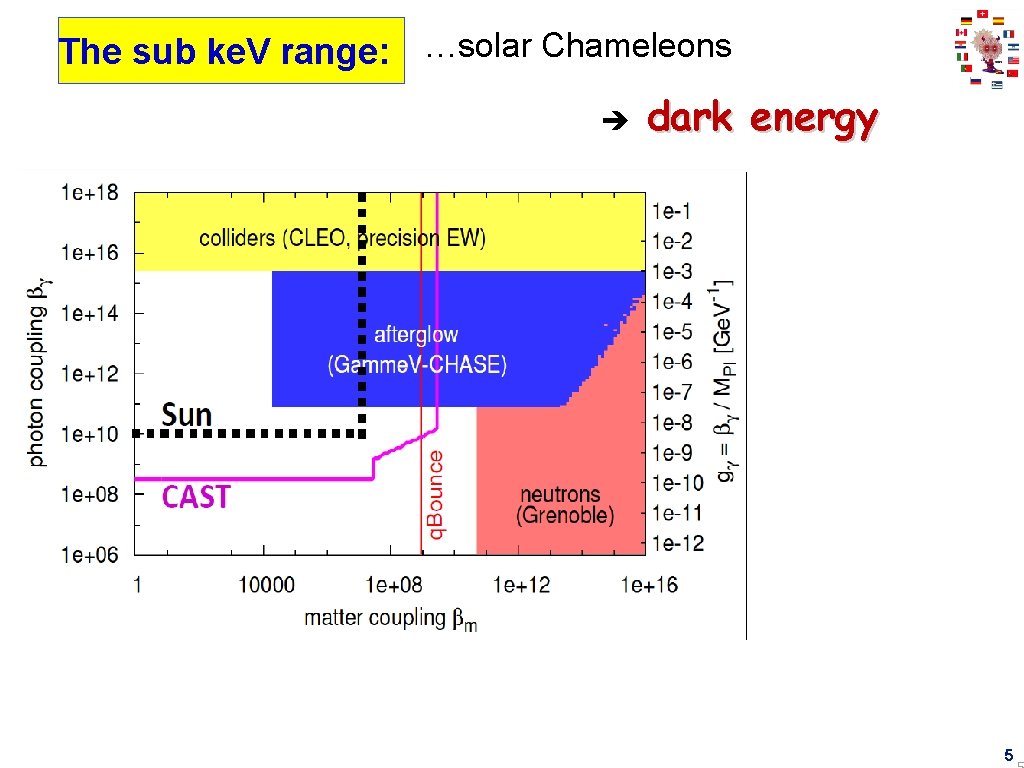
The sub ke. V range: …solar Chameleons 111 th CERN SPSC meeting - 22/10/2013 dark energy G. Cantatore (Uni. and INFN, Trieste) for the CAST Collaboration 5
111 th CERN SPSC meeting - 22/10/2013 G. Cantatore (Uni. and INFN, Trieste) for the CAST Collaboration 6
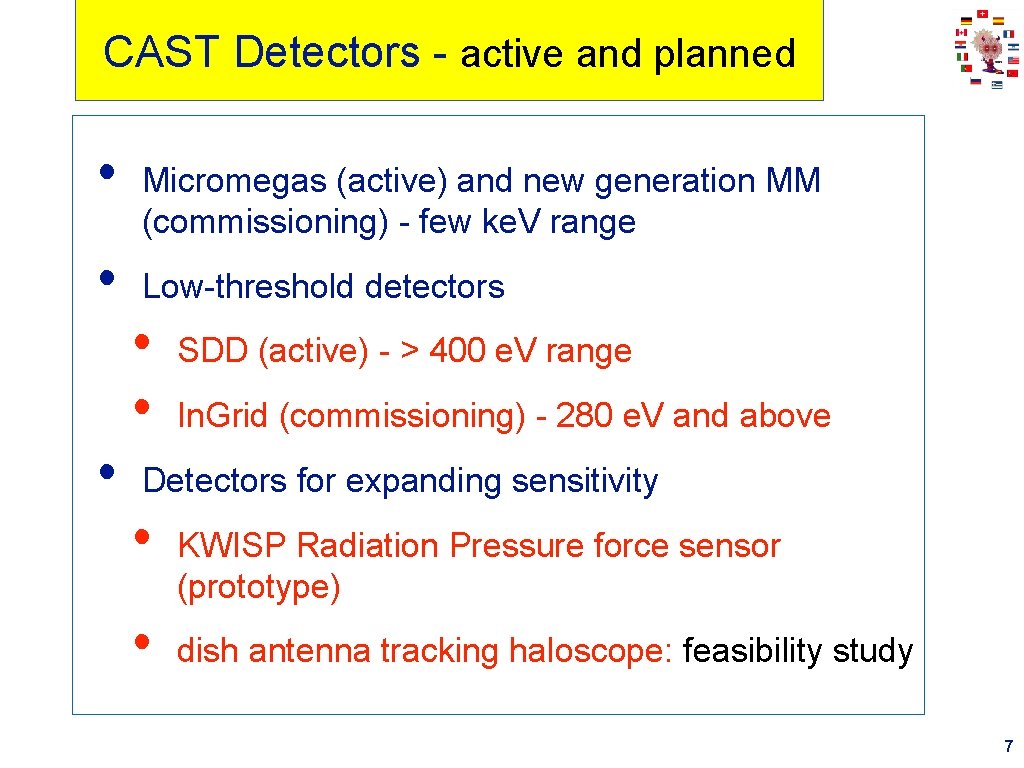
CAST Detectors - active and planned • • • Micromegas (active) and new generation MM (commissioning) - few ke. V range Low-threshold detectors • • SDD (active) - > 400 e. V range In. Grid (commissioning) - 280 e. V and above Detectors for expanding sensitivity • • KWISP Radiation Pressure force sensor (prototype) dish antenna tracking haloscope: feasibility study 111 th CERN SPSC meeting - 22/10/2013 G. Cantatore (Uni. and INFN, Trieste) for the CAST Collaboration 7
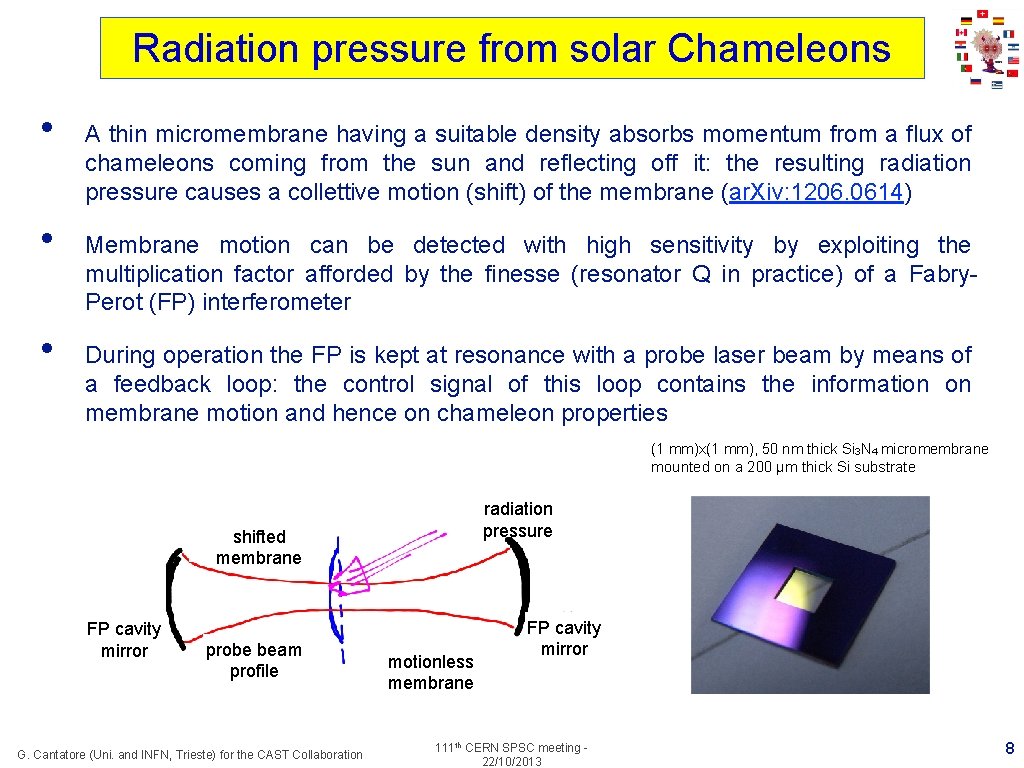
Radiation pressure from solar Chameleons • • • A thin micromembrane having a suitable density absorbs momentum from a flux of chameleons coming from the sun and reflecting off it: the resulting radiation pressure causes a collettive motion (shift) of the membrane (ar. Xiv: 1206. 0614) Membrane motion can be detected with high sensitivity by exploiting the multiplication factor afforded by the finesse (resonator Q in practice) of a Fabry. Perot (FP) interferometer During operation the FP is kept at resonance with a probe laser beam by means of a feedback loop: the control signal of this loop contains the information on membrane motion and hence on chameleon properties (1 mm)x(1 mm), 50 nm thick Si 3 N 4 micromembrane mounted on a 200 µm thick Si substrate radiation pressure shifted membrane FP cavity mirror probe beam profile G. Cantatore (Uni. and INFN, Trieste) for the CAST Collaboration motionless membrane FP cavity mirror 111 th CERN SPSC meeting - 22/10/2013 8
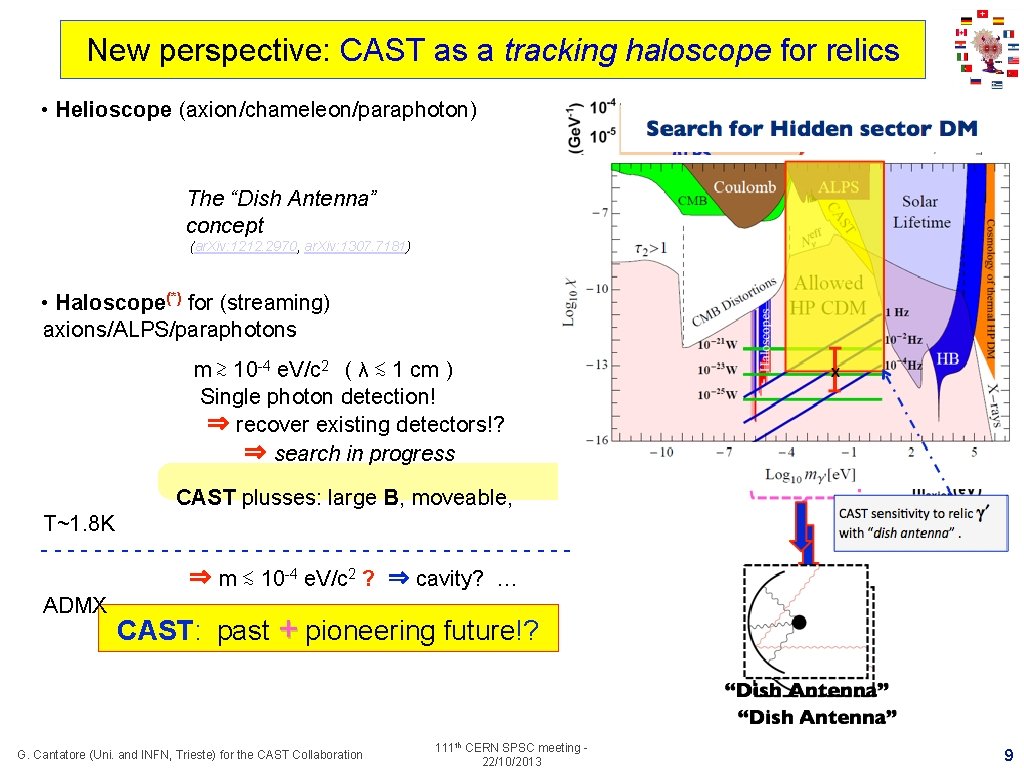
New perspective: CAST as a tracking haloscope for relics • Helioscope (axion/chameleon/paraphoton) The “Dish Antenna” concept (ar. Xiv: 1212. 2970, ar. Xiv: 1307. 7181) • Haloscope(*) for (streaming) axions/ALPS/paraphotons m ≳ 10 -4 e. V/c 2 ( λ ≲ 1 cm ) Single photon detection! ⇒ recover existing detectors!? ⇒ search in progress CAST plusses: large B, moveable, T~1. 8 K - - - - - - - - - - ⇒ m ≲ 10 -4 e. V/c 2 ? ⇒ cavity? … ADMX CAST: past + pioneering future!? G. Cantatore (Uni. and INFN, Trieste) for the CAST Collaboration 111 th CERN SPSC meeting - 22/10/2013 9
Dish antenna(s) in CAST => relics? >>> streaming DM, … Feasibility study ongoing - MPE (Garching) … μm - MPI (Bonn) … ~ mm - …? ? + Effective gain -> ~104 G. Cantatore (Uni. and INFN, Trieste) for the CAST Collaboration 111 th CERN SPSC meeting - 22/10/2013 10
>> Astrophysical signatures …strong CP problem >> axions Thomas Papaevangelou 107 th SPSC Meeting 22/10/2012 11
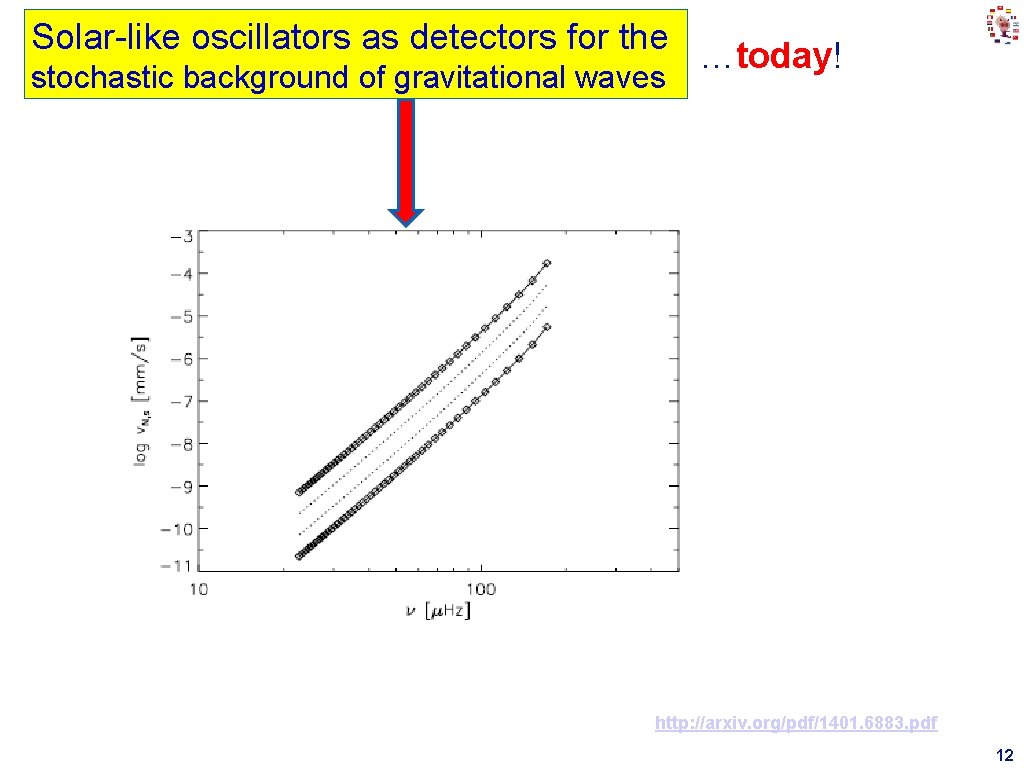
Solar-like oscillators as detectors for the stochastic background of gravitational waves …today! http: //arxiv. org/pdf/1401. 6883. pdf Thomas Papaevangelou 107 th SPSC Meeting 22/10/2012 12
The physics a student may get involved in, refer to the following issues: • CAST: Around june-july we should start with data taking again. Then one prepares various detector elements. One such CAST: equipment will be the In. GRID detector, a pixelized detector aiming to go into the sub-ke. V range, where solar chameleons are expected and we have started looking for since 2 months. The commissioning-alignment-test of the XRTelescope tested in Munich, might go on, and he/she could gain interesting practical-experimental experience. Similarly, a 2 nd XRT is expected to be delivered the next months by LLNL. However, I can not predict now how the situation will be at that period. • Dark energy: solar chameleons. He/she could get involved in this, and to my knowledge there are few experiments on dark Dark energy: energy. A task I could give even now is, to prepare a draft resummee, of what kind of experiments exist OR are scheduled in dark energy, and, compare them. This is a very interesting Q. Once this is ready, we could polish/edit and put it at least on the archives. For this DE issue we are working actively with people in DESY, Trieste, Rijeka, TU-Darmstadt, . . . In Trieste we test a state-of-the-art force sensor to detect the expected radiation pressure by the Chameleons, and at certain time, may be even overlapping, it should be moved the equipment to CAST: we intend to attach such a sensor to the focal plane of the CAST XRtelescope and enhance thus the flux of solar chameleons by factor 100 -1000. >>> an exciting issue. • CAST as DM antenna? At present we do a feasibility study aiming to transform CAST also to a dark matter antenna. For CAST as DM antenna? this we collaborate with people in DESY and TU-Darmstadt and we are in contact with MPE/Garching-Germany and MPI/Bonn for recovering supersensitive photon sensors in the 100 GHz to 30 micron range. How can they be used in CAST for this purpose? This will allow to search with CAST one day for dark matter axions and paraphotons (entering easily into the interesting phase space). BTW, one expects axions at some 300 GHz but if one believes two claims from White dwarfs and the Sun, they should show up at some 10 microns! >>> a potential development of interest, the Q is who will do that first! • Astrophysical signatures? I am working on this with few more others, and I do not know what will be “in” then! Needless Astrophysical signatures? to say, this might be the most promising approach, if it comes out that earth-bound detectors have not OR can not reach the natural detector design at quasi zero cost. >>> highly speculative for some people, but also of potential importance. • …? ? ? . . . • BTW, for the same time I expect 1 -2 students from my University to come. She/he will choose one among those items, and she/he may visit the lectures at the University of GVA with the rest of the people? ? If it works it will be just fine. Thomas Papaevangelou 107 th SPSC Meeting 22/10/2012 13
http: //axion-wimp 2014. desy. de/ Thomas Papaevangelou 107 th SPSC Meeting 22/10/2012 14
Further reading: Gravitational lensing by the Sun of non-relativistic penetrating particles D. H. H. Hoffmann, J. Jacoby, K. Zioutas, Astropart. Phys. 20 (2003) 73 DOI: 10. 1016/S 0927 -6505(03)00138 -5 Flux Enhancement of Slow-moving Particles by Sun or Jupiter: Can they be Detected on Earth? B. R. Patla, R. J. Nemiroff, D. H. H. Hoffmann, K. Zioutas http: //arxiv. org/abs/1305. 2454 Ap. J. 780 (2014) 158 The 11 -years solar cycle as the manifestation of the dark Universe K. Zioutas, M. Tsagri, Y. K. Semertzidis, T. Papaevangelou, D. H. H. Hoffmann, V. Anastassopoulos http: //arxiv. org/abs/1309. 4021 >> special issue of Mod. Phys. Lett. A (2013) "Indirect Dark Matter Searches“ Searching for WISPy Cold Dark Matter with a Dish Antenna, D. Horns, J. Jaeckel, A. Lindner, A. Lobanov, J. Redondo, A. Ringwald, JCAP 1304 (2013) 016, DOI: 10. 1088/1475 -7516/2013/04/016 About CAST: http: //ph-news. web. cern. ch/content/cast-opens-new-window-dark-energy-and-dark-matter-after-11 -years-operation-and-continuous Thomas Papaevangelou 107 th SPSC Meeting 22/10/2012 15