
On BurstinessAware Search for Document Sequences Theodoros Lappas
On Burstiness-Aware Search for Document Sequences Theodoros Lappas Manolis Platakis Benjamin Arai Dimitrios Kotsakos Dimitrios Gunopulos SIGKDD 2009
Outline q The Problem: How to effectively search through large document sequences (e. g. newspapers) q Previous Work q Using Bursty Terms to identify Events q Modeling Burstiness using Discrepancy Theory q Our Search Framework q Experiments SIGKDD 2009 Theodoros Lappas
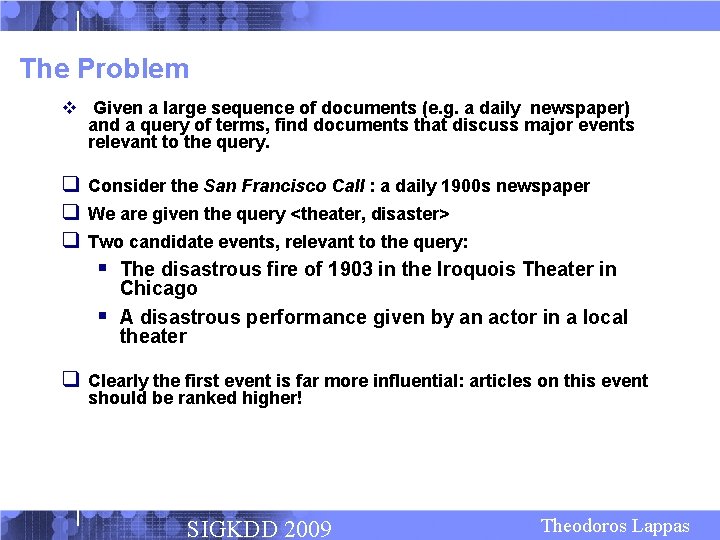
The Problem v Given a large sequence of documents (e. g. a daily newspaper) and a query of terms, find documents that discuss major events relevant to the query. q Consider the San Francisco Call : a daily 1900 s newspaper q We are given the query <theater, disaster> q Two candidate events, relevant to the query: § The disastrous fire of 1903 in the Iroquois Theater in § Chicago A disastrous performance given by an actor in a local theater q Clearly the first event is far more influential: articles on this event should be ranked higher! SIGKDD 2009 Theodoros Lappas
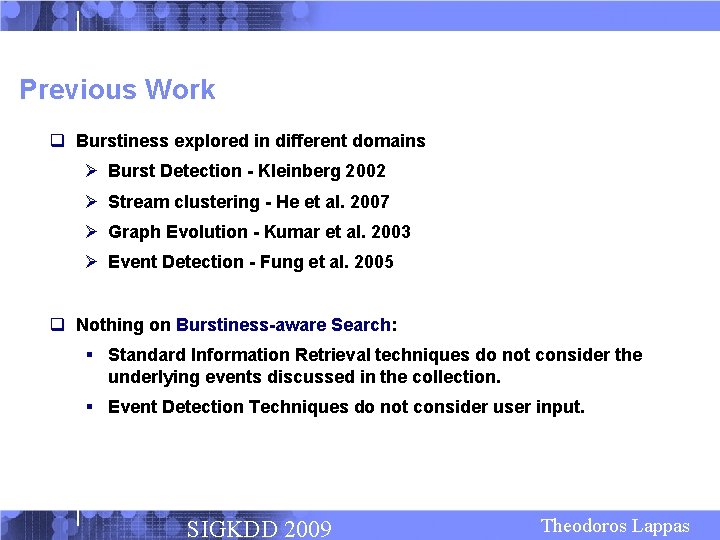
Previous Work q Burstiness explored in different domains Ø Burst Detection - Kleinberg 2002 Ø Stream clustering - He et al. 2007 Ø Graph Evolution - Kumar et al. 2003 Ø Event Detection - Fung et al. 2005 q Nothing on Burstiness-aware Search: § Standard Information Retrieval techniques do not consider the underlying events discussed in the collection. § Event Detection Techniques do not consider user input. SIGKDD 2009 Theodoros Lappas
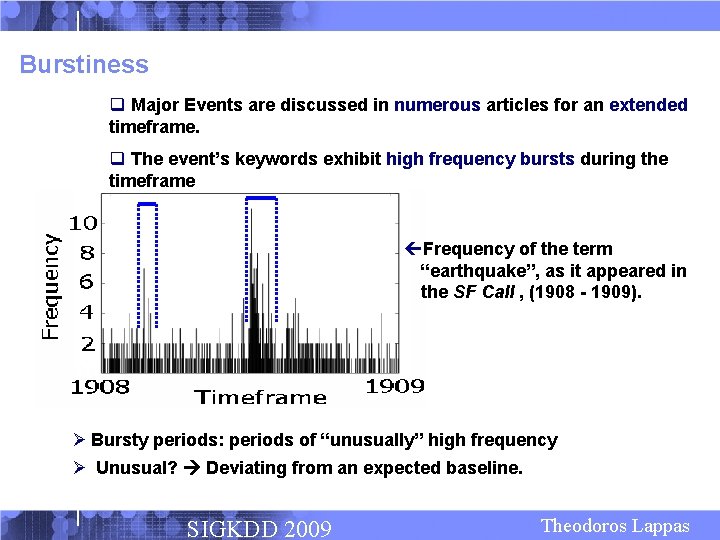
Burstiness q Major Events are discussed in numerous articles for an extended timeframe. q The event’s keywords exhibit high frequency bursts during the timeframe çFrequency of the term “earthquake”, as it appeared in the SF Call , (1908 - 1909). Ø Bursty periods: periods of “unusually” high frequency Ø Unusual? Deviating from an expected baseline. SIGKDD 2009 Theodoros Lappas
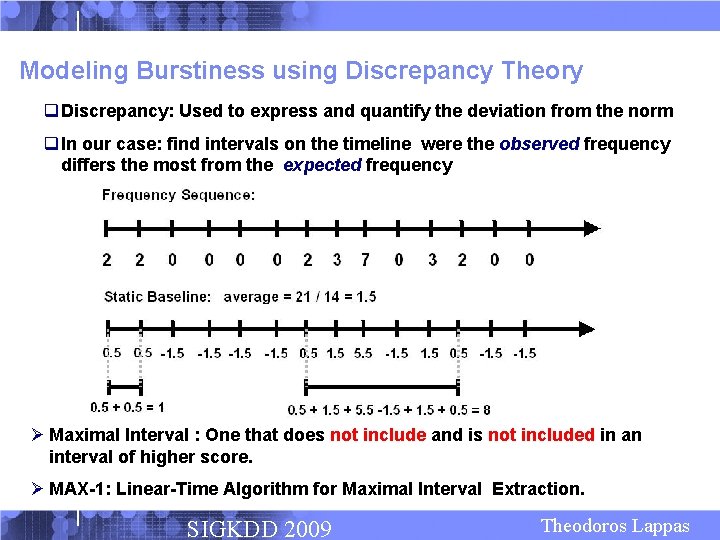
Modeling Burstiness using Discrepancy Theory q Discrepancy: Used to express and quantify the deviation from the norm q In our case: find intervals on the timeline were the observed frequency differs the most from the expected frequency Ø Maximal Interval : One that does not include and is not included in an interval of higher score. Ø MAX-1: Linear-Time Algorithm for Maximal Interval Extraction. SIGKDD 2009 Theodoros Lappas
Baseline - Discussion § Baseline can be dynamic : – frequency sequence(s) from previous year(s) – Time Series Decomposition to extract Seasonal, Trend and Irregular Components SIGKDD 2009 Theodoros Lappas
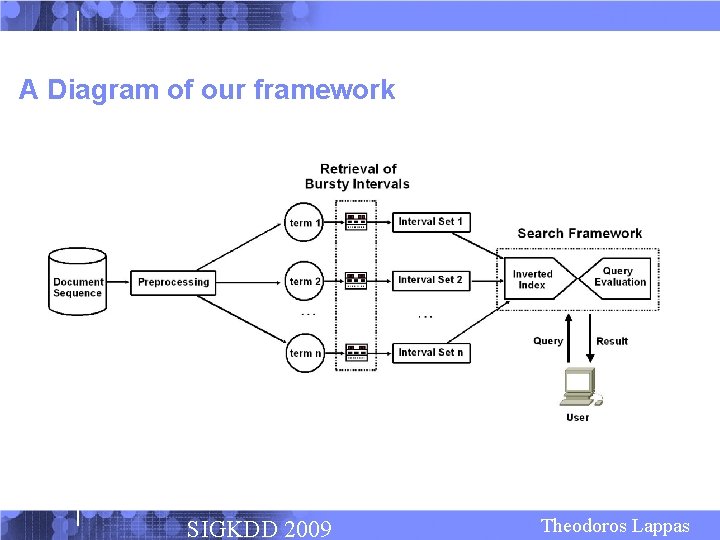
A Diagram of our framework SIGKDD 2009 Theodoros Lappas
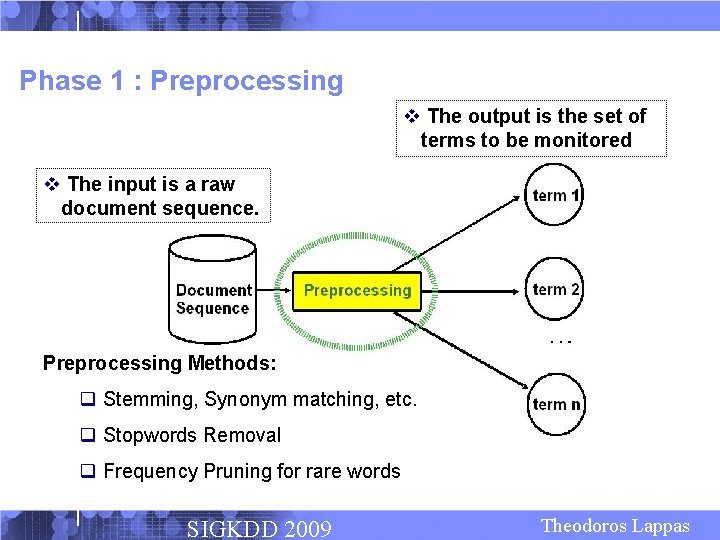
Phase 1 : Preprocessing v The output is the set of terms to be monitored v The input is a raw document sequence. Preprocessing Methods: q Stemming, Synonym matching, etc. q Stopwords Removal q Frequency Pruning for rare words SIGKDD 2009 Theodoros Lappas
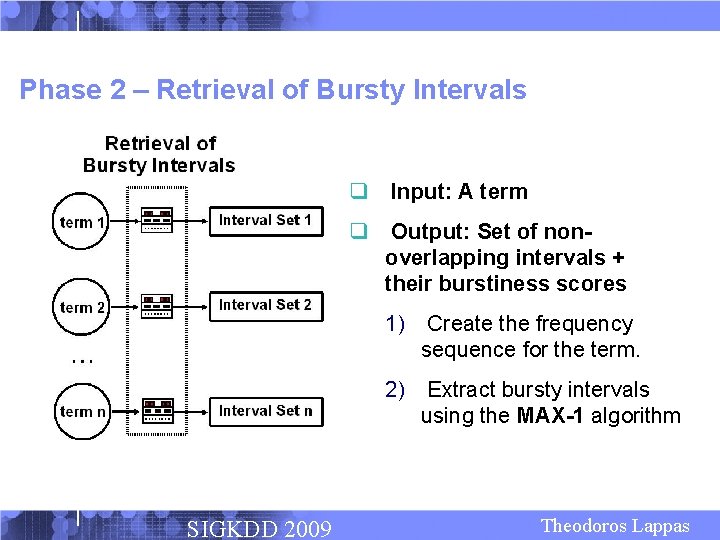
Phase 2 – Retrieval of Bursty Intervals q Input: A term q Output: Set of nonoverlapping intervals + their burstiness scores 1) Create the frequency sequence for the term. 2) Extract bursty intervals using the MAX-1 algorithm SIGKDD 2009 Theodoros Lappas
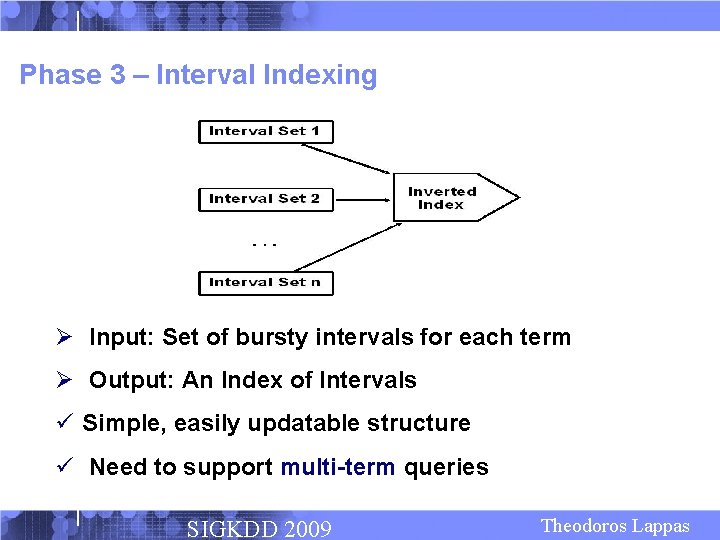
Phase 3 – Interval Indexing Ø Input: Set of bursty intervals for each term Ø Output: An Index of Intervals ü Simple, easily updatable structure ü Need to support multi-term queries SIGKDD 2009 Theodoros Lappas
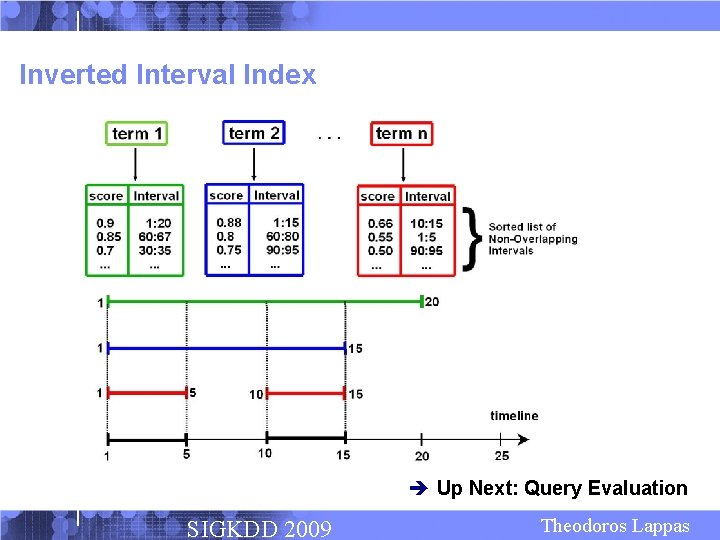
Inverted Interval Index è Up Next: Query Evaluation SIGKDD 2009 Theodoros Lappas
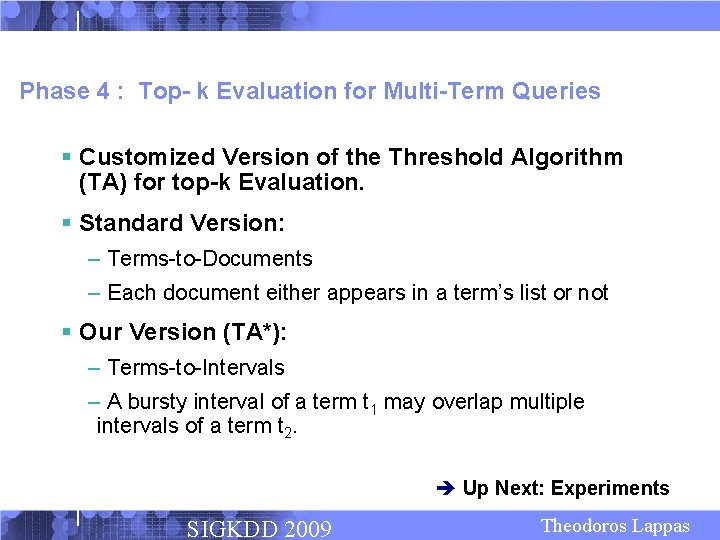
Phase 4 : Top- k Evaluation for Multi-Term Queries § Customized Version of the Threshold Algorithm (TA) for top-k Evaluation. § Standard Version: – Terms-to-Documents – Each document either appears in a term’s list or not § Our Version (TA*): – Terms-to-Intervals – A bursty interval of a term t 1 may overlap multiple intervals of a term t 2. è Up Next: Experiments SIGKDD 2009 Theodoros Lappas
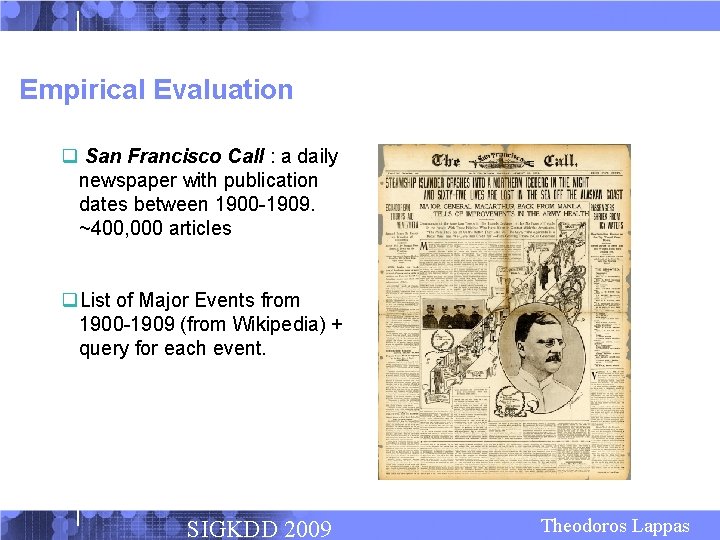
Empirical Evaluation q San Francisco Call : a daily newspaper with publication dates between 1900 -1909. ~400, 000 articles q. List of Major Events from 1900 -1909 (from Wikipedia) + query for each event. SIGKDD 2009 Theodoros Lappas
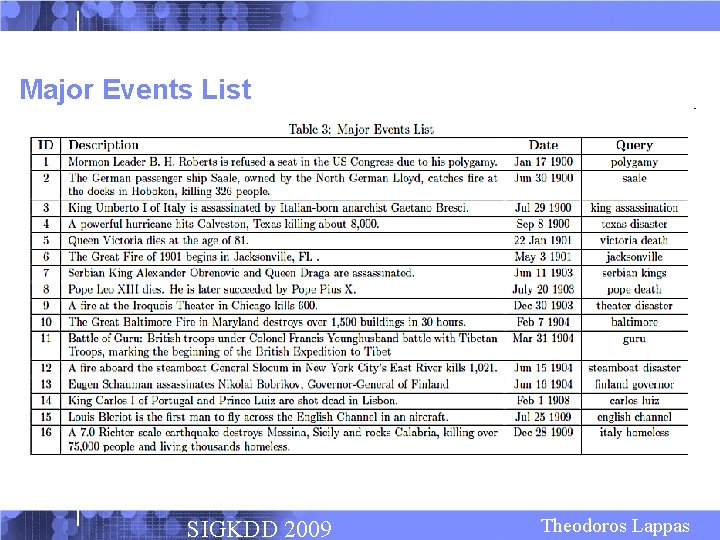
Major Events List SIGKDD 2009 Theodoros Lappas
Experiment 1 - Query Expansion 1) Submit respective query for each event in Major Events List. 2) Get top interval 3) Report the 10 terms that appear in the most document titles within the interval SIGKDD 2009 Theodoros Lappas
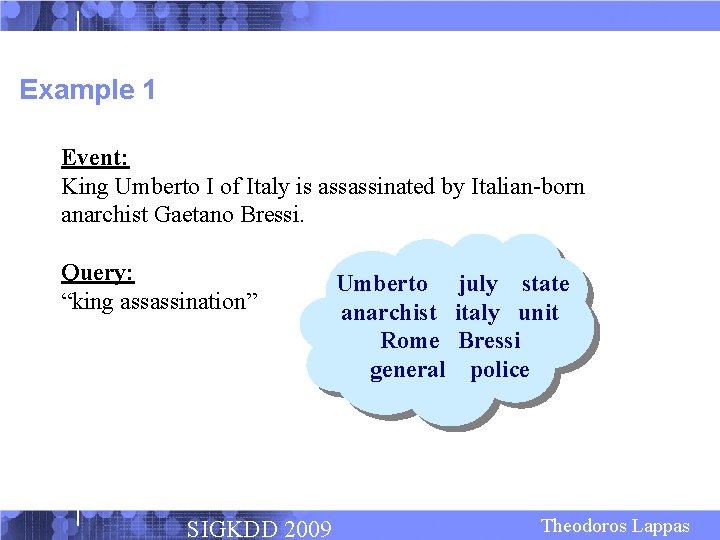
Example 1 Event: King Umberto I of Italy is assassinated by Italian-born anarchist Gaetano Bressi. Query: “king assassination” SIGKDD 2009 Umberto july state anarchist italy unit Rome Bressi general police Theodoros Lappas
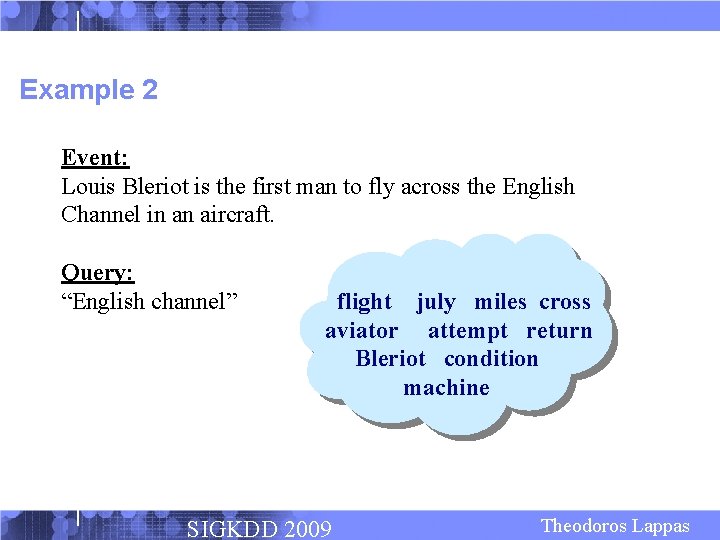
Example 2 Event: Louis Bleriot is the first man to fly across the English Channel in an aircraft. Query: “English channel” flight july miles cross aviator attempt return Bleriot condition machine SIGKDD 2009 Theodoros Lappas
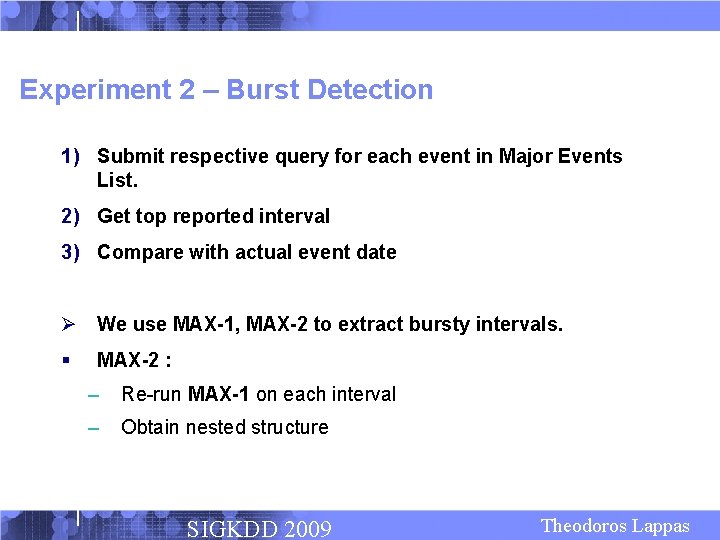
Experiment 2 – Burst Detection 1) Submit respective query for each event in Major Events List. 2) Get top reported interval 3) Compare with actual event date Ø We use MAX-1, MAX-2 to extract bursty intervals. § MAX-2 : – Re-run MAX-1 on each interval – Obtain nested structure SIGKDD 2009 Theodoros Lappas
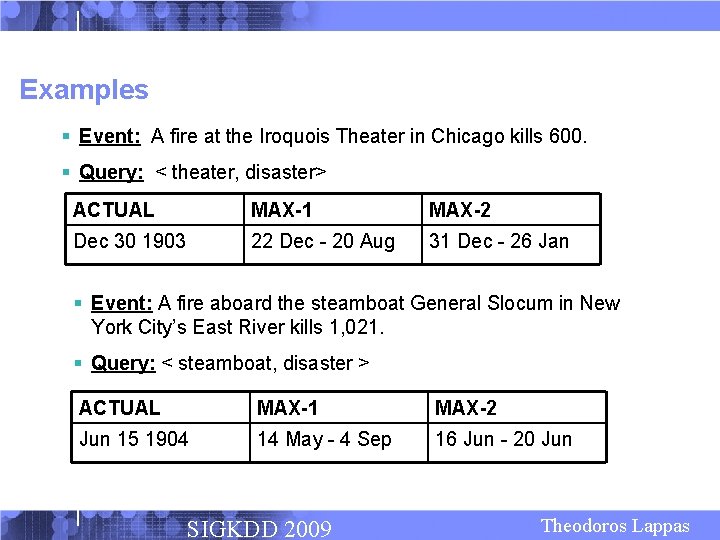
Examples § Event: A fire at the Iroquois Theater in Chicago kills 600. § Query: < theater, disaster> ACTUAL MAX-1 MAX-2 Dec 30 1903 22 Dec - 20 Aug 31 Dec - 26 Jan § Event: A fire aboard the steamboat General Slocum in New York City’s East River kills 1, 021. § Query: < steamboat, disaster > ACTUAL MAX-1 MAX-2 Jun 15 1904 14 May - 4 Sep 16 Jun - 20 Jun SIGKDD 2009 Theodoros Lappas
Conclusion § The 1 st efficient end-to-end framework for burstiness-aware search in document sequences. § Future Work: – Evaluate on even larger Corpora – Evaluate on more types of text SIGKDD 2009 Theodoros Lappas
Thank you!!! SIGKDD 2009 Theodoros Lappas
- Slides: 22