
Patient scheduling Luteal phase support Konstantin Y Boyarsky
Patient scheduling & Luteal phase support Konstantin Y. Boyarsky MD, Ph. D IVF Clinics “GENESIS” Department of Obstetrics and Gynecology, State Pediatric Medical Academy, St. Petersburg, Russia
If Gn. RH Antagonist IVF Is More Patient-Friendly and Safer, Why Are We Not Using it More? 2
Concerns that doctors report when considering moving over to the use of Gn. RH antagonists Cycle scheduling • Less predictable day of cycle commencement • Peaks and troughs in workload • Week end working Scheduling with OC • Pros and Cons • Other options? What type of luteal support • Which is the best protocol? 3
IVF Cycle Programming § Concerns regarding the ability to program Gn. RH antagonist cycles in order to avoid weekend oocyte retrievals (ORs) is the final barrier to general uptake of Gn. RH antagonist IVF therapy § We can equip doctors with 3 different tools to avoid weekend ORs – Scheduling With the OCP – Avoiding Weekend OR by Adjusting the Start Day for IVF Stimulation – Avoidance of Weekend OR by Simple Advancement or Delay of OR by 1 Day From Ideal 4
IVF Cycle Programming – Scheduling With the COCP – Avoiding Weekend OR by Adjusting the Start Day for IVF Stimulation or h. CG Administration – Avoidance of Weekend OR by Simple Advancement or Delay of OR by 1 Day From Ideal 5
1. Scheduling With the OCP § The following protocol using OCP cycle programming has been suggested: – The OCP should be started with menses (day 1 -5) – The OCP must be taken for at least for 14 days – Withdrawal bleeding can be expected within 48 -72 h of ceasing the OCP – r. FSH stimulation can be started on day 2 -5 following withdrawal of the OCP 1 1. Huirne et al. Hum Reprod. 2006; 21: 1408; 6
Drawbacks of Scheduling With OCP Pretreatment Disadvantages of OCP pretreatment include: § Longer duration of FSH stimulation (1 day) with the need for 1 additional injection and increased cost of gonadotrophins. 1 § Infertile patients often do not like the concept of taking “contraceptive” medication. 1 § Possible reduction in pregnancy rates 1 § Altered endocrinology and follicle growth rates have been described after OCP 2 1 Griesinger et al. Fertil Steril. 2010. 2. Huirne et al. Reprod Biomed Online. 2006; 13: 235 -245 7
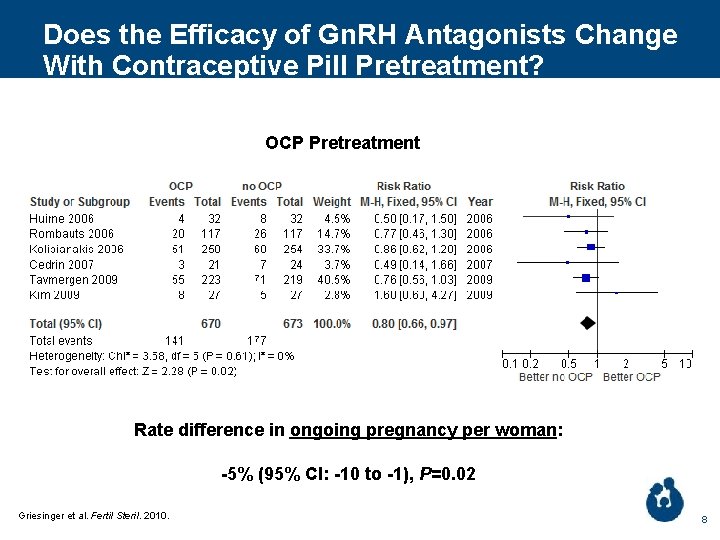
Does the Efficacy of Gn. RH Antagonists Change With Contraceptive Pill Pretreatment? OCP Pretreatment Rate difference in ongoing pregnancy per woman: -5% (95% CI: -10 to -1), P=0. 02 Griesinger et al. Fertil Steril. 2010. 8
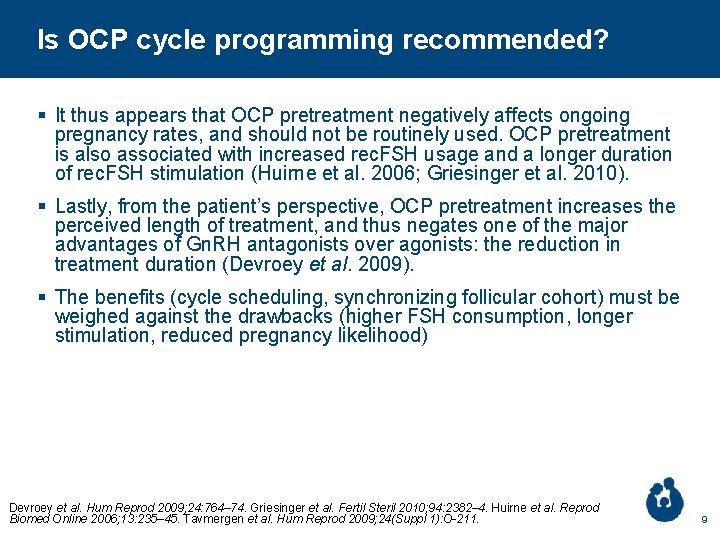
Is OCP cycle programming recommended? § It thus appears that OCP pretreatment negatively affects ongoing pregnancy rates, and should not be routinely used. OCP pretreatment is also associated with increased rec. FSH usage and a longer duration of rec. FSH stimulation (Huirne et al. 2006; Griesinger et al. 2010). § Lastly, from the patient’s perspective, OCP pretreatment increases the perceived length of treatment, and thus negates one of the major advantages of Gn. RH antagonists over agonists: the reduction in treatment duration (Devroey et al. 2009). § The benefits (cycle scheduling, synchronizing follicular cohort) must be weighed against the drawbacks (higher FSH consumption, longer stimulation, reduced pregnancy likelihood) Devroey et al. Hum Reprod 2009; 24: 764– 74. Griesinger et al. Fertil Steril 2010; 94: 2382– 4. Huirne et al. Reprod Biomed Online 2006; 13: 235– 45. Tavmergen et al. Hum Reprod 2009; 24(Suppl 1): O-211. 9
Do we have other options than the OCs for cycle programming? 10 10
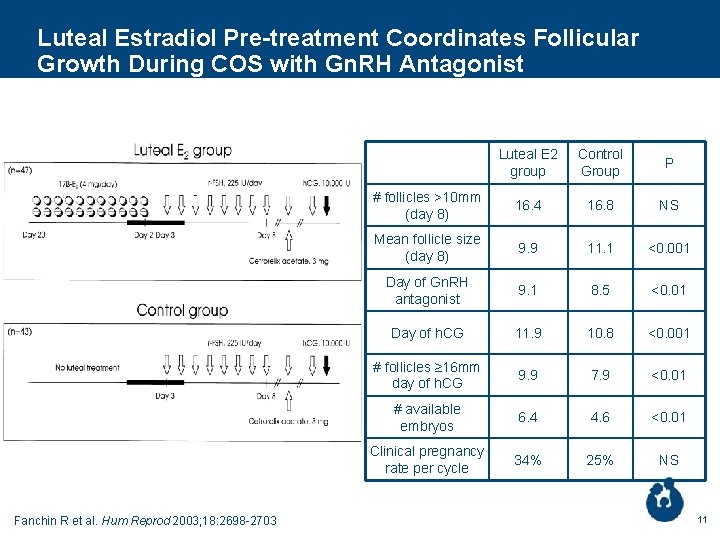
Luteal Estradiol Pre-treatment Coordinates Follicular Growth During COS with Gn. RH Antagonist Fanchin R et al. Hum Reprod 2003; 18: 2698 -2703 Luteal E 2 group Control Group P # follicles >10 mm (day 8) 16. 4 16. 8 NS Mean follicle size (day 8) 9. 9 11. 1 <0. 001 Day of Gn. RH antagonist 9. 1 8. 5 <0. 01 Day of h. CG 11. 9 10. 8 <0. 001 # follicles ≥ 16 mm day of h. CG 9. 9 7. 9 <0. 01 # available embryos 6. 4 4. 6 <0. 01 Clinical pregnancy rate per cycle 34% 25% NS 11
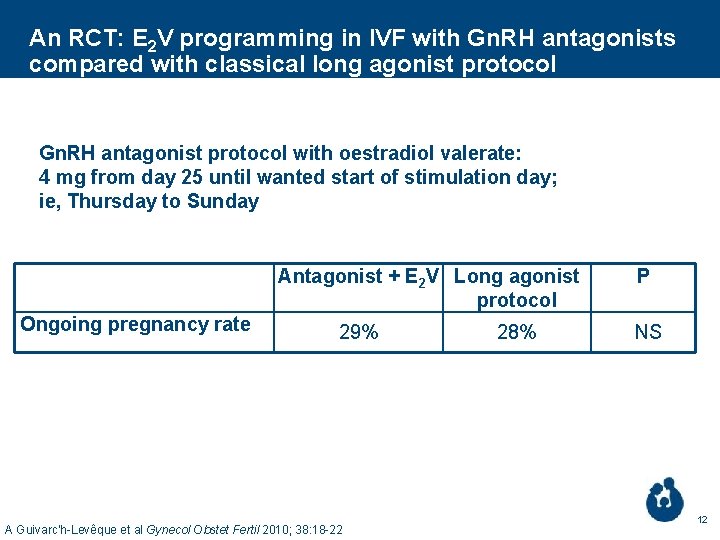
An RCT: E 2 V programming in IVF with Gn. RH antagonists compared with classical long agonist protocol Gn. RH antagonist protocol with oestradiol valerate: 4 mg from day 25 until wanted start of stimulation day; ie, Thursday to Sunday Antagonist + E 2 V Long agonist protocol Ongoing pregnancy rate 29% A Guivarc’h-Levêque et al Gynecol Obstet Fertil 2010; 38: 18 -22 28% P NS 12
IVF Cycle Programming – Scheduling With the COCP – Avoiding Weekend OR by Adjusting the Start Day for IVF Stimulation or h. CG Administration – Avoidance of Weekend OR by Simple Advancement or Delay of OR by 1 Day From Ideal 13
2. Avoiding Weekend OR by Adjusting the Start Day for IVF Stimulation or h. CG administration There is some flexibility in scheduling the start day of ovarian stimulation. § Pregnancy rates do not appear to be compromised when altering the start day of rec. FSH to day 2, 3, or 4 of menses 1, 2 § Moving the day of h. CG administration by one day is a common practice. Pregnancy rates do not appear to be compromised with 1 -day delay of h. CG administration 2 1 Huirne et al. Hum Reprod 2007; 22: 2805– 13. 2 T. Hillensjo et al. Human reproduction 2011 – ESHRE P-468 14
IVF Cycle Programming – Scheduling With the COCP – Avoiding Weekend OR by Adjusting the Start Day for IVF Stimulation or h. CG Administration – Avoidance of Weekend OR by Simple Advancement or Delay of OR by 1 Day From Ideal 15
3. Avoidance of Weekend OR by Simple Advancement or Delay of OR by 1 Day From Ideal § It is common practice to administer the h. CG trigger as soon as at least 3 follicles are ≥ 17 mm – Kolibianakis and colleagues suggest that waiting 2 days after this ‘ideal’ time is deleterious 1 – Administering h. CG as soon as at least 3 follicles were ≥ 17 mm resulted in an ongoing pregnancy rate of 35. 6%, compared with a rate of 25% when h. CG was given 2 days later § Is it possible to avoid “ideal” Sunday OPUs by delaying them until Monday (1 day delay)? Will this compromise IVF outcomes? § Could you avoid “ideal” Saturday OPUs by advancing the OPU by one day to Friday (1 day advancement)? Does this compromise pregnancy rate? 1. Kolibianakis et al. Fertil Steril. 2004; 82: 102 -107; 16
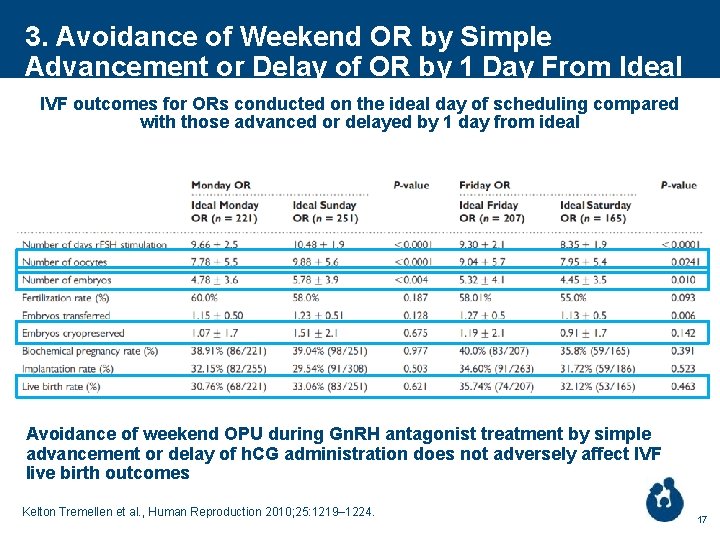
3. Avoidance of Weekend OR by Simple Advancement or Delay of OR by 1 Day From Ideal IVF outcomes for ORs conducted on the ideal day of scheduling compared with those advanced or delayed by 1 day from ideal Avoidance of weekend OPU during Gn. RH antagonist treatment by simple advancement or delay of h. CG administration does not adversely affect IVF live birth outcomes Kelton Tremellen et al. , Human Reproduction 2010; 25: 1219– 1224. 17
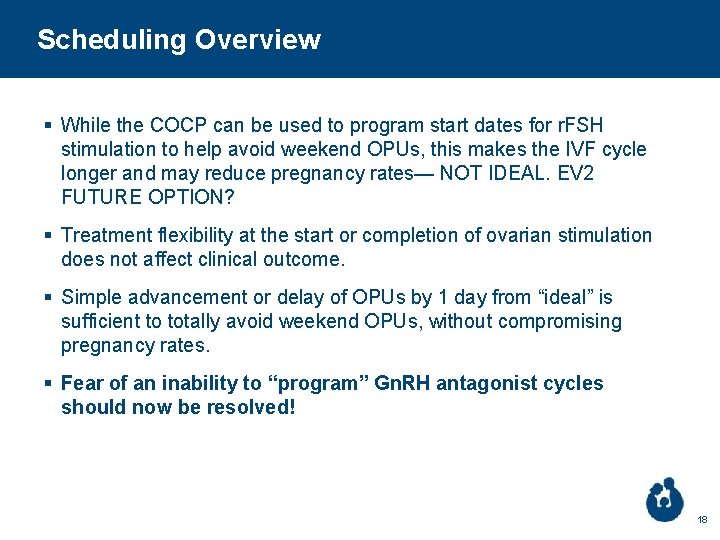
Scheduling Overview § While the COCP can be used to program start dates for r. FSH stimulation to help avoid weekend OPUs, this makes the IVF cycle longer and may reduce pregnancy rates— NOT IDEAL. EV 2 FUTURE OPTION? § Treatment flexibility at the start or completion of ovarian stimulation does not affect clinical outcome. § Simple advancement or delay of OPUs by 1 day from “ideal” is sufficient to totally avoid weekend OPUs, without compromising pregnancy rates. § Fear of an inability to “program” Gn. RH antagonist cycles should now be resolved! 18
Luteal Phase Support 19
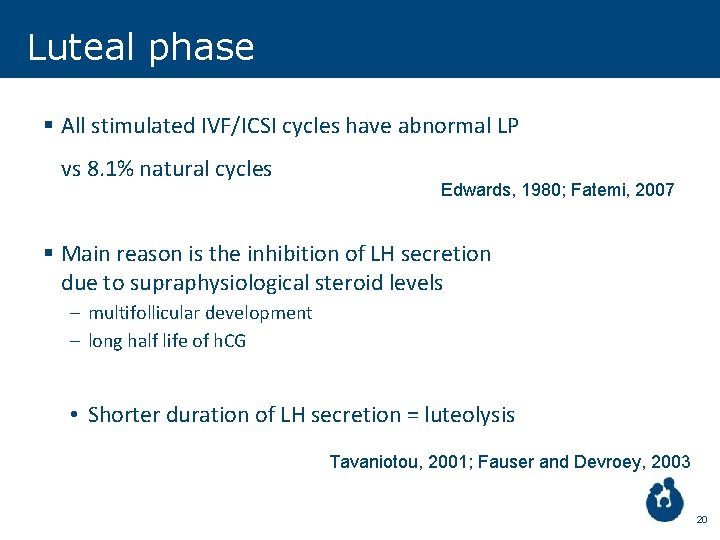
Luteal phase § All stimulated IVF/ICSI cycles have abnormal LP vs 8. 1% natural cycles Edwards, 1980; Fatemi, 2007 § Main reason is the inhibition of LH secretion due to supraphysiological steroid levels – multifollicular development – long half life of h. CG • Shorter duration of LH secretion = luteolysis Tavaniotou, 2001; Fauser and Devroey, 2003 20
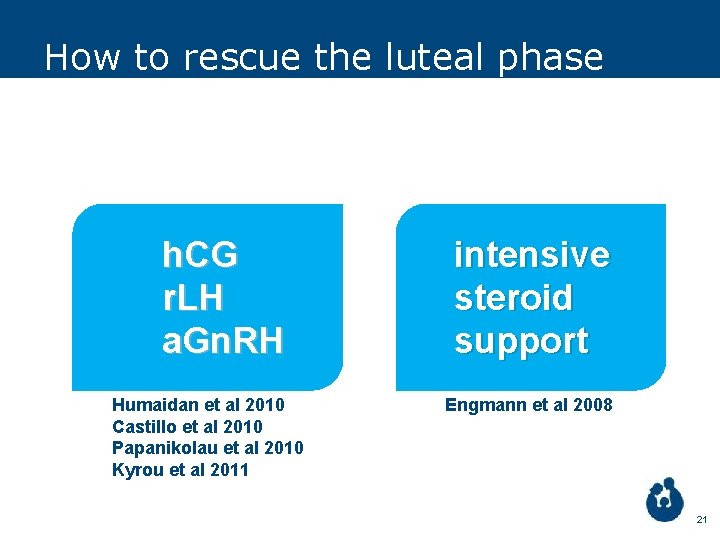
How to rescue the luteal phase h. CG r. LH a. Gn. RH Humaidan et al 2010 Castillo et al 2010 Papanikolau et al 2010 Kyrou et al 2011 intensive steroid support Engmann et al 2008 21
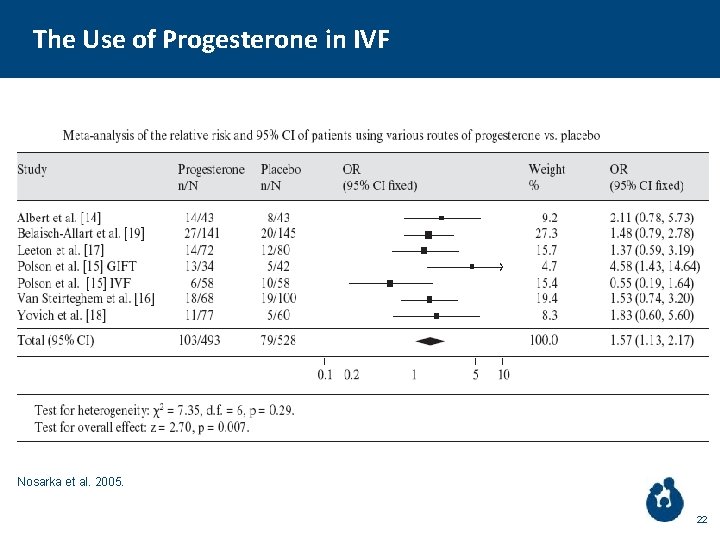
The Use of Progesterone in IVF Nosarka et al. 2005. 22
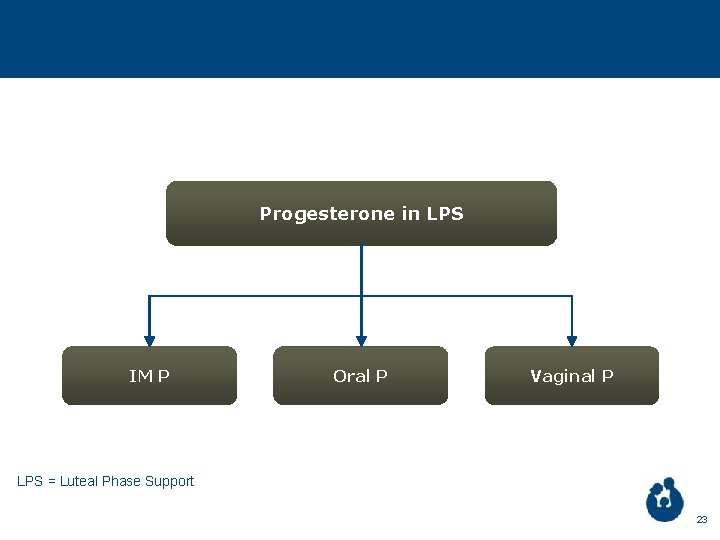
Progesterone in LPS IM P Oral P Vaginal P LPS = Luteal Phase Support 23
IM Progesterone § Effective § Physiological serum levels § Painful (long, thick needles) § Occasional sterile abscess § Occasional allergic reaction (oil vehicle) § Needs to be administered by nurse, husband § Acute eosinophilic pneumonia associated with IM administration of progesterone as luteal phase support after IVF: 5 case reports 24
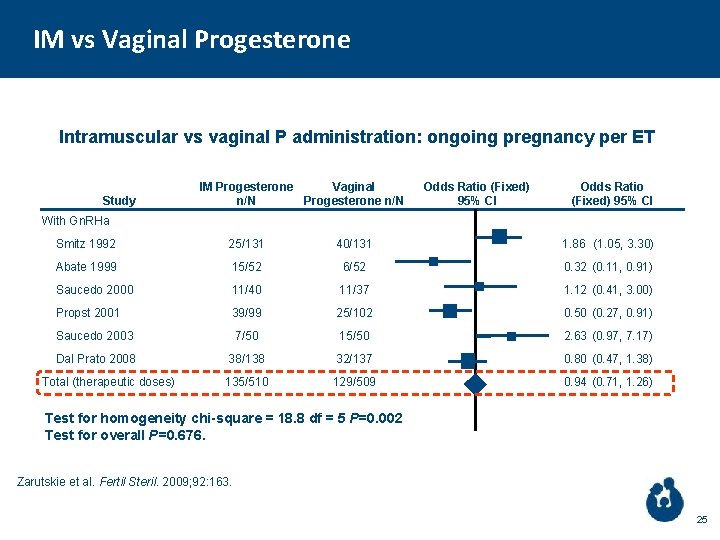
IM vs Vaginal Progesterone Intramuscular vs vaginal P administration: ongoing pregnancy per ET Study IM Progesterone Vaginal n/N Progesterone n/N Odds Ratio (Fixed) 95% CI With Gn. RHa Smitz 1992 25/131 40/131 1. 86 (1. 05, 3. 30) Abate 1999 15/52 6/52 0. 32 (0. 11, 0. 91) Saucedo 2000 11/40 11/37 1. 12 (0. 41, 3. 00) Propst 2001 39/99 25/102 0. 50 (0. 27, 0. 91) Saucedo 2003 7/50 15/50 2. 63 (0. 97, 7. 17) Dal Prato 2008 38/138 32/137 0. 80 (0. 47, 1. 38) 135/510 129/509 0. 94 (0. 71, 1. 26) Total (therapeutic doses) Test for homogeneity chi-square = 18. 8 df = 5 P=0. 002 Test for overall P=0. 676. Zarutskie et al. Fertil Steril. 2009; 92: 163. 25
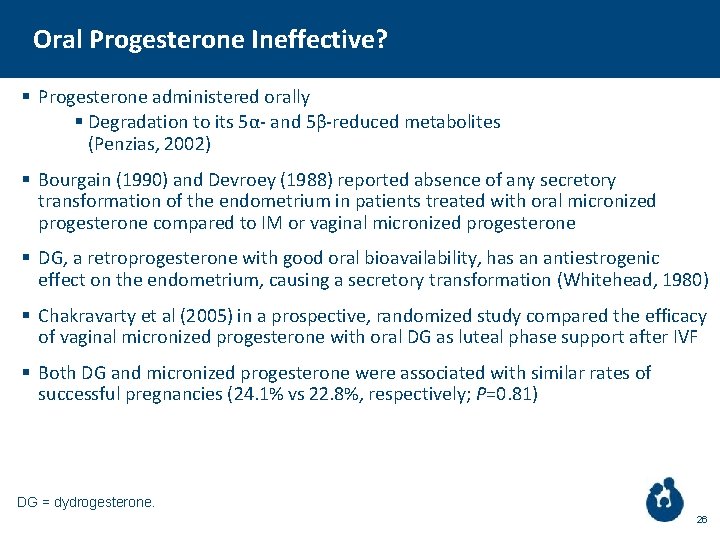
Oral Progesterone Ineffective? § Progesterone administered orally § Degradation to its 5α- and 5β-reduced metabolites (Penzias, 2002) § Bourgain (1990) and Devroey (1988) reported absence of any secretory transformation of the endometrium in patients treated with oral micronized progesterone compared to IM or vaginal micronized progesterone § DG, a retroprogesterone with good oral bioavailability, has an antiestrogenic effect on the endometrium, causing a secretory transformation (Whitehead, 1980) § Chakravarty et al (2005) in a prospective, randomized study compared the efficacy of vaginal micronized progesterone with oral DG as luteal phase support after IVF § Both DG and micronized progesterone were associated with similar rates of successful pregnancies (24. 1% vs 22. 8%, respectively; P=0. 81) DG = dydrogesterone. 26
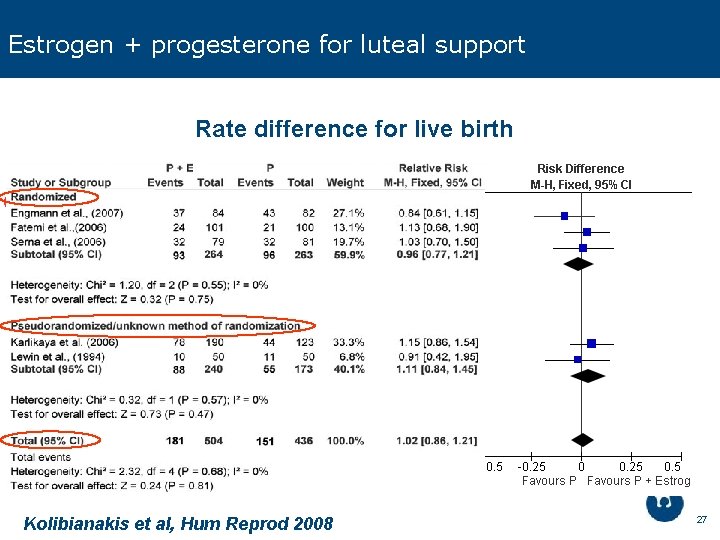
Estrogen + progesterone for luteal support Rate difference for live birth (2008) (200 6) Kolibianakis et al, Hum Reprod 2008 27
Is h. CG in the Luteal Phase Superior to Progesterone? § h. CG does not provide better results than progesterone and is associated with a greater risk of OHSS Daya and Gunby. Cochrane Database Syst Rev. 2008; CD 004830. 28
Gn. RH agonist trigger and Luteal Phase Support § In fresh-autologous cycles, Gn. RH agonist triggering was less effective than h. CG in live birth rate (OR 0. 44, P=0. 04) § Lower pregnancy rate may be due to luteal phase defect with Gn. RH agonist trigger, resulting from the short half-life of the LH surge Youssef et al. Cochrane Database Syst Rev. 2010 Nov 10; 11: CD 008046. 29
What Is the Best Length of Luteal Support? § Prolongation of progesterone supplementation in early pregnancy has no influence on the miscarriage rate, and thus no effect on the ongoing pregnancy rate § Progesterone supplementation can safely be withdrawn at the time of a positive h. CG test in antagonist protocols patients Kyrou et al, 2011 30
St. -Petersburg experience in the luteal support • 200 mg vaginal progesterone three times daily during 14 days from the day of transfer until the day of a positive HCG in three groups of patients during first IVF attempt. • Modified natural protocol, antagonist + FSH from 7 day of cycle (n=27 patients), IR= 35, 3% • Mild stimulation, antagonist + FSH from 5 day of cycle (n=25 patients), IR=27, 8% • Conventional ovarian stimulation, antagonist + FSH from 3 day of cycle (n=29), IR=37, 9% • Short luteal support can provide high implantation rate in antagonist protocols with different days of FSH administration 31
Conclusions Scheduling with Gn. RH antagonist protocols is possible to help avoiding weekend OPUs - COCP (E 2? ) to program start dates gonodotropin stimulation. - Adjusting the Start Day for IVF Stimulation or h. CG Administration. - Advancement or Delay of OR by 1 Day From Ideal. 32
Conclusions Adequate luteal support is necessary in Gn. RH antagonist cycles Vaginal progesterone is effective and is the most popular form of luteal support Duration of luteal support required may be shorter than current practice 33

THANK YOU! IVF CLINICS “GENESIS”, ST. -PETERSBURG, RUSSIA: IUI, IVF/ICSI/IMSI, OOCYTE DONATION, SURROGACY WWW. MCGENESIS. RU BOYARSKY@POCHTA. RU 34
- Slides: 34