
Experimental inputs for rprocess and the corecollapse supernovae



- Slides: 13
Experimental inputs for r-process and the core-collapse supernovae modeling Beyhan Bastin GANIL
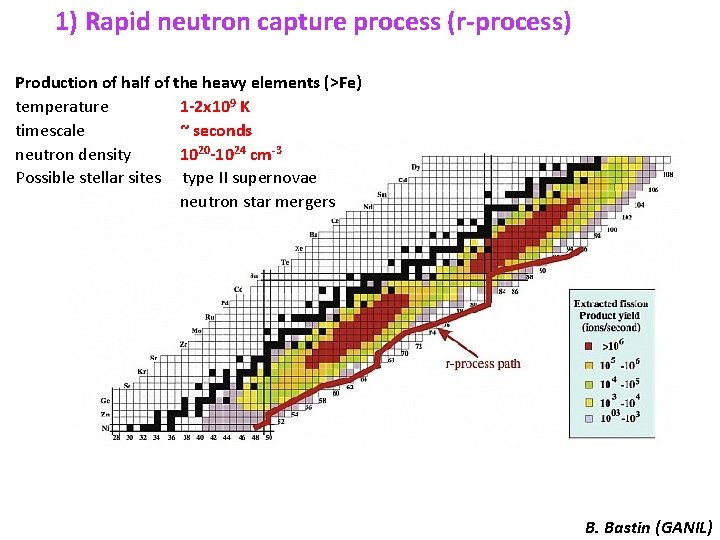
1) Rapid neutron capture process (r-process) Production of half of the heavy elements (>Fe) temperature 1 -2 x 10⁹ K timescale ~ seconds neutron density 1020 -1024 cm-3 Possible stellar sites type II supernovae neutron star mergers B. Bastin (GANIL)
1) Rapid neutron capture process (r-process) Recent sensitivity studies (as starting point, with caution…) “The impact of individual nuclear properties on r-process nucleosynthesis” M. R. Mumpower et al. , Progress in Particle and Nuclear Physics 86 (2016) 86– 126 • T 1/2 : progenitor abundances, process speed • b-delayed neutron emission branching : final abundances Impact parameter : Influential in the cold and merger cases (when photodissociation becomes negligible. ) Location of the path • Xb(A) is the final isobaric mass fraction in the baseline simulation • X(A) is the final isobaric mass fraction of the simulation with varied nuclear data input B. Bastin (GANIL)
Impact parameter : (factor 10) • Xb(A) is the final isobaric mass fraction in the baseline simulation • X(A) is the final isobaric mass fraction of the simulation with varied nuclear data input (factor 100) (+/- 500 ke. V FRDM 2012) B. Bastin (GANIL)
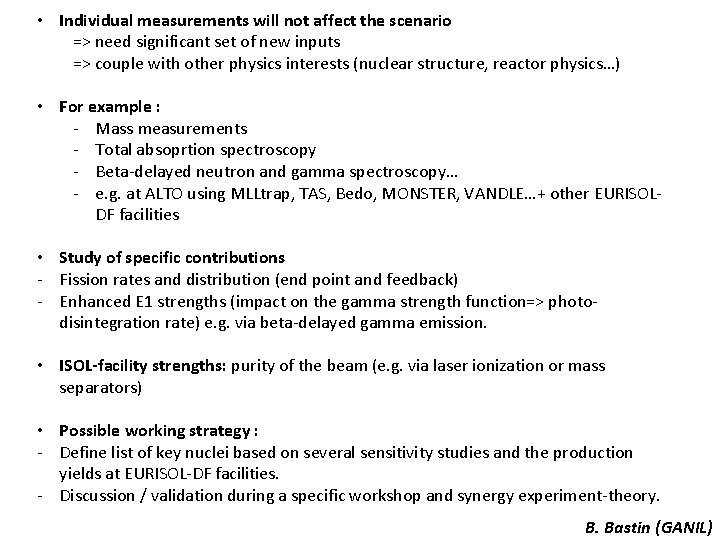
• Individual measurements will not affect the scenario => need significant set of new inputs => couple with other physics interests (nuclear structure, reactor physics…) • For example : - Mass measurements - Total absoprtion spectroscopy - Beta-delayed neutron and gamma spectroscopy… - e. g. at ALTO using MLLtrap, TAS, Bedo, MONSTER, VANDLE…+ other EURISOLDF facilities • Study of specific contributions - Fission rates and distribution (end point and feedback) - Enhanced E 1 strengths (impact on the gamma strength function=> photodisintegration rate) e. g. via beta-delayed gamma emission. • ISOL-facility strengths: purity of the beam (e. g. via laser ionization or mass separators) • Possible working strategy : - Define list of key nuclei based on several sensitivity studies and the production yields at EURISOL-DF facilities. - Discussion / validation during a specific workshop and synergy experiment-theory. B. Bastin (GANIL)
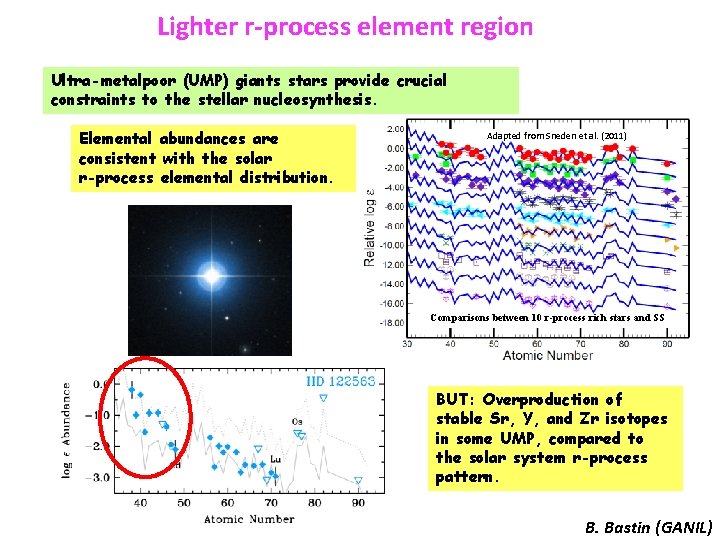
Lighter r-process element region Ultra-metalpoor (UMP) giants stars provide crucial constraints to the stellar nucleosynthesis. Elemental abundances are consistent with the solar r-process elemental distribution. Adapted from Sneden et al. (2011) Comparisons between 10 r-process rich stars and SS BUT: Overproduction of stable Sr, Y, and Zr isotopes in some UMP, compared to the solar system r-process pattern. B. Bastin (GANIL)
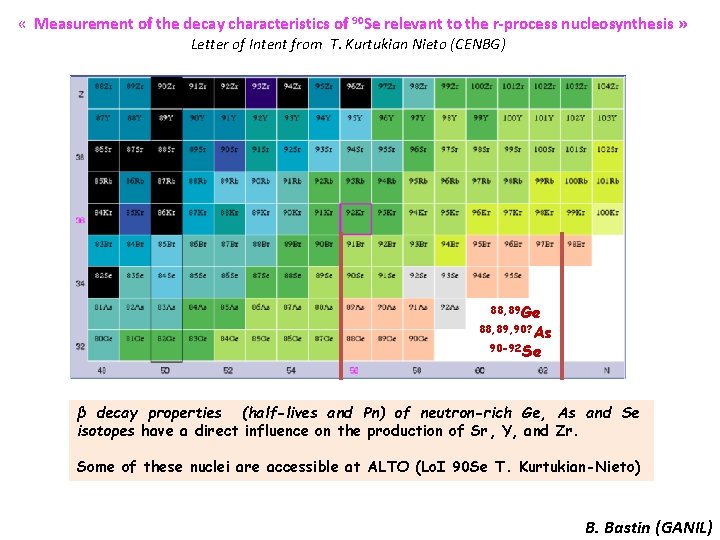
« Measurement of the decay characteristics of 90 Se relevant to the r-process nucleosynthesis » Letter of Intent from T. Kurtukian Nieto (CENBG) 88, 89 Ge 88, 89, 90? As 90 -92 Se β decay properties (half-lives and Pn) of neutron-rich Ge, As and Se isotopes have a direct influence on the production of Sr, Y, and Zr. Some of these nuclei are accessible at ALTO (Lo. I 90 Se T. Kurtukian-Nieto) B. Bastin (GANIL)
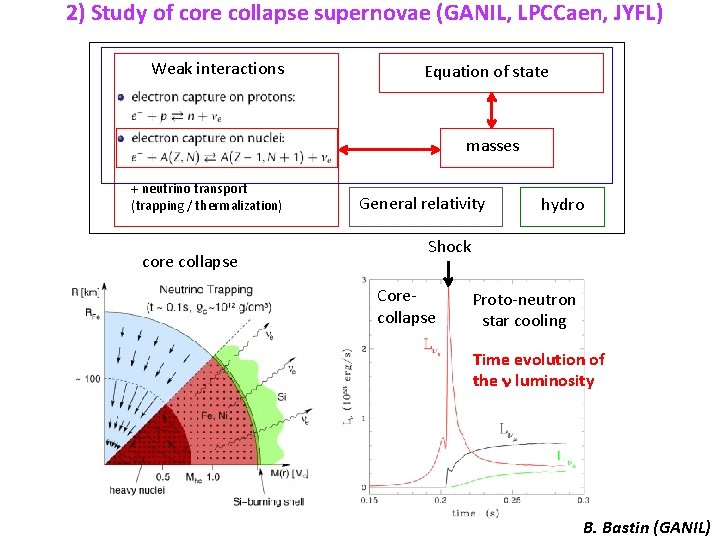
2) Study of core collapse supernovae (GANIL, LPCCaen, JYFL) Weak interactions Equation of state masses + neutrino transport (trapping / thermalization) core collapse General relativity hydro Shock Corecollapse Proto-neutron star cooling Time evolution of the n luminosity B. Bastin (GANIL)
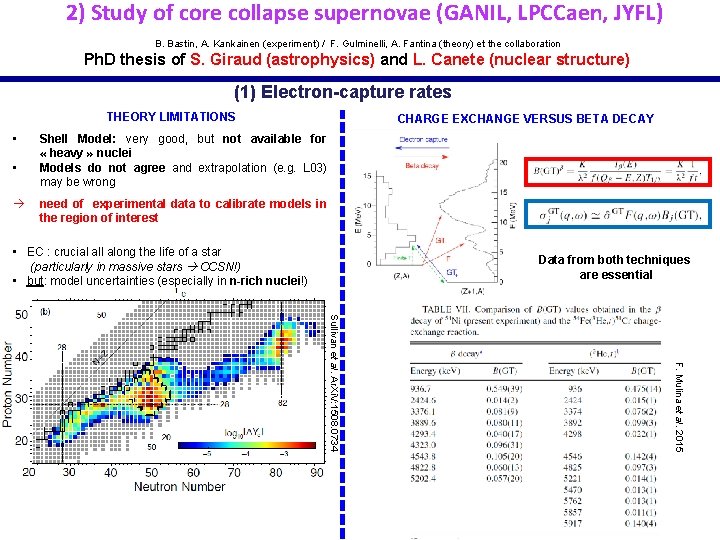
2) Study of core collapse supernovae (GANIL, LPCCaen, JYFL) Nuclear physics inputs influence the composition and ne rate • EC : crucial along the life of a star (particularly in massive stars CCSN!) • but: model uncertainties (especially in neutron-rich nuclei!) Sullivan et al. Ar. Xi. V: 1508. 0734 B. Bastin (GANIL)
2) Study of core collapse supernovae (GANIL, LPCCaen, JYFL) B. Bastin, A. Kankainen (experiment) / F. Gulminelli, A. Fantina (theory) et the collaboration Ph. D thesis of S. Giraud (astrophysics) and L. Canete (nuclear structure) (1) Electron-capture rates THEORY LIMITATIONS • • à CHARGE EXCHANGE VERSUS BETA DECAY Shell Model: very good, but not available for « heavy » nuclei Models do not agree and extrapolation (e. g. L 03) may be wrong need of experimental data to calibrate models in the region of interest • EC : crucial along the life of a star (particularly in massive stars CCSN!) • but: model uncertainties (especially in n-rich nuclei!) Data from both techniques are essential F. Mulina et al. 2015 Sullivan et al. Ar. Xi. V: 1508. 0734
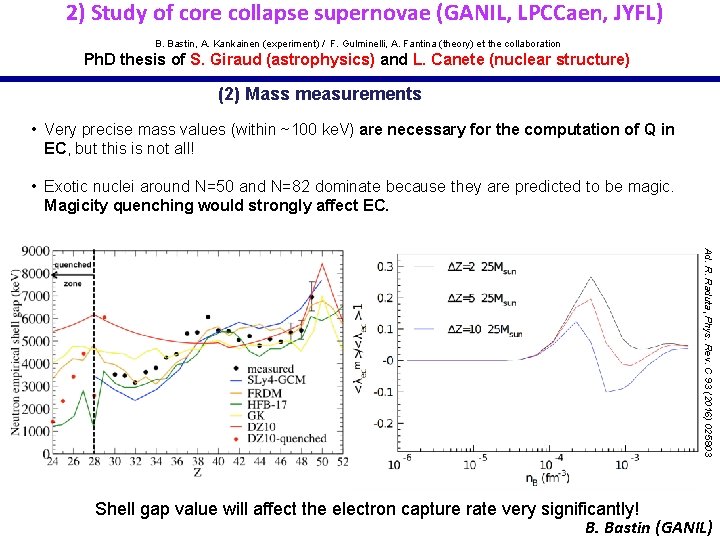
2) Study of core collapse supernovae (GANIL, LPCCaen, JYFL) B. Bastin, A. Kankainen (experiment) / F. Gulminelli, A. Fantina (theory) et the collaboration Ph. D thesis of S. Giraud (astrophysics) and L. Canete (nuclear structure) (2) Mass measurements • Very precise mass values (within ~100 ke. V) are necessary for the computation of Q in EC, but this is not all! • Exotic nuclei around N=50 and N=82 dominate because they are predicted to be magic. Magicity quenching would strongly affect EC. Ad. R. Raduta, Phys. Rev. C 93 (2016) 025803 Note : ΔZ=∞ would mean “no quenching” Shell gap value will affect the electron capture rate very significantly! B. Bastin (GANIL)
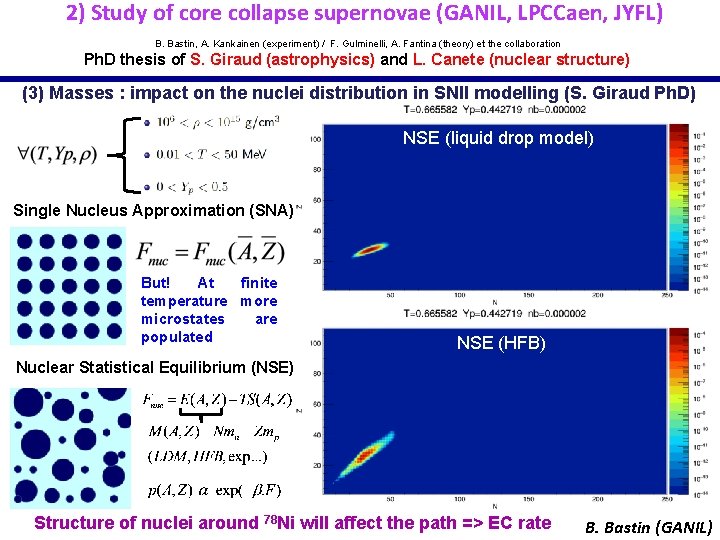
2) Study of core collapse supernovae (GANIL, LPCCaen, JYFL) B. Bastin, A. Kankainen (experiment) / F. Gulminelli, A. Fantina (theory) et the collaboration Ph. D thesis of S. Giraud (astrophysics) and L. Canete (nuclear structure) (3) Masses : impact on the nuclei distribution in SNII modelling (S. Giraud Ph. D) NSE (liquid drop model) Single Nucleus Approximation (SNA) But! At finite temperature more microstates are populated NSE (HFB) Nuclear Statistical Equilibrium (NSE) Structure of nuclei around 78 Ni will affect the path => EC rate B. Bastin (GANIL)
Summary • Extensive mass measurements and decay studies - r-process : along the path with some priorities - core-collapse : around 78 Ni and 126 Pd • Study of specific contributions - Fission rates and distribution (feedback) - Enhanced E 1 strengths (impact in the gamma strenth function => photo-disintegration rate) • Possible working strategy : - Define list of key nuclei based on several sensitivity studies and the production yields at EURISOL-DF facilities - Discussion / validation during a specific workshop and synergy experiment-theory. B. Bastin (GANIL)