
Modern cosmology 2 Type Ia supernovae and Distances
- Slides: 15
Modern cosmology 2: Type Ia supernovae and Λ Distances at z ~1 l Type Ia supernovae l SNe Ia and cosmology l Results from the Supernova Cosmology Project, the High z Supernova Search, and the HST l Conclusions l PHY 306 1
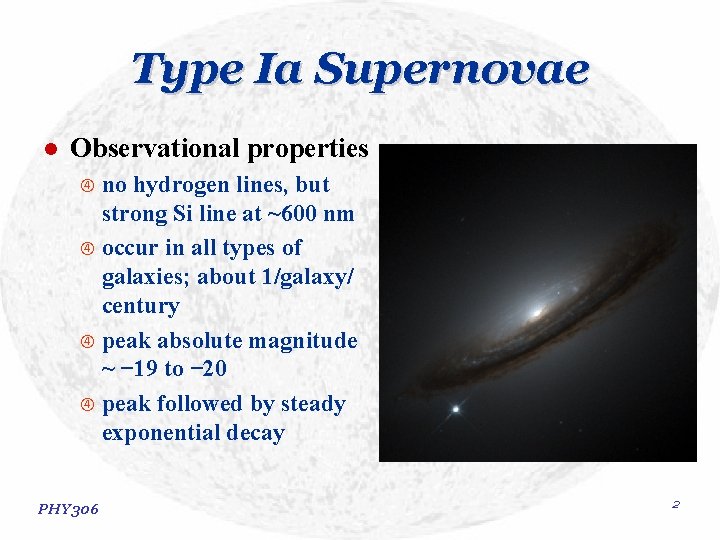
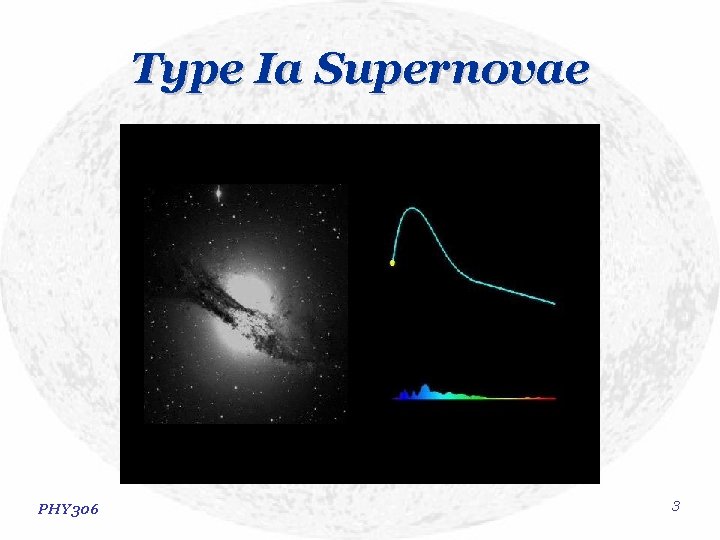
Type Ia Supernovae l Observational properties no hydrogen lines, but strong Si line at ~600 nm occur in all types of galaxies; about 1/galaxy/ century peak absolute magnitude ~ − 19 to − 20 peak followed by steady exponential decay PHY 306 2
Type Ia Supernovae PHY 306 3
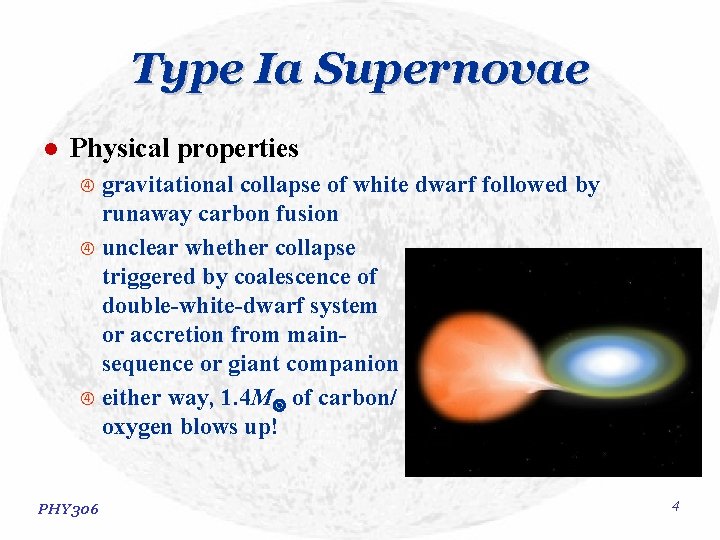
Type Ia Supernovae l Physical properties gravitational collapse of white dwarf followed by runaway carbon fusion unclear whether collapse triggered by coalescence of double-white-dwarf system or accretion from mainsequence or giant companion either way, 1. 4 M of carbon/ oxygen blows up! PHY 306 4
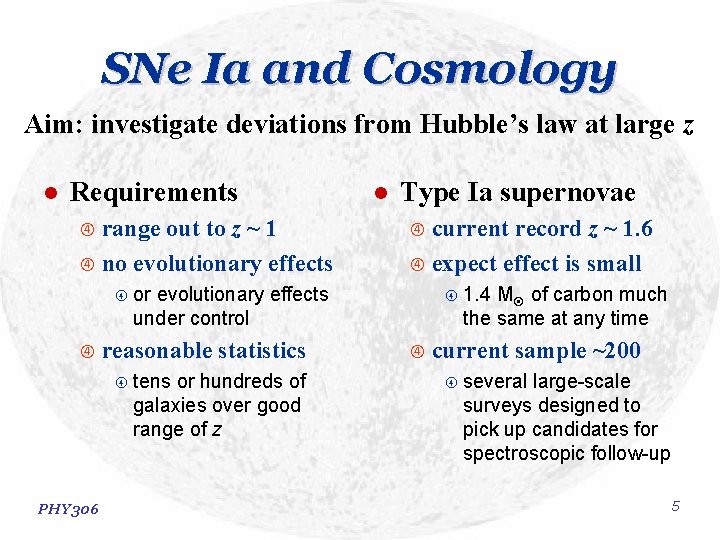
SNe Ia and Cosmology Aim: investigate deviations from Hubble’s law at large z l Requirements range out to z ~ 1 no evolutionary effects l Type Ia supernovae current record z ~ 1. 6 expect effect is small or evolutionary effects under control reasonable statistics tens or hundreds of galaxies over good range of z PHY 306 1. 4 M of carbon much the same at any time current sample ~200 several large-scale surveys designed to pick up candidates for spectroscopic follow-up 5
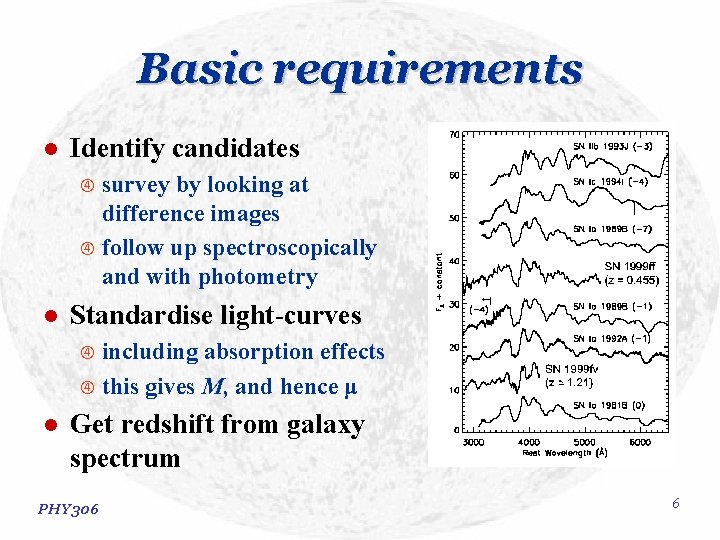
Basic requirements l Identify candidates survey by looking at difference images follow up spectroscopically and with photometry l Standardise light-curves including absorption effects this gives M, and hence μ l Get redshift from galaxy spectrum PHY 306 6
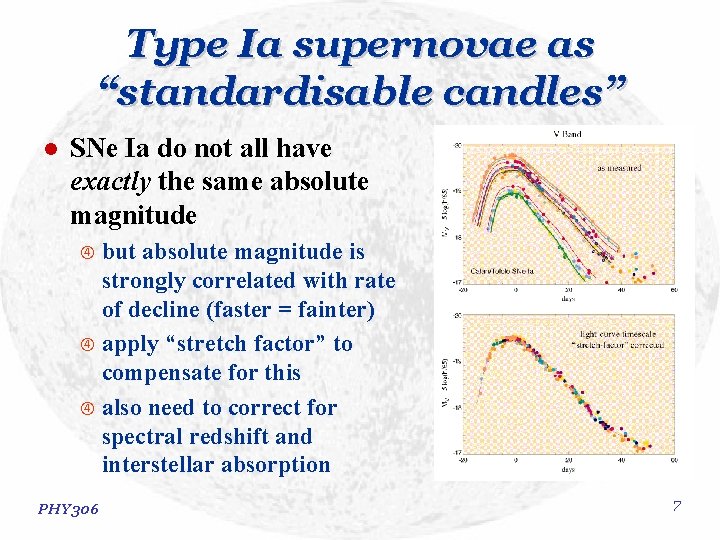
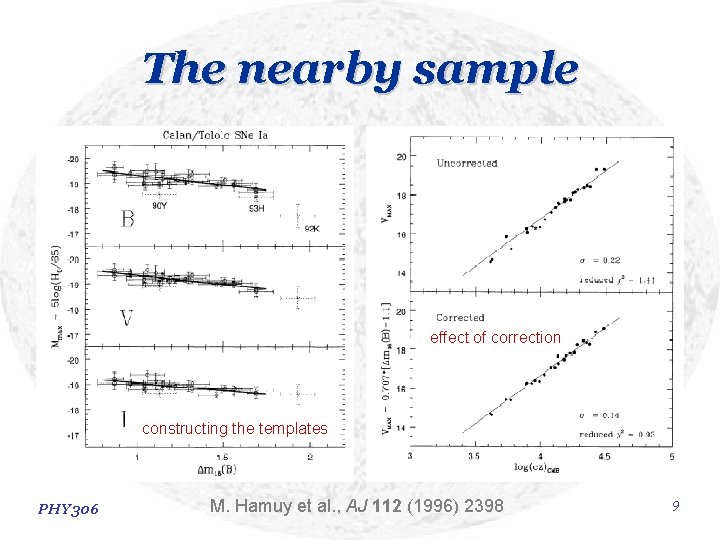
Type Ia supernovae as “standardisable candles” l SNe Ia do not all have exactly the same absolute magnitude but absolute magnitude is strongly correlated with rate of decline (faster = fainter) apply “stretch factor” to compensate for this also need to correct for spectral redshift and interstellar absorption PHY 306 7
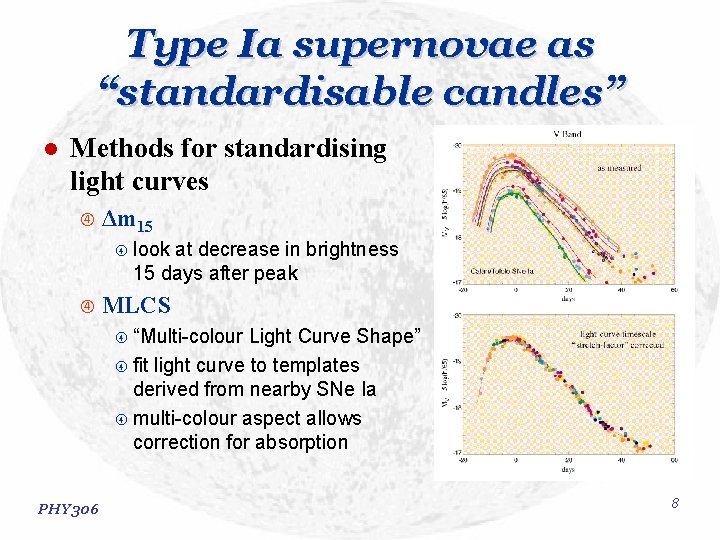
Type Ia supernovae as “standardisable candles” l Methods for standardising light curves Δm 15 look at decrease in brightness 15 days after peak MLCS “Multi-colour Light Curve Shape” fit light curve to templates derived from nearby SNe Ia multi-colour aspect allows correction for absorption PHY 306 8
The nearby sample effect of correction constructing the templates PHY 306 M. Hamuy et al. , AJ 112 (1996) 2398 9
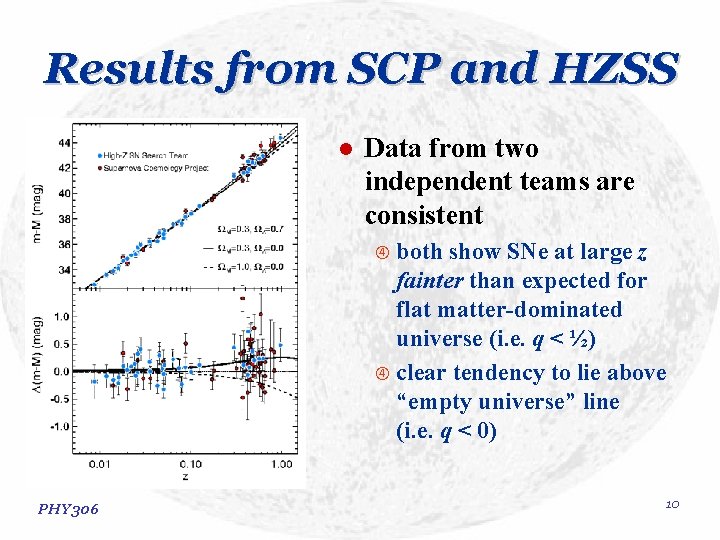
Results from SCP and HZSS l Data from two independent teams are consistent both show SNe at large z fainter than expected for flat matter-dominated universe (i. e. q < ½) clear tendency to lie above “empty universe” line (i. e. q < 0) PHY 306 10
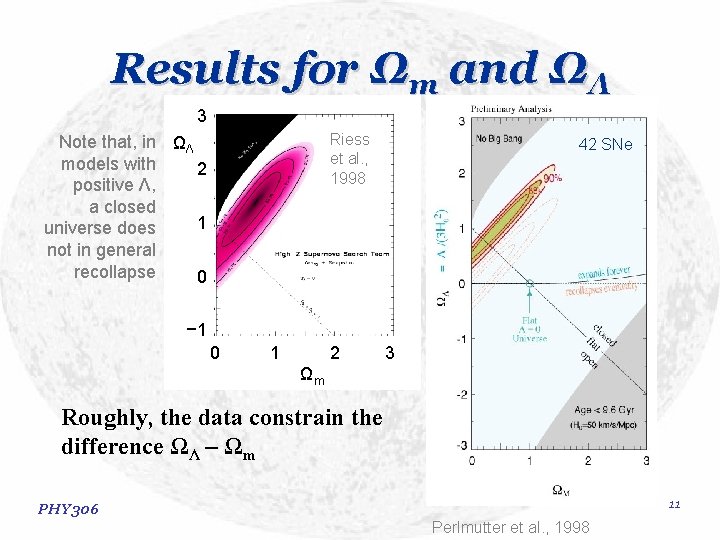
Results for Ωm and ΩΛ 3 Riess et al. , 1998 Note that, in ΩΛ models with 2 positive Λ, a closed 1 universe does not in general recollapse 0 42 SNe − 1 0 1 2 3 Ωm Roughly, the data constrain the difference ΩΛ – Ωm 11 PHY 306 Perlmutter et al. , 1998
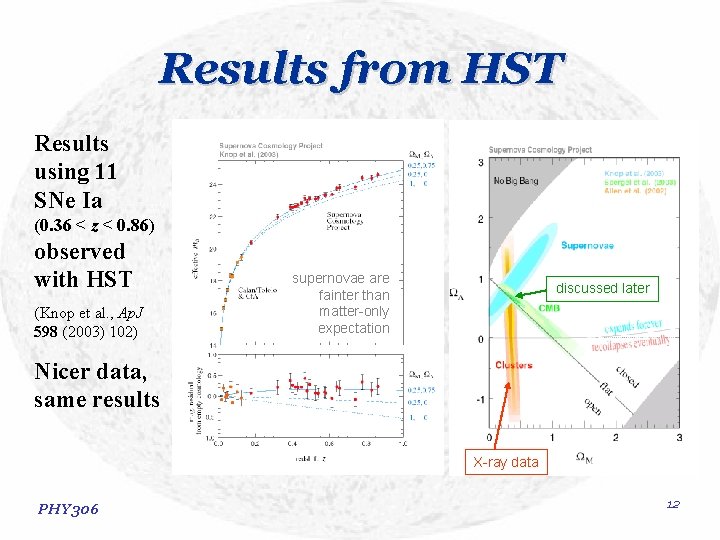
Results from HST Results using 11 SNe Ia (0. 36 < z < 0. 86) observed with HST (Knop et al. , Ap. J 598 (2003) 102) supernovae are fainter than matter-only expectation discussed later Nicer data, same results X-ray data PHY 306 12
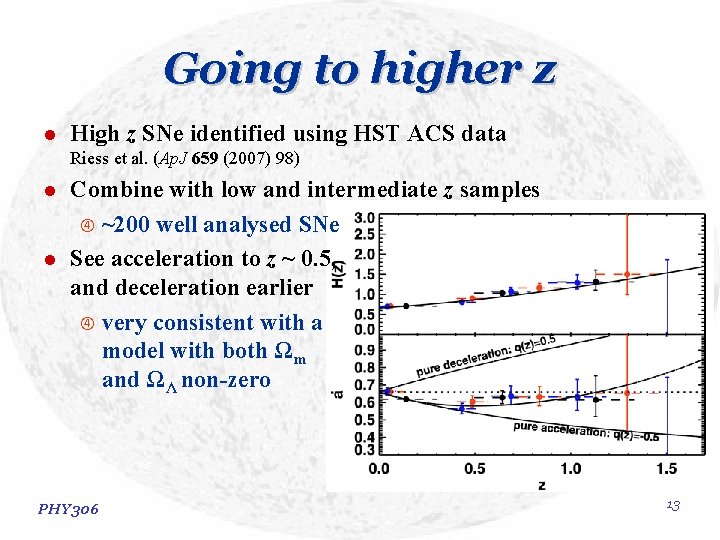
Going to higher z l High z SNe identified using HST ACS data Riess et al. (Ap. J 659 (2007) 98) l l Combine with low and intermediate z samples ~200 well analysed SNe See acceleration to z ~ 0. 5, and deceleration earlier very consistent with a model with both Ωm and ΩΛ non-zero PHY 306 13
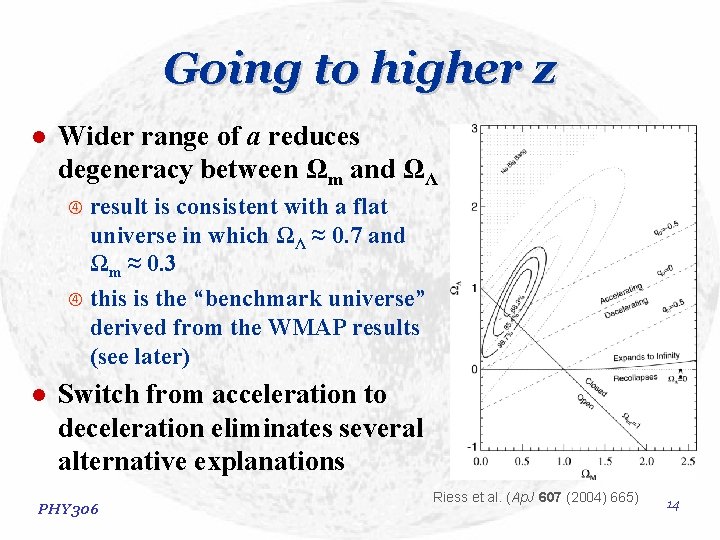
Going to higher z l Wider range of a reduces degeneracy between Ωm and ΩΛ result is consistent with a flat universe in which ΩΛ ≈ 0. 7 and Ωm ≈ 0. 3 this is the “benchmark universe” derived from the WMAP results (see later) l Switch from acceleration to deceleration eliminates several alternative explanations PHY 306 Riess et al. (Ap. J 607 (2004) 665) 14
Conclusion l Now several independent teams reporting results on Type Ia supernovae results consistently require positive ΩΛ and are consistent with (but do not require) k = 0 definitely not consistent with Ωm = 1, k = 0 definitely requires q 0 < 0 (acceleration) turnover from acceleration to deceleration at z ~ 0. 5 PHY 306 15