Good Hygiene Practices along the coffee chain Module
- Slides: 34
Good Hygiene Practices along the coffee chain Module 4. 6 List Potential Hazards; Conduct Hazard Analysis; Consider Control Measures (Task 6 / Principle 1)
Objectives and contents § Objectives § To emphasize the importance of hazard identification and analysis steps in food safety management § To enable trainees to identify potential hazards in a process and to find appropriate control measures § Contents § § 2 Examples of hazards Carrying out a hazard analysis Control measures Hazard assessment Module 4. 6 – List Potential Hazards; Conduct Hazard Analysis; Consider Control Measures (Task 6 / Principle 1)
Importance of hazard analysis § An accurate analysis of hazards is necessary for an effective HACCP plan § Involves technical and scientific expertise in various domains § Hazard analysis must be reviewed when there is any change in § § § 3 Raw materials Formulation Processing procedures Packaging Distribution Use Module 4. 6 – List Potential Hazards; Conduct Hazard Analysis; Consider Control Measures (Task 6 / Principle 1)
Potential hazards § The first step in the development of a HACCP plan is the identification of all potential hazards § Biological, chemical and physical § At all stages from raw material to consumption 4 Module 4. 6 – List Potential Hazards; Conduct Hazard Analysis; Consider Control Measures (Task 6 / Principle 1)
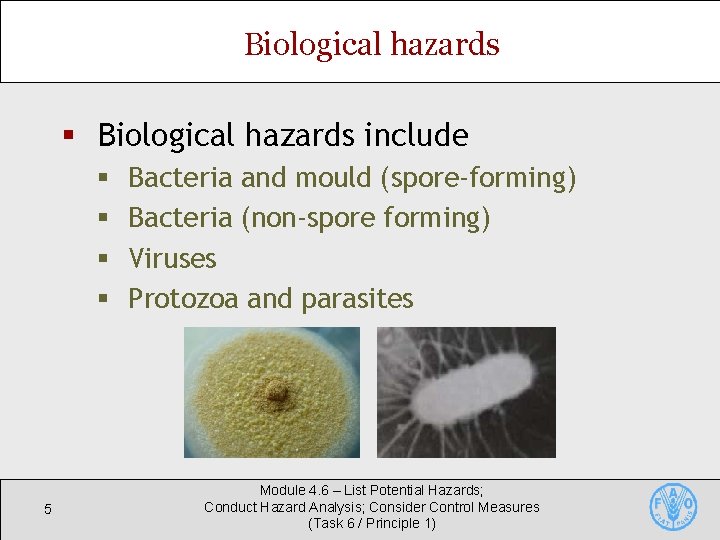
Biological hazards § Biological hazards include § § 5 Bacteria and mould (spore-forming) Bacteria (non-spore forming) Viruses Protozoa and parasites Module 4. 6 – List Potential Hazards; Conduct Hazard Analysis; Consider Control Measures (Task 6 / Principle 1)
Biological hazards § Commonly associated with humans and with raw products entering the food process § Most have the potential to increase spontaneously if control measures are inadequate § Usually killed or inactivated by heat processing § Fungi include moulds and yeasts § Some fungi are beneficial § Others produce toxic substances (mycotoxins) 6 Module 4. 6 – List Potential Hazards; Conduct Hazard Analysis; Consider Control Measures (Task 6 / Principle 1)
Chemical hazards § Chemical hazards include: § Naturally occurring chemicals § Added chemicals (intentional and unintentional) § Chemical contaminants may occur at levels that cause § Acute illness § Chronic illness 7 Module 4. 6 – List Potential Hazards; Conduct Hazard Analysis; Consider Control Measures (Task 6 / Principle 1)
Physical hazards § Examples include § Glass, wood, stones, metal, plastic, etc § Hard or sharp foreign objects can cause injury § Poor practices at many points along the food chain can lead to the introduction of physical hazards 8 Module 4. 6 – List Potential Hazards; Conduct Hazard Analysis; Consider Control Measures (Task 6 / Principle 1)
Hazard analysis § Sources of information for hazard analysis include § § § 9 Reference texts Company complaints file Scientific research and review papers Epidemiological data Web pages dealing with food safety issues Module 4. 6 – List Potential Hazards; Conduct Hazard Analysis; Consider Control Measures (Task 6 / Principle 1)
Hazard analysis § Objective § To determine which hazards need to be addressed under an effective HACCP plan § Overview of approach § § 10 Review incoming material Evaluate processing operations Observe actual operating practices Take and analyse measurements Module 4. 6 – List Potential Hazards; Conduct Hazard Analysis; Consider Control Measures (Task 6 / Principle 1)
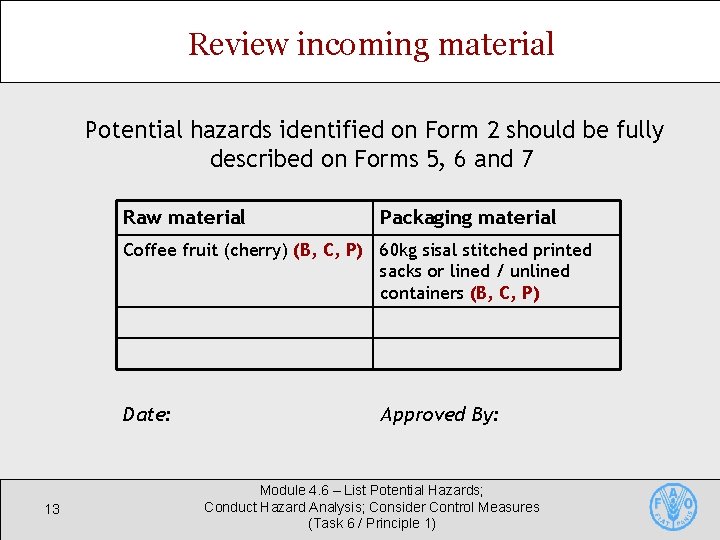
Review incoming material § Review product description form (Form 1) for information that could influence the analysis of hazards § Is it ready-to-eat or is further processing envisaged? § Is it intended for a vulnerable group? § For each incoming material (Form 2) write ‘B, C or P’ directly on the form to indicate the nature of all potential hazards 11 Module 4. 6 – List Potential Hazards; Conduct Hazard Analysis; Consider Control Measures (Task 6 / Principle 1)
Review of incoming raw material There is wide variation in practices (on-farm and throughout the marketing chain) that can influence the analysis of hazards in incoming raw material 12 Module 4. 6 – List Potential Hazards; Conduct Hazard Analysis; Consider Control Measures (Task 6 / Principle 1)
Review incoming material Potential hazards identified on Form 2 should be fully described on Forms 5, 6 and 7 Raw material Packaging material Coffee fruit (cherry) (B, C, P) 60 kg sisal stitched printed sacks or lined / unlined containers (B, C, P) Date: 13 Approved By: Module 4. 6 – List Potential Hazards; Conduct Hazard Analysis; Consider Control Measures (Task 6 / Principle 1)
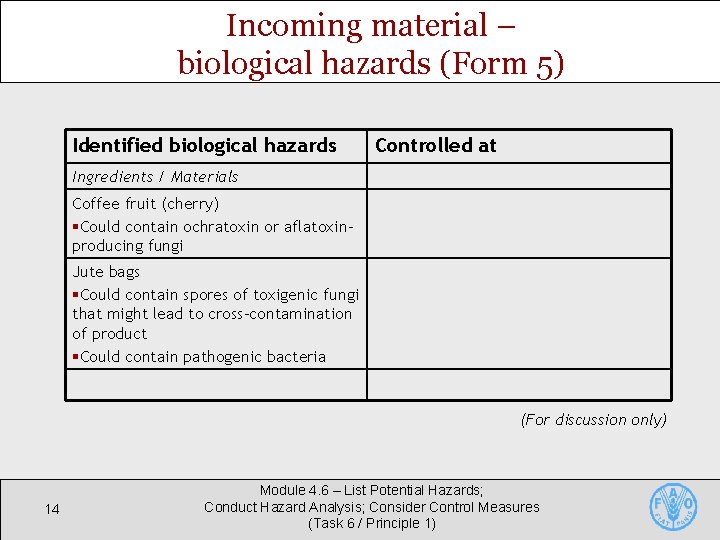
Incoming material – biological hazards (Form 5) Identified biological hazards Controlled at Ingredients / Materials Coffee fruit (cherry) §Could contain ochratoxin or aflatoxinproducing fungi Jute bags §Could contain spores of toxigenic fungi that might lead to cross-contamination of product §Could contain pathogenic bacteria (For discussion only) 14 Module 4. 6 – List Potential Hazards; Conduct Hazard Analysis; Consider Control Measures (Task 6 / Principle 1)
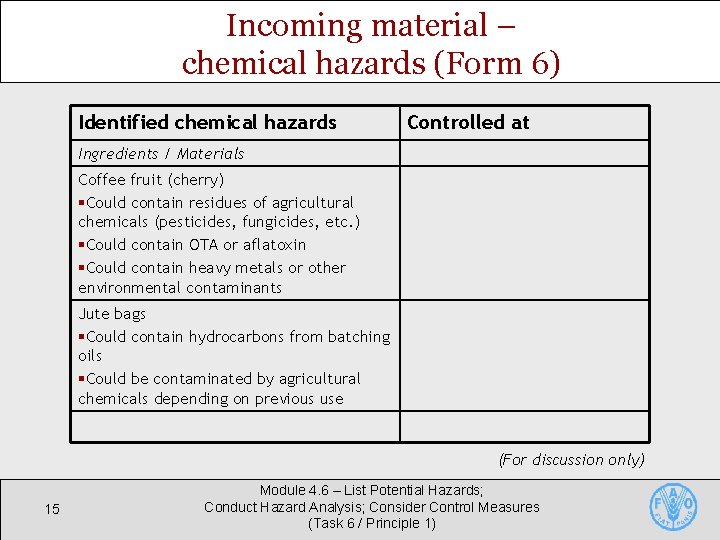
Incoming material – chemical hazards (Form 6) Identified chemical hazards Controlled at Ingredients / Materials Coffee fruit (cherry) §Could contain residues of agricultural chemicals (pesticides, fungicides, etc. ) §Could contain OTA or aflatoxin §Could contain heavy metals or other environmental contaminants Jute bags §Could contain hydrocarbons from batching oils §Could be contaminated by agricultural chemicals depending on previous use (For discussion only) 15 Module 4. 6 – List Potential Hazards; Conduct Hazard Analysis; Consider Control Measures (Task 6 / Principle 1)
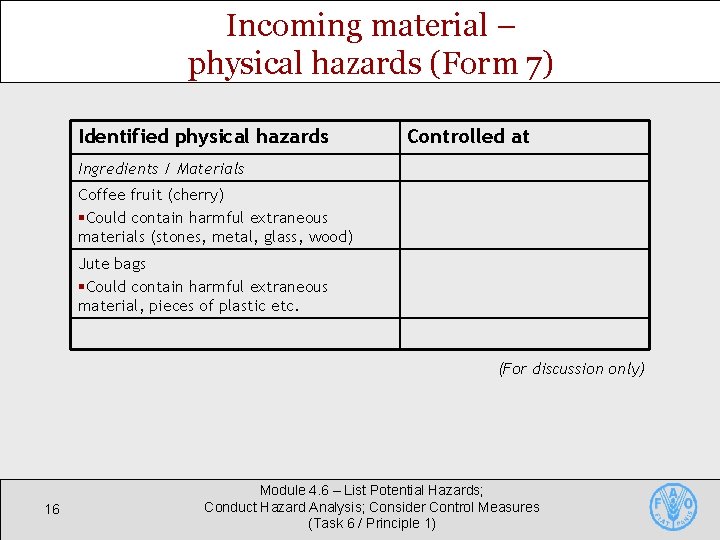
Incoming material – physical hazards (Form 7) Identified physical hazards Controlled at Ingredients / Materials Coffee fruit (cherry) §Could contain harmful extraneous materials (stones, metal, glass, wood) Jute bags §Could contain harmful extraneous material, pieces of plastic etc. (For discussion only) 16 Module 4. 6 – List Potential Hazards; Conduct Hazard Analysis; Consider Control Measures (Task 6 / Principle 1)
Hazards in incoming materials § Sample questions that guide the identification of potential hazards § Could pathogenic organisms, toxins, chemicals or physical objects possibly be present on this material § Are preservatives or additives used in the formulation to kill or inhibit growth of organisms § Are any ingredients hazardous if used excessively or in adequate amounts § Do moisture content and Aw in final product or ingredients affect microbial growth? 17 Module 4. 6 – List Potential Hazards; Conduct Hazard Analysis; Consider Control Measures (Task 6 / Principle 1)
Evaluating process operations § Objective § Identify all realistic potential hazards related to each processing operation, the product flow and employee traffic patterns § Review process flow diagram (Form 3) and plant schematic (Form 4) 18 Module 4. 6 – List Potential Hazards; Conduct Hazard Analysis; Consider Control Measures (Task 6 / Principle 1)
Hazards associated with process steps § Assign a number to each processing step on Form 3 § Examine each step and identify potential hazards (B, C, P) § Use plant schematic to assist in identification of potential hazards 19 Module 4. 6 – List Potential Hazards; Conduct Hazard Analysis; Consider Control Measures (Task 6 / Principle 1)
Analysing process steps – guiding questions § Could contaminants reach the product during this operation? § Could micro-organisms of concern multiply to the point where they constitute a hazard? 20 Module 4. 6 – List Potential Hazards; Conduct Hazard Analysis; Consider Control Measures (Task 6 / Principle 1)
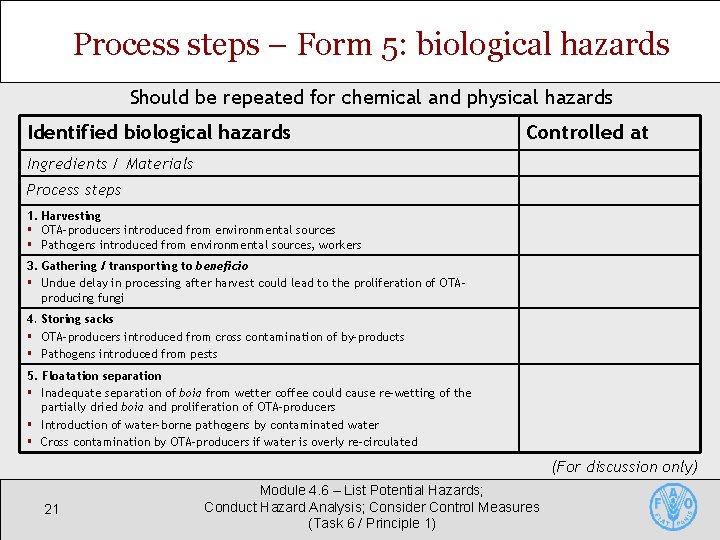
Process steps – Form 5: biological hazards Should be repeated for chemical and physical hazards Identified biological hazards Controlled at Ingredients / Materials Process steps 1. Harvesting § OTA-producers introduced from environmental sources § Pathogens introduced from environmental sources, workers 3. Gathering / transporting to beneficio § Undue delay in processing after harvest could lead to the proliferation of OTAproducing fungi 4. Storing sacks § OTA-producers introduced from cross contamination of by-products § Pathogens introduced from pests 5. Floatation separation § Inadequate separation of boia from wetter coffee could cause re-wetting of the partially dried boia and proliferation of OTA-producers § Introduction of water-borne pathogens by contaminated water § Cross contamination by OTA-producers if water is overly re-circulated (For discussion only) 21 Module 4. 6 – List Potential Hazards; Conduct Hazard Analysis; Consider Control Measures (Task 6 / Principle 1)
Observe actual operating practices § HACCP team must be familiar with every detail of each operation § Observe operation long enough to be confident of usual practices § Observe employees § Be attentive of the possibility of cross contamination after a kill step § Identified hazards must be recorded on appropriate form 22 Module 4. 6 – List Potential Hazards; Conduct Hazard Analysis; Consider Control Measures (Task 6 / Principle 1)
Take measurements § Confirm actual processing conditions by taking measurements of important process parameters § Physical properties of the product as Aw, temperature, p. H, moisture content § Residence time in processing steps § Dimensions, volumes § Storage conditions § Be sure of accuracy of measuring devices § Collect samples for microbial challenge studies if necessary 23 Module 4. 6 – List Potential Hazards; Conduct Hazard Analysis; Consider Control Measures (Task 6 / Principle 1)
Analyse measurements § Qualified individual must analyse and interpret data to determine impact or processing conditions on identified hazards § For example, plot Aw / moisture content / temperature against time as indicated by the circumstances § Compare Aw or p. H values with ranges known to support microbial growth § Estimate and evaluate cooling or thawing rates and determine influence on bacterial growth § Evaluate shelf stability of the product 24 Module 4. 6 – List Potential Hazards; Conduct Hazard Analysis; Consider Control Measures (Task 6 / Principle 1)
Control measures § Control measures are any actions and activities that can be used to prevent or eliminate a food safety hazard or reduce it to an acceptable level § More than one measure may be required to control a specific hazard and § More than one hazard may be controlled by a specified measure 25 Module 4. 6 – List Potential Hazards; Conduct Hazard Analysis; Consider Control Measures (Task 6 / Principle 1)
Controlling biological hazards § Minimize contamination § Prevent or minimize growth and toxin production using heating/cooling, low Aw, low Eh, high acidity, biological processes (e. g. fermentation), preservatives, etc. § Pathogens risk is based on concentration, not just presence / absence § Beware of possible concerted activity of more than one organism together 26 Module 4. 6 – List Potential Hazards; Conduct Hazard Analysis; Consider Control Measures (Task 6 / Principle 1)
Controlling chemical hazards § Source control involving raw material specifications and vendor certification § Proper segregation of non-food chemicals during storage and handling § Control of incidental contamination from chemicals § Formulation control and proper use of additives 27 Module 4. 6 – List Potential Hazards; Conduct Hazard Analysis; Consider Control Measures (Task 6 / Principle 1)
Controlling physical hazards § Source control – raw material specifications and vendor certification § Processing control – use of magnets, winnowers, screens, etc § Good maintenance of facilities and equipment 28 Module 4. 6 – List Potential Hazards; Conduct Hazard Analysis; Consider Control Measures (Task 6 / Principle 1)
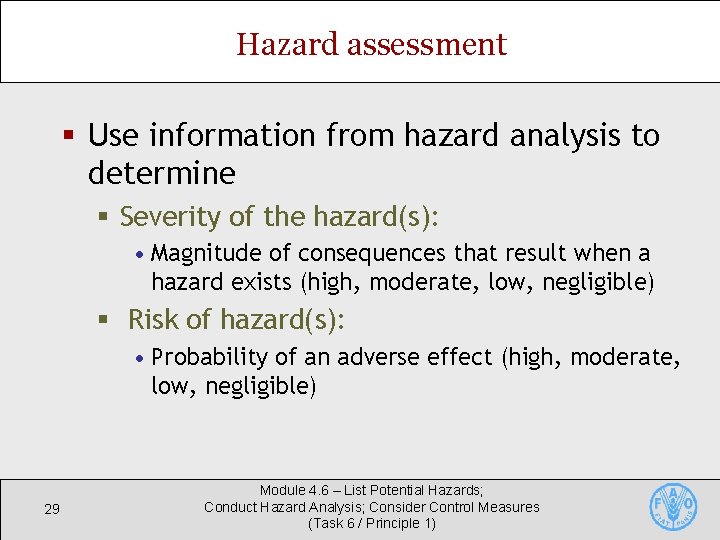
Hazard assessment § Use information from hazard analysis to determine § Severity of the hazard(s): • Magnitude of consequences that result when a hazard exists (high, moderate, low, negligible) § Risk of hazard(s): • Probability of an adverse effect (high, moderate, low, negligible) 29 Module 4. 6 – List Potential Hazards; Conduct Hazard Analysis; Consider Control Measures (Task 6 / Principle 1)
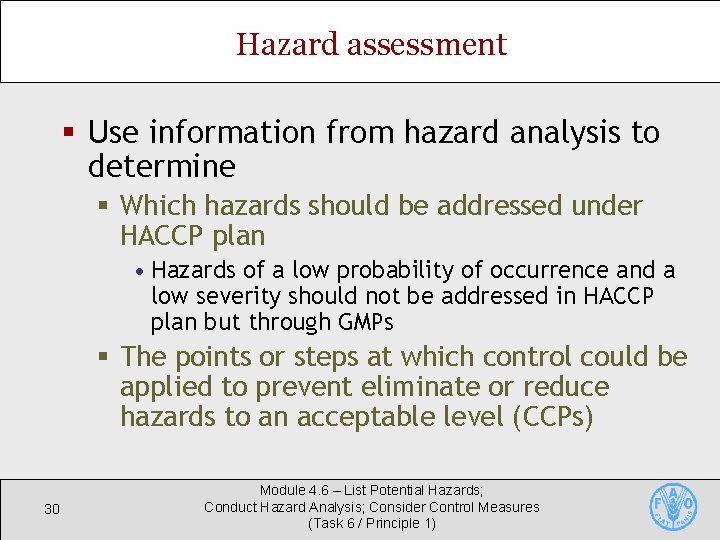
Hazard assessment § Use information from hazard analysis to determine § Which hazards should be addressed under HACCP plan • Hazards of a low probability of occurrence and a low severity should not be addressed in HACCP plan but through GMPs § The points or steps at which control could be applied to prevent eliminate or reduce hazards to an acceptable level (CCPs) 30 Module 4. 6 – List Potential Hazards; Conduct Hazard Analysis; Consider Control Measures (Task 6 / Principle 1)
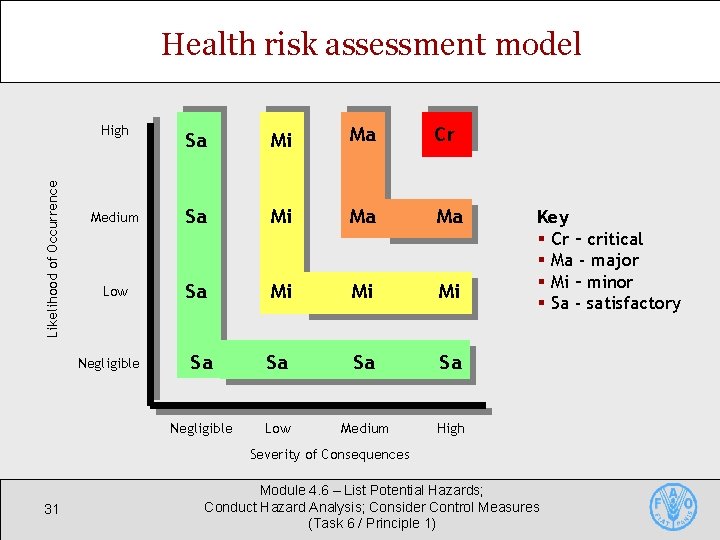
Likelihood of Occurrence Health risk assessment model High Sa Mi Ma Cr Medium Sa Mi Ma Ma Low Sa Mi Mi Mi Sa Sa Negligible Low Medium High Negligible Key § Cr – critical § Ma - major § Mi – minor § Sa - satisfactory Severity of Consequences 31 Module 4. 6 – List Potential Hazards; Conduct Hazard Analysis; Consider Control Measures (Task 6 / Principle 1)
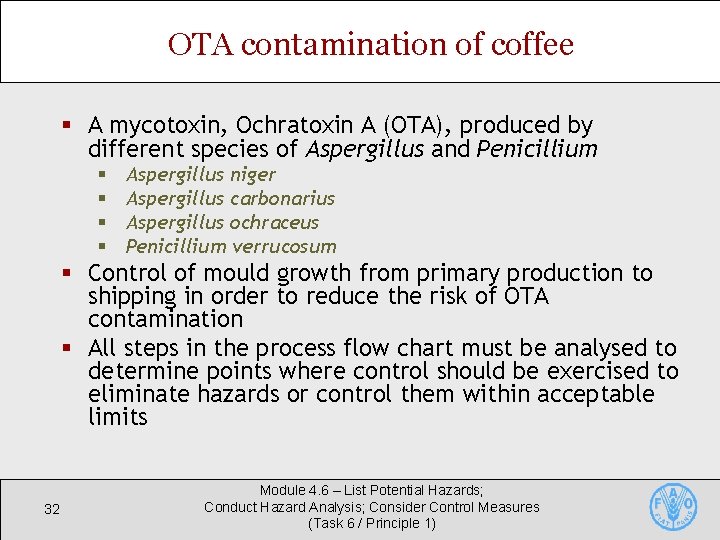
OTA contamination of coffee § A mycotoxin, Ochratoxin A (OTA), produced by different species of Aspergillus and Penicillium § § Aspergillus niger Aspergillus carbonarius Aspergillus ochraceus Penicillium verrucosum § Control of mould growth from primary production to shipping in order to reduce the risk of OTA contamination § All steps in the process flow chart must be analysed to determine points where control should be exercised to eliminate hazards or control them within acceptable limits 32 Module 4. 6 – List Potential Hazards; Conduct Hazard Analysis; Consider Control Measures (Task 6 / Principle 1)
Scientific support for HACCP plan development § Comprehensive identification of potential hazards and sound evaluation of control measures requires availability of good data § ‘Scientific support’ for HACCP-based safety management covers: § Mycology – ID of OTA-producers; investigation of conditions of mould growth and OTA- production § Evaluation of processing and handling technologies / equipment; moisture measurement devices 33 Module 4. 6 – List Potential Hazards; Conduct Hazard Analysis; Consider Control Measures (Task 6 / Principle 1)
Summary § What are biological, chemical and physical hazards § Systematically identifying hazards § Control measures § Deciding which hazards are to be addressed under the HACCP plan Next step: Determining the critical control points in a process 34 Module 4. 6 – List Potential Hazards; Conduct Hazard Analysis; Consider Control Measures (Task 6 / Principle 1)