VALUE CHAINS AND CLUSTER DEVELOPMENT TO ENHANCE LED





- Slides: 60
VALUE CHAINS AND CLUSTER DEVELOPMENT TO ENHANCE LED Local Administrative Development Agency (LODA) 3/04/2017 – Nobleza Hotel (Kigali)
CONTENT OF THE TRAINING Introduction Session 1: Value chain and clusters Session 2: Value chain development Session 3: Integration of VCD approach in district LED strategies Session 4: Practicals on intervention design for Nyagatare milk value chain Session 5: Applicability of value chain and cluster development to Rwanda
INTRODUCTION • Overall goal + objectives • Action planning
OVERALL GOAL + OBJECTIVES Equip participants with skills and knowledge on value chain and cluster analysis and development and discuss how they can be applied to enhance off- farm job creation in distract LED strategies Ø Discuss the concept and meaning of value chain and cluster analysis and clarify their similarities and differences Ø Examine value chain development and its drivers within an operational market system framework Ø Discuss the steps involved in implementing value chain and cluster development in District LED strategies Ø Explain the applicability of value chain and cluster development to Rwanda
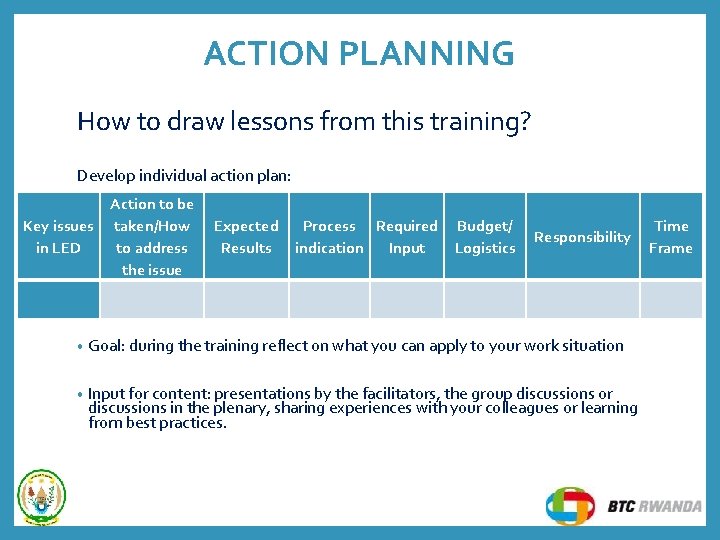
ACTION PLANNING How to draw lessons from this training? Develop individual action plan: Action to be Key issues taken/How in LED to address the issue Expected Process Required Budget/ Results indication Input Logistics Time Frame Responsibility • Goal: during the training reflect on what you can apply to your work situation • Input for content: presentations by the facilitators, the group discussions or discussions in the plenary, sharing experiences with your colleagues or learning from best practices.
SESSION 1 Concept and Meaning of Value Chain and cluster • What is a value chain? • Value chain development and value chain analysis • Meaning of clusters • Value chain approach vs cluster approach
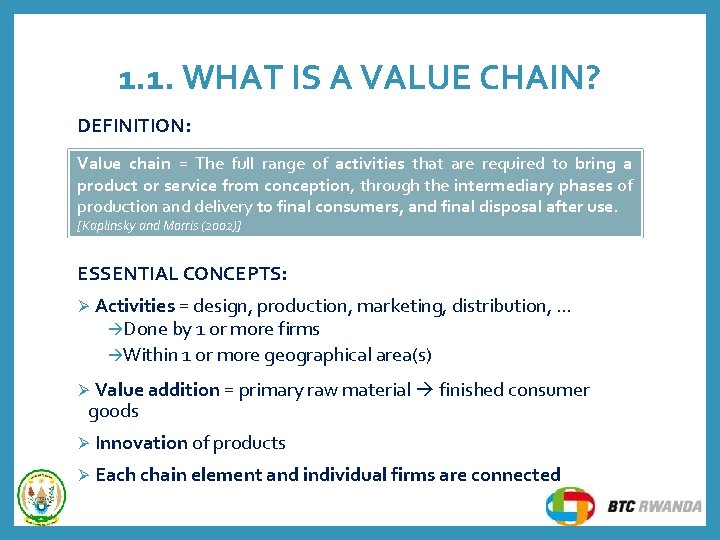
1. 1. WHAT IS A VALUE CHAIN? DEFINITION: Value chain = The full range of activities that are required to bring a product or service from conception, through the intermediary phases of production and delivery to final consumers, and final disposal after use. [Kaplinsky and Morris (2002)] ESSENTIAL CONCEPTS: Ø Activities = design, production, marketing, distribution, … Done by 1 or more firms Within 1 or more geographical area(s) Ø Value addition = primary raw material finished consumer goods Ø Innovation of products Ø Each chain element and individual firms are connected
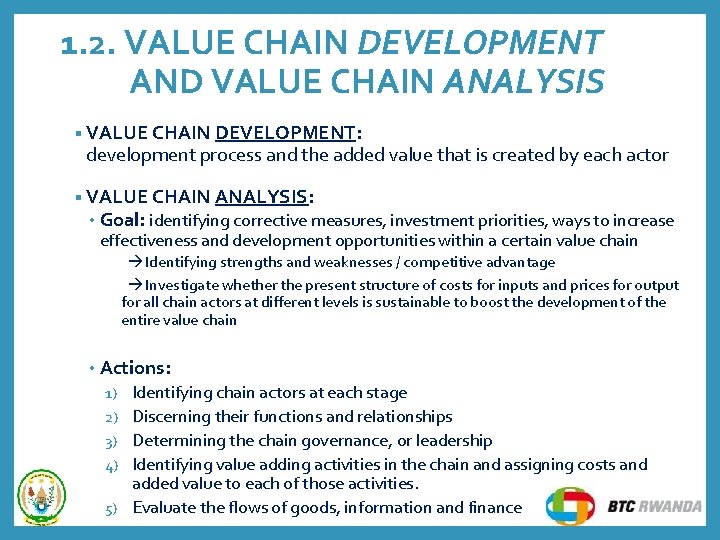
1. 2. VALUE CHAIN DEVELOPMENT AND VALUE CHAIN ANALYSIS § VALUE CHAIN DEVELOPMENT: development process and the added value that is created by each actor § VALUE CHAIN ANALYSIS: • Goal: identifying corrective measures, investment priorities, ways to increase effectiveness and development opportunities within a certain value chain Identifying strengths and weaknesses / competitive advantage Investigate whether the present structure of costs for inputs and prices for output for all chain actors at different levels is sustainable to boost the development of the entire value chain • Actions: 1) 2) 3) 4) 5) Identifying chain actors at each stage Discerning their functions and relationships Determining the chain governance, or leadership Identifying value adding activities in the chain and assigning costs and added value to each of those activities. Evaluate the flows of goods, information and finance
1. 2. VALUE CHAIN DEVELOPMENT AND VALUE CHAIN ANALYSIS Example: Value chain analysis of the dairy sector in Nyagatare Basic analysis on the value chain is possible through mapping Final consumers of Final consumers processed milk Food Manufacturers Whole sale & Retail Transporting & Distribution Shipping & whole sale distribution Brand Development and marketing Locally Brand Development and Export Constituents Diary Processing Local Sales transporting & marketing Manufacture of diary products Extraction of milk constituents Processing raw milk Home Consumption Diary Milking farming Diary Hard Management Animal inputs Pasture inputs Stock & Vet services Land, grass &Infrastructure
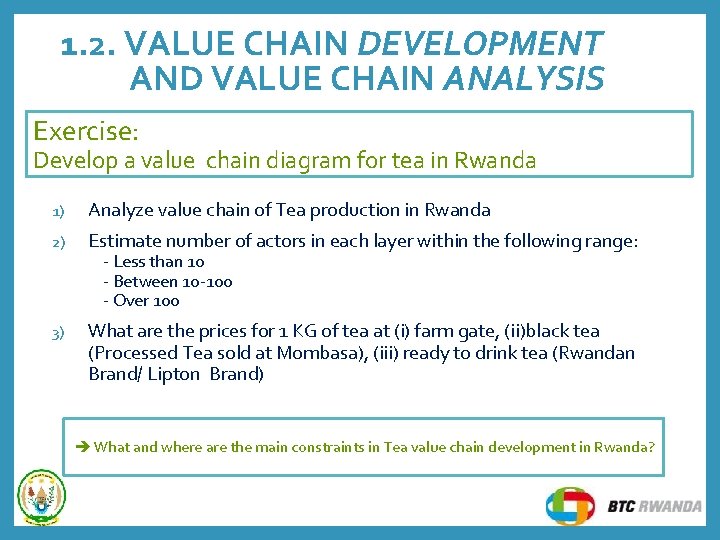
1. 2. VALUE CHAIN DEVELOPMENT AND VALUE CHAIN ANALYSIS Exercise: Develop a value chain diagram for tea in Rwanda 1) Analyze value chain of Tea production in Rwanda 2) Estimate number of actors in each layer within the following range: 3) What are the prices for 1 KG of tea at (i) farm gate, (ii)black tea (Processed Tea sold at Mombasa), (iii) ready to drink tea (Rwandan Brand/ Lipton Brand) - Less than 10 - Between 10 -100 - Over 100 What and where are the main constraints in Tea value chain development in Rwanda?
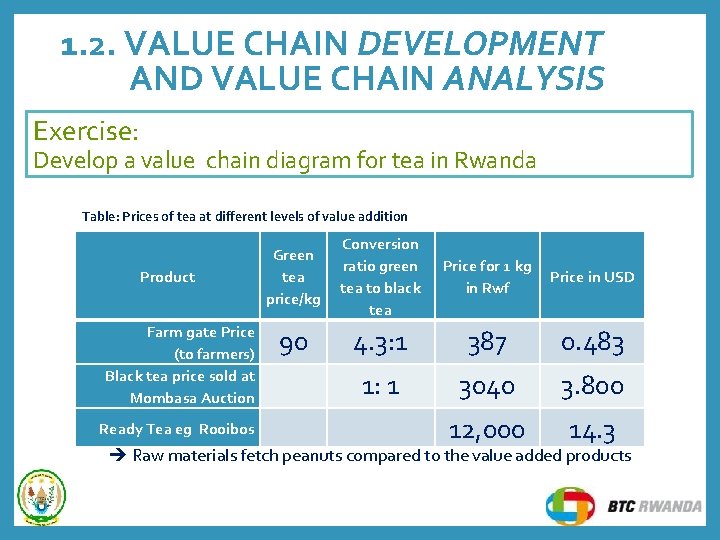
1. 2. VALUE CHAIN DEVELOPMENT AND VALUE CHAIN ANALYSIS Exercise: Develop a value chain diagram for tea in Rwanda Table: Prices of tea at different levels of value addition Green tea price/kg Conversion ratio green tea to black tea Farm gate Price (to farmers) Black tea price sold at Mombasa Auction 90 4. 3: 1 387 0. 483 1: 1 3040 3. 800 Ready Tea eg Rooibos 12, 000 14. 3 Product Price for 1 kg Price in USD in Rwf Raw materials fetch peanuts compared to the value added products
1. 2. VALUE CHAIN DEVELOPMENT AND VALUE CHAIN ANALYSIS Value addition spearheaded by private Sector RMA
1. 3. MEANING OF A CLUSTER Essence of clusters: Ø The companies co-located in a specific geographic region Ø They provide a related group of products and/or services Ø Built on the collaboration to address a common problem Ø Driven by externalities: specialised knowledge, skills, infrastructure and supporting industries Ø Include all stakeholders within a locality Industrial cluster = geographic concentration of firms in the same or related industries Natural agglomerations of micro and small enterprises are common in major cities in Africa
1. 3. MEANING OF A CLUSTER Economic benefits of clusters: Ø Competition and innovation Ø Increase value added (drive innovation & productivity) Ø Stimulate formation of new businesses ( expanding and strengthen the cluster itself) Ø Informal way of organizing independent companies, institutions, governments for mutual competitive advantages Ø More opportunities to better learn and innovate Ø Emergence of public-private partnerships Ø The reputation of a location is enhanced Ø Special economic Zones or Export Processing Zones should be organized around clusters, with governing regulations designed to encourage linkages with the local economy
1. 3. MEANING OF A CLUSTER DEVELOPMENT IN DEVELOPING COUNTRIES Ø Needed to attain middle-income levels Ø Prime tool to increase value added in an economy Ø Upgrade traditional clusters (including agriculture), never abandon them Ø Export growth strategies should focus on widening the subclusters within established clusters, and encouraging the growth of related clusters Ø Every country should seek to enhance the hospitality and tourism cluster because of its multiple beneficial effects on the economy Ø The attraction of FDI should focus on existing and emerging clusters
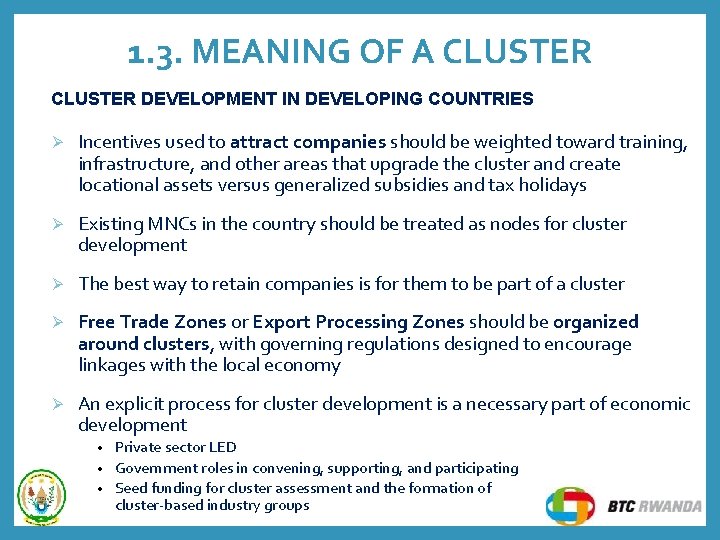
1. 3. MEANING OF A CLUSTER DEVELOPMENT IN DEVELOPING COUNTRIES Ø Incentives used to attract companies should be weighted toward training, infrastructure, and other areas that upgrade the cluster and create locational assets versus generalized subsidies and tax holidays Ø Existing MNCs in the country should be treated as nodes for cluster development Ø The best way to retain companies is for them to be part of a cluster Ø Free Trade Zones or Export Processing Zones should be organized around clusters, with governing regulations designed to encourage linkages with the local economy Ø An explicit process for cluster development is a necessary part of economic development Private sector LED • Government roles in convening, supporting, and participating • Seed funding for cluster assessment and the formation of cluster-based industry groups •
1. 3. MEANING OF A CLUSTER Special Economic Zones (SEZ) in Rwanda Ø Where is Government of Rwanda planning to establish SEZ? Ø What is the economic rationale for establishing Special Economic Zone (SEZ) in Rwanda? Ø What are similarities and differences between SEZ and Clusters
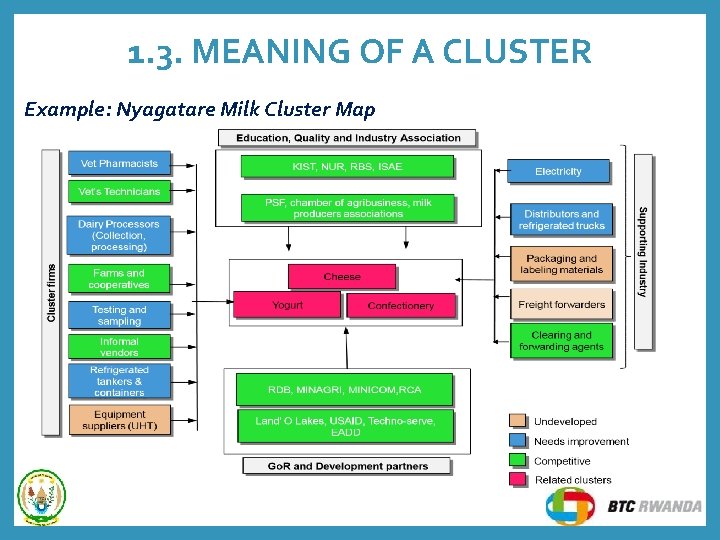
1. 3. MEANING OF A CLUSTER Example: Nyagatare Milk Cluster Map
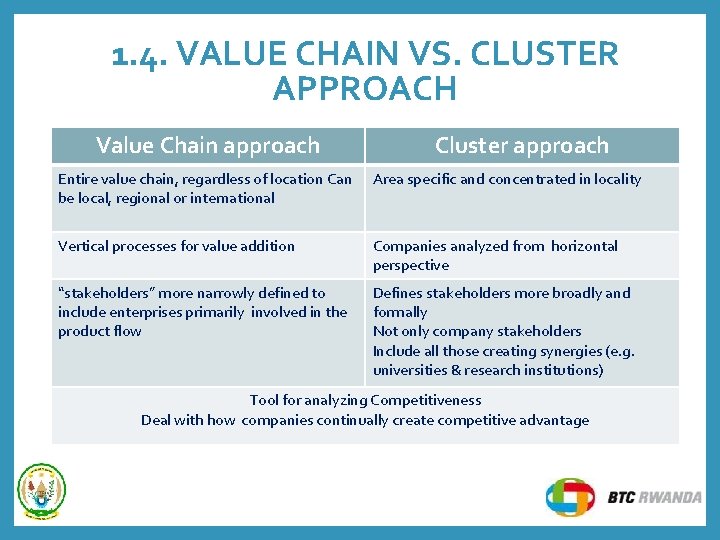
1. 4. VALUE CHAIN VS. CLUSTER APPROACH Value Chain approach Cluster approach Entire value chain, regardless of location Can be local, regional or international Area specific and concentrated in locality Vertical processes for value addition Companies analyzed from horizontal perspective “stakeholders” more narrowly defined to include enterprises primarily involved in the product flow Defines stakeholders more broadly and formally Not only company stakeholders Include all those creating synergies (e. g. universities & research institutions) Tool for analyzing Competitiveness Deal with how companies continually create competitive advantage
SESSION 2 Value chain development • Meaning of value chain development • Vertical and horizontal integration • Drivers of productivity and development • Link with market systems
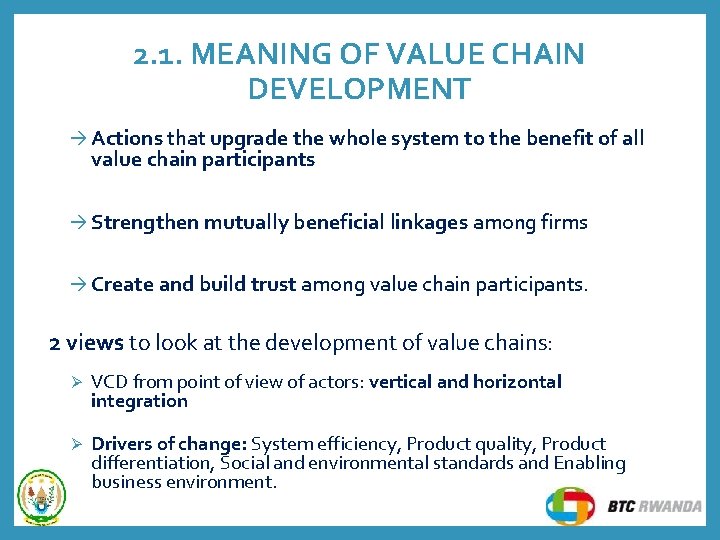
2. 1. MEANING OF VALUE CHAIN DEVELOPMENT Actions that upgrade the whole system to the benefit of all value chain participants Strengthen mutually beneficial linkages among firms Create and build trust among value chain participants. 2 views to look at the development of value chains: Ø VCD from point of view of actors: vertical and horizontal integration Ø Drivers of change: System efficiency, Product quality, Product differentiation, Social and environmental standards and Enabling business environment.
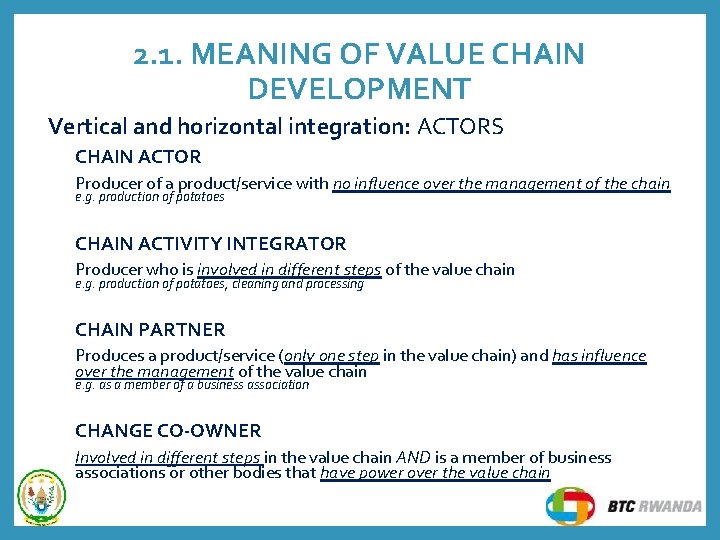
2. 1. MEANING OF VALUE CHAIN DEVELOPMENT Vertical and horizontal integration: ACTORS CHAIN ACTOR Producer of a product/service with no influence over the management of the chain e. g. production of potatoes CHAIN ACTIVITY INTEGRATOR Producer who is involved in different steps of the value chain e. g. production of potatoes, cleaning and processing CHAIN PARTNER Produces a product/service (only one step in the value chain) and has influence over the management of the value chain e. g. as a member of a business association CHANGE CO-OWNER Involved in different steps in the value chain AND is a member of business associations or other bodies that have power over the value chain 22
2. 1. MEANING OF VALUE CHAIN DEVELOPMENT Vertical and horizontal integration Vertical integration (activities) Farmers do not participate in chain management Farmers do many chain activities CHAIN ACTIVITY INTEGRATOR CHAIN COOWNER CHAIN ACTOR CHAIN PARTNER Farmers specialised in production Source: Adapted from Chain Empowerment, Supporting African farmers to develop markets. Royal Tropical Institute, Netherlands Farmers participate in chain management Horizontal integration (management)
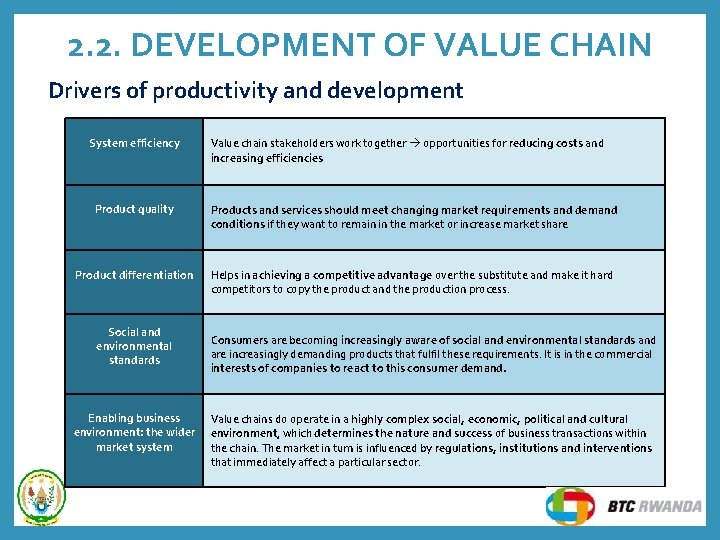
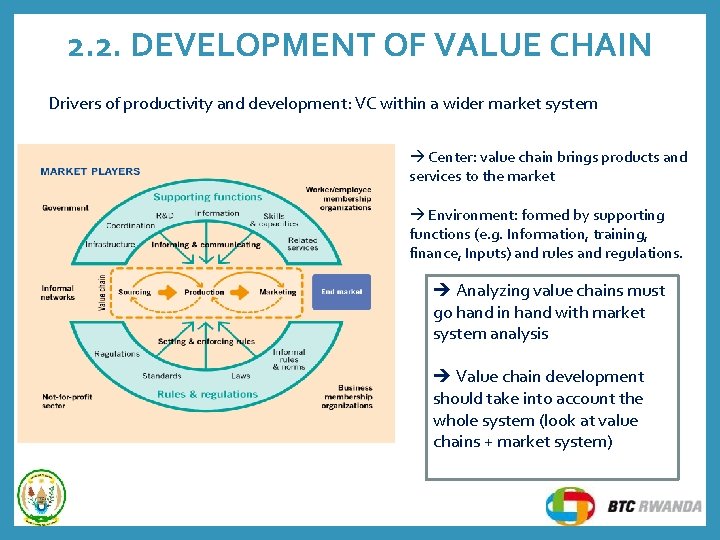
2. 2. DEVELOPMENT OF VALUE CHAIN Drivers of productivity and development System efficiency Value chain stakeholders work together opportunities for reducing costs and increasing efficiencies Product quality Products and services should meet changing market requirements and demand conditions if they want to remain in the market or increase market share Product differentiation Helps in achieving a competitive advantage over the substitute and make it hard competitors to copy the product and the production process. Social and environmental standards Enabling business environment: the wider market system Consumers are becoming increasingly aware of social and environmental standards and are increasingly demanding products that fulfil these requirements. It is in the commercial interests of companies to react to this consumer demand. Value chains do operate in a highly complex social, economic, political and cultural environment, which determines the nature and success of business transactions within the chain. The market in turn is influenced by regulations, institutions and interventions that immediately affect a particular sector.
2. 2. DEVELOPMENT OF VALUE CHAIN Drivers of productivity and development: VC within a wider market system Center: value chain brings products and services to the market Environment: formed by supporting functions (e. g. Information, training, finance, Inputs) and rules and regulations. Analyzing value chains must go hand in hand with market system analysis Value chain development should take into account the whole system (look at value chains + market system)
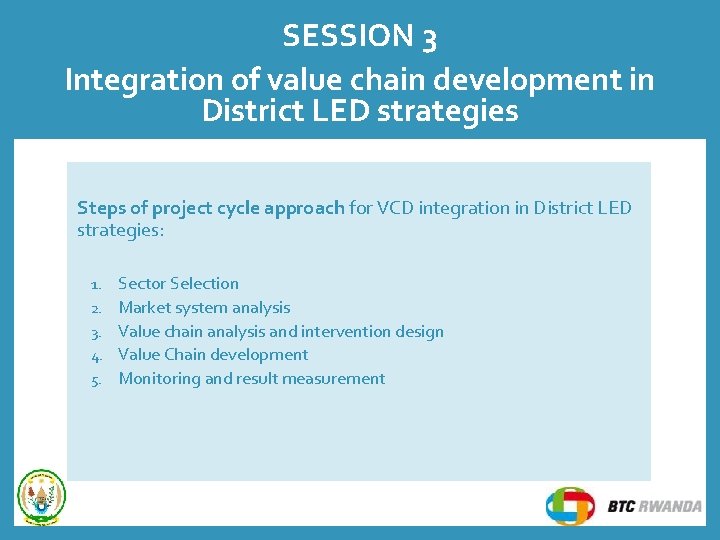
SESSION 3 Integration of value chain development in District LED strategies Steps of project cycle approach for VCD integration in District LED strategies: 1. 2. 3. 4. 5. Sector Selection Market system analysis Value chain analysis and intervention design Value Chain development Monitoring and result measurement
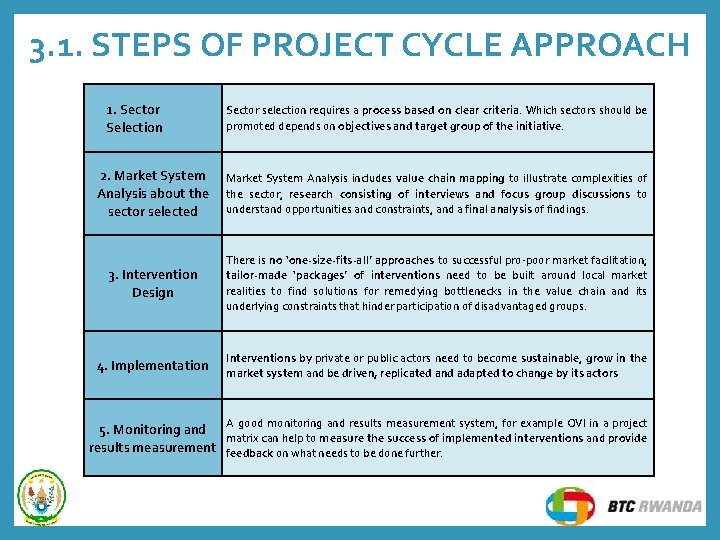
3. 1. STEPS OF PROJECT CYCLE APPROACH 1. Sector Selection Sector selection requires a process based on clear criteria. Which sectors should be promoted depends on objectives and target group of the initiative. 2. Market System Analysis about the sector selected Market System Analysis includes value chain mapping to illustrate complexities of the sector, research consisting of interviews and focus group discussions to understand opportunities and constraints, and a final analysis of findings. 3. Intervention Design There is no ‘one-size-fits-all’ approaches to successful pro-poor market facilitation; tailor-made ‘packages’ of interventions need to be built around local market realities to find solutions for remedying bottlenecks in the value chain and its underlying constraints that hinder participation of disadvantaged groups. 4. Implementation Interventions by private or public actors need to become sustainable, grow in the market system and be driven, replicated and adapted to change by its actors A good monitoring and results measurement system, for example OVI in a project 5. Monitoring and matrix can help to measure the success of implemented interventions and provide results measurement feedback on what needs to be done further.
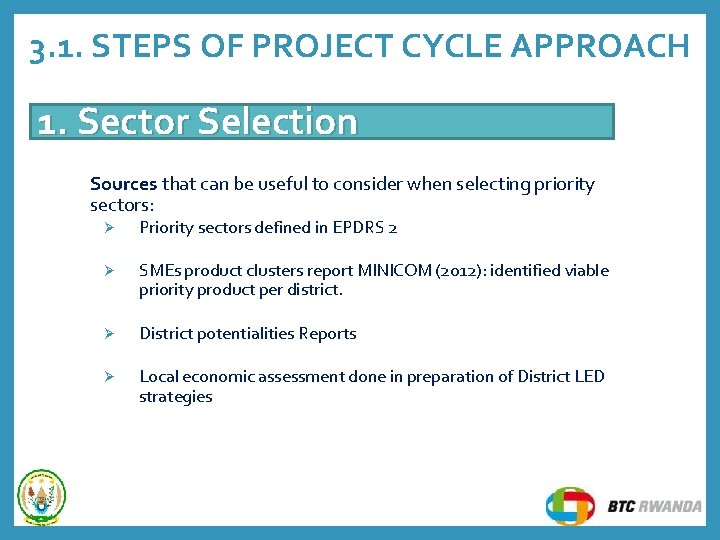
3. 1. STEPS OF PROJECT CYCLE APPROACH 1. Sector Selection Sources that can be useful to consider when selecting priority sectors: Ø Priority sectors defined in EPDRS 2 Ø SMEs product clusters report MINICOM (2012): identified viable priority product per district. Ø District potentialities Reports Ø Local economic assessment done in preparation of District LED strategies
3. 1. STEPS OF PROJECT CYCLE APPROACH 2. Market system analysis and value chain mapping Value chain research team: initial research + initial value chain map Economic assessment takes place before selection of sector Market system analysis targets the selected sectors/value chains to invest in Components of MARKET SYSTEM ANALYIS: - Value chain mapping - Value chain research - Value chain analysis identify categorize key market players & supporting organizations & different market channels
3. 1. STEPS OF PROJECT CYCLE APPROACH 2. Market system analysis and value chain mapping VALUE CHAIN MAPPING Ø Tool to illustrate complexities of sectors and value chains Ø Visual representation of connections between businesses, supporting organizations and other market players Ø Illustrate and understand processes Ø Identifying key market players Ø Illustrate different market channels Ø Map value chains beyond border
3. 1. STEPS OF PROJECT CYCLE APPROACH 3. Value chain analysis and intervention design Market system analysis + value chain mapping NEXT STEP: VALUE CHAIN ANALYSIS + INTERVENTION DESIGN OUTCOMES VALUE CHAIN ANALYSIS: 1. 2. 3. Clear vision for systemic chain and sustainability An intervention framework: outlines possible upgrading strategies and interventions Documentation of research, analysis and findings clear strategy on how to involve key market players and ensure market up-take for wider change
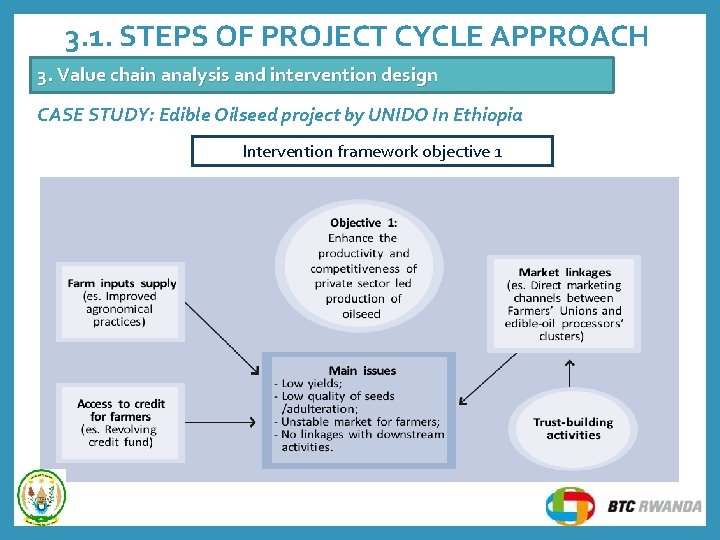
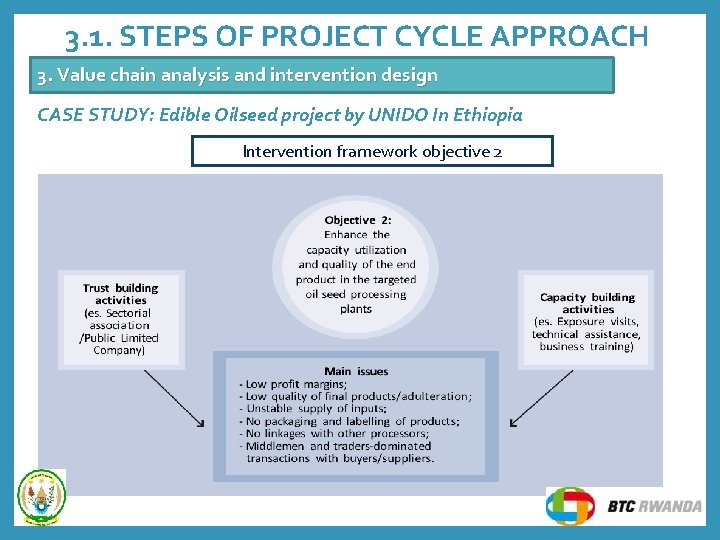
3. 1. STEPS OF PROJECT CYCLE APPROACH 3. Value chain analysis and intervention design CASE STUDY: Edible Oilseed project by UNIDO In Ethiopia Pilot project conducted jointly by UNIDO, FAO and ILO in Ethiopia focusing on value chain development of the Ethiopian ed ible oil sector (niger seeds and linseed) GENERAL STRATEGY Addressing bottlenecks affecting different levels of the value chain: Raw materials production • Processing capacity • Quality of the final product • Marketing channels • OBJECTIVES 1. 2. 3. Boost productivity and competitiveness of private sector led agricultural production of oilseed Capacity utilization and quality of the end product in the targeted oil seed processing plants was addressed as follows. Improved access to local and international markets for edible oil producers
3. 1. STEPS OF PROJECT CYCLE APPROACH 3. Value chain analysis and intervention design CASE STUDY: Edible Oilseed project by UNIDO In Ethiopia Intervention framework objective 1
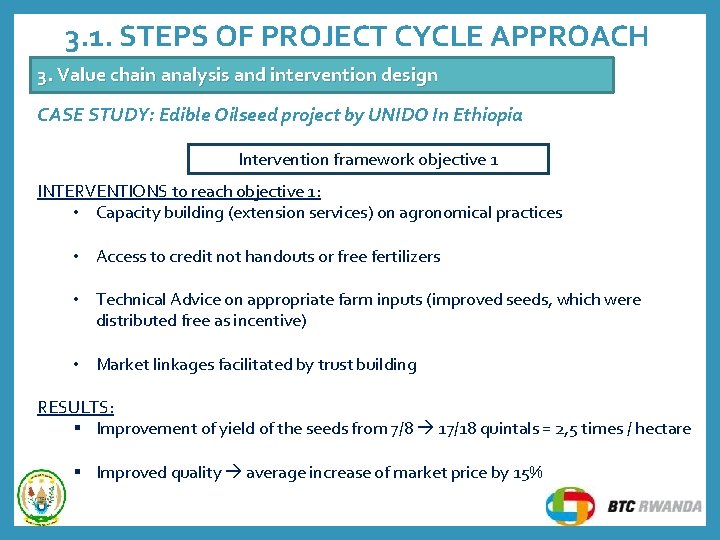
3. 1. STEPS OF PROJECT CYCLE APPROACH 3. Value chain analysis and intervention design CASE STUDY: Edible Oilseed project by UNIDO In Ethiopia Intervention framework objective 1 INTERVENTIONS to reach objective 1: • Capacity building (extension services) on agronomical practices • Access to credit not handouts or free fertilizers • Technical Advice on appropriate farm inputs (improved seeds, which were distributed free as incentive) • Market linkages facilitated by trust building RESULTS: § Improvement of yield of the seeds from 7/8 17/18 quintals = 2, 5 times / hectare § Improved quality average increase of market price by 15%
3. 1. STEPS OF PROJECT CYCLE APPROACH 3. Value chain analysis and intervention design CASE STUDY: Edible Oilseed project by UNIDO In Ethiopia Intervention framework objective 2
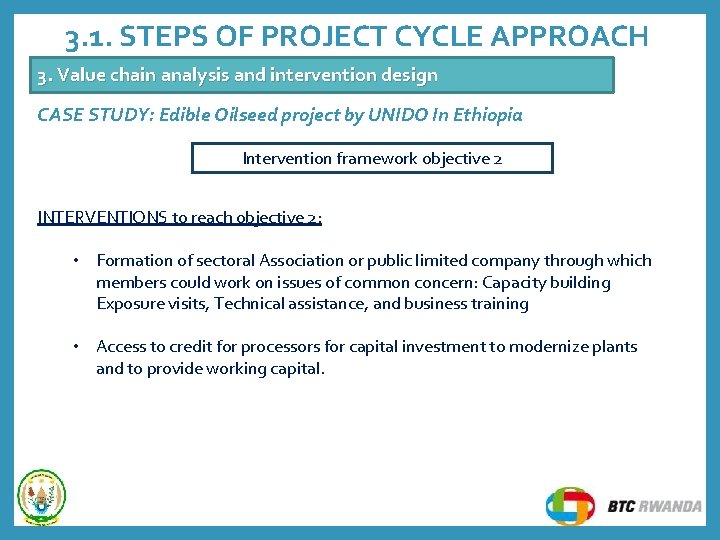
3. 1. STEPS OF PROJECT CYCLE APPROACH 3. Value chain analysis and intervention design CASE STUDY: Edible Oilseed project by UNIDO In Ethiopia Intervention framework objective 2 INTERVENTIONS to reach objective 2: • Formation of sectoral Association or public limited company through which members could work on issues of common concern: Capacity building Exposure visits, Technical assistance, and business training • Access to credit for processors for capital investment to modernize plants and to provide working capital.
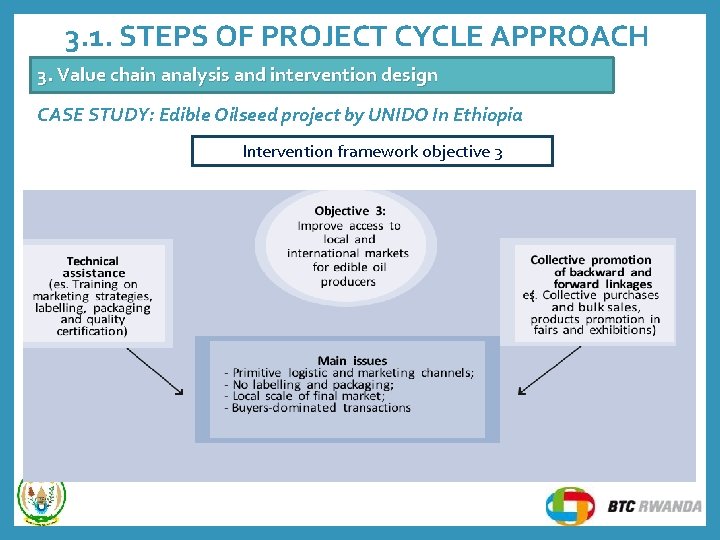
3. 1. STEPS OF PROJECT CYCLE APPROACH 3. Value chain analysis and intervention design CASE STUDY: Edible Oilseed project by UNIDO In Ethiopia Intervention framework objective 3
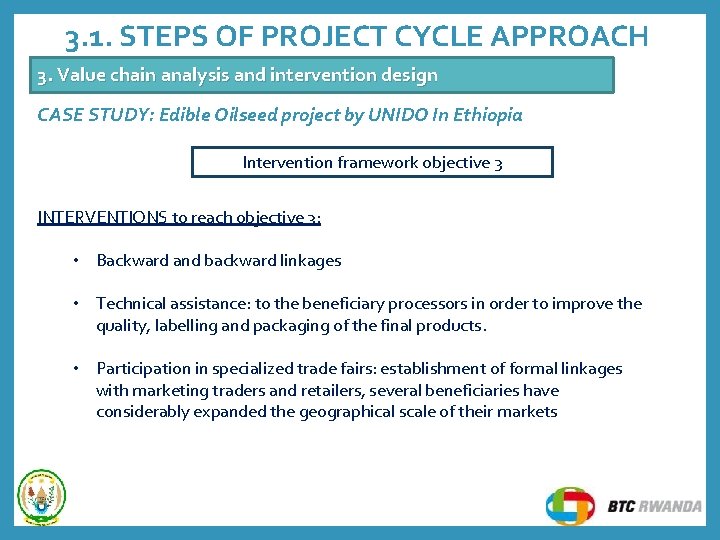
3. 1. STEPS OF PROJECT CYCLE APPROACH 3. Value chain analysis and intervention design CASE STUDY: Edible Oilseed project by UNIDO In Ethiopia Intervention framework objective 3 INTERVENTIONS to reach objective 3: • Backward and backward linkages • Technical assistance: to the beneficiary processors in order to improve the quality, labelling and packaging of the final products. • Participation in specialized trade fairs: establishment of formal linkages with marketing traders and retailers, several beneficiaries have considerably expanded the geographical scale of their markets
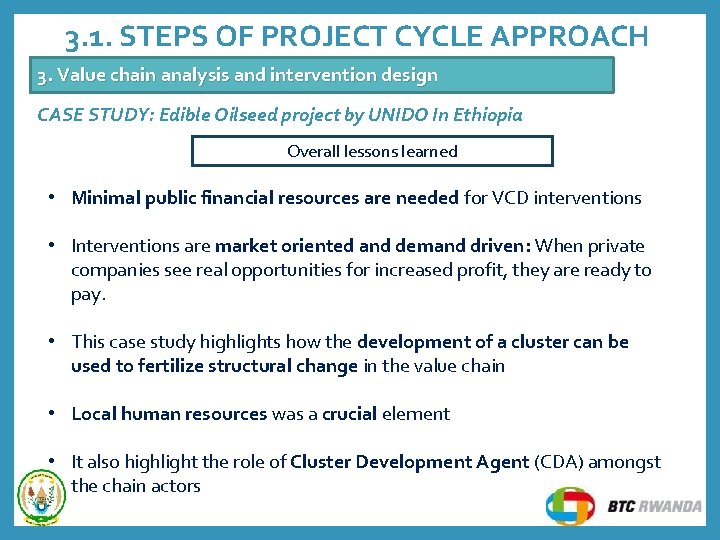
3. 1. STEPS OF PROJECT CYCLE APPROACH 3. Value chain analysis and intervention design CASE STUDY: Edible Oilseed project by UNIDO In Ethiopia Overall lessons learned • Minimal public financial resources are needed for VCD interventions • Interventions are market oriented and demand driven: When private companies see real opportunities for increased profit, they are ready to pay. • This case study highlights how the development of a cluster can be used to fertilize structural change in the value chain • Local human resources was a crucial element • It also highlight the role of Cluster Development Agent (CDA) amongst the chain actors
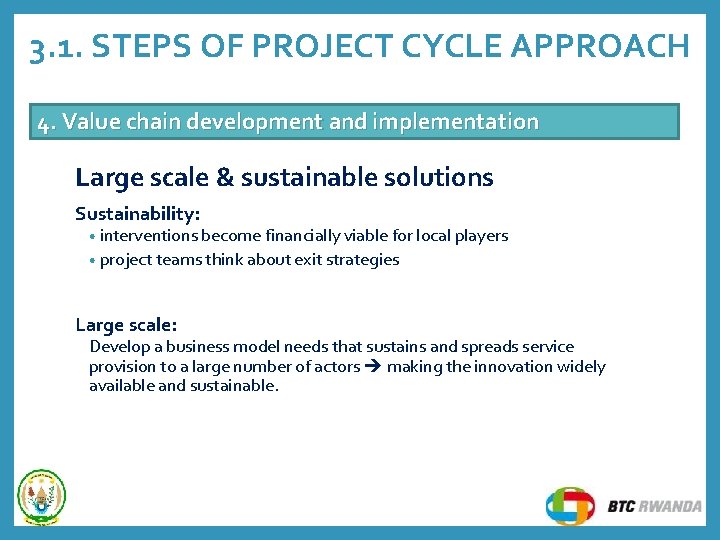
3. 1. STEPS OF PROJECT CYCLE APPROACH 4. Value chain development and implementation Large scale & sustainable solutions Sustainability: • interventions become financially viable for local players • project teams think about exit strategies Large scale: Develop a business model needs that sustains and spreads service provision to a large number of actors making the innovation widely available and sustainable.
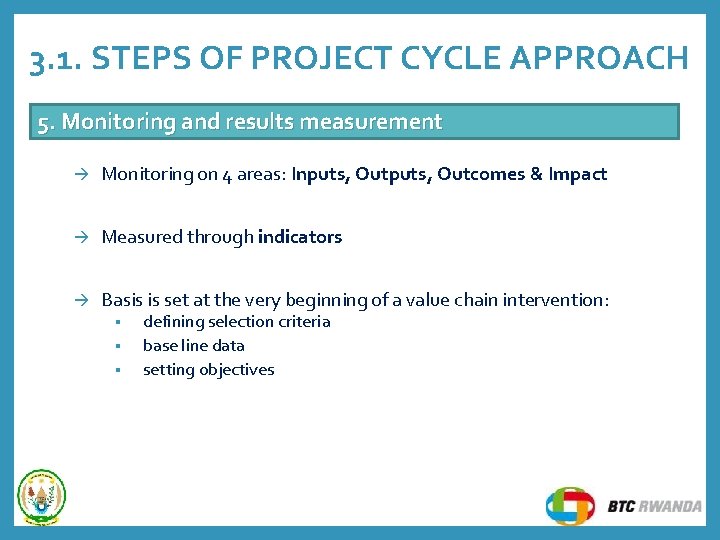
3. 1. STEPS OF PROJECT CYCLE APPROACH 5. Monitoring and results measurement Monitoring on 4 areas: Inputs, Outcomes & Impact Measured through indicators Basis is set at the very beginning of a value chain intervention: § § § defining selection criteria base line data setting objectives
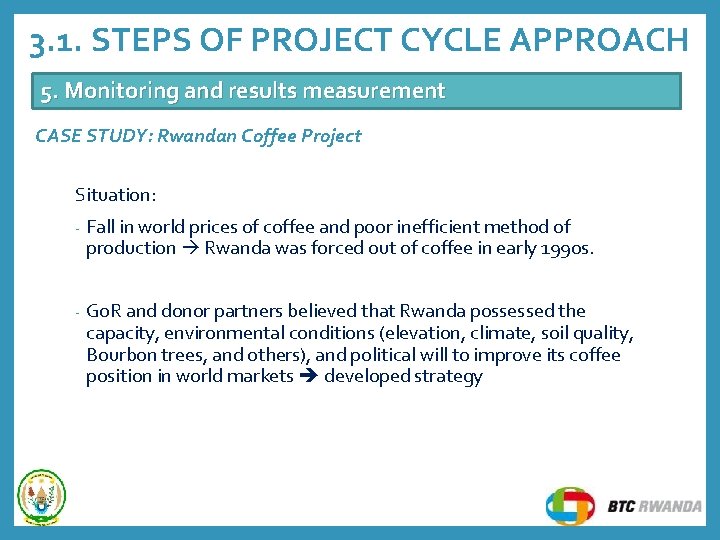
3. 1. STEPS OF PROJECT CYCLE APPROACH 5. Monitoring and results measurement CASE STUDY: Rwandan Coffee Project Situation: - Fall in world prices of coffee and poor inefficient method of production Rwanda was forced out of coffee in early 1990 s. - Go. R and donor partners believed that Rwanda possessed the capacity, environmental conditions (elevation, climate, soil quality, Bourbon trees, and others), and political will to improve its coffee position in world markets developed strategy
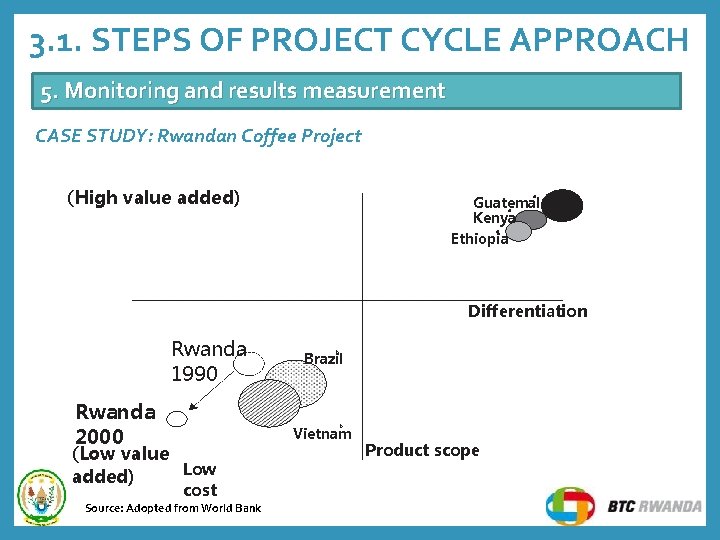
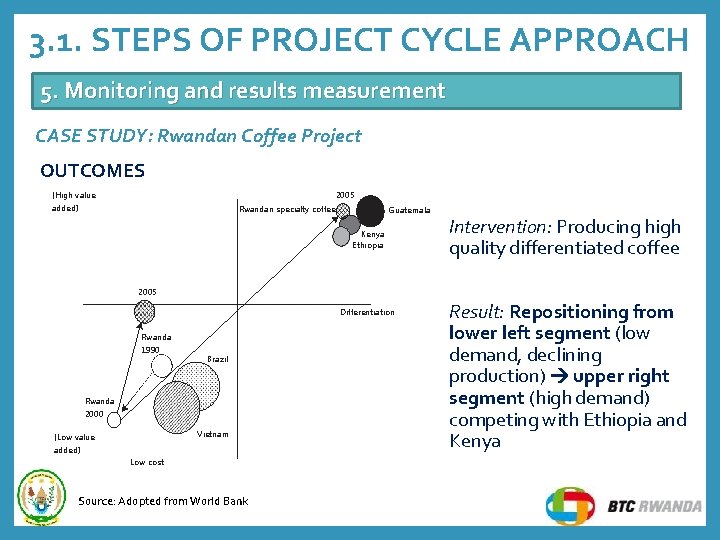
3. 1. STEPS OF PROJECT CYCLE APPROACH 5. Monitoring and results measurement CASE STUDY: Rwandan Coffee Project (High value added) a Guatemala a Kenya a Ethiopia Differentiation Rwanda 1990 Rwanda 2000 b Brazil b (Low value Low added) cost Source: Adopted from World Bank Vietnam Product scope
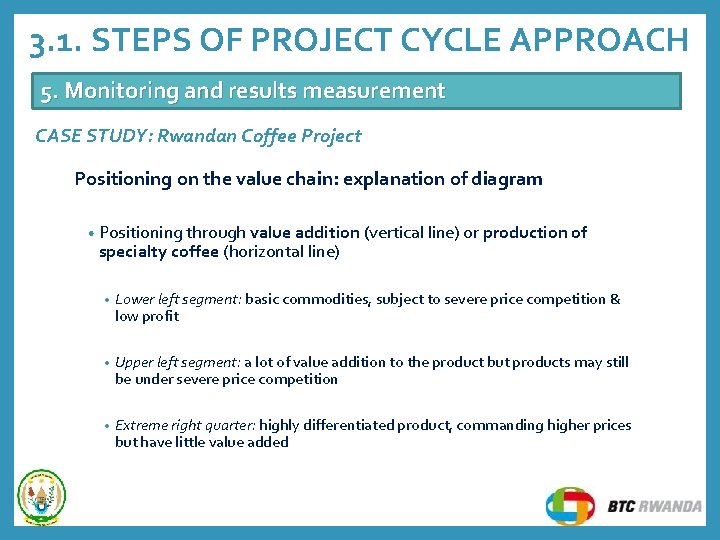
3. 1. STEPS OF PROJECT CYCLE APPROACH 5. Monitoring and results measurement CASE STUDY: Rwandan Coffee Project Positioning on the value chain: explanation of diagram • Positioning through value addition (vertical line) or production of specialty coffee (horizontal line) • Lower left segment: basic commodities, subject to severe price competition & low profit • Upper left segment: a lot of value addition to the product but products may still be under severe price competition • Extreme right quarter: highly differentiated product, commanding higher prices but have little value added
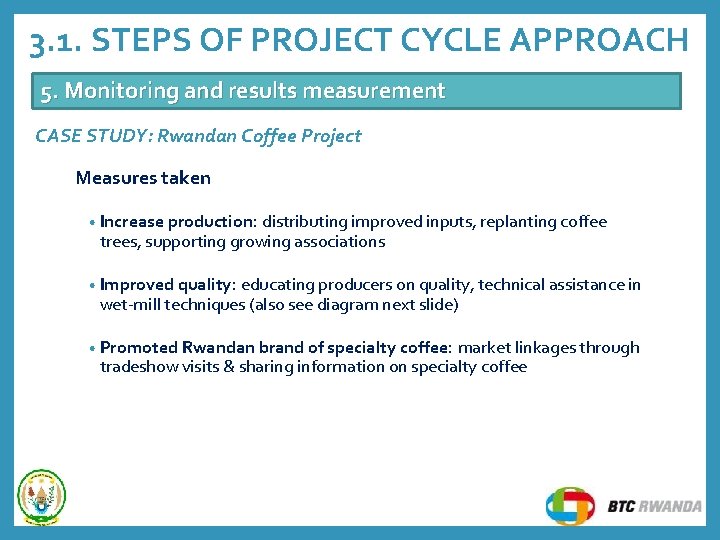
3. 1. STEPS OF PROJECT CYCLE APPROACH 5. Monitoring and results measurement CASE STUDY: Rwandan Coffee Project Measures taken • Increase production: distributing improved inputs, replanting coffee trees, supporting growing associations • Improved quality: educating producers on quality, technical assistance in wet-mill techniques (also see diagram next slide) • Promoted Rwandan brand of specialty coffee: market linkages through tradeshow visits & sharing information on specialty coffee
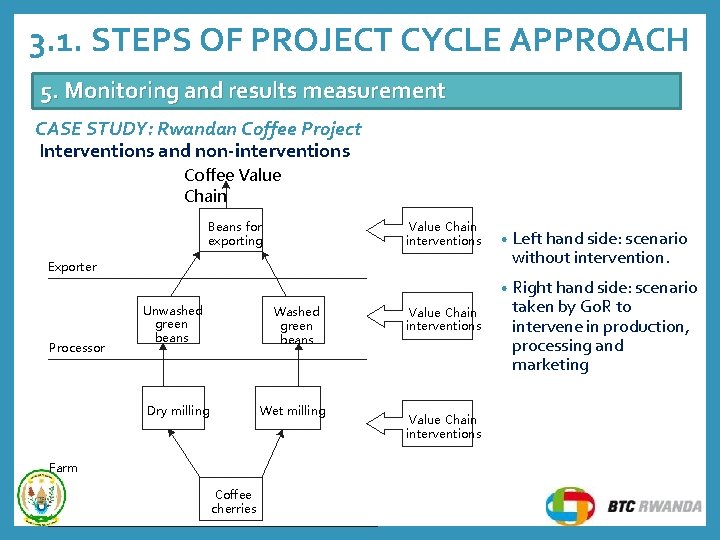
3. 1. STEPS OF PROJECT CYCLE APPROACH 5. Monitoring and results measurement CASE STUDY: Rwandan Coffee Project Interventions and non-interventions Coffee Value Chain Beans for exporting Value Chain interventions Exporter • Left hand side: scenario without intervention. • Right hand side: scenario Processor Unwashed green beans Washed green beans Dry milling Wet milling Farm Coffee cherries Value Chain interventions taken by Go. R to intervene in production, processing and marketing
3. 1. STEPS OF PROJECT CYCLE APPROACH 5. Monitoring and results measurement CASE STUDY: Rwandan Coffee Project OUTCOMES ( High value 2005 added) Rwandan specialty coffee Guatemala Kenya Ethiopia Intervention: Producing high quality differentiated coffee 2005 Differentiation Rwanda 1990 Brazil Rwanda 2000 Vietnam (Low value added) Low cost Source: Adopted from World Bank Result: Repositioning from lower left segment (low demand, declining production) upper right segment (high demand) competing with Ethiopia and Kenya
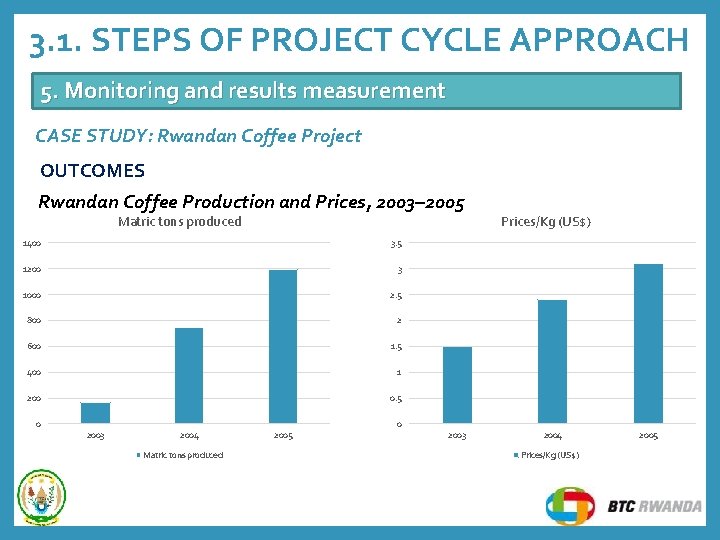
3. 1. STEPS OF PROJECT CYCLE APPROACH 5. Monitoring and results measurement CASE STUDY: Rwandan Coffee Project OUTCOMES Rwandan Coffee Production and Prices, 2003– 2005 Matric tons produced 1400 3. 5 1200 3 1000 2. 5 800 2 600 1. 5 400 1 200 0. 5 0 2003 2004 Matric tons produced 2005 0 2003 Prices/Kg (US$) 2004 Prices/Kg (US$) 2005
3. 1. STEPS OF PROJECT CYCLE APPROACH 5. Monitoring and results measurement CASE STUDY: Rwandan Coffee Project Lessons learned: Ø The interventions revitalized the coffee industry in Rwanda + improved earning potential of small growers Ø Challenge is to focus on value addition of specialty coffee towards most profitable position “competitiveness nirvana” Ø Though a national project, Districts with good potential can strategize to seize opportunities to tap from such national intervention.
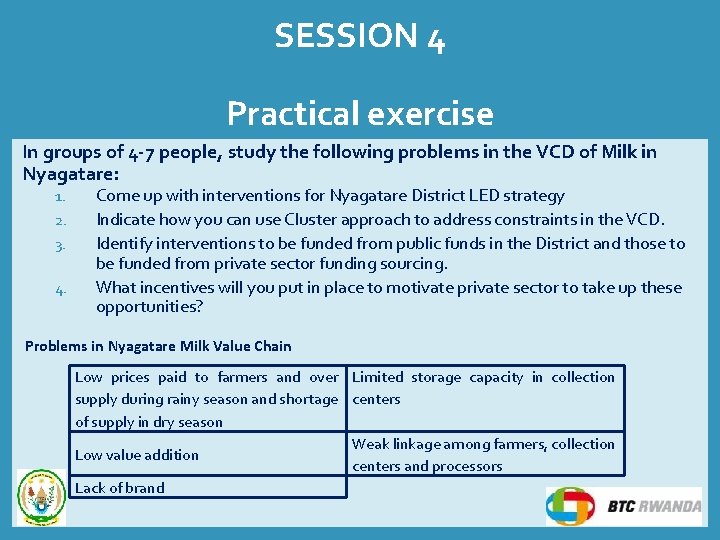
SESSION 4 Practical exercise In groups of 4 -7 people, study the following problems in the VCD of Milk in Nyagatare: 1. 2. 3. 4. Come up with interventions for Nyagatare District LED strategy Indicate how you can use Cluster approach to address constraints in the VCD. Identify interventions to be funded from public funds in the District and those to be funded from private sector funding sourcing. What incentives will you put in place to motivate private sector to take up these opportunities? Problems in Nyagatare Milk Value Chain Low prices paid to farmers and over Limited storage capacity in collection supply during rainy season and shortage centers of supply in dry season Weak linkage among farmers, collection Low value addition centers and processors Lack of brand
SESSION 5 Applicability of value chain and cluster development to Rwanda • Value addition in Rwanda • Types of clusters • Value chain development model
5. 1. THE CASE FOR VALUE ADDITION Primary products fetch peanuts compared to value added products from these raw materials Opportunities through VCA in up-stream market Consider options to bring upstream value addition elements into the local economy Create jobs and enhance earnings from its raw products
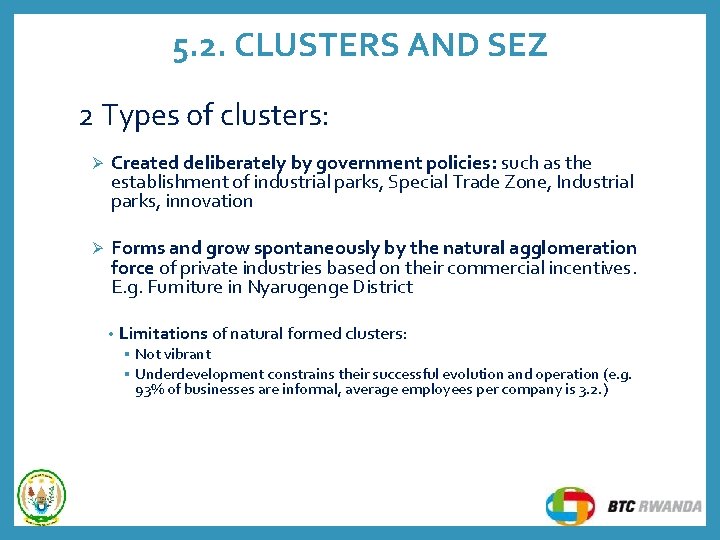
5. 2. CLUSTERS AND SEZ 2 Types of clusters: Ø Created deliberately by government policies: such as the establishment of industrial parks, Special Trade Zone, Industrial parks, innovation Ø Forms and grow spontaneously by the natural agglomeration force of private industries based on their commercial incentives. E. g. Furniture in Nyarugenge District • Limitations of natural formed clusters: § § Not vibrant Underdevelopment constrains their successful evolution and operation (e. g. 93% of businesses are informal, average employees per company is 3. 2. )
5. 2. CLUSTERS AND SEZ - 93% of Businesses in Rwanda Are Informal - Fewer Formal Businesses Outside Kigali Percent Formal Enterprises 25 20 15 10 5 SOURCE: Rwanda Establishment Census, 2014 M uh an ga nz e us a M Ny ag at ar e vu ba Ru i Ru siz Hu ye ro ki cu Ki bo sa Ga Ny ar ug en ge 0
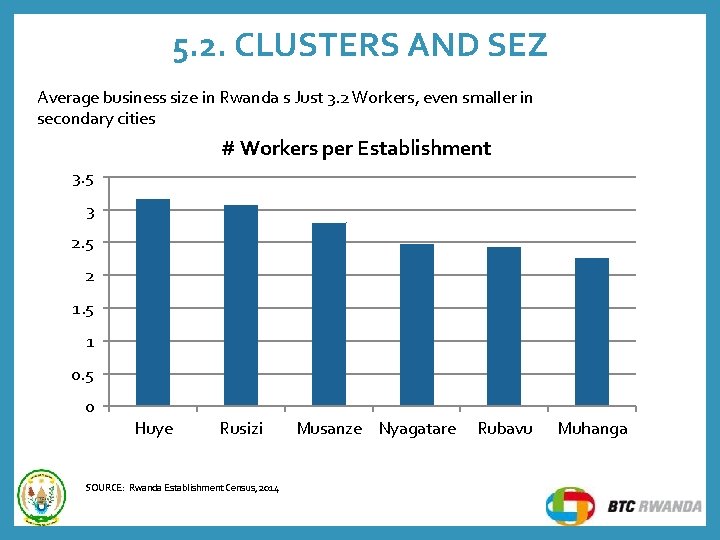
5. 2. CLUSTERS AND SEZ Average business size in Rwanda s Just 3. 2 Workers, even smaller in secondary cities # Workers per Establishment 3. 5 3 2. 5 2 1. 5 1 0. 5 0 Huye Rusizi SOURCE: Rwanda Establishment Census, 2014 Musanze Nyagatare Rubavu Muhanga
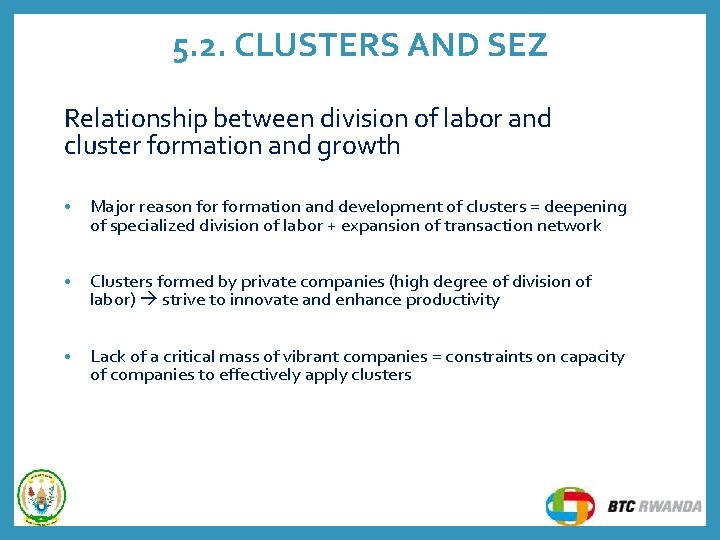
5. 2. CLUSTERS AND SEZ Relationship between division of labor and cluster formation and growth • Major reason formation and development of clusters = deepening of specialized division of labor + expansion of transaction network • Clusters formed by private companies (high degree of division of labor) strive to innovate and enhance productivity • Lack of a critical mass of vibrant companies = constraints on capacity of companies to effectively apply clusters
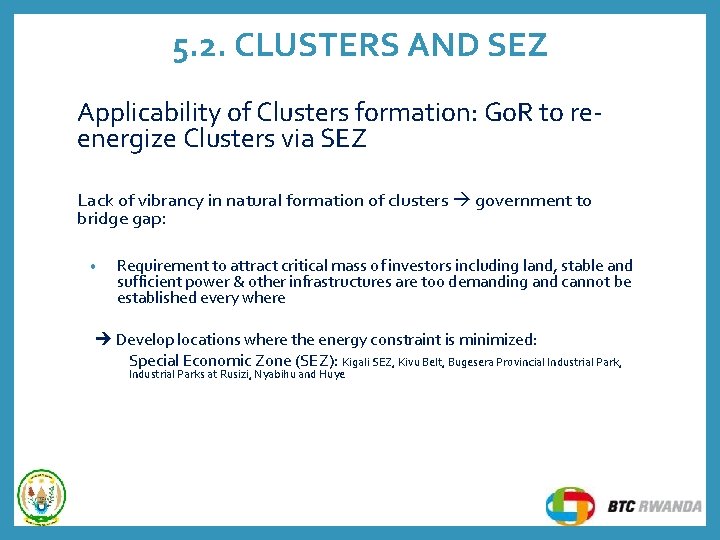
5. 2. CLUSTERS AND SEZ Applicability of Clusters formation: Go. R to reenergize Clusters via SEZ Lack of vibrancy in natural formation of clusters government to bridge gap: • Requirement to attract critical mass of investors including land, stable and sufficient power & other infrastructures are too demanding and cannot be established every where Develop locations where the energy constraint is minimized: Special Economic Zone (SEZ): Kigali SEZ, Kivu Belt, Bugesera Provincial Industrial Park, Industrial Parks at Rusizi, Nyabihu and Huye
5. 3. VALUE CHAIN DEVELOPMENT IN RWANDA Ø Value Chain and Cluster models: successfully used as intervention strategies/tools to improve productivity Ø Examples of successful VCD projects Value Chain Strategies for Market Repositioning for competitiveness for Rwandan coffee • The USAID project on Competitiveness and Policy Program (CPP) in the Dominican Republic through value chains and the cluster approach for mango export. • The UNIDO intervene in the Edible-Oil Value Chain in Ethiopia • Ø When opportunities are presented to private companies, they are willing to pay Possibility to fund interventions largely by private sector funding = cost effective Remains important to include some small incentives e. g. free seeds to farmers
5. 3. VALUE CHAIN DEVELOPMENT IN RWANDA Districts should initiate VCD projects • Most of the examples: initiated and funded by development agencies • Technical capacity important for local entities to initiate VCD: Ø Come up with appropriate designs Ø correct targets for interventions
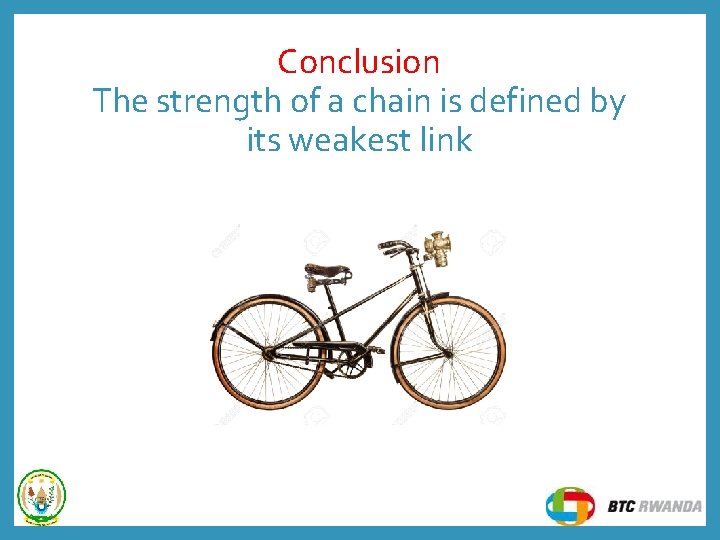
Conclusion The strength of a chain is defined by its weakest link