Whats Eating You Food Chain Unit Savanna Hazelrigg

- Slides: 17
What’s Eating You? Food Chain Unit Savanna Hazelrigg, Hilary Miles, Julie Parker , and Allison Spencer
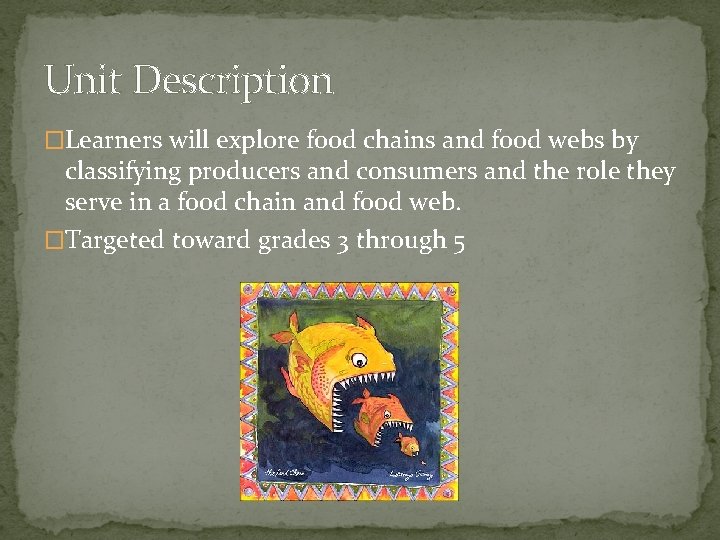
Unit Description �Learners will explore food chains and food webs by classifying producers and consumers and the role they serve in a food chain and food web. �Targeted toward grades 3 through 5
Grade Level Expectations � 3 rd Grade: 4. A. a Identify sunlight as the primary source of energy plants use to produce their own food. 4. A. b Classify populations of organisms as producers or consumers by the role they serve in the ecosystem. 4. A. c Sequence the flow of energy through a food chain beginning with the Sun. 4. A. d Predict the possible effects of removing an organism from a food chain.
Grade Level Expectations � 4 th Grade: 4. A. a Classify populations of organisms as producers or consumers by the role they serve in the ecosystem. 4. A. b Differentiate between the types of consumers (herbivore, carnivore, omnivore, and detrivore/decomposer).
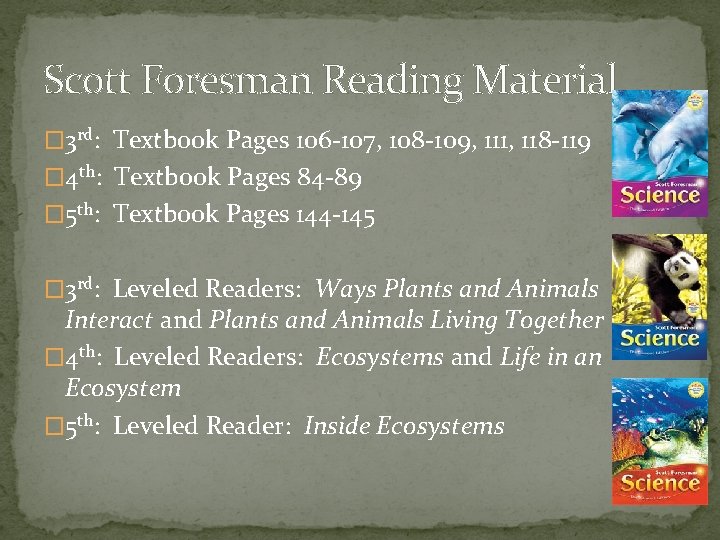
Scott Foresman Reading Material � 3 rd: Textbook Pages 106 -107, 108 -109, 111, 118 -119 � 4 th: Textbook Pages 84 -89 � 5 th: Textbook Pages 144 -145 � 3 rd: Leveled Readers: Ways Plants and Animals Interact and Plants and Animals Living Together � 4 th: Leveled Readers: Ecosystems and Life in an Ecosystem � 5 th: Leveled Reader: Inside Ecosystems
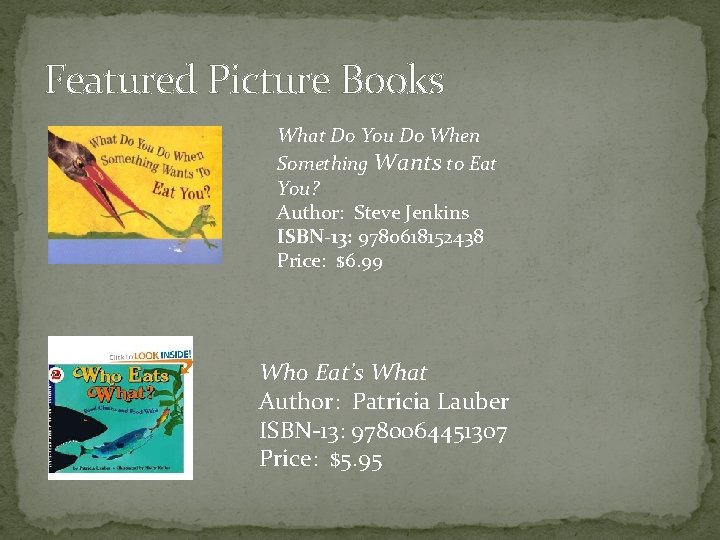
Featured Picture Books What Do You Do When Something Wants to Eat You? Author: Steve Jenkins ISBN-13: 9780618152438 Price: $6. 99 Who Eat’s What Author: Patricia Lauber ISBN-13: 9780064451307 Price: $5. 95
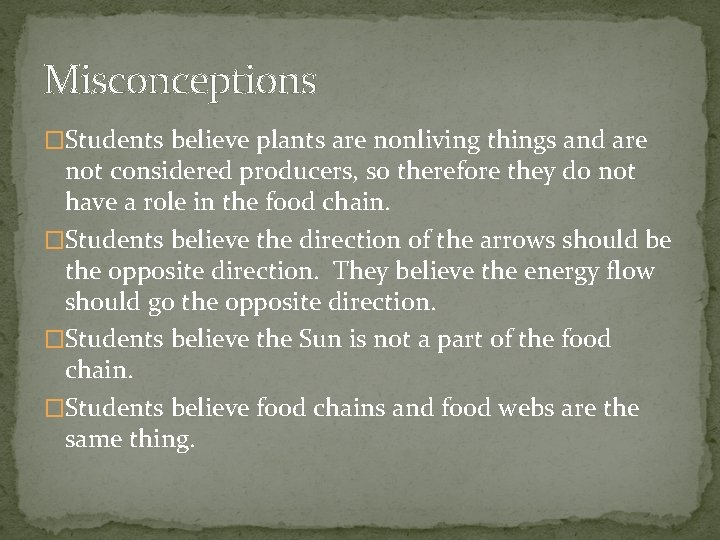
Misconceptions �Students believe plants are nonliving things and are not considered producers, so therefore they do not have a role in the food chain. �Students believe the direction of the arrows should be the opposite direction. They believe the energy flow should go the opposite direction. �Students believe the Sun is not a part of the food chain. �Students believe food chains and food webs are the same thing.
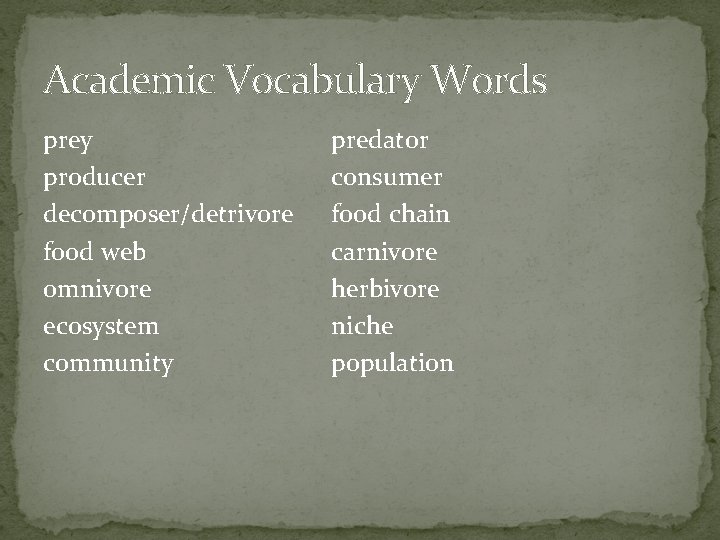
Academic Vocabulary Words prey producer decomposer/detrivore food web omnivore ecosystem community predator consumer food chain carnivore herbivore niche population
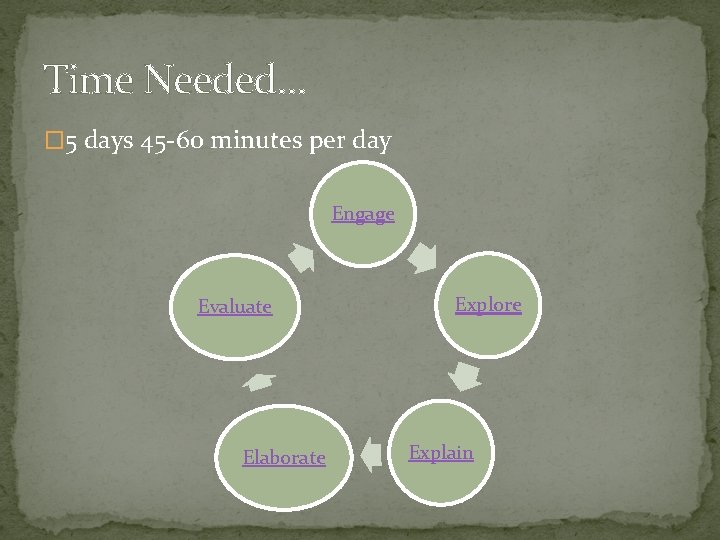
Time Needed… � 5 days 45 -60 minutes per day Engage Evaluate Elaborate Explore Explain
Day One Engage �What did you eat for dinner last night? Activity Begin the lesson with the question: “What did you eat for dinner last night? ” The teacher will then break down the responses into individual ingredients and will write all responses down on the board or chart paper. Once there is a broad sampling, categorize the ingredients into producers and consumers. This will then lead into a more in depth discussion of all the parts of a food chain.
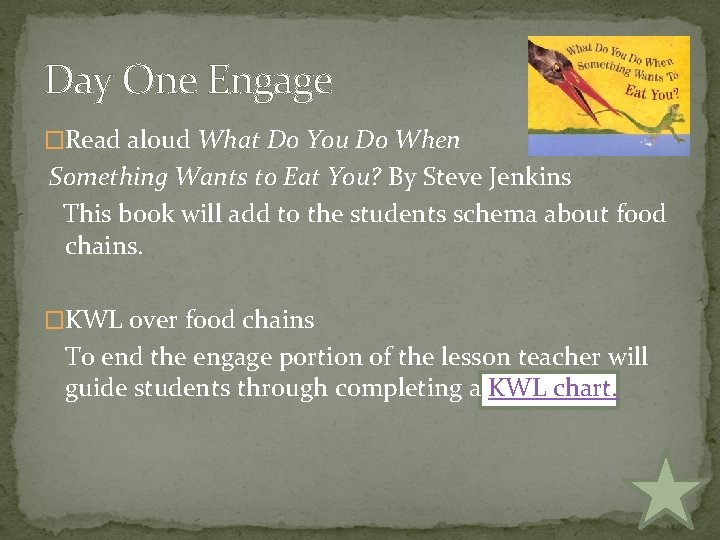
Day One Engage �Read aloud What Do You Do When Something Wants to Eat You? By Steve Jenkins This book will add to the students schema about food chains. �KWL over food chains To end the engage portion of the lesson teacher will guide students through completing a KWL chart.
Day Two Explore Lab �Food Chain Game In this game, there are four links to the food chain: plants, grasshoppers, frogs and hawks. Popcorn represents the plants, and students play the parts of grasshoppers (plant eaters), frogs (which eat grasshoppers) and hawks (which eat frogs). During each round of the game, the “animals” must get enough to eat to avoid being eaten. In this game, the populations (one kind of organism living in a given area) are so small that the survival of two grasshoppers, two frogs and one hawk (which can fly and find a mate and thus reproduce) represents a “balanced” food chain.
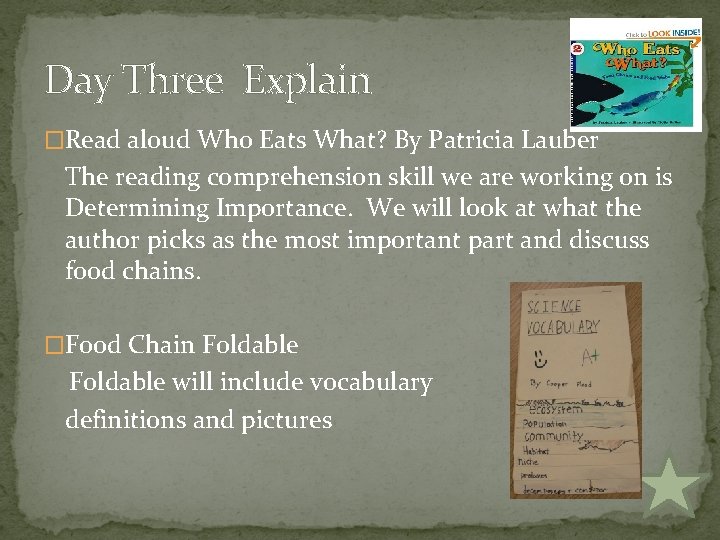
Day Three Explain �Read aloud Who Eats What? By Patricia Lauber The reading comprehension skill we are working on is Determining Importance. We will look at what the author picks as the most important part and discuss food chains. �Food Chain Foldable will include vocabulary definitions and pictures
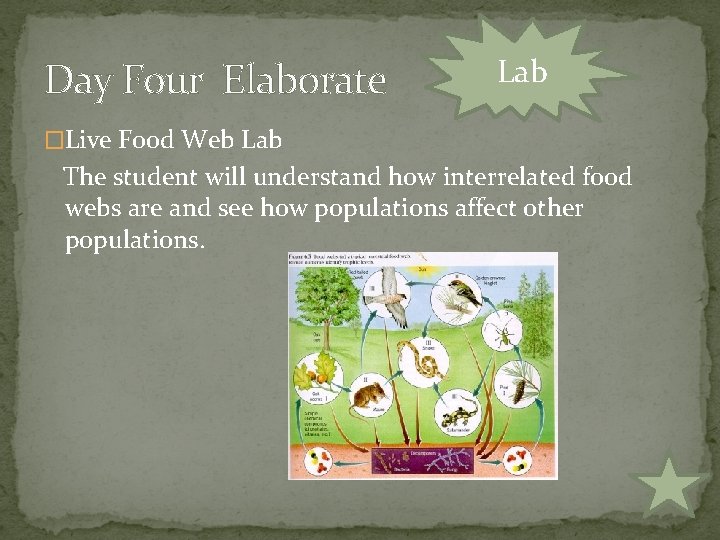
Day Four Elaborate Lab �Live Food Web Lab The student will understand how interrelated food webs are and see how populations affect other populations.
Day Five Evaluate �Food Chain Quiz is in the form of multiple choice and constructed response. Teachers can choose to have their students take the multiple choice portion of the food chain quiz by using either CPS clickers or Promethean Expressions �Informal evaluations are also taking place daily through foldables , KWLs, and labs.
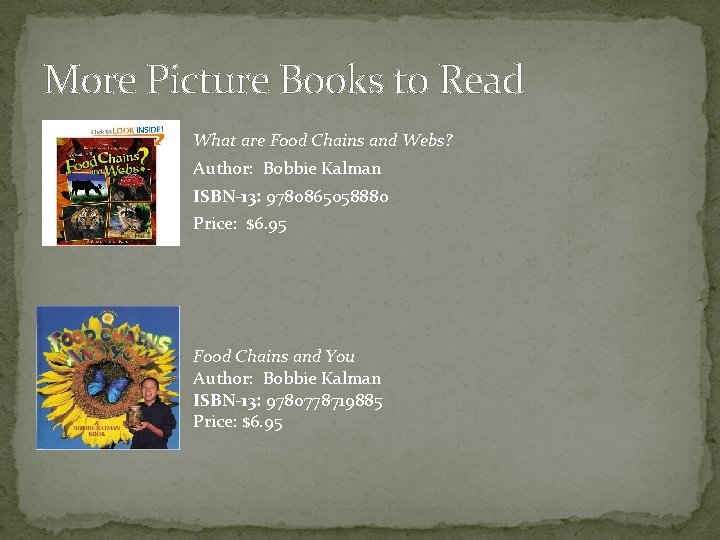
More Picture Books to Read What are Food Chains and Webs? Author: Bobbie Kalman ISBN-13: 9780865058880 Price: $6. 95 Food Chains and You Author: Bobbie Kalman ISBN-13: 9780778719885 Price: $6. 95
Websites and Extension Activities �http: //magma. nationalgeographic. com/ngexplorer/03 09/quickflicks/ �http: //www. ecokids. ca/pub/eco_info/topics/frogs/cha inreaction/index. cfm �http: //bbc. co. uk/schools/ks 2 bitesize/science/tests/fo od_chains. html �http: //www. totally 3 rdgrade. com/food_chain. html �http: //www. emints. org/ethemes/resources/S 0000032 8. shtml �http: //www. pearsonsuccessnet. com