Geography 5 Words To Know Savanna grasslands a


- Slides: 26
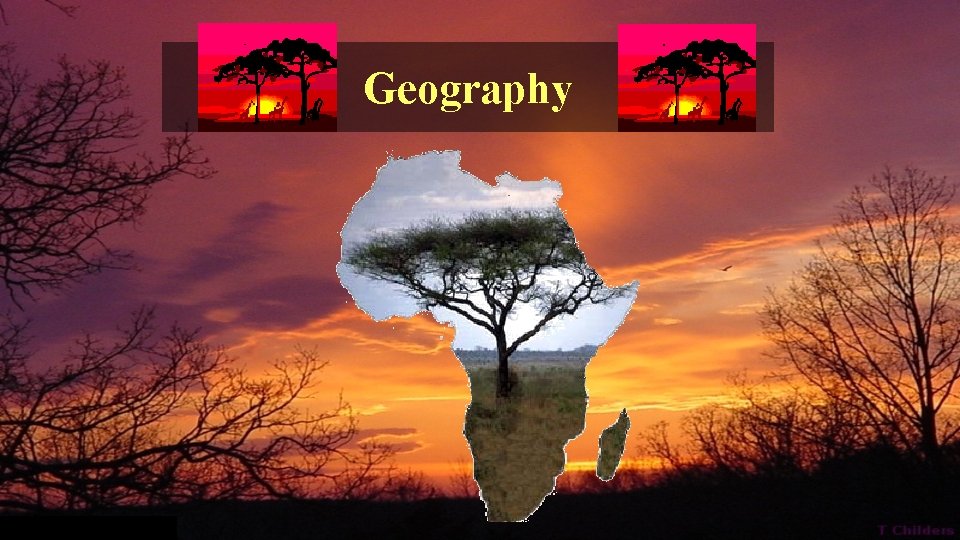
Geography
5 Words To Know
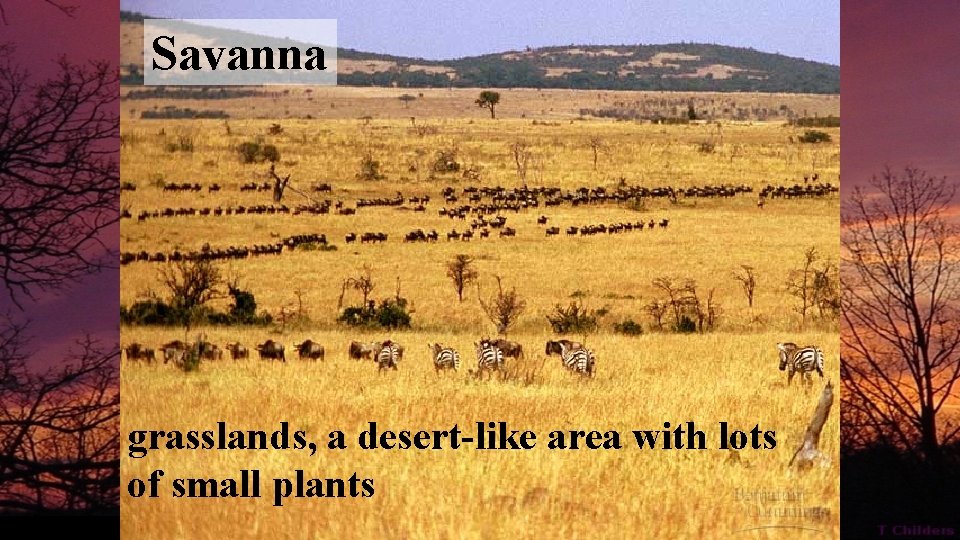
Savanna grasslands, a desert-like area with lots of small plants
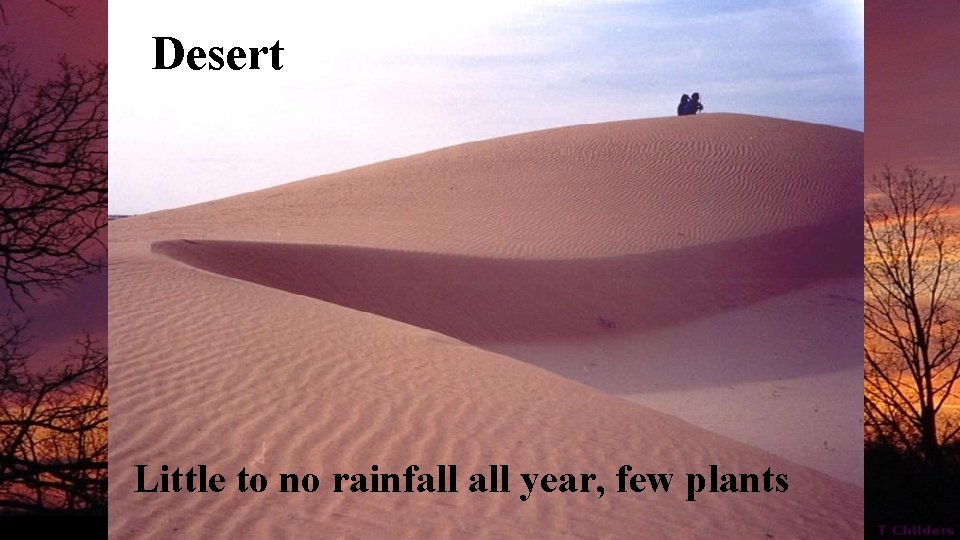
Desert Little to no rainfall year, few plants
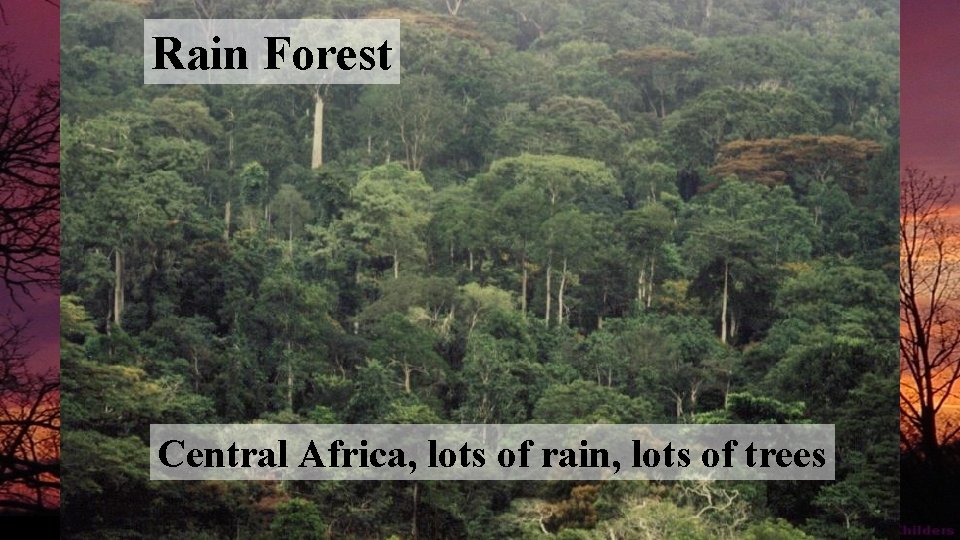
Rain Forest Central Africa, lots of rain, lots of trees
Delta Triangular shaped landform at the mouth of a river, great for farming.
Sahel Region of savanna on the Southern border of the Sahara
Africa is much more than just a desert!
Chapter 5 The Roots of Mighty Empires A Land of Many Climates • Dried-up riverbeds as well as cave paintings indicate that in 5000 B. C. , the Sahara was indeed a land of flowing rivers, lush green pastures, and forests. • As the Sahara's climate changed, people who lived there migrated south to settle in more fertile areas -- the savannas and rain forests.
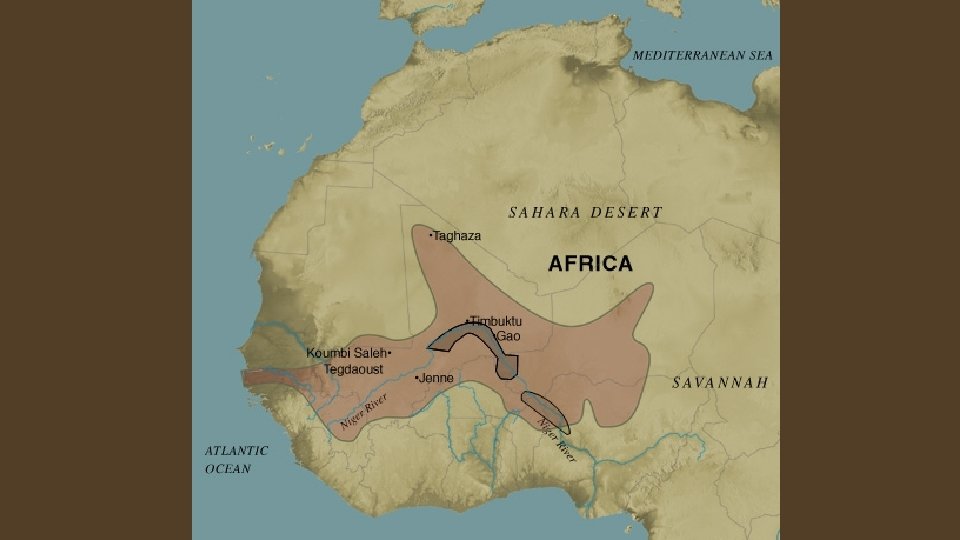
Grass is gone… • Some of those who migrated to West Africa settled on oases located along a strip of grasslands, or savanna, on the Sahara's southern border. • This region is known as the sahel, or "shore of the desert. "
What river was important to both Ghana and Mali? Niger River
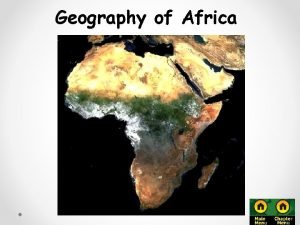
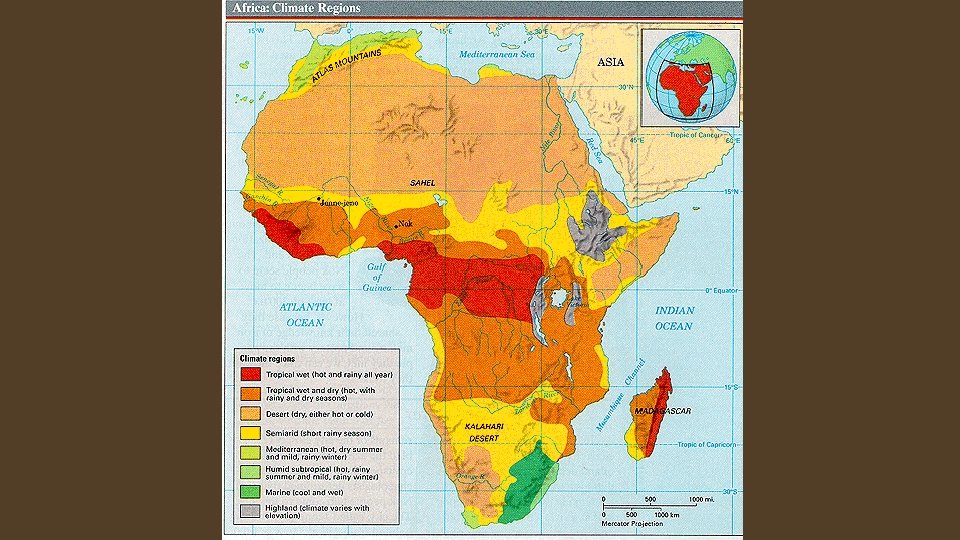
The Land of Africa • 2 nd largest continent & very diverse. • Northern Coast- mountains • Sahara- South of the mountains. • Grasslands- west of the deserts • Tropical jungles- west of the deserts along the coast. • Plateau (relatively high, flat land areas)- East • Great Rift Valley- deep canyons surrounded by mountains. • Congo Basin- tropical rain forests
The Climate of Africa • 4 distinct climate zones. Explains different lifestyles. 1. Northern coast & southern tip of Africa- mild climate with warm temperature & moderate rainfall. Farming 2. Deserts- 40%. Sahara in the north & Kalahari in the south. 3. Rain Forest- 10%. Located along the Equator. Heavy rains & warm temperatures. Farming & travel very difficult. Disease carrying insects. 4. Savannas- 40%. North & South of the Rain Forests. Enough to farm & herd animals.
Emerging Civilization & the Rise of Islam • 7 -8, 000 yrs. ago Africans began to tame animals. • Kush & Axum 1 st civilizations. • Kush (Nubia) freed itself from Egypt. 1 st was a farming community. Then traded ivory, ebony, frankincense, & leopard skins. Conquered Egypt & ran out by Assyrians. Learned to make iron weapons & tools. Traded iron goods with the Romans, Arabia, & India. Received luxury goods. Gave way to Axum.
• Axum combined Arab & African cultures. Prosperous because between India & the Mediterranean Sea. Traded ivory, frankincense, myrrh, & slaves. In 4 th century, King Ezana invaded Kush & converted to Chrisitanity. Took over Egypt & controlled entire coastal region of N. Africa. Had peaceful relations with Muslim states. 12 th century Muslims moved inland & wanted control over slaves & ivory. Axum in growing conflict with Muslims.
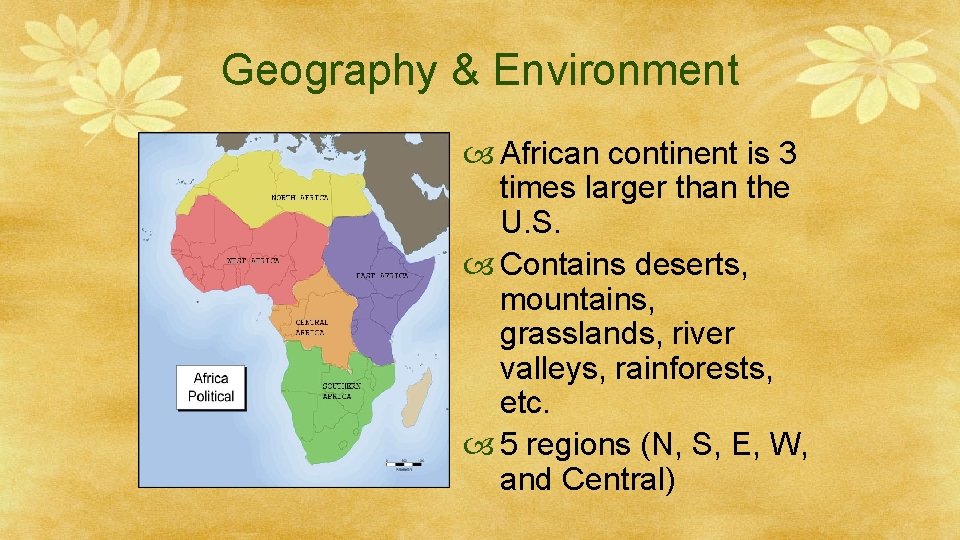
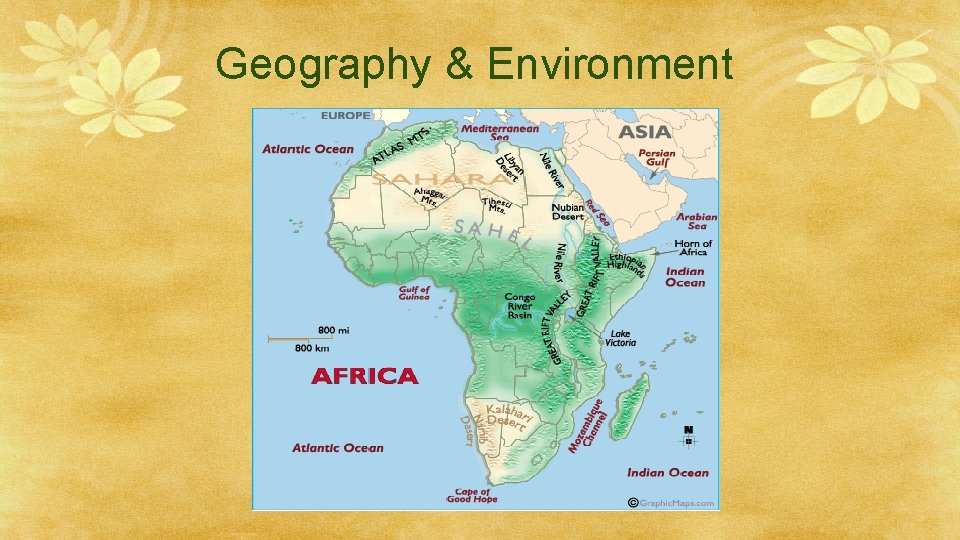
Geography & Environment African continent is 3 times larger than the U. S. Contains deserts, mountains, grasslands, river valleys, rainforests, etc. 5 regions (N, S, E, W, and Central)
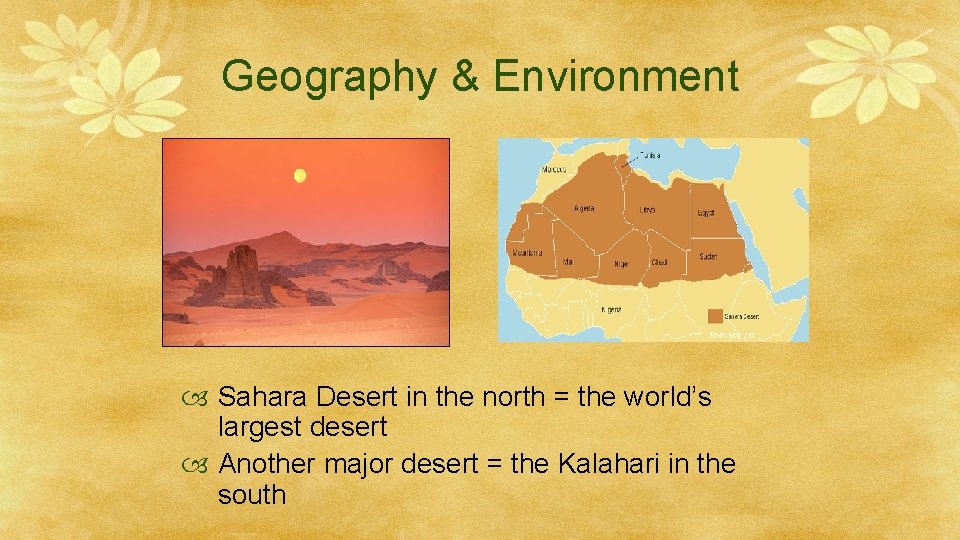
Geography & Environment Sahara Desert in the north = the world’s largest desert Another major desert = the Kalahari in the south
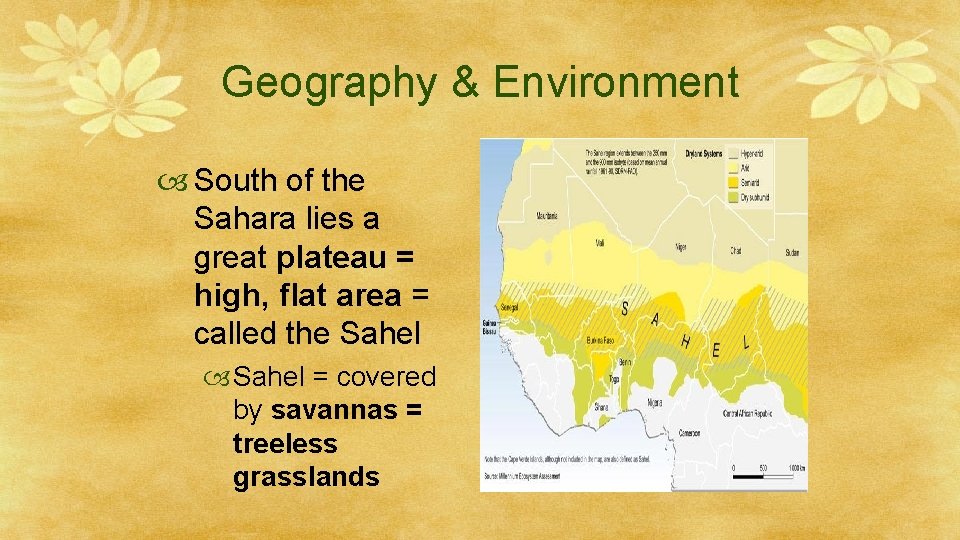
Geography & Environment South of the Sahara lies a great plateau = high, flat area = called the Sahel = covered by savannas = treeless grasslands
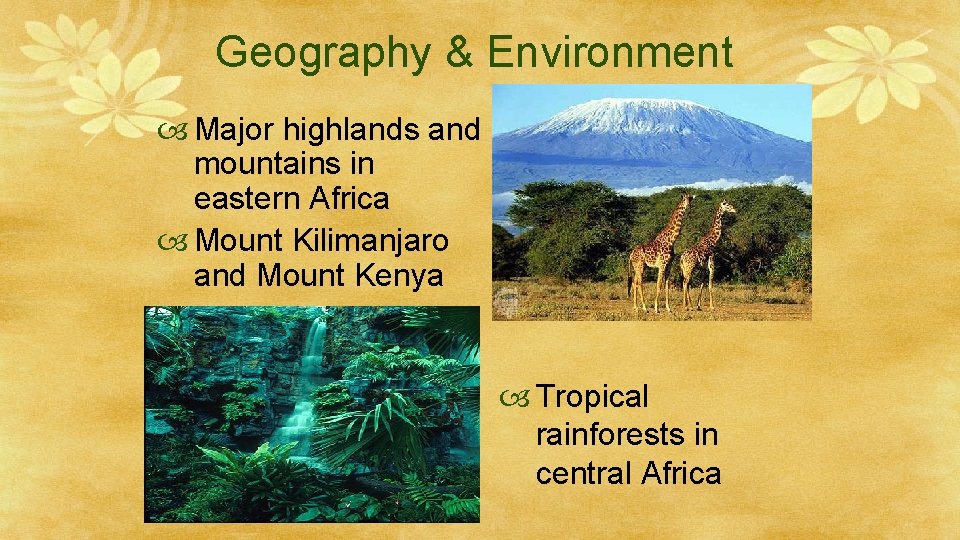
Geography & Environment Major highlands and mountains in eastern Africa Mount Kilimanjaro and Mount Kenya Tropical rainforests in central Africa
Geography & Environment
Geography and Environment As a result of Africa’s size and environmental variations, many separate societies, cultures, and civilizations grew throughout Africa
Africa’s Climate Africa is one of the most tropical continents in the world As a result of this tropical climate: 1) Poorer and less fertile soil = less productive agriculture than in Eurasia 2) Many disease-carrying insects and parasites = long -term health problems
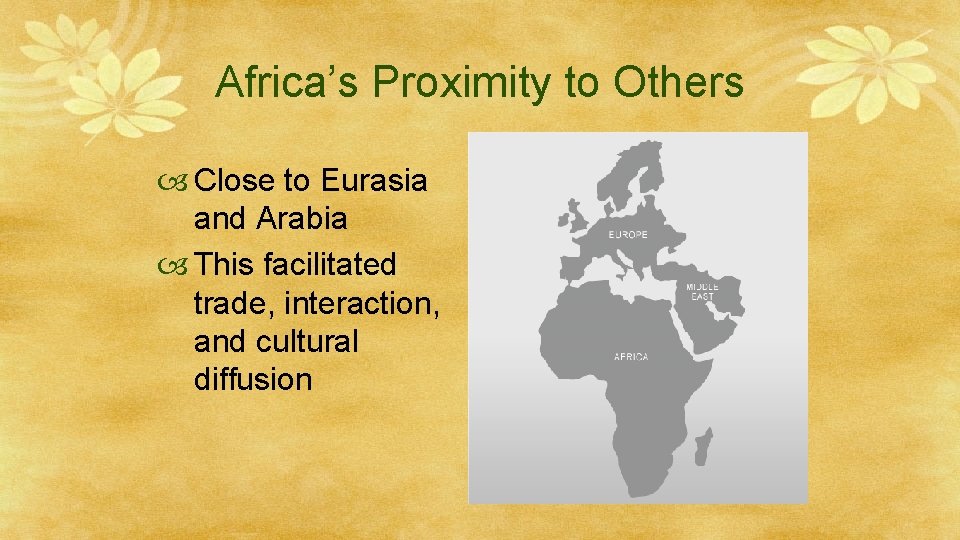
Africa’s Proximity to Others Close to Eurasia and Arabia This facilitated trade, interaction, and cultural diffusion