Girl Mothers in Armed Forces and Groups and
- Slides: 61
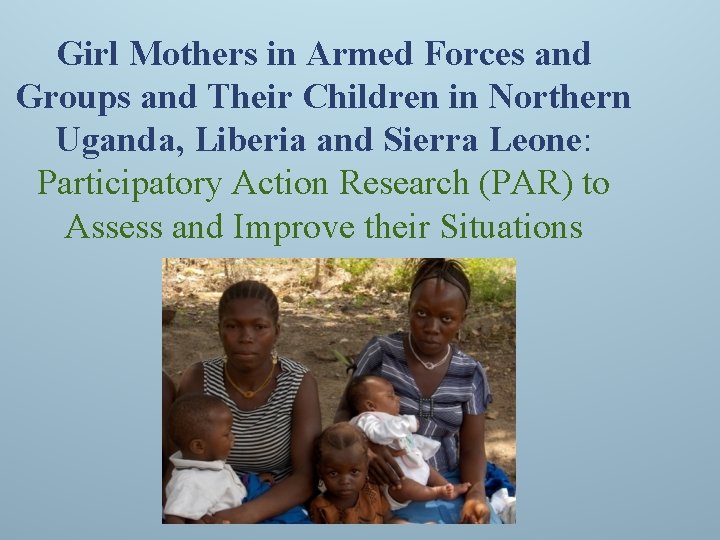
Girl Mothers in Armed Forces and Groups and Their Children in Northern Uganda, Liberia and Sierra Leone: Participatory Action Research (PAR) to Assess and Improve their Situations
Why do this PAR? • Reintegration has been constructed according to adult ideas without including girls’ voices. Agency programs have, in the main, been ineffective in reducing stigma and facilitating girls’ economic livelihoods. • Girl mothers’ reintegration into the community is a shared responsibility between the community and affected girls.
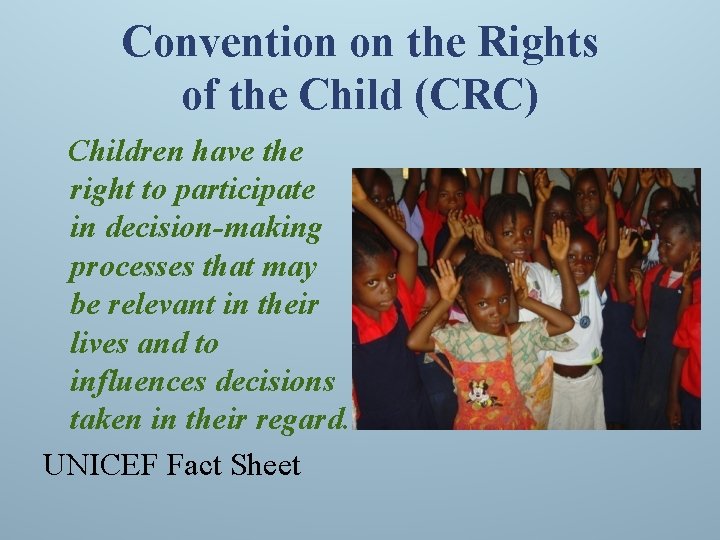
Convention on the Rights of the Child (CRC) Children have the right to participate in decision-making processes that may be relevant in their lives and to influences decisions taken in their regard. UNICEF Fact Sheet
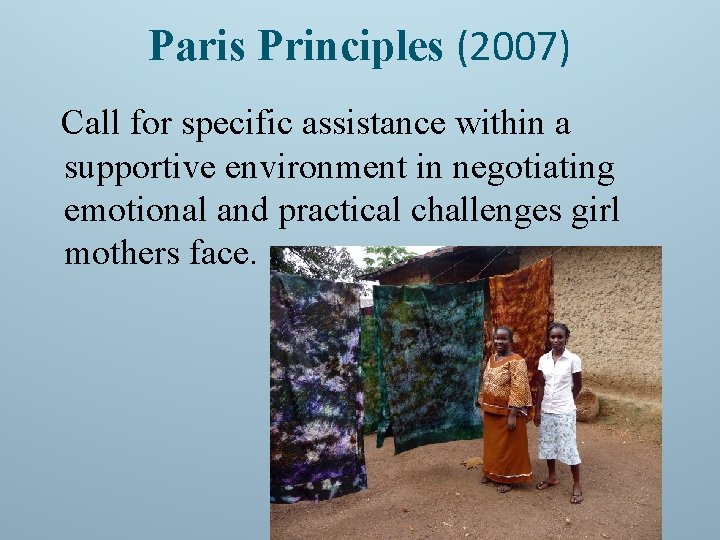
Paris Principles (2007) Call for specific assistance within a supportive environment in negotiating emotional and practical challenges girl mothers face.
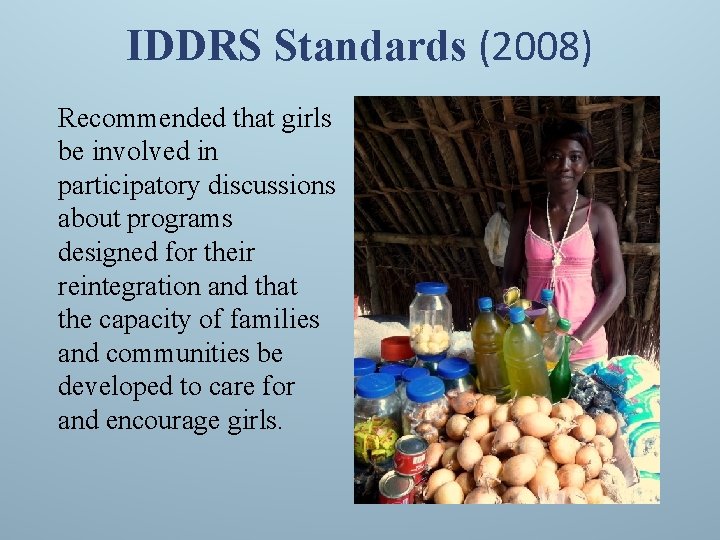
IDDRS Standards (2008) Recommended that girls be involved in participatory discussions about programs designed for their reintegration and that the capacity of families and communities be developed to care for and encourage girls.
Machel Study 10 -Year Strategic Review (2009) Advocated broader and comprehensive reintegration programs that include girls should seek approaches that are durable inclusive, flexible, grounded in the community, based on child rights, and outside of formal DDR processes.
Participatory Action Research (PAR) • Core principle: generation of knowledge (rather than its ‘extraction’) through a merging of academic with local knowledge • Participants (girls mothers) define and implement social action and research their most relevant concerns
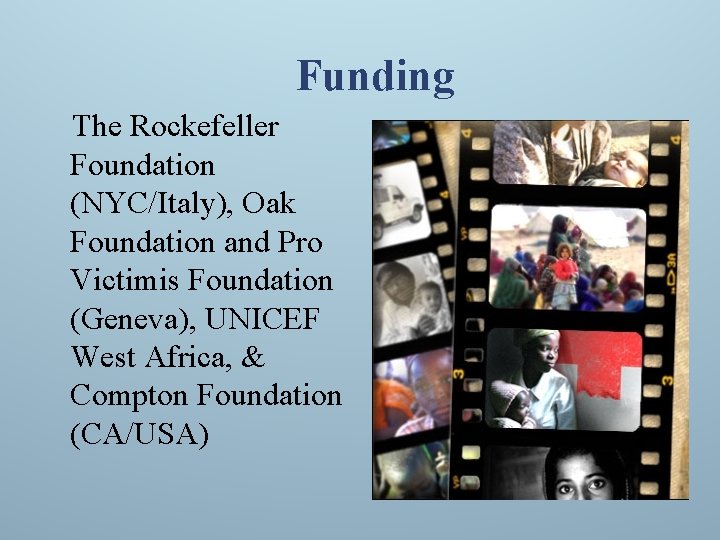
Funding The Rockefeller Foundation (NYC/Italy), Oak Foundation and Pro Victimis Foundation (Geneva), UNICEF West Africa, & Compton Foundation (CA/USA)
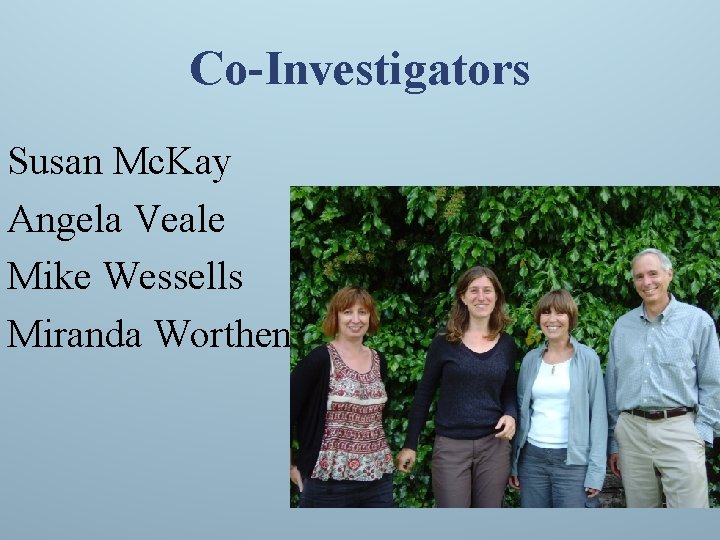
Co-Investigators Susan Mc. Kay Angela Veale Mike Wessells Miranda Worthen
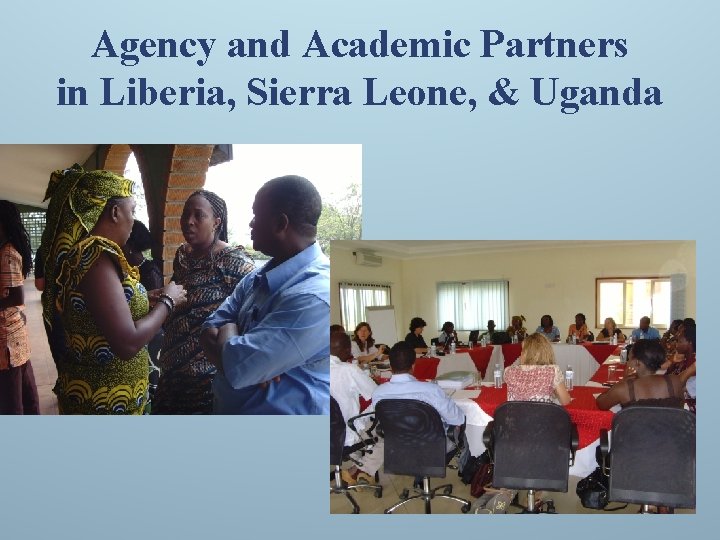
Agency and Academic Partners in Liberia, Sierra Leone, & Uganda
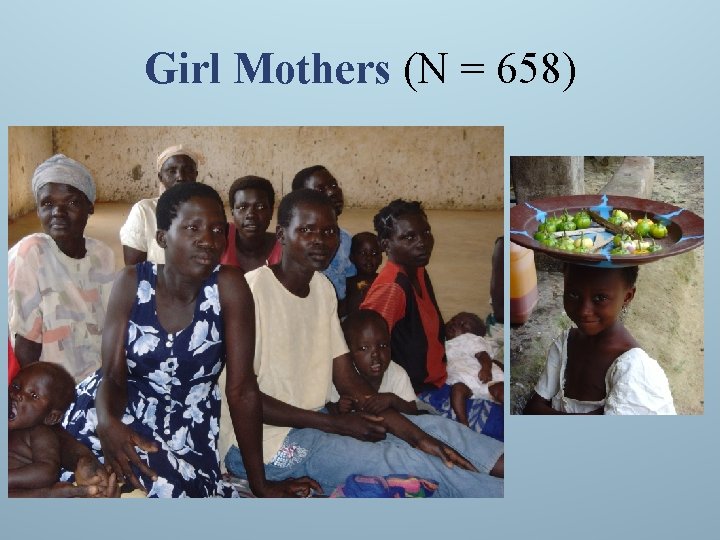
Girl Mothers (N = 658)
Demographics of Participants How many participants? • Liberia = 111, average • 20 • Sierra Leone = 266, average 22 • Uganda = 281, average 18 How many participants formerly associated? • 33% vulnerable • community girls • 67% formerly associated
Demographics of Participants Who do the participants live with? How many children did they have at the start? • 273 (41%) live with boyfriends or husbands • 234 (36%) live with parents or guardians • 36 (5%) live alone • • 93 had only 1 child 191 had 2 children 107 had 3 children 38 had 4 children or more
PAR Focus Develop approaches to involve the girls as highly -active participants and address at community levels the stigma faced by reintegrating girl mothers and their children. Potential Benefit Empowerment of girls in societies where their status is low.
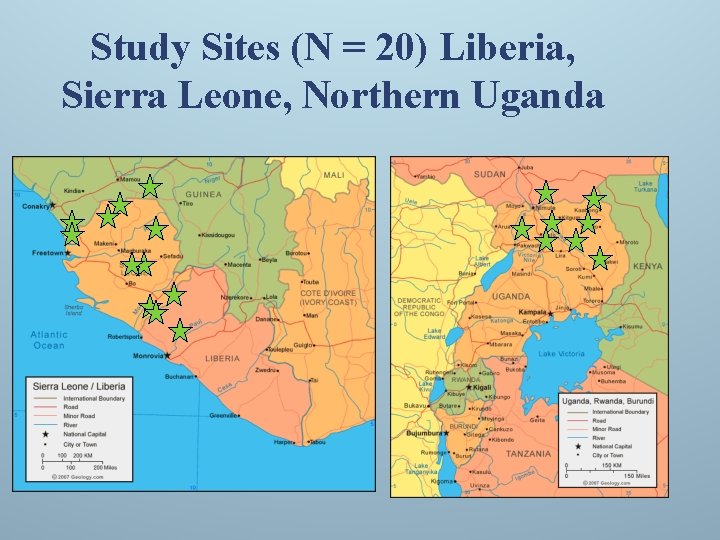
Study Sites (N = 20) Liberia, Sierra Leone, Northern Uganda
Academic Partnerships with Child Protection Agencies (NGOs) • Sierra Leone: Christian Children’s Fund, Christian Brothers, Council of Churches in Sierra Leone, National Network for Psychosocial Care • Liberia: Save the Children/UK, THINK • Uganda: Caritas, Concerned Parents Association, Transcultural Psychosocial Organization, World Vision
Do No Harm • • Code of Conduct No research without action Manage expectations Confidentiality Informed consent Avoid excessive targeting Ethical interviewing U. of Wyoming IRB and local consultation
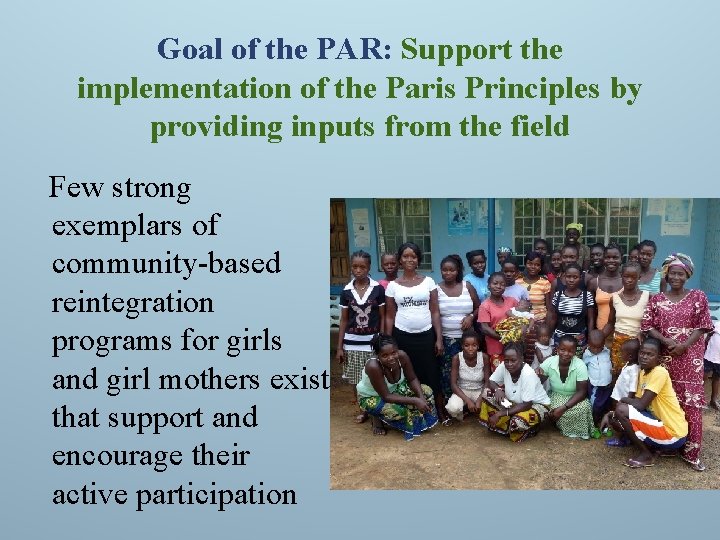
Goal of the PAR: Support the implementation of the Paris Principles by providing inputs from the field Few strong exemplars of community-based reintegration programs for girls and girl mothers exist that support and encourage their active participation
Selection of Participants • Planned for half of participants to be girls CAAFAG and other vulnerable girl mothers • The plan was for agencies to identify two field sites for study implementation where both groups were present in significant numbers. • Field site facilitators invited girl mother participation via the community and families. • The goal was 30 girls for each field site.
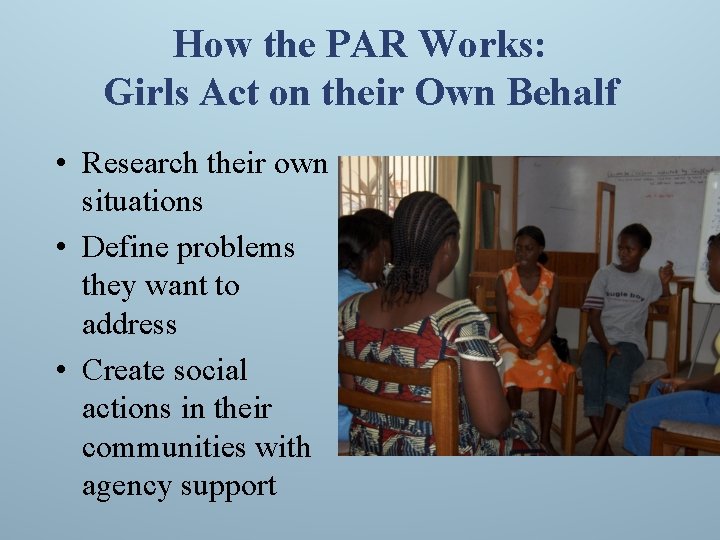
How the PAR Works: Girls Act on their Own Behalf • Research their own situations • Define problems they want to address • Create social actions in their communities with agency support
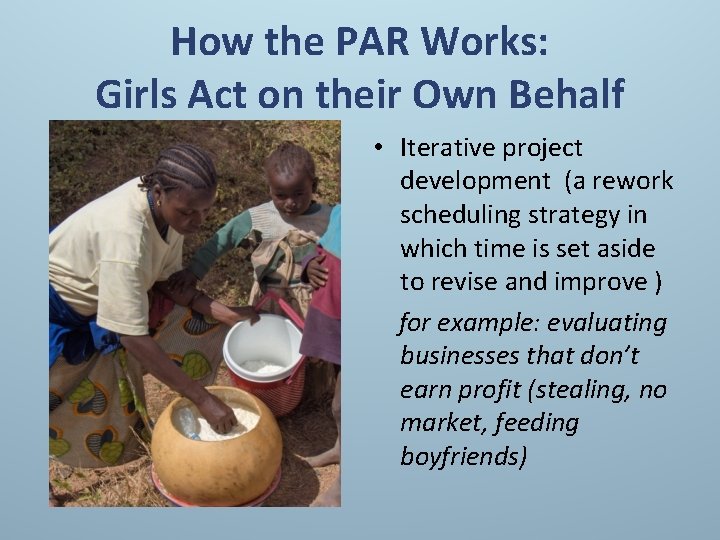
How the PAR Works: Girls Act on their Own Behalf • Iterative project development (a rework scheduling strategy in which time is set aside to revise and improve ) for example: evaluating businesses that don’t earn profit (stealing, no market, feeding boyfriends)
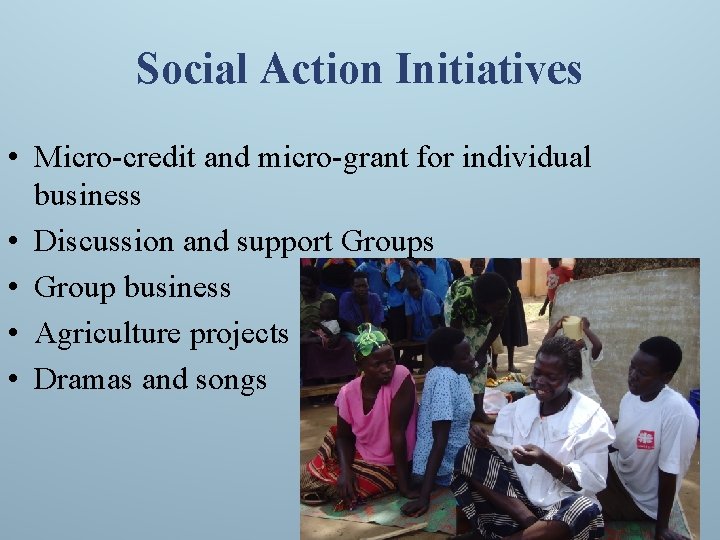
Social Action Initiatives • Micro-credit and micro-grant for individual business • Discussion and support Groups • Group business • Agriculture projects • Dramas and songs
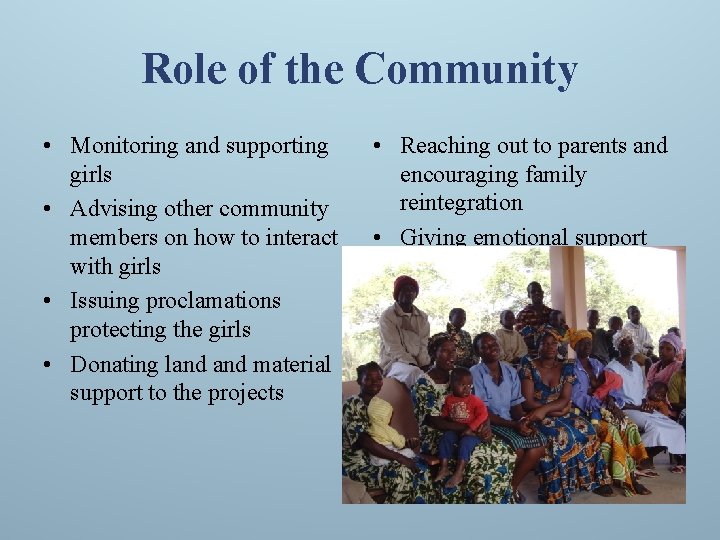
Role of the Community • Monitoring and supporting girls • Advising other community members on how to interact with girls • Issuing proclamations protecting the girls • Donating land material support to the projects • Reaching out to parents and encouraging family reintegration • Giving emotional support
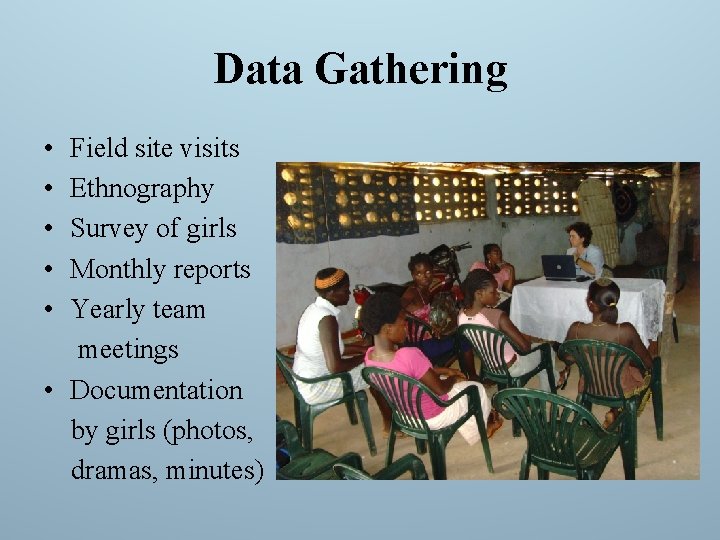
Data Gathering • • • Field site visits Ethnography Survey of girls Monthly reports Yearly team meetings • Documentation by girls (photos, dramas, minutes)
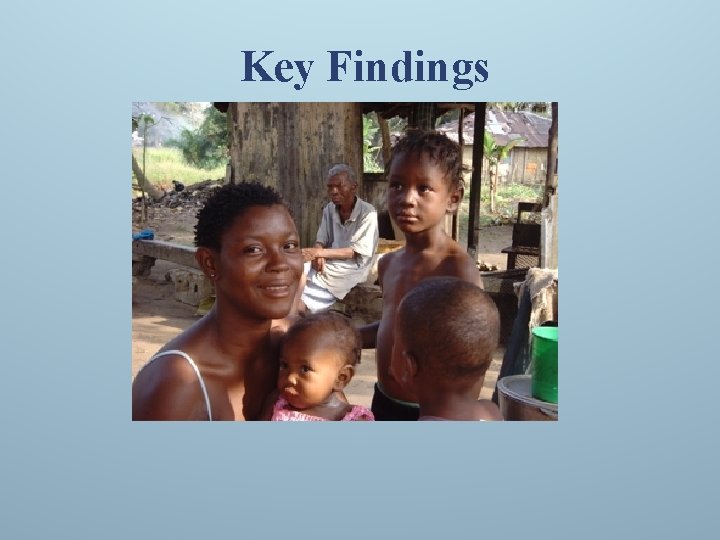
Key Findings
Finding: The meaning of social (re)integration for girl mothers is that they and their children are accepted, respected, and included as contributing family and community members. This is consistent with the Paris Principles’ definition: “The process through which children transition into civil society and enter meaningful roles and identities as civilians who are accepted by the families and communities in a context of local and national reconciliation. ”
Outcomes for Girl Mothers • Stigma and discrimination toward girls formerly associated with armed groups and their children is significantly reduced and often eliminated when girls engage in sustainable livelihoods and behave according to community and gender norms. • Participation in the PAR overwhelmingly resulted in better relationships with the broader community. • Girls, with facilitation from project personnel, became more active in the community and were seen as “serious” by community members.
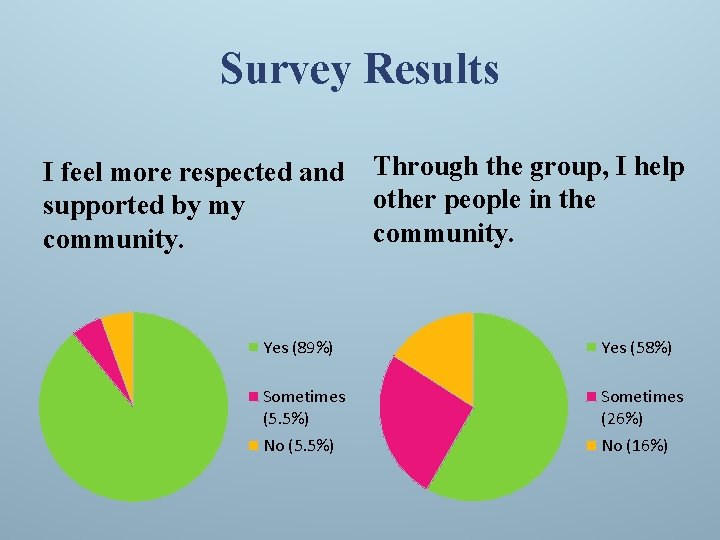
Survey Results I feel more respected and supported by my community. Through the group, I help other people in the community. Yes (89%) Yes (58%) Sometimes (5. 5%) Sometimes (26%) No (5. 5%) No (16%)
Finding: To facilitate social reintegration that is community based and highly participatory, communities should be involved from the outset and should take ownership of the process. Extensive community dialogue, involvement and ownership is essential to motivate influential community members to support girl mothers’ reintegration. Thus PAR staff engaged with extensive dialogue with community members, families, and girls.
Role of Community Advisors • Facilitated girls’ social and economic reintegration • Provided a crucial link between the girl mothers’ groups and the larger community • Acted as intermediaries who encouraged the girls and supplied pragmatic advice. • Helped girls managed conflict • Gave psychosocial support
Finding: Peer groups for mothers were instrumental in providing psychosocial support for positive coping and social reintegration. Group processes formed the bedrock of social reintegration. In the groups, formerly associated and community girl mothers learned to talk and listen to each other in respectful ways, manage conflict, engage in collective problem solving and give each other support.
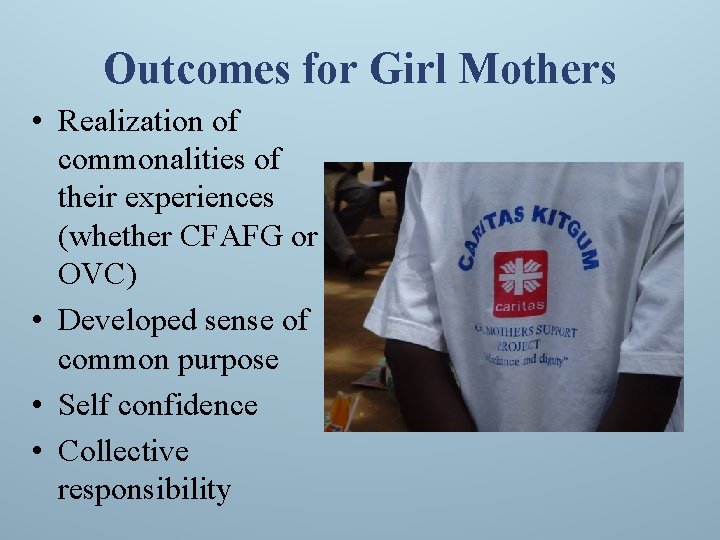
Outcomes for Girl Mothers • Realization of commonalities of their experiences (whether CFAFG or OVC) • Developed sense of common purpose • Self confidence • Collective responsibility
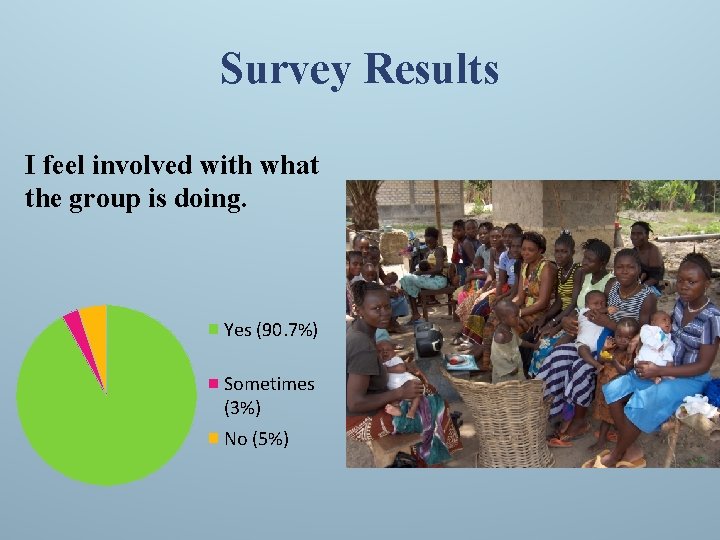
Survey Results I feel involved with what the group is doing. Yes (90. 7%) Sometimes (3%) No (5%)
Finding: Girls peer groups require organizing, structuring, and expert facilitation by agency staff, whose ongoing aim is to shift decision making to the girls. Organizing and facilitating girl mothers’ groups and providing psychosocial support required significant investment of time. Most importantly, agency staff needed to demonstrate their respect of the girls’ ideas.
Outcomes for Girl Mothers • Girl mothers began to drive the process, make decisions about the use of resources, and experienced a growing sense of group purpose and ownership • Innovative and creative individual or group projects emerged which resulted in differentiated and flexible activities. • Girl mothers came to understand that they were responsible for outcomes and to each other.
Finding: Girl mothers’ group work facilitated their reintegration through increasing their strength and improving their capacity to be seen and heard in communities. The project benefitted from slow development at the field sites with small funds for use in social action initiatives which were available incrementally as girls identified social actions.
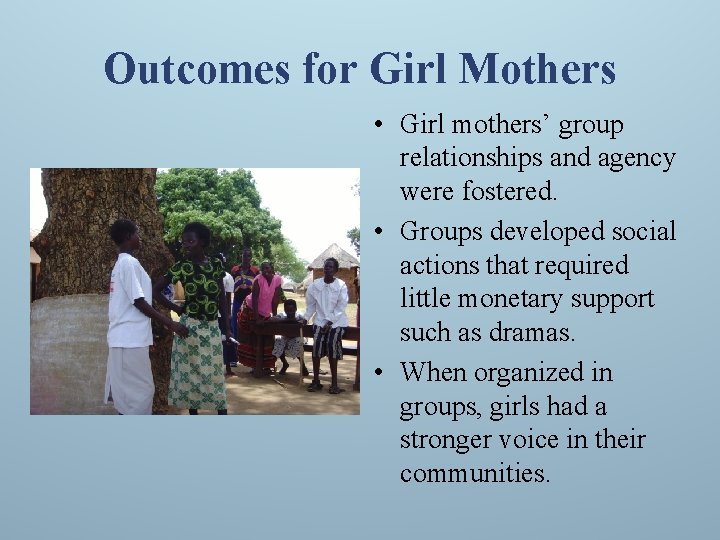
Outcomes for Girl Mothers • Girl mothers’ group relationships and agency were fostered. • Groups developed social actions that required little monetary support such as dramas. • When organized in groups, girls had a stronger voice in their communities.
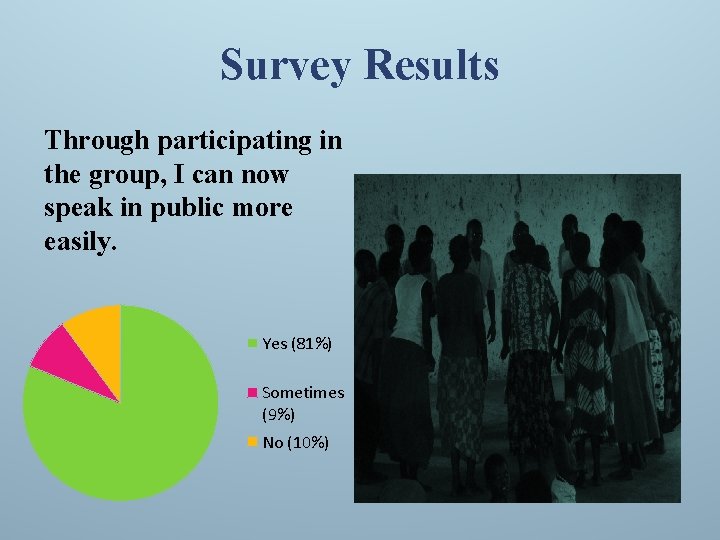
Survey Results Through participating in the group, I can now speak in public more easily. Yes (81%) Sometimes (9%) No (10%)
Finding: Economic livelihood supports were instrumental in improving girl mother’s family and community status and relationships. Sustainability was strongly related to flexibility and diversification in income generating activities. Girls who enrolled in school or skills training did best when they simultaneously engaged in group or individual livelihoods.
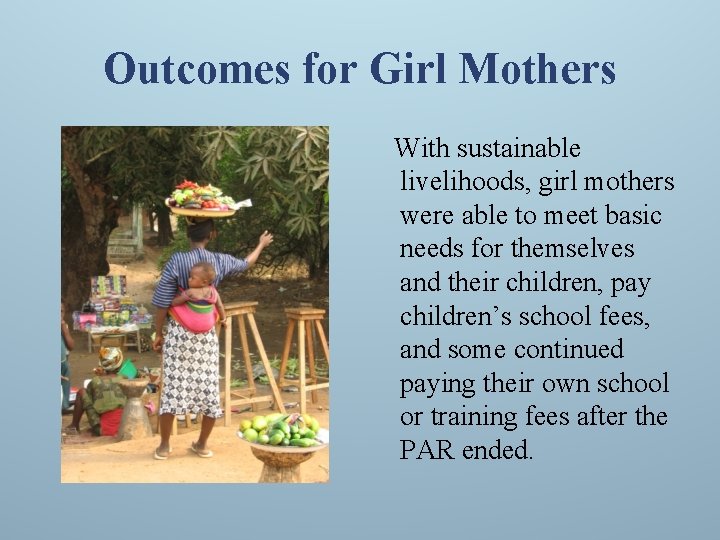
Outcomes for Girl Mothers With sustainable livelihoods, girl mothers were able to meet basic needs for themselves and their children, pay children’s school fees, and some continued paying their own school or training fees after the PAR ended.
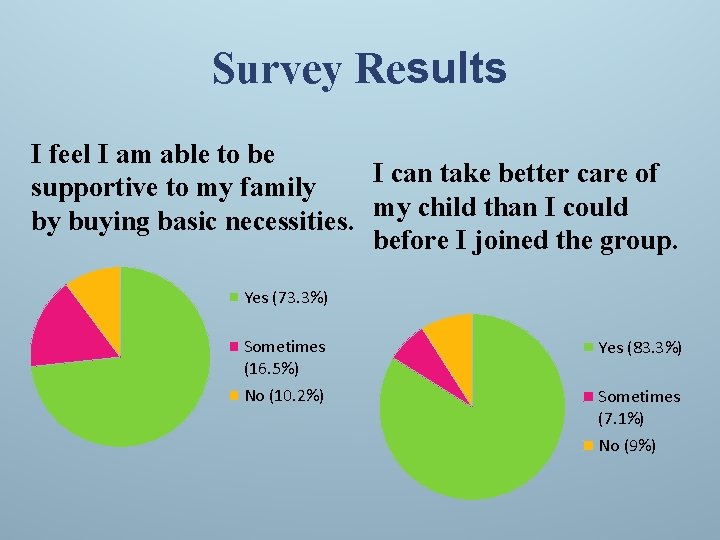
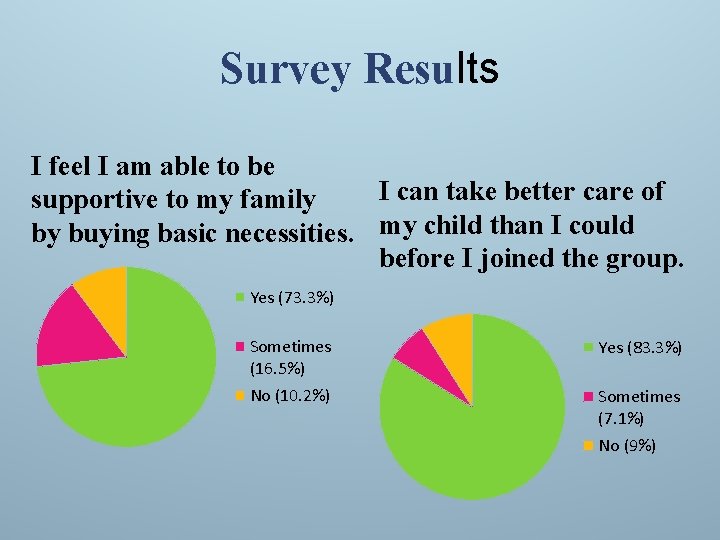
Survey Results I feel I am able to be I can take better care of supportive to my family my child than I could by buying basic necessities. before I joined the group. Yes (73. 3%) Sometimes (16. 5%) Yes (83. 3%) No (10. 2%) Sometimes (7. 1%) No (9%)
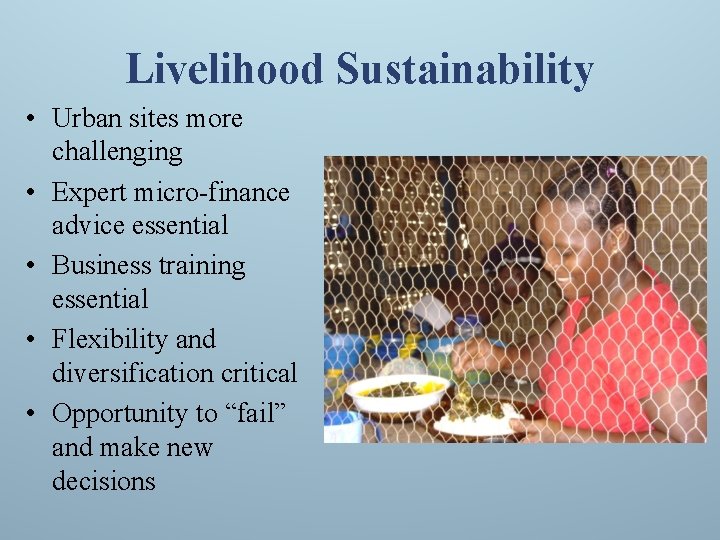
Livelihood Sustainability • Urban sites more challenging • Expert micro-finance advice essential • Business training essential • Flexibility and diversification critical • Opportunity to “fail” and make new decisions
Finding: Family relationships were significantly improved through girl mothers’ participation in the project. Girls’ ability to give to the family fostered respect and enhanced social reintegration. This was, in large part, because of their ability to support and care for their children.
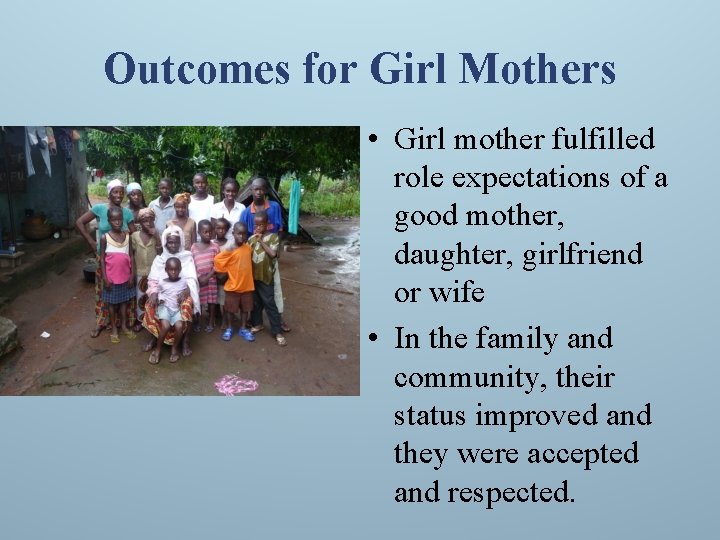
Outcomes for Girl Mothers • Girl mother fulfilled role expectations of a good mother, daughter, girlfriend or wife • In the family and community, their status improved and they were accepted and respected.
Survey Results I feel I am able to be I can take better care of supportive to my family by buying basic necessities. my child than I could before I joined the group. Yes (73. 3%) Sometimes (16. 5%) Yes (83. 3%) No (10. 2%) Sometimes (7. 1%) No (9%)
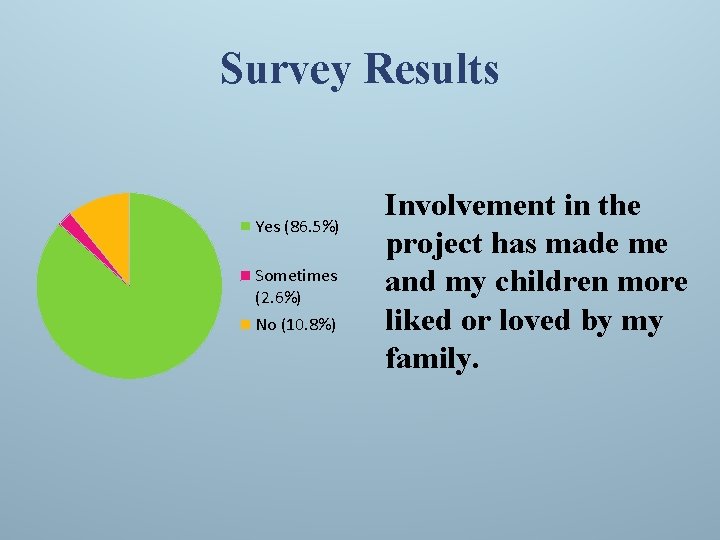
Survey Results Yes (86. 5%) Sometimes (2. 6%) No (10. 8%) Involvement in the project has made me and my children more liked or loved by my family.
Finding: Girl mothers showed improved physical and psychosocial well-being. Children of girl mothers show improved physical and psychosocial well-being which facilitates their social reintegration. Over the project lifespan, in all three countries, girl mothers’ emotional and behavioral problems were reduced.
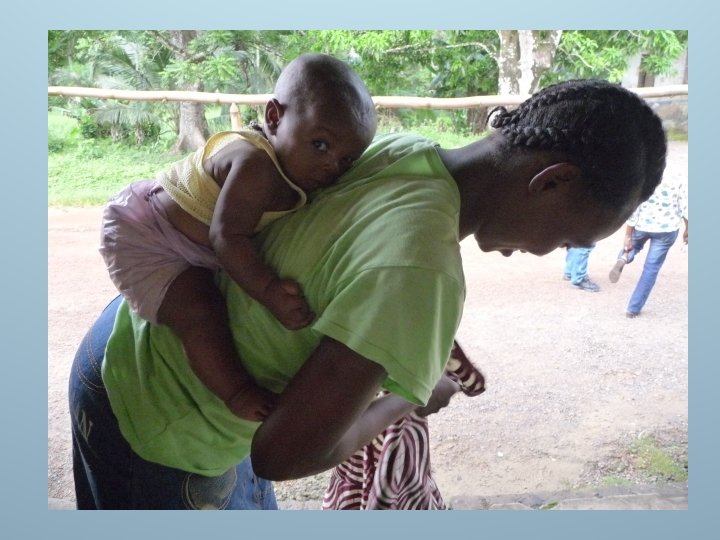
Outcomes for Girl Mothers and their Children • Girl mothers exhibited better self-care and psychological well-being. They showed greater confidence and self-efficacy. • They continued to lack sufficient access to primary health care because of costs. • Children achieved increased acceptance and belonging within the family and community. Girls reported they were better mothers.
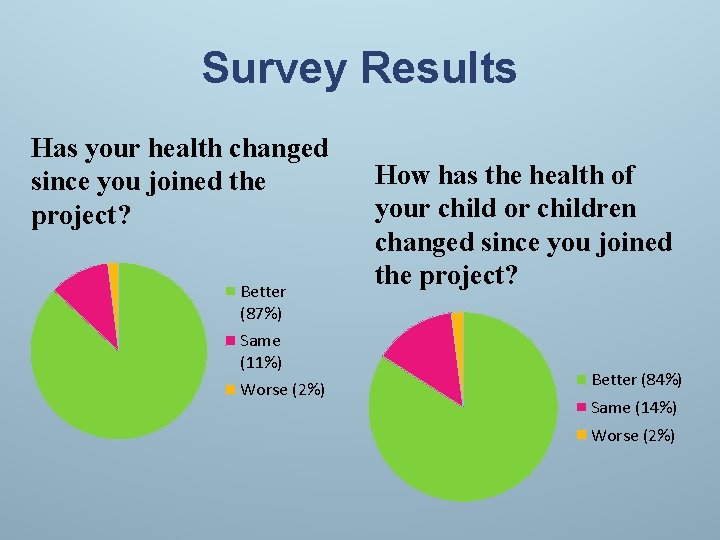
Survey Results Has your health changed since you joined the project? Better (87%) Same (11%) Worse (2%) How has the health of your child or children changed since you joined the project? Better (84%) Same (14%) Worse (2%)
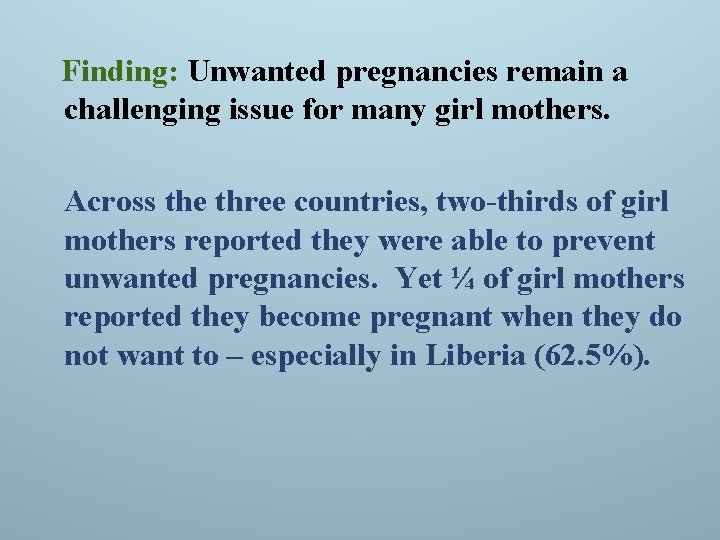
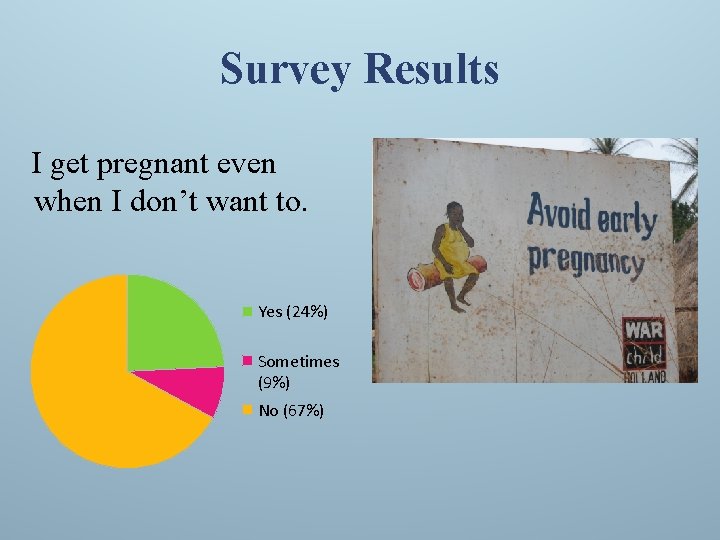
Finding: Unwanted pregnancies remain a challenging issue for many girl mothers. Across the three countries, two-thirds of girl mothers reported they were able to prevent unwanted pregnancies. Yet ¼ of girl mothers reported they become pregnant when they do not want to – especially in Liberia (62. 5%).
Survey Results I get pregnant even when I don’t want to. Yes (24%) Sometimes (9%) No (67%)
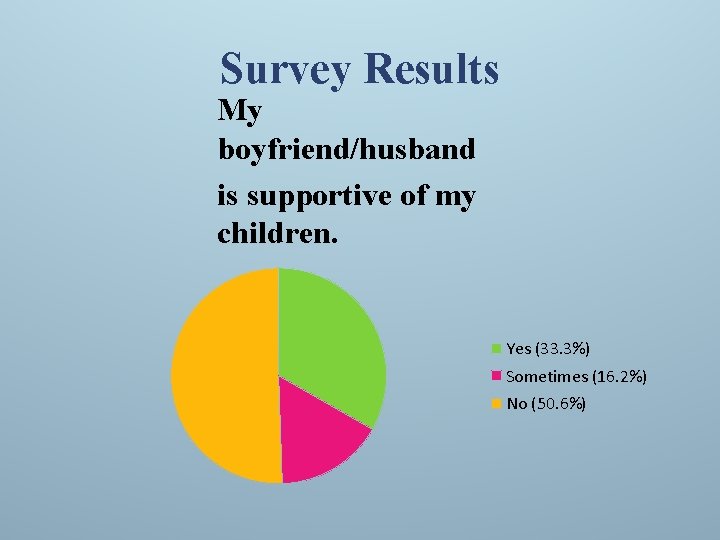
Finding: While some girl mothers report supportive relationships, the majority say they do not experience their boyfriends or husbands as supportive of them. In all three countries, they reported leaving boyfriends of husbands because of domestic violence and/or discrimination against their children not conceived with their current partner. This was especially true in Uganda. Girls are ashamed to speak out about domestic violence.
Survey Results My boyfriend/husband is supportive of my children. Yes (33. 3%) Sometimes (16. 2%) No (50. 6%)
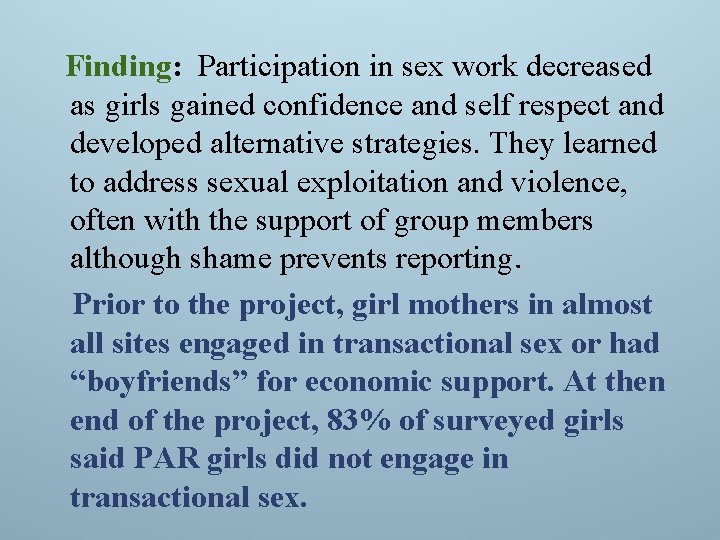
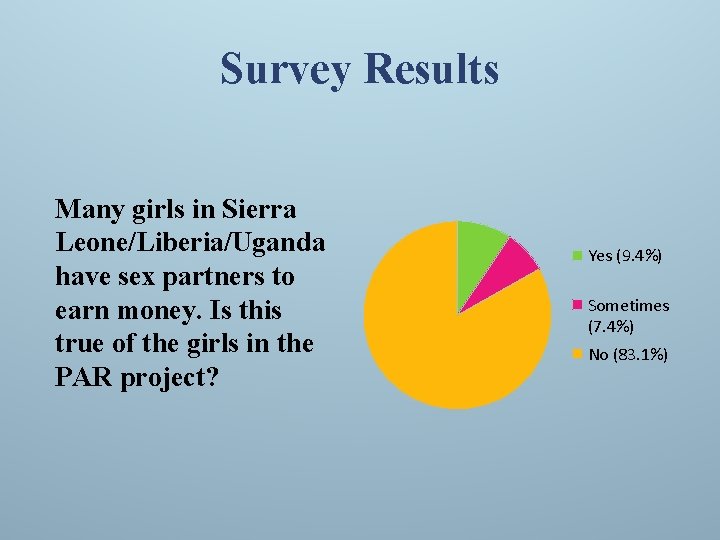
Finding: Participation in sex work decreased as girls gained confidence and self respect and developed alternative strategies. They learned to address sexual exploitation and violence, often with the support of group members although shame prevents reporting. Prior to the project, girl mothers in almost all sites engaged in transactional sex or had “boyfriends” for economic support. At then end of the project, 83% of surveyed girls said PAR girls did not engage in transactional sex.
Survey Results Many girls in Sierra Leone/Liberia/Uganda have sex partners to earn money. Is this true of the girls in the PAR project? Yes (9. 4%) Sometimes (7. 4%) No (83. 1%)
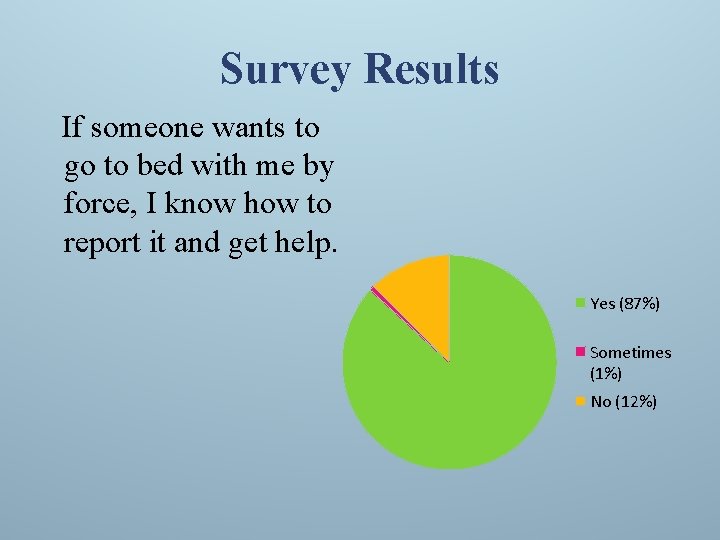
Survey Results If someone wants to go to bed with me by force, I know how to report it and get help. Yes (87%) Sometimes (1%) No (12%)
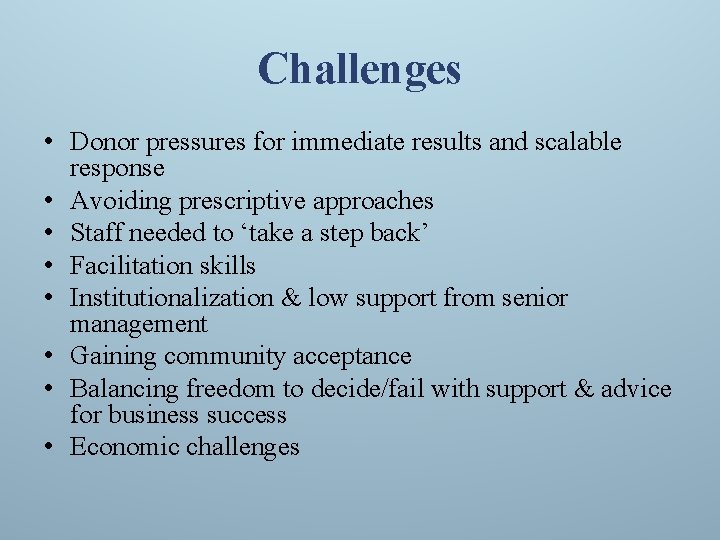
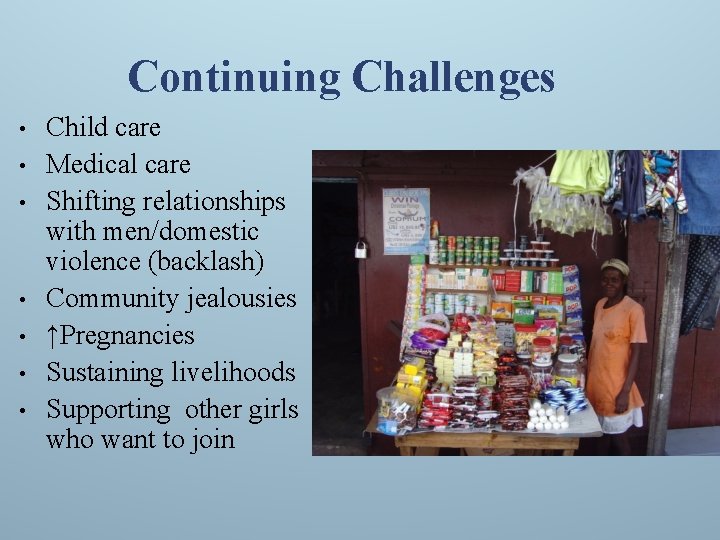
Challenges • Donor pressures for immediate results and scalable response • Avoiding prescriptive approaches • Staff needed to ‘take a step back’ • Facilitation skills • Institutionalization & low support from senior management • Gaining community acceptance • Balancing freedom to decide/fail with support & advice for business success • Economic challenges
Continuing Challenges • • Child care Medical care Shifting relationships with men/domestic violence (backlash) Community jealousies ↑Pregnancies Sustaining livelihoods Supporting other girls who want to join
Recommendations for Practice • Enable meaningful participation, building reintegration supports around girl mothers’ own understandings and agency. • Facilitate group support among the girls. • Encourage effective mentoring and advocacy by respected community members • Take a longer slower approach that builds a sense of ownership by the communities and the girl mothers. • Build staff capacities for taking a more flexible, facilitative, girl-centered approach.
Recommendations for Donors and Policy Makers • Programming for the integration of CAAFAG should include specific attention to young women and their children. • Economic reintegration is key for the successful integration of girl mothers, including former CAAFAG. • Provide long-term, flexible, inclusive funding for the integration of formerly recruited girl mothers. • Support girls’ and women’s rights as part of postconflict transformation for development and peace.