GIC Modeling Expectations Eric Meier Model Administration 2262019

- Slides: 30
GIC Modeling Expectations Eric Meier Model Administration 2/26/2019
Agenda • Model Building Contact List Review • GIC Modeling Expectations Review • Modeling Discussion Items • GIC Modeling Building Overview PUBLIC 2
Model Building Contact List • ERCOT updated the contact list for those involved with PGDTF Model Building • It will be posted on MIS • Would the task force want it released on either the restricted or public mailing list? PUBLIC 3
GIC Modeling Expectations • The purpose of the GIC Modeling Expectations document is to lay out standards that the GIC System Models should adhere to • It is not a ROS approved document like the Procedure Manual • We will now go over some highlights before reviewing the document itself PUBLIC 4
Shunt Devices • All shunt reactors, either bus or line connected must be modeled • NOT just in-service reactors. – In-service and out of service reactors must be modeled • ERCOT Planning will modify the GIC file to switch shunts as needed for the vulnerability assessment • Series capacitors are have a negative impedance – status is read in from the AC case PUBLIC 5
Transformers • The I, J, K buses do not reflect voltages • They must match what is in the AC case • Some new transformers will be modeled: – Load serving power transformers with a high side winding of 200 k. V or greater – There are 35 loads in operations connected to the 345 k. V system – 8 are RE loads and will be ERCOTs responsibility to model – Full modeling in both the GIC and AC case will be needed PUBLIC 6
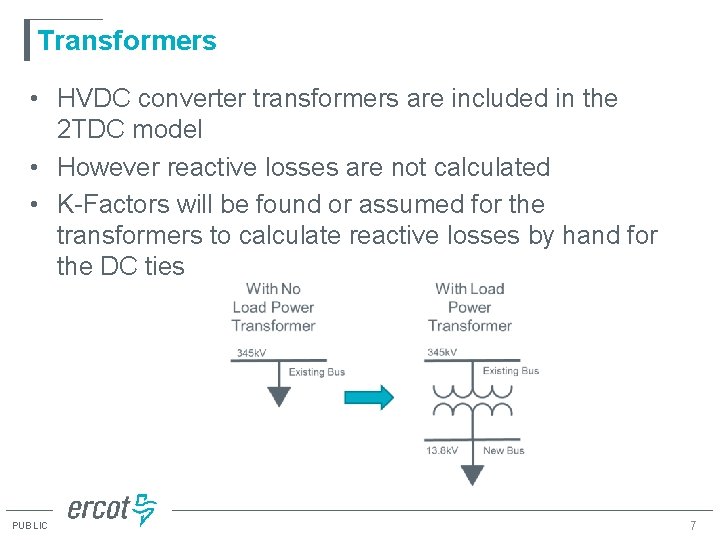
Transformers • HVDC converter transformers are included in the 2 TDC model • However reactive losses are not calculated • K-Factors will be found or assumed for the transformers to calculate reactive losses by hand for the DC ties PUBLIC 7
Validation Rules • The validation rules were taken from the GIC System Model User Guide created by PGDTF • These are only applied to data that is added or modified, not everything in the database – If the submission fails validation, the submission is not accepted • Each rule is assigned an id, e. g. 5 A – The Expectations and validation log ids are correlated • Inactive Rules: – Latitude and longitude, flag if: • # of digits is less than 4 significant digits (after decimal) – For branch data, flag if: • Branch mileage > 160 km (found in branch GIC output) PUBLIC 8
PTI Responses to ERCOT Questions • Auto transformer Series and Common winding designation is done based on Winding voltage, not how you enter data. • PSSE does not require transfomer winding buses to be any voltage order. There is HV, LV bus designations in PSSE. As data is entered 1 st bus is Winding 1 Bus, 2 nd bus is Winding 2 bus etc. • Series capacitor branches defined in PSSE Case data are automatically ignored (open circuit) in GIC. You do not need to provide 1 Mohm Rdc for these lines. PUBLIC 10
Substation Groupings • How are buses in a station being aggregated? • Are there any differences due to voltage levels, the grounding grid, or reasons due to the software? PUBLIC 11
Combined Reactor and Shunt Modeling • In PSSE, some separate reactors and caps that share a bus may be modeled as a single switched shunt • The reactor component is significant for GIC flows • Any thoughts on modeling? PUBLIC 12
SVC/Statcom Modeling • Reactive devices capable of providing both positive and negative VARs • Shunt reactors offer a flow for GICs while shunt caps block GICs • SVC/STATCOMs are mostly (but not all), machines in the PSSE planning cases • Any thoughts on modeling? – They could be modeled as switched shunts but it then becomes a combined cap and reactor model PUBLIC 13
GIC Model Building Process Eric Meier Model Administration 2/26/2019
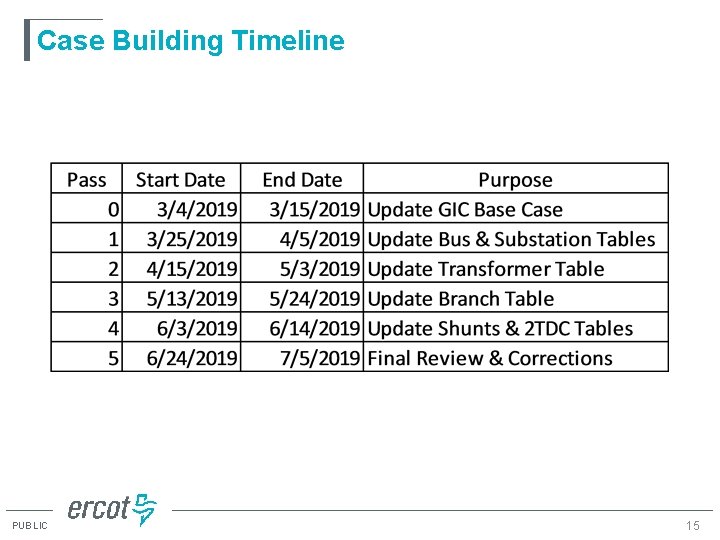
Case Building Timeline PUBLIC 15
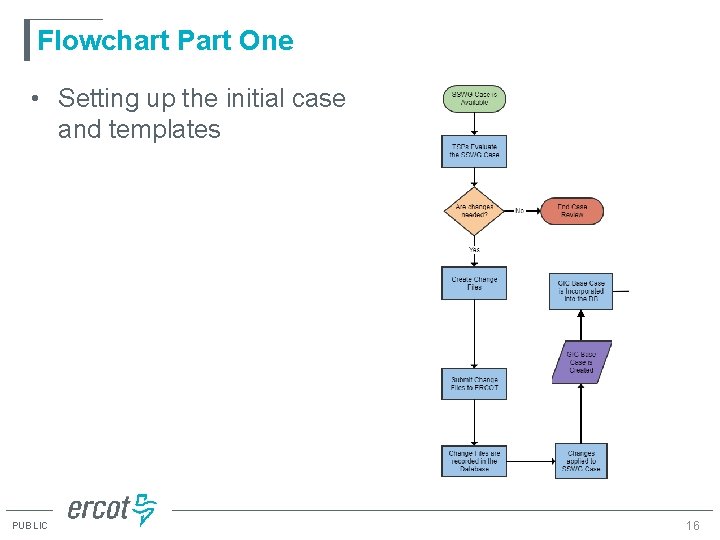
Flowchart Part One • Setting up the initial case and templates PUBLIC 16
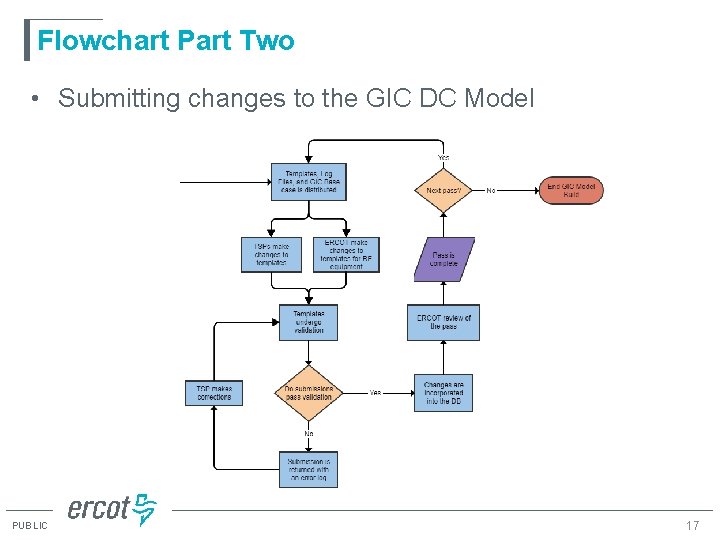
Flowchart Part Two • Submitting changes to the GIC DC Model PUBLIC 17
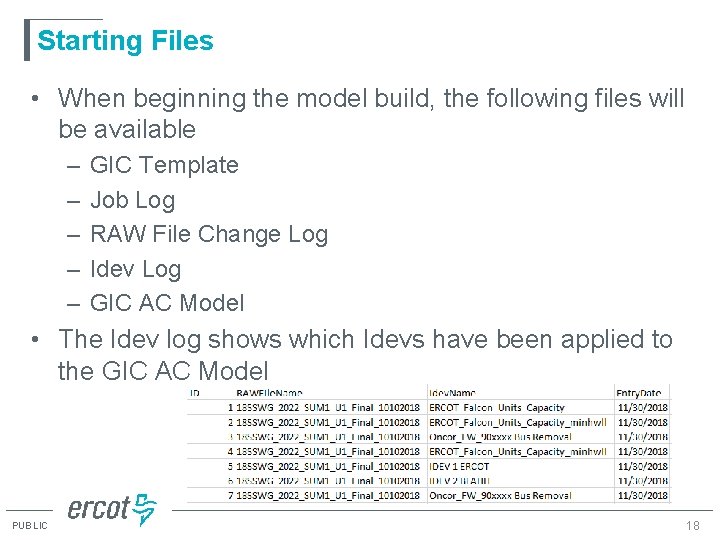
Starting Files • When beginning the model build, the following files will be available – – – GIC Template Job Log RAW File Change Log Idev Log GIC AC Model • The Idev log shows which Idevs have been applied to the GIC AC Model PUBLIC 18
How to Submit • Use the ERCOT supplied template to submit changes • Email the ERCOT Modeler with the modified template • Two Options: – Modify the provided template – Delete all info from the template except the headers and then make all the changes – Either option works and depends on user preference PUBLIC 19
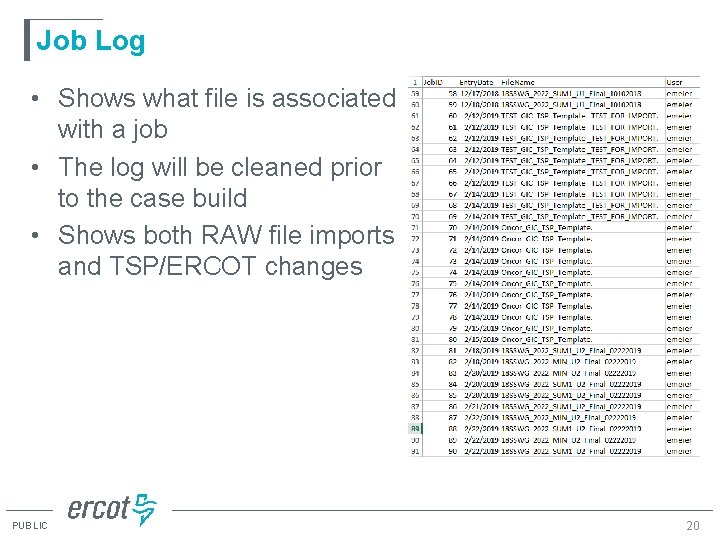
Job Log • Shows what file is associated with a job • The log will be cleaned prior to the case build • Shows both RAW file imports and TSP/ERCOT changes PUBLIC 20
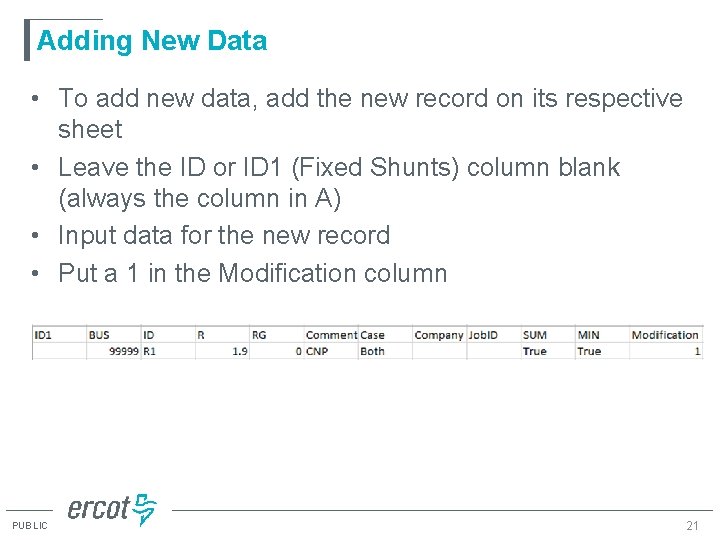
Adding New Data • To add new data, add the new record on its respective sheet • Leave the ID or ID 1 (Fixed Shunts) column blank (always the column in A) • Input data for the new record • Put a 1 in the Modification column PUBLIC 21
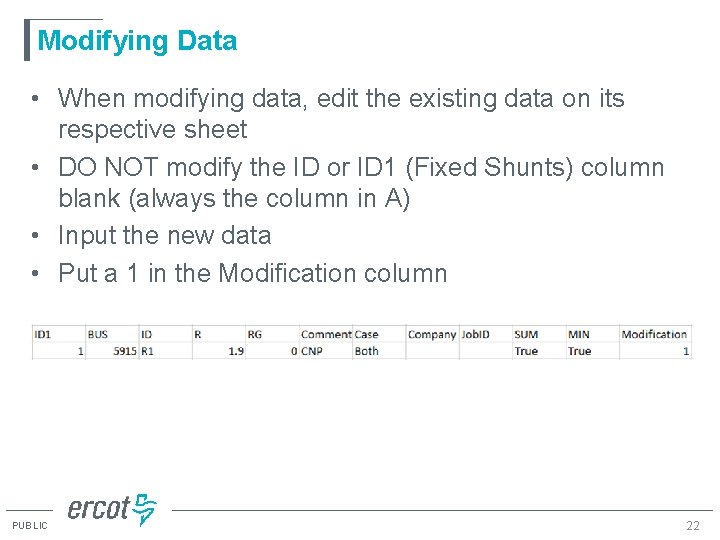
Modifying Data • When modifying data, edit the existing data on its respective sheet • DO NOT modify the ID or ID 1 (Fixed Shunts) column blank (always the column in A) • Input the new data • Put a 1 in the Modification column PUBLIC 22
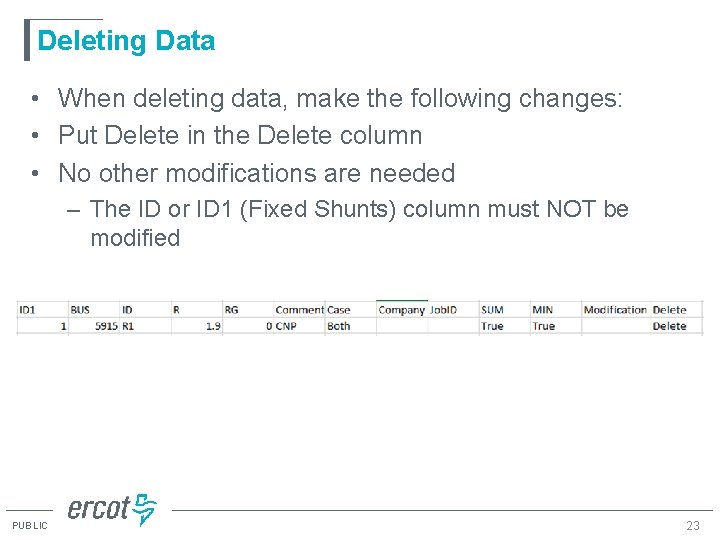
Deleting Data • When deleting data, make the following changes: • Put Delete in the Delete column • No other modifications are needed – The ID or ID 1 (Fixed Shunts) column must NOT be modified PUBLIC 23
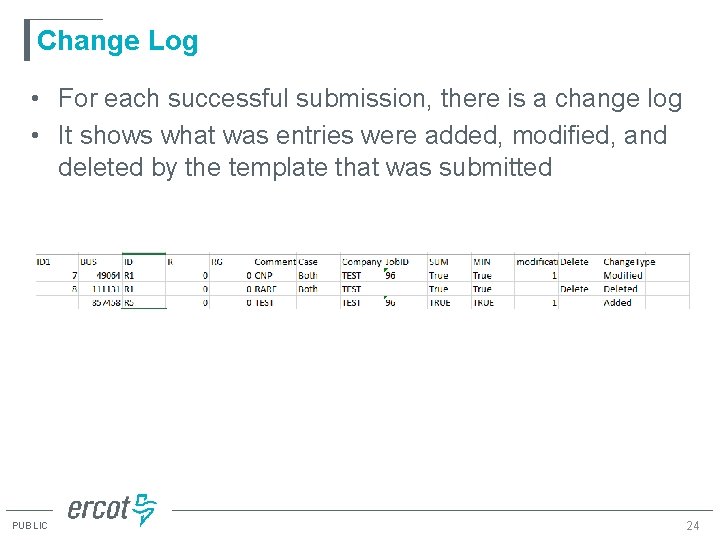
Change Log • For each successful submission, there is a change log • It shows what was entries were added, modified, and deleted by the template that was submitted PUBLIC 24
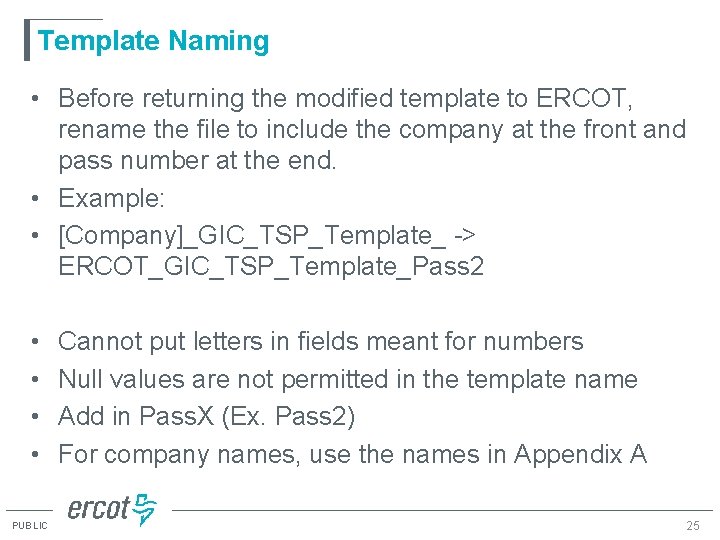
Template Naming • Before returning the modified template to ERCOT, rename the file to include the company at the front and pass number at the end. • Example: • [Company]_GIC_TSP_Template_ -> ERCOT_GIC_TSP_Template_Pass 2 • • PUBLIC Cannot put letters in fields meant for numbers Null values are not permitted in the template name Add in Pass. X (Ex. Pass 2) For company names, use the names in Appendix A 25
Data Submission • If a secure data transmission method is need, use the following: • Submit templates in an encrypted ZIP file. • The zip file should then be encrypted, not the Excel template. – By encrypting the zip file and not the template, corruption of the template is less likely. • The encrypted zip file should then be emailed to the ERCOT modeler. • The password should follow in a separate, second email to the ERCOT modeler. PUBLIC 26
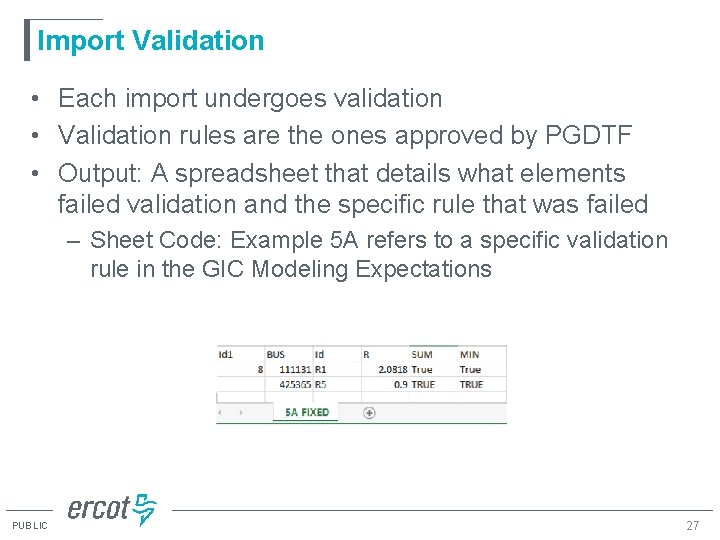
Import Validation • Each import undergoes validation • Validation rules are the ones approved by PGDTF • Output: A spreadsheet that details what elements failed validation and the specific rule that was failed – Sheet Code: Example 5 A refers to a specific validation rule in the GIC Modeling Expectations PUBLIC 27
Full Database Validation • Validation rules are only run on new submissions • However it was also expanded to run on the entire database • Elements in the database fail to meet the following rules 1 A, 4 D, 4 E, 5 B_Fixed, 5 B_Switched, 6 A • Excluding Lat and Long Issues there are 444 validation issues of existing data PUBLIC 28
Questions? PUBLIC
New Earth Model Regions Boundaries • At the NERC GMDTF meeting, EPRI presented on a new report – Use of Magnetotelluric Measurement Data to Validate/Improve Existing Earth Conductivity Models • In the report is a map of updated 1 D regional boundaries for the United States earth model • The boundaries near and in Texas have changed a bit • This is not in the GIC Modeling Expectations PUBLIC 30