
Tier 1 Virtual Training Day 2 Behavioral Expectations
Tier 1 Virtual Training Day 2 Behavioral Expectations (TFI 1. 3) Virtual Training: Defining & Teaching Expectations 1. 3 & 1. 4
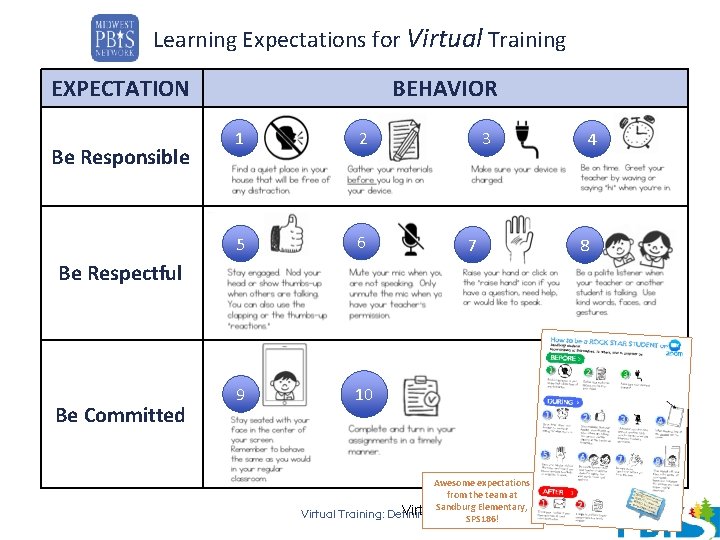
Learning Expectations for Virtual Training EXPECTATION Be Responsible BEHAVIOR 1 2 5 6 9 10 3 7 4 8 Be Respectful Be Committed Awesome expectations from the team at Sandburg Elementary, Virtual Tier. SPS 186! 1 Training TFI 1. 3 and Virtual Training: Defining & Teaching Expectations 1. 3 & 1. 4 2
Virtual Tier 1 Team Training Day 2: Welcome Back! Attn Coaches and Note-Takers 1. To help you facilitate your team’s discussion during breakouts, you can download today’s NEW Power. Point at: http: //www. midwestpbis. org/materials/tier-i-team-training 2. In CHAT, report out from yesterday. What is one action item you documented from any of these sections: TFI 1. 1, 1. 2, 1. 13? ur HAT o y Virtual Tier 1 Trainingre TFI 1. 3 and 1. 4 C 3 a Virtual Training: Defining & Teaching Expectations 1. 3 &in 1. 4 h e S mpl
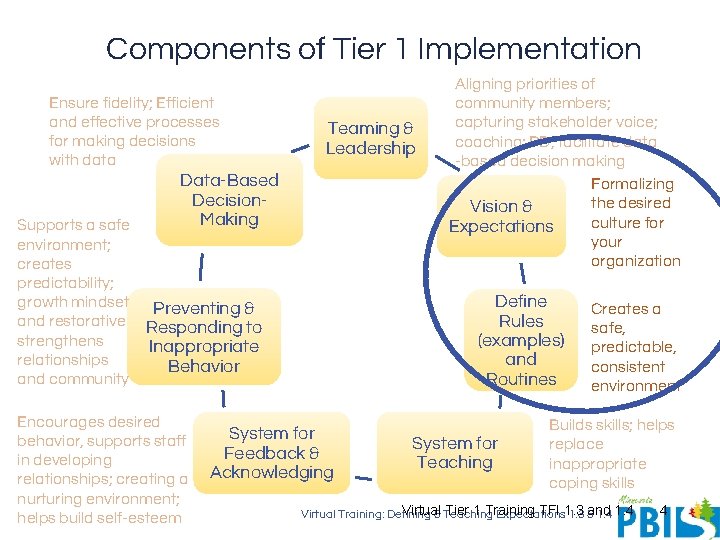
Components of Tier 1 Implementation Ensure fidelity; Efficient and effective processes for making decisions with data Teaming & Leadership Data-Based Decision. Making Supports a safe environment; creates predictability; growth mindset Preventing & and restorative Responding to strengthens Inappropriate relationships Behavior and community Encourages desired behavior, supports staff in developing relationships; creating a nurturing environment; helps build self-esteem Aligning priorities of community members; capturing stakeholder voice; coaching; PD; facilitate data -based decision making Formalizing the desired Vision & culture for Expectations your organization Define Rules (examples) and Routines System for Feedback & Acknowledging System for Teaching Creates a safe, predictable, consistent environment Builds skills; helps replace inappropriate coping skills Virtual Tier 1 Training TFI 1. 3 and Virtual Training: Defining & Teaching Expectations 1. 3 & 1. 4 4
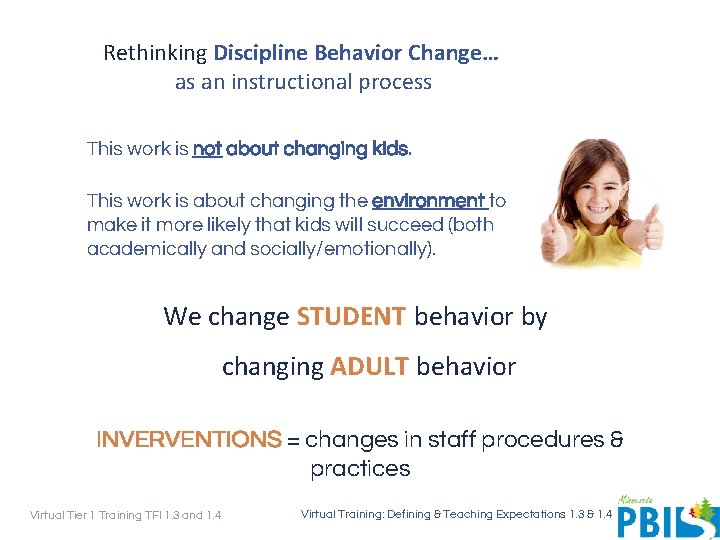
Rethinking Discipline Behavior Change… as an instructional process This work is not about changing kids. This work is about changing the environment to make it more likely that kids will succeed (both academically and socially/emotionally). We change STUDENT behavior by changing ADULT behavior INVERVENTIONS = changes in staff procedures & practices Virtual Tier 1 Training TFI 1. 3 and 1. 4 Virtual Training: Defining & Teaching Expectations 1. 3 & 1. 4 5
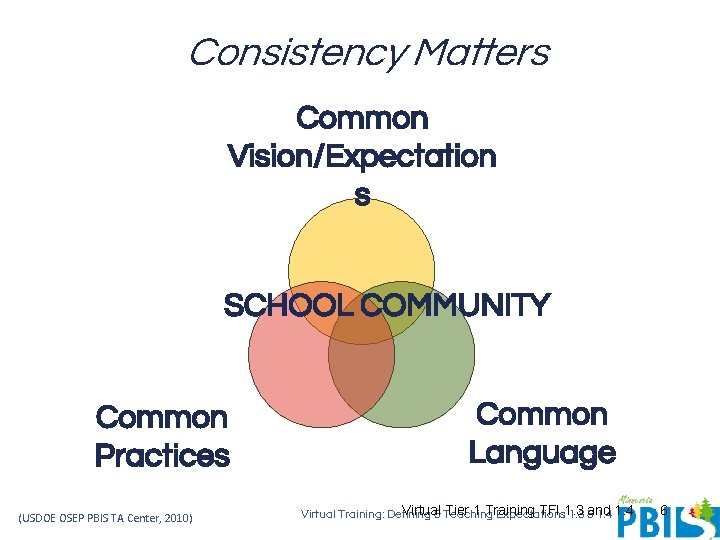
Consistency Matters Common Vision/Expectation s SCHOOL COMMUNITY Common Practices (USDOE OSEP PBIS TA Center, 2010) Common Language Virtual Tier 1 Training TFI 1. 3 and Virtual Training: Defining & Teaching Expectations 1. 3 & 1. 4 6
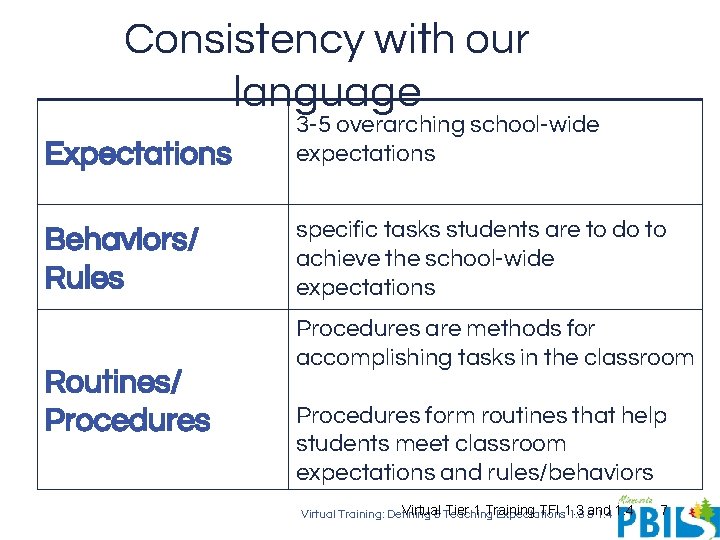
Consistency with our language Expectations 3 -5 overarching school-wide expectations Behaviors/ Rules specific tasks students are to do to achieve the school-wide expectations Routines/ Procedures are methods for accomplishing tasks in the classroom Procedures form routines that help students meet classroom expectations and rules/behaviors Virtual Tier 1 Training TFI 1. 3 and Virtual Training: Defining & Teaching Expectations 1. 3 & 1. 4 7
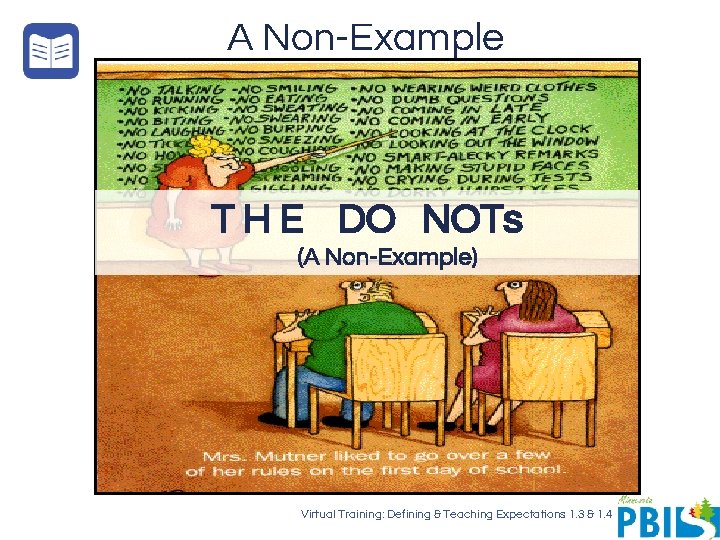
A Non-Example T H E DO NOTs (A Non-Example) Virtual Training: Defining & Teaching Expectations 1. 3 & 1. 4
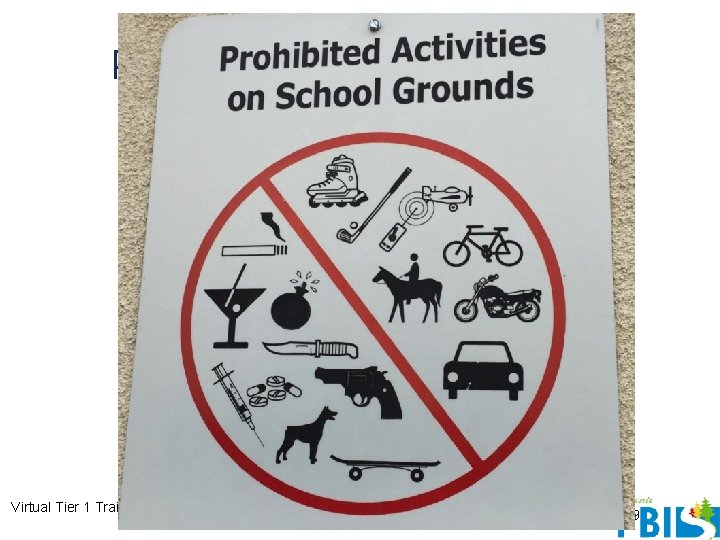
Prohibited Activities Virtual Tier 1 Training TFI 1. 3 and 1. 4 Virtual Training: Defining & Teaching Expectations 1. 3 & 1. 4 9
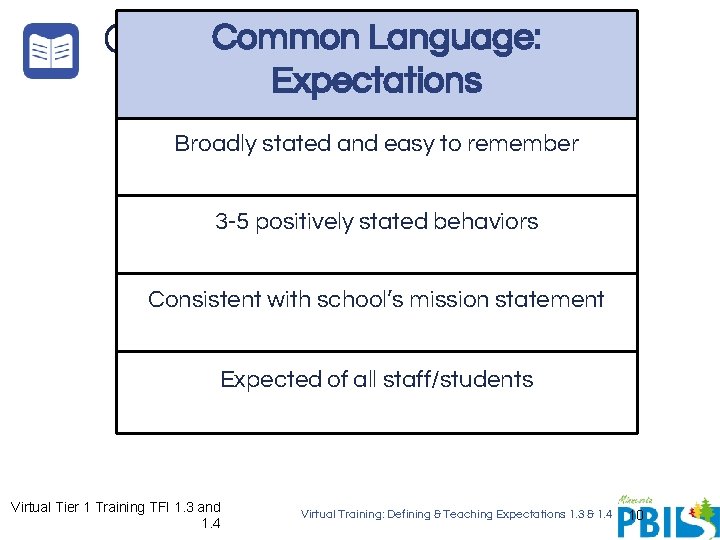
Common Language: Expectations Broadly stated and easy to remember 3 -5 positively stated behaviors Consistent with school’s mission statement Expected of all staff/students Virtual Tier 1 Training TFI 1. 3 and 1. 4 Virtual Training: Defining & Teaching Expectations 1. 3 & 1. 4 10
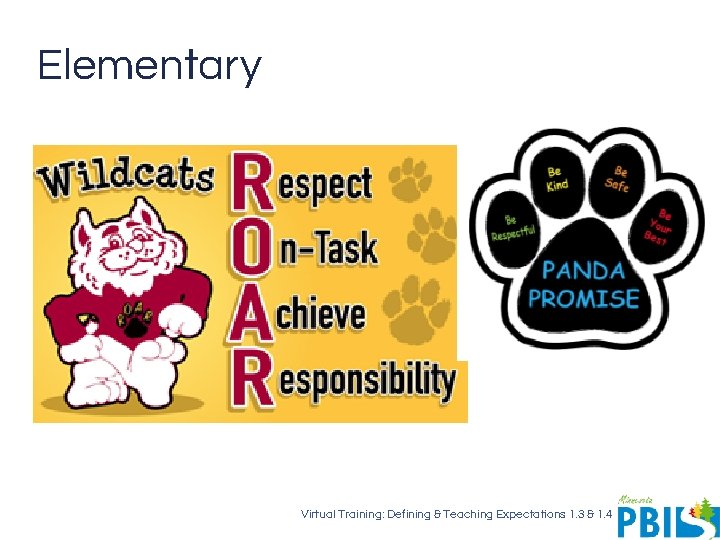
Elementary Virtual Training: Defining & Teaching Expectations 1. 3 & 1. 4
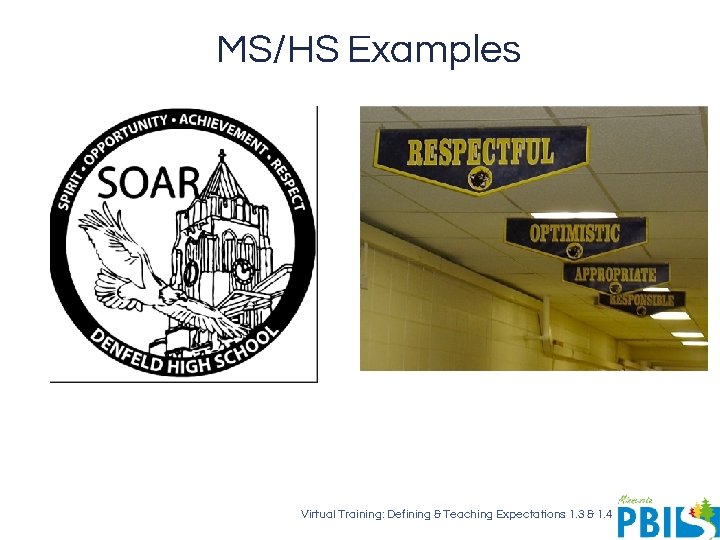
MS/HS Examples Virtual Training: Defining & Teaching Expectations 1. 3 & 1. 4
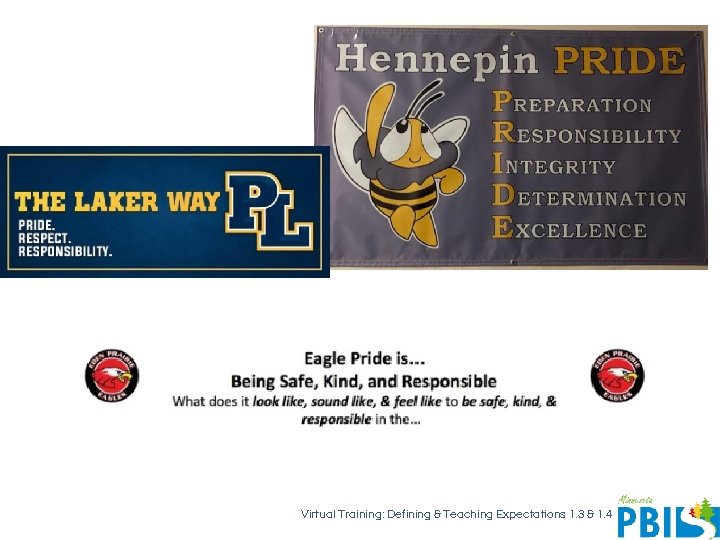
Expectations Examples Virtual Training: Defining & Teaching Expectations 1. 3 & 1. 4
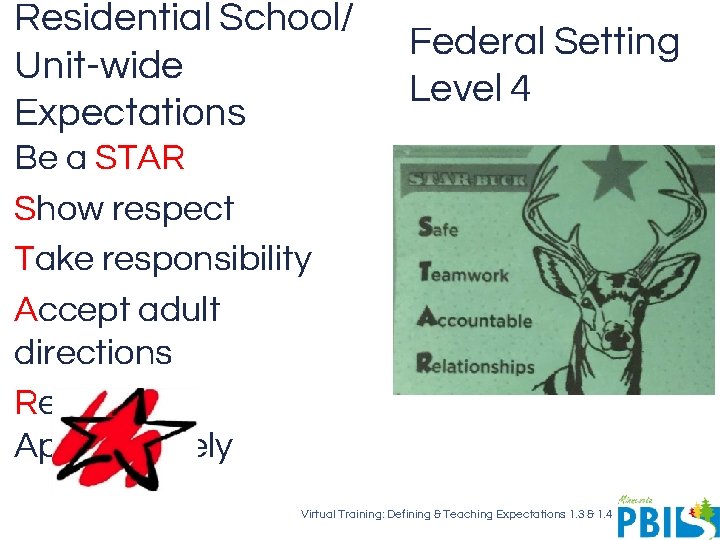
Residential School/ Unit-wide Expectations Federal Setting Level 4 Be a STAR Show respect Take responsibility Accept adult directions Respond Appropriately Virtual Training: Defining & Teaching Expectations 1. 3 & 1. 4
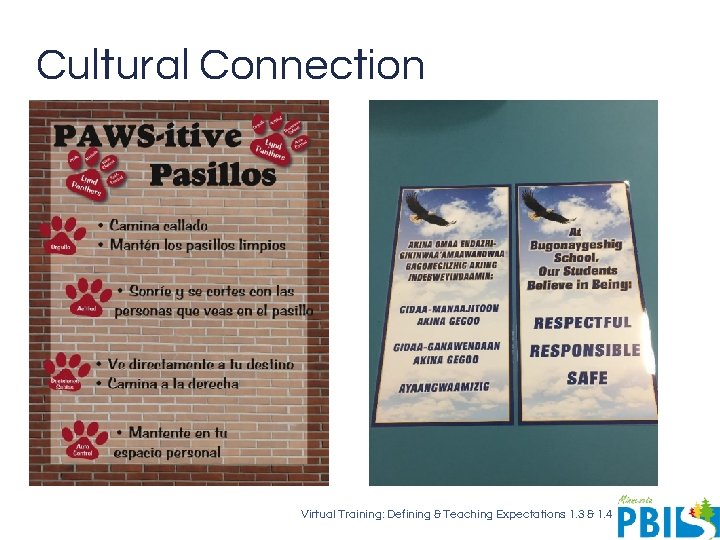
Cultural Connection Virtual Training: Defining & Teaching Expectations 1. 3 & 1. 4
Build Your 3 -5 School-wide Expectations • • • Think school vision statement Think School Improvement Plan Think data: what is showing up in your school? Think about what you already have in your school Get input from stakeholders What words describe the culture you want in your school? Workbook: TFI 1. 3 Activity 1 • Can you also come up with a name for your school-wide expectations? • The Wilson Way • Tiger ROAR • SOAR Expectations • Panther Pride • Bradley B’s Virtual Tier 1 Training TFI 1. 3 and Virtual Training: Defining & Teaching Expectations 1. 3 & 1. 4 16
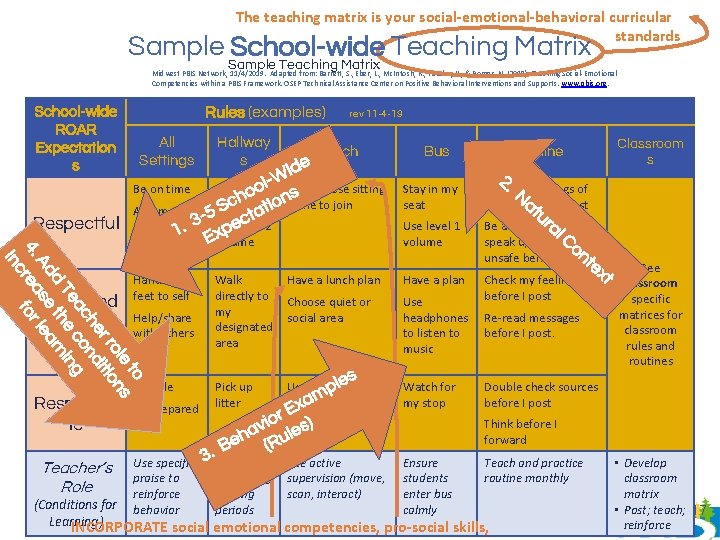
The teaching matrix is your social-emotional-behavioral curricular standards Sample School-wide Teaching Matrix Midwest PBIS Network, 11/4/2019. Adapted from: Barrett, S. , Eber, L. , Mc. Intosh, K. , Perales, K. , & Romer, N. (2018). Teaching Social-Emotional Competencies within a PBIS Framework. OSEP Technical Assistance Center on Positive Behavioral Interventions and Supports. www. pbis. org. School-wide ROAR Expectation s Rules (examples) All Settings Hallway s rev 11 -4 -19 Lunch to s ole n r r itio he nd ac co g Te the rnin d Ad se lea 4. rea for c In ide W ol- Invite Be on time Walk to o s those sitting h n c the S right tio alone to join Assume a 5 t c Respectful positive 1. 3 Use pelevel 2 x Evolume intent Organized and Achieving Responsib le Teacher’s Role Hands and feet to self Help/share with others Recycle Be prepared Use specific praise to reinforce behavior Walk directly to my designated area Pick up litter Stay in my seat Use level 1 volume Have a lunch plan Have a plan Choose quiet or social area Use headphones to listen to music s le Use my p breathing m technique xa E r Listen o i av usignals es) to my l h Be (R. 3 Stand in Use active hall during passing periods Bus Watch for my stop Classroom s Online 2 . N feelings of Consider at I post others before u ra – Be an upstander l speak up when. CIosee unsafe behavior nt Check my feelings before I post ex Re-read messages before I post. t See classroom specific matrices for classroom rules and routines Double check sources before I post Think before I forward Ensure Teach and practice • supervision (move, students routine monthly scan, interact) enter bus calmly& Teaching Expectations 1. 3 & 1. 4 • Virtual Training: Defining (Conditions for Learning) INCORPORATE social emotional competencies, pro-social skills, Develop classroom matrix Post; teach; 17 reinforce
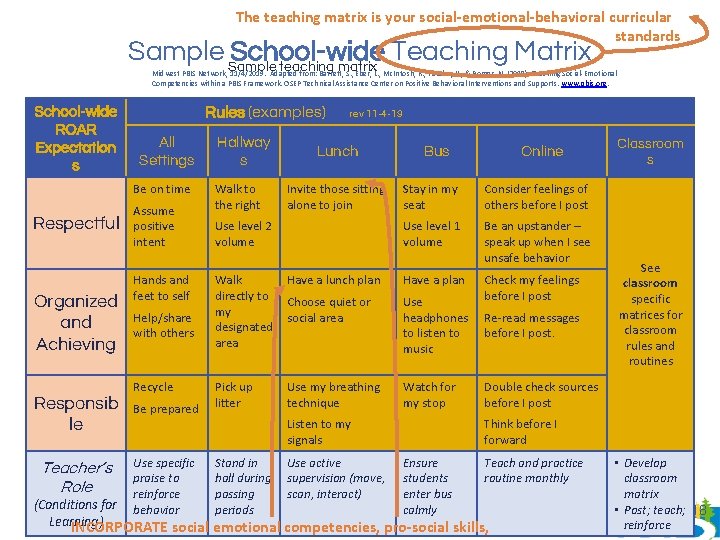
The teaching matrix is your social-emotional-behavioral curricular standards Sample School-wide Teaching Matrix teaching matrix Midwest PBIS Network, 11/4/2019. Adapted from: Barrett, S. , Eber, L. , Mc. Intosh, K. , Perales, K. , & Romer, N. (2018). Teaching Social-Emotional Competencies within a PBIS Framework. OSEP Technical Assistance Center on Positive Behavioral Interventions and Supports. www. pbis. org. School-wide ROAR Expectation s Rules (examples) All Settings Be on time Respectful Organized and Achieving Responsib le Teacher’s Role Assume positive intent Hands and feet to self Hallway s Walk to the right rev 11 -4 -19 Lunch Invite those sitting alone to join Use level 2 volume Bus Stay in my seat Consider feelings of others before I post Use level 1 volume Be an upstander – speak up when I see unsafe behavior Walk directly to my designated area Have a lunch plan Have a plan Choose quiet or social area Use headphones to listen to music Be prepared Pick up litter Use my breathing technique Watch for my stop Use specific praise to reinforce behavior Stand in hall during passing periods Help/share with others Recycle Listen to my signals Use active supervision (move, scan, interact) Online Check my feelings before I post Re-read messages before I post. Classroom s See classroom specific matrices for classroom rules and routines Double check sources before I post Think before I forward Ensure students enter bus calmly Teach and practice routine monthly (Conditions for Day 2 A: Behavioral Expectations (TFI 1. 3) Learning) INCORPORATE social emotional competencies, pro-social skills, • Develop classroom matrix • Post; teach; 18 reinforce
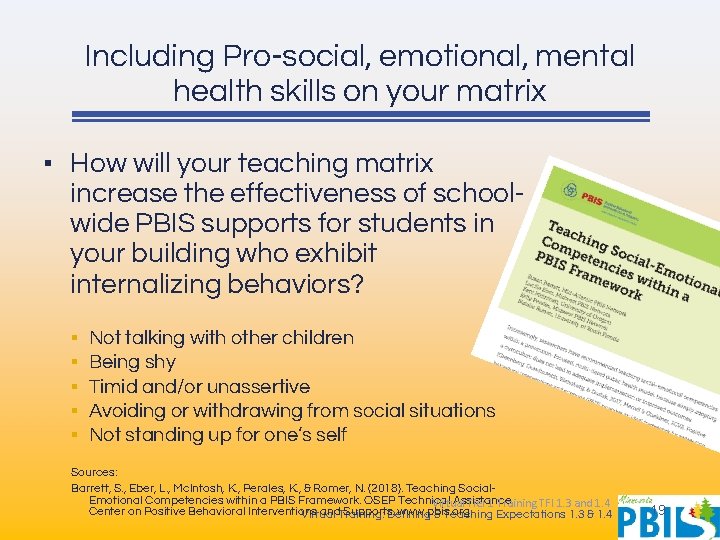
Including Pro-social, emotional, mental health skills on your matrix ▪ How will your teaching matrix increase the effectiveness of schoolwide PBIS supports for students in your building who exhibit internalizing behaviors? ▪ ▪ ▪ Not talking with other children Being shy Timid and/or unassertive Avoiding or withdrawing from social situations Not standing up for one’s self Sources: Barrett, S. , Eber, L. , Mc. Intosh, K. , Perales, K. , & Romer, N. (2018). Teaching Social. Emotional Competencies within a PBIS Framework. OSEP Technical Assistance Virtual Tier 1 Training TFI 1. 3 and 1. 4 Center on Positive Behavioral Interventions and Supports. www. pbis. org. Virtual Training: Defining & Teaching Expectations 1. 3 & 1. 4 19
Discuss in breakout Team Time Continue creating or improving your matrix and plan for engaging school community (staff, students, families) Prepare to share one location Workbook: TFI 1. 3 Activities 5 & 6 Tier. Expectations 1 Training TFI 1. 3&and Virtual Training: Defining &Virtual Teaching 1. 4 20
Classroom Day 5 will be dedicated to supporting PBIS in the classroom. Virtual Training: Defining & Teaching Expectations 1. 3 & 1. 4
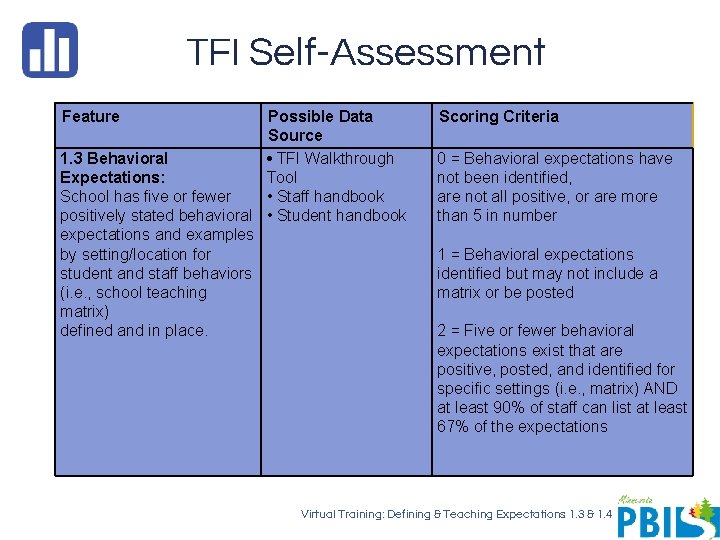
TFI Self-Assessment Feature Possible Data Source 1. 3 Behavioral • TFI Walkthrough Expectations: Tool School has five or fewer • Staff handbook positively stated behavioral • Student handbook expectations and examples by setting/location for student and staff behaviors (i. e. , school teaching matrix) defined and in place. Scoring Criteria 0 = Behavioral expectations have not been identified, are not all positive, or are more than 5 in number 1 = Behavioral expectations identified but may not include a matrix or be posted 2 = Five or fewer behavioral expectations exist that are positive, posted, and identified for specific settings (i. e. , matrix) AND at least 90% of staff can list at least 67% of the expectations Virtual Training: Defining & Teaching Expectations 1. 3 & 1. 4
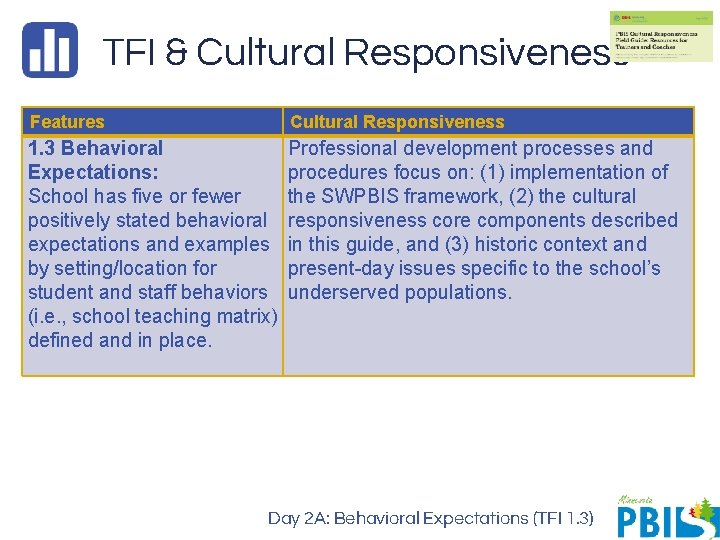
TFI & Cultural Responsiveness Features Cultural Responsiveness 1. 3 Behavioral Expectations: School has five or fewer positively stated behavioral expectations and examples by setting/location for student and staff behaviors (i. e. , school teaching matrix) defined and in place. Professional development processes and procedures focus on: (1) implementation of the SWPBIS framework, (2) the cultural responsiveness core components described in this guide, and (3) historic context and present-day issues specific to the school’s underserved populations. Day 2 A: Behavioral Expectations (TFI 1. 3)
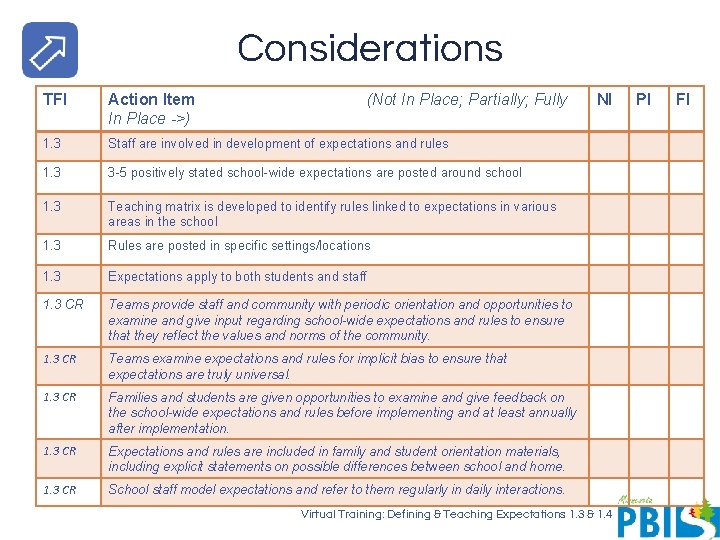
Considerations TFI Action Item In Place ->) (Not In Place; Partially; Fully 1. 3 Staff are involved in development of expectations and rules 1. 3 3 -5 positively stated school-wide expectations are posted around school 1. 3 Teaching matrix is developed to identify rules linked to expectations in various areas in the school 1. 3 Rules are posted in specific settings/locations 1. 3 Expectations apply to both students and staff 1. 3 CR Teams provide staff and community with periodic orientation and opportunities to examine and give input regarding school-wide expectations and rules to ensure that they reflect the values and norms of the community. 1. 3 CR Teams examine expectations and rules for implicit bias to ensure that expectations are truly universal. 1. 3 CR Families and students are given opportunities to examine and give feedback on the school-wide expectations and rules before implementing and at least annually after implementation. 1. 3 CR Expectations and rules are included in family and student orientation materials, including explicit statements on possible differences between school and home. 1. 3 CR School staff model expectations and refer to them regularly in daily interactions. NI Virtual Training: Defining & Teaching Expectations 1. 3 & 1. 4 PI FI
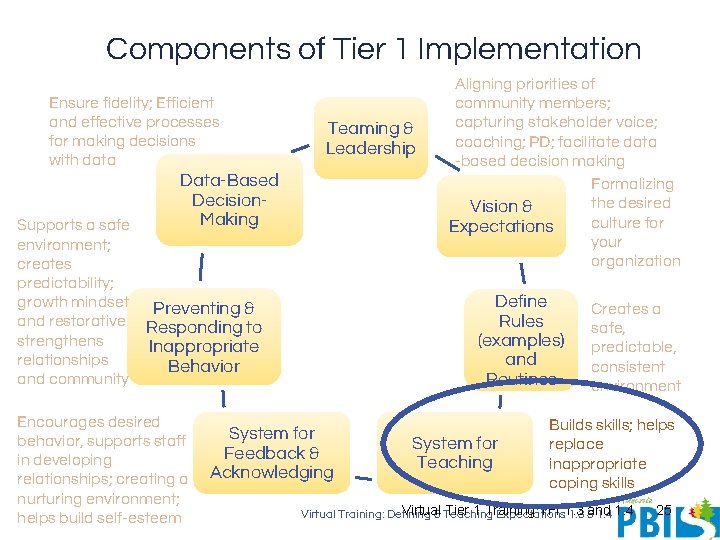
Components of Tier 1 Implementation Ensure fidelity; Efficient and effective processes for making decisions with data Teaming & Leadership Data-Based Decision. Making Supports a safe environment; creates predictability; growth mindset Preventing & and restorative Responding to strengthens Inappropriate relationships Behavior and community Encourages desired behavior, supports staff in developing relationships; creating a nurturing environment; helps build self-esteem Aligning priorities of community members; capturing stakeholder voice; coaching; PD; facilitate data -based decision making Formalizing the desired Vision & culture for Expectations your organization Define Rules (examples) and Routines System for Feedback & Acknowledging System for Teaching Creates a safe, predictable, consistent environment Builds skills; helps replace inappropriate coping skills Virtual Tier 1 Training TFI 1. 3 and Virtual Training: Defining & Teaching Expectations 1. 3 & 1. 4 25
Define Expectations Teaching Behavior Virtual Tier 1 Training TFI 1. 3 and 1. 4 Virtual Training: Defining & Teaching Expectations 1. 3 & 1. 4 26
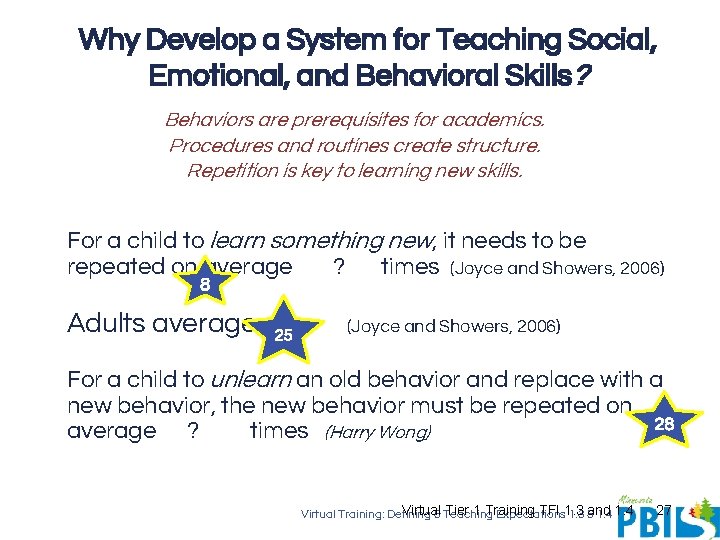
Why Develop a System for Teaching Social, Emotional, and Behavioral Skills? Behaviors are prerequisites for academics. Procedures and routines create structure. Repetition is key to learning new skills. For a child to learn something new, it needs to be repeated on average ? times (Joyce and Showers, 2006) 8 Adults average ? 25 (Joyce and Showers, 2006) For a child to unlearn an old behavior and replace with a new behavior, the new behavior must be repeated on 28 average ? times (Harry Wong) Virtual Tier 1 Training TFI 1. 3 and Virtual Training: Defining & Teaching Expectations 1. 3 & 1. 4 27
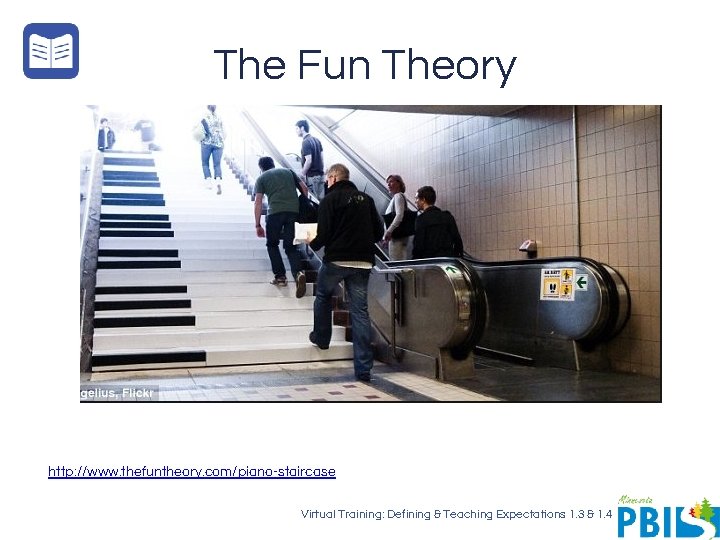
The Fun Theory http: //www. thefuntheory. com/piano-staircase Virtual Training: Defining & Teaching Expectations 1. 3 & 1. 4
Behavior Change The change is an instructional process We change STUDENT behavior by changing ADULT behavior Interventions = changes in staff procedures & practices Virtual Tier 1 Training TFI 1. 3 and Virtual Training: Defining & Teaching Expectations 1. 3 & 1. 4 29
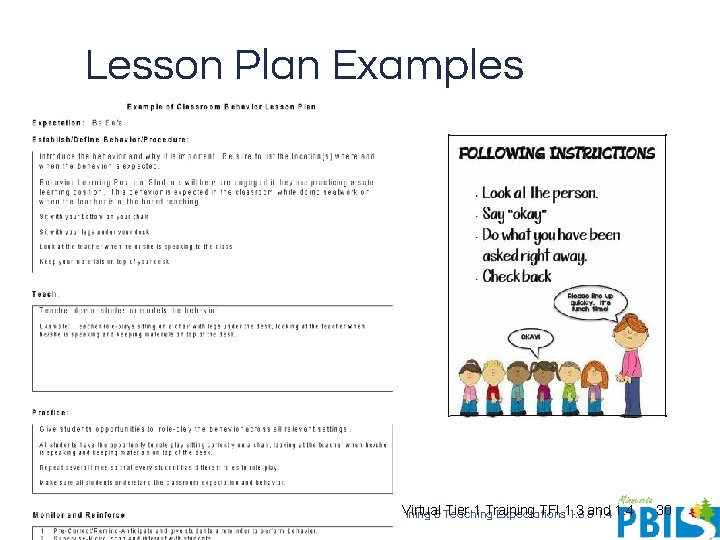
Lesson Plan Examples Virtual Tier 1 Training TFI 1. 3 and Virtual Training: Defining & Teaching Expectations 1. 3 & 1. 4 30
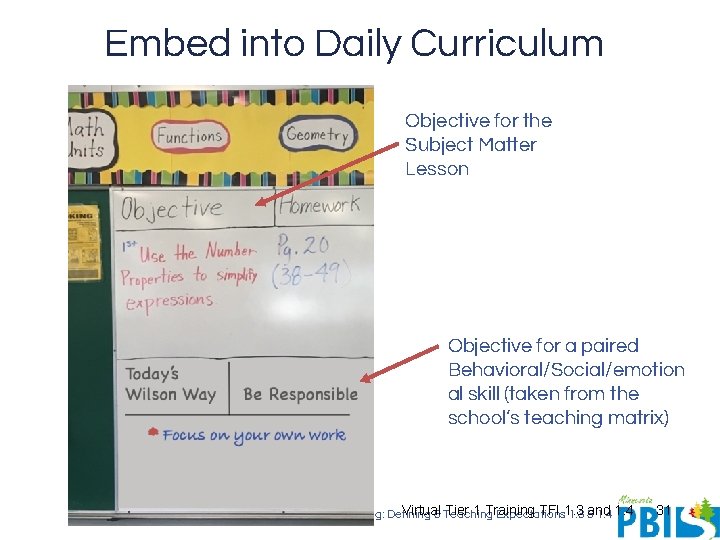
Embed into Daily Curriculum Objective for the Subject Matter Lesson Objective for a paired Behavioral/Social/emotion al skill (taken from the school’s teaching matrix) Virtual Tier 1 Training TFI 1. 3 and Virtual Training: Defining & Teaching Expectations 1. 3 & 1. 4 31
Will you teach through Videos? Important Considerations When Making Teaching Videos ✔ Matching the climate of your building ✔ Making sure they are data driven ✔ Pairing them with follow up activities (Discussion, etc. ) ✔ Do not roll-play non-examples. Video’s should demonstrate the positive examples only. ✔ Involve students in the process ✔ Ensure students involved are representative of your student body Virtual Tier 1 Training TFI 1. 3 and 1. 4 Virtual Training: Defining & Teaching Expectations 1. 3 & 1. 4 32
Using Instructional Videos. Transition Procedure Virtual Tier 1 Training TFI 1. 3 and Virtual Training: Defining & Teaching Expectations 1. 3 & 1. 4 33
Using Instructional Videos. Arrive on Time https: //youtu. be/5 C-Wyy_l. PNk Virtual Tier 1 Training TFI 1. 3 and Virtual Training: Defining & Teaching Expectations 1. 3 & 1. 4 34
Plan for Teaching Expectations Discuss in breakout TFI 1. 4 Activity 2 (workbook) ✧ How will your school teach the expectations? (Lesson plans that include examples, practicing, variety of teaching strategies, etc. ) ✧ How will lessons be taught throughout the school year? ✧ How will you start to embed into subject area curriculum? ✧ Will faculty and staff model appropriate behavior? ✧ How will lessons be taught to new students and new faculty/staff? 35 Virtual Tier 1 Training TFI 1. 3 and 1. 4 Virtual Training: Defining & Teaching Expectations 1. 3 & 1. 4
Appreciation is given to the following for their contributions to this Professional Learning: Virtual Training: Defining & Teaching Expectations 1. 3 & 1. 4
Food for Thought… ▪ ▪ ▪ If a child doesn’t know how to read, we teach. If a child doesn’t know how to swim, we teach. If a child doesn’t know how to multiply, we teach. If a child doesn’t know how to drive, we teach. If a child doesn’t know how to behave, we… teach? punish? Why can’t we finish the last sentence as automatically as we do the others? John Herner (NASDE Preent) Counterpoint 1998, page 2 Virtual Training: Defining & Teaching Expectations 1. 3 & 1. 4
Creating Behavior Lesson Plans ▪ Teachers create lesson plans for each desired ❏ Teams and school staff behavior incorporate real life experiences or values of ▪ Students are taught the students into expectations, rules and lessons. ❏ Teams examine rules for routines for both the reflection of dominant school-wide system and cultural values that may the classroom-wide need explicit teaching and, if found, define the system. necessity of that skill and a plan for explicitly ▪ Remember… If you are teaching it to all students. seeing problematic behavior, ask, “Have I taught the desired and Virtual Training: Defining & Teaching Expectations 1. 3 & 1. 4
When Will You Teach? Schedule for Teaching Classroom Rules ▪ Beginning of school year ▪ Teach rules for all areas of school, including individual classrooms, during first week of school ▪ After first week, review rules 2 or 3 times/week ▪ Remainder of the year ▪ Review rules periodically as needed ▪ Review rules immediately after a school break ▪ When behavior data indicates a need Virtual Training: Defining & Teaching Expectations 1. 3 & 1. 4
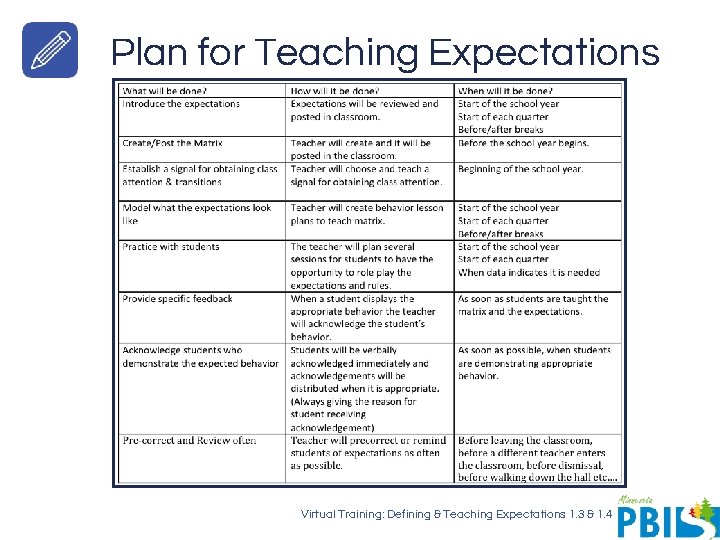
Plan for Teaching Expectations Virtual Training: Defining & Teaching Expectations 1. 3 & 1. 4
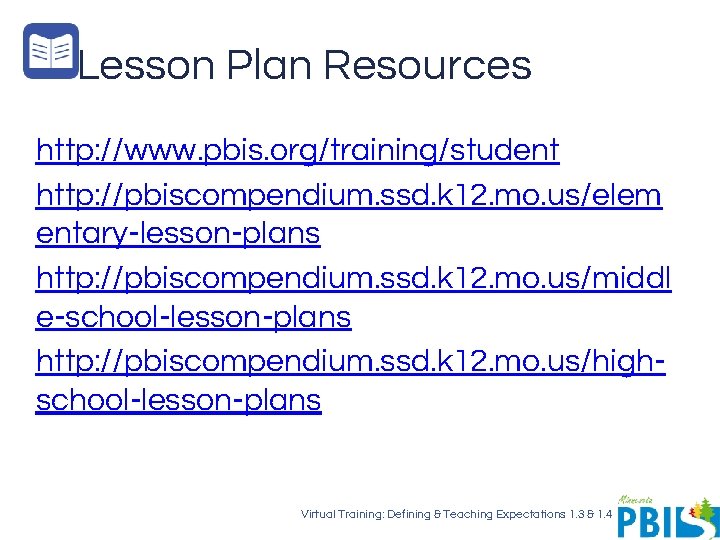
Lesson Plan Resources http: //www. pbis. org/training/student http: //pbiscompendium. ssd. k 12. mo. us/elem entary-lesson-plans http: //pbiscompendium. ssd. k 12. mo. us/middl e-school-lesson-plans http: //pbiscompendium. ssd. k 12. mo. us/highschool-lesson-plans Virtual Training: Defining & Teaching Expectations 1. 3 & 1. 4
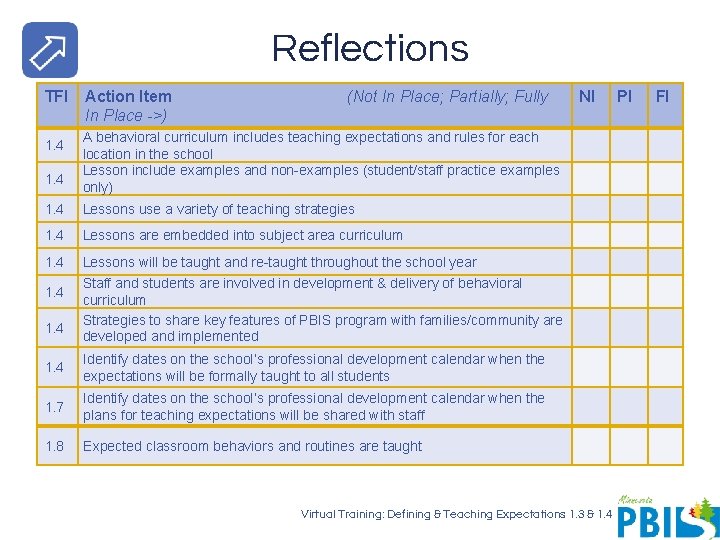
Reflections TFI 1. 4 Action Item In Place ->) (Not In Place; Partially; Fully A behavioral curriculum includes teaching expectations and rules for each location in the school Lesson include examples and non-examples (student/staff practice examples only) 1. 4 Lessons use a variety of teaching strategies 1. 4 Lessons are embedded into subject area curriculum 1. 4 Lessons will be taught and re-taught throughout the school year 1. 4 NI Staff and students are involved in development & delivery of behavioral curriculum Strategies to share key features of PBIS program with families/community are developed and implemented 1. 4 Identify dates on the school’s professional development calendar when the expectations will be formally taught to all students 1. 7 Identify dates on the school’s professional development calendar when the plans for teaching expectations will be shared with staff 1. 8 Expected classroom behaviors and routines are taught Virtual Training: Defining & Teaching Expectations 1. 3 & 1. 4 PI FI
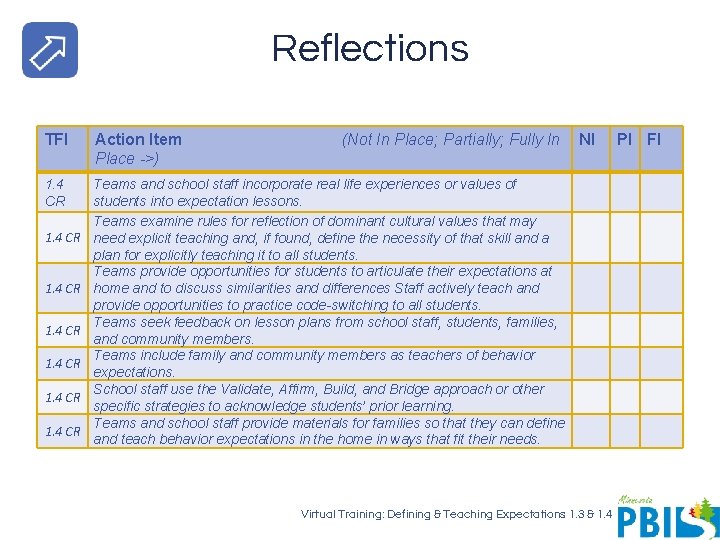
Reflections TFI Action Item Place ->) 1. 4 CR Teams and school staff incorporate real life experiences or values of students into expectation lessons. Teams examine rules for reflection of dominant cultural values that may need explicit teaching and, if found, define the necessity of that skill and a plan for explicitly teaching it to all students. Teams provide opportunities for students to articulate their expectations at home and to discuss similarities and differences Staff actively teach and provide opportunities to practice code-switching to all students. Teams seek feedback on lesson plans from school staff, students, families, and community members. Teams include family and community members as teachers of behavior expectations. School staff use the Validate, Affirm, Build, and Bridge approach or other specific strategies to acknowledge students’ prior learning. Teams and school staff provide materials for families so that they can define and teach behavior expectations in the home in ways that fit their needs. 1. 4 CR (Not In Place; Partially; Fully In NI Virtual Training: Defining & Teaching Expectations 1. 3 & 1. 4 PI FI
- Slides: 43