Gearing Up for Safety Production Agriculture Safety Training
- Slides: 29
Gearing Up for Safety Production Agriculture Safety Training Lesson Nine: ATV & Utility Vehicle Operation 9 -1
Lesson Nine Outline n Injury and fatality data n Pre-operational inspections n ATV and UTVs n Safe starting n Components n Riding procedures n Hazards n Role of body movement n PPE n Safety procedures n Sizing ATVs n Transporting passengers 9 -2
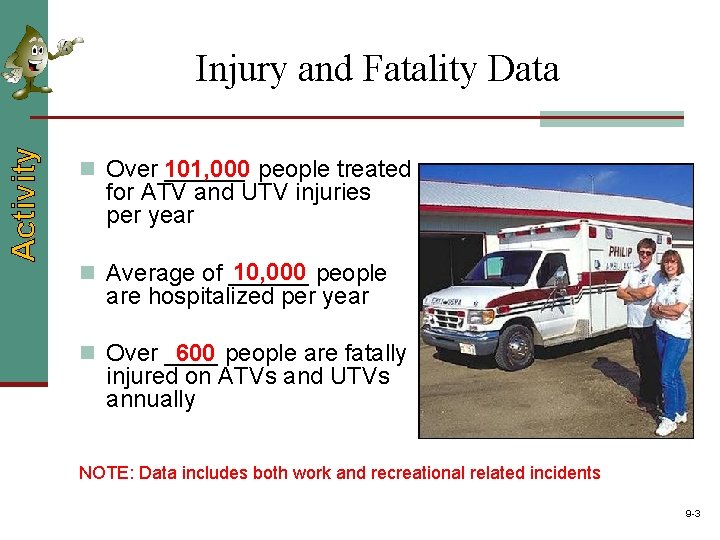
Activity Injury and Fatality Data n Over 101, 000 ______ people treated for ATV and UTV injuries per year 10, 000 people n Average of ______ are hospitalized per year 600 people are fatally n Over ____ injured on ATVs and UTVs annually NOTE: Data includes both work and recreational related incidents 9 -3
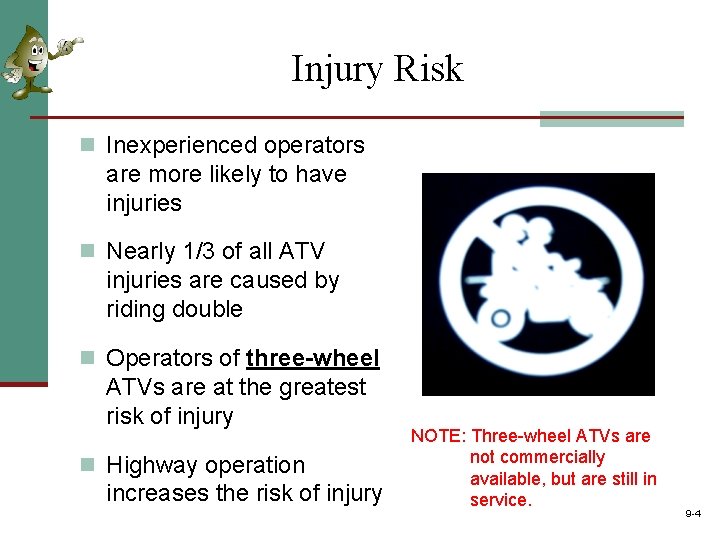
Injury Risk n Inexperienced operators are more likely to have injuries n Nearly 1/3 of all ATV injuries are caused by riding double n Operators of three-wheel ATVs are at the greatest risk of injury n Highway operation increases the risk of injury NOTE: Three-wheel ATVs are not commercially available, but are still in service. 9 -4
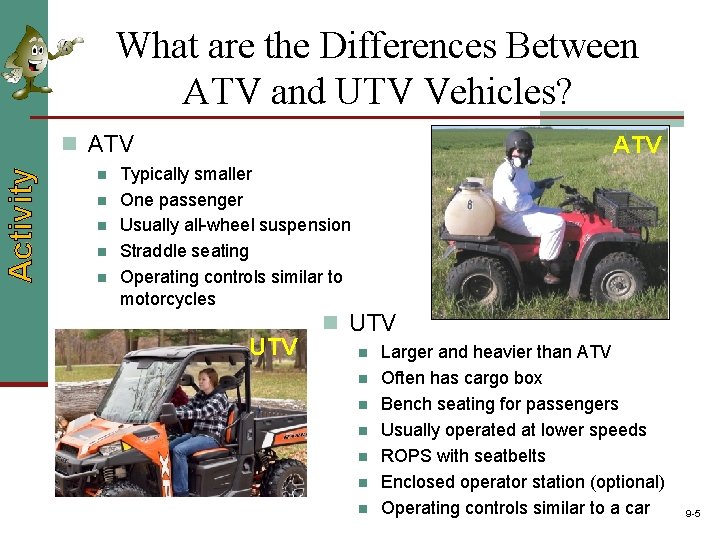
What are the Differences Between ATV and UTV Vehicles? Activity n ATV n n n ATV Typically smaller One passenger Usually all-wheel suspension Straddle seating Operating controls similar to motorcycles UTV n n n n Larger and heavier than ATV Often has cargo box Bench seating for passengers Usually operated at lower speeds ROPS with seatbelts Enclosed operator station (optional) Operating controls similar to a car 9 -5
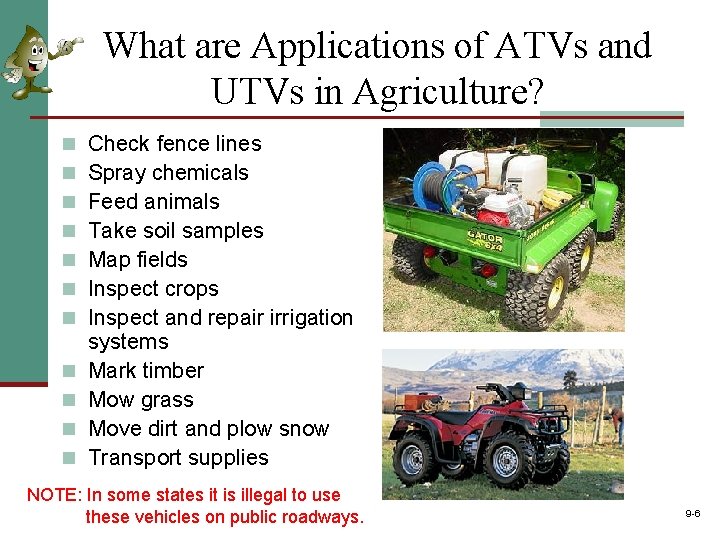
What are Applications of ATVs and UTVs in Agriculture? n n n Check fence lines Spray chemicals Feed animals Take soil samples Map fields Inspect crops Inspect and repair irrigation systems Mark timber Mow grass Move dirt and plow snow Transport supplies NOTE: In some states it is illegal to use these vehicles on public roadways. 9 -6
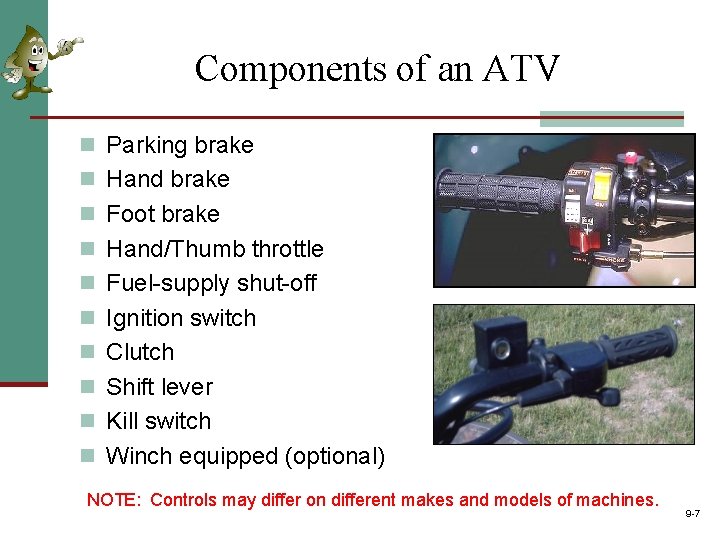
Components of an ATV n Parking brake n Hand brake n Foot brake n Hand/Thumb throttle n Fuel-supply shut-off n Ignition switch n Clutch n Shift lever n Kill switch n Winch equipped (optional) NOTE: Controls may differ on different makes and models of machines. 9 -7
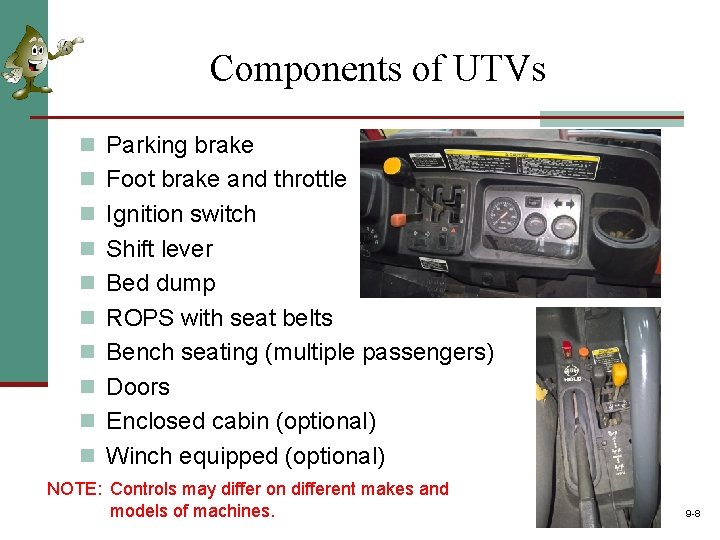
Components of UTVs n Parking brake n Foot brake and throttle n Ignition switch n Shift lever n Bed dump n ROPS with seat belts n Bench seating (multiple passengers) n Doors n Enclosed cabin (optional) n Winch equipped (optional) NOTE: Controls may differ on different makes and models of machines. 9 -8
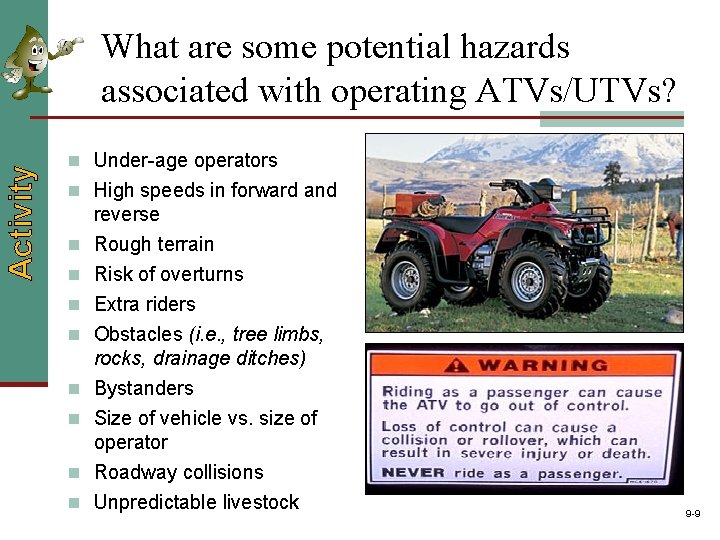
Activity What are some potential hazards associated with operating ATVs/UTVs? n Under-age operators n High speeds in forward and n n n n reverse Rough terrain Risk of overturns Extra riders Obstacles (i. e. , tree limbs, rocks, drainage ditches) Bystanders Size of vehicle vs. size of operator Roadway collisions Unpredictable livestock 9 -9
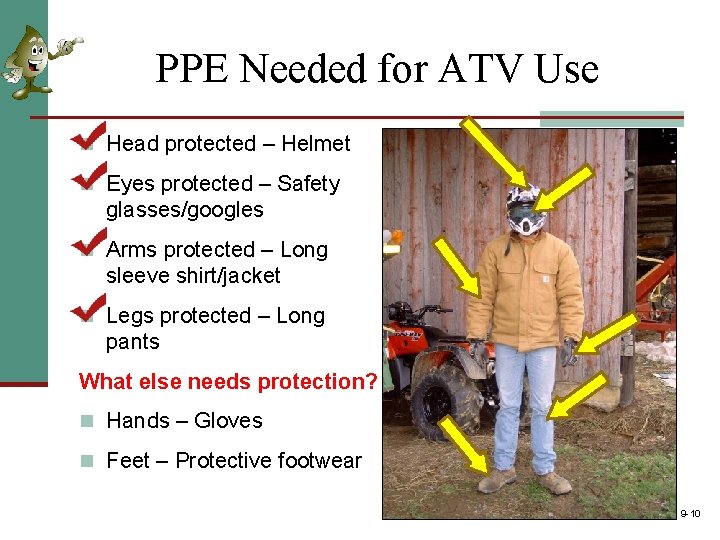
PPE Needed for ATV Use n Head protected – Helmet n Eyes protected – Safety glasses/googles n Arms protected – Long sleeve shirt/jacket n Legs protected – Long pants What else needs protection? n Hands – Gloves n Feet – Protective footwear 9 -10
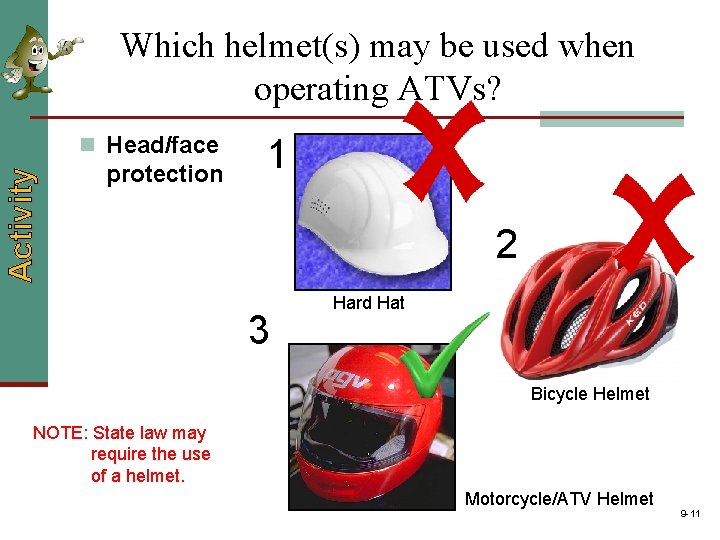
Which helmet(s) may be used when operating ATVs? Activity n Head/face protection 1 2 3 Hard Hat Bicycle Helmet NOTE: State law may require the use of a helmet. Motorcycle/ATV Helmet 9 -11
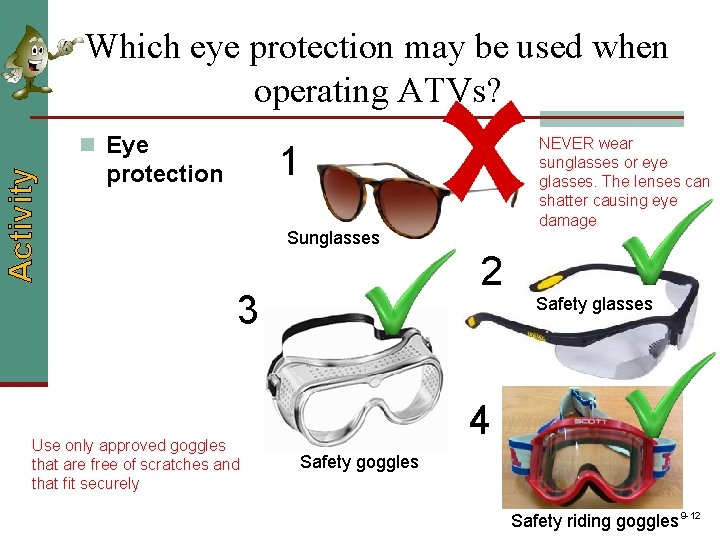
Which eye protection may be used when operating ATVs? Activity n Eye NEVER wear sunglasses or eye glasses. The lenses can shatter causing eye damage 1 protection Sunglasses 2 3 Use only approved goggles that are free of scratches and that fit securely Safety glasses 4 Safety goggles Safety riding goggles 9 -12
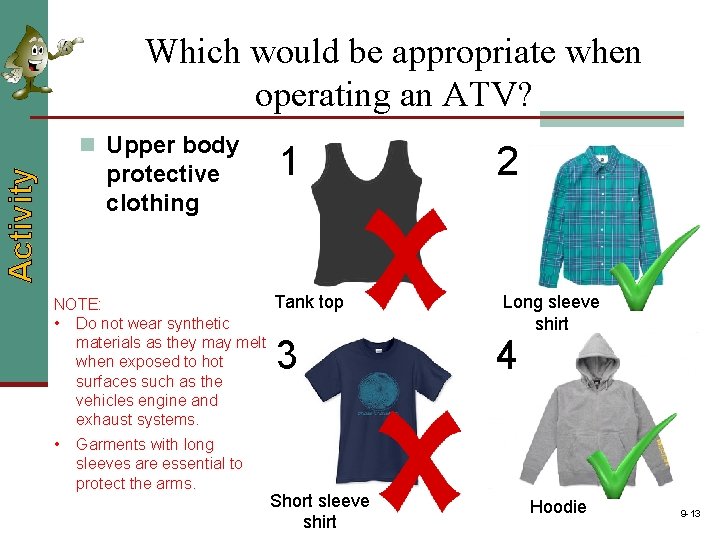
Which would be appropriate when operating an ATV? n Upper body Activity protective clothing 1 Tank top NOTE: • Do not wear synthetic materials as they may melt when exposed to hot surfaces such as the vehicles engine and exhaust systems. 3 • Garments with long sleeves are essential to protect the arms. Short sleeve shirt 2 Long sleeve shirt 4 Hoodie 9 -13
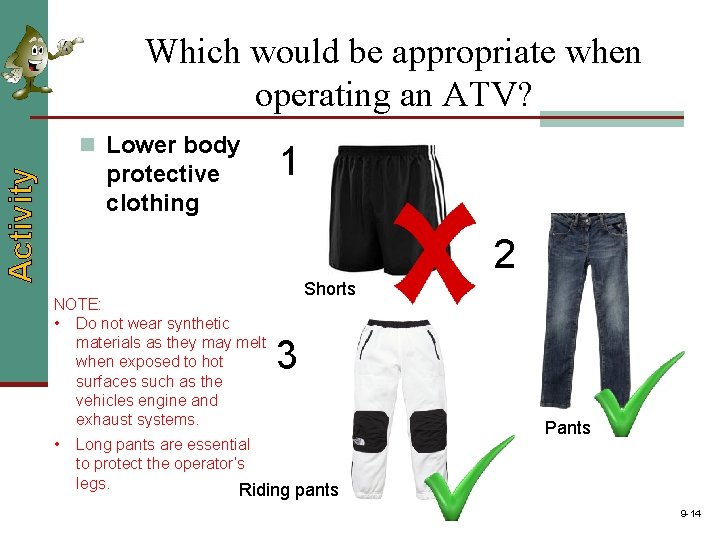
Which would be appropriate when operating an ATV? n Lower body Activity protective clothing 1 2 NOTE: • Do not wear synthetic materials as they may melt when exposed to hot surfaces such as the vehicles engine and exhaust systems. • Shorts 3 Long pants are essential to protect the operator’s legs. Riding pants Pants 9 -14
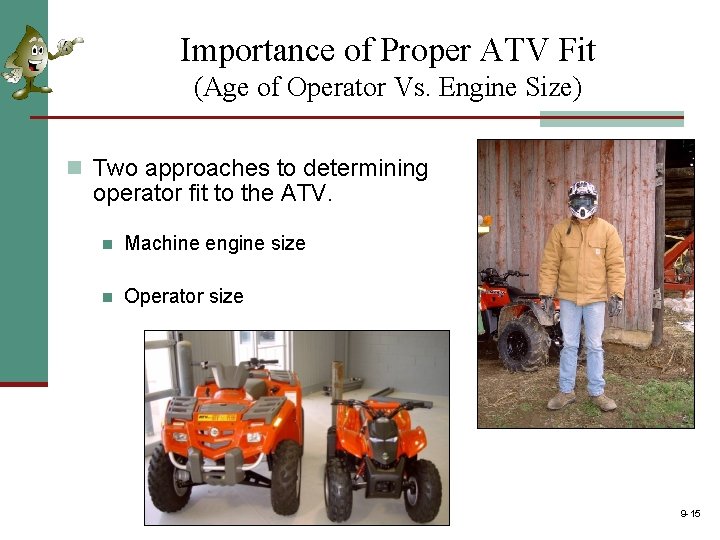
Importance of Proper ATV Fit (Age of Operator Vs. Engine Size) n Two approaches to determining operator fit to the ATV. n Machine engine size n Operator size 9 -15
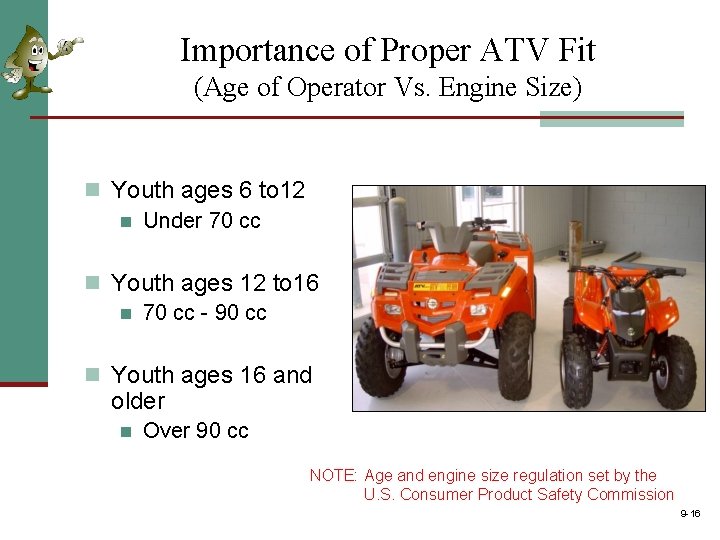
Importance of Proper ATV Fit (Age of Operator Vs. Engine Size) n Youth ages 6 to 12 n Under 70 cc n Youth ages 12 to 16 n 70 cc - 90 cc n Youth ages 16 and older n Over 90 cc NOTE: Age and engine size regulation set by the U. S. Consumer Product Safety Commission 9 -16
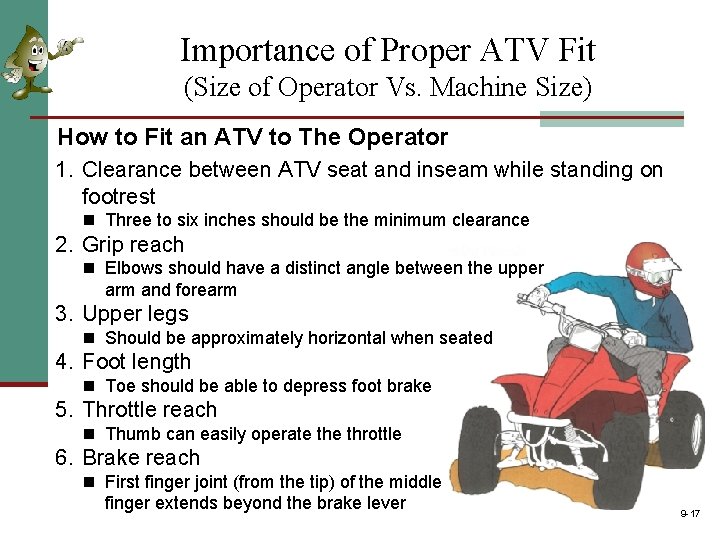
Importance of Proper ATV Fit (Size of Operator Vs. Machine Size) How to Fit an ATV to The Operator 1. Clearance between ATV seat and inseam while standing on footrest n Three to six inches should be the minimum clearance 2. Grip reach n Elbows should have a distinct angle between the upper arm and forearm 3. Upper legs n Should be approximately horizontal when seated 4. Foot length n Toe should be able to depress foot brake 5. Throttle reach n Thumb can easily operate throttle 6. Brake reach n First finger joint (from the tip) of the middle finger extends beyond the brake lever 9 -17
Pre-Operational Inspections of ATVs and Utility Vehicles (T-CLOC) T C L O C T-CLOC is an acronym designed to help the ATV or UTV operator remember the five key areas of the machine that should be checked before operating the machine. The following slides explain what each of the letters represent. 9 -18
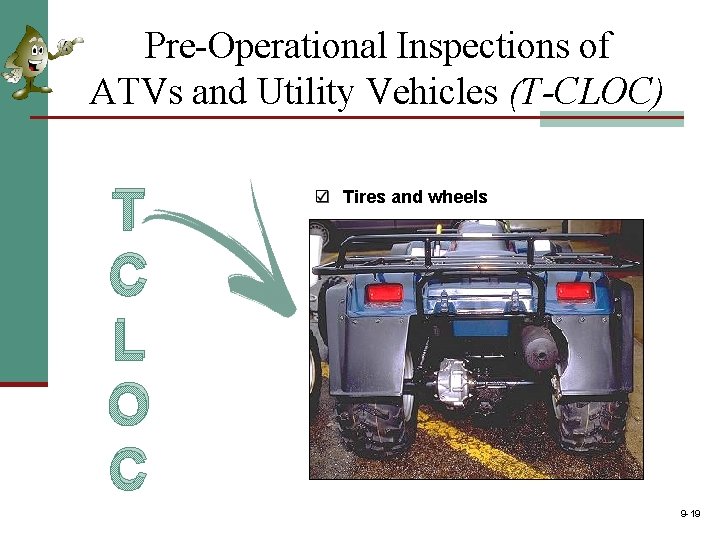
Pre-Operational Inspections of ATVs and Utility Vehicles (T-CLOC) T C L O C Tires and wheels 9 -19
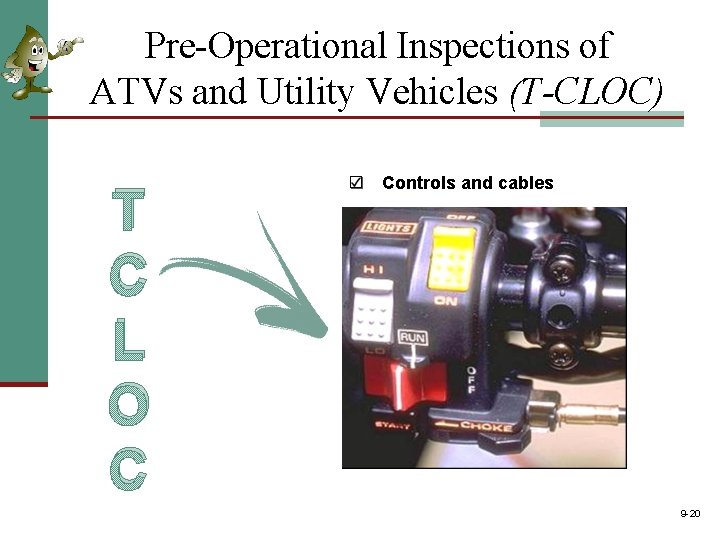
Pre-Operational Inspections of ATVs and Utility Vehicles (T-CLOC) T C L O C Controls and cables 9 -20
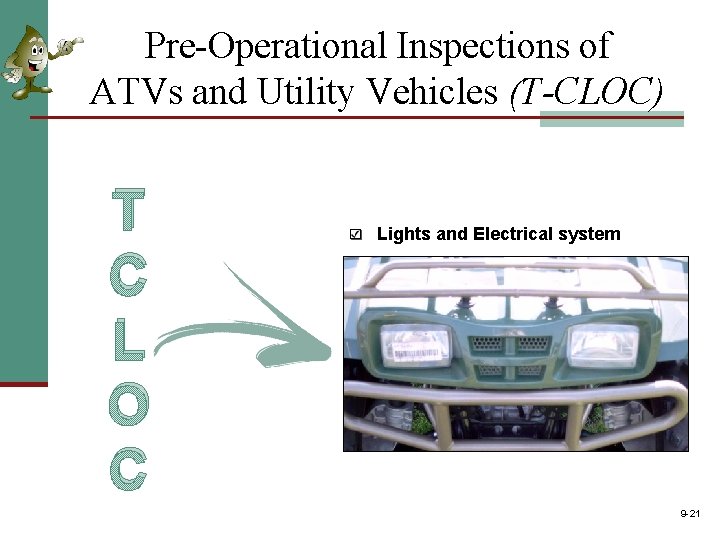
Pre-Operational Inspections of ATVs and Utility Vehicles (T-CLOC) T C L O C Lights and Electrical system 9 -21
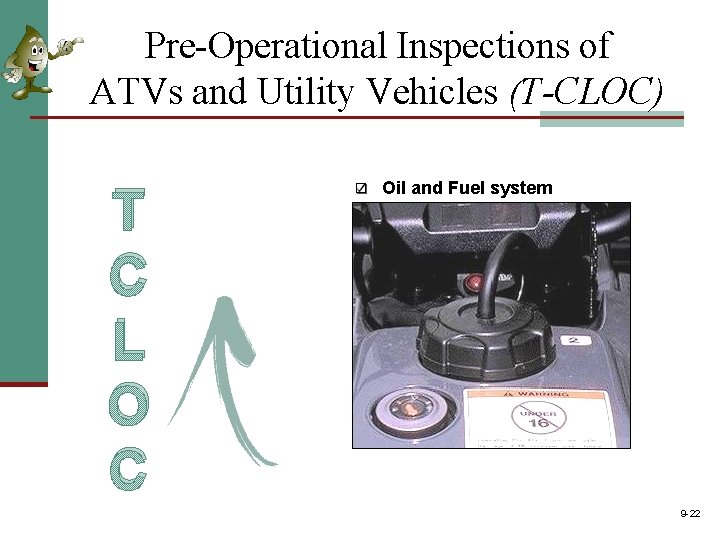
Pre-Operational Inspections of ATVs and Utility Vehicles (T-CLOC) T C L O C Oil and Fuel system 9 -22
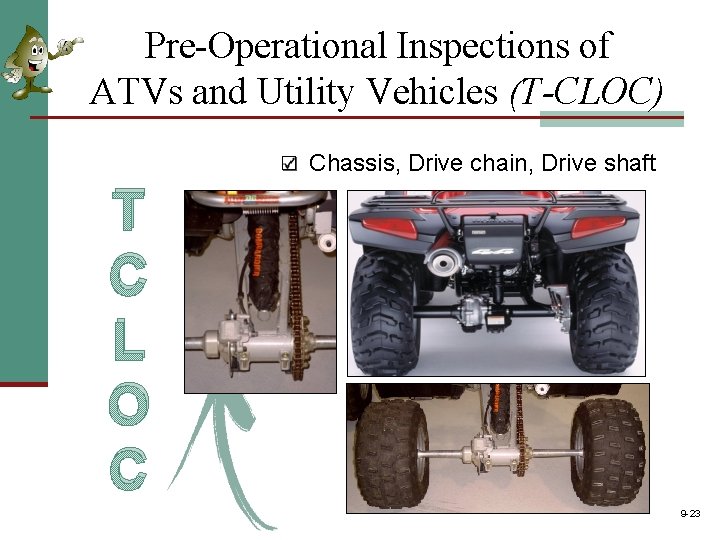
Pre-Operational Inspections of ATVs and Utility Vehicles (T-CLOC) Chassis, Drive chain, Drive shaft T C L O C 9 -23
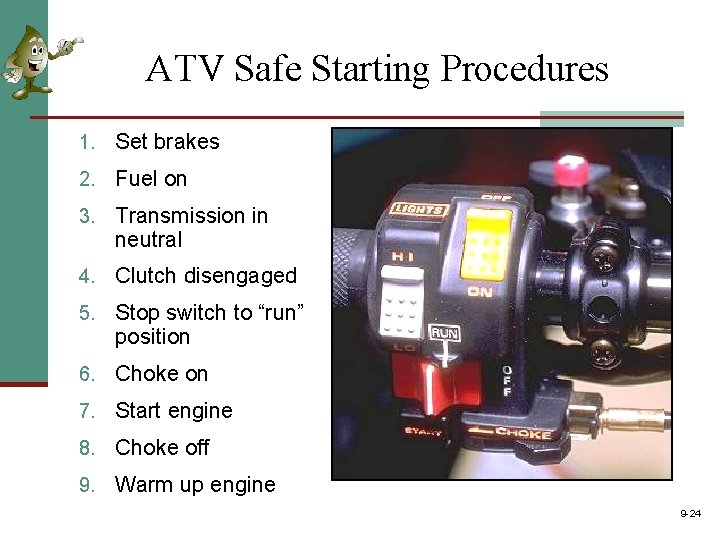
ATV Safe Starting Procedures 1. Set brakes 2. Fuel on 3. Transmission in neutral 4. Clutch disengaged 5. Stop switch to “run” position 6. Choke on 7. Start engine 8. Choke off 9. Warm up engine 9 -24
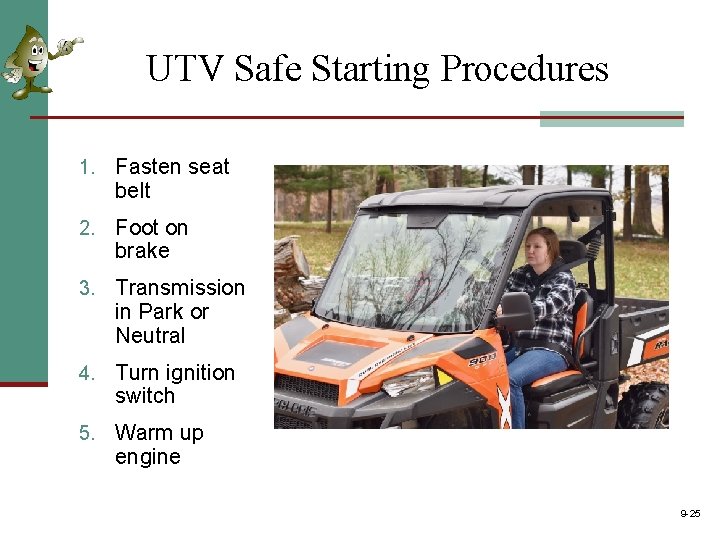
UTV Safe Starting Procedures 1. Fasten seat belt 2. Foot on brake 3. Transmission in Park or Neutral 4. Turn ignition switch 5. Warm up engine 9 -25
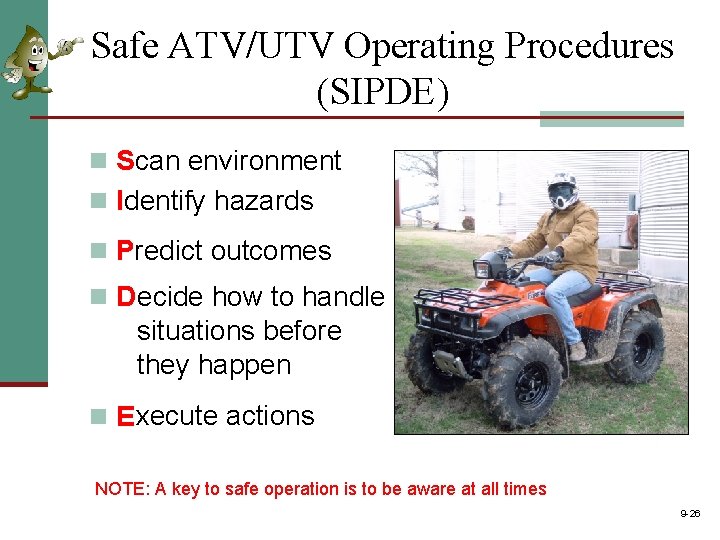
Safe ATV/UTV Operating Procedures (SIPDE) n Scan environment n Identify hazards n Predict outcomes n Decide how to handle situations before they happen n Execute actions NOTE: A key to safe operation is to be aware at all times 9 -26
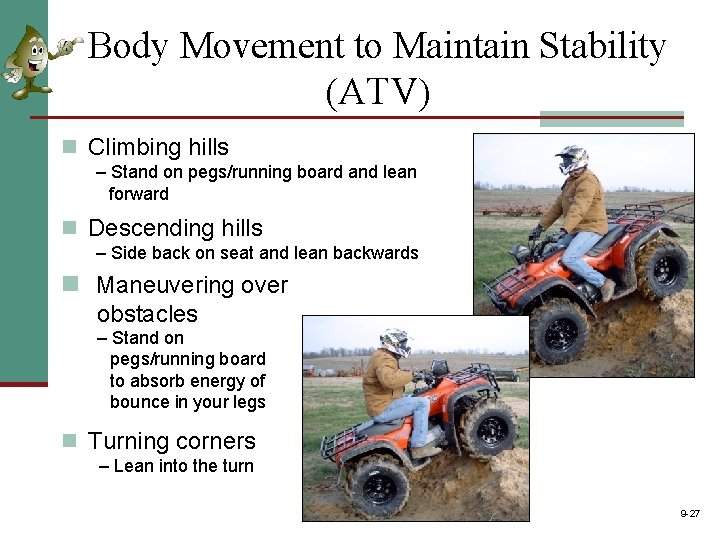
Body Movement to Maintain Stability (ATV) n Climbing hills – Stand on pegs/running board and lean forward n Descending hills – Side back on seat and lean backwards n Maneuvering over obstacles – Stand on pegs/running board to absorb energy of bounce in your legs n Turning corners – Lean into the turn 9 -27
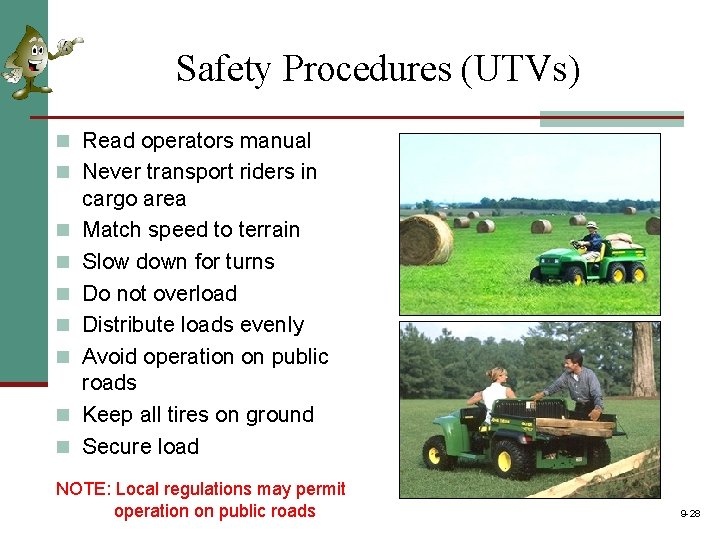
Safety Procedures (UTVs) n Read operators manual n Never transport riders in n n n cargo area Match speed to terrain Slow down for turns Do not overload Distribute loads evenly Avoid operation on public roads Keep all tires on ground Secure load NOTE: Local regulations may permit operation on public roads 9 -28
How could this have been prevented? ATV accident claims a boy’s life Beaver – A 15 -year-old Gainesville boy died Sunday after his all-terrain vehicle rolled over while being driven up a steep incline in a gravel pit on the family farm near the Oklahoma Toll Road on County Road 650 West, state conservation officer, Bill Reynolds, said. Gary Ezzell was pronounced dead at the scene on land owned by his parents, Chad and Stephanie Ezzell. Gary was discovered about 10: 00 p. m. Sunday after his parents had filed a missing person’s report. “It appears he had tried to climb a hill in the (gravel) pit, and the machine just rolled over on him, causing severe head trauma, ” Reynolds said. Gary had been driving his ATV Sunday afternoon. Apparently the accident happened several hours before Gary was discovered. He hadn’t been wearing a helmet. The Oklahoma Department of Natural Resources, Beaver County Sheriff’s Department, Oklahoma State Police and Beaver Fire Rescue were on the scene. 9 -29