Gas Detectors Aging Review Mar CAPEANS CERN 10
- Slides: 25
Gas Detectors Aging Review Mar CAPEANS CERN 10 -11 Sept’ 07 Micro Pattern Gas Detectors. Towards an R&D Collaboration th-11 CAPEANS th September 2007 CERN, 10 Mar
Gas Detectors Aging • First reported ~1950 • Common, critical issue for MWPC ~ 1970 • First compilation: “Workshop on Radiation Damage to Wire Chambers”, Berkeley ~ 1986 • Crucial studies for the development of LHC detectors, Systematic Studies: RD-10 (Generic) & RD-28 (MSGC) ~1990 • Last compilation: “International Workshop on Aging Phenomena in Gaseous Detectors”, DESY, Hamburg ~ 2003 10 -11 Sept’ 07 Mar CAPEANS 2
Integrated charge per year 10 -11 Sept’ 07 Mar CAPEANS 3
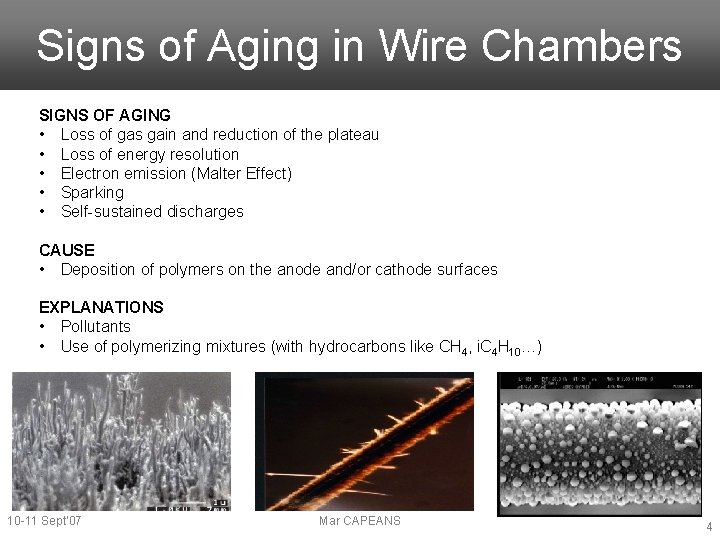
Signs of Aging in Wire Chambers SIGNS OF AGING • Loss of gas gain and reduction of the plateau • Loss of energy resolution • Electron emission (Malter Effect) • Sparking • Self-sustained discharges CAUSE • Deposition of polymers on the anode and/or cathode surfaces EXPLANATIONS • Pollutants • Use of polymerizing mixtures (with hydrocarbons like CH 4, i. C 4 H 10…) 10 -11 Sept’ 07 Mar CAPEANS 4
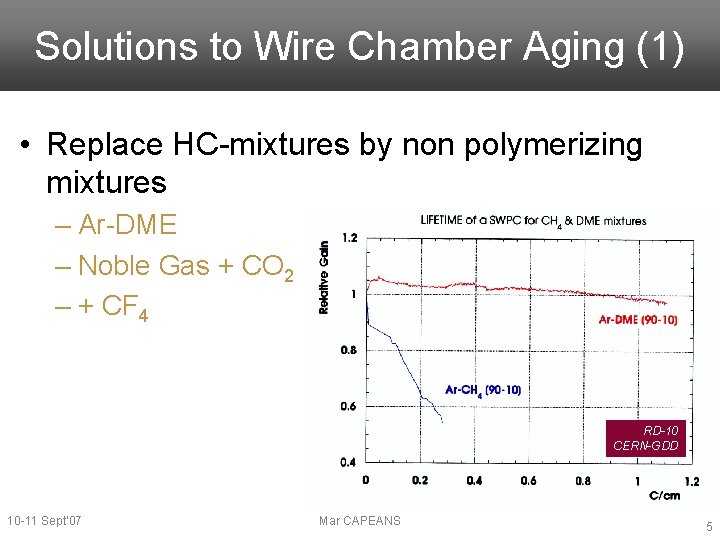
Solutions to Wire Chamber Aging (1) • Replace HC-mixtures by non polymerizing mixtures – Ar-DME – Noble Gas + CO 2 – + CF 4 RD-10 CERN-GDD 10 -11 Sept’ 07 Mar CAPEANS 5
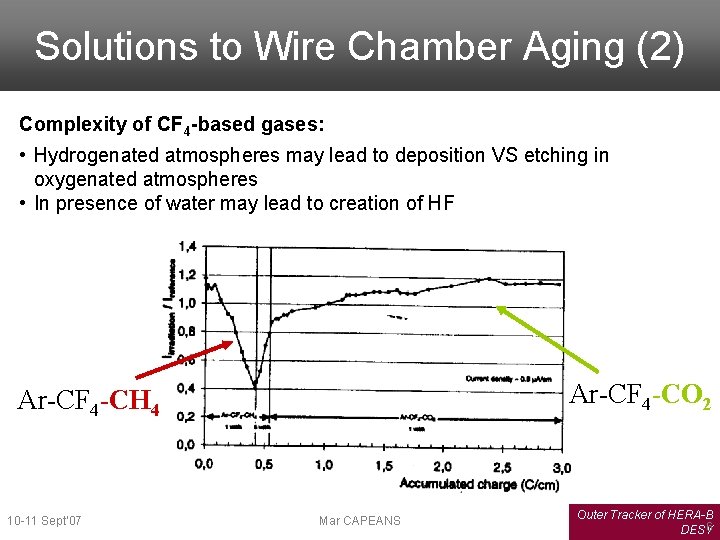
Solutions to Wire Chamber Aging (2) Complexity of CF 4 -based gases: • Hydrogenated atmospheres may lead to deposition VS etching in oxygenated atmospheres • In presence of water may lead to creation of HF Ar-CF 4 -CO 2 Ar-CF 4 -CH 4 10 -11 Sept’ 07 Mar CAPEANS Outer Tracker of HERA-B 6 DESY
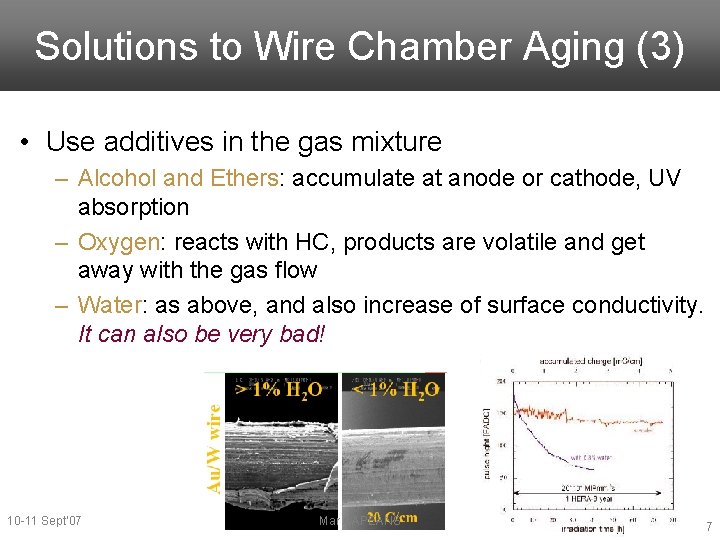
Solutions to Wire Chamber Aging (3) • Use additives in the gas mixture – Alcohol and Ethers: accumulate at anode or cathode, UV absorption – Oxygen: reacts with HC, products are volatile and get away with the gas flow – Water: as above, and also increase of surface conductivity. It can also be very bad! 10 -11 Sept’ 07 Mar CAPEANS 7
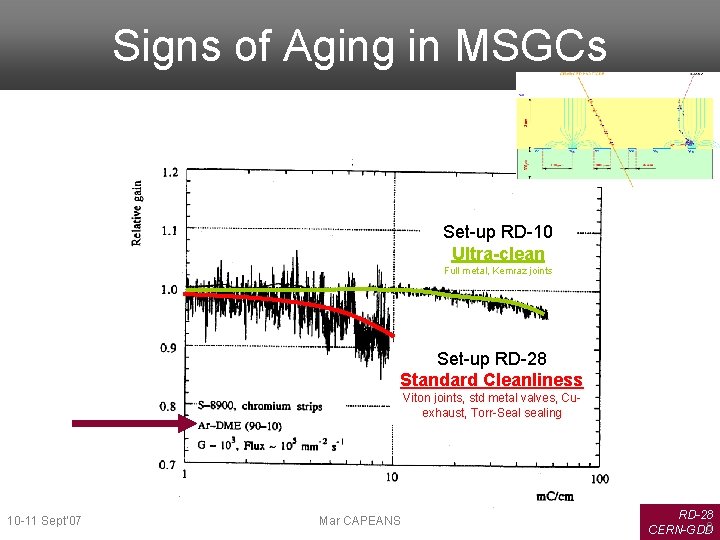
Signs of Aging in MSGCs Set-up RD-10 Ultra-clean Full metal, Kemraz joints Set-up RD-28 Standard Cleanliness Viton joints, std metal valves, Cuexhaust, Torr-Seal sealing 10 -11 Sept’ 07 Mar CAPEANS RD-28 8 CERN-GDD
Solutions to MSGC Aging • In addition to using non-polimerizing gas mixtures… • Control pollutants in contact with the gas – High purity gases – Assembly materials – Ultra-clean gas systems 10 -11 Sept’ 07 Mar CAPEANS 9
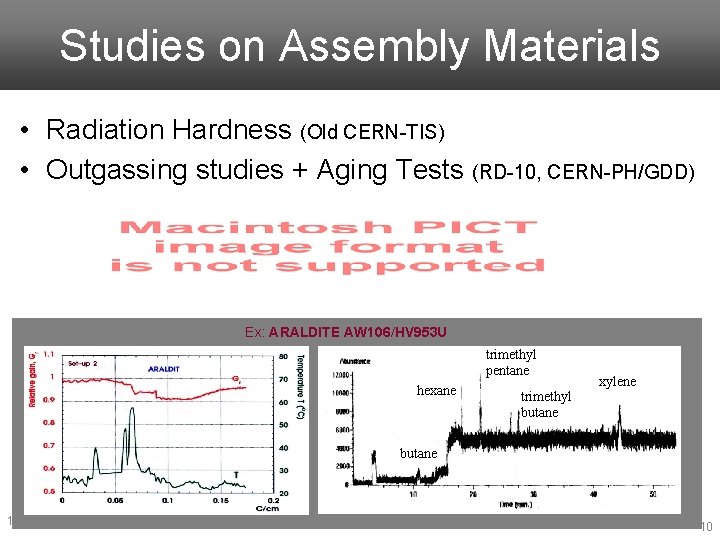
Studies on Assembly Materials • Radiation Hardness (Old CERN-TIS) • Outgassing studies + Aging Tests (RD-10, CERN-PH/GDD) Ex: ARALDITE AW 106/HV 953 U trimethyl pentane hexane trimethyl butane xylene butane 10 -11 Sept’ 07 Mar CAPEANS 10
Studies on Assembly Materials • Tables for: – – – Epoxies and adhesives Leak sealers Rigid materials Common contaminants (silicone, user-generated, etc) O-rings… RD-10 CERN-GDD Low Outgassing room-T epoxies 10 -11 Sept’ 07 Mar CAPEANS Outgassing room-T epoxies 11
Studies on Assembly Materials CERN-GDD C. Bellachioma, E. Broilo, P. Chiggiato, M. V. Stenis CERN 2 -component Polyurethane (Nuvovern LW) Adequate processing Component expired 10 -11 Sept’ 07 Mar CAPEANS 12
Studies on Assembly Materials Accidental Si-contamination of Straw Tubes 10% gain drop in 14 h, weak 55 Fe irradiation E Resolution Amplitude ~ 10 % gain loss 10 -11 Sept’ 07 S. Mouraviev ATLAS TRT CERN Mar CAPEANS 13
Studies on Gas Systems • Search for components (Cylinder P-regulators, Filters, O-rings, Flowmeters, Valves, Bubbler fillings, Piping, Connectors, etc): – Material compatibility with gas mix – Low Outgassing – Specially, silicon-free Piping for gas systems M. Capeans CERN-GDD Lists of validated components available at CERN PH-DT 1 Gas Section WEB http: //detector-gas-systems. web. cern. ch/ S. Konovalov ATLAS TRT Rotameter VOEGTLIN Type V 100 Inserted in gas stream 10 -11 Sept’ 07 Mar CAPEANS 14
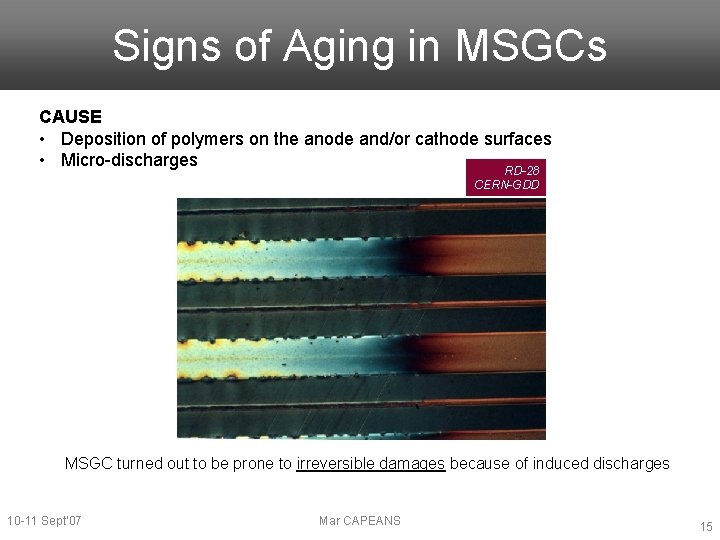
Signs of Aging in MSGCs CAUSE • Deposition of polymers on the anode and/or cathode surfaces • Micro-discharges RD-28 CERN-GDD MSGC turned out to be prone to irreversible damages because of induced discharges 10 -11 Sept’ 07 Mar CAPEANS 15
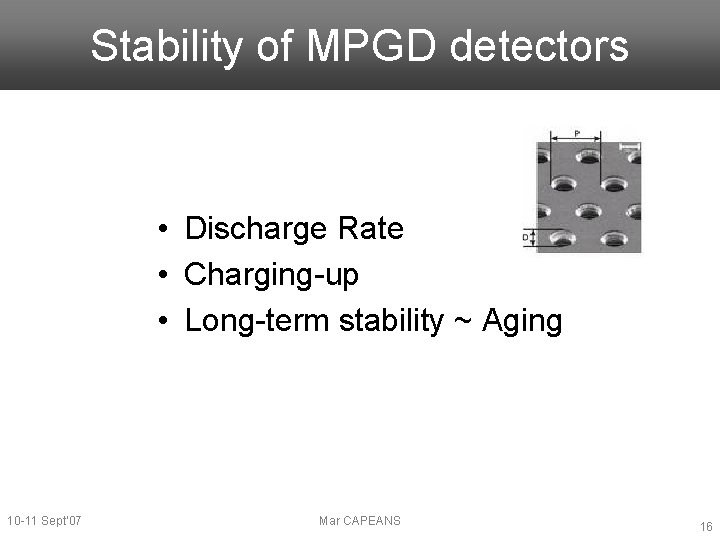
Stability of MPGD detectors • Discharge Rate • Charging-up • Long-term stability ~ Aging 10 -11 Sept’ 07 Mar CAPEANS 16
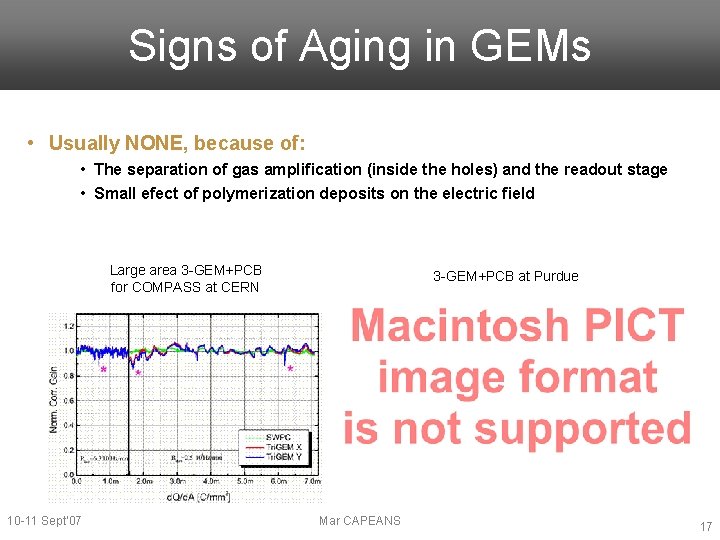
Signs of Aging in GEMs • Usually NONE, because of: • The separation of gas amplification (inside the holes) and the readout stage • Small efect of polymerization deposits on the electric field Large area 3 -GEM+PCB for COMPASS at CERN 10 -11 Sept’ 07 3 -GEM+PCB at Purdue Mar CAPEANS 17
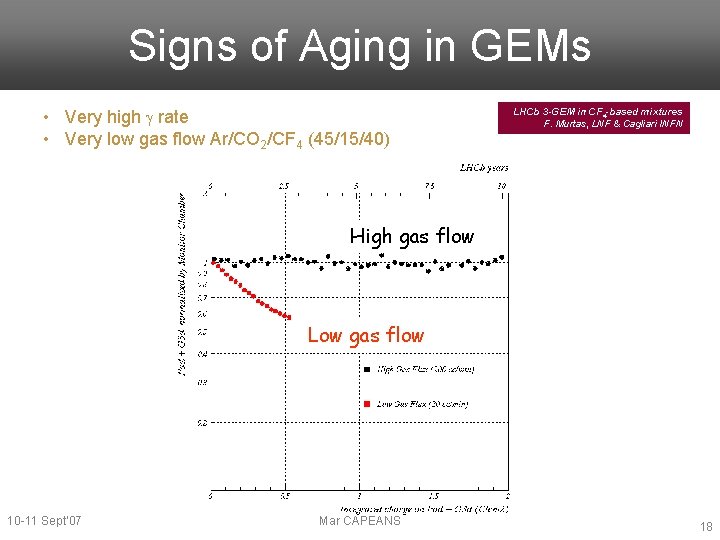
Signs of Aging in GEMs • Very high g rate • Very low gas flow Ar/CO 2/CF 4 (45/15/40) LHCb 3 -GEM in CF 4 -based mixtures F. Murtas, LNF & Cagliari INFN High gas flow Low gas flow 10 -11 Sept’ 07 Mar CAPEANS 18
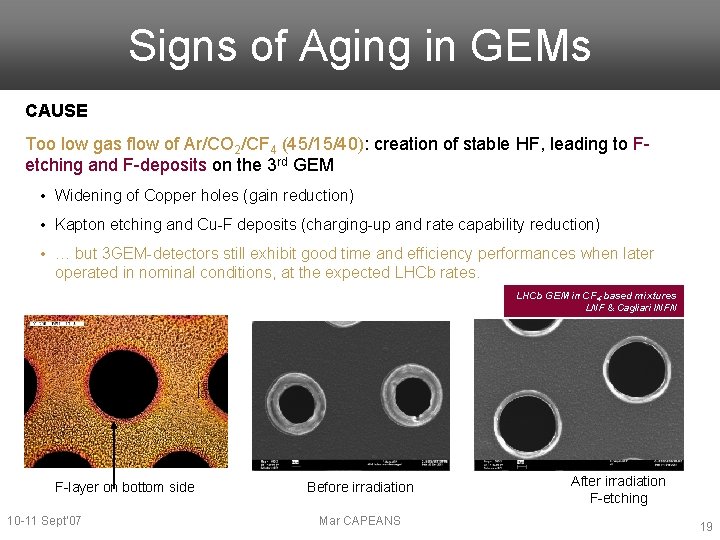
Signs of Aging in GEMs CAUSE Too low gas flow of Ar/CO 2/CF 4 (45/15/40): creation of stable HF, leading to Fetching and F-deposits on the 3 rd GEM • Widening of Copper holes (gain reduction) • Kapton etching and Cu-F deposits (charging-up and rate capability reduction) • … but 3 GEM-detectors still exhibit good time and efficiency performances when later operated in nominal conditions, at the expected LHCb rates. LHCb GEM in CF 4 -based mixtures LNF & Cagliari INFN F-layer on bottom side 10 -11 Sept’ 07 Before irradiation Mar CAPEANS After irradiation F-etching 19
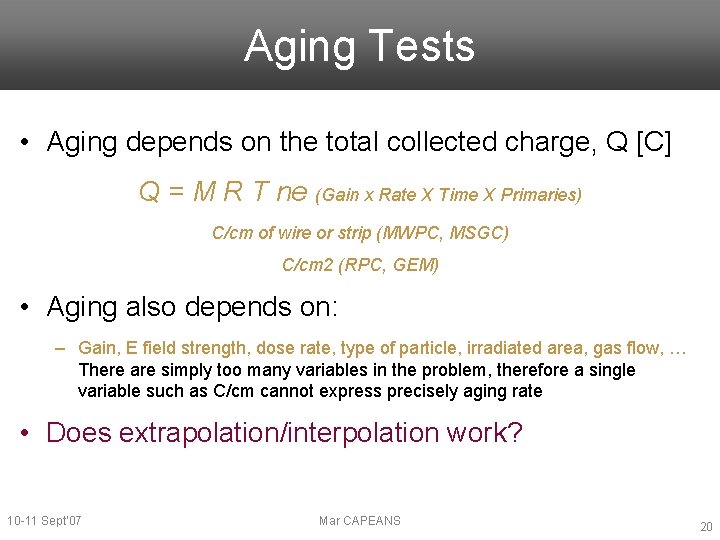
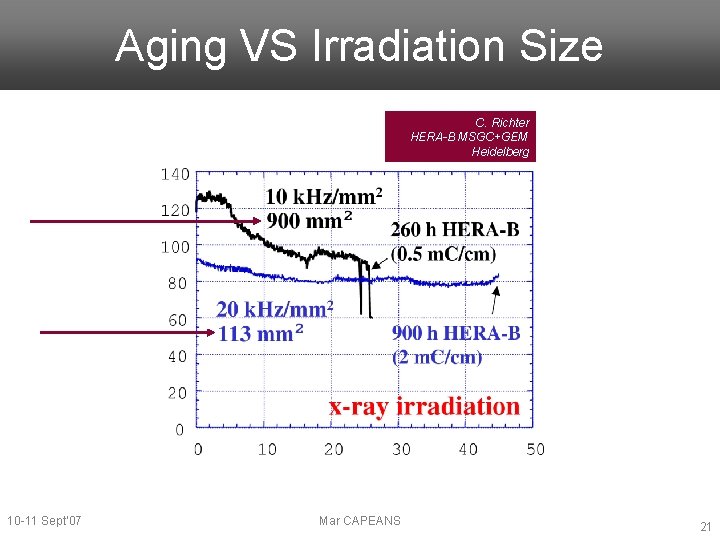
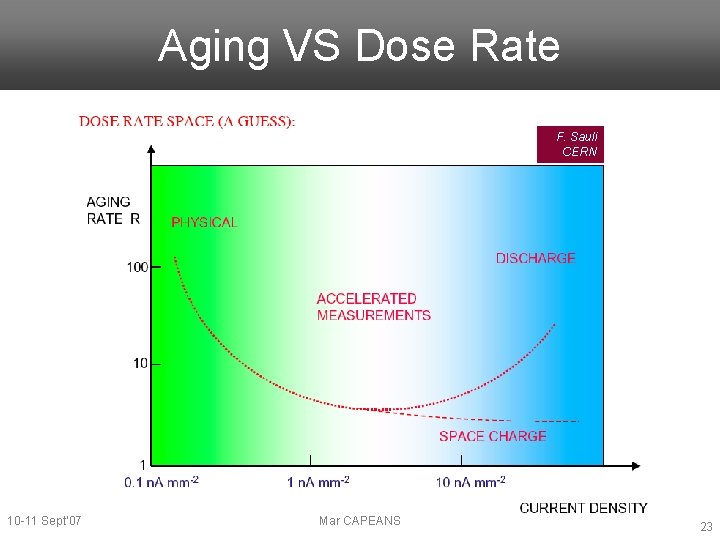
Aging Tests • Aging depends on the total collected charge, Q [C] Q = M R T ne (Gain x Rate X Time X Primaries) C/cm of wire or strip (MWPC, MSGC) C/cm 2 (RPC, GEM) • Aging also depends on: – Gain, E field strength, dose rate, type of particle, irradiated area, gas flow, … There are simply too many variables in the problem, therefore a single variable such as C/cm cannot express precisely aging rate • Does extrapolation/interpolation work? 10 -11 Sept’ 07 Mar CAPEANS 20
Aging VS Irradiation Size C. Richter HERA-B MSGC+GEM Heidelberg 10 -11 Sept’ 07 Mar CAPEANS 21
Aging VS Gas Flow P. Cwetanski ATLAS TRT Straw tubes CERN 10 -11 Sept’ 07 Mar CAPEANS 22
Aging VS Dose Rate F. Sauli CERN 10 -11 Sept’ 07 Mar CAPEANS 23
The Most Followed Recommendations • Avoid HC mixtures • Use CF 4…. Then, for high rate applications, reduce the concentration of CF 4 as much as possible • Use clean assembly materials • Use clean gas systems • Test any new material/component. – Lots of work on validation has been made, in the lab and the experimental sites. • Test in conditions as close as possible to the final ones (gas flow, gas system, large detector areas, particle type, etc) – Lots of studies at large irradiation facilities (e. g. CERN-GIF) with prototypes and mass produced chambers 10 -11 Sept’ 07 Mar CAPEANS 24
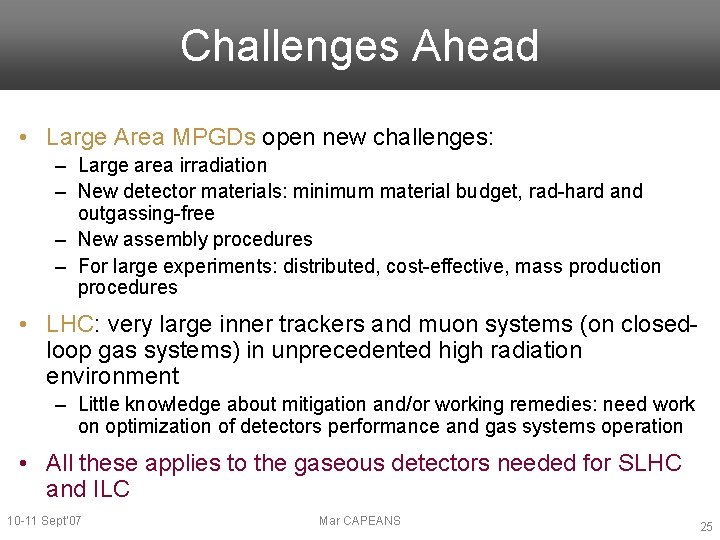
Challenges Ahead • Large Area MPGDs open new challenges: – Large area irradiation – New detector materials: minimum material budget, rad-hard and outgassing-free – New assembly procedures – For large experiments: distributed, cost-effective, mass production procedures • LHC: very large inner trackers and muon systems (on closedloop gas systems) in unprecedented high radiation environment – Little knowledge about mitigation and/or working remedies: need work on optimization of detectors performance and gas systems operation • All these applies to the gaseous detectors needed for SLHC and ILC 10 -11 Sept’ 07 Mar CAPEANS 25