Finding Evaluating and Processing Information Copyright 2010 Pearson
- Slides: 32
Finding, Evaluating, and Processing Information Copyright © 2010 Pearson Education International Chapter 11 - 1
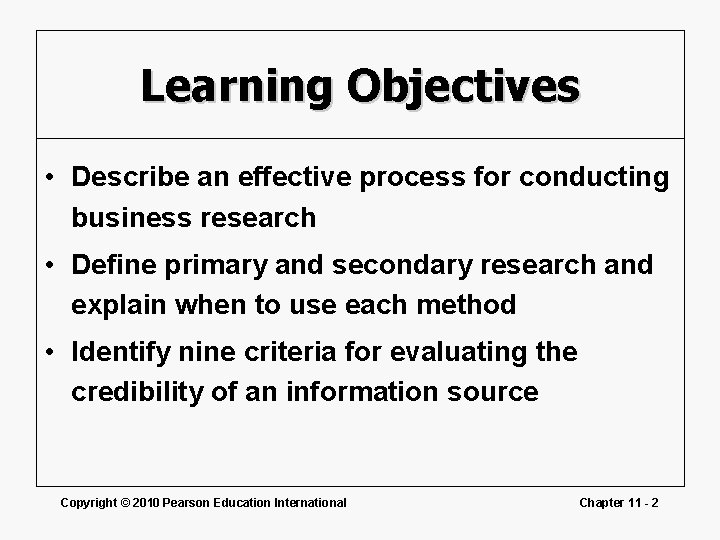
Learning Objectives • Describe an effective process for conducting business research • Define primary and secondary research and explain when to use each method • Identify nine criteria for evaluating the credibility of an information source Copyright © 2010 Pearson Education International Chapter 11 - 2
Learning Objectives • Provide five guidelines for conducting an effective online search • Outline the steps required to create and administer surveys and interviews • Describe the major tasks involved in processing and applying your research results Copyright © 2010 Pearson Education International Chapter 11 - 3
Supporting Your Messages 1. Plan your research 2. Locate data and information 3. Process data and information 4. Apply your findings 5. Manage information Copyright © 2010 Pearson Education International Chapter 11 - 4
Plan Your Research • Learn about the subject • Target information gaps • Prioritize research needs Copyright © 2010 Pearson Education International Chapter 11 - 5
Ethics and Etiquette • Don’t force a specific outcome • Respect privacy of participants • Document and credit your sources • Respect intellectual property rights • Don’t misquote your sources • Don’t misrepresent your intentions Copyright © 2010 Pearson Education International Chapter 11 - 6
Learn About the Subject • Read industry publications • Explore competitor’s websites • Interview experts • Search online resources • Scan topical books • Develop a problem statement Copyright © 2010 Pearson Education International Chapter 11 - 7
Target Information Gaps • Frame your purpose • Indentify gaps • Focus your efforts • Locate information Copyright © 2010 Pearson Education International Chapter 11 - 8
Prioritize Research Needs • Constraints – Limited time – Limited resources • Information – “Need to know” – “Nice to know” Copyright © 2010 Pearson Education International Chapter 11 - 9
Data and Information • Secondary research • Primary research Copyright © 2010 Pearson Education International Chapter 11 - 10
Evaluating Your Sources • Is the source honest and reliable? • Is the source potentially biased? • What is the purpose of the material? • Is the author credible? • What is the source of the information? Copyright © 2010 Pearson Education International Chapter 11 - 11
Evaluating Your Sources • Can you verify the material? • Is the material current? • Is the material complete? • Are all claims supported by evidence? • Do the claims stand up to scrutiny? Copyright © 2010 Pearson Education International Chapter 11 - 12
Secondary Research • Inside the company – Reports and memos – Other documents • Outside the company – Print resources – Online resources Copyright © 2010 Pearson Education International Chapter 11 - 13
Finding Information at the Public Library • Newspapers and periodicals • Business books • Directories • Almanacs and statistical resources • Government publications • Electronic databases Copyright © 2010 Pearson Education International Chapter 11 - 14
Online Information • Internet public library • Librarian’s Internet index • Company websites Copyright © 2010 Pearson Education International Chapter 11 - 15
Internet Search Tools • Search engines – Web directories – Online databases – Meta-search engines Copyright © 2010 Pearson Education International Chapter 11 - 16
Search Techniques • Keyword searches • Boolean operators • Natural language • Forms-based searches Copyright © 2010 Pearson Education International Chapter 11 - 17
Fine Tune Search Methods • Read the instructions • Observe the details • Review search and display options • Vary the search terms • Adjust the scope of the search Copyright © 2010 Pearson Education International Chapter 11 - 18
Innovative Search Tools • • • Desktop search engines Enterprise search engines Research and content managers Social bookmarking sites Newsfeeds Copyright © 2010 Pearson Education International Chapter 11 - 19
Documenting Sources • Credit research sources • Build your credibility • Help your readers Copyright © 2010 Pearson Education International Chapter 11 - 20
Primary Research • Surveys • Interviews • Experiments • Observations Copyright © 2010 Pearson Education International Chapter 11 - 21
Conducting Surveys • Representative sample • Effective questionnaire Copyright © 2010 Pearson Education International Chapter 11 - 22
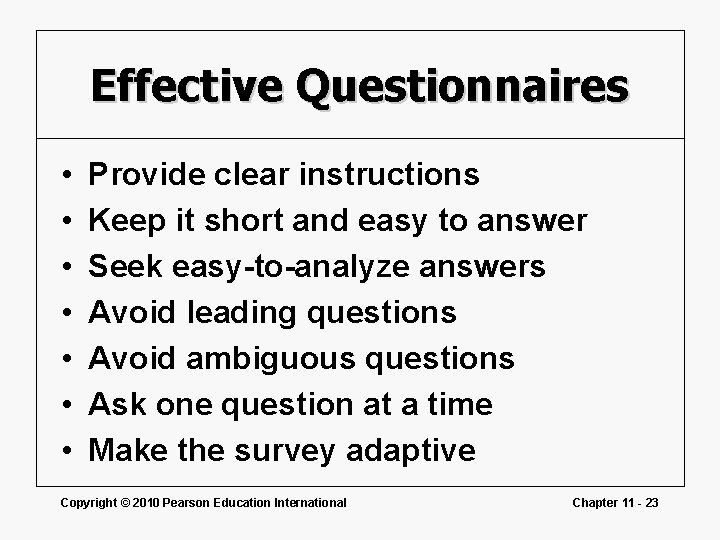
Effective Questionnaires • • Provide clear instructions Keep it short and easy to answer Seek easy-to-analyze answers Avoid leading questions Avoid ambiguous questions Ask one question at a time Make the survey adaptive Copyright © 2010 Pearson Education International Chapter 11 - 23
Internet Surveys • Save time • Minimize cost Copyright © 2010 Pearson Education International Chapter 11 - 24
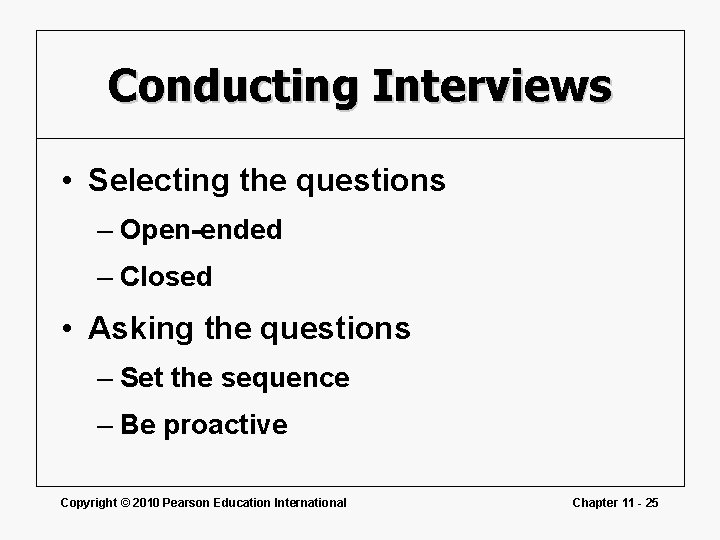
Conducting Interviews • Selecting the questions – Open-ended – Closed • Asking the questions – Set the sequence – Be proactive Copyright © 2010 Pearson Education International Chapter 11 - 25
Types of Interviews • Face-to-face • Email • Focus group Copyright © 2010 Pearson Education International Chapter 11 - 26
Data and Information • Quoting • Paraphrasing • Summarizing • Analyzing • Concluding • Recommending Copyright © 2010 Pearson Education International Chapter 11 - 27
Process the Information • Quoting, paraphrasing, summarizing – Avoid plagiarism – Cite sources – Observe context Copyright © 2010 Pearson Education International Chapter 11 - 28
Analyze Numeric Data • Mean, median, and mode • Overall trends • Cause and correlation • Cross-tabulation Copyright © 2010 Pearson Education International Chapter 11 - 29
Watch for Mistakes • Avoid faulty comparisons • Don’t push research results beyond their limits • Avoid misleading presentations Copyright © 2010 Pearson Education International Chapter 11 - 30
Apply Your Findings • Summarizing your research • Drawing conclusions • Making recommendations Copyright © 2010 Pearson Education International Chapter 11 - 31
Knowledge Management • Technologies • Policies • Procedures Copyright © 2010 Pearson Education International Chapter 11 - 32