Fall 2004 Physics 3 TuTh Section Claudio Campagnari
- Slides: 23
Fall 2004 Physics 3 Tu-Th Section Claudio Campagnari Web page: http: //hep. ucsb. edu/people/claudio/ph 3 -04/ 1
Chapter 15: Waves What is a wave? From www. dictionary. com: Physics. – A disturbance traveling through a medium by which energy is transferred from one particle of the medium to another without causing any permanent displacement of the medium itself. – A graphic representation of the variation of such a disturbance with time. – A single cycle of such a disturbance. Close, but not quite right!!! 2
"disturbance" and "medium" Disturbance = displacement from equilibrium Medium = material in which displacement occurs 3
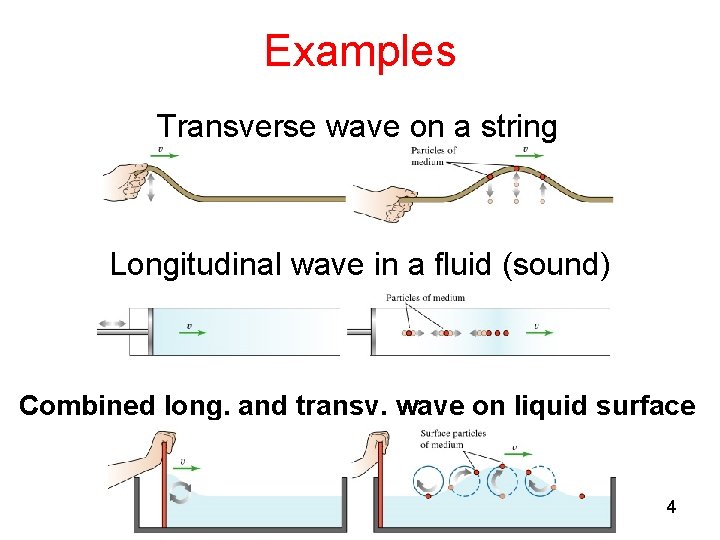
Examples Transverse wave on a string Longitudinal wave in a fluid (sound) Combined long. and transv. wave on liquid surface 4
So what's wrong with dictionary. com? • There are waves that do not need a "medium" to propagate. • e. g. , Electromagnetic Waves (light) can propagate in vacuum. – This was a hard concept to swallow at the end of the 19 th century, but it is the way it is. • For now we concentrate on mechanical waves that propagate in a medium. 5
Longitudinal vs. Transverse • Longitudinal: the disturbance is parallel to the direction of propagation. • Transverse: the disturbance is perpendicular to the direction of propagation. 6
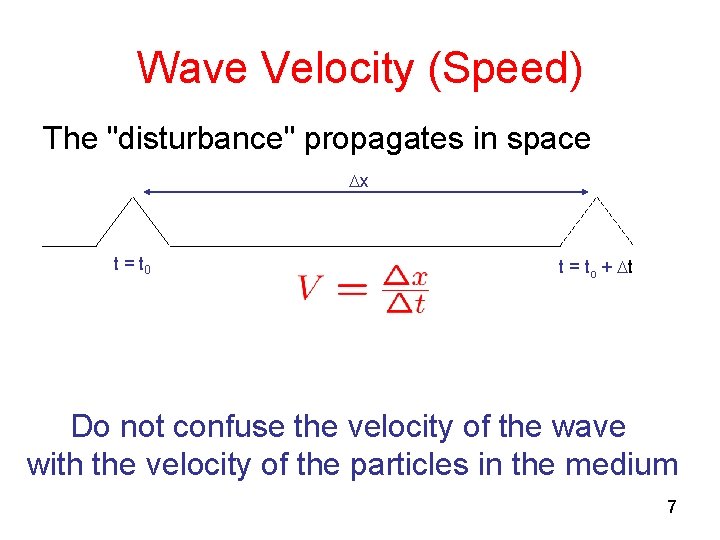
Wave Velocity (Speed) The "disturbance" propagates in space x t = t 0 t = to + t Do not confuse the velocity of the wave with the velocity of the particles in the medium 7
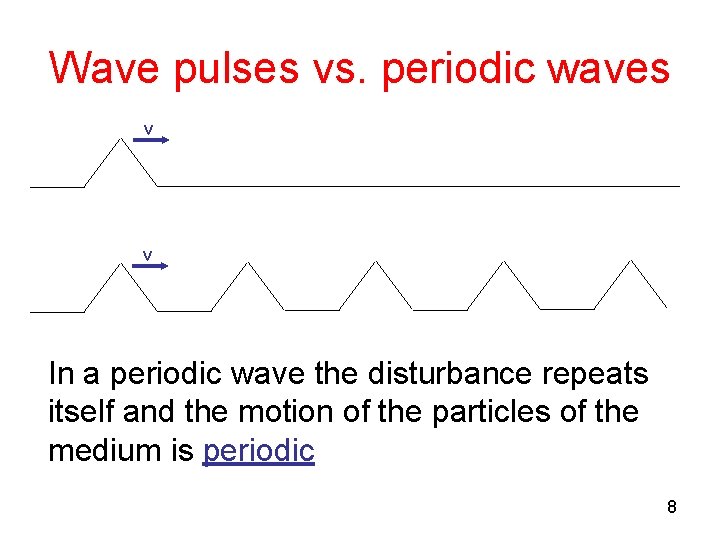
Wave pulses vs. periodic waves v v In a periodic wave the disturbance repeats itself and the motion of the particles of the medium is periodic 8
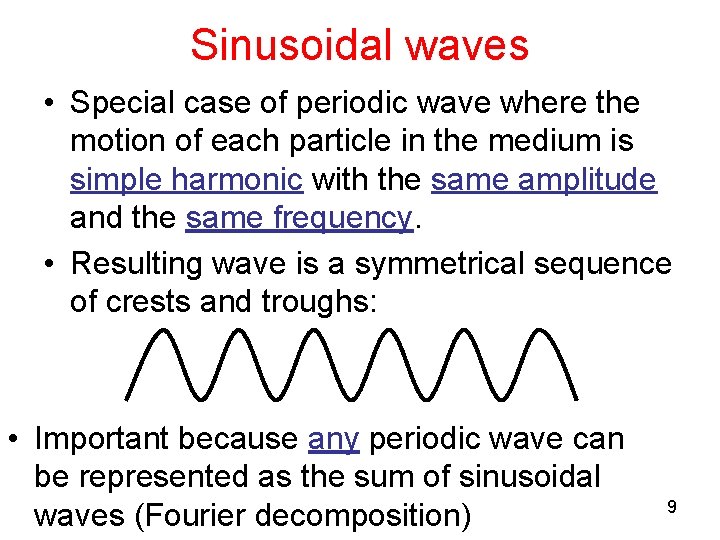
Sinusoidal waves • Special case of periodic wave where the motion of each particle in the medium is simple harmonic with the same amplitude and the same frequency. • Resulting wave is a symmetrical sequence of crests and troughs: • Important because any periodic wave can be represented as the sum of sinusoidal waves (Fourier decomposition) 9
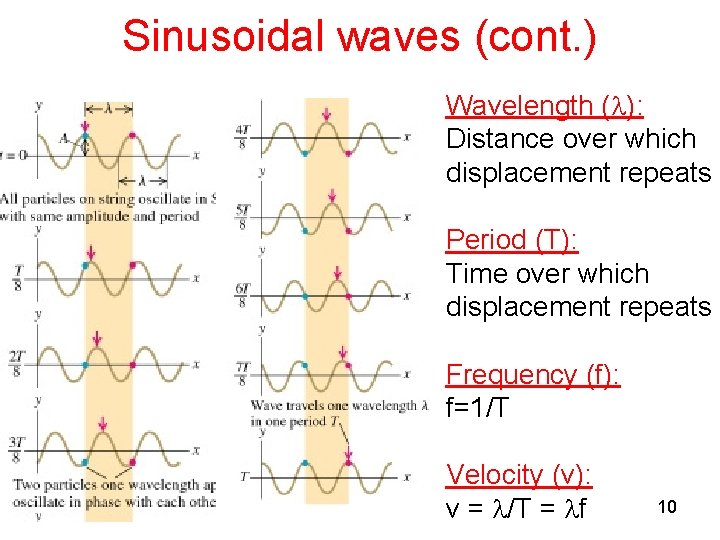
Sinusoidal waves (cont. ) Wavelength ( ): Distance over which displacement repeats Period (T): Time over which displacement repeats Frequency (f): f=1/T Velocity (v): v = /T = f 10
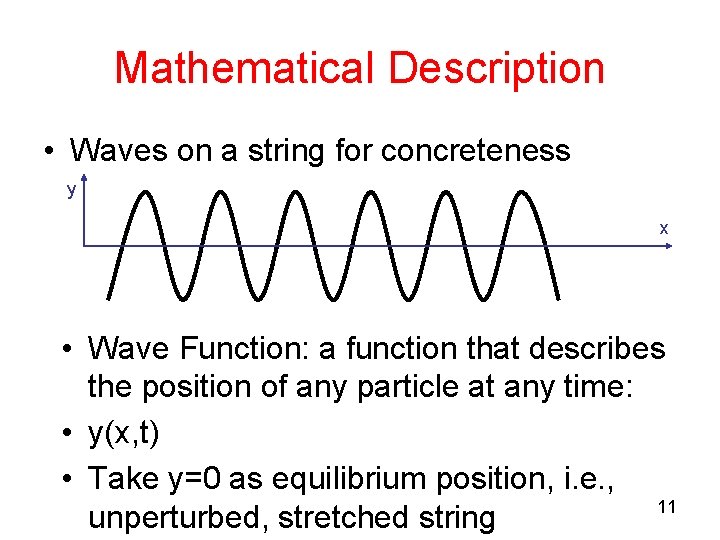
Mathematical Description • Waves on a string for concreteness y x • Wave Function: a function that describes the position of any particle at any time: • y(x, t) • Take y=0 as equilibrium position, i. e. , 11 unperturbed, stretched string
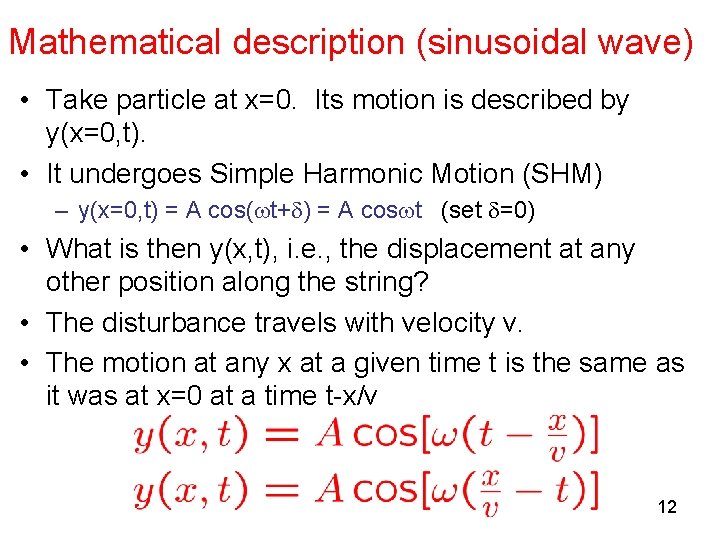
Mathematical description (sinusoidal wave) • Take particle at x=0. Its motion is described by y(x=0, t). • It undergoes Simple Harmonic Motion (SHM) – y(x=0, t) = A cos( t+ ) = A cos t (set =0) • What is then y(x, t), i. e. , the displacement at any other position along the string? • The disturbance travels with velocity v. • The motion at any x at a given time t is the same as it was at x=0 at a time t-x/v 12
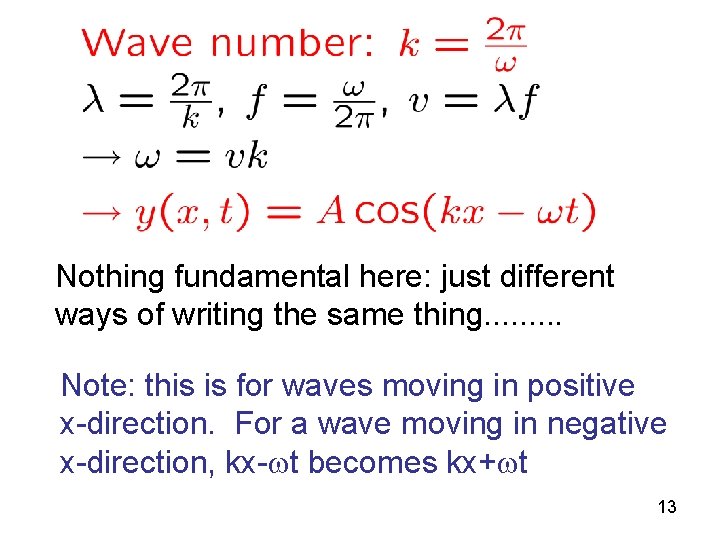
Nothing fundamental here: just different ways of writing the same thing. . Note: this is for waves moving in positive x-direction. For a wave moving in negative x-direction, kx- t becomes kx+ t 13
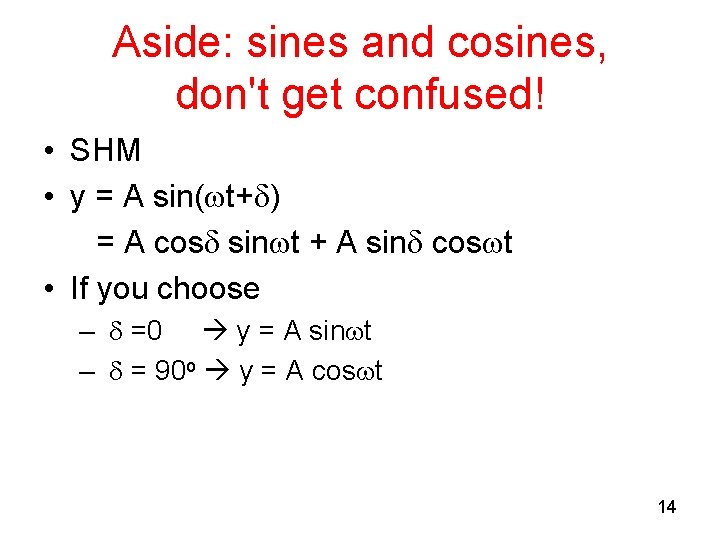
Aside: sines and cosines, don't get confused! • SHM • y = A sin( t+ ) = A cos sin t + A sin cos t • If you choose – =0 y = A sin t – = 90 o y = A cos t 14
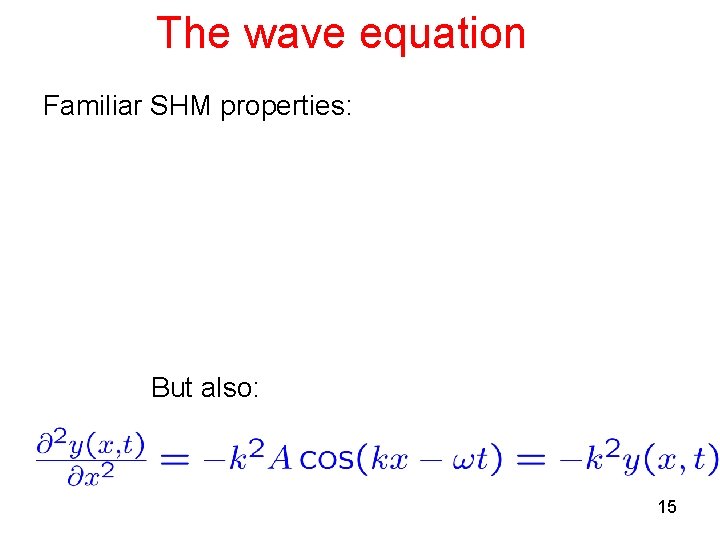
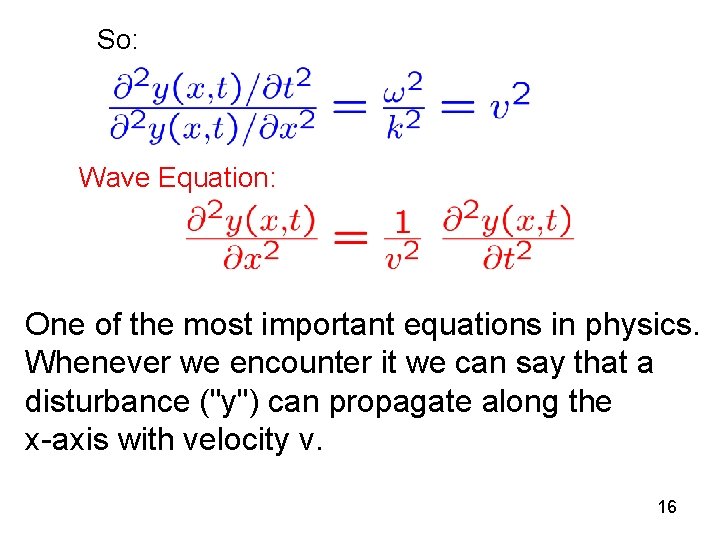
The wave equation Familiar SHM properties: But also: 15
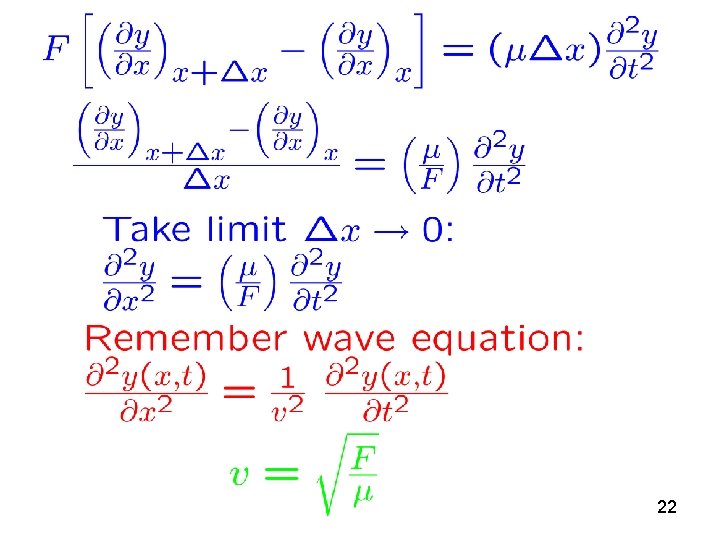
So: Wave Equation: One of the most important equations in physics. Whenever we encounter it we can say that a disturbance ("y") can propagate along the x-axis with velocity v. 16
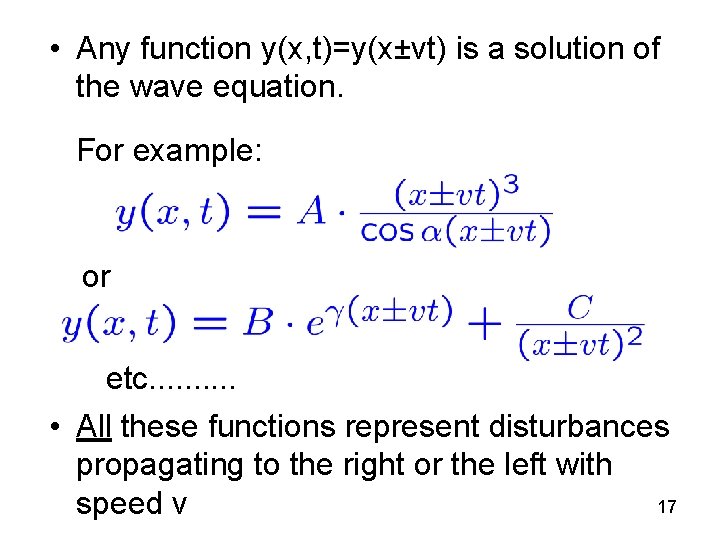
• Any function y(x, t)=y(x±vt) is a solution of the wave equation. For example: or etc. . • All these functions represent disturbances propagating to the right or the left with 17 speed v
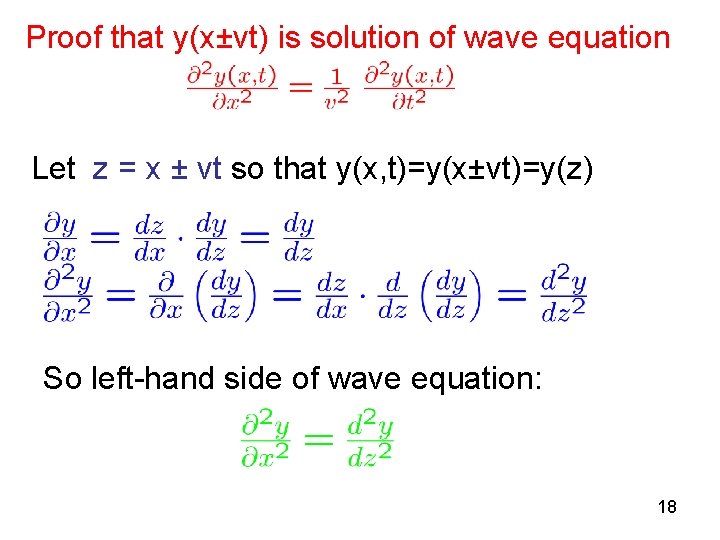
Proof that y(x±vt) is solution of wave equation Let z = x ± vt so that y(x, t)=y(x±vt)=y(z) So left-hand side of wave equation: 18
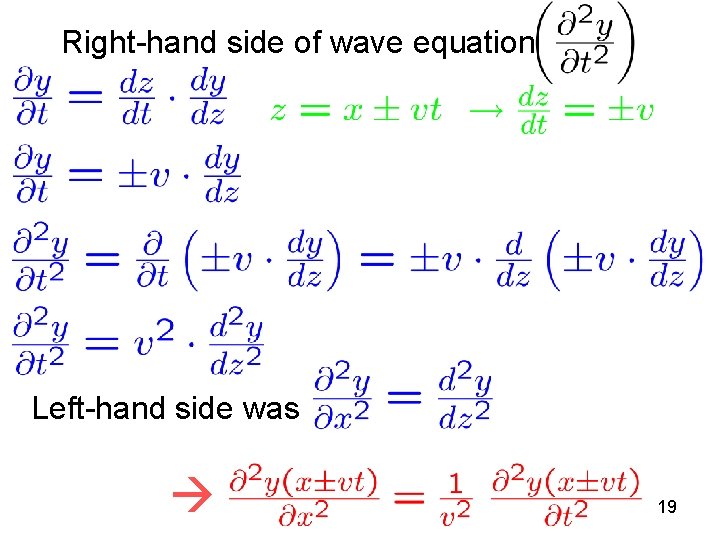
Right-hand side of wave equation: Left-hand side was 19
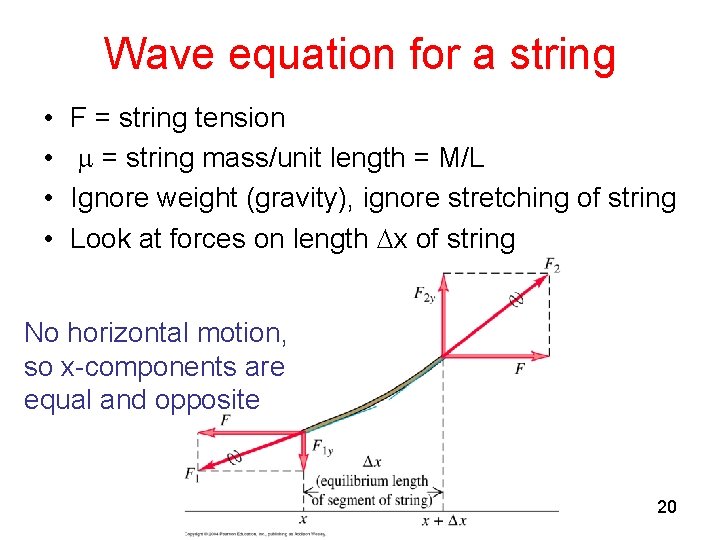
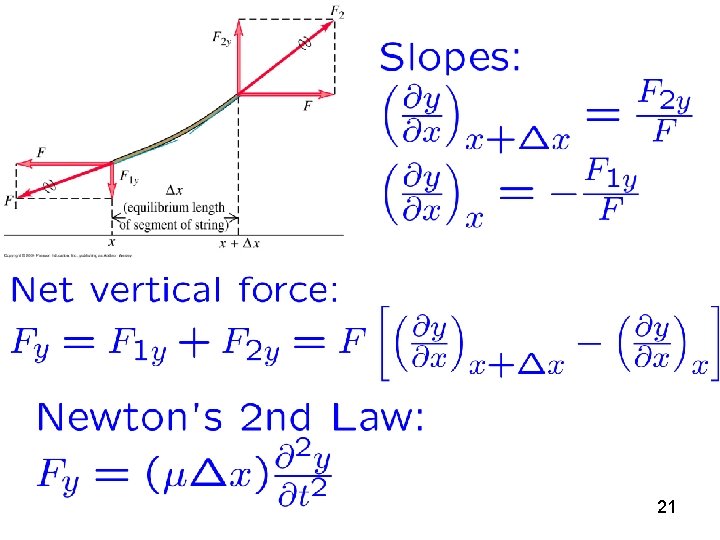
Wave equation for a string • • F = string tension = string mass/unit length = M/L Ignore weight (gravity), ignore stretching of string Look at forces on length x of string No horizontal motion, so x-components are equal and opposite 20
21
22
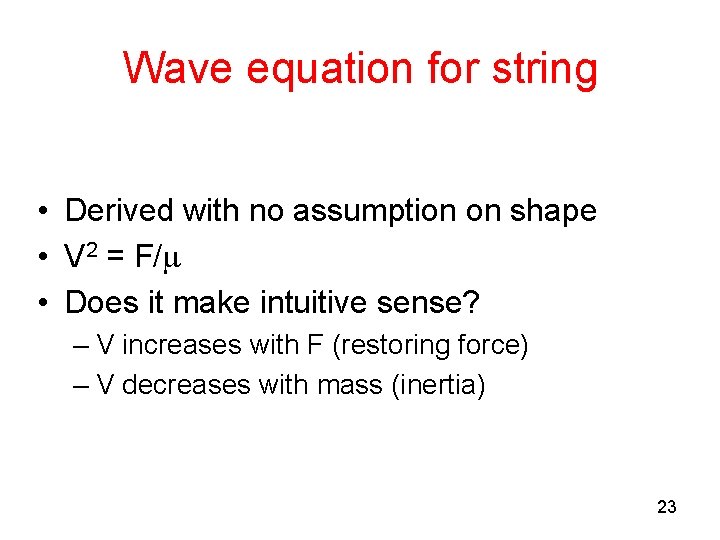
Wave equation for string • Derived with no assumption on shape • V 2 = F/ • Does it make intuitive sense? – V increases with F (restoring force) – V decreases with mass (inertia) 23