
FREE FALL Physics Mr Villa Acceleration Due to





- Slides: 16
FREE FALL Physics Mr. Villa
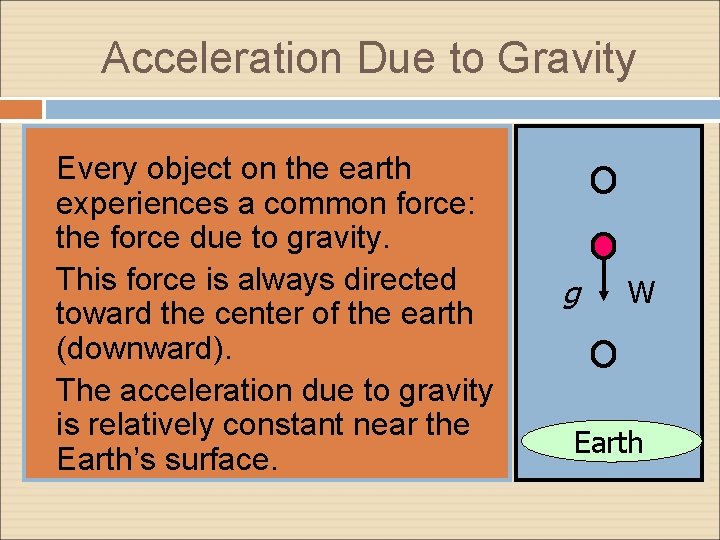
Acceleration Due to Gravity o o o Every object on the earth experiences a common force: the force due to gravity. This force is always directed toward the center of the earth (downward). The acceleration due to gravity is relatively constant near the Earth’s surface. g W Earth
Gravitational Acceleration In a vacuum, all objects fall with same acceleration. Equations for constant acceleration apply as usual. Near the a = Earth’s g = 9. 80 surface: m/s 2 Directed downward (always negative).
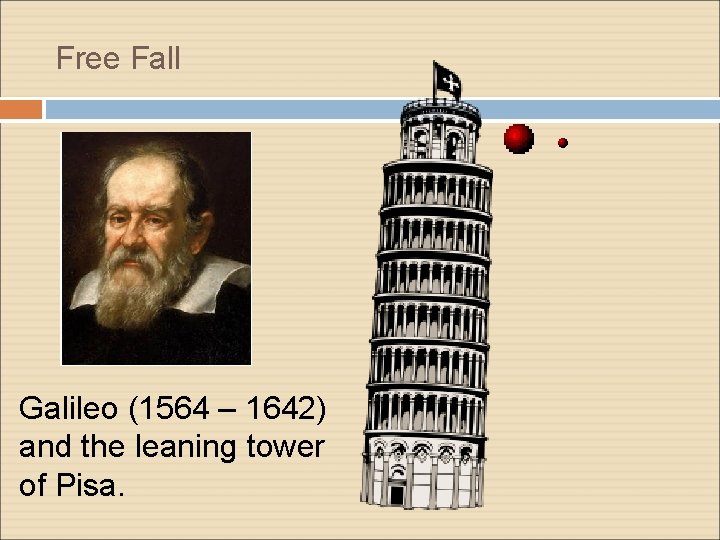
Free Fall Galileo (1564 – 1642) and the leaning tower of Pisa.
Gravitational Acceleration • When an object is thrown straight up, it will have a velocity of 0 m/s 2 at its peak height just before it begins its free fall. – • This means that for a split second, an object will stop in mid air while it transitions from upward motion to downward motion. Because gravity is constant, the rate at which an object decelerates as it moves upward, is the same rate it accelerates at as it falls downward. – In other words, an object falling will have the same speed at any point that it did on the way up.
Hammer vs. Feather
Questions: Do heavier objects fall faster than lighter ones when starting from the same position? Does air resistance matter? If the free fall motion has a constant acceleration, what is this acceleration and how was it found? How do we solve problems involving free fall?
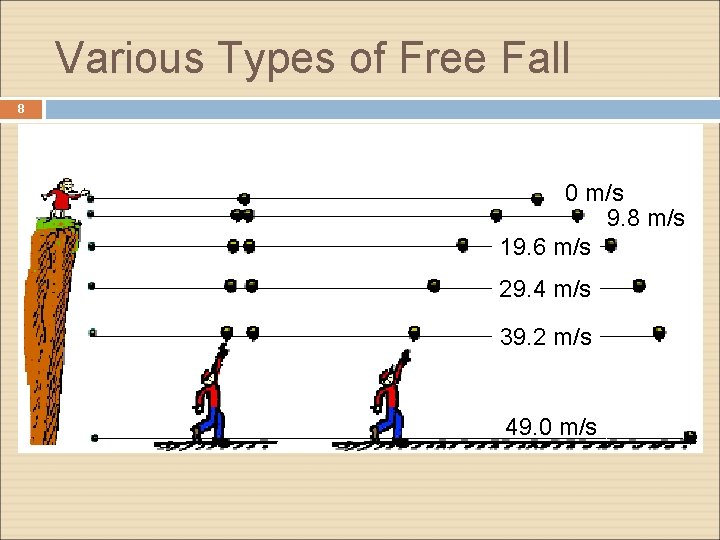
Various Types of Free Fall 8 0 m/s 9. 8 m/s 19. 6 m/s 29. 4 m/s 39. 2 m/s 49. 0 m/s
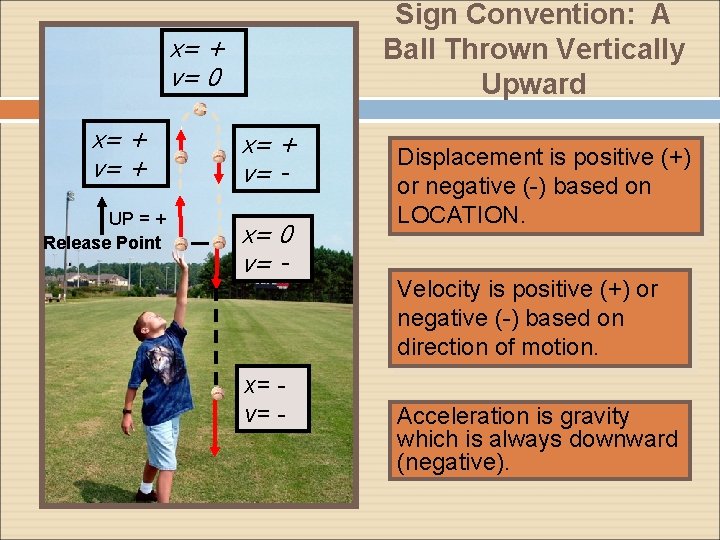
Sign Convention: A Ball Thrown Vertically Upward x= + v= 0 x= + v= + UP = + Release Point x= + v= x= 0 v= - x= v= - Displacement is positive (+) or negative (-) based on LOCATION. Velocity is positive (+) or negative (-) based on direction of motion. Acceleration is gravity which is always downward (negative).
Motion Formulas #1 #3 #2 #4 #5 For constant acceleration only
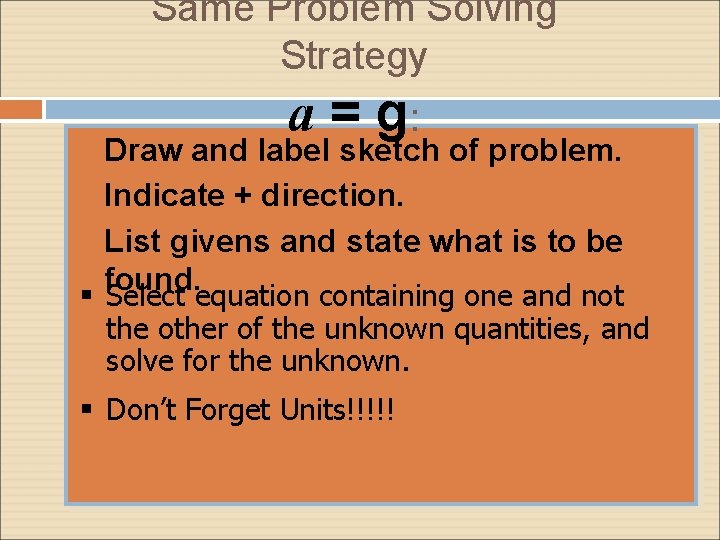
Same Problem Solving Strategy a = g: § § § Draw and label sketch of problem. Indicate + direction. List givens and state what is to be found. § Select equation containing one and not the other of the unknown quantities, and solve for the unknown. § Don’t Forget Units!!!!!
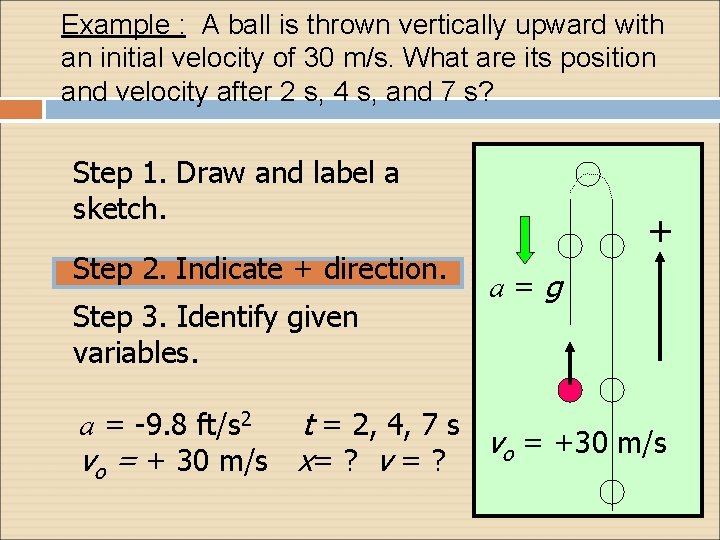
Example : A ball is thrown vertically upward with an initial velocity of 30 m/s. What are its position and velocity after 2 s, 4 s, and 7 s? Step 1. Draw and label a sketch. Step 2. Indicate + direction. Step 3. Identify given variables. + a=g a = -9. 8 ft/s 2 t = 2, 4, 7 s vo = +30 m/s vo = + 30 m/s x= ? v = ?
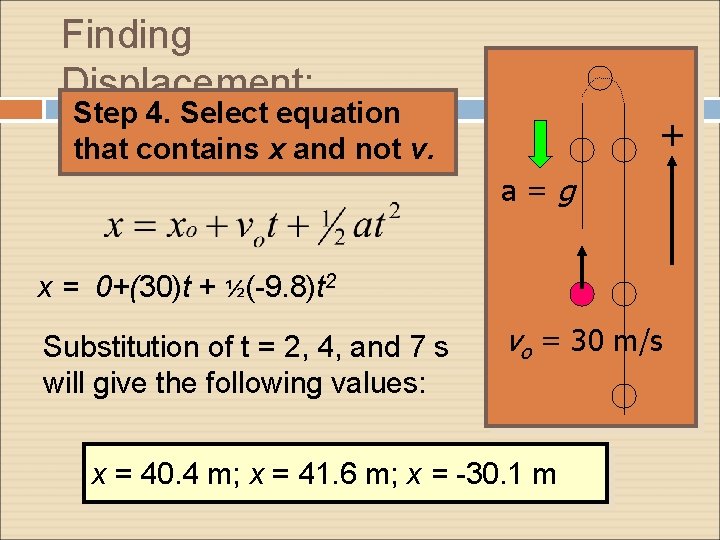
Finding Displacement: Step 4. Select equation that contains x and not v. + a=g x = 0+(30)t + ½(-9. 8)t 2 Substitution of t = 2, 4, and 7 s will give the following values: vo = 30 m/s x = 40. 4 m; x = 41. 6 m; x = -30. 1 m
Finding Velocity: Step 5. Find v from equation that contains v and not x: Substitute t = 2, 4, and 7 s: + a=g vo = 30 m/s v = +10. 4 m/s; v = -9. 20 m/s; v = -38. 6 m/s
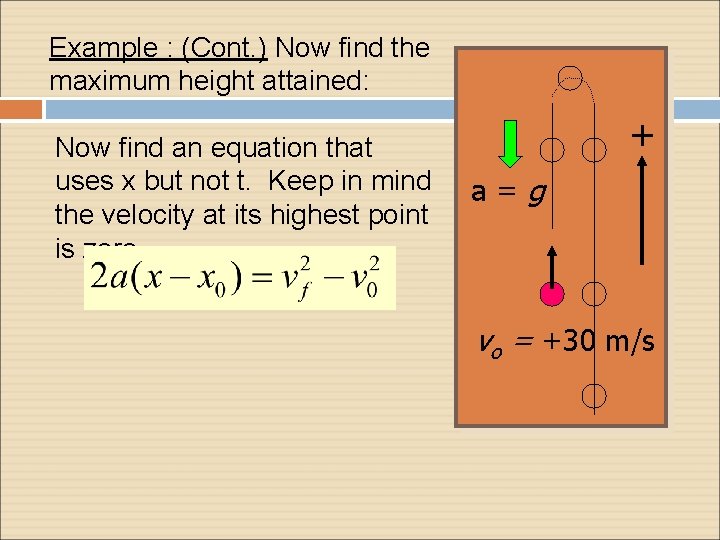
Example : (Cont. ) Now find the maximum height attained: Now find an equation that uses x but not t. Keep in mind the velocity at its highest point is zero + a=g vo = +30 m/s
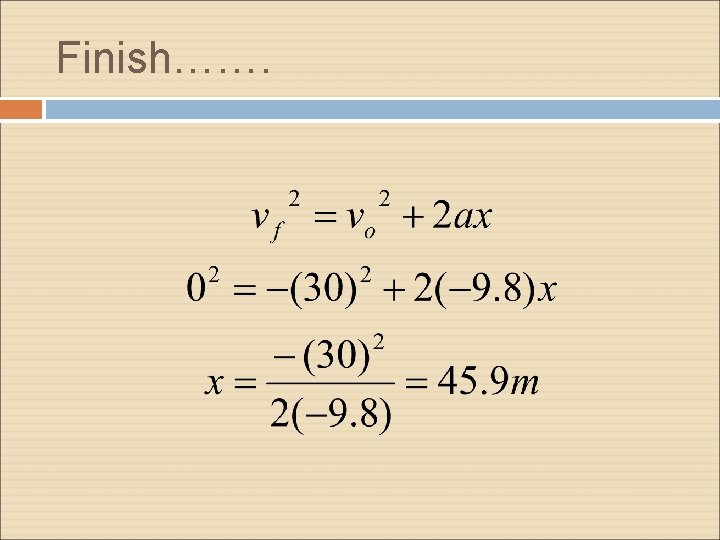
Finish…….