FACOLT DI INGEGNERIA Dottorato in Ingegneria Industriale Ph
- Slides: 28
FACOLTÀ DI INGEGNERIA - Dottorato in Ingegneria Industriale Ph. D course “Game Theory And Analysis Of Competitive Dynamics For Industrial Systems” An introduction to Game Theory Prof. ssa Lina Mallozzi Ph. D STUDENTs Pellegrino Maria Sole Percuoco Chiara Napoli, 16 Marzo 2018
Contents Ø A brief introduction to game theory Ø Definition and classification of games Ø Nash Equilibrium Ø Evolutionary game theory Ø Evolutionary Stable Strategy ESS Ø An example: hawk-dove game An introduction to: Evolutionary Game Theory PELLEGRINO, PERCUOCO – 16/03/2018
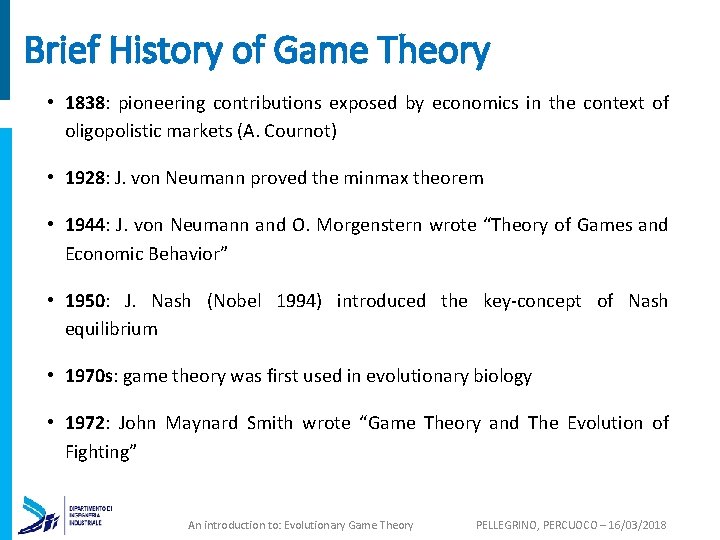
Brief History of Game Theory • 1838: pioneering contributions exposed by economics in the context of oligopolistic markets (A. Cournot) • 1928: J. von Neumann proved the minmax theorem • 1944: J. von Neumann and O. Morgenstern wrote “Theory of Games and Economic Behavior” • 1950: J. Nash (Nobel 1994) introduced the key-concept of Nash equilibrium • 1970 s: game theory was first used in evolutionary biology • 1972: John Maynard Smith wrote “Game Theory and The Evolution of Fighting” An introduction to: Evolutionary Game Theory PELLEGRINO, PERCUOCO – 16/03/2018
Game Theory Game theory is a branch of mathematics that deals with interactive decision-making models, namely with situations where two or more individuals (called players) make decisions that affect each other. Game theory is widely applied in economics, engineering, political science, and biology, among others (Vasile and Becerra 2014). …that is… Game theory is a study of how to mathematically determine the best strategy for given conditions in order to optimize the outcome. An introduction to: Evolutionary Game Theory PELLEGRINO, PERCUOCO – 16/03/2018
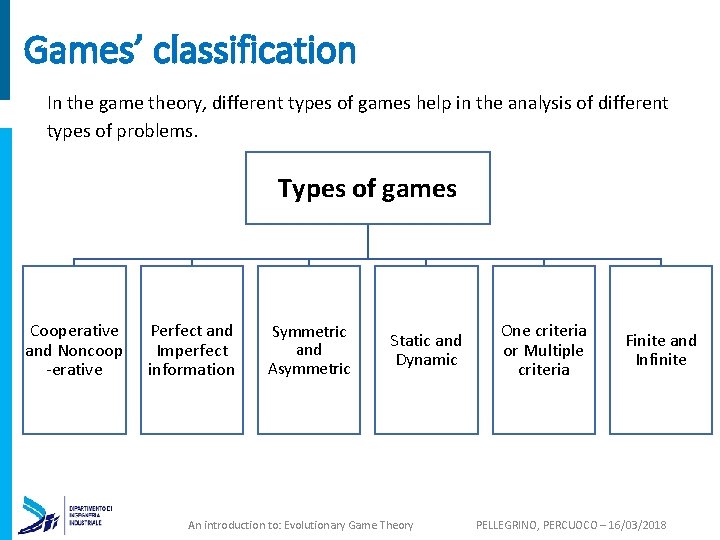
Games’ classification In the game theory, different types of games help in the analysis of different types of problems. Types of games Cooperative and Noncoop -erative Perfect and Imperfect information Symmetric and Asymmetric Static and Dynamic An introduction to: Evolutionary Game Theory One criteria or Multiple criteria Finite and Infinite PELLEGRINO, PERCUOCO – 16/03/2018
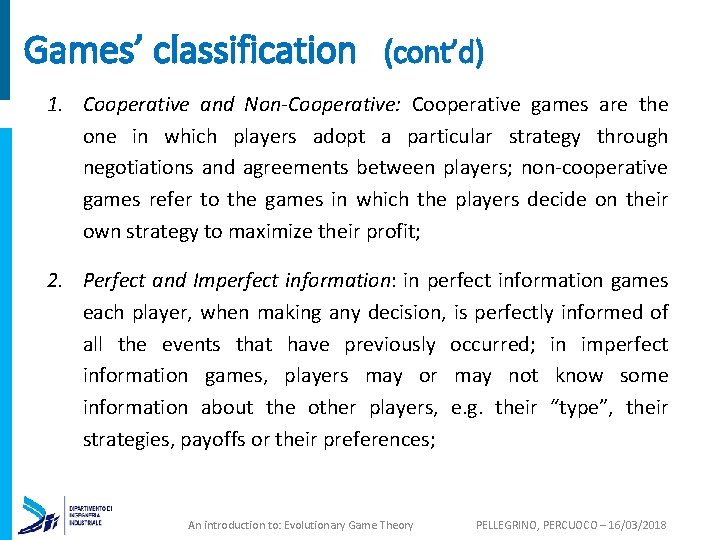
Games’ classification (cont’d) 1. Cooperative and Non-Cooperative: Cooperative games are the one in which players adopt a particular strategy through negotiations and agreements between players; non-cooperative games refer to the games in which the players decide on their own strategy to maximize their profit; 2. Perfect and Imperfect information: in perfect information games each player, when making any decision, is perfectly informed of all the events that have previously occurred; in imperfect information games, players may or may not know some information about the other players, e. g. their “type”, their strategies, payoffs or their preferences; An introduction to: Evolutionary Game Theory PELLEGRINO, PERCUOCO – 16/03/2018
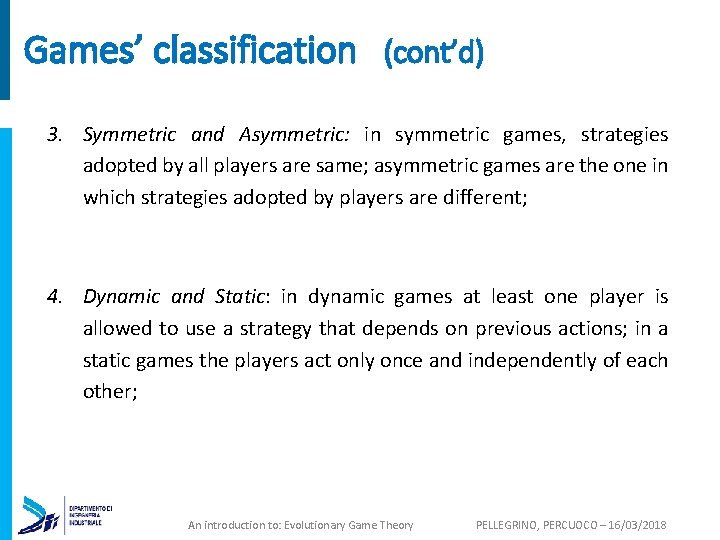
Games’ classification (cont’d) 3. Symmetric and Asymmetric: in symmetric games, strategies adopted by all players are same; asymmetric games are the one in which strategies adopted by players are different; 4. Dynamic and Static: in dynamic games at least one player is allowed to use a strategy that depends on previous actions; in a static games the players act only once and independently of each other; An introduction to: Evolutionary Game Theory PELLEGRINO, PERCUOCO – 16/03/2018
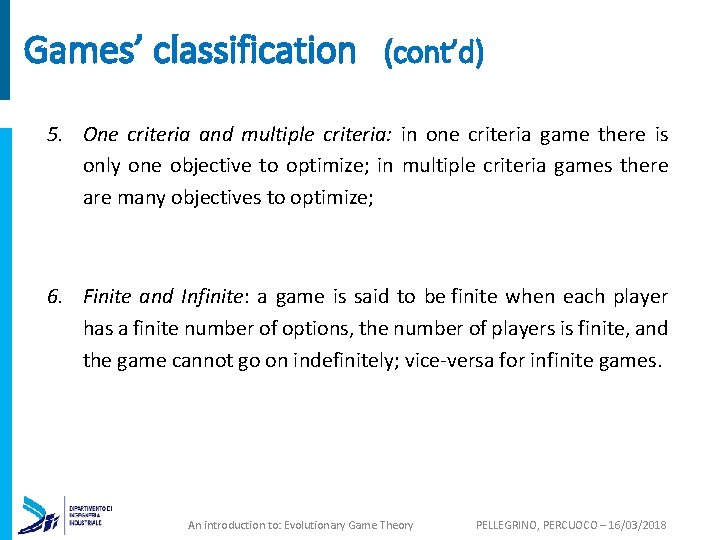
Games’ classification (cont’d) 5. One criteria and multiple criteria: in one criteria game there is only one objective to optimize; in multiple criteria games there are many objectives to optimize; 6. Finite and Infinite: a game is said to be finite when each player has a finite number of options, the number of players is finite, and the game cannot go on indefinitely; vice-versa for infinite games. An introduction to: Evolutionary Game Theory PELLEGRINO, PERCUOCO – 16/03/2018
Definition of Game and Nash Equilibrium (NE) An introduction to: Evolutionary Game Theory PELLEGRINO, PERCUOCO – 16/03/2018
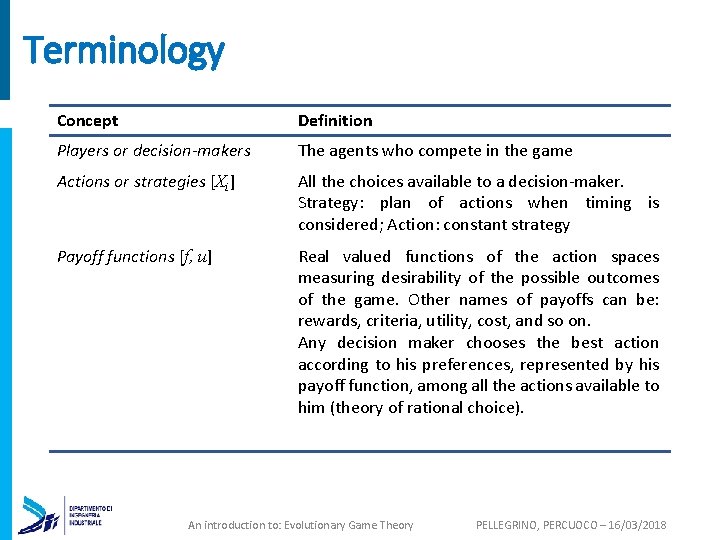
Terminology Concept Definition Players or decision-makers The agents who compete in the game Actions or strategies [Xi] All the choices available to a decision-maker. Strategy: plan of actions when timing is considered; Action: constant strategy Payoff functions [f, u] Real valued functions of the action spaces measuring desirability of the possible outcomes of the game. Other names of payoffs can be: rewards, criteria, utility, cost, and so on. Any decision maker chooses the best action according to his preferences, represented by his payoff function, among all the actions available to him (theory of rational choice). An introduction to: Evolutionary Game Theory PELLEGRINO, PERCUOCO – 16/03/2018
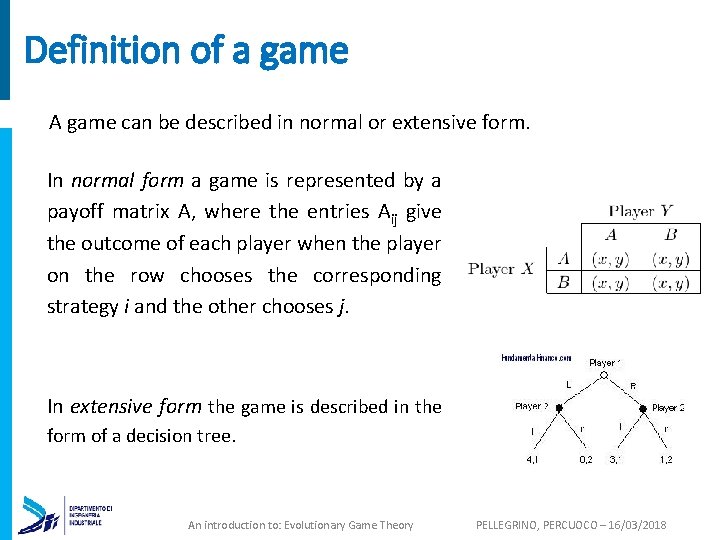
Definition of a game A game can be described in normal or extensive form. In normal form a game is represented by a payoff matrix A, where the entries Aij give the outcome of each player when the player on the row chooses the corresponding strategy i and the other chooses j. In extensive form the game is described in the form of a decision tree. An introduction to: Evolutionary Game Theory PELLEGRINO, PERCUOCO – 16/03/2018
Solution of a game Among the several types of games, the focus will be hereafter on Noncooperative, static and with perfect information games. The optimum solution for a game is the dominant strategy. However, this ideal solution is not always available. Thus, an alternative solution is equilibrium point. The concept, which today is known as Nash equilibrium solution, poses this question: does there exist an obvious or reasonable way to play a noncooperative game? An introduction to: Evolutionary Game Theory PELLEGRINO, PERCUOCO – 16/03/2018
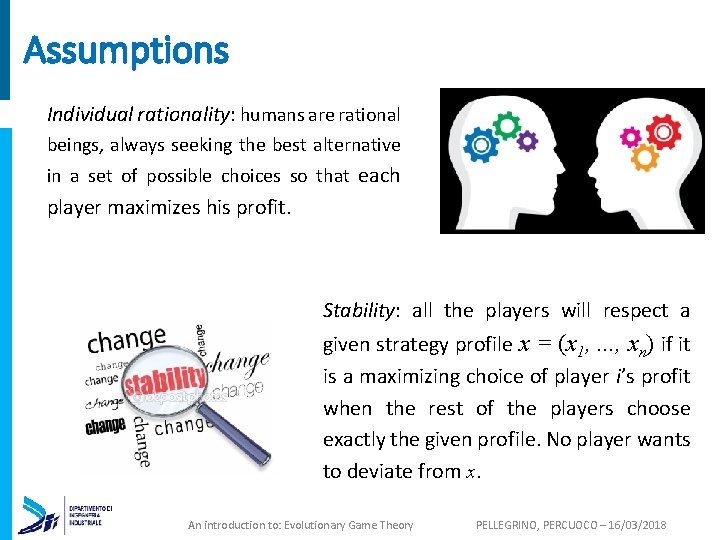
Assumptions Individual rationality: humans are rational beings, always seeking the best alternative in a set of possible choices so that each player maximizes his profit. Stability: all the players will respect a given strategy profile x = (x 1, . . . , xn) if it is a maximizing choice of player i’s profit when the rest of the players choose exactly the given profile. No player wants to deviate from x. An introduction to: Evolutionary Game Theory PELLEGRINO, PERCUOCO – 16/03/2018
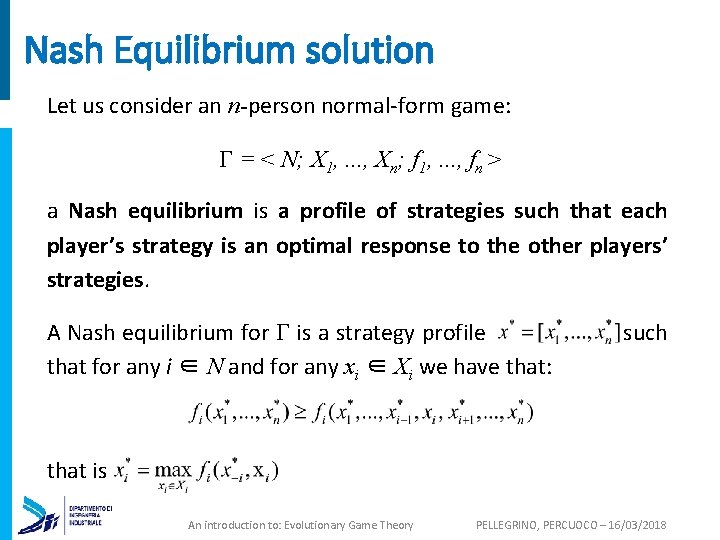
Nash Equilibrium solution Let us consider an n-person normal-form game: Γ = < N; X 1, . . . , Xn; f 1, . . . , fn > a Nash equilibrium is a profile of strategies such that each player’s strategy is an optimal response to the other players’ strategies. A Nash equilibrium for Γ is a strategy profile such that for any i ∈ N and for any xi ∈ Xi we have that: that is An introduction to: Evolutionary Game Theory PELLEGRINO, PERCUOCO – 16/03/2018
Evolutionary Game Theory An introduction to: Evolutionary Game Theory PELLEGRINO, PERCUOCO – 16/03/2018
Evolutionary Game Theory Differing from classical game theory, evolutionary game theory focuses more on the dynamics of strategy change as influenced not only by the quality of the various competing strategies, but also by the effect of the frequency with which those various competing strategies are found in the population. …that is… Rational behavior is replaced by natural selection; indeed Evolutionary game theory originates from biology (J. M. Smith and Price 1973), but nowadays has become an established tool in other disciplines, in particular in economics (Sandholm 2010), computer science (Suri 2007) and engineering. An introduction to: Evolutionary Game Theory PELLEGRINO, PERCUOCO – 16/03/2018
Evolutionary Game Theory (cont’d) The solution of evolutionary game is an Evolutionary Stable Strategy (ESS). The ESS is a behavior that, when adopted by a population of players, cannot be invaded by an alternative strategy. In other words, an ESS is a strategy such that, if all the members of a population adopt a strategy x, then no mutant strategy x’ could invade the population under the influence of natural selection. An introduction to: Evolutionary Game Theory PELLEGRINO, PERCUOCO – 16/03/2018
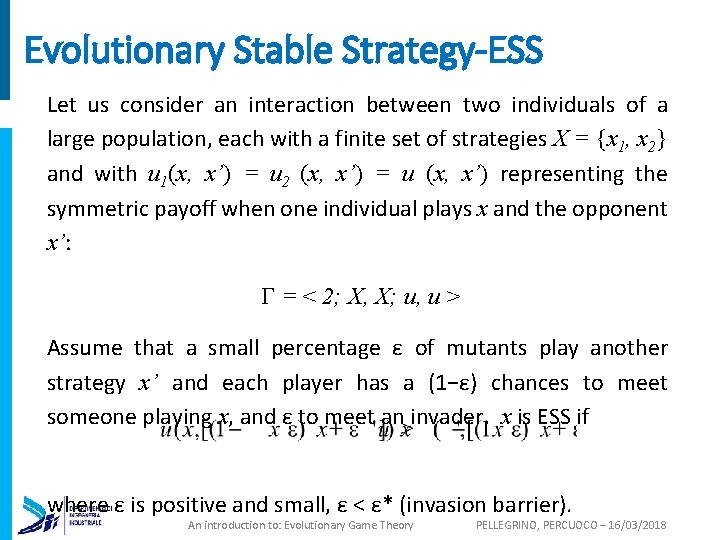
Evolutionary Stable Strategy-ESS Let us consider an interaction between two individuals of a large population, each with a finite set of strategies X = {x 1, x 2} and with u 1(x, x’) = u 2 (x, x’) = u (x, x’) representing the symmetric payoff when one individual plays x and the opponent x’: Γ = < 2; X, X; u, u > Assume that a small percentage ε of mutants play another strategy x’ and each player has a (1−ε) chances to meet someone playing x, and ε to meet an invader. x is ESS if where ε is positive and small, ε < ε* (invasion barrier). An introduction to: Evolutionary Game Theory PELLEGRINO, PERCUOCO – 16/03/2018
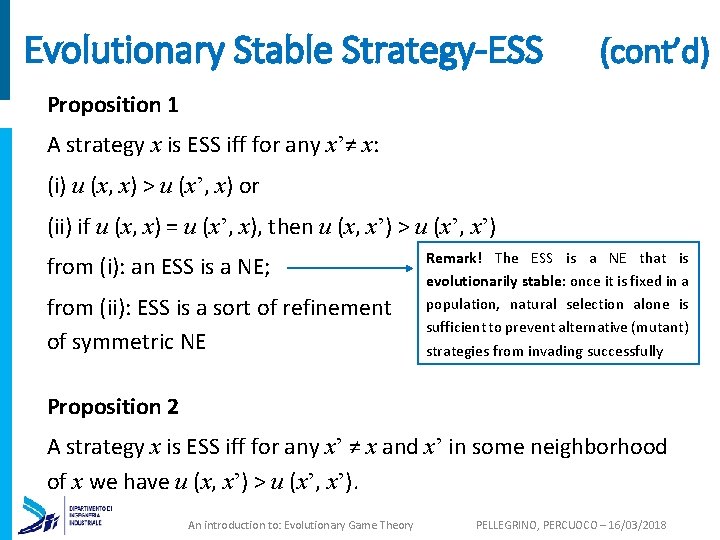
Evolutionary Stable Strategy-ESS (cont’d) Proposition 1 A strategy x is ESS iff for any x’≠ x: (i) u (x, x) > u (x’, x) or (ii) if u (x, x) = u (x’, x), then u (x, x’) > u (x’, x’) from (i): an ESS is a NE; from (ii): ESS is a sort of refinement of symmetric NE Remark! The ESS is a NE that is evolutionarily stable: once it is fixed in a population, natural selection alone is sufficient to prevent alternative (mutant) strategies from invading successfully Proposition 2 A strategy x is ESS iff for any x’ ≠ x and x’ in some neighborhood of x we have u (x, x’) > u (x’, x’). An introduction to: Evolutionary Game Theory PELLEGRINO, PERCUOCO – 16/03/2018
An Evolutionary Game: Hawk and Dove An introduction to: Evolutionary Game Theory PELLEGRINO, PERCUOCO – 16/03/2018
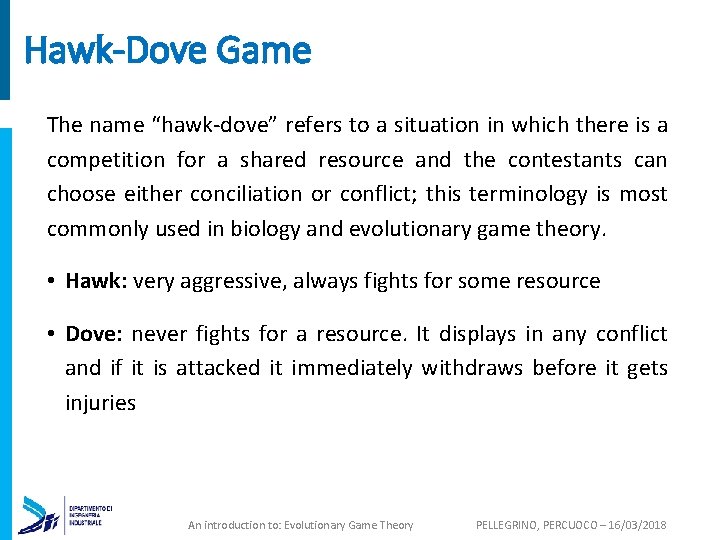
Hawk-Dove Game The name “hawk-dove” refers to a situation in which there is a competition for a shared resource and the contestants can choose either conciliation or conflict; this terminology is most commonly used in biology and evolutionary game theory. • Hawk: very aggressive, always fights for some resource • Dove: never fights for a resource. It displays in any conflict and if it is attacked it immediately withdraws before it gets injuries An introduction to: Evolutionary Game Theory PELLEGRINO, PERCUOCO – 16/03/2018
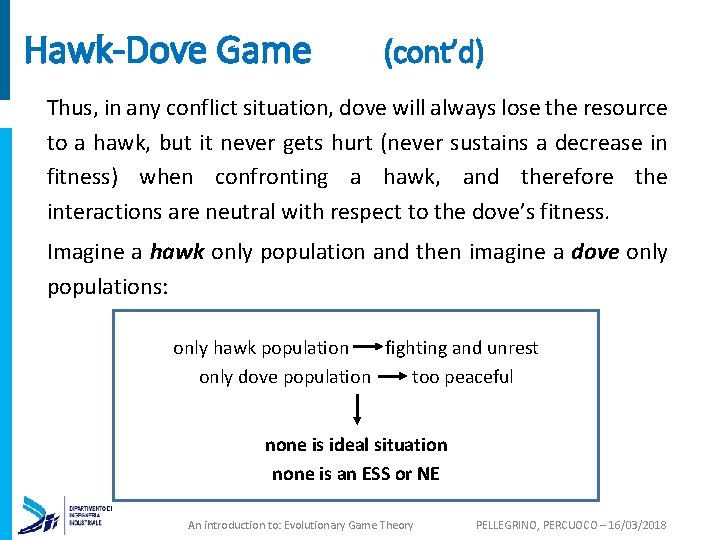
Hawk-Dove Game (cont’d) Thus, in any conflict situation, dove will always lose the resource to a hawk, but it never gets hurt (never sustains a decrease in fitness) when confronting a hawk, and therefore the interactions are neutral with respect to the dove’s fitness. Imagine a hawk only population and then imagine a dove only populations: only hawk population fighting and unrest only dove population too peaceful none is ideal situation none is an ESS or NE An introduction to: Evolutionary Game Theory PELLEGRINO, PERCUOCO – 16/03/2018
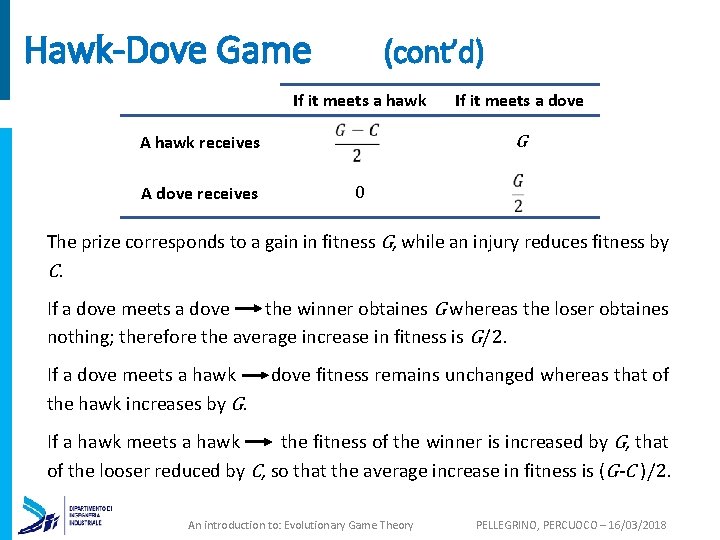
Hawk-Dove Game (cont’d) If it meets a hawk A hawk receives A dove receives If it meets a dove G 0 The prize corresponds to a gain in fitness G, while an injury reduces fitness by C. If a dove meets a dove the winner obtaines G whereas the loser obtaines nothing; therefore the average increase in fitness is G/2. If a dove meets a hawk dove fitness remains unchanged whereas that of the hawk increases by G. If a hawk meets a hawk the fitness of the winner is increased by G, that of the looser reduced by C, so that the average increase in fitness is (G-C )/2. An introduction to: Evolutionary Game Theory PELLEGRINO, PERCUOCO – 16/03/2018
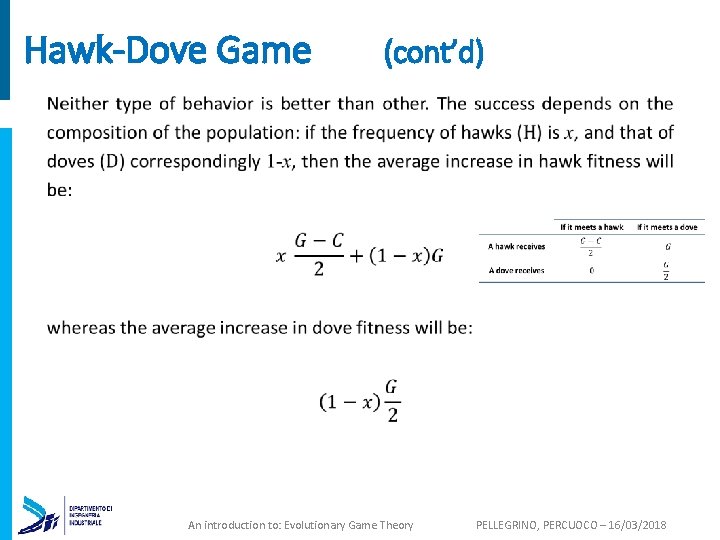
Hawk-Dove Game (cont’d) An introduction to: Evolutionary Game Theory PELLEGRINO, PERCUOCO – 16/03/2018
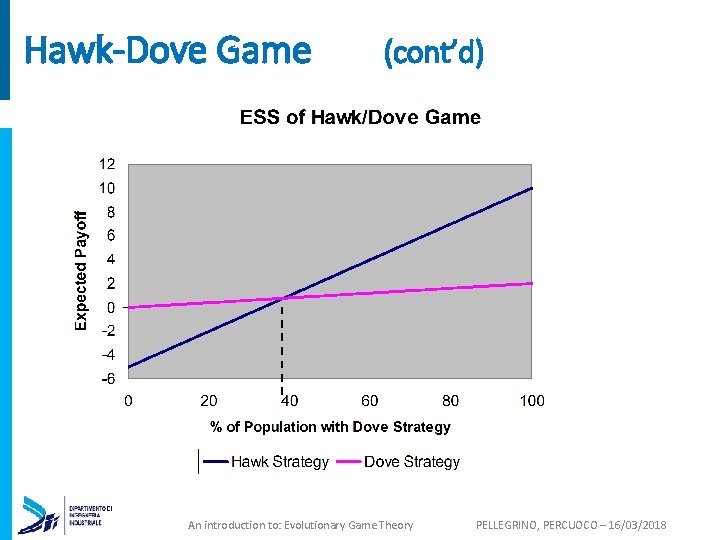
Hawk-Dove Game (cont’d) An introduction to: Evolutionary Game Theory PELLEGRINO, PERCUOCO – 16/03/2018
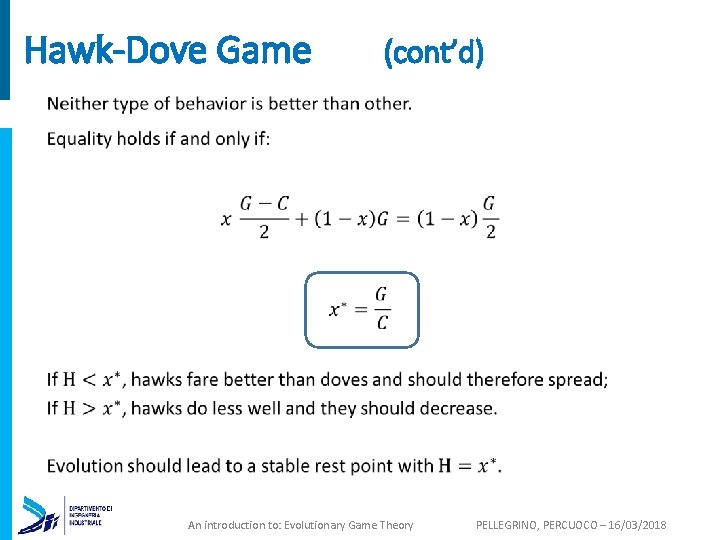
Hawk-Dove Game (cont’d) An introduction to: Evolutionary Game Theory PELLEGRINO, PERCUOCO – 16/03/2018
Main references • Cournot, A. , Recherches sur les Principes Mathématiques de la Théorie des Richesses, 1838 [English edition: Researches into the Mathematical Principles of the Theory of Wealth, edited. by N. Bacon, Macmillan, London, U. K. , 1897. ] • von Neumann, J. , “Zur Theorie der Gesellschaftsspiele, ” Mathematische Annalen, Vol. 100, 1928, pp. 295– 320. • von Neumann, J. , and Morgenstern, O. , Theory of Games and Economic Behavior, Princeton University Press, Princeton, 1944. • Nash, J. F. , “Equilibrium Points in n-Person Games, ” Proceedings of the National Academy of Science, Vol. 36, 1950, pp. 48– 49. • Smith, J. Maynard. Game theory and the evolution of fighting. On evolution, 1972, 8 -28. • Vasile, M. ; Becerra, V. M. Computational intelligence in aerospace sciences. American Institute of Aeronautics and Astronautics, 2014. • Hofbauer, J. , & Sigmund, K. Evolutionary games and population dynamics. Cambridge university press. 1998 • Smith, J. M. , & Price, G. R. The logic of animal conflict. Nature, 246(5427), 15. 1973 • Sandholm, W. H. Population games and evolutionary dynamics. MIT press. 2010 • Suri, S. Computational evolutionary game theory. Algorithmic Game Theory, 29. 2007 An introduction to: Evolutionary Game Theory PELLEGRINO, PERCUOCO – 16/03/2018
Thank you for your attention! An introduction to: Evolutionary Game Theory PELLEGRINO, PERCUOCO – 16/03/2018