EXCEED AS A TOOL FOR GOOD GOVERNANCE OF

- Slides: 34
EXCEED AS A TOOL FOR GOOD GOVERNANCE OF WATER RESOURCES IN THE MIDDLE EAST REGION Mahmoud Alawi, Mehmet Emin Aydin, Ahmet Baban, Müfit Bahadir, Mufeed Batarseh, Eyüp Debik, Rasha El Gohary, Ahmed Hassan, Anwar Jiries, Zeinab Abou El Naga, Abbas Al Omari, Bülent Topkaya* *Akdeniz University Department of Environmental Engineering EXCEED CLOSING SYMPOSIUM Braunschweig, September 23 -24, 2014
Contents • • ME Region and Partner Institutions Water resources in the ME Exceed activities Outlook
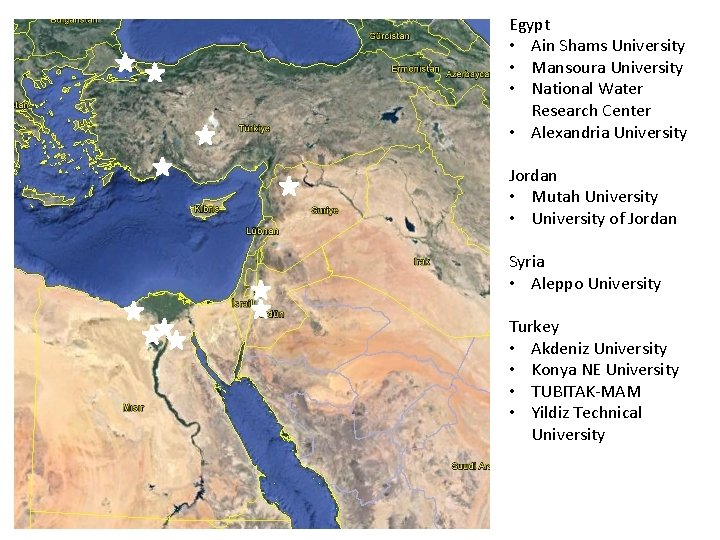
Egypt • Ain Shams University • Mansoura University • National Water Research Center • Alexandria University Jordan • Mutah University • University of Jordan Syria • Aleppo University Turkey • Akdeniz University • Konya NE University • TUBITAK‐MAM • Yildiz Technical University
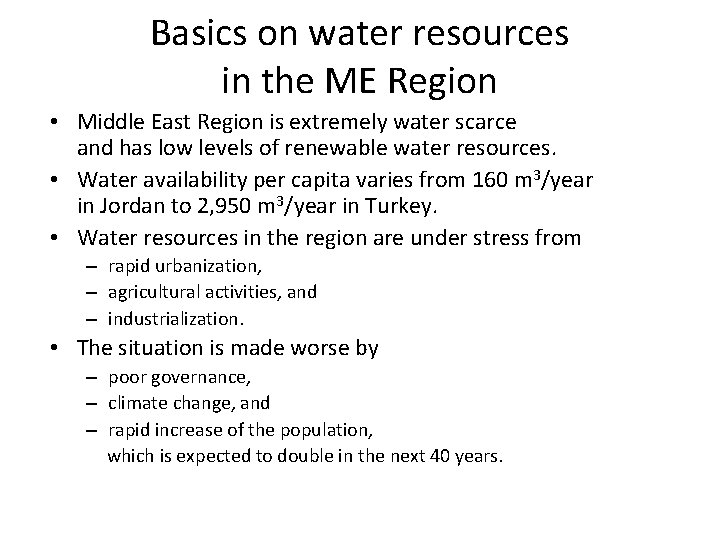
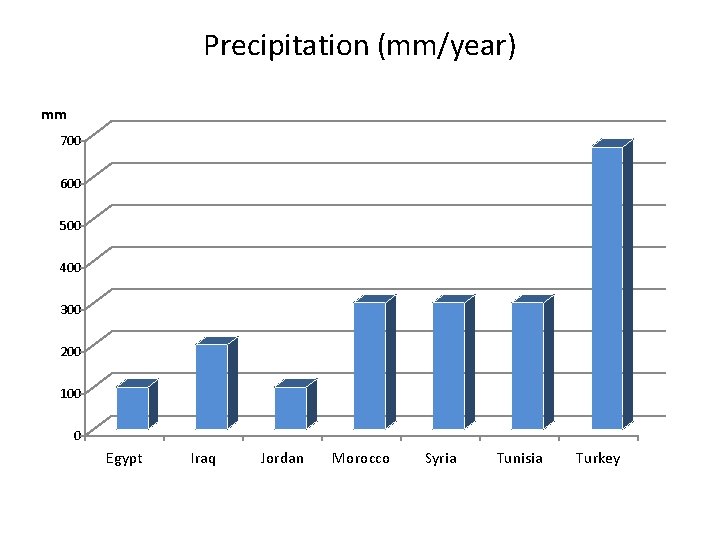
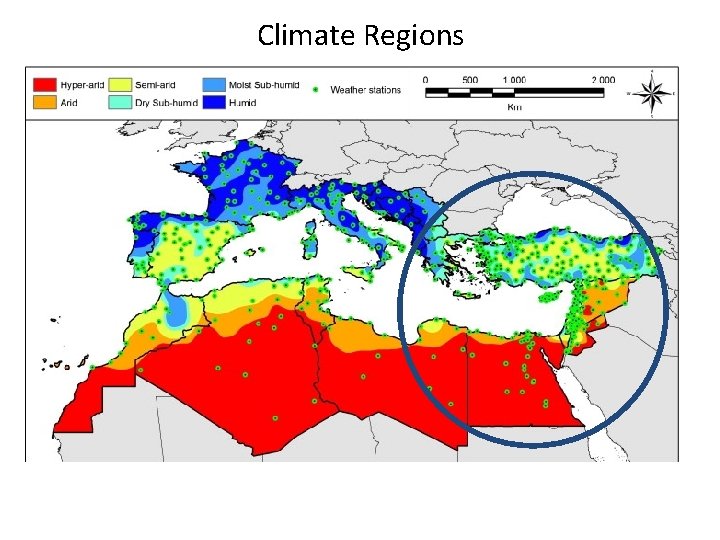
Basics on water resources in the ME Region • Middle East Region is extremely water scarce and has low levels of renewable water resources. • Water availability per capita varies from 160 m 3/year in Jordan to 2, 950 m 3/year in Turkey. • Water resources in the region are under stress from – rapid urbanization, – agricultural activities, and – industrialization. • The situation is made worse by – poor governance, – climate change, and – rapid increase of the population, which is expected to double in the next 40 years.
Precipitation (mm/year) mm 700 600 500 400 300 200 100 0 Egypt Iraq Jordan Morocco Syria Tunisia Turkey
Climate Regions
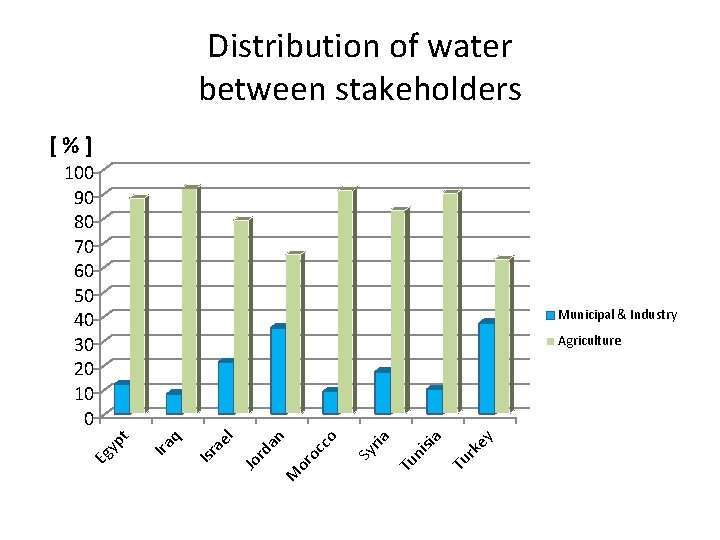
Distribution of water between stakeholders [%] 100 90 80 70 60 50 40 30 20 10 0 Municipal & Industry ey rk Tu sia ni ria Tu or M Sy oc co an Jo rd l ae Isr Ira q Eg yp t Agriculture
Water related problems • Supplying the residents with water of adequate quantity and quality. • Water losses in the supply systems play an important role as at least half of the water pumped into the systems are lost due to several reasons. • Water quality is another important issue • Wastewater treatment and reuse will become more important with decreasing natural water resources.
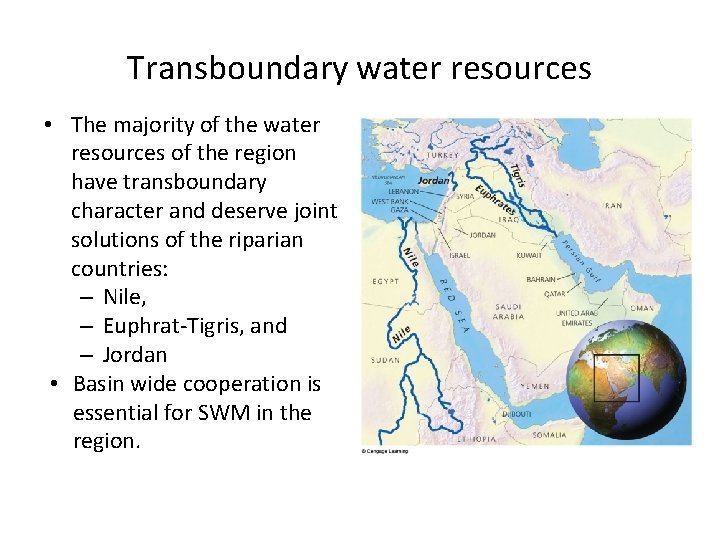
Transboundary water resources • The majority of the water resources of the region have transboundary character and deserve joint solutions of the riparian countries: – Nile, – Euphrat‐Tigris, and – Jordan • Basin wide cooperation is essential for SWM in the region.
EXCEED Impacts /Added Value • Exceed Project addresses the core problems of the region and proposes establishing “Sustainable Water Management” (SWM). • In the framework of Exceed‐ME workshops, – academicians, – responsible water authorities, and – other stakeholders worked together and SWM proposals were evaluated. • For the first time, it was possible for the academicians of the countries in the region to come together and to discuss on common problems, joint use, and joint solutions of the water scarcity. • It is generally agreed that joint working is the only way to cope with water related problems and to survive in a water scarce region.
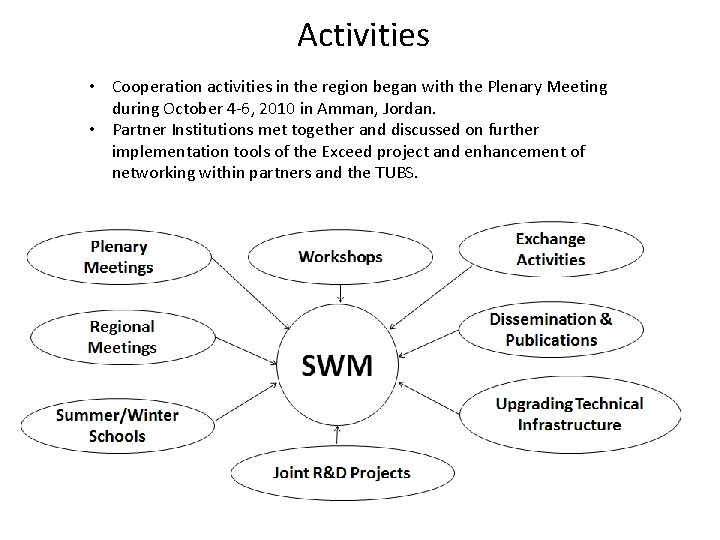
Activities • Cooperation activities in the region began with the Plenary Meeting during October 4‐ 6, 2010 in Amman, Jordan. • Partner Institutions met together and discussed on further implementation tools of the Exceed project and enhancement of networking within partners and the TUBS.
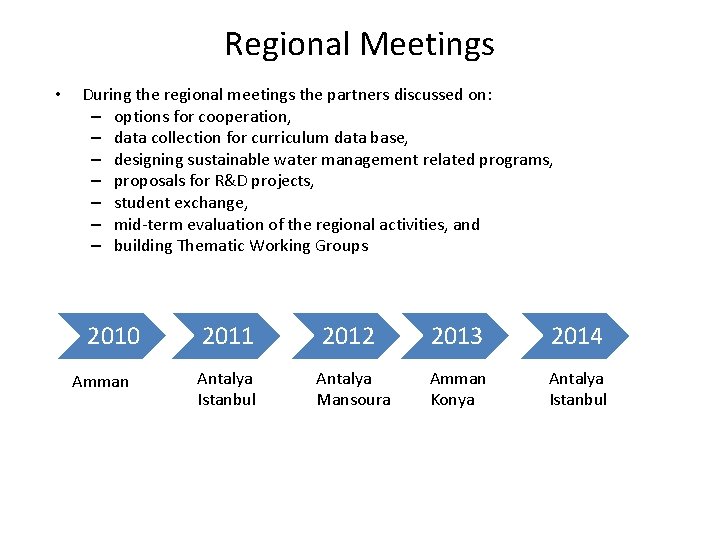
Regional Meetings • During the regional meetings the partners discussed on: – options for cooperation, – data collection for curriculum data base, – designing sustainable water management related programs, – proposals for R&D projects, – student exchange, – mid‐term evaluation of the regional activities, and – building Thematic Working Groups 2010 Amman 2011 2012 2013 2014 Antalya Istanbul Antalya Mansoura Amman Konya Antalya Istanbul
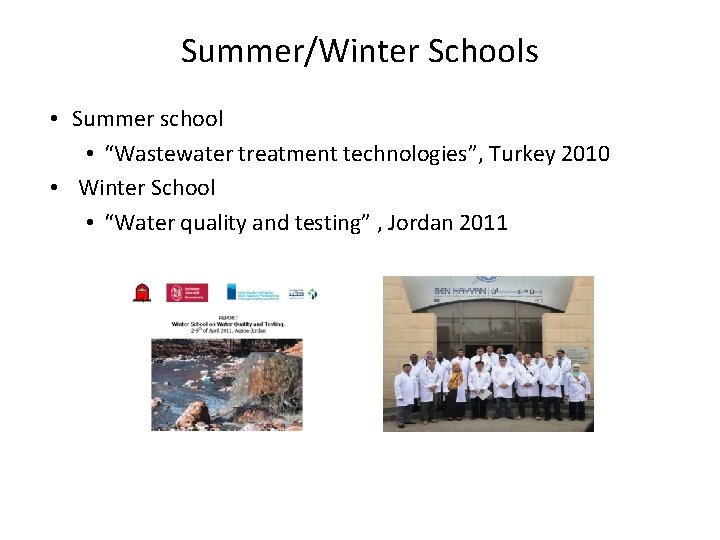
Summer/Winter Schools • Summer school • “Wastewater treatment technologies”, Turkey 2010 • Winter School • “Water quality and testing” , Jordan 2011
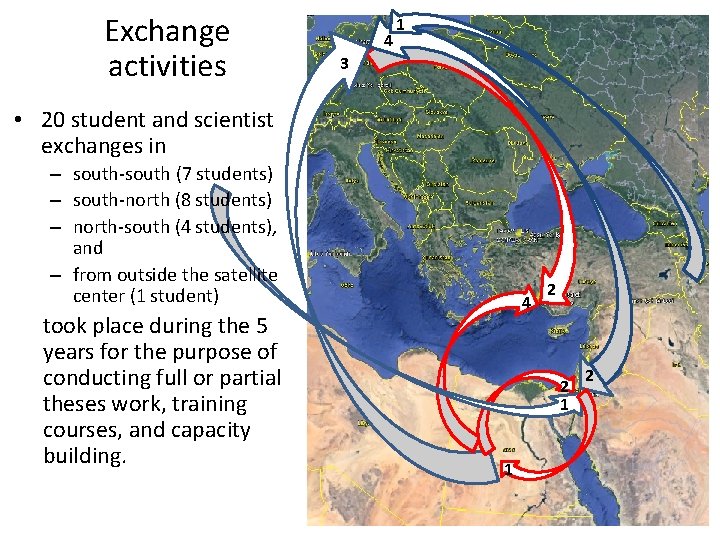
Exchange activities 4 1 3 • 20 student and scientist exchanges in – south‐south (7 students) – south‐north (8 students) – north‐south (4 students), and – from outside the satellite center (1 student) took place during the 5 years for the purpose of conducting full or partial theses work, training courses, and capacity building. 4 2 2 1 1 2
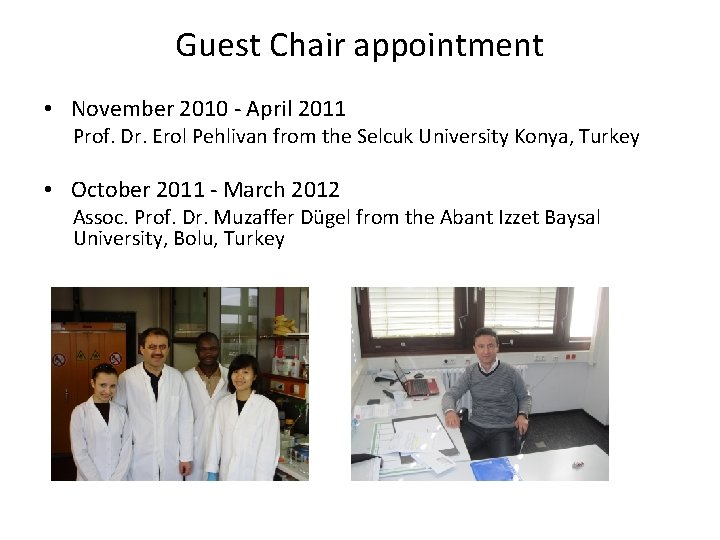
Guest Chair appointment • November 2010 ‐ April 2011 Prof. Dr. Erol Pehlivan from the Selcuk University Konya, Turkey • October 2011 ‐ March 2012 Assoc. Prof. Dr. Muzaffer Dügel from the Abant Izzet Baysal University, Bolu, Turkey
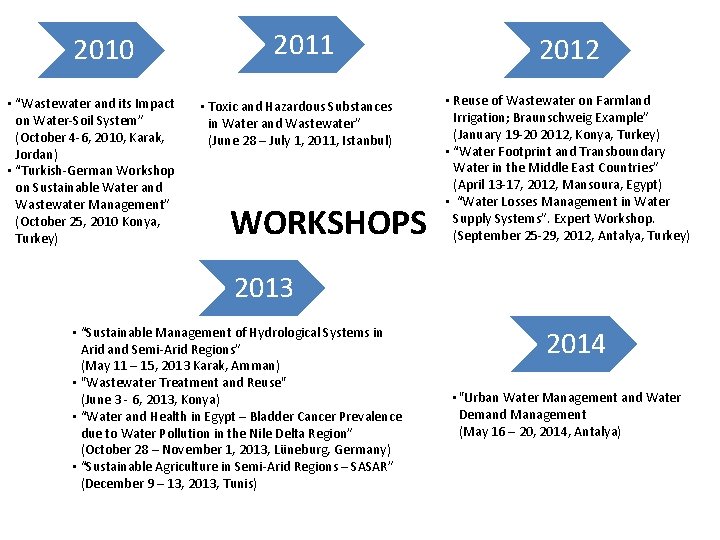
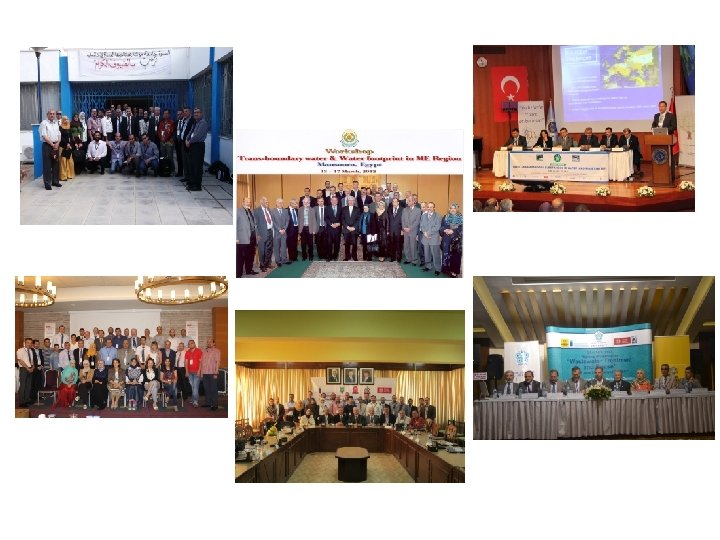
2011 2010 • “Wastewater and its Impact on Water‐Soil System” (October 4‐ 6, 2010, Karak, Jordan) • “Turkish‐German Workshop on Sustainable Water and Wastewater Management” (October 25, 2010 Konya, Turkey) • Toxic and Hazardous Substances in Water and Wastewater” (June 28 – July 1, 2011, Istanbul) WORKSHOPS 2012 • Reuse of Wastewater on Farmland Irrigation; Braunschweig Example” (January 19‐ 20 2012, Konya, Turkey) • “Water Footprint and Transboundary Water in the Middle East Countries” (April 13‐ 17, 2012, Mansoura, Egypt) • “Water Losses Management in Water Supply Systems”. Expert Workshop. (September 25‐ 29, 2012, Antalya, Turkey) 2013 • “Sustainable Management of Hydrological Systems in Arid and Semi‐Arid Regions” (May 11 – 15, 2013 Karak, Amman) • "Wastewater Treatment and Reuse" (June 3 ‐ 6, 2013, Konya) • “Water and Health in Egypt – Bladder Cancer Prevalence due to Water Pollution in the Nile Delta Region” (October 28 – November 1, 2013, Lüneburg, Germany) • “Sustainable Agriculture in Semi‐Arid Regions – SASAR” (December 9 – 13, 2013, Tunis) 2014 • "Urban Water Management and Water Demand Management (May 16 – 20, 2014, Antalya)
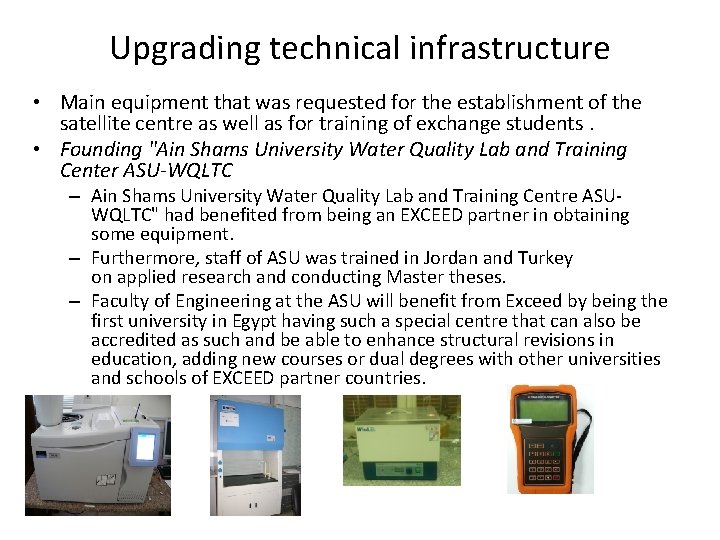
Upgrading technical infrastructure • Main equipment that was requested for the establishment of the satellite centre as well as for training of exchange students. • Founding "Ain Shams University Water Quality Lab and Training Center ASU-WQLTC – Ain Shams University Water Quality Lab and Training Centre ASU‐ WQLTC" had benefited from being an EXCEED partner in obtaining some equipment. – Furthermore, staff of ASU was trained in Jordan and Turkey on applied research and conducting Master theses. – Faculty of Engineering at the ASU will benefit from Exceed by being the first university in Egypt having such a special centre that can also be accredited as such and be able to enhance structural revisions in education, adding new courses or dual degrees with other universities and schools of EXCEED partner countries.
R&D Projects • “Pharmaceutical Residues and Persistent Organic Pollutants in Surface and Wastewater in Jordan” Mutah University and TUBS Supported by: Scientific Research Support Fund (SRF) of Jordan • “Investigation of Pollution Caused by Long-Term Irrigation Untreated Wastewater in the Agricultural Area of Konya, Turkey” Konya University and TUBS Supported by TUBITAK and BMBF • “Monitoring of Konya Sewerage System with Biofilm Collectors”. Konya University and TUBS Supported by Konya Metropolitan Municipality • with “Red Mud/Fe 3 O 4 Magnetic Nanoparticles Composite Sorbent: Preparation, characterization and potential use for the removal of organic and inorganic pollutants from environmental waters” (Under preparation) Konya University, TUBS and Halle University
Dissemination and Publications • Congress participations – The Exceed Sustainable Water Management Project was presented on the 22 nd Annual Conference of the European Association for International Education EAIE, September 15‐ 18, 2010 in Nantes, France through the DAAD as a “best practice example” for an international cooperation for capacity building. – UNESCO‐DAAD–EXCEED Conference “Water in Africa” October 22, 2012 in Kisumu, Kenya. Several members of the Exceed ME Network contributed to this symposium with practice examples conducted in their countries/regions. This is a good example for close cooperation of the different regional networks within the Exceed SWM Project. – The paper entitled “Sustainable Water Management in Developing Countries” was presented at the International Solid Waste, Water and Wastewater Congress, May 22 – 24, 2013 in Istanbul, Turkey. The main challenges of SWM in the Middle East were presented and the contribution of the Exceed Project were highlighted.
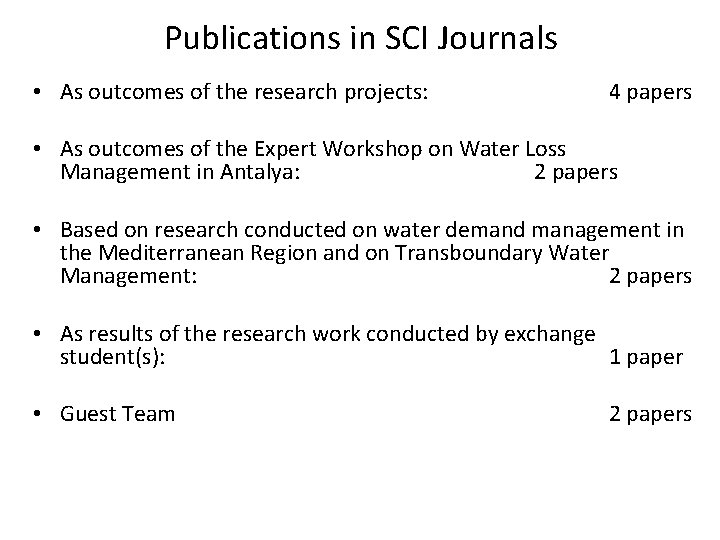
Publications in SCI Journals • As outcomes of the research projects: 4 papers • As outcomes of the Expert Workshop on Water Loss Management in Antalya: 2 papers • Based on research conducted on water demand management in the Mediterranean Region and on Transboundary Water Management: 2 papers • As results of the research work conducted by exchange student(s): 1 paper • Guest Team 2 papers
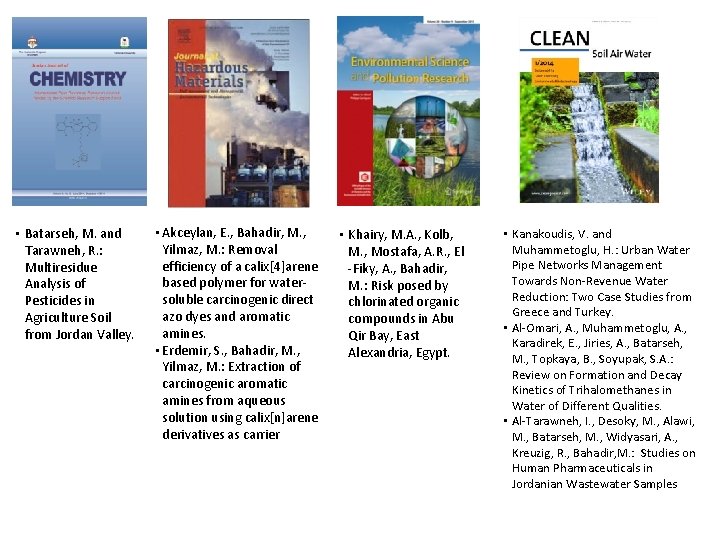
• Batarseh, M. and Tarawneh, R. : Multiresidue Analysis of Pesticides in Agriculture Soil from Jordan Valley. • Akceylan, E. , Bahadir, M. , Yilmaz, M. : Removal efficiency of a calix[4]arene based polymer for water‐ soluble carcinogenic direct azo dyes and aromatic amines. • Erdemir, S. , Bahadir, M. , Yilmaz, M. : Extraction of carcinogenic aromatic amines from aqueous solution using calix[n]arene derivatives as carrier • Khairy, M. A. , Kolb, M. , Mostafa, A. R. , El ‐Fiky, A. , Bahadir, M. : Risk posed by chlorinated organic compounds in Abu Qir Bay, East Alexandria, Egypt. • Kanakoudis, V. and Muhammetoglu, H. : Urban Water Pipe Networks Management Towards Non‐Revenue Water Reduction: Two Case Studies from Greece and Turkey. • Al‐Omari, A. , Muhammetoglu, A. , Karadirek, E. , Jiries, A. , Batarseh, M. , Topkaya, B. , Soyupak, S. A. : Review on Formation and Decay Kinetics of Trihalomethanes in Water of Different Qualities. • Al‐Tarawneh, I. , Desoky, M. , Alawi, M. , Batarseh, M. , Widyasari, A. , Kreuzig, R. , Bahadir, M. : Studies on Human Pharmaceuticals in Jordanian Wastewater Samples
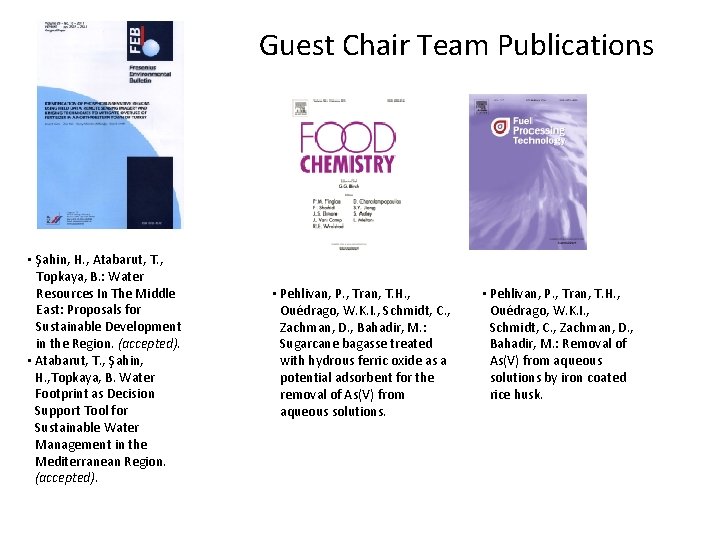
Guest Chair Team Publications • Şahin, H. , Atabarut, T. , Topkaya, B. : Water Resources In The Middle East: Proposals for Sustainable Development in the Region. (accepted). • Atabarut, T. , Şahin, H. , Topkaya, B. Water Footprint as Decision Support Tool for Sustainable Water Management in the Mediterranean Region. (accepted). • Pehlivan, P. , Tran, T. H. , Ouédrago, W. K. I. , Schmidt, C. , Zachman, D. , Bahadir, M. : Sugarcane bagasse treated with hydrous ferric oxide as a potential adsorbent for the removal of As(V) from aqueous solutions. • Pehlivan, P. , Tran, T. H. , Ouédrago, W. K. I. , Schmidt, C. , Zachman, D. , Bahadir, M. : Removal of As(V) from aqueous solutions by iron coated rice husk.
Symposium Presentations International Sustainable Water and Wastewater Management Symposium, October 26‐ 28, 2010, Konya, Turkey • 14 presentations
International cooperation • MESAEP (Mediterranean Scientific Association of Environmental Protection) • EMPOWER Tunisia
Curriculum development • Akdeniz University – Beginning from the academic year 2014‐ 2015 at least 30% of the curriculum will be tutored in English. – In addition, it is intended to modify the existing graduate program completely to English. – This will not only contribute to enhance the cooperation with other Exceed Partners, but will also help the entire university for intensifying its international cooperation. • Konya NE University A curriculum improvement with the new course for master and Ph. D students entitled “Behavior and Transport of Pollutants in the Environment”.
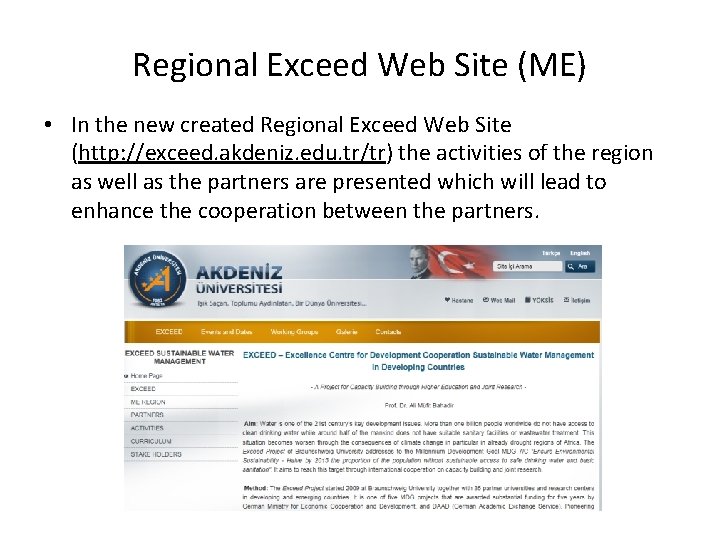
Regional Exceed Web Site (ME) • In the new created Regional Exceed Web Site (http: //exceed. akdeniz. edu. tr/tr) the activities of the region as well as the partners are presented which will lead to enhance the cooperation between the partners.
Conclusions and Outlook • • • Before the implementation of the project, great deal of research activities and cooperation in the region were accomplished with partners in EU countries and the USA. There were almost no contacts among the countries of the ME Region. Exceed project made it possible that scientists from the neighboring countries of the region meet each other. The Regional Meeting organized in Antalya March 2011 served as basis for meeting colleagues from Turkey, Syria, Jordan, and Egypt. During this regional meeting, the partners were informed about the new curriculum and the cooperation opportunities. The key problems in the ME region regarding water issues are the dealing with water scarcity and sharing the same watersheds. Exceed created an excellent basis for cooperation on these two urgent issues in a scientific way. Sustainable water management is proven to be very important in the water scarce ME region. Especially in transboundary water management issues, cooperation among the riparian countries is mandatory. As some political issues play also a role, it is our intention to bring scientific solutions to a region‐wide existing problem. 2012 was the beginning year of our works on transboundary water resources.
Water demand management • Along with climate change, water scarcity/availability will play a most crucial role in the near future. • As agriculture is the main water consuming sector in the ME it is important to focus our efforts on the water demand management in agricultural production. • It is proven that Water Footprint (WF) methodology gives some useful hints for the sustainable water management efforts. • In order to develop respective ideas on water demand management, the ME Regional Network began to work on WF methodology (2013). • During the coordination trip to Amman, Jordan meetings were organized with colleagues and representatives of state agencies, who were also interested to work on WF. • The main goal to organize a summer school on WF was not successful at that time. But this attempt will be revitalized in 2015.
Urban water management • Another key issue of importance is the water loss management in water supply systems and water quality management. • The variety of participation to the Expert Workshop on Water Loss Management from the water authorities of the countries in the region and the significant outcomes of the workshop presented in two scientific publications indicate the rich and fruitful cooperation in the future. • Besides the quantity of water, the quality of the existing water resources suffers a lot under the pressure of increasing population, uncontrolled agricultural and industrial activities, etc. • Degradation of water quality in the region is another common problem. • Residues from agricultural practices as well as diverse micro pollutants threaten the use of the scarce resources significantly.
Thematic Working Groups (TWG) • As a perspective for future network activities, establishing Thematic Working Groups (TWG) was proposed in order to enhance the joint research work as well as the cooperation under the partners: • Urban water management • Water loss management in water supply systems • Water quality in water supply systems • Water demand management • Agriculture, domestic, and industrial water demand management • Impacts of climate change on water resources • Application of water footprint methodology as decision support tool for water allocation/management tasks • Water pollution and health • Emerging pollutants and effects on environment and human health • Wastewater management and reuse
TWG cont‘d. / Expectations • Enhancing the cooperation under the partners and the regions • Increased number of joint research proposals • Developing interdisciplinary research clusters or programs • Tailor‐made concepts for the relevant regions • The TWGs will be operable in each of the four regions of Exceed.
Exceed could. . – provide a platform to experts in the field of SWM for exchanging and sharing experiences, – create a pool of experts on wastewater treatment and reuse of reclaimed water, and – become a catalyst in bridging the gap between water authorities and downstream users. EXCEED II
THANK YOU. . Mahmoud Alawi, Mehmet Emin Aydin, Ahmet Baban, Müfit Bahadir, Mufeed Batarseh, Eyüp Debik, Rasha El Gohary, Ahmed Hassan, Anwar Jiries, Zeinab Abou El Naga, Abbas Al Omari, Bülent Topkaya EXCEED CLOSING SYMPOSIUM Braunschweig, September 23 -24, 2014