Evaluating Numerical Models to Improve the Prediction of
- Slides: 12
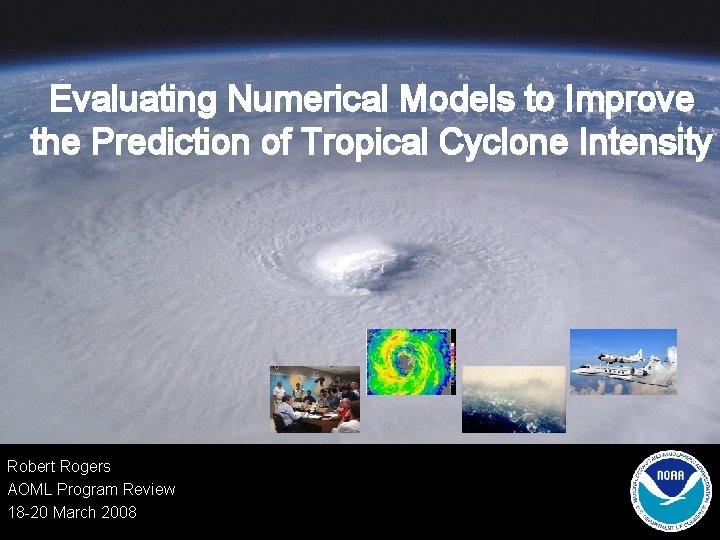
Evaluating Numerical Models to Improve the Prediction of Tropical Cyclone Intensity Robert Rogers AOML Program Review 18 -20 March 2008
Outline • Background and motivation • Examples • • • 2 Surface winds Boundary layer structure Humidity Microphysics Rainfall AOML Program Review
Background and motivation Improvements in intensity forecasts have lagged improvements in track forecasts Numerical model guidance can be key contributor to intensity forecasts Limitations in numerical models a significant contributor to slower improvements in intensity forecasts • inadequate specification of the TC vortex in the initial conditions • deficient representation of physical processes • insufficient resolution 3 AOML Program Review
Background and motivation Comparing numerical models with observations in a robust manner can identify deficiencies in the models and lead to improvements in those models HRD is uniquely positioned to contribute to this effort through a combination of data collection and analysis and numerical model experiments 4 AOML Program Review
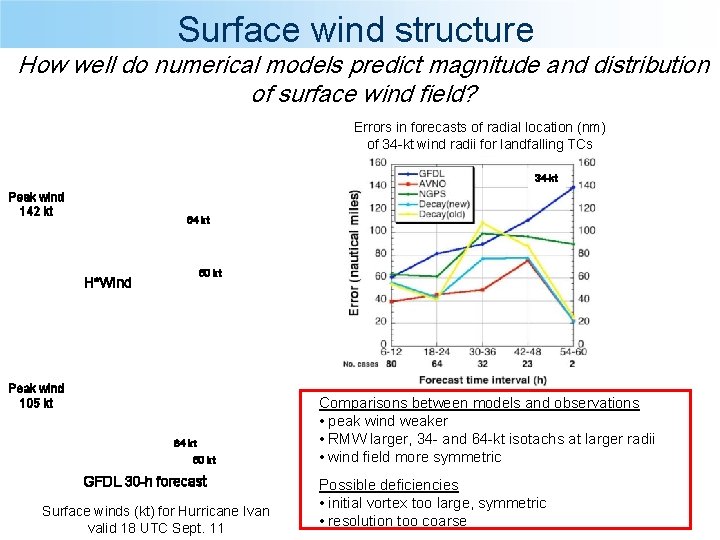
Surface wind structure How well do numerical models predict magnitude and distribution of surface wind field? Errors in forecasts of radial location (nm) of 34 -kt wind radii for landfalling TCs 34 -kt Peak wind 142 kt 64 kt 50 kt H*Wind Peak wind 105 kt 64 kt 50 kt GFDL 30 -h forecast 5 Surface winds (kt) for Hurricane Ivan valid 18 UTC Sept. 11 Comparisons between models and observations • peak wind weaker • RMW larger, 34 - and 64 -kt isotachs at larger radii • wind field more symmetric Possible deficiencies • initial vortex too large, symmetric • resolution too coarse AOML Program Review
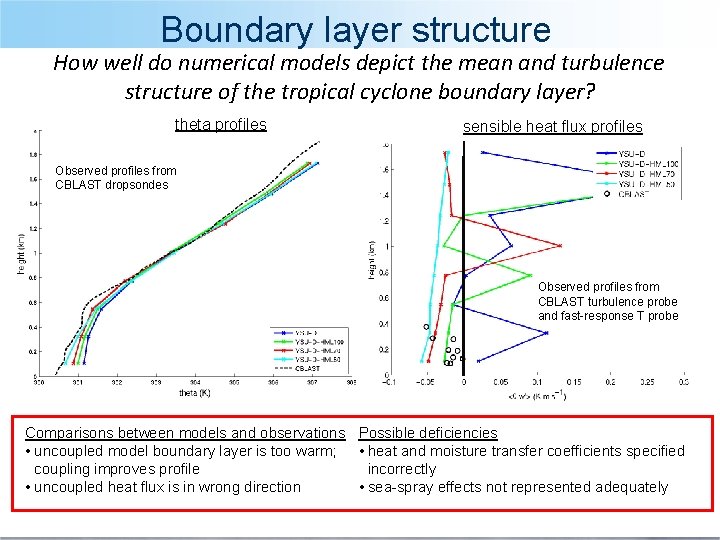
Boundary layer structure How well do numerical models depict the mean and turbulence structure of the tropical cyclone boundary layer? theta profiles sensible heat flux profiles Observed profiles from CBLAST dropsondes Observed profiles from CBLAST turbulence probe and fast-response T probe Comparisons between models and observations Possible deficiencies • uncoupled model boundary layer is too warm; • heat and moisture transfer coefficients specified coupling improves profile incorrectly • uncoupled heat flux is in wrong direction • sea-spray effects not represented adequately 6
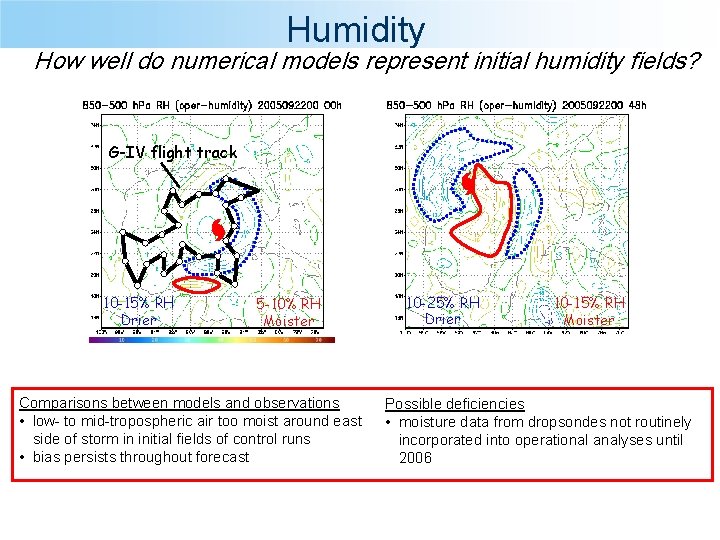
Humidity How well do numerical models represent initial humidity fields? G-IV flight track 10 -15% RH Drier 5 -10% RH Moister Comparisons between models and observations • low- to mid-tropospheric air too moist around east side of storm in initial fields of control runs • bias persists throughout forecast 7 10 -25% RH Drier 10 -15% RH Moister Possible deficiencies • moisture data from dropsondes not routinely incorporated into operational analyses until 2006 AOML Program Review
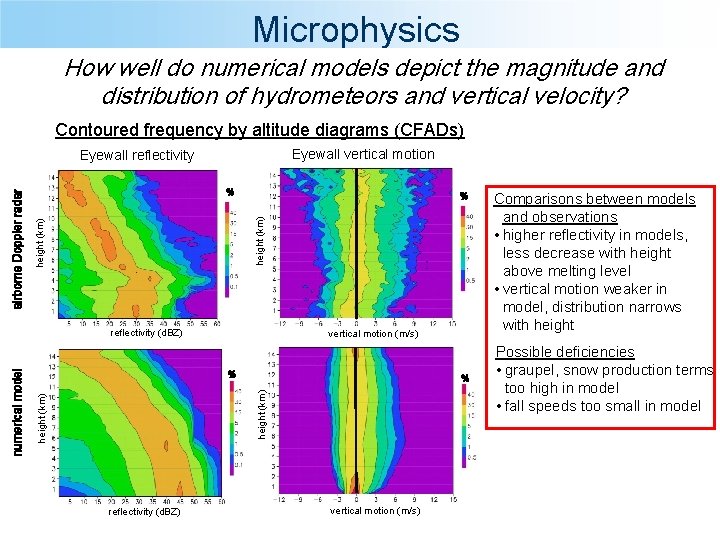
Microphysics How well do numerical models depict the magnitude and distribution of hydrometeors and vertical velocity? % % height (km) 240 stratiform eyewall reflectivity (d. BZ) vertical motion (m/s) 0 height (km) % rainband height (km) numerical model 8 % 120 distance (km) Airborne radar 120 (Olivia 1994) reflectivity (d. BZ) Comparisons between models and observations • higher reflectivity in models, less decrease with height stratiform above melting level • vertical motion weaker in model, distribution narrows with height eyewall Possible rainband deficiencies eyewall • % graupel, snow production terms % too high rainband in model rainband 0 model Eyewall vertical motion Eyewall reflectivity 120 height (km) airborne Doppler radar 240 120 Contoured frequency by altitude diagrams (CFADs) airborne radar 240 distance (km) • fall speeds too small in model 1. 67 km MM 5 240 (Floyd 1999) vertical motion (m/s)
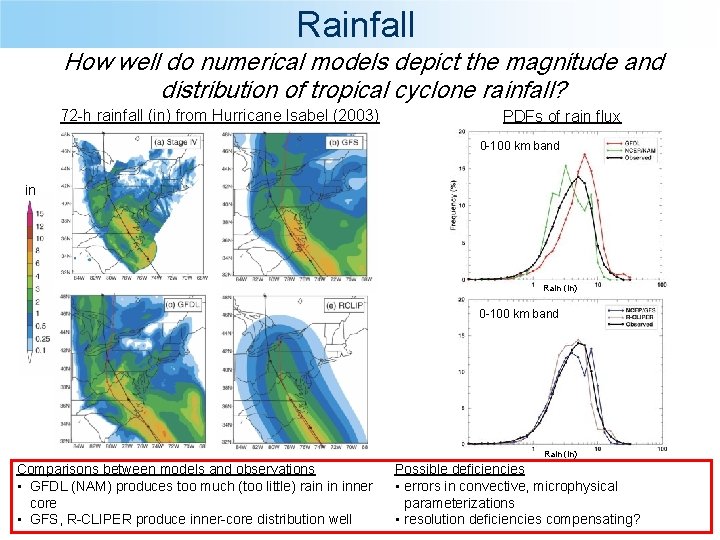
Rainfall How well do numerical models depict the magnitude and distribution of tropical cyclone rainfall? 72 -h rainfall (in) from Hurricane Isabel (2003) PDFs of rain flux 0 -100 km band in Rain (in) 0 -100 km band Rain (in) Comparisons between models and observations • GFDL (NAM) produces too much (too little) rain in inner core • 9 GFS, R-CLIPER produce inner-core distribution well Possible deficiencies • errors in convective, microphysical parameterizations • resolution deficiencies compensating? AOML Program Review
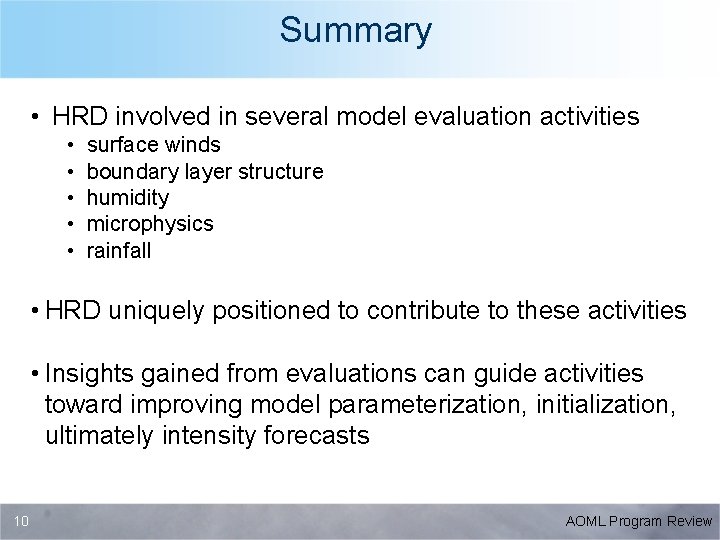
Summary • HRD involved in several model evaluation activities • • • surface winds boundary layer structure humidity microphysics rainfall • HRD uniquely positioned to contribute to these activities • Insights gained from evaluations can guide activities toward improving model parameterization, initialization, ultimately intensity forecasts 10 AOML Program Review
Evaluating Numerical Models to Improve the Prediction of Tropical Cyclone Intensity RI/Decay (John Kaplan) QUESTIONS?
Background Material