Electric Grid Modernization Working Group KickOff Workshop Larry
- Slides: 33
Electric Grid Modernization Working Group Kick-Off Workshop Larry Gelbien, Vice President of Engineering, NSTAR Jennifer Schilling, Director of Asset Management, Western Massachusetts Electric Company November 14, 2012 1
Agenda 1 Introduction 2 NSTAR Grid Modernization Activities 3 WMECo Grid Modernization Activities 2
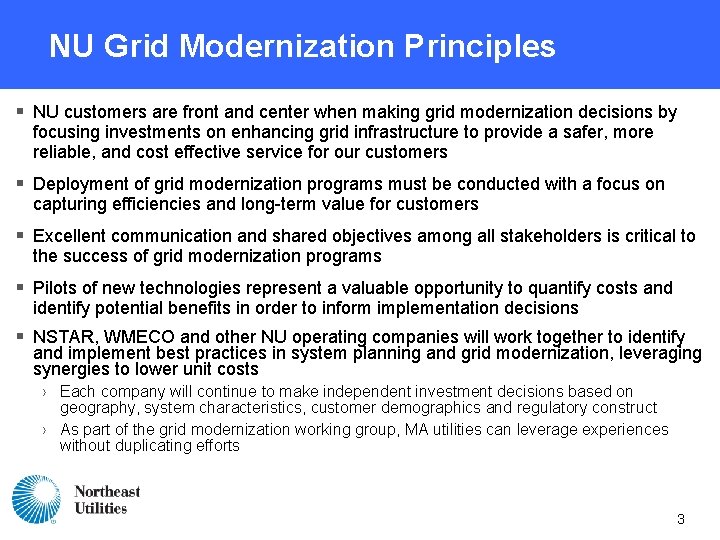
NU Grid Modernization Principles § NU customers are front and center when making grid modernization decisions by focusing investments on enhancing grid infrastructure to provide a safer, more reliable, and cost effective service for our customers § Deployment of grid modernization programs must be conducted with a focus on capturing efficiencies and long-term value for customers § Excellent communication and shared objectives among all stakeholders is critical to the success of grid modernization programs § Pilots of new technologies represent a valuable opportunity to quantify costs and identify potential benefits in order to inform implementation decisions § NSTAR, WMECO and other NU operating companies will work together to identify and implement best practices in system planning and grid modernization, leveraging synergies to lower unit costs › Each company will continue to make independent investment decisions based on geography, system characteristics, customer demographics and regulatory construct › As part of the grid modernization working group, MA utilities can leverage experiences without duplicating efforts 3
Agenda 1 Introduction 2 NSTAR Grid Modernization Activities 3 WMECo Grid Modernization Activities 4
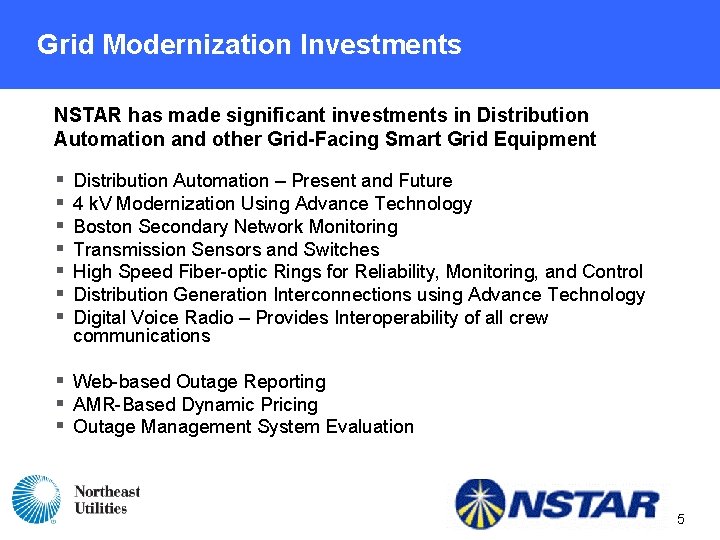
Grid Modernization Investments NSTAR has made significant investments in Distribution Automation and other Grid-Facing Smart Grid Equipment § § § § Distribution Automation – Present and Future 4 k. V Modernization Using Advance Technology Boston Secondary Network Monitoring Transmission Sensors and Switches High Speed Fiber-optic Rings for Reliability, Monitoring, and Control Distribution Generation Interconnections using Advance Technology Digital Voice Radio – Provides Interoperability of all crew communications § Web-based Outage Reporting § AMR-Based Dynamic Pricing § Outage Management System Evaluation 5
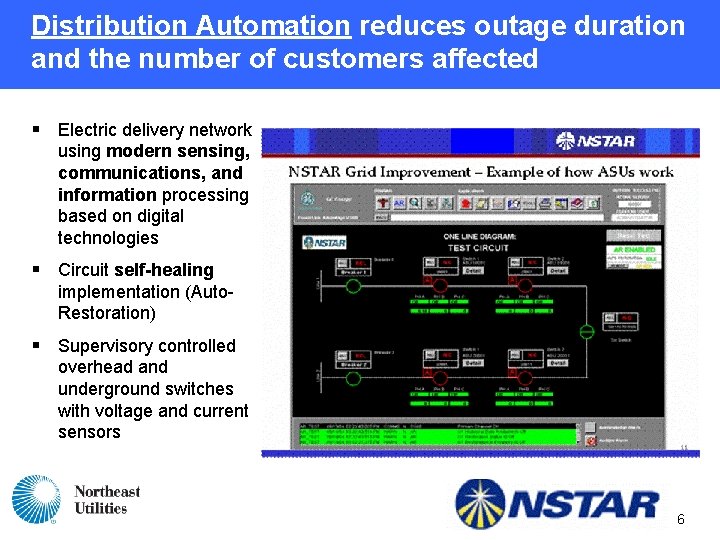
Distribution Automation reduces outage duration and the number of customers affected § Electric delivery network using modern sensing, communications, and information processing based on digital technologies § Circuit self-healing implementation (Auto. Restoration) § Supervisory controlled overhead and underground switches with voltage and current sensors 6
Significant Distribution Automation Investment § NSTAR has installed more than 2, 000 switches throughout our service territory and has over 5, 000 sensors monitoring the electric grid. § 80% of NSTAR customers benefit from Distribution Automation. § NSTAR is expanding this program and capabilities as part of our $20 MM US DOE ARRA Project. 7
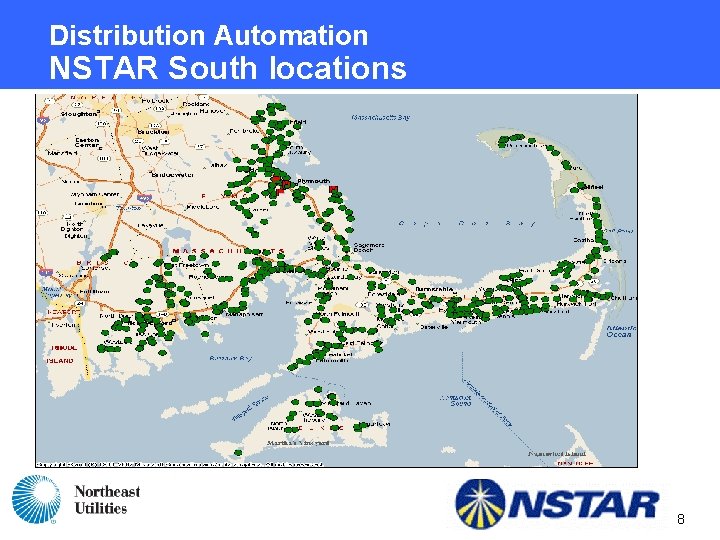
Distribution Automation NSTAR South locations 8
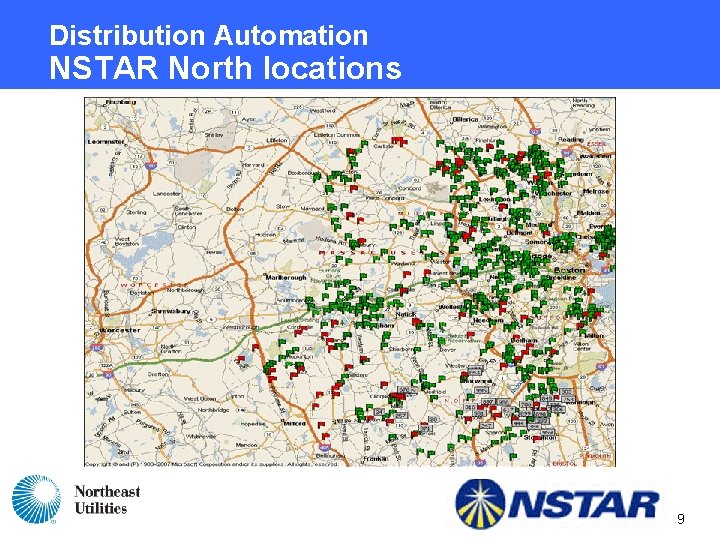
Distribution Automation NSTAR North locations 9
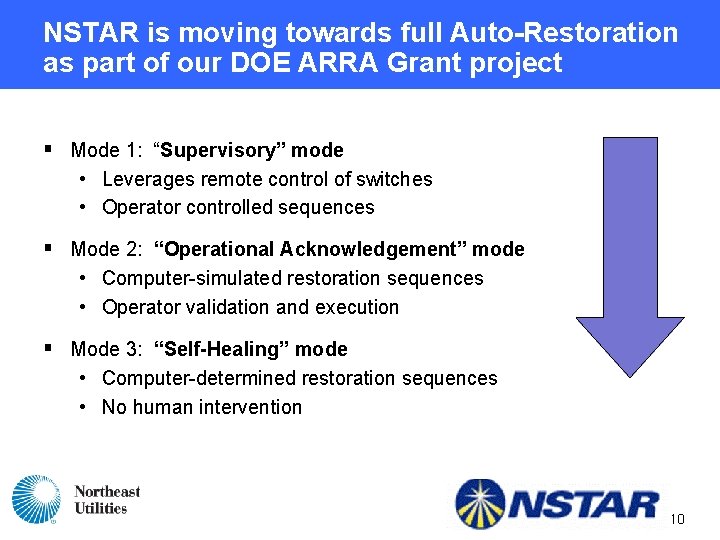
NSTAR is moving towards full Auto-Restoration as part of our DOE ARRA Grant project § Mode 1: “Supervisory” mode • Leverages remote control of switches • Operator controlled sequences § Mode 2: “Operational Acknowledgement” mode • Computer-simulated restoration sequences • Operator validation and execution § Mode 3: “Self-Healing” mode • Computer-determined restoration sequences • No human intervention 10
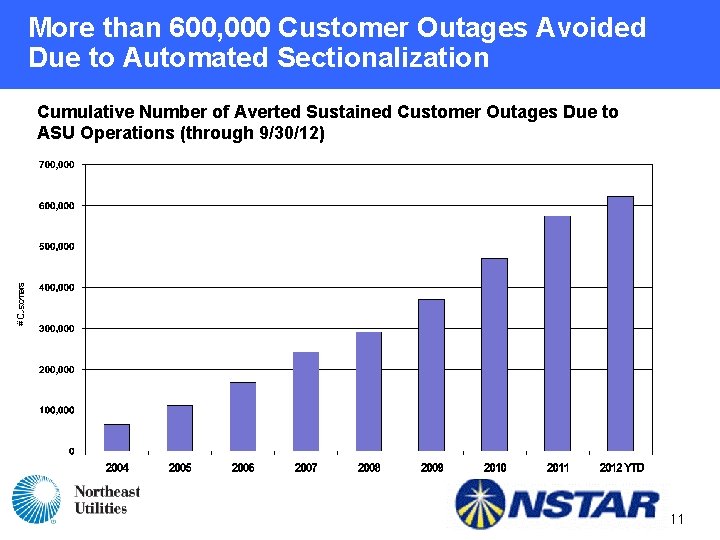
More than 600, 000 Customer Outages Avoided Due to Automated Sectionalization Cumulative Number of Averted Sustained Customer Outages Due to ASU Operations (through 9/30/12) 11
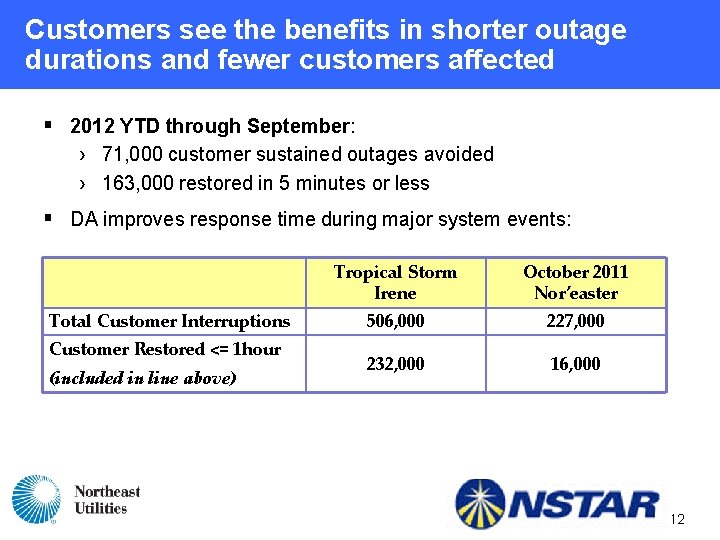
Customers see the benefits in shorter outage durations and fewer customers affected § 2012 YTD through September: › 71, 000 customer sustained outages avoided › 163, 000 restored in 5 minutes or less § DA improves response time during major system events: Total Customer Interruptions Customer Restored <= 1 hour (included in line above) Tropical Storm Irene October 2011 Nor’easter 506, 000 227, 000 232, 000 16, 000 12
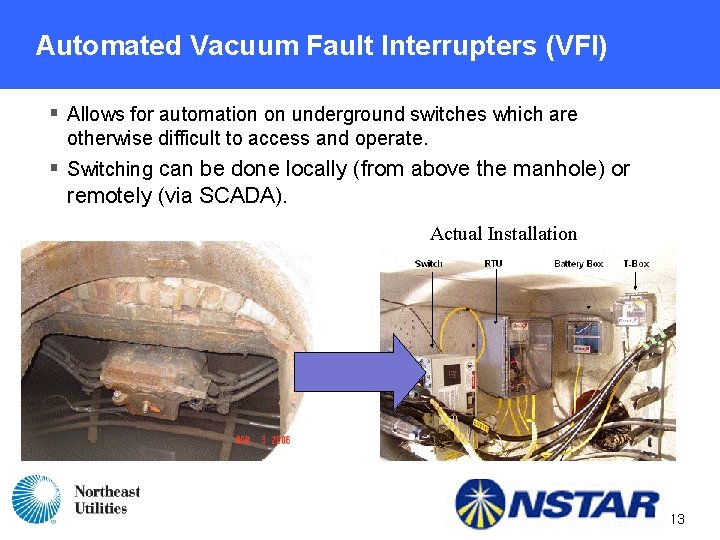
Automated Vacuum Fault Interrupters (VFI) § Allows for automation on underground switches which are otherwise difficult to access and operate. § Switching can be done locally (from above the manhole) or remotely (via SCADA). Actual Installation 13
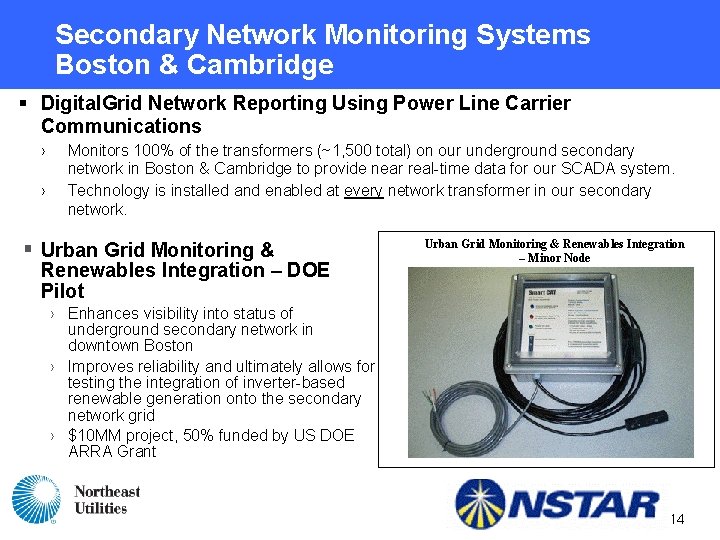
Secondary Network Monitoring Systems Boston & Cambridge § Digital. Grid Network Reporting Using Power Line Carrier Communications › › Monitors 100% of the transformers (~1, 500 total) on our underground secondary network in Boston & Cambridge to provide near real-time data for our SCADA system. Technology is installed and enabled at every network transformer in our secondary network. § Urban Grid Monitoring & Renewables Integration – DOE Pilot Urban Grid Monitoring & Renewables Integration – Minor Node › Enhances visibility into status of underground secondary network in downtown Boston › Improves reliability and ultimately allows for testing the integration of inverter-based renewable generation onto the secondary network grid › $10 MM project, 50% funded by US DOE ARRA Grant 14
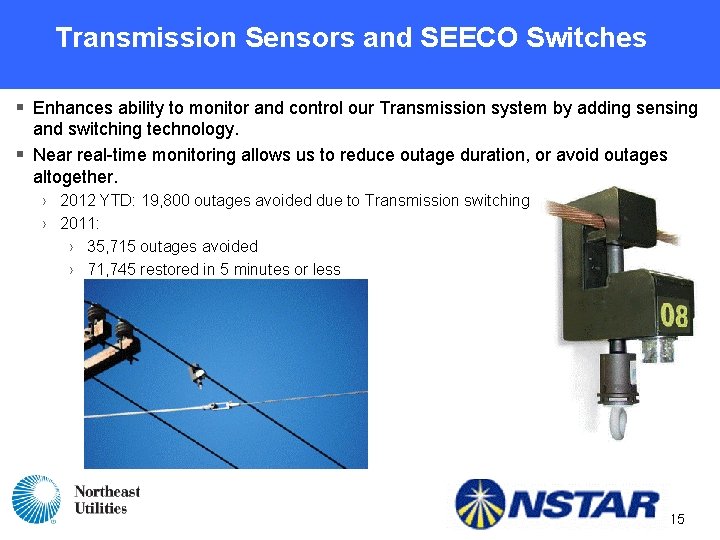
Transmission Sensors and SEECO Switches § Enhances ability to monitor and control our Transmission system by adding sensing and switching technology. § Near real-time monitoring allows us to reduce outage duration, or avoid outages altogether. › 2012 YTD: 19, 800 outages avoided due to Transmission switching › 2011: › 35, 715 outages avoided › 71, 745 restored in 5 minutes or less 15
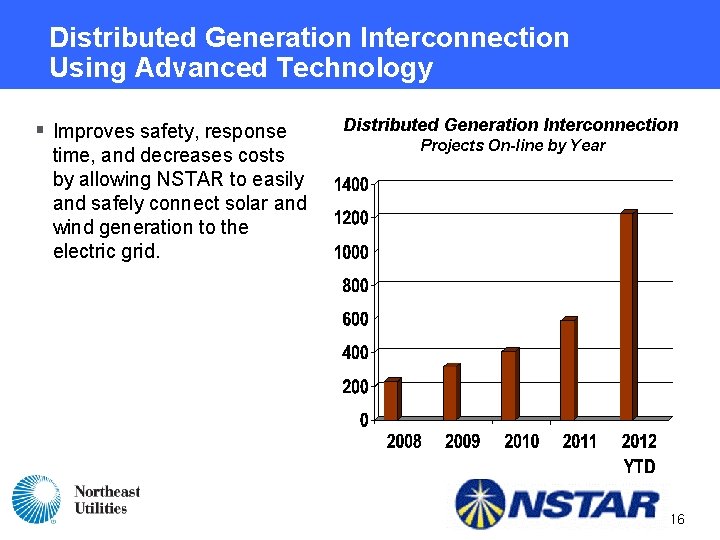
Distributed Generation Interconnection Using Advanced Technology § Improves safety, response time, and decreases costs by allowing NSTAR to easily and safely connect solar and wind generation to the electric grid. Distributed Generation Interconnection Projects On-line by Year 16
Digital Communication System § Provides field crews with voice, data, and phone during emergency operations. › Enables Interoperability of all field crews communications. › Voice Radio that can be used for communications, particularly during major system events when commercial cellular service is not available or is unreliable. § Improves safety via: › Emergency alert and GPS location features › Improved reliability and coverage § Increases effectiveness of recovery and restoration as well as mutual aid, improving overall response times 17
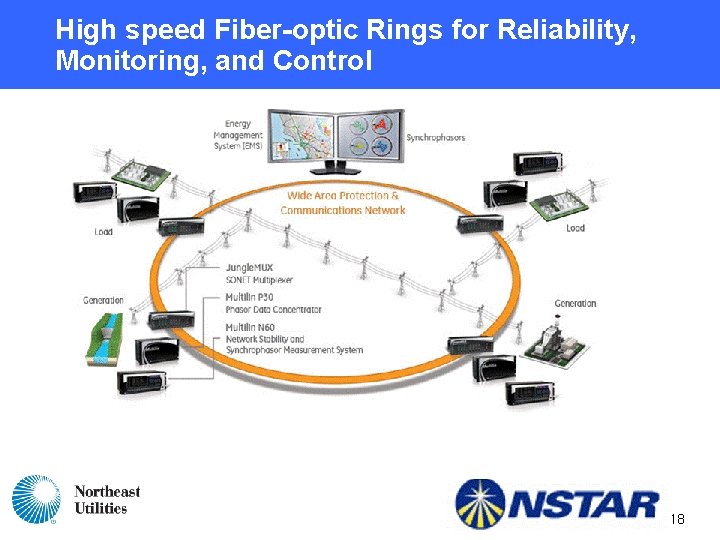
High speed Fiber-optic Rings for Reliability, Monitoring, and Control 18
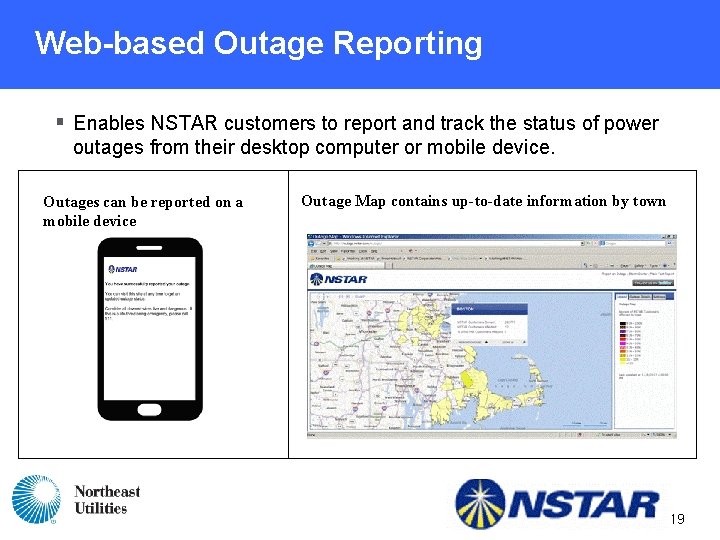
Web-based Outage Reporting § Enables NSTAR customers to report and track the status of power outages from their desktop computer or mobile device. Outages can be reported on a mobile device Outage Map contains up-to-date information by town 19
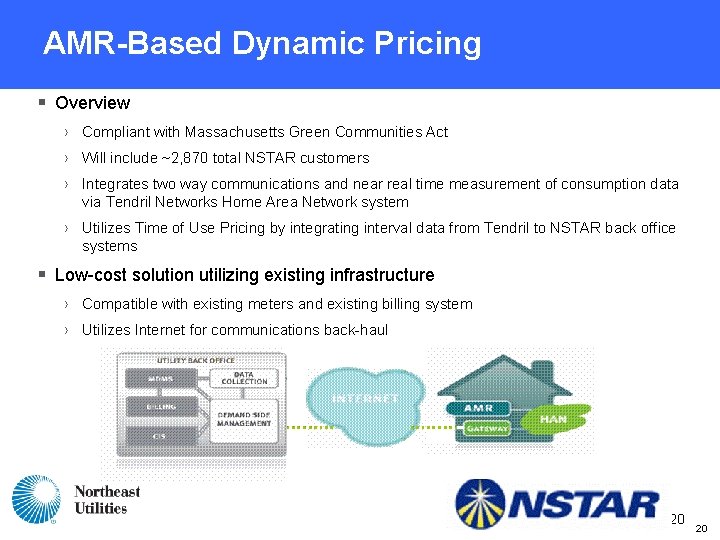
AMR-Based Dynamic Pricing § Overview › Compliant with Massachusetts Green Communities Act › Will include ~2, 870 total NSTAR customers › Integrates two way communications and near real time measurement of consumption data via Tendril Networks Home Area Network system › Utilizes Time of Use Pricing by integrating interval data from Tendril to NSTAR back office systems § Low-cost solution utilizing existing infrastructure › Compatible with existing meters and existing billing system › Utilizes Internet for communications back-haul 20 20
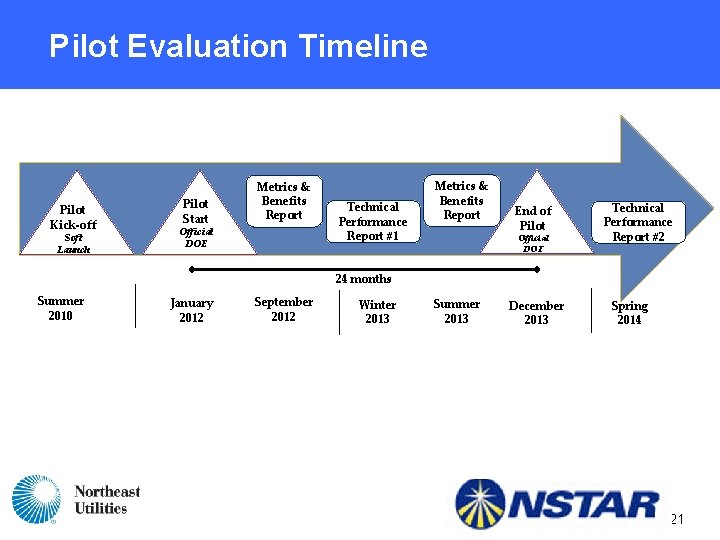
Pilot Evaluation Timeline Pilot Kick-off Soft Launch Pilot Start Metrics & Benefits Report Official DOE Technical Performance Report #1 Metrics & Benefits Report End of Pilot Official DOE Technical Performance Report #2 24 months Summer 2010 January 2012 September 2012 Winter 2013 Summer 2013 December 2013 Spring 2014 21
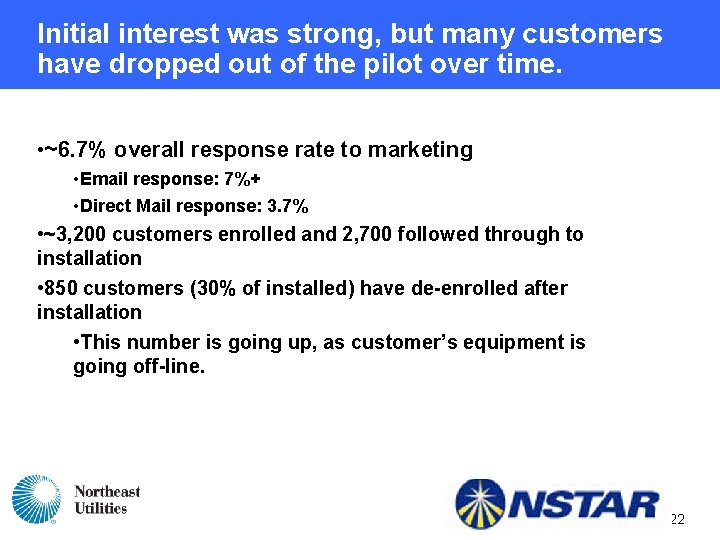
Initial interest was strong, but many customers have dropped out of the pilot over time. • ~6. 7% overall response rate to marketing • Email response: 7%+ • Direct Mail response: 3. 7% • ~3, 200 customers enrolled and 2, 700 followed through to installation • 850 customers (30% of installed) have de-enrolled after installation • This number is going up, as customer’s equipment is going off-line. 22
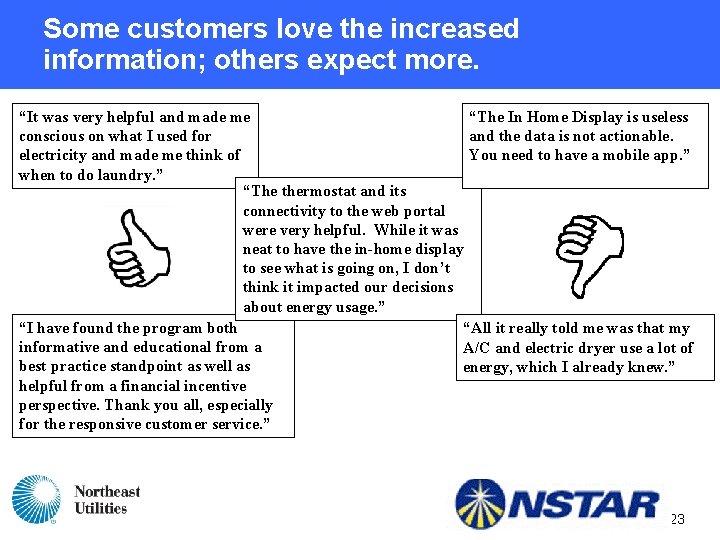
Some customers love the increased information; others expect more. “It was very helpful and made me “The In Home Display is useless conscious on what I used for and the data is not actionable. electricity and made me think of You need to have a mobile app. ” when to do laundry. ” “The thermostat and its connectivity to the web portal were very helpful. While it was neat to have the in-home display to see what is going on, I don’t think it impacted our decisions about energy usage. ” “I have found the program both “All it really told me was that my informative and educational from a A/C and electric dryer use a lot of best practice standpoint as well as energy, which I already knew. ” helpful from a financial incentive perspective. Thank you all, especially for the responsive customer service. ” 23
There are many open questions on the benefits of the program. § While there are several pros to this approach vs. AMI deployment (namely cost), there are many challenges and uncertainties › Billing complexities › Customer acceptance and participation › Overall energy savings resulting from each treatment group and the persistence of these savings over time § This emphasizes the importance of carefully analyzing the results to identify trends, areas for improvement and best practices. By undertaking this exercise, NSTAR will ensure that future grid modernization strategies provide real benefits to customers. 24
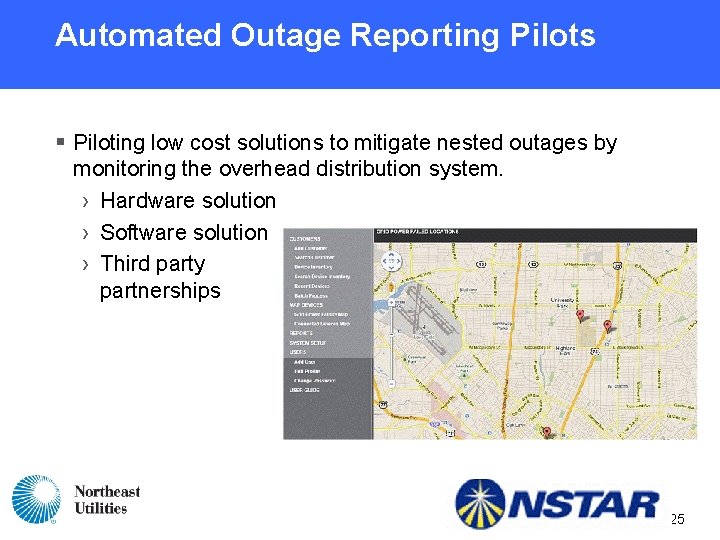
Automated Outage Reporting Pilots § Piloting low cost solutions to mitigate nested outages by monitoring the overhead distribution system. › Hardware solution › Software solution › Third party partnerships 25
Agenda 1 Introduction 2 NSTAR Grid Modernization Activities 3 WMECo Grid Modernization Activities 26
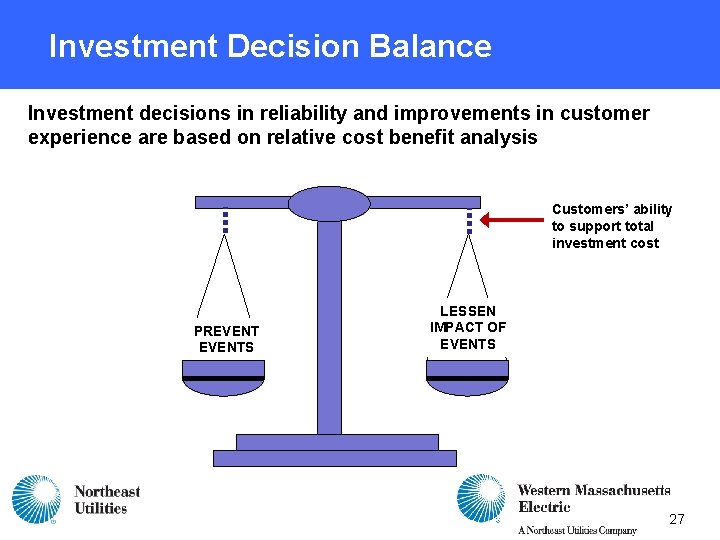
Investment Decision Balance Investment decisions in reliability and improvements in customer experience are based on relative cost benefit analysis Customers’ ability to support total investment cost PREVENTS LESSEN IMPACT OF EVENTS 27
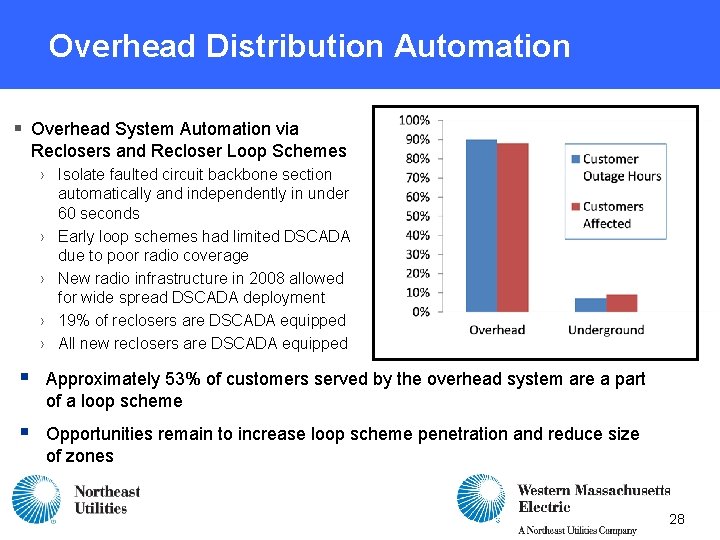
Overhead Distribution Automation § Overhead System Automation via Reclosers and Recloser Loop Schemes › Isolate faulted circuit backbone section automatically and independently in under 60 seconds › Early loop schemes had limited DSCADA due to poor radio coverage › New radio infrastructure in 2008 allowed for wide spread DSCADA deployment › 19% of reclosers are DSCADA equipped › All new reclosers are DSCADA equipped § Approximately 53% of customers served by the overhead system are a part of a loop scheme § Opportunities remain to increase loop scheme penetration and reduce size of zones 28
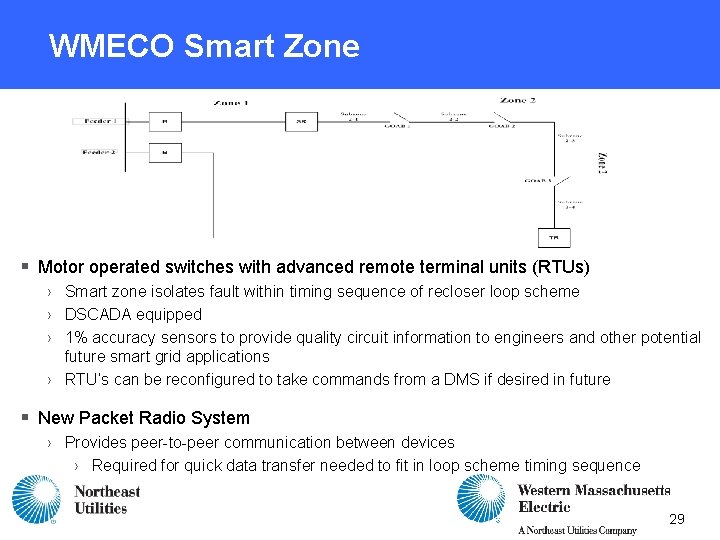
WMECO Smart Zone § Motor operated switches with advanced remote terminal units (RTUs) › Smart zone isolates fault within timing sequence of recloser loop scheme › DSCADA equipped › 1% accuracy sensors to provide quality circuit information to engineers and other potential future smart grid applications › RTU’s can be reconfigured to take commands from a DMS if desired in future § New Packet Radio System › Provides peer-to-peer communication between devices › Required for quick data transfer needed to fit in loop scheme timing sequence 29
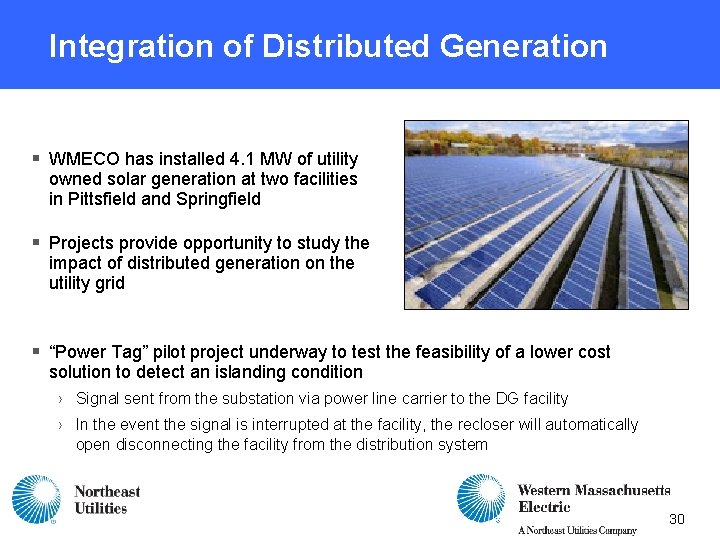
Integration of Distributed Generation § WMECO has installed 4. 1 MW of utility owned solar generation at two facilities in Pittsfield and Springfield § Projects provide opportunity to study the impact of distributed generation on the utility grid § “Power Tag” pilot project underway to test the feasibility of a lower cost solution to detect an islanding condition › Signal sent from the substation via power line carrier to the DG facility › In the event the signal is interrupted at the facility, the recloser will automatically open disconnecting the facility from the distribution system 30
Customer Facing Technologies § WMECO has not yet identified a cost effective business case for widespread deployment of customer facing technologies on the distribution grid § Enabling time of use pricing and customer access to real time usage information via AMI has a high fixed cost that must be spread over a relatively small customer base › Communications infrastructure would need to cover 15% of the state land area to reach fewer than 210, 000 customers § Benefits should be quantifiable and sustainable › Customers response to technology must be maintained over life of investment › Incremental benefits relative to AMR systems have yet to be proven GREEN COMMUNITIES ACT SMART GRID PILOT ON HOLD WMECO proposed a sixmonth pilot for 1, 750 customers at a cost of $7. 1 million Settlement agreement calls for waiting to achieve cost savings with upgrade of NU meter data management system and gathering lessons learned from other Massachusetts utility pilots 31
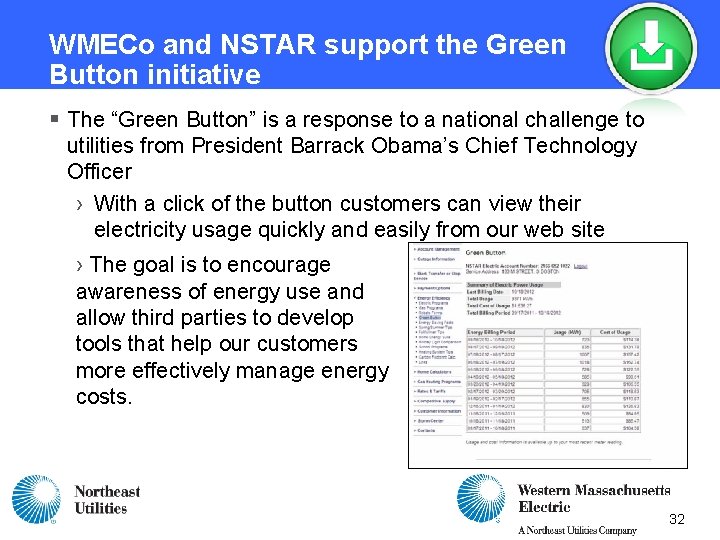
WMECo and NSTAR support the Green Button initiative § The “Green Button” is a response to a national challenge to utilities from President Barrack Obama’s Chief Technology Officer › With a click of the button customers can view their electricity usage quickly and easily from our web site › The goal is to encourage awareness of energy use and allow third parties to develop tools that help our customers more effectively manage energy costs. 32
NU Grid Modernization Policy Issues § Investment decisions should be informed by robust risk adjusted cost benefit analysis targeted to each company’s operating characteristics § Pilot programs represent a valuable opportunity to assess costs and benefits of technology applications prior to widespread deployment § Performance measurement and reporting is an important part of the implementation of grid modernization programs § Distribution automation is a proven approach to limiting the duration and number of customers affected by outage events § Advanced Meter Infrastructure (AMI) may be difficult to justify in many situations based on operational benefits, particularly given prior investment in Automated Meter Reading (AMR). Investments of these types must be justified on a cost benefit basis. 33