ELECTRIC CARS VEHICLES OF THE FUTURE Patrick Pltz













- Slides: 31
ELECTRIC CARS – VEHICLES OF THE FUTURE? Patrick Plötz, Fraunhofer ISI, Karlsruhe SÜD Heidelberg, November 2011 © Fraunhofer ISI
Myth: “Electric vehicles are useless – they can’t go far. ” © Fraunhofer ISI Seite 2
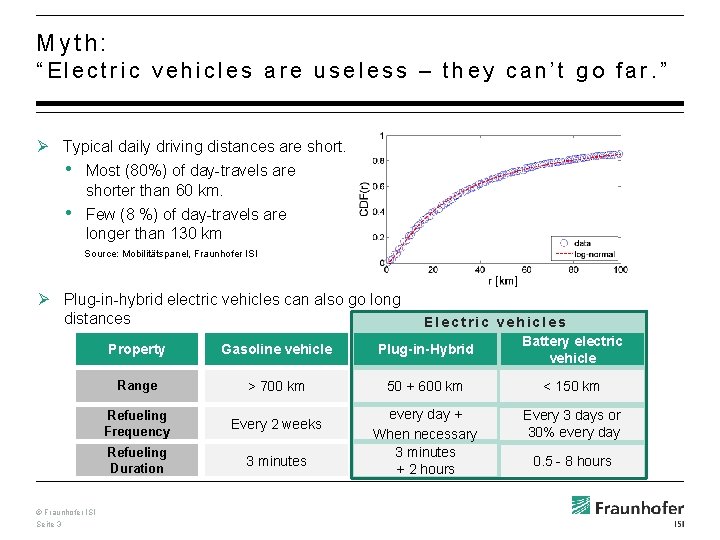
Myth: “Electric vehicles are useless – they can’t go far. ” Ø Typical daily driving distances are short. • Most (80%) of day-travels are shorter than 60 km. • Few (8 %) of day-travels are longer than 130 km Source: Mobilitätspanel, Fraunhofer ISI Ø Plug-in-hybrid electric vehicles can also go long distances © Fraunhofer ISI Seite 3 Property Gasoline vehicle Range > 700 km Refueling Frequency Every 2 weeks Refueling Duration 3 minutes Electric vehicles Battery electric Plug-in-Hybrid vehicle 50 + 600 km < 150 km every day + When necessary 3 minutes + 2 hours Every 3 days or 30% every day 0. 5 - 8 hours
Myth: “Electric vehicles can help integrating renewable energies, but they need so much electricity. ” © Fraunhofer ISI Seite 4
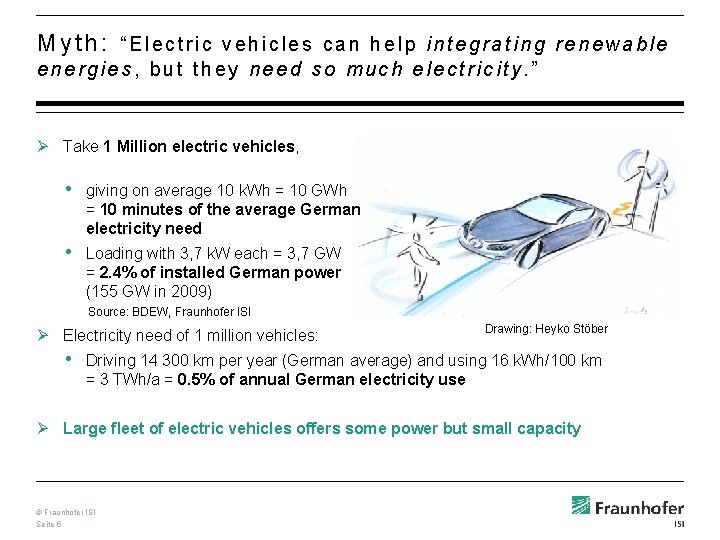
Myth: “Electric vehicles can help integrating renewable energies, but they need so much electricity. ” Ø Take 1 Million electric vehicles, • giving on average 10 k. Wh = 10 GWh = 10 minutes of the average German electricity need • Loading with 3, 7 k. W each = 3, 7 GW = 2. 4% of installed German power (155 GW in 2009) Source: BDEW, Fraunhofer ISI Drawing: Heyko Stöber Ø Electricity need of 1 million vehicles: • Driving 14 300 km per year (German average) and using 16 k. Wh/100 km = 3 TWh/a = 0. 5% of annual German electricity use Ø Large fleet of electric vehicles offers some power but small capacity © Fraunhofer ISI Seite 5
Myth: “Electric vehicles need public charging points. ” © Fraunhofer ISI Seite 6
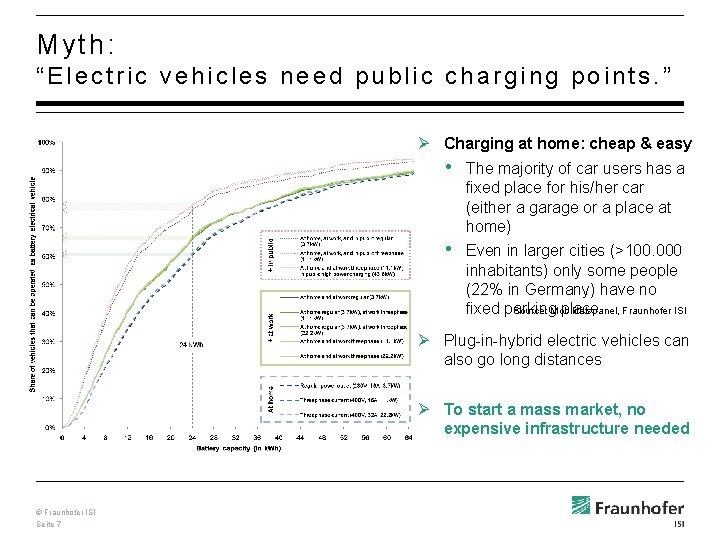
Myth: “Electric vehicles need public charging points. ” Ø Charging at home: cheap & easy • The majority of car users has a fixed place for his/her car (either a garage or a place at home) • Even in larger cities (>100. 000 inhabitants) only some people (22% in Germany) have no Source: Mobilitätspanel, fixed parking place Fraunhofer ISI Ø Plug-in-hybrid electric vehicles can also go long distances Ø To start a mass market, no expensive infrastructure needed © Fraunhofer ISI Seite 7
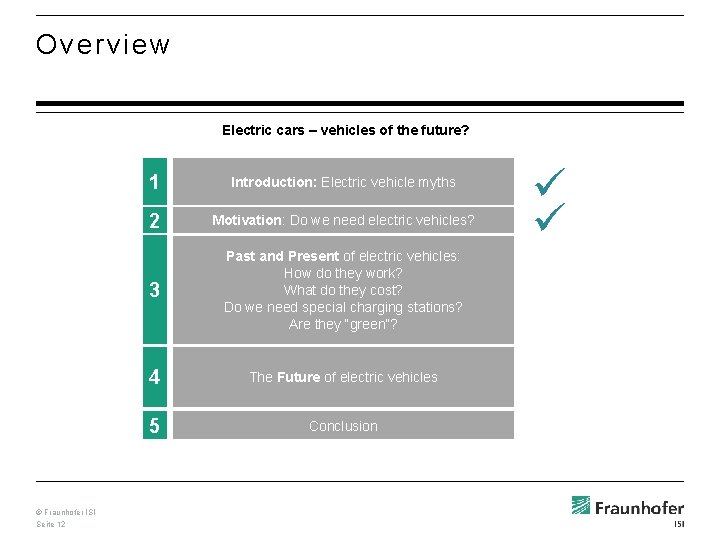
Overview Electric cars – vehicles of the future? © Fraunhofer ISI Seite 8 1 Introduction: Electric vehicle myths 2 Motivation: Do we need electric vehicles? 3 Past and Present of electric vehicles 4 The Future of eletric vehicles 5 Conclusion ü
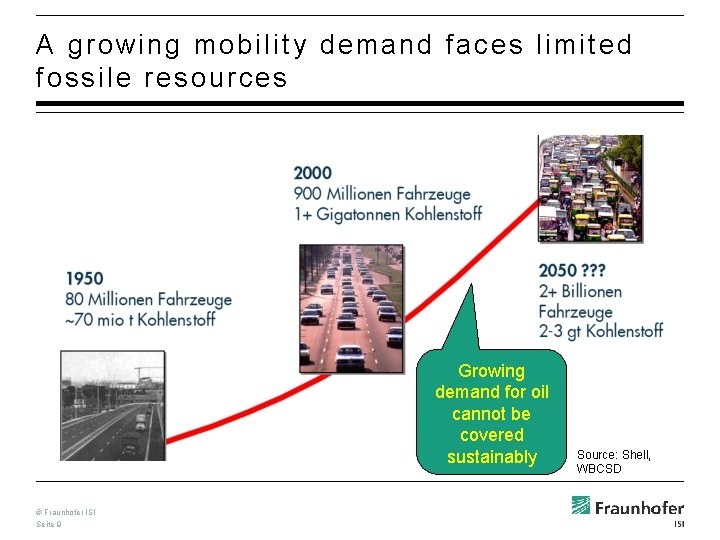
A growing mobility demand faces limited fossile resources Growing demand for oil cannot be covered sustainably © Fraunhofer ISI Seite 9 Source: Shell, WBCSD
To achieve Europe‘s climate targets, a drastic reduction in transport CO 2 -emissions is needed Ø The EU‘s long term goal is to reduce GHG emissions by 80% Ø Power production and road transport have to become almost CO 2 -free Ø This is impossible with efficiency gains in combustion engines Ø New technologies and concepts are clearly needed. Ø Electric vehicles powered by renewable energies can contribute significantly Source: www. roadmap 2050. eu © Fraunhofer ISI Seite 10
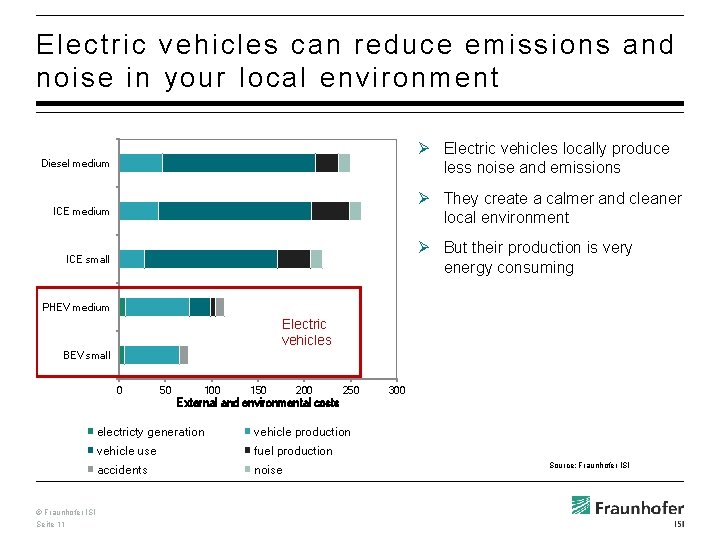
Electric vehicles can reduce emissions and noise in your local environment Ø Electric vehicles locally produce less noise and emissions Diesel medium Ø They create a calmer and cleaner local environment ICE medium Ø But their production is very energy consuming ICE small PHEV medium Electric vehicles BEV small 0 50 100 150 200 250 300 External and environmental costs © Fraunhofer ISI Seite 11 electricty generation vehicle production vehicle use fuel production accidents noise Source: Fraunhofer ISI
Overview Electric cars – vehicles of the future? © Fraunhofer ISI Seite 12 1 Introduction: Electric vehicle myths 2 Motivation: Do we need electric vehicles? 3 Past and Present of electric vehicles: How do they work? What do they cost? Do we need special charging stations? Are they “green”? 4 The Future of electric vehicles 5 Conclusion ü ü
The first road vehicle achieving a speed of more than 100 km/h The French electric vehicle La jamais contente with 105 km/h in 1899 © Fraunhofer ISI Seite 13
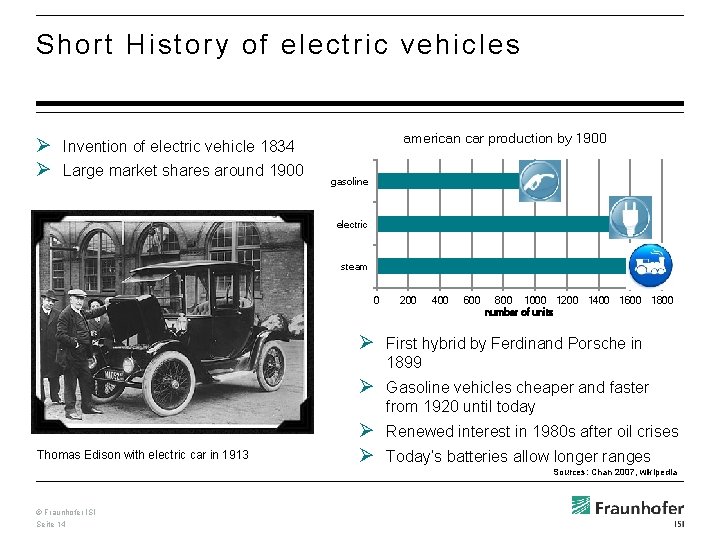
Short History of electric vehicles Ø Invention of electric vehicle 1834 Ø Large market shares around 1900 american car production by 1900 gasoline electric steam 0 200 400 600 800 1000 1200 1400 1600 1800 number of units Ø First hybrid by Ferdinand Porsche in 1899 Ø Gasoline vehicles cheaper and faster from 1920 until today Thomas Edison with electric car in 1913 Ø Renewed interest in 1980 s after oil crises Ø Today‘s batteries allow longer ranges Sources: Chan 2007, wikipedia © Fraunhofer ISI Seite 14
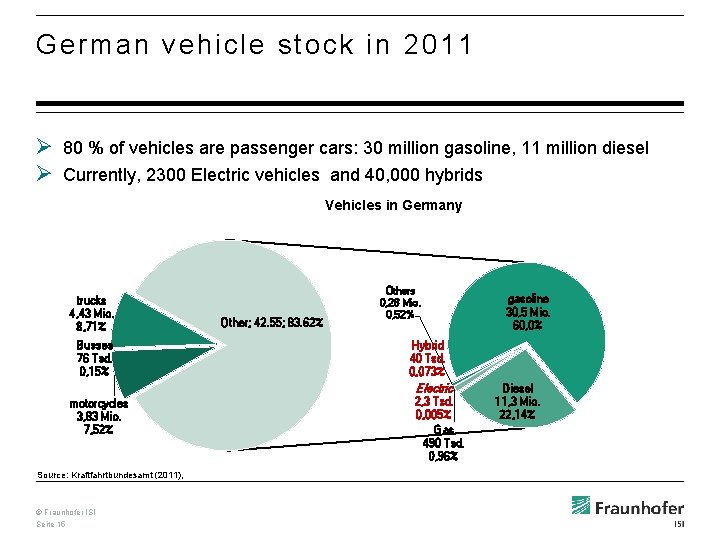
German vehicle stock in 2011 Ø 80 % of vehicles are passenger cars: 30 million gasoline, 11 million diesel Ø Currently, 2300 Electric vehicles and 40, 000 hybrids Vehicles in Germany trucks 4, 43 Mio. 8, 71% Busses 76 Tsd. 0, 15% Other; 42. 55; 83. 62% Others 0, 26 Mio. 0, 52% Hybrid 40 Tsd. 0, 073% Electric motorcycles 3, 83 Mio. 7, 52% Source: Kraftfahrtbundesamt (2011), © Fraunhofer ISI Seite 15 gasoline 30, 5 Mio. 60, 0% 2, 3 Tsd. 0, 005% Gas 490 Tsd. 0, 96% Diesel 11, 3 Mio. 22, 14%
How does an electric vehicle work? Ø Battery electric vehicle: Small number of main components: • Electric motor • Large battery • AC/DC converter • Electronics. . . Ø No oil or fuel tank Ø No exhaust system (tail pipe etc. ) Ø Hybrid electric vehicle: • Small combustion engine • Small fuel tank • Electronics Ø Fuel cell electric vehicle has an additional tank and fuel cell Ø Electric vehicle ≈ several wheels and a plug Source: Bosch AG © Fraunhofer ISI Seite 16
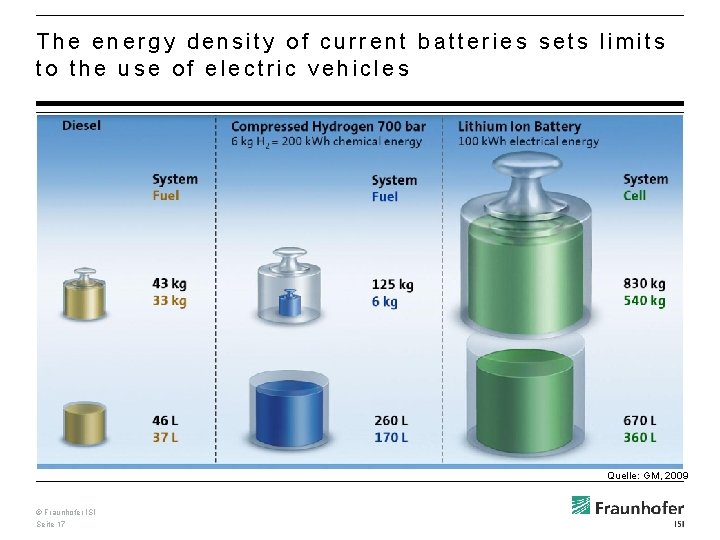
The energy density of current batteries sets limits to the use of electric vehicles Quelle: GM, 2009 © Fraunhofer ISI Seite 17
Electric vehicles produced in 2010 Ø A few manufacturers are already producing electric vehicles Ø Numbers are really tiny compared to world vehicle production of 78 million units in 2010 © Fraunhofer ISI Seite 18
When can we buy eletcric vehicles? § Alternative fuel vehicles already available or announced for 2011 – 2014 by major manufacturers in the German market Manufacturer MERCEDES Hybrid Gashybrid Plug-in Hybrid Battery electric Fuel cell vehicle Total 1 4 1 11 2 3 9 5 8 7 7 1 2 6 1 1 4 2 1 3 1 2 3 5 TOYOTA 3 VW 3 1 RENAULT BMW HYUNDAI CITROEN PEUGEOT AUDI 3 1 1 NISSAN Simple hybrids Total already available © Fraunhofer ISI Seite 19 20 2 5 Only some plug-in hybrids announced 2 1 3 29 2 57 electric Many battery vehicles underway
Electric vehicles come in a broad variety Sports cars Small electric vehicles Plug-in hybrid passenger car soon Battery LDVs Off-road duty vehicle y toda Elektroroller © Fraunhofer ISI Seite 20 Plug-in hybrid LDV
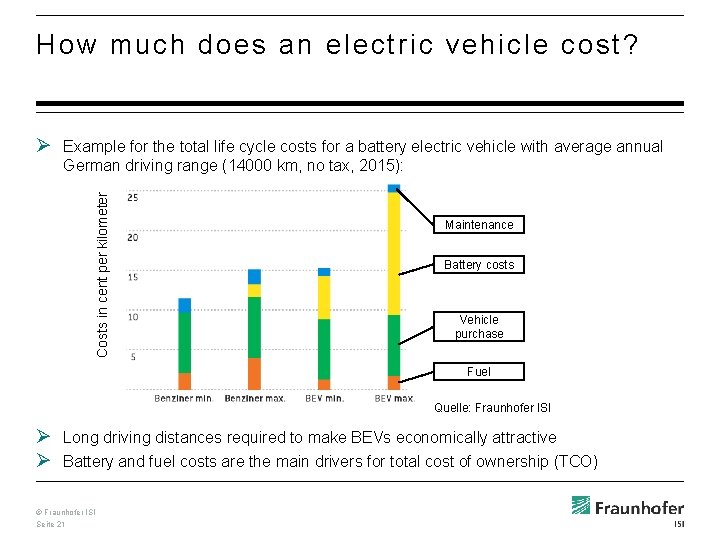
How much does an electric vehicle cost? Ø Example for the total life cycle costs for a battery electric vehicle with average annual Costs in cent per kilometer German driving range (14000 km, no tax, 2015): Maintenance Battery costs Vehicle purchase Fuel Quelle: Fraunhofer ISI Ø Long driving distances required to make BEVs economically attractive Ø Battery and fuel costs are the main drivers for total cost of ownership (TCO) © Fraunhofer ISI Seite 21
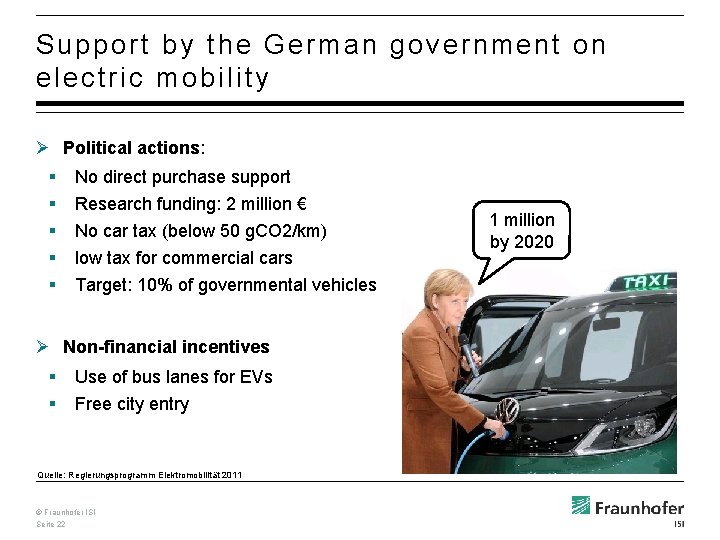
Support by the German government on electric mobility Ø Political actions: § § § No direct purchase support Research funding: 2 million € No car tax (below 50 g. CO 2/km) low tax for commercial cars Target: 10% of governmental vehicles Ø Non-financial incentives § § Use of bus lanes for EVs Free city entry Quelle: Regierungsprogramm Elektromobilität 2011 © Fraunhofer ISI Seite 22 1 million by 2020
In the beginning, electric vehicles will mainly target a niche market Selection of Propulsion Technology - 2015 (in relation to mileage and share of city traffic) Annual Mileage (in km) 17, 500 § EVs only in some segments profitable § Attractive first user segments – Commuters – Second-car users – Full time employees from areas with less than 100, 000 inhab. § Potential of up to 4% of car users (2015) in existing infrastructure equivalent to 1. 6 mn. Trip L Rest ength rictio ns 15, 000 Battery Electric Vehicle 12, 500 Utili z Res ation trict ions 10, 000 Internal Combustion Engine 7, 500 5, 000 0% 20% 40% 60% Share of City Traffic Source: Own calculations © Fraunhofer ISI Seite 23 80% 100%
EVs are the most efficient propulsion technology and can reduce CO 2 -emissions in transport Efficiency and Emissions of Different Propulsion Technologies Biofuels BEV (EU mix) 50 Biodiesel (RME) 100 Battery Electric Vehicle (Wind) Plug-In Hybrid (EU mix) 150 Less emissions Emissions in GHG-Equivalents (in g/km) 0 ICE 200 Hydrogen Fuel Cell 250 Coal-to. Liquid 300 More efficient 350 0% 20% 40% 60% Efficiency (Well-to-Wheel Analysis) Note: BEV: Battery Electric Vehicle; RME: Raps-Methyl-Ester Source: Own calculations and LBST © Fraunhofer ISI Seite 24 80% 100%
How „green“ are electric vehicles? Ø The production of batteries for electric vehicles is very energy intense Ø Depending on the electricity used, additional CO 2 emissions from electricity generation need to be taken into account Conventional vehicles Electric vehicles Vehicle production Battery production Additional battery Electricity generation GHG potential in tons CO 2 e Ø With electricity from renewable sources drastic reduction of CO 2 emissions are possible © Fraunhofer ISI Seite 25
Overview Electric cars – vehicles of the future? © Fraunhofer ISI Seite 26 1 Introduction: Electric vehicle myths 2 Motivation: Do we need electric vehicles? 3 Past and Present of electric vehicles: How do they work? What do they cost? Do we need special charging stations? Are they “green”? 4 The Future of electric vehicles 5 Conclusion ü ü ü
Market scenarios for Germany Millions 35 Electric vehicles expected in 2020 (NPE, 2011) 30 5% Szenarios I/IV Nutzfahrzeuge PHEV 25 45% 20 Dominance BEV 50% Referenzszenario 15 Energiekonzept 10 5 0 2020 © Fraunhofer ISI Seite 27 Pluralism 2030 2040
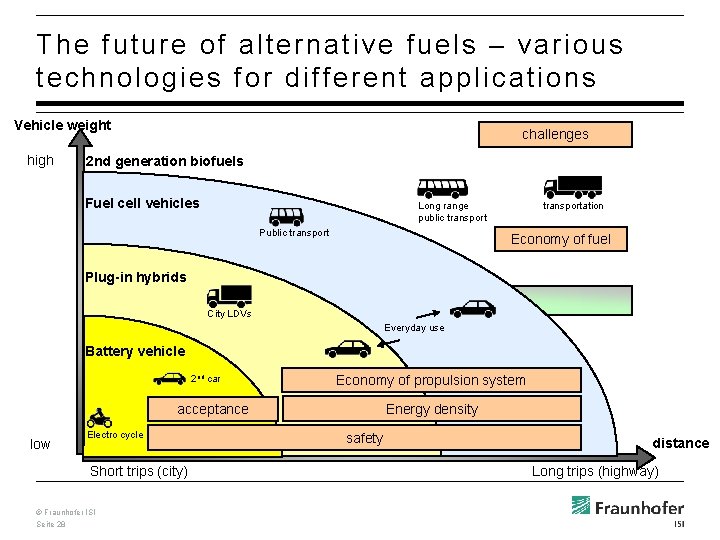
The future of alternative fuels – various technologies for different applications Vehicle weight high challenges 2 nd generation biofuels Fuel cell vehicles transportation Long range public transport Public transport Economy of fuel Plug-in hybrids City LDVs Everyday use Battery vehicle 2 nd car Economy of propulsion system Energy density acceptance low Electro cycle Short trips (city) © Fraunhofer ISI Seite 28 safety distance Long trips (highway)
Depending on market penetration, charging infrastructure has to change Grid Integration with Increasing Market Penetration Charging Infrastructure Innovators´ Market Niche Market (e. g. commuters, business clients) Market Penetration Mass Market Grid Integration § Norms and Infrastructure Control standards § Mainly private infrastructure § Selective public infrastructure to support early adoption § Time-of-use rates § Smart Metering § Expansion of semi - public charging infrastr. § Demand Side Management (Dynamic rates) § Load shift System Services Source: Own visualization © Fraunhofer ISI Seite 29 (negative supply of balancing power) § Smart Grids § Bi-directional connection § Load shift and active load leveling Time
Conclusions 1 What are electric vehicles? § Electric vehicles use electric motors and batteries and/or fuel cells § Many forms of hybrid vehicles are possible 2 How much do electric vehicles cost? § They are more expensive to buy but cheaper to drive than current conventional vehicles § Special charging stations are required later 3 Are electric vehicle green? § Electric vehicles can significantly reduce global and local emissions, but only when charged from renewable energy sources § Their production is very energy intense Are electric vehicles the vehicles of the future? § They can play an important role in transport and in reduction of CO 2 emissions § Other vehicle technologies can be become important too, especially fuel cell vehicles © Fraunhofer ISI Seite 30
Thank you Special thanks to Ø Martin Wietschel Ø Fabian Kley Ø Till Gnann Ø Wolfgang Schade Thank you for listening! References: Biere, D. ; Dallinger, D. ; Wietschel, M. : Ökonomische Analyse der Erstnutzer-von Elektrofahrzeugen, Zeitschrift für Energiewirtschaft 02/2009, 173 -183. Wietschel, M. , Kley, F. und Dallinger, D. : Eine Bewertung der Ladeinfrastruktur für Elektrofahrzeuge, Zeitschrift für die gesamte Wertschöpfungskette Automobilwirtschaft, Bd. 12 (3), S. 33– 41. Kley, F. , Dallinger, D. und Wietschel, M. : Assessment of future charging infrastructure, International Advanced Mobility Forum, 9 -10 März 2010, S. 1– 7. Genf. Kley, F. , Entwicklung und Bewertung einer Strategie für den Aufbau einer Beladeinfrastruktur für Elektrofahrzeuge auf Basis des Fahrverhaltens. Dissertation. Karlsruhe, 2011. © Fraunhofer ISI Seite 31