Momentum Can you name 5 safety features found


- Slides: 48
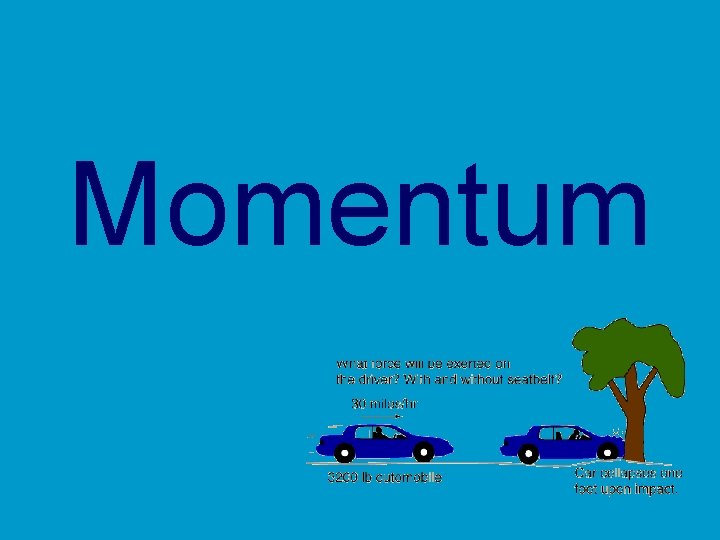
Momentum
Can you name 5 safety features found in an automobile? • • Seat belts Air bags Bumpers Padded consoles, collapsible steering wheels, padded interior • Crumple zones
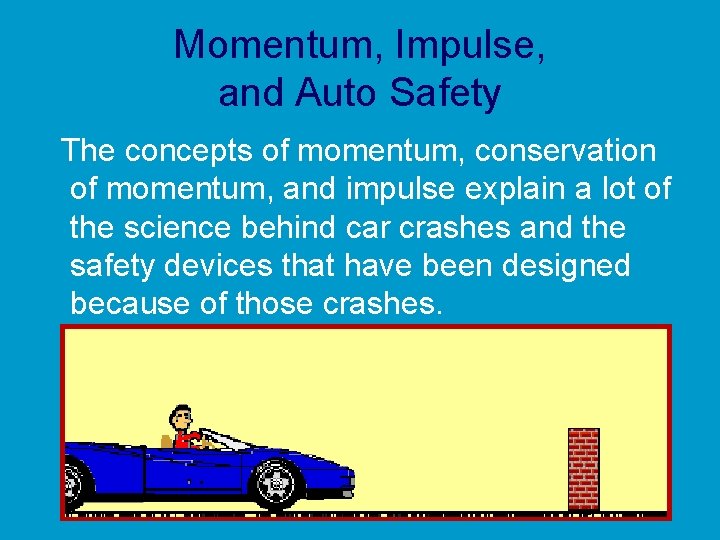
Momentum, Impulse, and Auto Safety The concepts of momentum, conservation of momentum, and impulse explain a lot of the science behind car crashes and the safety devices that have been designed because of those crashes.
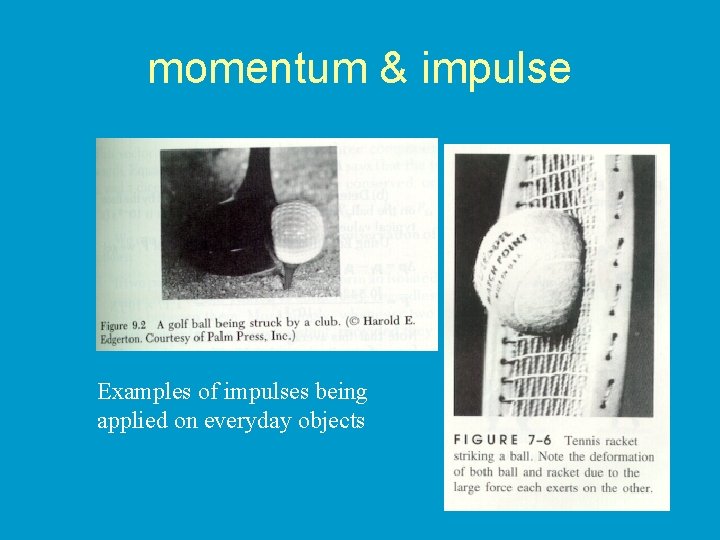
momentum & impulse Examples of impulses being applied on everyday objects
Momentum • What is momentum? • Anything that is moving has momentum • Depends on what?
Momentum • Momentum = mass * velocity • In physics, the symbol for momentum is “p” sssooo… • p=m*v measured in kg·m/s Which has more momentum, a supertanker tied to a dock or a raindrop falling?
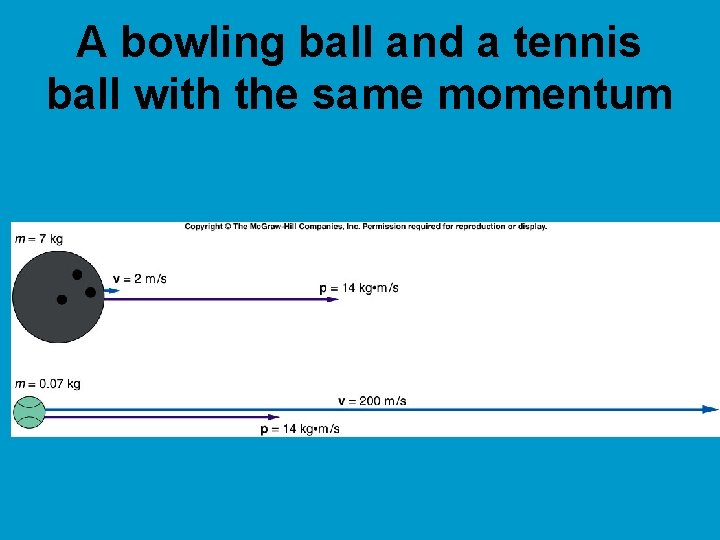
A bowling ball and a tennis ball with the same momentum
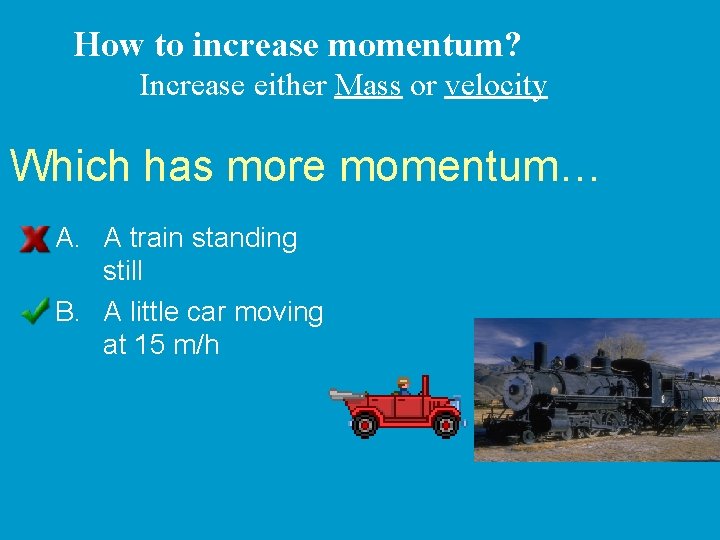
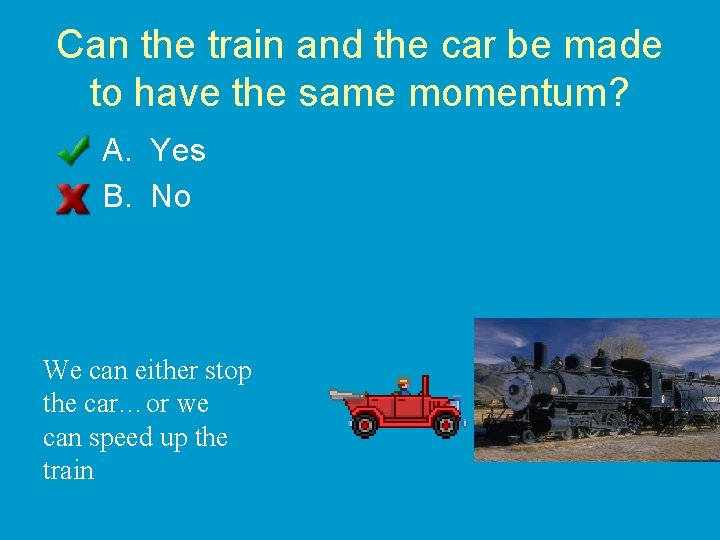
How to increase momentum? Increase either Mass or velocity Which has more momentum… A. A train standing still B. A little car moving at 15 m/h
Can the train and the car be made to have the same momentum? A. Yes B. No We can either stop the car…or we can speed up the train
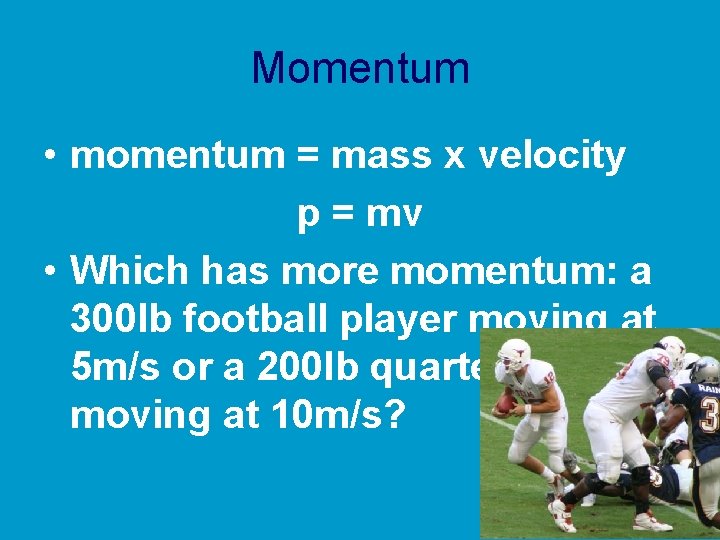
Momentum • momentum = mass x velocity p = mv • Which has more momentum: a 300 lb football player moving at 5 m/s or a 200 lb quarterback moving at 10 m/s?
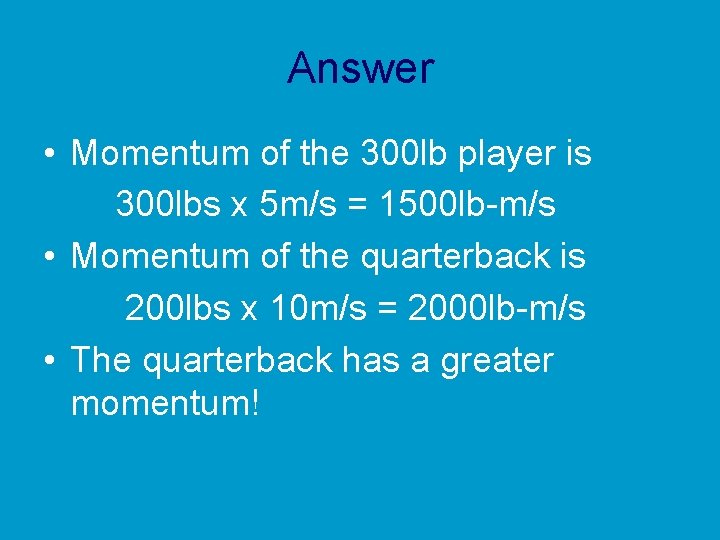
Answer • Momentum of the 300 lb player is 300 lbs x 5 m/s = 1500 lb-m/s • Momentum of the quarterback is 200 lbs x 10 m/s = 2000 lb-m/s • The quarterback has a greater momentum!
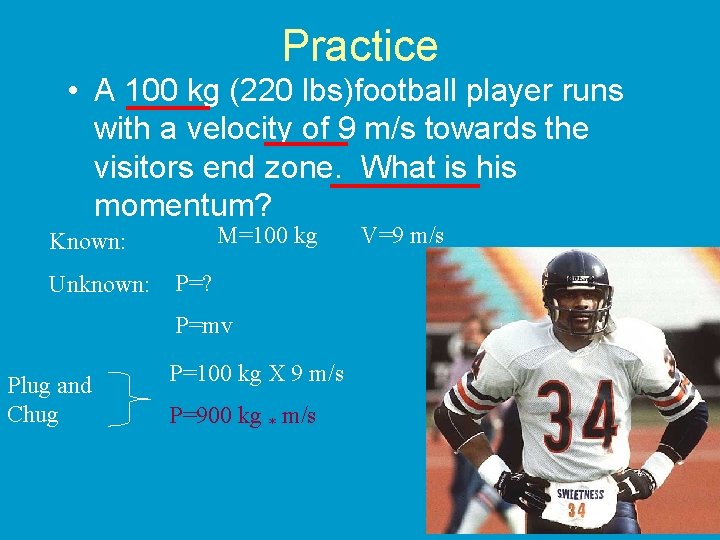
Practice • A 100 kg (220 lbs)football player runs with a velocity of 9 m/s towards the visitors end zone. What is his momentum? M=100 kg Known: Unknown: P=? P=mv Plug and Chug P=100 kg X 9 m/s P=900 kg * m/s V=9 m/s
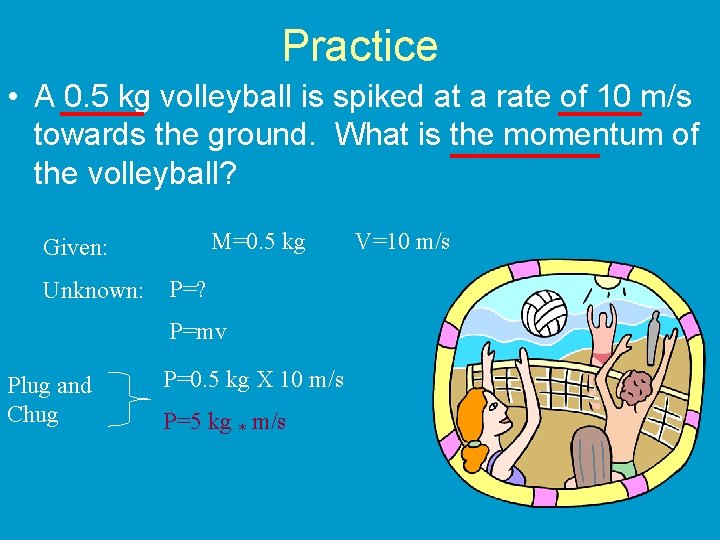
Practice • A 0. 5 kg volleyball is spiked at a rate of 10 m/s towards the ground. What is the momentum of the volleyball? M=0. 5 kg Given: Unknown: P=? P=mv Plug and Chug P=0. 5 kg X 10 m/s P=5 kg * m/s V=10 m/s
Momentum • Determine the momentum of a. . . – 60 -kg halfback moving eastward at 9 m/s. • 60 x 9 = 540 kg·m/s east – 1000 -kg car moving northward at 20 m/s. • 1000 x 20 = 20, 000 kg·m/s – 40 -kg freshman moving southward at 2 m/s. • 40 x 2 = 80 kg·m/s
IMPULSE
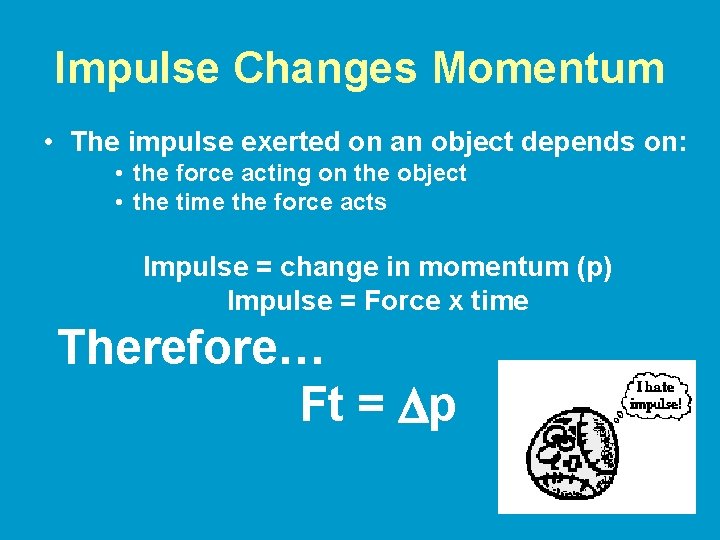
Impulse Changes Momentum • The impulse exerted on an object depends on: • the force acting on the object • the time the force acts Impulse = change in momentum (p) Impulse = Force x time Therefore… Ft = Dp
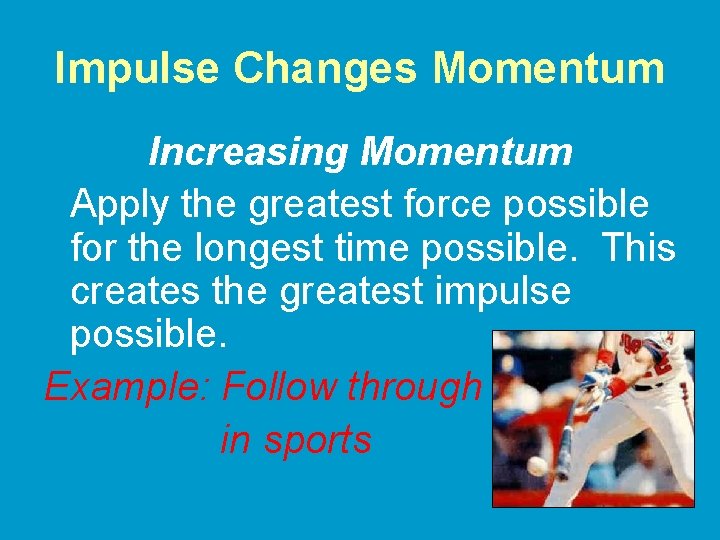
Impulse Changes Momentum Increasing Momentum Apply the greatest force possible for the longest time possible. This creates the greatest impulse possible. Example: Follow through in sports
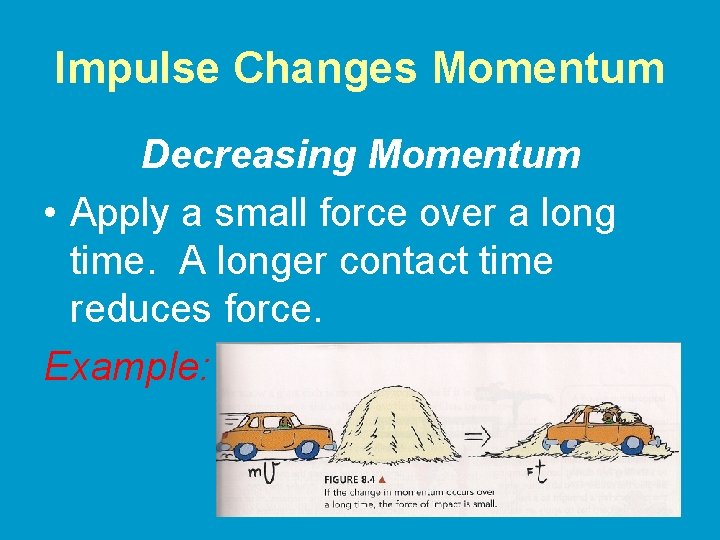
Impulse Changes Momentum Decreasing Momentum • Apply a small force over a long time. A longer contact time reduces force. Example:
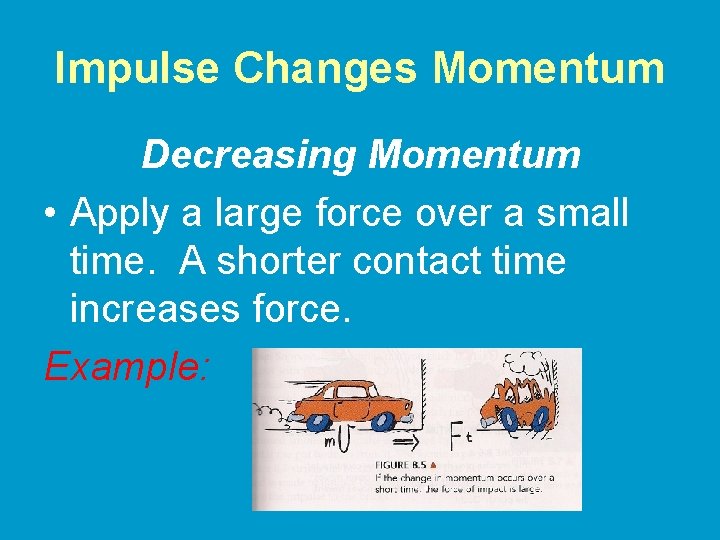
Impulse Changes Momentum Decreasing Momentum • Apply a large force over a small time. A shorter contact time increases force. Example:
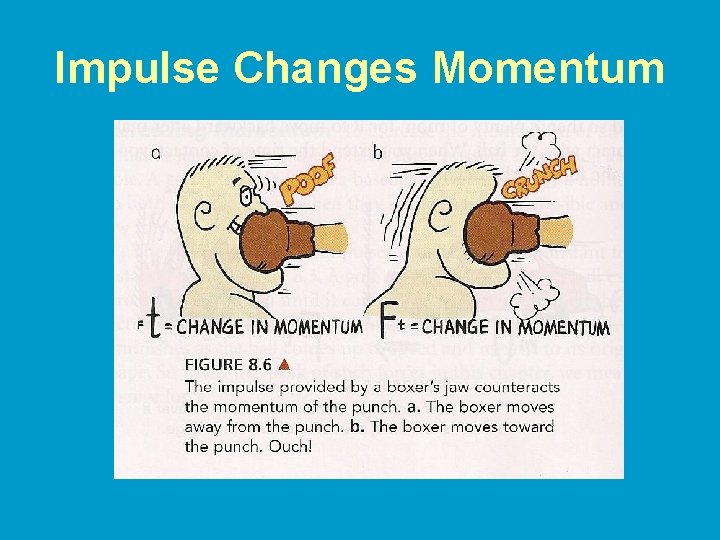
Impulse Changes Momentum
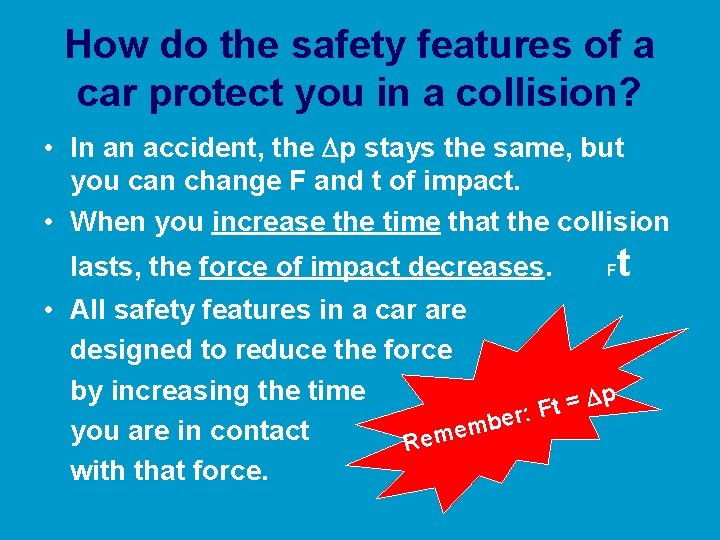
How do the safety features of a car protect you in a collision? • In an accident, the Dp stays the same, but you can change F and t of impact. • When you increase the time that the collision lasts, the force of impact decreases. F • All safety features in a car are designed to reduce the force by increasing the time Dp = t : F r e b em you are in contact Rem with that force. t
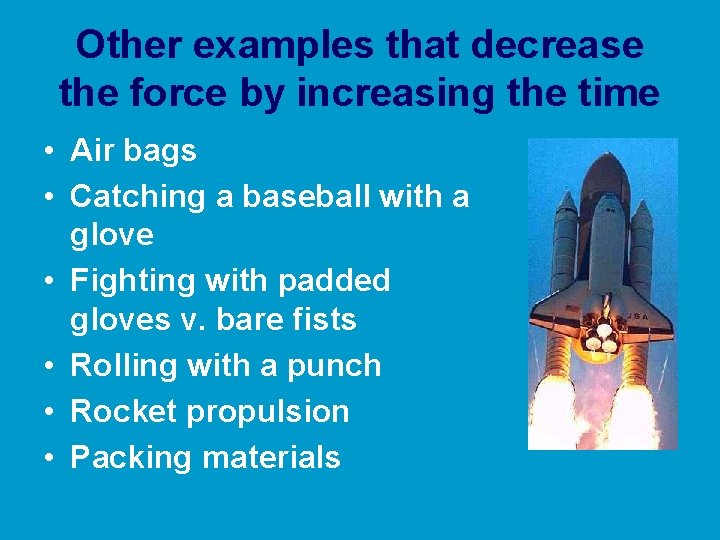
Other examples that decrease the force by increasing the time • Air bags • Catching a baseball with a glove • Fighting with padded gloves v. bare fists • Rolling with a punch • Rocket propulsion • Packing materials
Real Life Applications. . • Sports… – Follow-through! – Gymnastics Mats • Cars… – Airbags! – Before airbags…. – Bumpers • Jumping… – Knees – Shoes
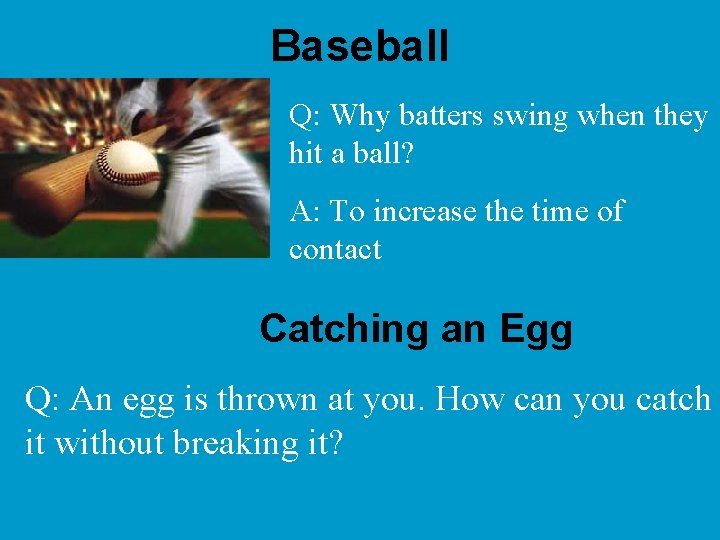
Baseball Q: Why batters swing when they hit a ball? A: To increase the time of contact Catching an Egg Q: An egg is thrown at you. How can you catch it without breaking it?
Momentum Impulse • An egg (0. 1 kg) is flying through the air at 20. M/s. • How are we going to stop it?
BOUNCING • The impulse required to bring an object to a stop and then to “throw it back again” is greater than the impulse required to merely bring the object to a stop.
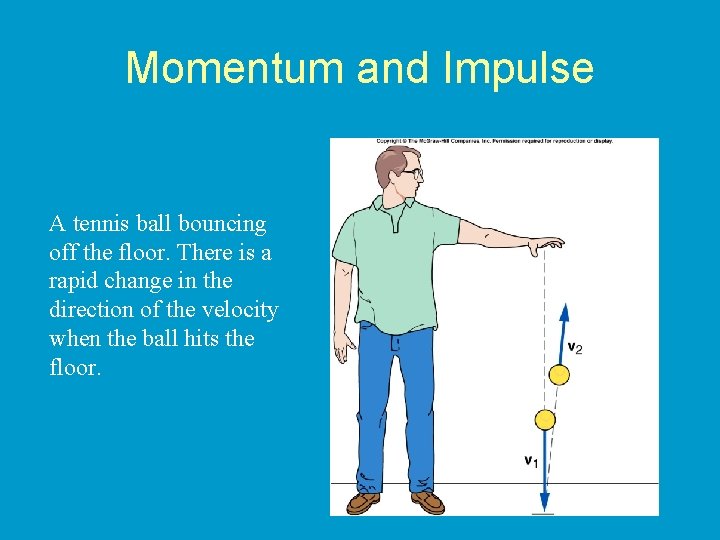
Momentum and Impulse A tennis ball bouncing off the floor. There is a rapid change in the direction of the velocity when the ball hits the floor.
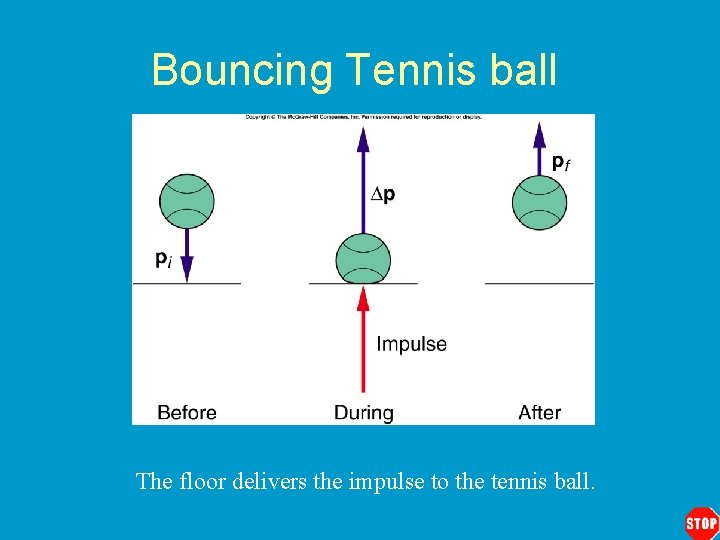
Bouncing Tennis ball The floor delivers the impulse to the tennis ball.
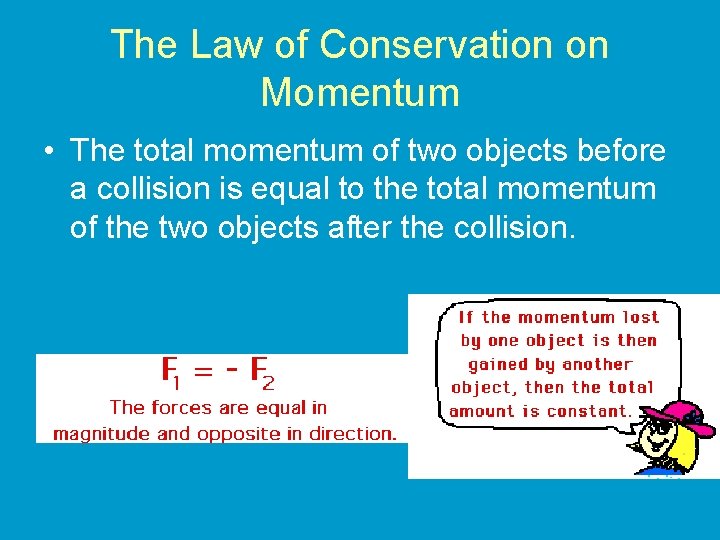
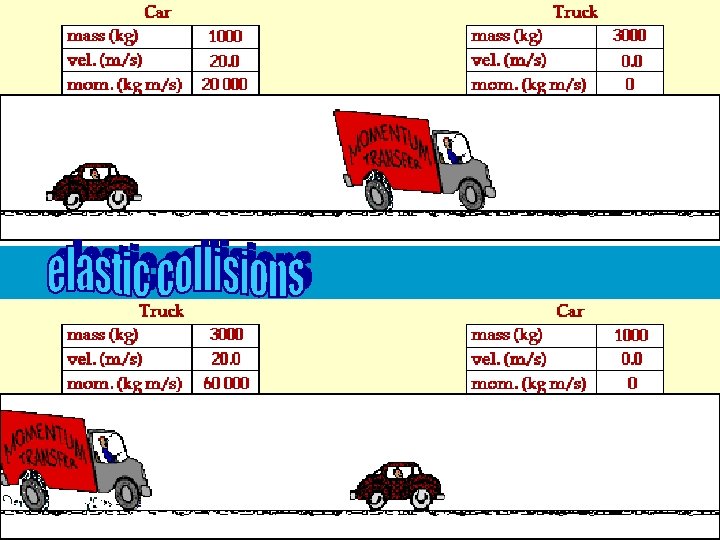
The Law of Conservation on Momentum • The total momentum of two objects before a collision is equal to the total momentum of the two objects after the collision.
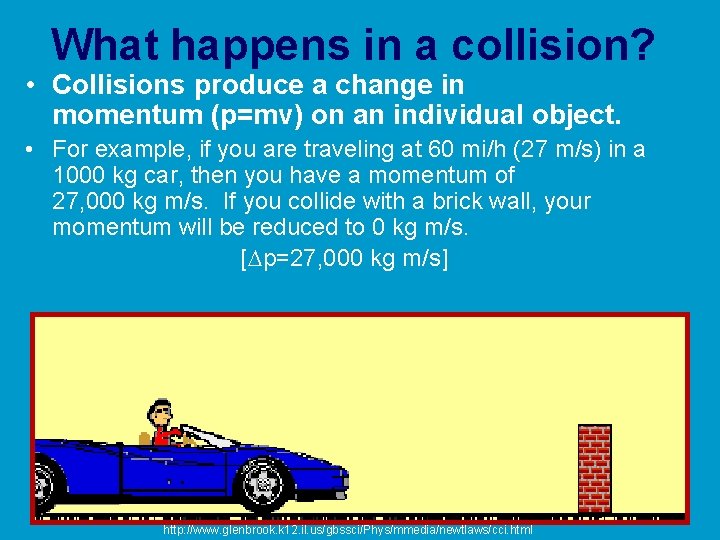
What happens in a collision? • Collisions produce a change in momentum (p=mv) on an individual object. • For example, if you are traveling at 60 mi/h (27 m/s) in a 1000 kg car, then you have a momentum of 27, 000 kg m/s. If you collide with a brick wall, your momentum will be reduced to 0 kg m/s. [Dp=27, 000 kg m/s] http: //www. glenbrook. k 12. il. us/gbssci/Phys/mmedia/newtlaws/cci. html
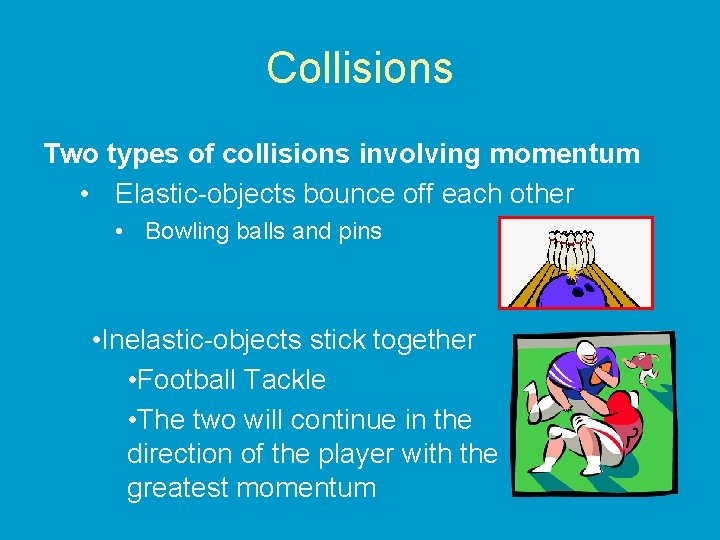
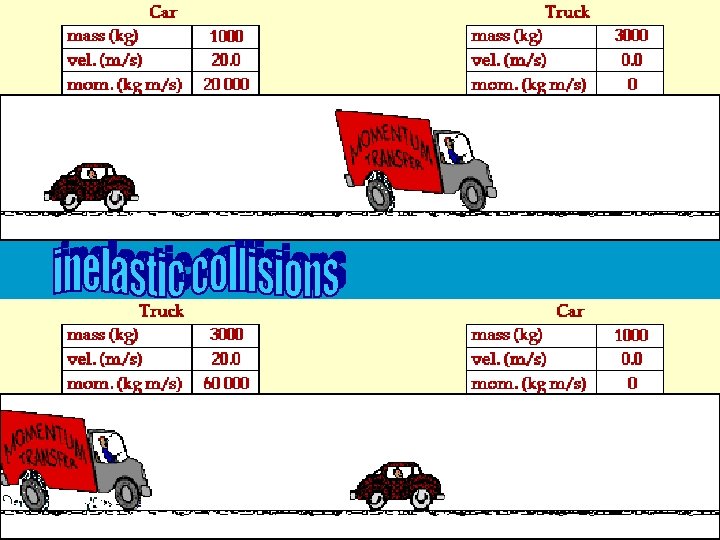
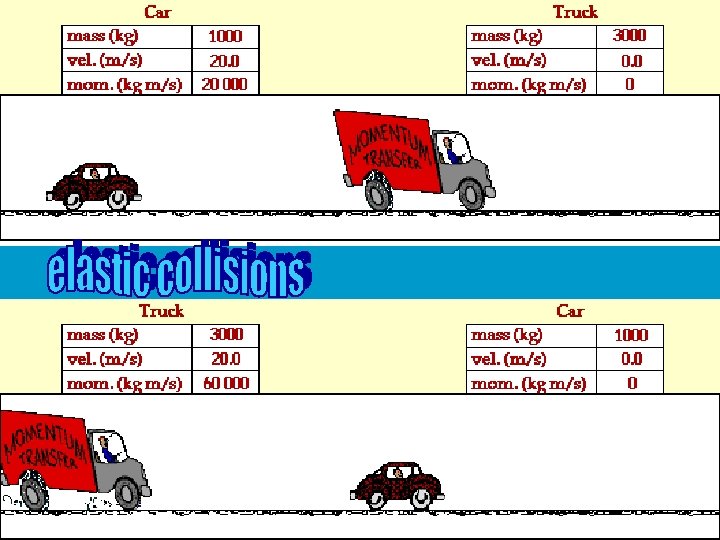
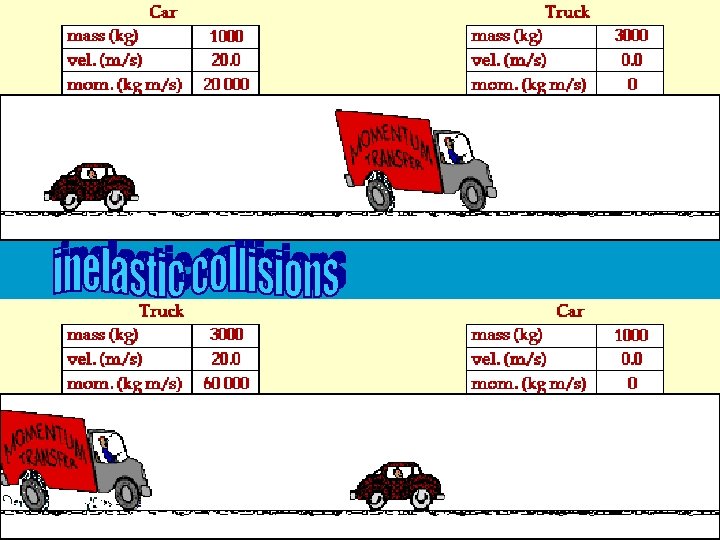
Collisions Two types of collisions involving momentum • Elastic-objects bounce off each other • Bowling balls and pins • Inelastic-objects stick together • Football Tackle • The two will continue in the direction of the player with the greatest momentum
Elastic Collisions In an elastic collision, the kinetic energy of the system is unchanged by the collision Example: In billiards, collisions between balls are almost completely elastic http: //www. billiard-tables-cues. com/images/billiard%20 balls. jpg
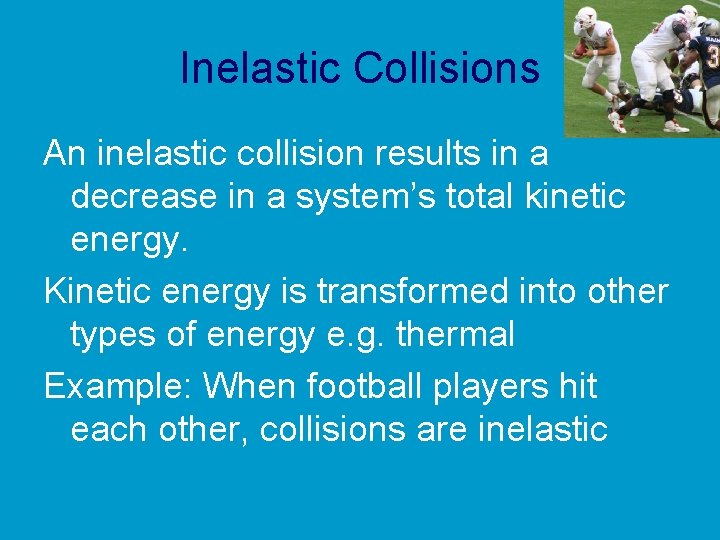
Inelastic Collisions An inelastic collision results in a decrease in a system’s total kinetic energy. Kinetic energy is transformed into other types of energy e. g. thermal Example: When football players hit each other, collisions are inelastic
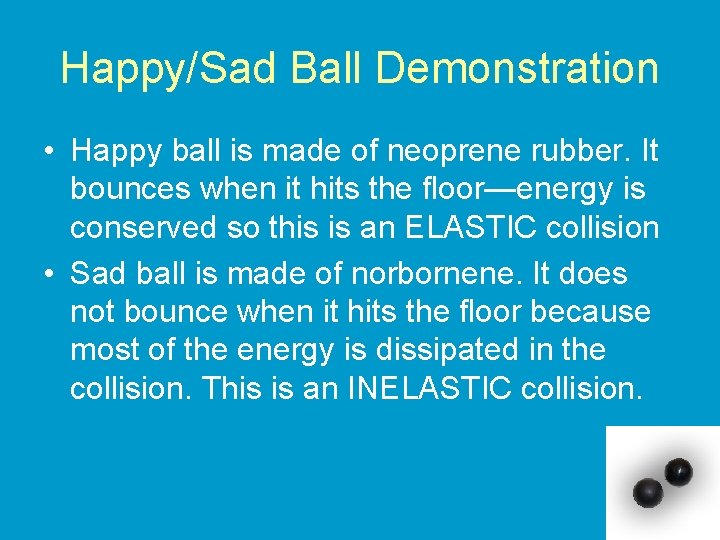
Happy/Sad Ball Demonstration • Happy ball is made of neoprene rubber. It bounces when it hits the floor—energy is conserved so this is an ELASTIC collision • Sad ball is made of norbornene. It does not bounce when it hits the floor because most of the energy is dissipated in the collision. This is an INELASTIC collision.
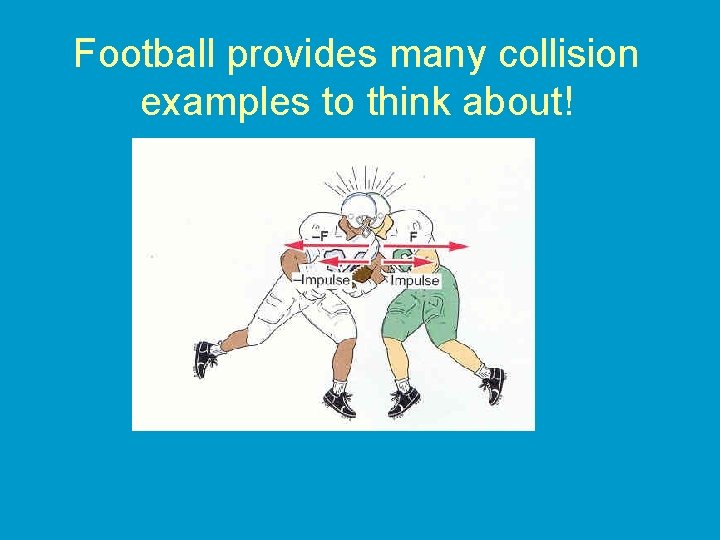
Football provides many collision examples to think about!
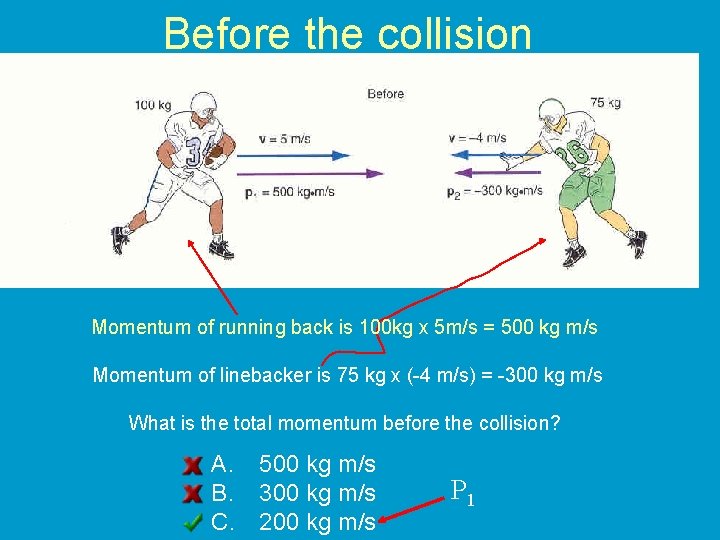
Before the collision Momentum of running back is 100 kg x 5 m/s = 500 kg m/s Momentum of linebacker is 75 kg x (-4 m/s) = -300 kg m/s What is the total momentum before the collision? A. 500 kg m/s B. 300 kg m/s C. 200 kg m/s P 1
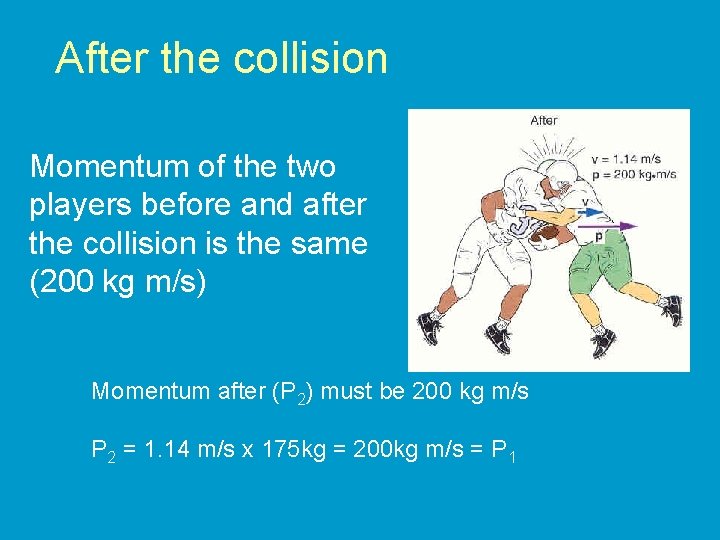
After the collision Momentum of the two players before and after the collision is the same (200 kg m/s) Momentum after (P 2) must be 200 kg m/s P 2 = 1. 14 m/s x 175 kg = 200 kg m/s = P 1
Momentum Practice 2 cars are heading east, car A is traveling 30 mi/hr, car B is traveling 60 mi/hr. Each car weighs 2000 lbs. – What is the momentum of car A? – What is the momentum of car B? – If car B crashes into car A, what is the total momentum?
Answer p=mv Car X’s momentum = 30 mi/hr x 2000 lbs p. X = 60, 000 mi-lbs/hr east Car Y’s momentum = 60 mi/hr x 2000 lbs p. Y = 120, 000 mi-lbs/hr west Total momentum = p. Y - p. X = 120, 000 - 60, 000 = 60, 000 mi-lbs/hr west
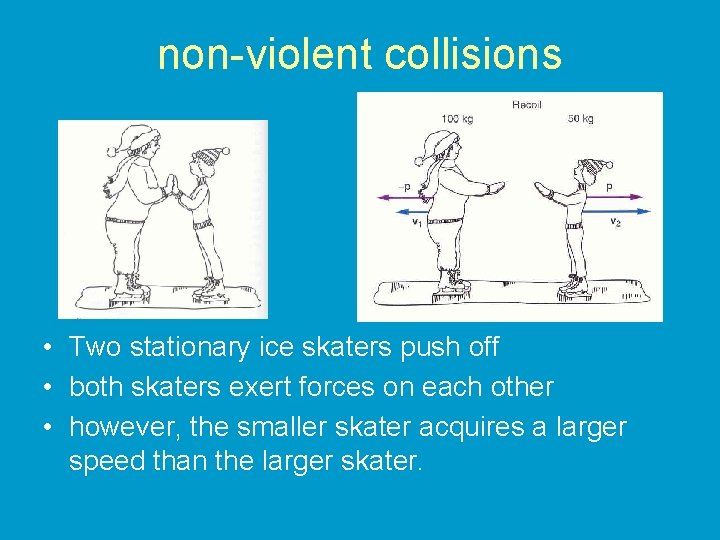
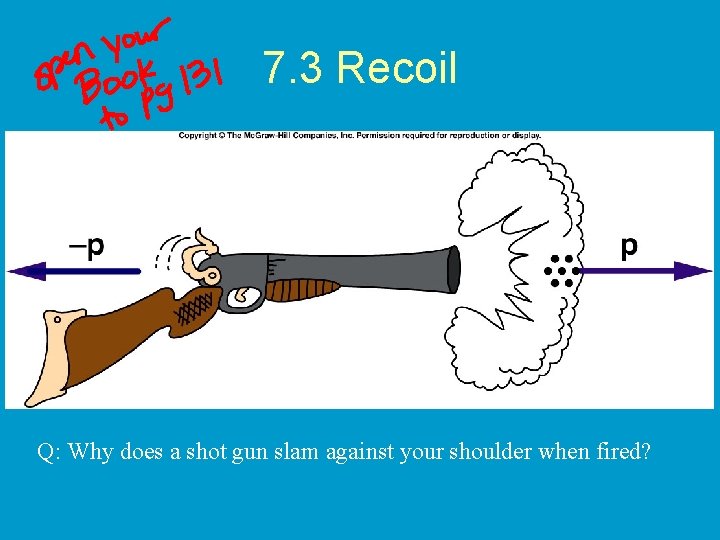
non-violent collisions • Two stationary ice skaters push off • both skaters exert forces on each other • however, the smaller skater acquires a larger speed than the larger skater.
7. 3 Recoil Q: Why does a shot gun slam against your shoulder when fired?
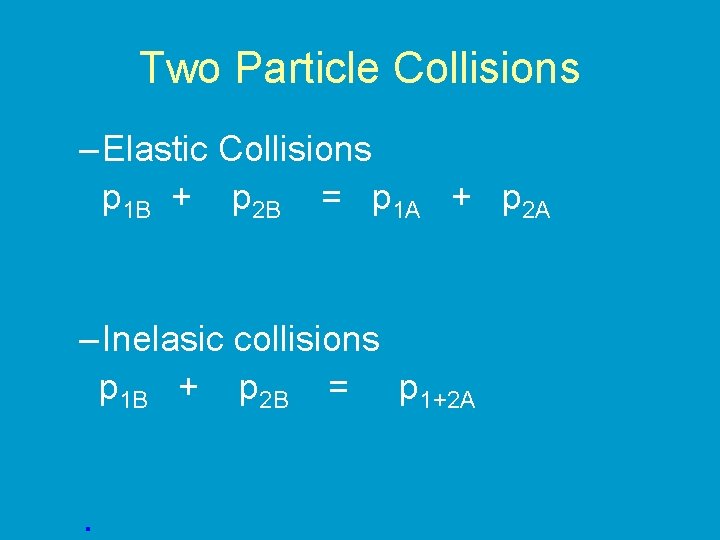
Two Particle Collisions – Elastic Collisions p 1 B + p 2 B = p 1 A + p 2 A m 1 v 1 B + m 2 v 2 B = m 1 v 1 A + m 2 v 2 A – Inelasic collisions p 1 B + p 2 B = p 1+2 A m 1 v 1 B + m 2 v 2 B = m 1+2 v 1+2 A