ECE 3822 Tools For Engineers 8443 Software Pattern
- Slides: 22
ECE 3822 Tools For Engineers 8443 – Software Pattern Recognition LECTURE 33: Database Introduction • Topics: Definitions and Terminology Abstraction Schema Tables Types of Databases • Resources: You. Tube: Introduction LM: Database Concepts Dsoergel: Fundamentals
Introduction to Databases ECE 3822: Lecture 33, Slide 1
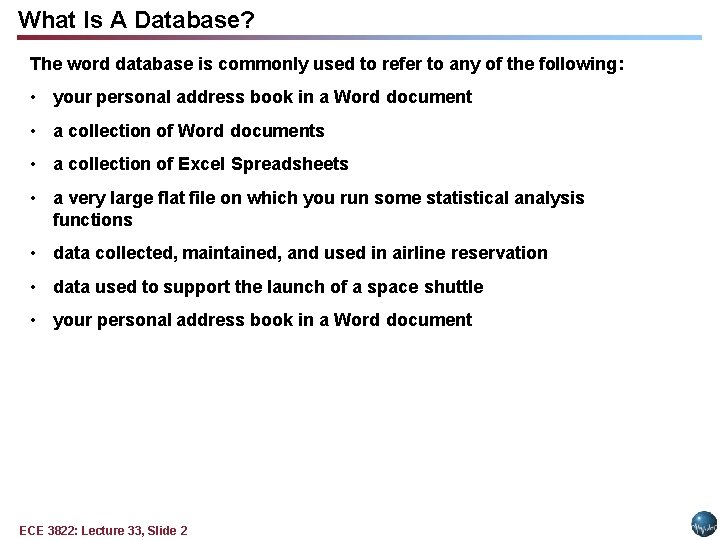
What Is A Database? The word database is commonly used to refer to any of the following: • your personal address book in a Word document • a collection of Word documents • a collection of Excel Spreadsheets • a very large flat file on which you run some statistical analysis functions • data collected, maintained, and used in airline reservation • data used to support the launch of a space shuttle • your personal address book in a Word document ECE 3822: Lecture 33, Slide 2
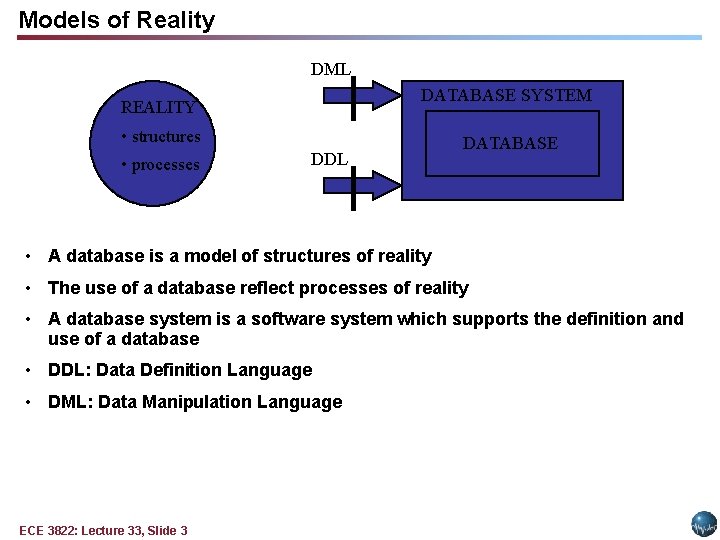
Models of Reality DML DATABASE SYSTEM REALITY • structures • processes DDL DATABASE • A database is a model of structures of reality • The use of a database reflect processes of reality • A database system is a software system which supports the definition and use of a database • DDL: Data Definition Language • DML: Data Manipulation Language ECE 3822: Lecture 33, Slide 3
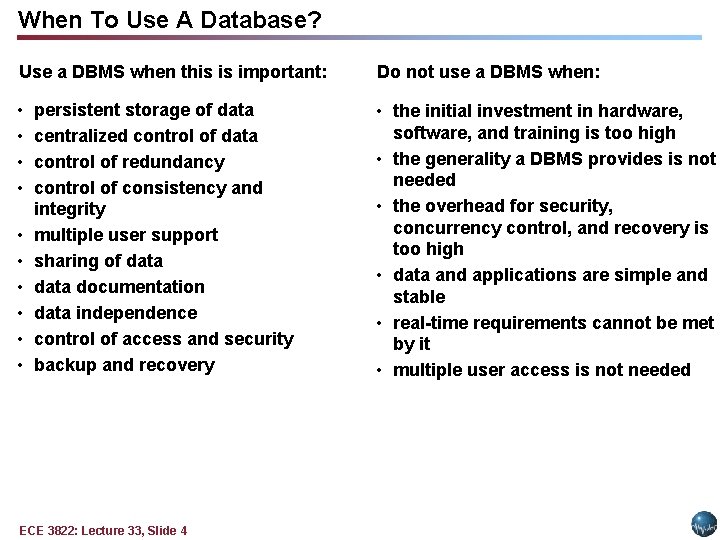
When To Use A Database? Use a DBMS when this is important: Do not use a DBMS when: • • • the initial investment in hardware, software, and training is too high • the generality a DBMS provides is not needed • the overhead for security, concurrency control, and recovery is too high • data and applications are simple and stable • real-time requirements cannot be met by it • multiple user access is not needed • • • persistent storage of data centralized control of data control of redundancy control of consistency and integrity multiple user support sharing of data documentation data independence control of access and security backup and recovery ECE 3822: Lecture 33, Slide 4
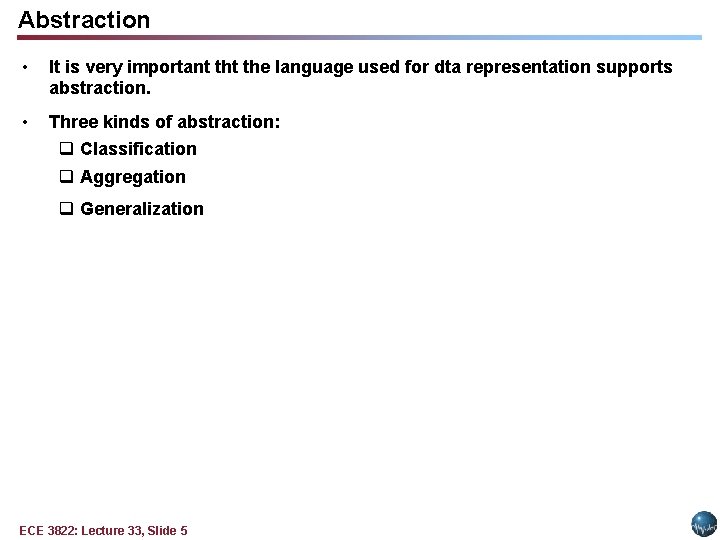
Abstraction • It is very important the language used for dta representation supports abstraction. • Three kinds of abstraction: q Classification q Aggregation q Generalization ECE 3822: Lecture 33, Slide 5
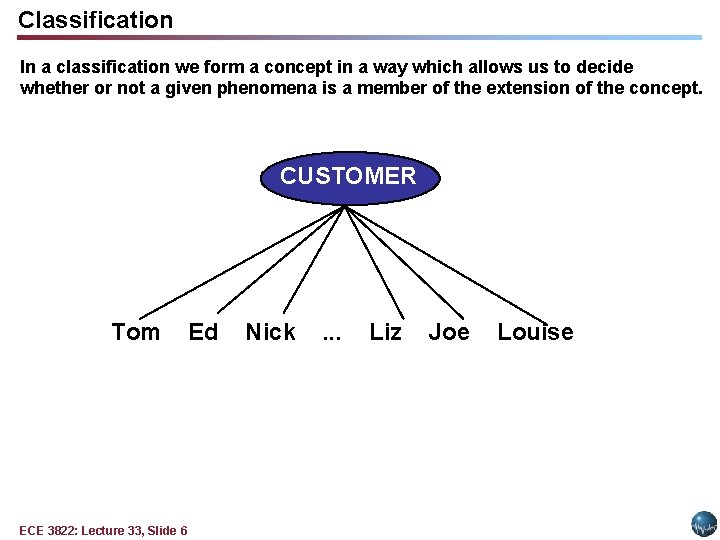
Classification In a classification we form a concept in a way which allows us to decide whether or not a given phenomena is a member of the extension of the concept. CUSTOMER Tom ECE 3822: Lecture 33, Slide 6 Ed Nick . . . Liz Joe Louise
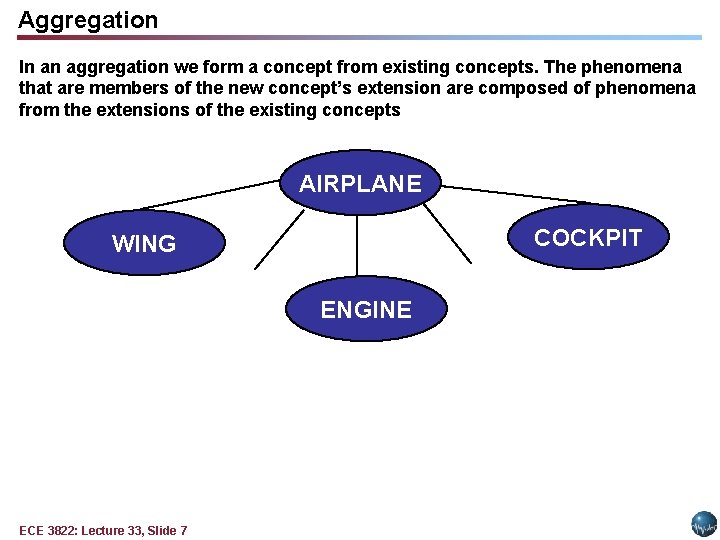
Aggregation In an aggregation we form a concept from existing concepts. The phenomena that are members of the new concept’s extension are composed of phenomena from the extensions of the existing concepts AIRPLANE COCKPIT WING ENGINE ECE 3822: Lecture 33, Slide 7
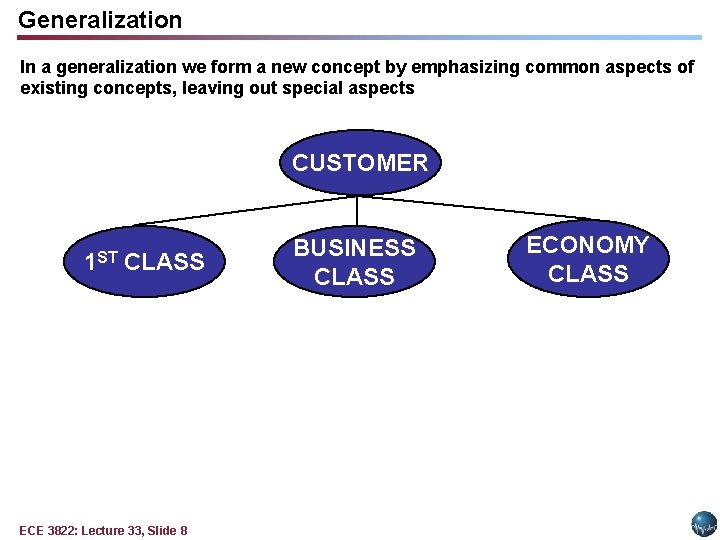
Generalization In a generalization we form a new concept by emphasizing common aspects of existing concepts, leaving out special aspects CUSTOMER 1 ST CLASS ECE 3822: Lecture 33, Slide 8 BUSINESS CLASS ECONOMY CLASS
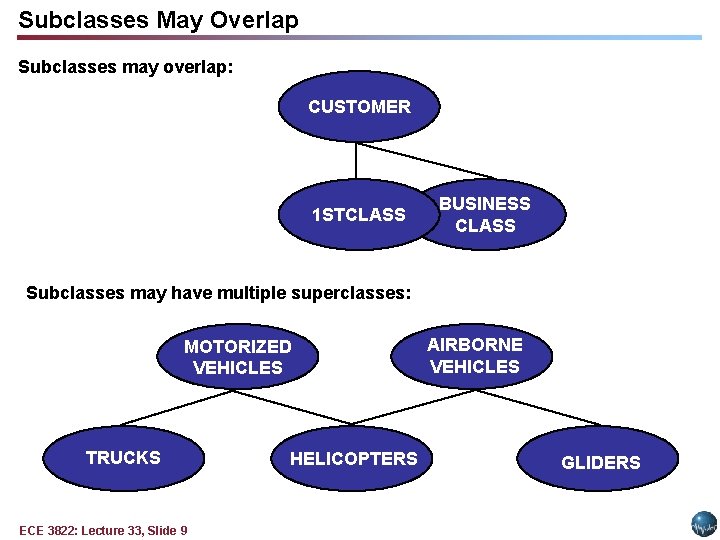
Subclasses May Overlap Subclasses may overlap: CUSTOMER 1 STCLASS BUSINESS CLASS Subclasses may have multiple superclasses: MOTORIZED VEHICLES TRUCKS ECE 3822: Lecture 33, Slide 9 HELICOPTERS AIRBORNE VEHICLES GLIDERS
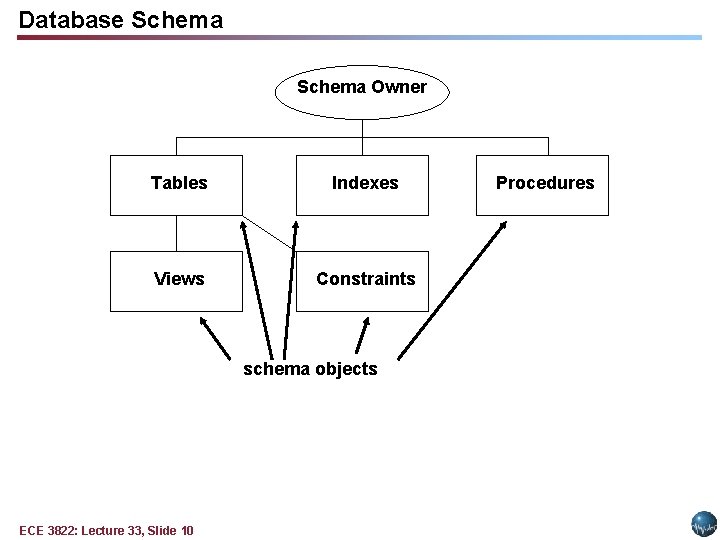
Database Schema Owner Tables Indexes Views Constraints schema objects ECE 3822: Lecture 33, Slide 10 Procedures
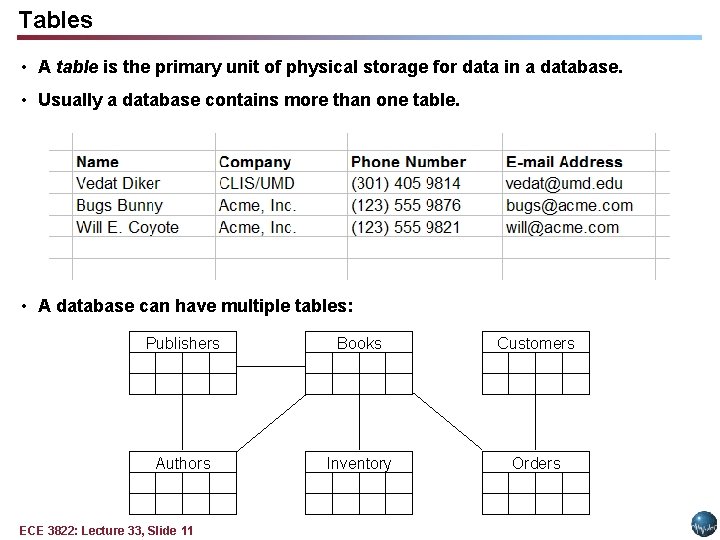
Tables • A table is the primary unit of physical storage for data in a database. • Usually a database contains more than one table. • A database can have multiple tables: Publishers Books Customers Authors Inventory Orders ECE 3822: Lecture 33, Slide 11
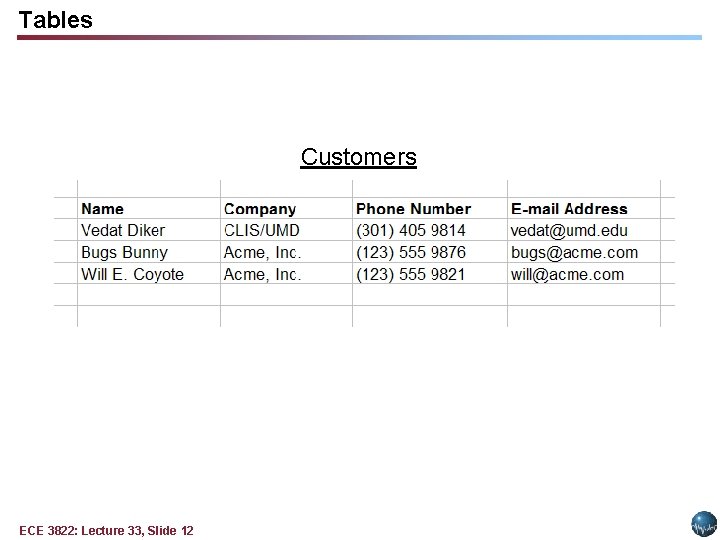
Tables Customers ECE 3822: Lecture 33, Slide 12
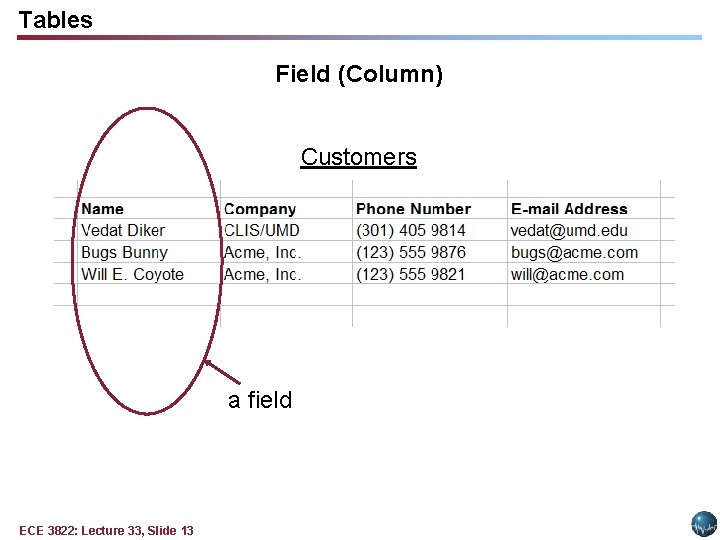
Tables Field (Column) Customers a field ECE 3822: Lecture 33, Slide 13
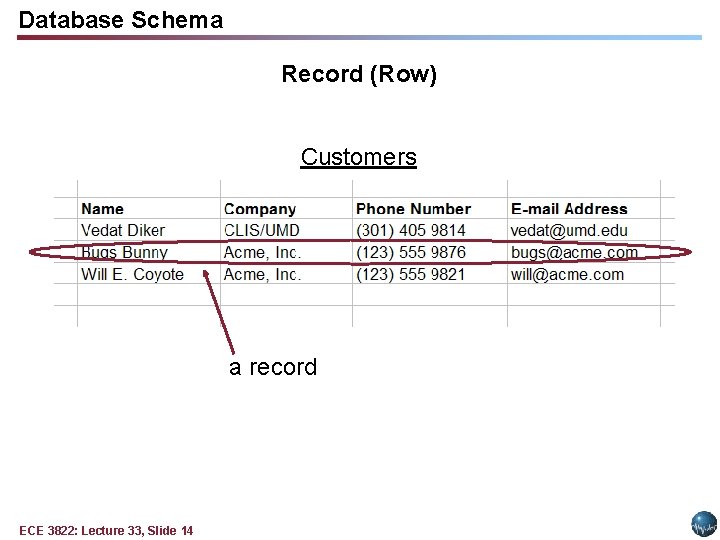
Database Schema Record (Row) Customers a record ECE 3822: Lecture 33, Slide 14
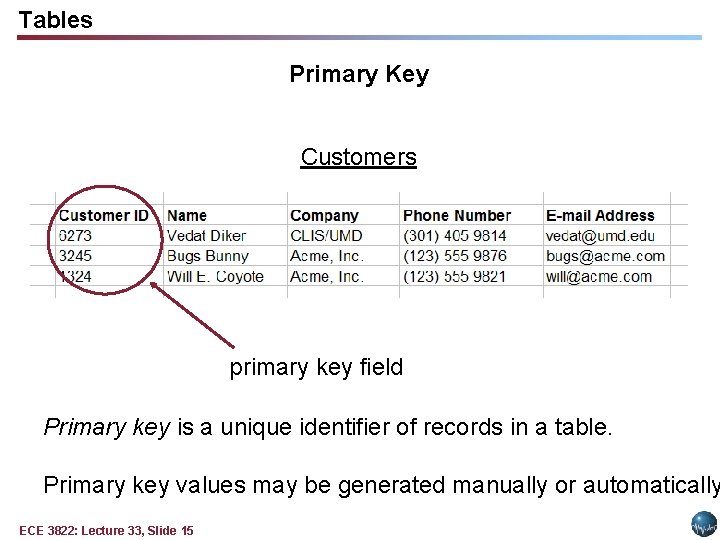
Tables Primary Key Customers primary key field Primary key is a unique identifier of records in a table. Primary key values may be generated manually or automatically ECE 3822: Lecture 33, Slide 15
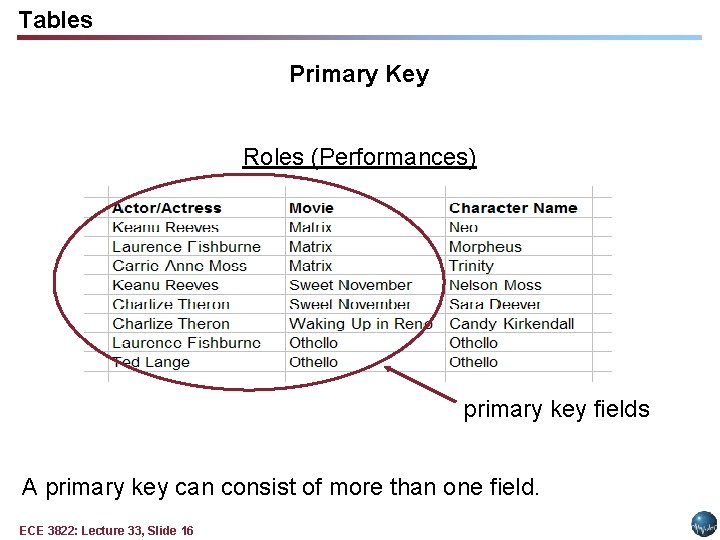
Tables Primary Key Roles (Performances) primary key fields A primary key can consist of more than one field. ECE 3822: Lecture 33, Slide 16
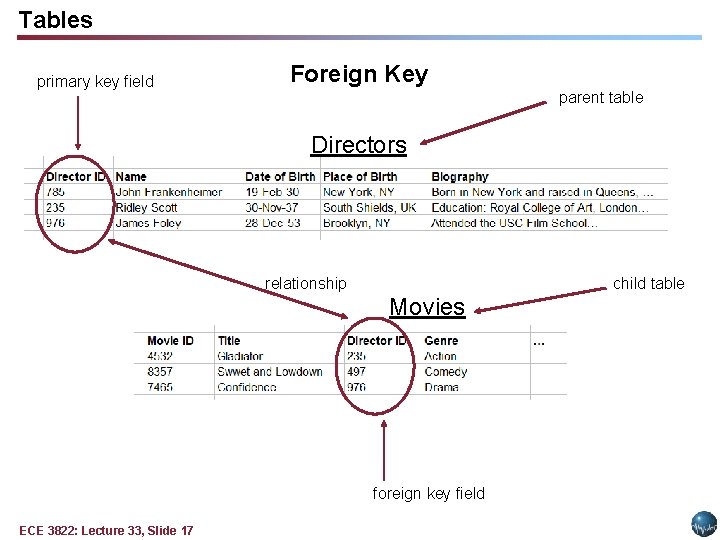
Tables primary key field Foreign Key parent table Directors relationship child table Movies foreign key field ECE 3822: Lecture 33, Slide 17
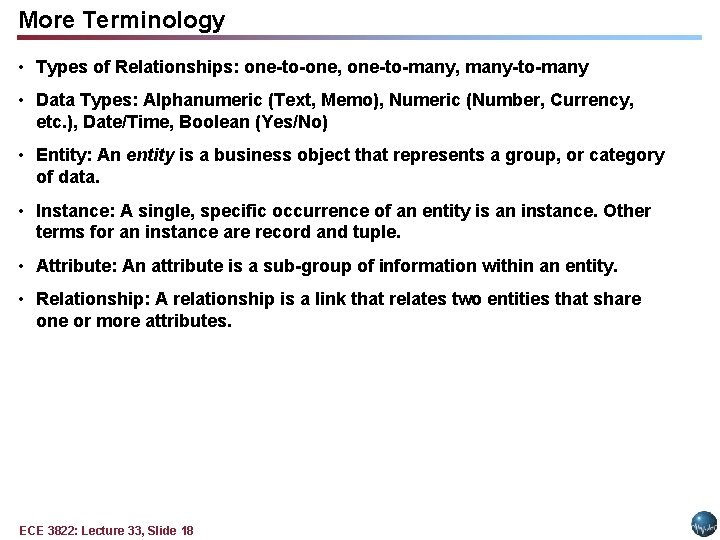
More Terminology • Types of Relationships: one-to-one, one-to-many, many-to-many • Data Types: Alphanumeric (Text, Memo), Numeric (Number, Currency, etc. ), Date/Time, Boolean (Yes/No) • Entity: An entity is a business object that represents a group, or category of data. • Instance: A single, specific occurrence of an entity is an instance. Other terms for an instance are record and tuple. • Attribute: An attribute is a sub-group of information within an entity. • Relationship: A relationship is a link that relates two entities that share one or more attributes. ECE 3822: Lecture 33, Slide 18
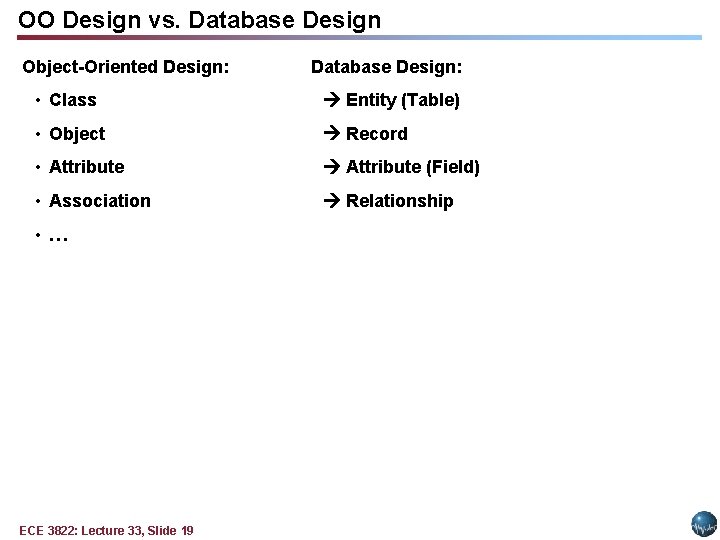
OO Design vs. Database Design Object-Oriented Design: Database Design: • Class Entity (Table) • Object Record • Attribute (Field) • Association Relationship • … ECE 3822: Lecture 33, Slide 19
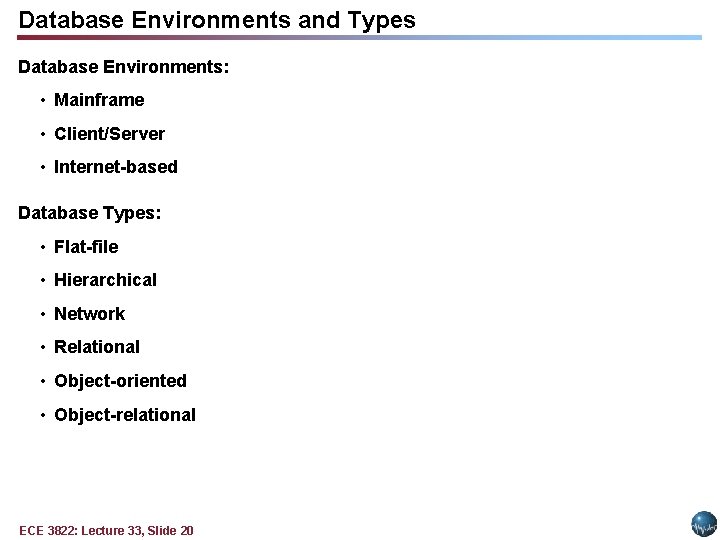
Database Environments and Types Database Environments: • Mainframe • Client/Server • Internet-based Database Types: • Flat-file • Hierarchical • Network • Relational • Object-oriented • Object-relational ECE 3822: Lecture 33, Slide 20
Summary • • • Flat-file Hierarchical Network Relational Object-oriented Object-relational ECE 3822: Lecture 33, Slide 21