Discover Universal Design for Learning UDL to respond

- Slides: 28
Discover Universal Design for Learning (UDL) to respond to learner diversity Please log into http: //www. udlcenter. org/aboutudl/take_a _tour_udl Jayne Pletser – curriculum manager for inclusive education
This session In this session we will consider: • • • IB Inclusion and teaching to learner variability. UDL – overview and guidelines. Research - UDL and inclusive practices in IB schools world wide. Practical session – exploring UDL. References and suggested reading.
Responding to learner diversity: removing barriers to learning Inclusion is an ongoing process that aims to increase access and engagement in learning for all students by identifying and removing barriers. (IBO, 2010)
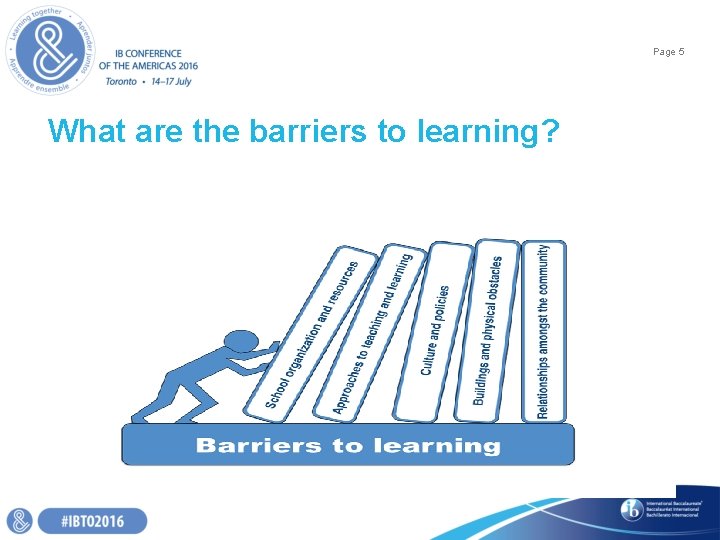
Page 5 What are the barriers to learning?
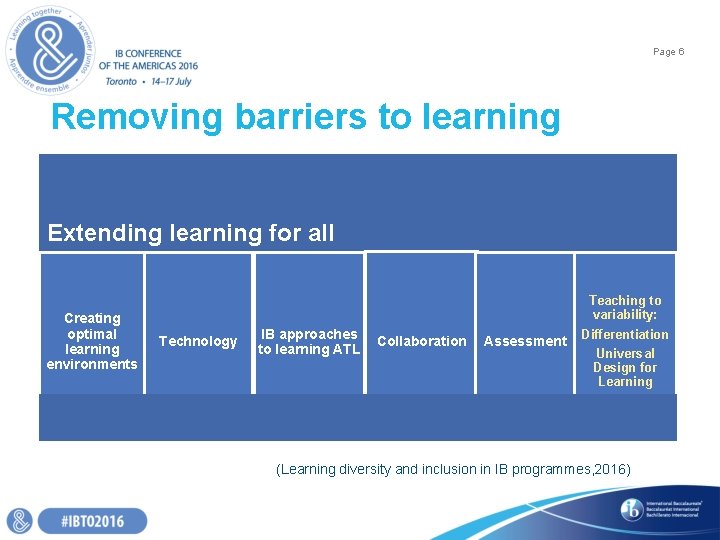
Page 6 Removing barriers to learning Extending learning for all Creating optimal learning environments Technology IB approaches to learning ATL Collaboration Assessment Teaching to variability: Differentiation Universal Design for Learning (Learning diversity and inclusion in IB programmes, 2016)
7 Teaching to variability: differentiation Differentiation – concerns curriculum content Content What should a student come to know, understand be able to do? How will the student gain access to knowledge, skills and understanding? Process What activities will be used to help students make sense of the knowledge, understanding and skills? Product What products will provide evidence of what the student knows, understands and is able to do? (Tomlinson, 2003)
UDL at a glance https: //youtu. be/b. Dv. Kn. Y 0 g 6 e 4
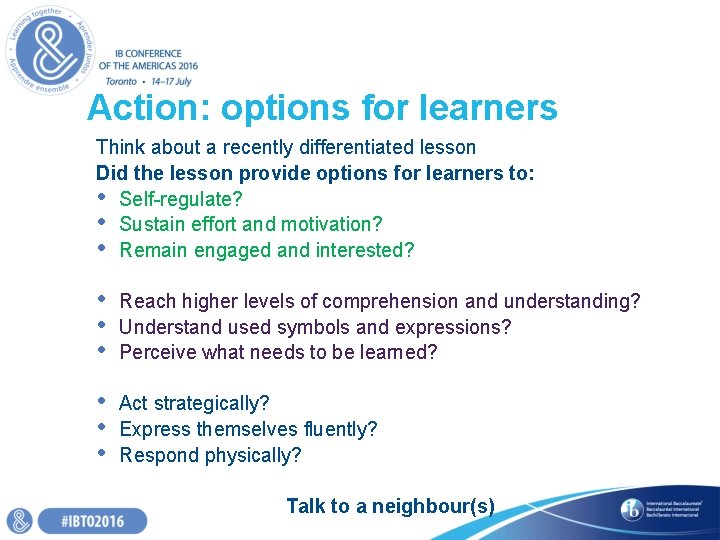
Action: options for learners Think about a recently differentiated lesson Did the lesson provide options for learners to: • Self-regulate? • Sustain effort and motivation? • Remain engaged and interested? • • • Reach higher levels of comprehension and understanding? Understand used symbols and expressions? Perceive what needs to be learned? • • • Act strategically? Express themselves fluently? Respond physically? Talk to a neighbour(s)
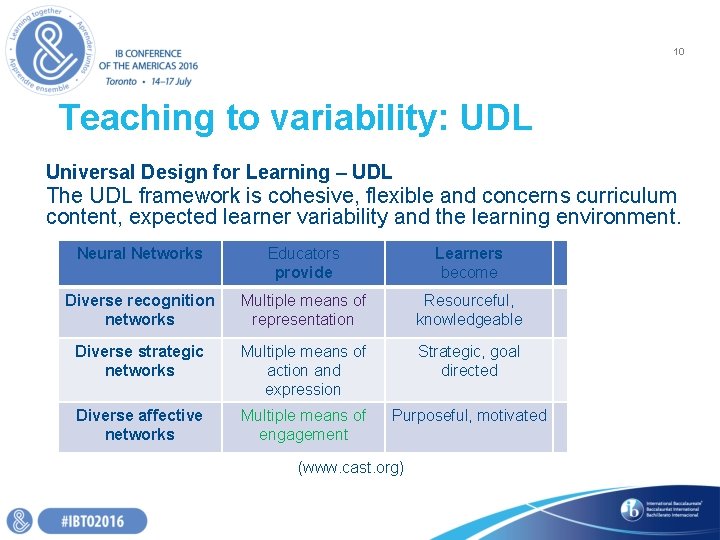
10 Teaching to variability: UDL Universal Design for Learning – UDL The UDL framework is cohesive, flexible and concerns curriculum content, expected learner variability and the learning environment. Neural Networks Educators provide Learners become Diverse recognition networks Multiple means of representation Resourceful, knowledgeable Diverse strategic networks Multiple means of action and expression Strategic, goal directed Diverse affective networks Multiple means of engagement Purposeful, motivated (www. cast. org)
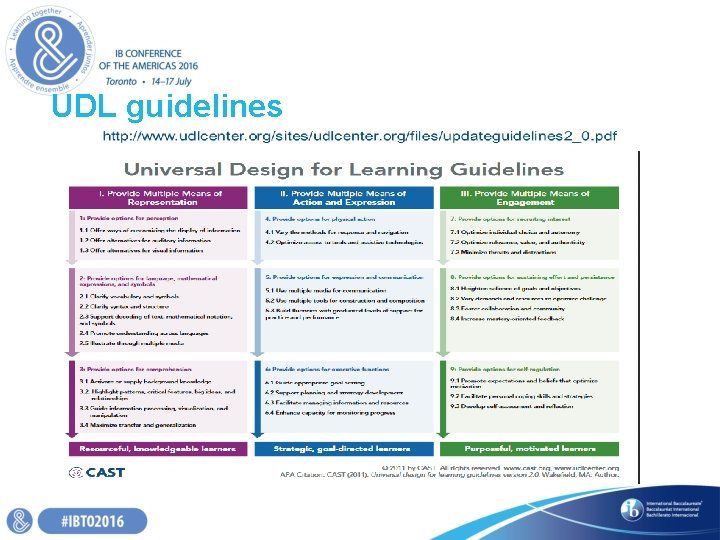
UDL guidelines
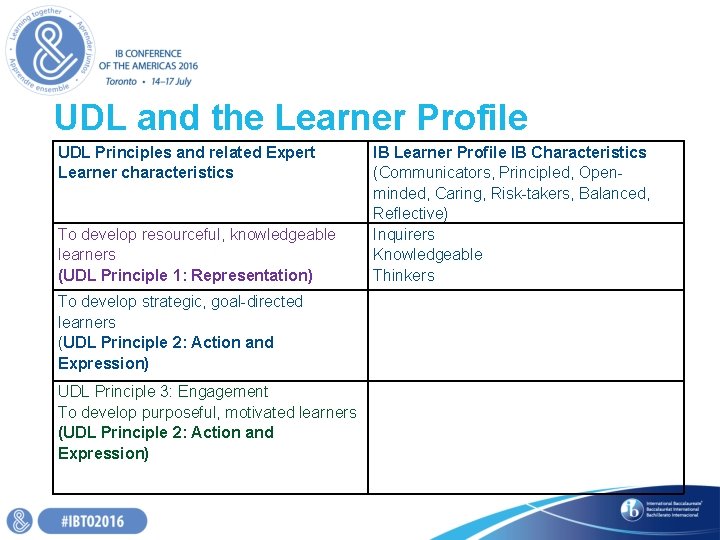
UDL and the Learner Profile UDL Principles and related Expert Learner characteristics To develop resourceful, knowledgeable learners (UDL Principle 1: Representation) To develop strategic, goal-directed learners (UDL Principle 2: Action and Expression) UDL Principle 3: Engagement To develop purposeful, motivated learners (UDL Principle 2: Action and Expression) IB Learner Profile IB Characteristics (Communicators, Principled, Openminded, Caring, Risk-takers, Balanced, Reflective) Inquirers Knowledgeable Thinkers
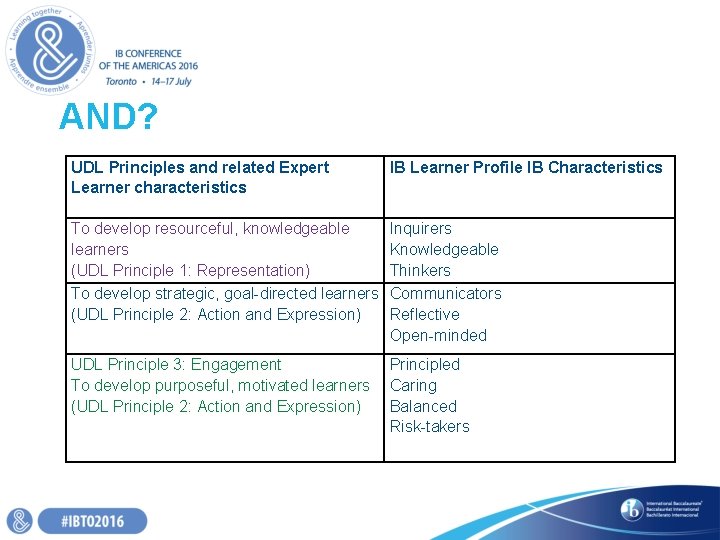
AND? UDL Principles and related Expert Learner characteristics To develop resourceful, knowledgeable learners (UDL Principle 1: Representation) To develop strategic, goal-directed learners (UDL Principle 2: Action and Expression) IB Learner Profile IB Characteristics UDL Principle 3: Engagement To develop purposeful, motivated learners (UDL Principle 2: Action and Expression) Principled Caring Balanced Risk-takers Inquirers Knowledgeable Thinkers Communicators Reflective Open-minded
Action: UDL guidelines Options for learners to: • Self-regulate? Would the UDL guidelines increase • Sustain effort and motivation? learning opportunities for you and • Remain engaged and your students? interested? • Reach higher levels of comprehension and understanding? • Understand used symbols CAST (2011). Universal Design for Learning Guidelines version 2. 0. and expressions? Wakefield, MA: Author. • Perceive what needs to be learned? • Act strategically? • Express themselves fluently? • Respond physically? Talk to a neighbour
IB commissioned research UDL and Inclusive Practices in IB Schools Worldwide http: //ibo. org/research/programme-development-research/continuumstudies/ Purpose To examine how inclusive practices and UDL are used in IB schools worldwide, focusing on the following areas: • How UDL and inclusive practices are currently being implemented at the classroom and schoolwide level in IB schools worldwide and what specific factors impact this implementation • How the inclusive practices IB educators are using align with the UDL framework
Research Questions and Methods Research questions: • What are the key findings in the literature base about UDL implementation in K-12 settings? • How is UDL currently implemented in IB schools? • How does UDL support the IB goal of promoting inclusive education? Research Methods Qualitative research design: • Document analysis. • Literature review. • Large-scale survey. • Interviews of selected participants > case stories on a set of schools.
General research findings jp • • • IB Philosophy and practices are well-aligned with the guiding tenets of UDL. IB guidelines emphasize the need to consider student diversity at various levels, from school philosophy to organization to instructional practices. The IB focus on reducing barriers and providing teaching and learning approaches that support and engage all learners is consistent with UDL’s central premise of addressing learner variability by proactively designing instruction for all learners.
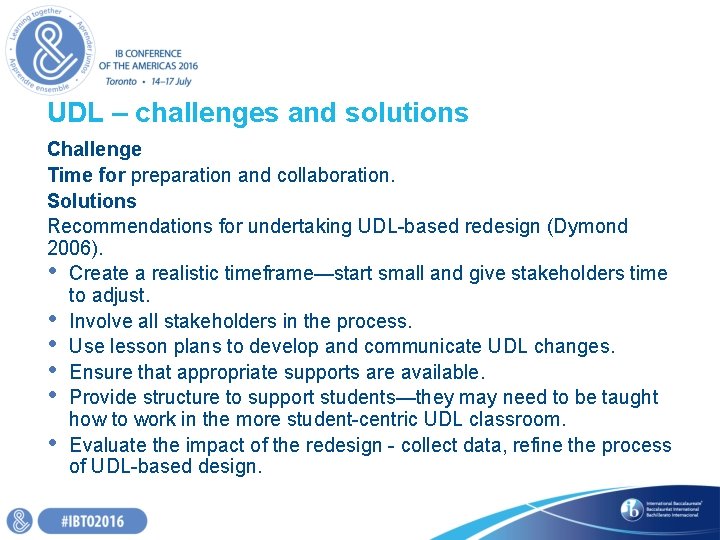
UDL – challenges and solutions UDL framework: • Open-ended. • Flexible. • Not prescriptive. • Many ideas and options for use. • Anyone can use. Challenge Overwhelming for some because there is no clearly defined path for use. Solutions • Concrete ideas and strategies for how to operationalize UDL. • Professional development workshops. • Online courses. • Professional learning communities.
UDL – challenges and solutions Challenge Time for preparation and collaboration. Solutions Recommendations for undertaking UDL-based redesign (Dymond 2006). • Create a realistic timeframe—start small and give stakeholders time to adjust. • Involve all stakeholders in the process. • Use lesson plans to develop and communicate UDL changes. • Ensure that appropriate supports are available. • Provide structure to support students—they may need to be taught how to work in the more student-centric UDL classroom. • Evaluate the impact of the redesign - collect data, refine the process of UDL-based design.
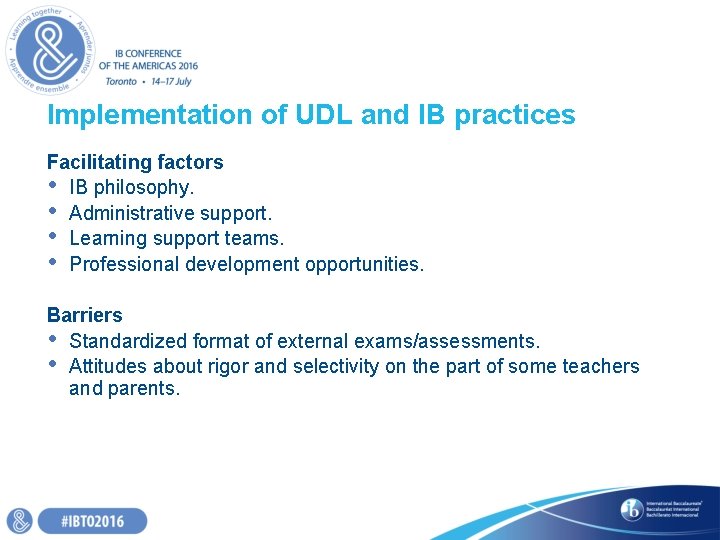
Implementation of UDL and IB practices Facilitating factors • IB philosophy. • Administrative support. • Learning support teams. • Professional development opportunities. Barriers • Standardized format of external exams/assessments. • Attitudes about rigor and selectivity on the part of some teachers and parents.
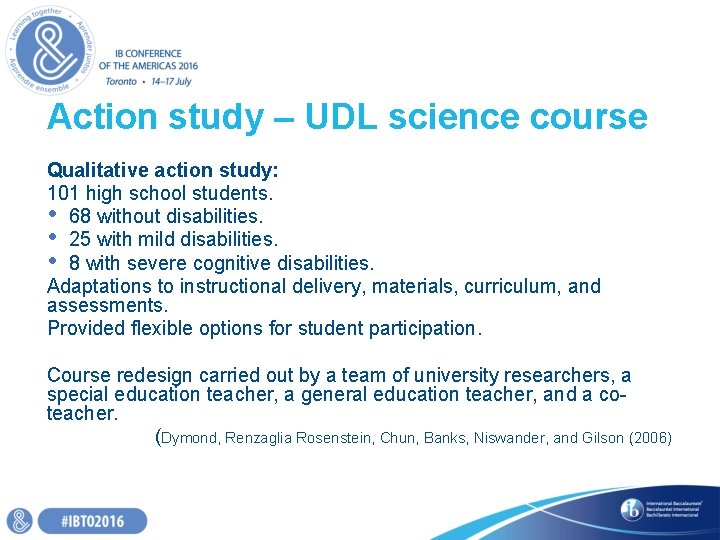
Action study – UDL science course Qualitative action study: 101 high school students. • 68 without disabilities. • 25 with mild disabilities. • 8 with severe cognitive disabilities. Adaptations to instructional delivery, materials, curriculum, and assessments. Provided flexible options for student participation. Course redesign carried out by a team of university researchers, a special education teacher, a general education teacher, and a coteacher. (Dymond, Renzaglia Rosenstein, Chun, Banks, Niswander, and Gilson (2006)
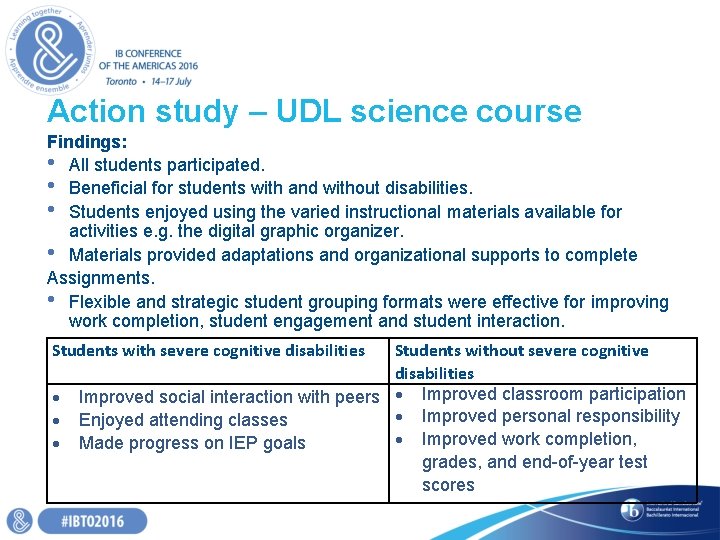
Action study – UDL science course Findings: • All students participated. • Beneficial for students with and without disabilities. • Students enjoyed using the varied instructional materials available for activities e. g. the digital graphic organizer. • Materials provided adaptations and organizational supports to complete Assignments. • Flexible and strategic student grouping formats were effective for improving work completion, student engagement and student interaction. Students with severe cognitive disabilities Students without severe cognitive disabilities Improved social interaction with peers Improved classroom participation Improved personal responsibility Enjoyed attending classes Improved work completion, Made progress on IEP goals grades, and end-of-year test scores
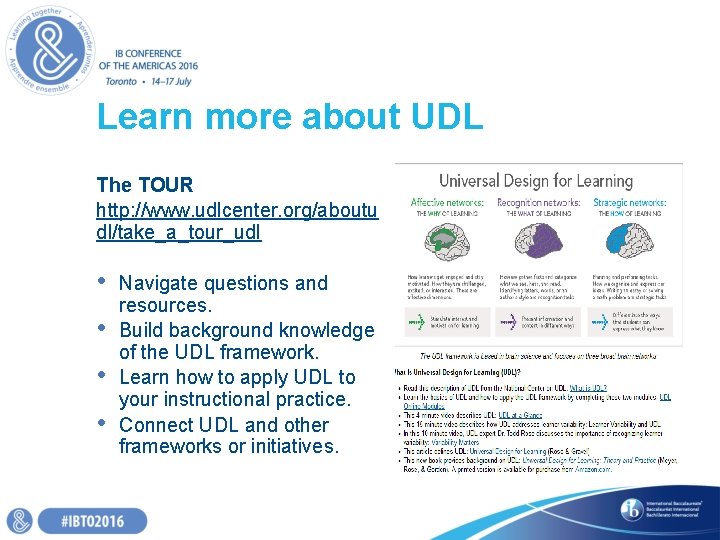
Learn more about UDL The TOUR http: //www. udlcenter. org/aboutu dl/take_a_tour_udl • • Navigate questions and resources. Build background knowledge of the UDL framework. Learn how to apply UDL to your instructional practice. Connect UDL and other frameworks or initiatives.
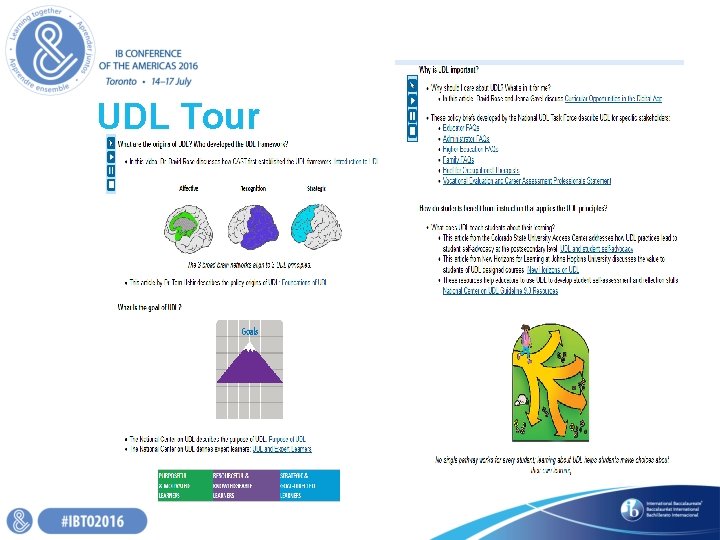
UDL Tour
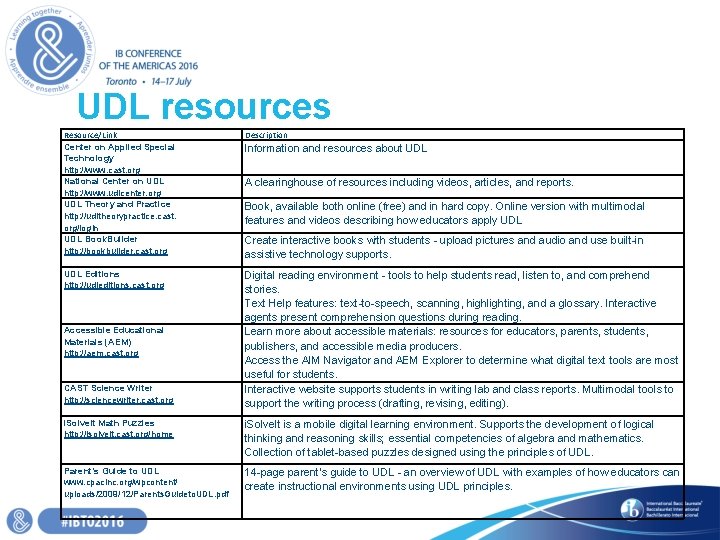
UDL resources Resource/Link Center on Applied Special Technology http: //www. cast. org National Center on UDL http: //www. udlcenter. org UDL Theory and Practice http: //udltheorypractice. cast. org/login UDL Book. Builder http: //bookbuilder. cast. org Description UDL Editions http: //udleditions. cast. org Digital reading environment - tools to help students read, listen to, and comprehend stories. Text Help features: text-to-speech, scanning, highlighting, and a glossary. Interactive agents present comprehension questions during reading. Learn more about accessible materials: resources for educators, parents, students, publishers, and accessible media producers. Access the AIM Navigator and AEM Explorer to determine what digital text tools are most useful for students. Interactive website supports students in writing lab and class reports. Multimodal tools to support the writing process (drafting, revising, editing). Accessible Educational Materials (AEM) http: //aem. cast. org CAST Science Writer http: //sciencewriter. cast. org i. Solve. It Math Puzzles http: //isolveit. cast. org/home Parent’s Guide to UDL www. cpacinc. org/wpcontent/ uploads/2009/12/Parents. Guideto. UDL. pdf Information and resources about UDL A clearinghouse of resources including videos, articles, and reports. Book, available both online (free) and in hard copy. Online version with multimodal features and videos describing how educators apply UDL Create interactive books with students - upload pictures and audio and use built-in assistive technology supports. i. Solve. It is a mobile digital learning environment. Supports the development of logical thinking and reasoning skills; essential competencies of algebra and mathematics. Collection of tablet-based puzzles designed using the principles of UDL. 14 -page parent’s guide to UDL - an overview of UDL with examples of how educators can create instructional environments using UDL principles.
Action Login in to view the interactive book http: //udltheorypractice. cast. org/login With a neighbour or alone choose to: ØTake the UDL tour @ http: //www. udlcenter. org/aboutudl/take_a_tour_udl Discuss What would be the benefit of using these materials in your school? How would you use them? Who would benefit from their use? OR ØExplore the UDL resources (handout) Which resource would be the most useful to you at this moment? Which of your students would benefit from which resource?
Page 27 • References and suggested reading Armstrong, T. (2011) The Power of Neurodiversity: Unleashing the Advantages of Your Differently Wired Brain. United States: Perseus Books Group. • Dymond, S. K. , Renzaglia, A. , Rosenstein, A. , Chun, E. J. , Banks, R. A. , Niswander, V. , & Gibson, C. L. (2006). Using a participatory action research approach to create a universally designed inclusive high school science course: A case study. Research & Practice for Persons with Severe Disabilities, 31, 293 -308. • Kalambouka, A. , Farrell, P. , Dyson, A. and Kaplan, I. (2007) ‘The impact of placing pupils with special educational needs in mainstream schools on the achievement of their peers’, Educational Research, 49(4), pp. 365– 382. doi: 10. 1080/00131880701717222. • Meyer, A. , Rose, D. H. , Gordon, D. 2014 Universal Design for Learning: theory and practice. Wakefield, USA. CAST, Inc. • Mitchell, D. (2013) What Really Works in Special and Inclusive Education: Using Evidence. Based Teaching Strategies. United Kingdom. • Slee, R. , 2011 The Irregular School: Exclusion, schooling and inclusive education. Oxon, UK. Routledge. • Tomlinson, C. A, Cunningham Eidsen, C. Differentiation in Practice: A resource guide for differentiating curriculum. Alexandria, USA. ASCD. IB resources Learning diversity and inclusion in IB programmes (2016). The IB guide to inclusive education: a resource for whole school development (2015). Meeting student learning diversity in the classrooms (2013).
Thank you! Jayne Pletser jayne. pletserdent@ibo. org