
Universal Design for Learning Introduction Learning Objectives Explain


Universal Design for Learning: Introduction

Learning Objectives • Explain the history and purpose of Universal Design • Recognize the 3 principles of Universal Design for Learning in practice • Identify valuable resources available for UDL implementation in the classroom
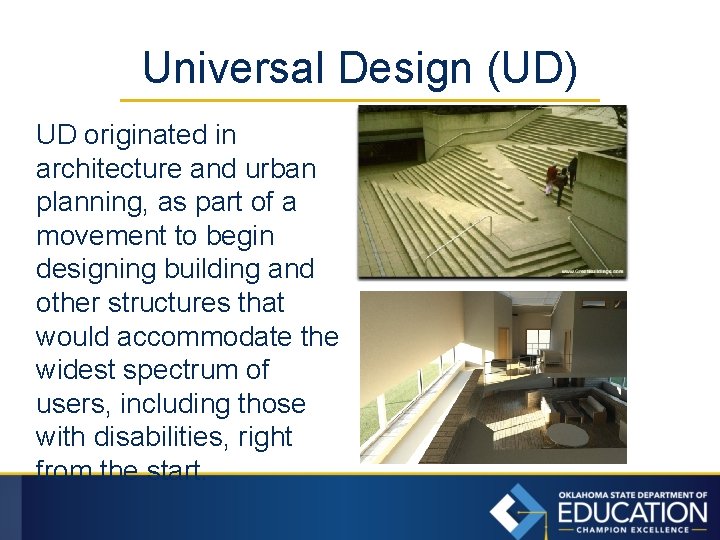
Universal Design (UD) UD originated in architecture and urban planning, as part of a movement to begin designing building and other structures that would accommodate the widest spectrum of users, including those with disabilities, right from the start.
UD Assumptions ü Not one size fits all – but alternatives for everyone. ü Not added on later – but designed from the beginning. ü Not access for some – but access for everyone.
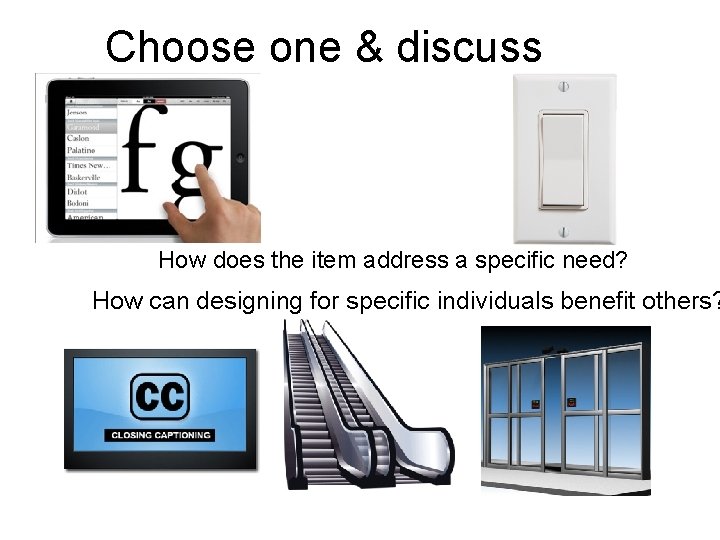
Choose one & discuss How does the item address a specific need? How can designing for specific individuals benefit others?
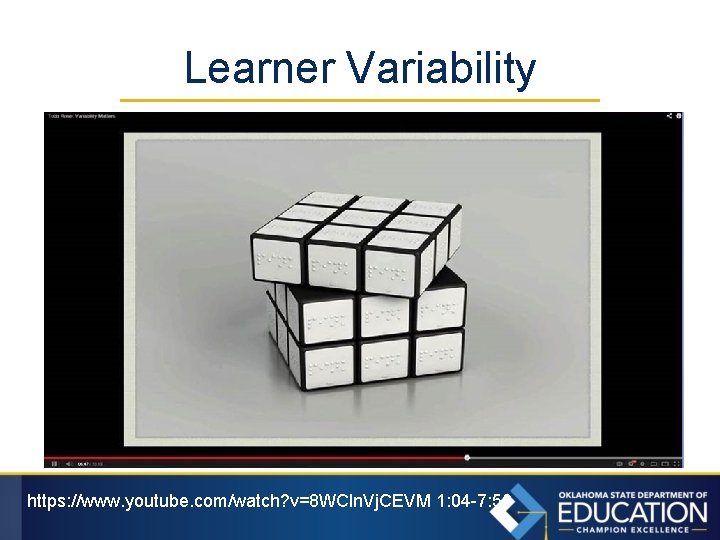
Learner Variability https: //www. youtube. com/watch? v=8 WCln. Vj. CEVM 1: 04 -7: 56
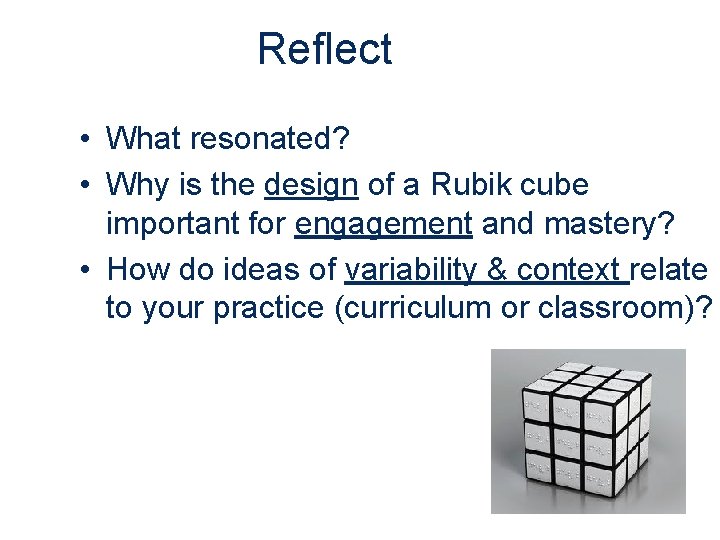
Reflect • What resonated? • Why is the design of a Rubik cube important for engagement and mastery? • How do ideas of variability & context relate to your practice (curriculum or classroom)?
Definition (HEOA) Universal Design for Learning (UDL) is a scientifically valid framework for guiding educational practice that: (a) provides flexibility in the way information is presented, in the ways students respond or demonstrate knowledge and skills, and in the ways students are engaged; and (b) reduces barriers in instruction, provides appropriate accommodations, supports, and challenges, and maintains high achievement expectations for all students, including students with disabilities and students who are limited English proficient. Higher Education Opportunity Act of 2008
Definition (CAST) Universal Design for Learning is a proactive design of curricula (educational goals, methods, materials, and assessments) that enable all individuals to gain knowledge, skills, and enthusiasm for learning. Center for Applied Special Technology (CAST)
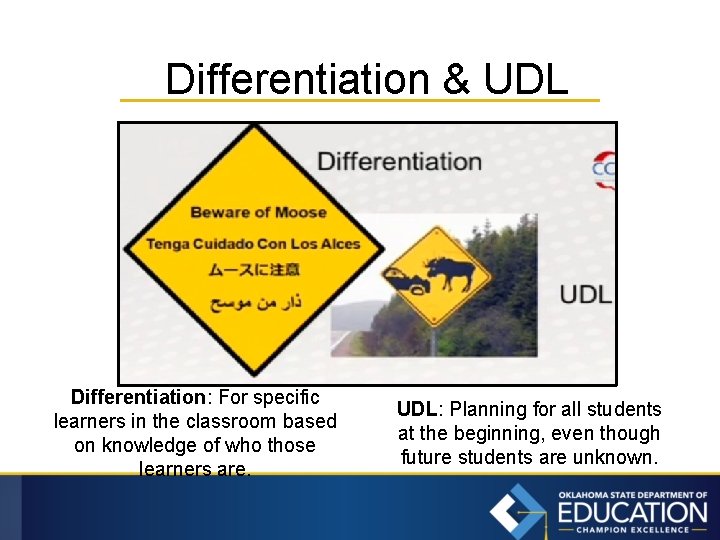
Differentiation & UDL Differentiation: For specific learners in the classroom based on knowledge of who those learners are. UDL: Planning for all students at the beginning, even though future students are unknown.

What is Universal Design for Learning? • Uses multiple delivery methods for instruction • Designing quality instruction from the onset of the lesson. • Providing multiple opportunities for students to learn, acquire and demonstrate understanding of the material presented. • Creating experiences for students regardless of disability to participate in the lesson through a variety of mediums.
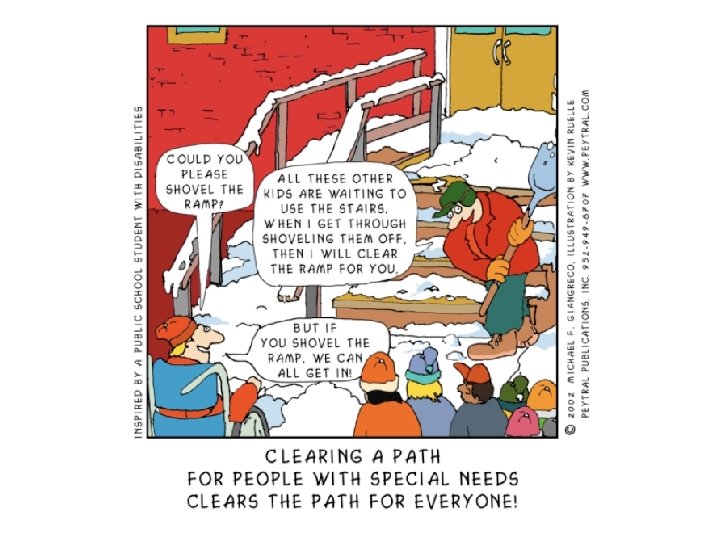
Why encourage UDL? • Benefit to all learners (ELL, gifted, special ed). • Healthy learning environment (respect). • Positive experiences conducive to learning. • Learners acquire skills in a medium of their strength/interest. • Lessons are designed with integrity from the onset. Long term benefit. Purposeful planning for all rather than consideration of a few for short term.

Brain Research Recognition Strategic What of learning How of learning See, hear, read Task performance Center for Applied Special Technology (CAST) Affective Why of learning Motivation to learn
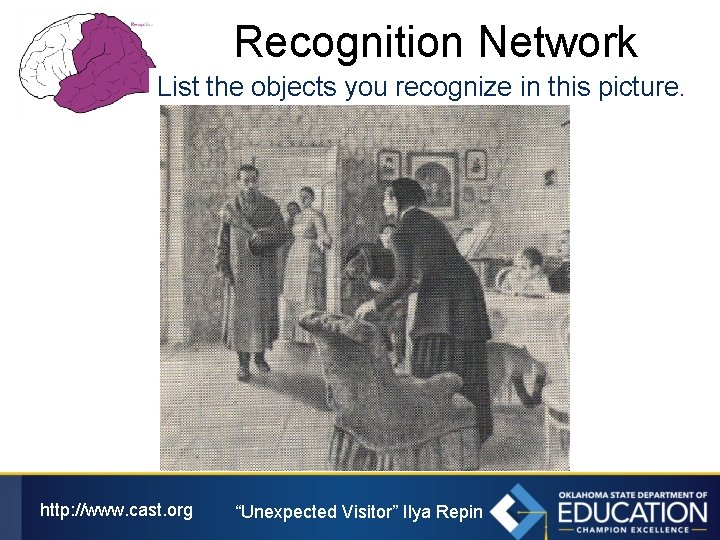
Recognition Network List the objects you recognize in this picture. http: //www. cast. org “Unexpected Visitor” Ilya Repin
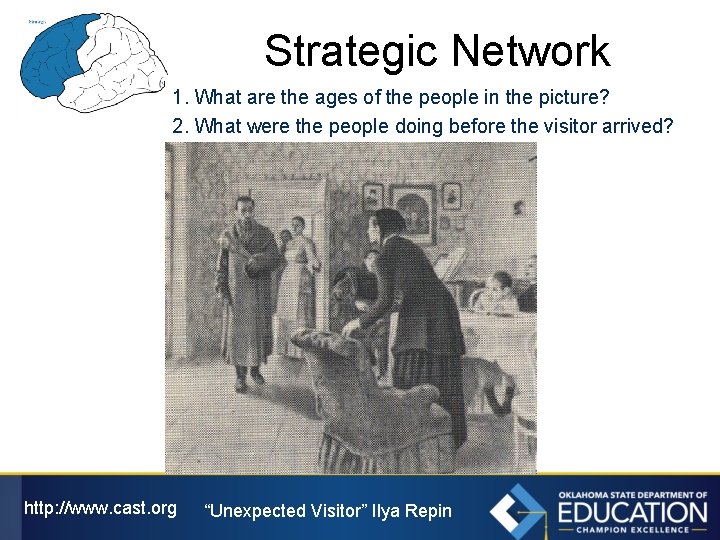
Strategic Network 1. What are the ages of the people in the picture? 2. What were the people doing before the visitor arrived? http: //www. cast. org “Unexpected Visitor” Ilya Repin
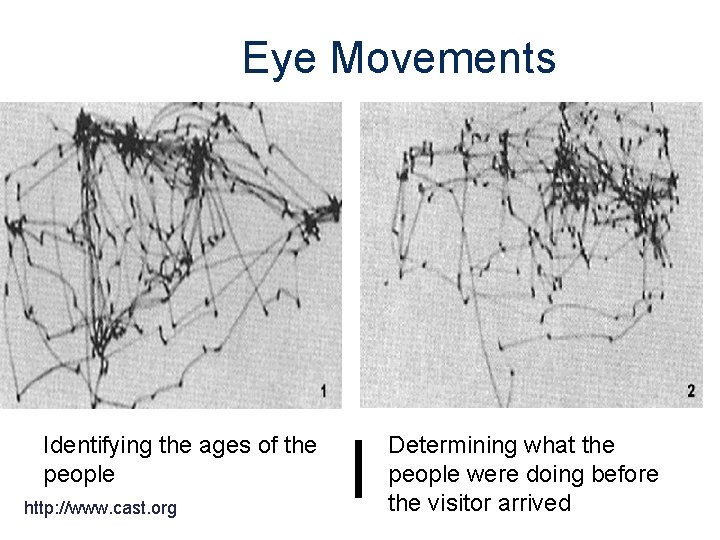
Eye Movements Identifying the ages of the people http: //www. cast. org l Determining what the people were doing before the visitor arrived
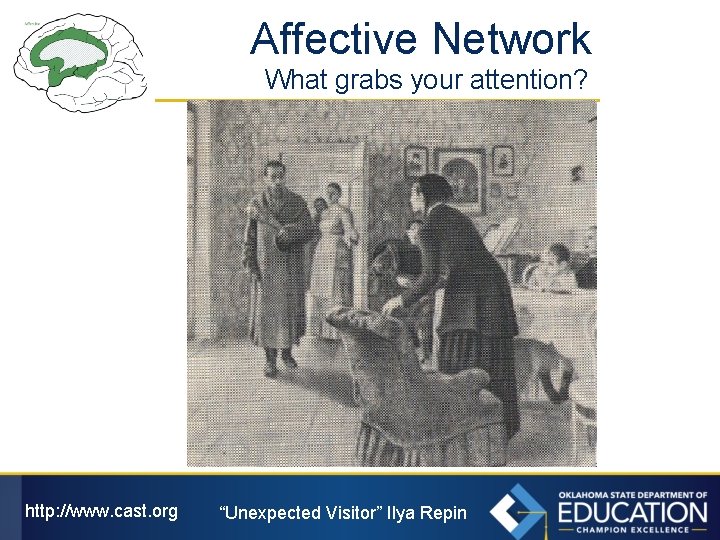
Affective Network What grabs your attention? http: //www. cast. org “Unexpected Visitor” Ilya Repin
Activity Summary • All three brain networks are working when you do something as simple as view an image. • Each network contributes something vital to the task. • This is true of everything we do and everything we learn.
Three Principles of UDL http: //www. udlcenter. org/resource_library/videos/udlcent er/guidelines#video 1 0: 00 -6: 22
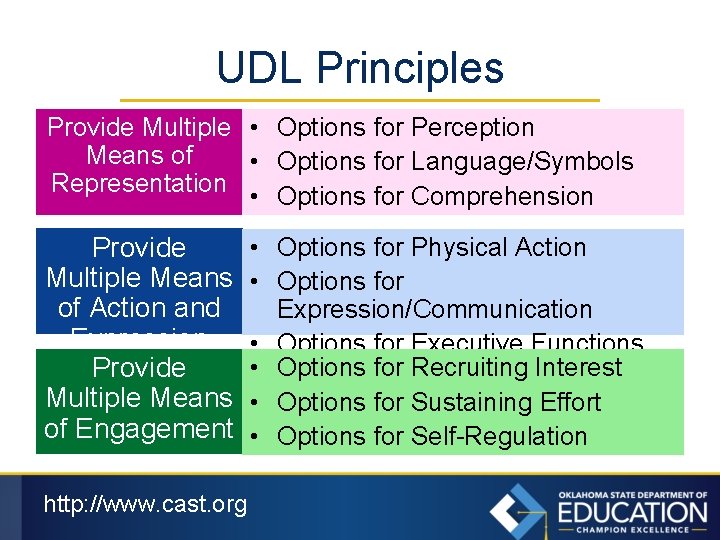
UDL Principles Provide Multiple • Options for Perception Means of • Options for Language/Symbols Representation • Options for Comprehension Provide Multiple Means of Action and Expression Provide Multiple Means of Engagement http: //www. cast. org • Options for Physical Action • Options for Expression/Communication • Options for Executive Functions • Options for Recruiting Interest • Options for Sustaining Effort • Options for Self-Regulation
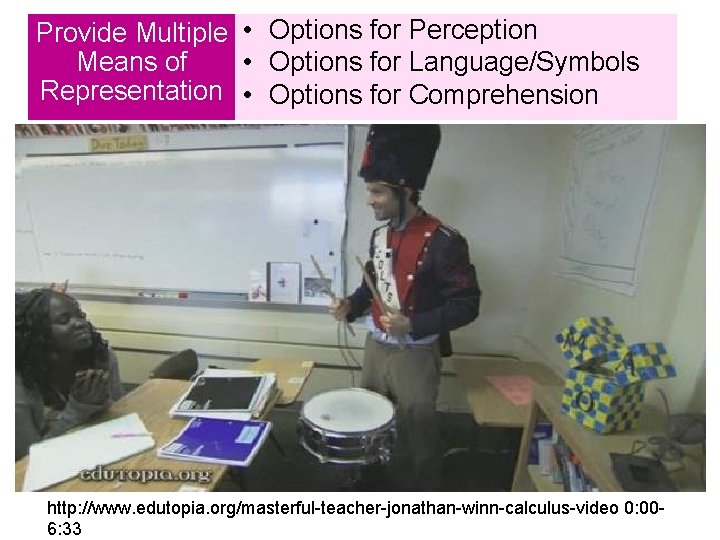
Provide Multiple • Options for Perception Means of • Options for Language/Symbols Representation • Options for Comprehension http: //www. edutopia. org/masterful-teacher-jonathan-winn-calculus-video 0: 006: 33
Provide Multiple • Options for Perception Means of • Options for Language/Symbols Representation • Options for Comprehension Representation Video 2 http: //udlseries. udlcenter. org/presentations/bach_to_gaga. html 21: 1125: 00
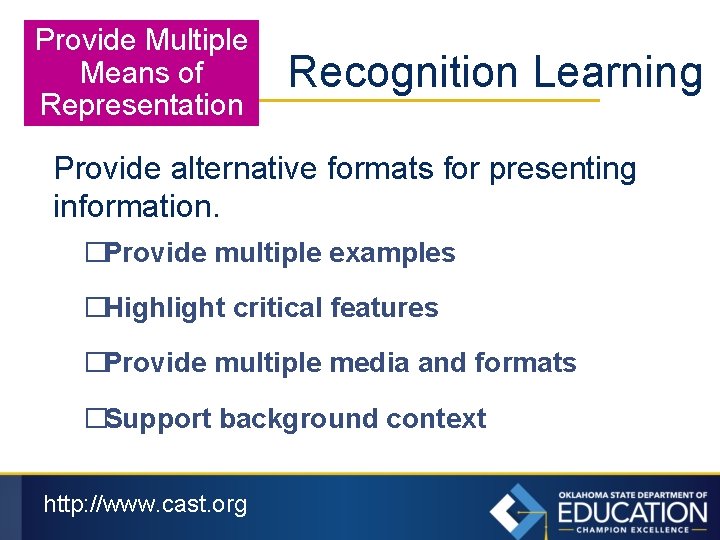
Provide Multiple Means of Representation Recognition Learning Provide alternative formats for presenting information. �Provide multiple examples �Highlight critical features �Provide multiple media and formats �Support background context http: //www. cast. org
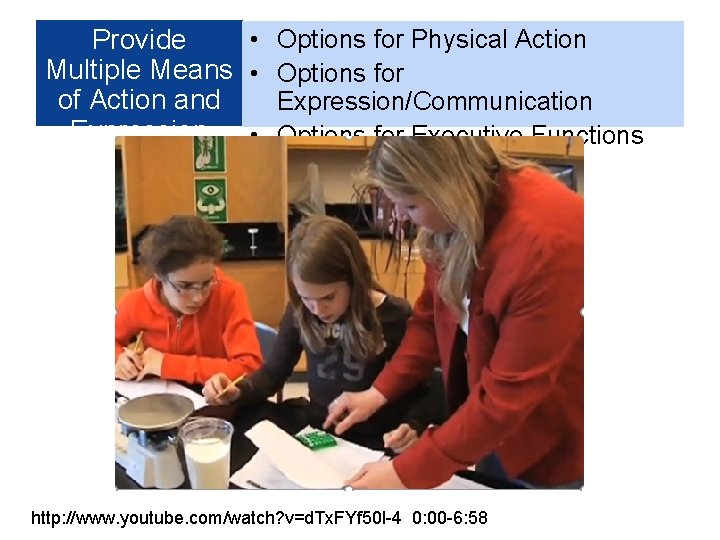
• Options for Physical Action Provide Multiple Means • Options for of Action and Expression/Communication Expression • Options for Executive Functions http: //www. youtube. com/watch? v=d. Tx. FYf 50 l-4 0: 00 -6: 58
Provide Multiple Means of Action and Expression Strategic Learning Provide alternative means for action and expression. �Provide flexible models of skilled performance �Provide opportunities to practice with supports �Provide ongoing, relevant feedback �Offer flexible opportunities for demonstrating skill
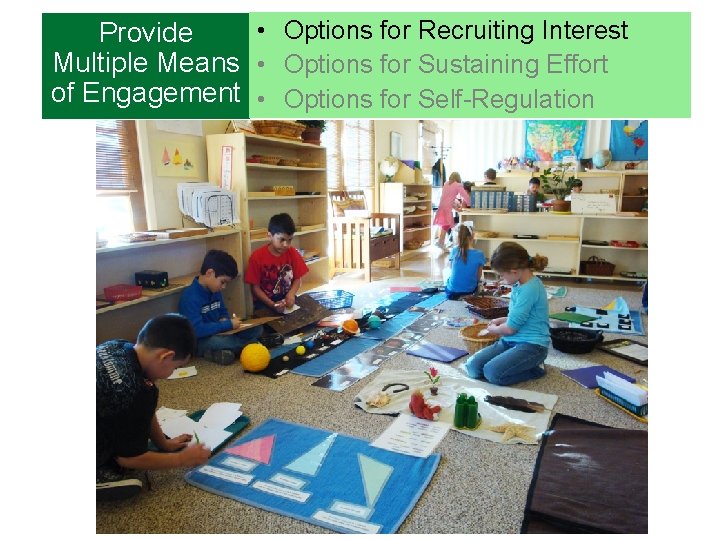
• Options for Recruiting Interest Provide Multiple Means • Options for Sustaining Effort of Engagement • Options for Self-Regulation
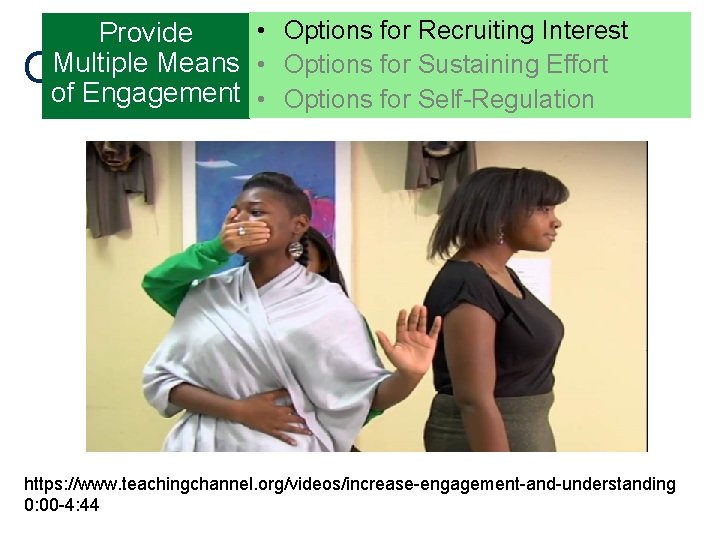
• Options for Recruiting Interest Provide Multiple Means • Options for Sustaining Effort Options for Engagement Video of Engagement • Options for Self-Regulation https: //www. teachingchannel. org/videos/increase-engagement-and-understanding 0: 00 -4: 44
Provide Multiple Means of Engagement Affective Learning Provide alternative means for engagement. �Offer choices of content and tools �Offer adjustable levels of challenge �Offer choices of rewards �Offer choices of learning context http: //www. cast. org
UDL Wrap Up • All 3 UDL principles are not intended to be incorporated into every lesson plan. Rather, they guide instruction over time. • Some students may need additional support to meet an individual needs. Accommodations are still appropriate (i. e. Braille text).
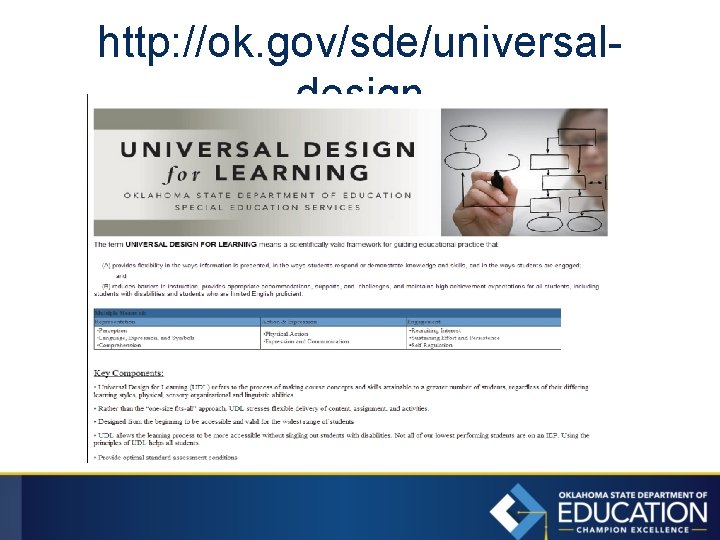
http: //ok. gov/sde/universaldesign
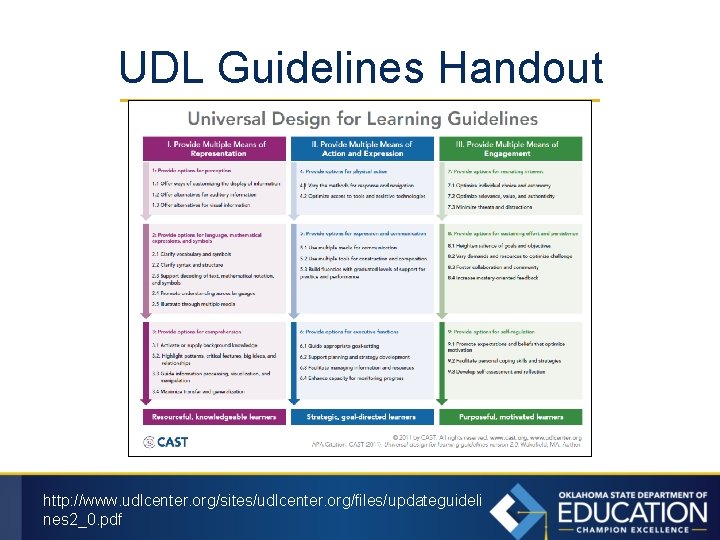
UDL Guidelines Handout http: //www. udlcenter. org/sites/udlcenter. org/files/updateguideli nes 2_0. pdf
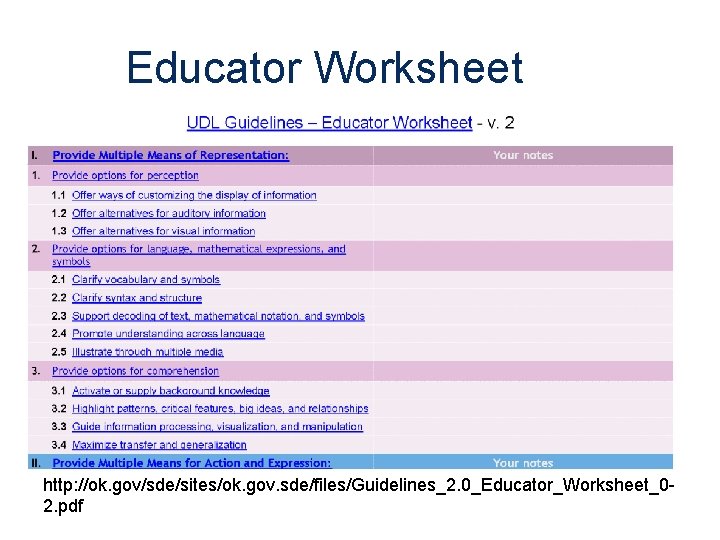
Educator Worksheet http: //ok. gov/sde/sites/ok. gov. sde/files/Guidelines_2. 0_Educator_Worksheet_02. pdf
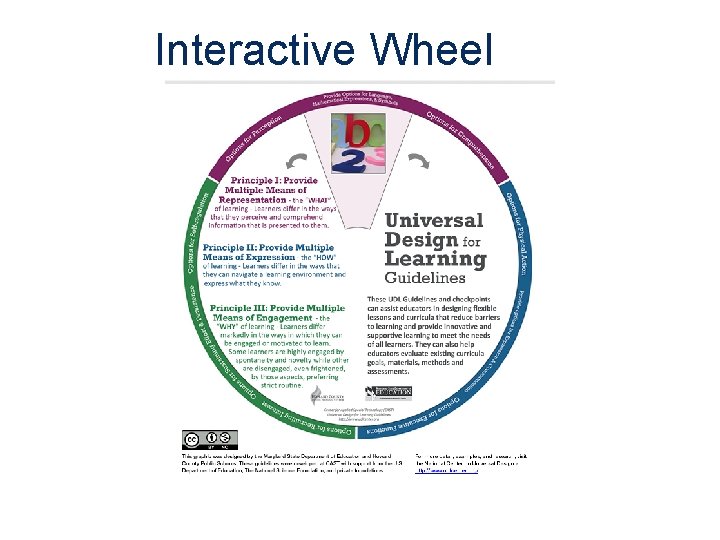
Interactive Wheel http: //udlwheel. mdonlinegrants. org /
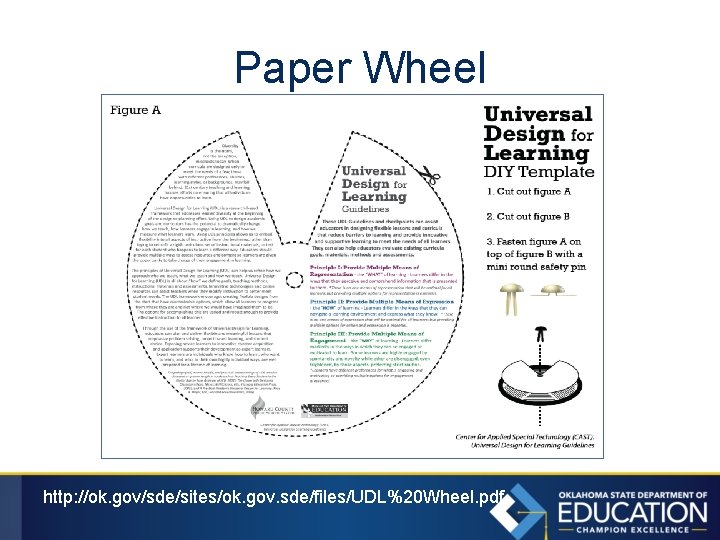
Paper Wheel http: //ok. gov/sde/sites/ok. gov. sde/files/UDL%20 Wheel. pdf
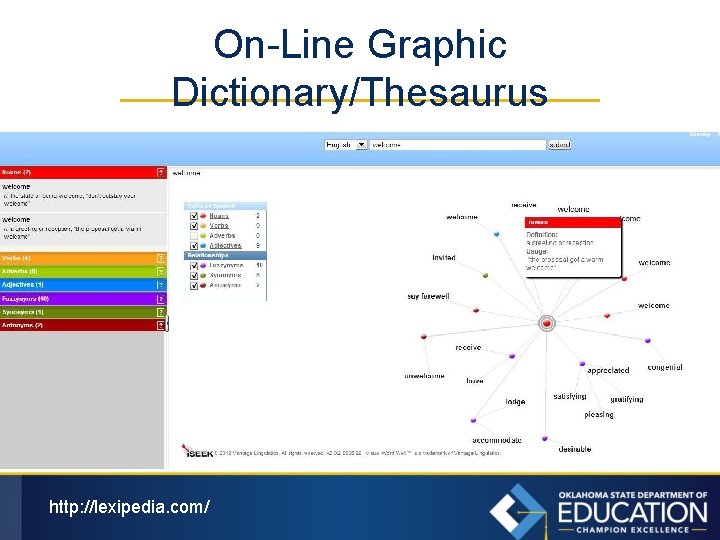
On-Line Graphic Dictionary/Thesaurus http: //lexipedia. com/
Questions/Comments
Contact Information Oklahoma State Department of Education Special Education Services 2500 N. Lincoln Blvd. Oklahoma City, OK 73105 405 -521 -3351
- Slides: 39