Deep Dive Arizona v United States 2012 and

- Slides: 32
Deep Dive Arizona v. United States (2012) and the Federal power over immigration
The Non-Delegation Doctrine Issue. The delegation of legislative authority from Congress to the Executive • Separation of Powers
The Non-Delegation Doctrine FIRST PHASE … Recognition of the non-delegation doctrine Schechter v. United States (1935) • National Industrial Recovery Act – “Instead of prescribing rules of conduct, [the Act] authorizes the making of codes to proscribe rules of conduct” • Congress cannot delegate legislative power to the President to be exercised in unfettered discretion • e. g. , making whatever laws he thinks may be needed or advisable. Panama Refining v. Ryan (1935) • National Industrial Recovery Act – “did not declare in what circumstances transportation of [excess petroleum] should be forbidden, or require the President to make any determination as to any facts or circumstances” • Struck down the delegation of law-making authority with essentially no standard or rule to guide the President in the exercise of that authority. NOTE. Neither Schechter nor Panama Refining has been expressly overruled, but they haven’t necessarily been followed either—even when Congress arguably fails to provide any real criteria.
The Non-Delegation Doctrine SECOND PHASE … The end of the non-delegation doctrine (1) It does not violate separation-of-powers principles for Congress to lay down ground rules (guidance) and for Executive agencies to exercise judgment in implementation. Yakus v. United States (1944) • “The essentials of the legislative function are … [a] the determination of the legislative policy and [b] its formulation and promulgation as a defined and binding rule of conduct. • These essentials are preserved when Congress has specified the basic conditions of fact upon whose existence or occurrence, ascertained from relevant data by a designated administrative agency, [to be considered in effectuating the statute]. • It is no objection that the determination of facts and the inferences to be drawn from them in the light of the statutory standards and declaration of policy call for the exercise of judgment, and for the formulation of subsidiary administrative policy within the prescribed statutory framework. ”
The Non-Delegation Doctrine (2) In providing Executive agencies with adequate guidance, Congress must provide an intelligible principle for the promulgation of regulations and their application. Whitman v. American Trucking Association (2001) • Rule. When does the delegation of authority rise to the level of legislative authority? • “When Congress confers decision-making authority upon agencies Congress must lay down by legislative act an intelligible principle to which the person or body authorized to act is directed to conform” • Deference to Congress. “we have almost never felt qualified to second-guess Congress regarding the permissible degree of policy judgment that can be left to those executing or applying the law” • Application. The statute instructs the EPA to set national ambient air quality standards for identified air pollutants … "the attainment and maintenance of which. . . are requisite to protect the public health" within "an adequate margin of safety. ” • Statutes need not provide a determinate criterion for saying how much of a regulated harm is too much to avoid delegating legislative power. • This statute provides an intelligible principle that is well within the outer limits of the Court's non-delegation precedents.
The Non-Delegation Doctrine (3) Assuming that Congress has provided an intelligible principle, an Executive agency’s construction of the statute is afforded considerable weight (deference). Chevron U. S. A. v. Natural Resources Defense Council (1984) United States v. Mead Corp. (2001) • Express Delegation. The agency’s interpretations of its governing statute are valid “unless they are procedurally arbitrary, capricious, or manifestly contrary to the statute. ” • Implicit Delegation. The agency’s interpretation is valid if “reasonable. ”
The Non-Delegation Doctrine Application: Clinton v. New York (1998) • Statute. Line-item veto. • A grant of power from Congress to the executive, permitting the President to nullify specific provisions of a budget bill without vetoing the entire bill. • The President may cancel three types of provisions: 1. Any dollar amount of discretionary budget authority 2. Any item of new direct spending 3. Any limited tax benefit • Process 1. Presidentifies items for cancellation. 2. President determines that cancelling these items will (a) reduce the federal budget deficit, (b) not impair any essential government functions, and (c) not harm the national interest. 3. President transmits a special message to Congress within five days of enactment, giving them notice of each cancellation. 4. Congress is given an opportunity to pass a disapproval bill, via expedited procedure, nullifying the cancellation. • Requires 50%+ • Can be vetoed • Veto can be overridden
The Non-Delegation Doctrine Application: Clinton v. New York (1998) • Application. A separation-of-powers problem. • The legal and practical effect of the line item veto is to amend an act of Congress, and the Constitution does not authorize the President to amend legislation. • Congress has the authority to legislate. • The President has the power (a) to veto legislation or (b) to apply and enforce legislation. • The President may not legislate (by amending legislation via line-item veto). • The only way to get a line-item is by Constitutional Amendment
The Non-Delegation Doctrine NEW Supreme Court case … Gundy v. United States • The Sex Offender Registration and Notification Act (SORNA) requires that convicted sex offenders must register with every jurisdiction in which he resides, works or studies, as well as in the jurisdiction in which he was convicted. • SORNA also makes it a crime for a convicted sex offender subject to the registration requirement to fail to register or to keep his registration information updated if he travels across state lines. • Issue (1). May SORNA be applied retroactively, to sex offenders convicted before the statute’s enactment? • SORNA did not specify whether pre-SORNA offenders were required to register. • Instead, SORNA authorized the Attorney General of the United States to … • “specify the applicability” of SORNA’s registration requirement to “sex offenders convicted before” the date of SORNA’s enactment, and • “to prescribe rules for the registration of any such sex offenders and for other categories of sex offenders who are unable to comply” with the registration requirement. • The A. G. issued a rule making SORNA applicable to pre-SORNA offenders
The Non-Delegation Doctrine Gundy v. United States (con’t …) • Question Presented. “Whether SORNA’s delegation of authority to the Attorney General to issue regulations under [the statute] violates the non-delegation doctrine. ” • Gundy’s Arguments. • SORNA’s delegation to the Attorney General violates a core principle of separation of powers: That only Congress can legislate. • The A. G. ’s rules are “quintessentially legislative” • The A. G. is “prescribing rules, backed by criminal sanctions, governing the conduct of roughly half a million people. ” • Argument 1. Bring back the tougher non-delegation doctrine—and it fails. • Argument 2. Even under the modern “intelligible principle” standard, it fails. • The A. G. (the nation’s top prosecutor) is given “unguided discretion” to subject hundreds of thousands of individuals to SORNA’s provisions. • BIG PICTURE. The A. G. ’s rule could subject hundreds of thousands of pre-SORNA offenders to criminal liability, including many who have no idea that they are required to register.
The Non-Delegation Doctrine Gundy v. United States (con’t …) • The Government’s Arguments. • Argument 1. If criminal, ok to delegate. • The court has continually upheld congressional power to delegate, including in cases in which the delegation authorized the executive to trigger criminal sanctions for private conduct. • Argument 2. Not criminal, so ok to delegate. • The A. G. ’s rule creates a new civil registration regime, not a new crime. • Argument 3. The statute supplies sufficient guidance. • SORNA sets forth the “general policy” for the attorney general to pursue. • Establishing a “comprehensive national system” • And “protecting the public” • BIG PICTURE. Since SORNA was enacted, 4, 000 sex offenders have been convicted of federal sex-offender registry violations. Many of these (pre-SORNA violators) would go free if the court were to invalidate the delegation.
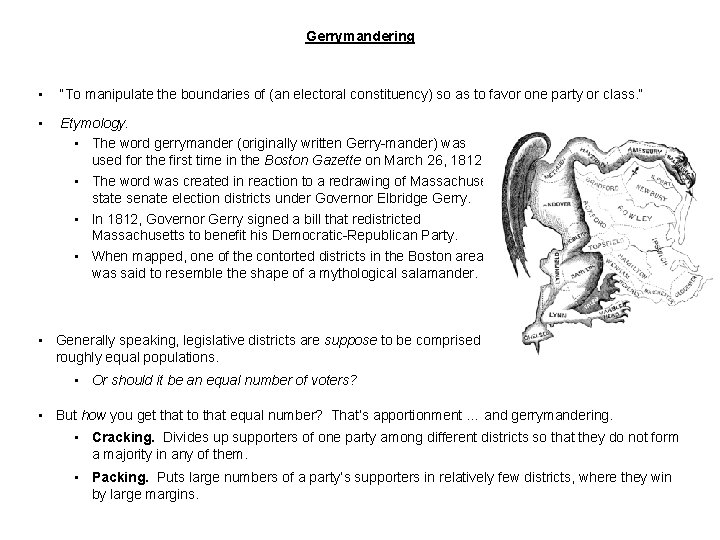
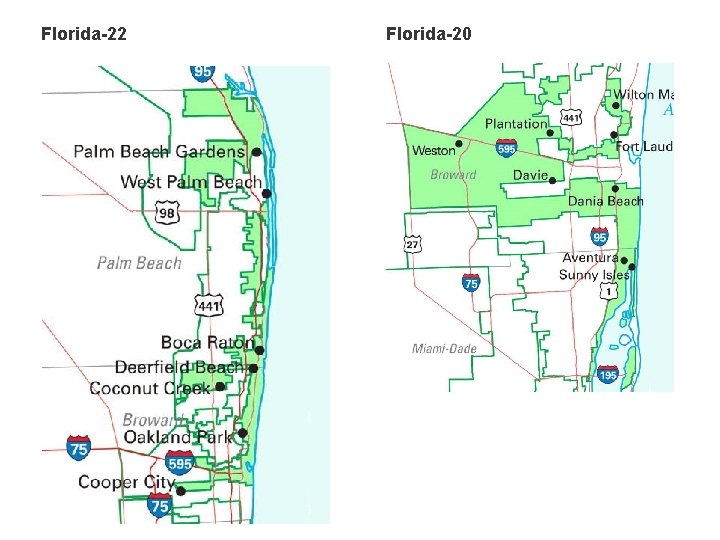
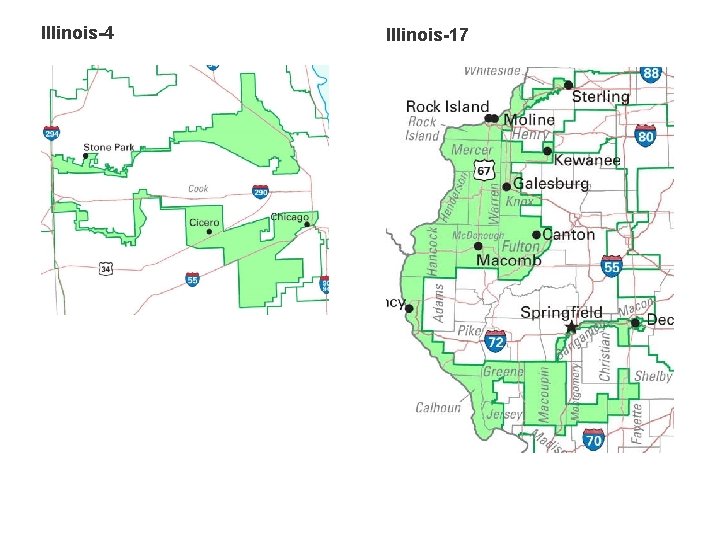
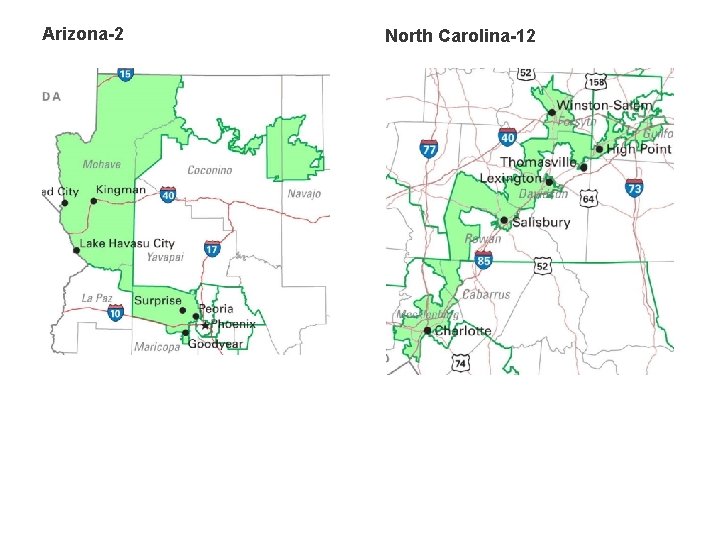
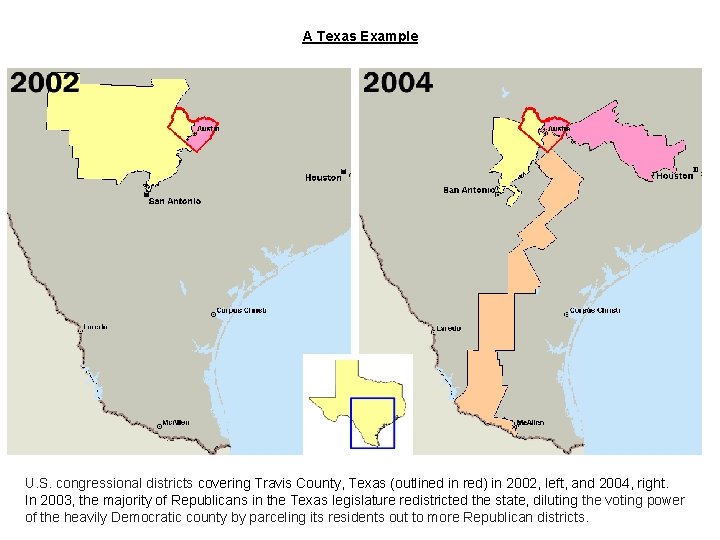
Gerrymandering • “To manipulate the boundaries of (an electoral constituency) so as to favor one party or class. ” • Etymology. • The word gerrymander (originally written Gerry-mander) was used for the first time in the Boston Gazette on March 26, 1812. • The word was created in reaction to a redrawing of Massachusetts state senate election districts under Governor Elbridge Gerry. • In 1812, Governor Gerry signed a bill that redistricted Massachusetts to benefit his Democratic-Republican Party. • When mapped, one of the contorted districts in the Boston area was said to resemble the shape of a mythological salamander. • Generally speaking, legislative districts are suppose to be comprised of roughly equal populations. • Or should it be an equal number of voters? • But how you get that to that equal number? That’s apportionment … and gerrymandering. • Cracking. Divides up supporters of one party among different districts so that they do not form a majority in any of them. • Packing. Puts large numbers of a party’s supporters in relatively few districts, where they win by large margins.
Florida-22 Florida-20
Illinois-4 Illinois-17
Arizona-2 North Carolina-12
A Texas Example U. S. congressional districts covering Travis County, Texas (outlined in red) in 2002, left, and 2004, right. In 2003, the majority of Republicans in the Texas legislature redistricted the state, diluting the voting power of the heavily Democratic county by parceling its residents out to more Republican districts.
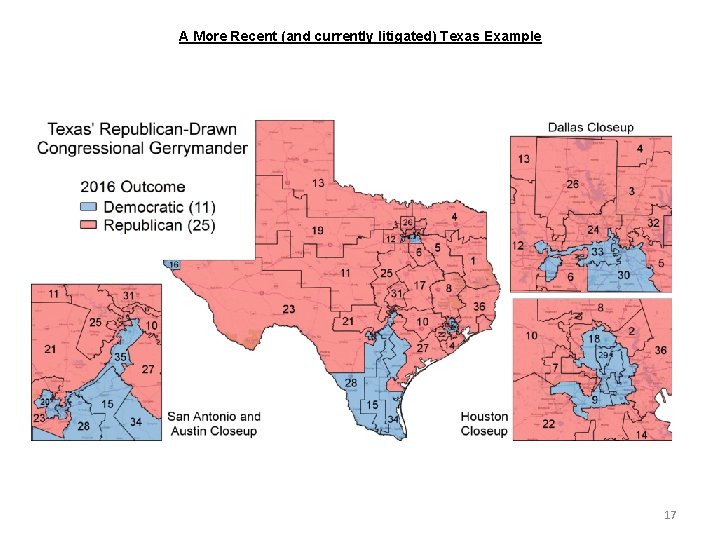
A More Recent (and currently litigated) Texas Example 17
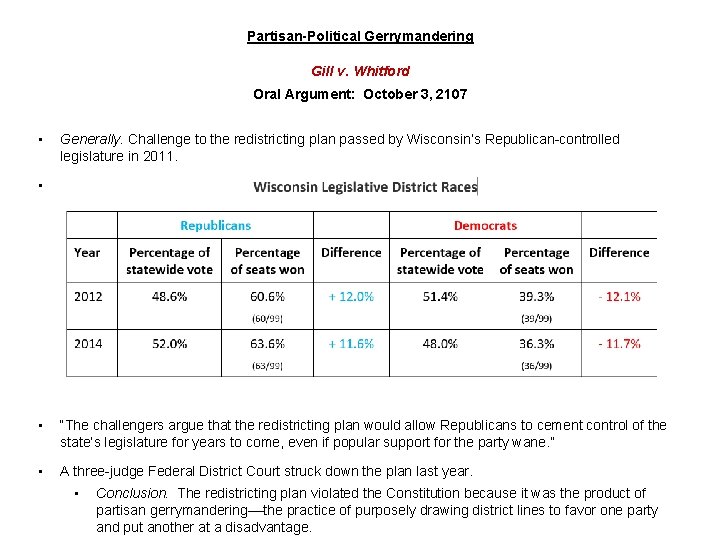
Partisan-Political Gerrymandering Gill v. Whitford Oral Argument: October 3, 2107 • Generally. Challenge to the redistricting plan passed by Wisconsin’s Republican-controlled legislature in 2011. • Effect. • “The challengers argue that the redistricting plan would allow Republicans to cement control of the state’s legislature for years to come, even if popular support for the party wane. ” • A three-judge Federal District Court struck down the plan last year. • Conclusion. The redistricting plan violated the Constitution because it was the product of partisan gerrymandering––the practice of purposely drawing district lines to favor one party and put another at a disadvantage.
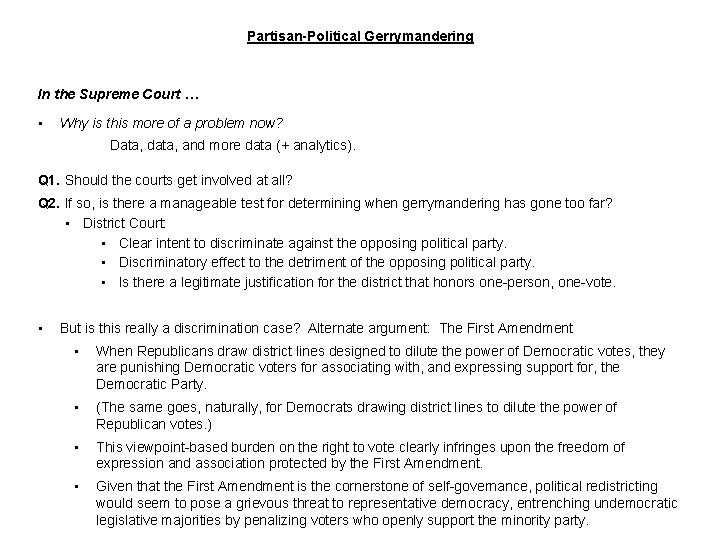
Partisan-Political Gerrymandering In the Supreme Court … • Why is this more of a problem now? Data, data, and more data (+ analytics). Q 1. Should the courts get involved at all? Q 2. If so, is there a manageable test for determining when gerrymandering has gone too far? • District Court: • Clear intent to discriminate against the opposing political party. • Discriminatory effect to the detriment of the opposing political party. • Is there a legitimate justification for the district that honors one-person, one-vote. • But is this really a discrimination case? Alternate argument: The First Amendment • When Republicans draw district lines designed to dilute the power of Democratic votes, they are punishing Democratic voters for associating with, and expressing support for, the Democratic Party. • (The same goes, naturally, for Democrats drawing district lines to dilute the power of Republican votes. ) • This viewpoint-based burden on the right to vote clearly infringes upon the freedom of expression and association protected by the First Amendment. • Given that the First Amendment is the cornerstone of self-governance, political redistricting would seem to pose a grievous threat to representative democracy, entrenching undemocratic legislative majorities by penalizing voters who openly support the minority party.
Wedding Cakes Masterpiece Cakeshop, Ltd. v. Colorado Civil Rights Commission Oral Argument: December 5, 2107 Non-Discrimination Statutes and the First Amendment • Colorado’s anti-discrimination law bars places of public accommodation (businesses that sell to the public) from discriminating based on, among other things, sexual orientation. • “In 2012, Charlie Craig and David Mullins went to Masterpiece Cakeshop, a Denver-area bakery, to order a cake to celebrate their upcoming wedding. But the couple left empty-handed … and upset. Masterpiece’s owner, Jack Phillips, is a Christian who closes his business on Sundays and refuses to design custom cakes that conflict with his religious beliefs – for example, cakes that contain alcohol, have Halloween themes or celebrate a divorce. And because Phillips also believes that marriage should be limited to opposite-sex couples, he told Craig and Mullins that he would not design a custom cake for their same-sex wedding celebration. ” (Scotus. Blog) • There is no question that Colorado has the power to enact the anti-discrimination statute. • The only questions are whether that law is trumped by Phillips’ First Amendment rights of (1) free exercise of religion or (2) free expression. Continued …
Wedding Cakes Starting Point. Employment Division v. Smith • The free exercise clause of the First Amendment is not violated by generally applicable laws not specifically directed at religion even if those laws substantially burden the ability of people to exercise their religion. • Free Exercise • The freedom to live out one’s religious identity in the public square. • Free Expression • The expressive freedom of all who create art or other speech for a living. • An interesting twist. The government’s argument in favor of Phillips … • “The federal government argues that public-accommodations laws like Colorado’s will generally pass constitutional muster, because they normally only regulate discrimination in providing goods and services – conduct that is not protected by the First Amendment – rather than expression. For example, the government says, when wedding vendors rent out a banquet hall or a limousine, that is not a form of expression. And even if the vendors believed that they were expressing a message about marriage by renting out a venue or providing a chauffeured vehicle, others would not necessarily agree, nor would they necessarily pick up on that message. ” (Scotus. Blog)
Preemption: Introduction Supremacy Clause Article VI, Clause 2 This Constitution, and the Laws of the United States which shall be made in Pursuance thereof; and all Treaties made, or which shall be made, under the Authority of the United States, shall be the supreme Law of the Land…. Two Conditions for Preemption A state law is preempted by federal law when: 1. The federal government has exercised its power to regulate, and 2. There is either a (a) conflict or (b) potential conflict, between the federal law and the state law. Types of preemption 1. Express (statutory) Preemption 2. Implied Preemption a. Conflict Preemption i. Physical impossibility or Mutual Exclusivity ii. Impeding a Federal Objective b. Field Preemption
Preemption: Analytical Framework 1. Express Preemption: Focusing on the existence and scope of express preemptive statutory language • Essentially an exercise in statutory interpretation. • When Congress is legislating in an area traditionally regulated by the state, such as police powers, preemption provisions are to be narrowly construed. • In all cases, interpretation is guided by congressional intent. 2. Implied Preemption: Focusing on evidence of an implicit but clear congressional intent to preempt. a. Conflict Preemption i. Physical Impossibility or Mutual Exclusivity: Compliance with both federal and state regulation is a physical impossibility. • Are the laws actually in conflict? • Is the federal standard merely a floor, or is it meant as a uniform standard? ii. Impeding a Federal Objective (“obstacle to … the full purposes and objectives of Congress) • What is the federal objective? • At what point does state regulation unduly interfere with achieving the federal objective? b. Field Preemption: Clear congressional intent to have federal law occupy a particular area of law, as evidenced by a scheme of federal regulation that is so pervasive as to make a reasonable inference that Congress left no room for the states to supplement it. • Factors to Consider 1. Is it an area of regulation where the federal gov’t has traditionally played a unique role? 2. Has Congress expressed its intent, in the text or the legislative history, to have a federal law be exclusive in the area? 3. Would allowing state or local law to regulate in this area risk interfering with comprehensive federal regulatory efforts? 4. Is there an important traditional state or local interest served by the law be challenged?
Arizona v. United States (2012) Starting Point: STATE laws at issue • The State’s interest in immigration policy and enforcement • “Arizona bears many of the consequences of unlawful immigration. ” • State statutes at issue … • Substantive Offenses. Two create new state offenses. • Section 3 makes failure to comply with federal alien-registration requirements a state misdemeanor. • Section 5(C) … makes it a misdemeanor for an unauthorized alien to seek or engage in work in the State… • Authority to Arrest and Investigate. Two other provisions give specific arrest authority and investigative duties with respect to certain aliens to state and local law enforcement officers. • Section 6 authorizes officers to arrest without a warrant a person ‘the officer has probable cause to believe. . . has committed any public offense that makes the person removable from the United States. ’ • Section 2(B) provides that officers who conduct a stop, detention, or arrest must in some circumstances make efforts to verify the person’s immigration status with the Federal Government. ” • Issue. “The issue is whether, under preemption principles, federal law permits Arizona to implement the state-law provisions in dispute. ”
Arizona v. United States (2012) Starting Point: Sources of FEDERAL power over immigration • Federal authority is broad and well-established. • “The Government of the United States has broad, undoubted power over the subject of immigration and the status of aliens. ” • “The federal power to determine immigration policy is well settled. ” • Sources of federal authority over immigration. • “This authority rests, in part, on [1] the National Government’s constitutional power to ‘establish an uniform Rule of Naturalization, ’ and [2] its inherent power as sovereign to control and conduct relations with foreign nations…. • More on [2] the relationship of immigration and foreign relations. • Immigration policy can affect trade, investment, tourism, and diplomatic relations for the entire Nation, as well as the perceptions and expectations of aliens in this country who seek the full protection of its laws. • Perceived mistreatment of aliens in the United States may lead to harmful reciprocal treatment of American citizens abroad. • It is fundamental that foreign countries concerned about the status, safety, and security of their nationals in the United States must be able to confer and communicate on this subject with one national sovereign, not the 50 separate States. • This Court has reaffirmed that ‘one of the most important and delicate of all international relationships. . . has to do with the protection of the just rights of a country’s own nationals when those nationals are in another country. ’”
Arizona v. United States (2012) Starting Point: FEDERAL power over immigration is pervasive • “Federal governance of immigration and alien status is extensive and complex. • “Congress has specified categories of aliens who may not be admitted to the United States. Unlawful entry and unlawful reentry into the country are federal offenses. • Congress has specified which aliens may be removed from the United States and the procedures for doing so. ” • Once here, aliens are required to register with the Federal Government and to carry proof of status on their person. Failure to do so is a federal misdemeanor. • [Federal Law] imposes sanctions on employers who hire unauthorized workers. • Federal law also authorizes States to deny noncitizens a range of public benefits…. • “Aliens may be removed if they were inadmissible at the time of entry, have been convicted of certain crimes, or meet other criteria set by federal law. • Removal is a civil, not criminal, matter. • A principal feature of the removal system is the broad discretion exercised by immigration officials. • Federal officials, as an initial matter, must decide whether it makes sense to pursue removal at all. • If removal proceedings commence, aliens may seek asylum and other discretionary relief allowing them to remain in the country or at least to leave without formal removal. ” • Importance of discretion in the application of immigration law, regulation, and policy … • “The equities of an individual case may turn on many factors… • Some discretionary decisions involve policy choices that bear on this Nation’s international relations. • The dynamic nature of relations with other countries requires the Executive Branch to ensure that enforcement policies are consistent with this Nation’s foreign policy with respect to these and other realities. ”
Arizona v. United States (2012) Starting Point: FEDERAL immigration enforcement power • Customs and Border Protection (CPB) • Immigration and Customs Enforcement (ICE) • Law Enforcement Support Center (LESC)
Arizona v. United States (2012) Application (provision-by-provision) • Section 3. Failure to complete or carry an alien registration document. • Effect. Imposes an additional state penalty for a federal violation. • Challenge. Field preemption. Clear congressional intent to have federal law occupy a particular area of law, as evidenced by a scheme of federal regulation that is so pervasive as to make a reasonable inference that Congress left no room for the states to supplement it. • Rules and precedent re: registration and documentation. • “In 1940… Congress added to federal immigration law a ‘complete system for alien registration…. In Davidowitz (1941), the Court found that Congress intended the federal plan for registration to be a ‘single integrated and all-embracing system. ’ Because this ‘complete scheme. . . for the registration of aliens’ touched on foreign relations, it did not allow the States to ‘curtail or complement’ federal law or to ‘enforce additional or auxiliary regulations. ’” • “The framework enacted by Congress leads to the conclusion here, as it did in Hines, that the Federal Government has occupied the field of alien registration. ” • Effect of field preemption. • “Where Congress occupies an entire field, as it has in the field of alien registration, even complementary state regulation is impermissible. Field preemption reflects a congressional decision to foreclose any state regulation in the area, even if it is parallel to federal standards. ” • “Even if a State may make violation of federal law a crime in some instances, it cannot do so in a field (like the field of alien registration) that has been occupied by federal law. ” • Application to the Arizona statute. • “The state framework of sanctions creates a conflict with the plan Congress put in place. ” • “If § 3 of the Arizona statute were valid, every State could give itself independent authority to prosecute federal registration violations, ‘diminishing the Federal Government’s control over enforcement’ and ‘detracting from the ‘integrated scheme of regulation’ created by
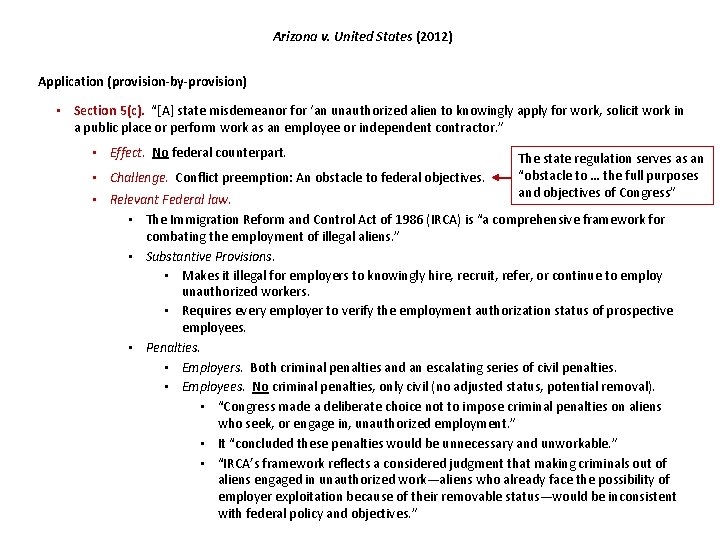
Arizona v. United States (2012) Application (provision-by-provision) • Section 5(c). “[A] state misdemeanor for ‘an unauthorized alien to knowingly apply for work, solicit work in a public place or perform work as an employee or independent contractor. ” • Effect. No federal counterpart. • Challenge. Conflict preemption: An obstacle to federal objectives. The state regulation serves as an “obstacle to … the full purposes and objectives of Congress” • Relevant Federal law. • The Immigration Reform and Control Act of 1986 (IRCA) is “a comprehensive framework for combating the employment of illegal aliens. ” • Substantive Provisions. • Makes it illegal for employers to knowingly hire, recruit, refer, or continue to employ unauthorized workers. • Requires every employer to verify the employment authorization status of prospective employees. • Penalties. • Employers. Both criminal penalties and an escalating series of civil penalties. • Employees. No criminal penalties, only civil (no adjusted status, potential removal). • “Congress made a deliberate choice not to impose criminal penalties on aliens who seek, or engage in, unauthorized employment. ” • It “concluded these penalties would be unnecessary and unworkable. ” • “IRCA’s framework reflects a considered judgment that making criminals out of aliens engaged in unauthorized work—aliens who already face the possibility of employer exploitation because of their removable status—would be inconsistent with federal policy and objectives. ”
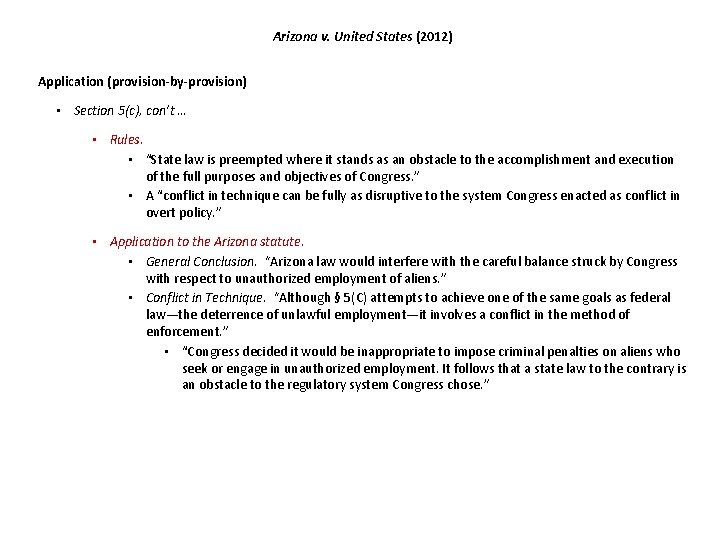
Arizona v. United States (2012) Application (provision-by-provision) • Section 5(c), con’t … • Rules. • “State law is preempted where it stands as an obstacle to the accomplishment and execution of the full purposes and objectives of Congress. ” • A “conflict in technique can be fully as disruptive to the system Congress enacted as conflict in overt policy. ” • Application to the Arizona statute. • General Conclusion. “Arizona law would interfere with the careful balance struck by Congress with respect to unauthorized employment of aliens. ” • Conflict in Technique. “Although § 5(C) attempts to achieve one of the same goals as federal law—the deterrence of unlawful employment—it involves a conflict in the method of enforcement. ” • “Congress decided it would be inappropriate to impose criminal penalties on aliens who seek or engage in unauthorized employment. It follows that a state law to the contrary is an obstacle to the regulatory system Congress chose. ”
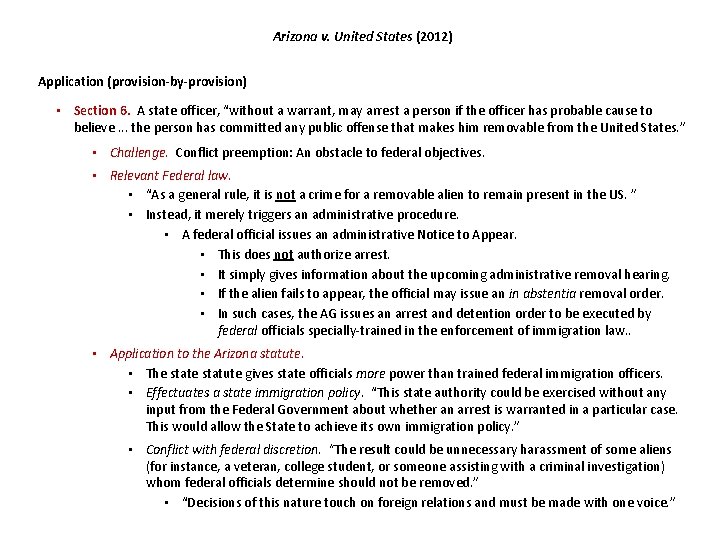
Arizona v. United States (2012) Application (provision-by-provision) • Section 6. A state officer, “without a warrant, may arrest a person if the officer has probable cause to believe. . . the person has committed any public offense that makes him removable from the United States. ” • Challenge. Conflict preemption: An obstacle to federal objectives. • Relevant Federal law. • “As a general rule, it is not a crime for a removable alien to remain present in the US. ” • Instead, it merely triggers an administrative procedure. • A federal official issues an administrative Notice to Appear. • This does not authorize arrest. • It simply gives information about the upcoming administrative removal hearing. • If the alien fails to appear, the official may issue an in abstentia removal order. • In such cases, the AG issues an arrest and detention order to be executed by federal officials specially-trained in the enforcement of immigration law. . • Application to the Arizona statute. • The statute gives state officials more power than trained federal immigration officers. • Effectuates a state immigration policy. “This state authority could be exercised without any input from the Federal Government about whether an arrest is warranted in a particular case. This would allow the State to achieve its own immigration policy. ” • Conflict with federal discretion. “The result could be unnecessary harassment of some aliens (for instance, a veteran, college student, or someone assisting with a criminal investigation) whom federal officials determine should not be removed. ” • “Decisions of this nature touch on foreign relations and must be made with one voice. ”
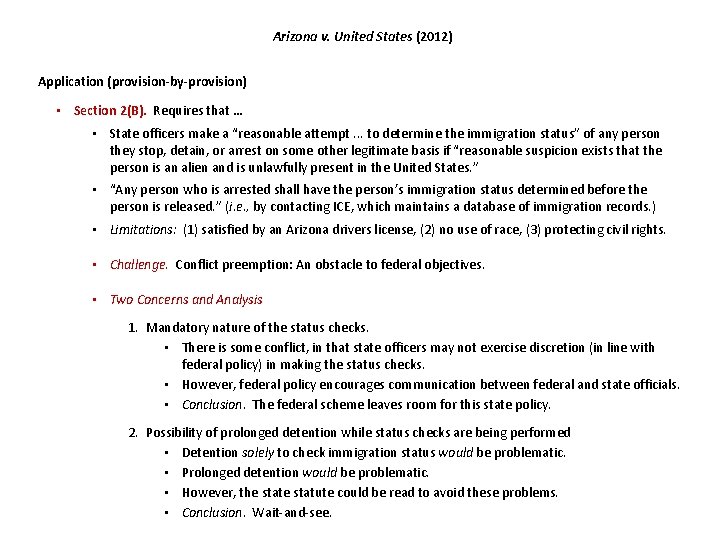
Arizona v. United States (2012) Application (provision-by-provision) • Section 2(B). Requires that … • State officers make a “reasonable attempt. . . to determine the immigration status” of any person they stop, detain, or arrest on some other legitimate basis if “reasonable suspicion exists that the person is an alien and is unlawfully present in the United States. ” • “Any person who is arrested shall have the person’s immigration status determined before the person is released. ” (i. e. , by contacting ICE, which maintains a database of immigration records. ) • Limitations: (1) satisfied by an Arizona drivers license, (2) no use of race, (3) protecting civil rights. • Challenge. Conflict preemption: An obstacle to federal objectives. • Two Concerns and Analysis 1. Mandatory nature of the status checks. • There is some conflict, in that state officers may not exercise discretion (in line with federal policy) in making the status checks. • However, federal policy encourages communication between federal and state officials. • Conclusion. The federal scheme leaves room for this state policy. 2. Possibility of prolonged detention while status checks are being performed • Detention solely to check immigration status would be problematic. • Prolonged detention would be problematic. • However, the statute could be read to avoid these problems. • Conclusion. Wait-and-see.