Dark Energy and Modified Gravity Shinji Tsujikawa Gunma
- Slides: 26
Dark Energy and Modified Gravity Shinji Tsujikawa (Gunma National College of Technology) Collaborations with L. Amendola, S. Capozziello, R. Gannouji, S. Mizuno, D. Polarski, R. Tavakol, K. Uddin, J. Yokoyama
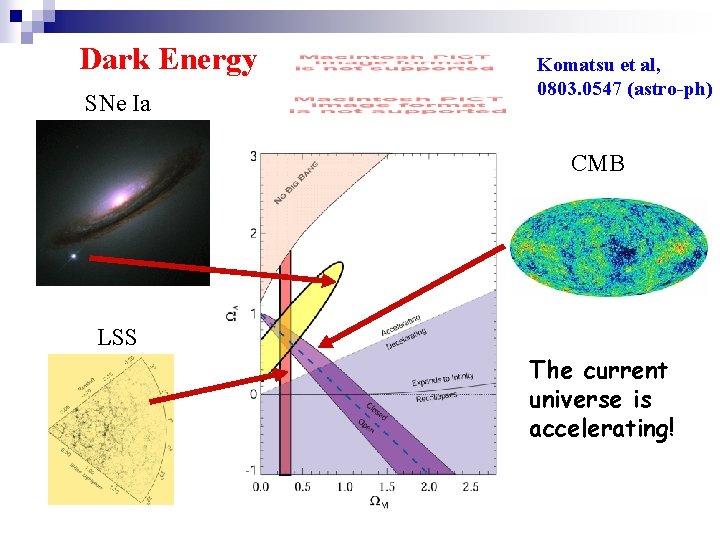
Dark Energy SNe Ia Komatsu et al, 0803. 0547 (astro-ph) CMB LSS The current universe is accelerating!
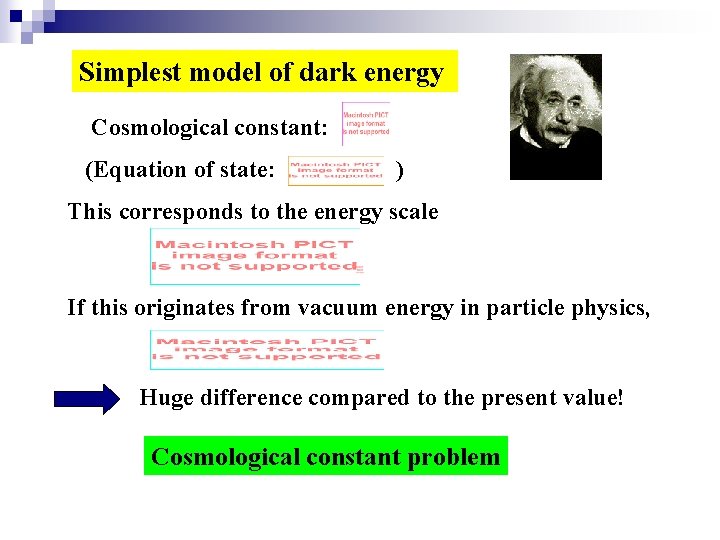
Simplest model of dark energy Cosmological constant: (Equation of state: ) This corresponds to the energy scale If this originates from vacuum energy in particle physics, Huge difference compared to the present value! Cosmological constant problem
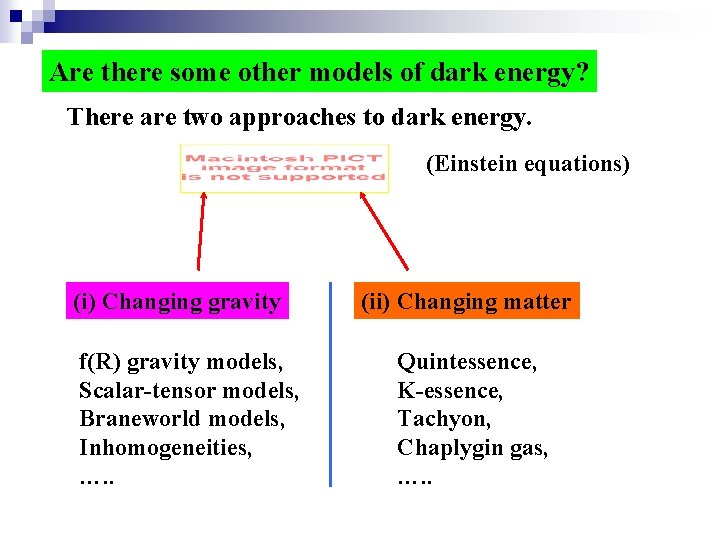
Are there some other models of dark energy? There are two approaches to dark energy. (Einstein equations) (i) Changing gravity f(R) gravity models, Scalar-tensor models, Braneworld models, Inhomogeneities, …. . (ii) Changing matter Quintessence, K-essence, Tachyon, Chaplygin gas, …. .
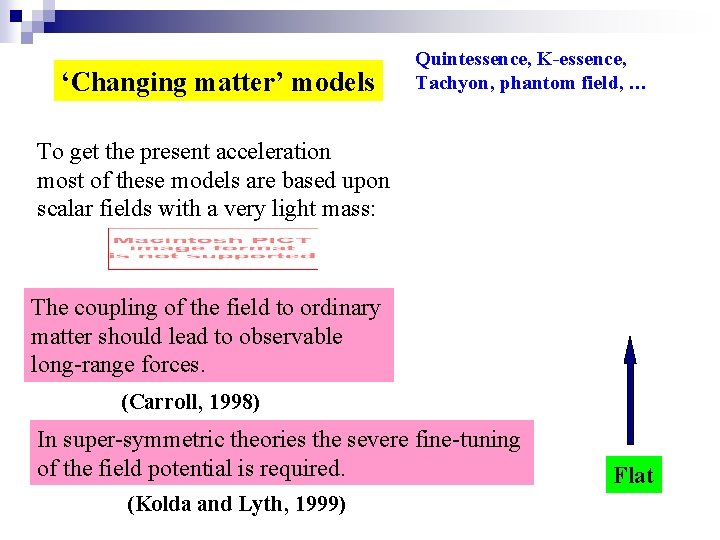
‘Changing matter’ models Quintessence, K-essence, Tachyon, phantom field, … To get the present acceleration most of these models are based upon scalar fields with a very light mass: The coupling of the field to ordinary matter should lead to observable long-range forces. (Carroll, 1998) In super-symmetric theories the severe fine-tuning of the field potential is required. (Kolda and Lyth, 1999) Flat
‘Changing gravity’ models f(R) gravity, scalar-tensor gravity, braneworld models, . . Dark energy may originate from some geometric modification from Einstein gravity. The simplest model: f(R) gravity R: Ricci scalar model: Starobinsky’s inflation model: Used for early universe inflation f(R) modified gravity models can be used for dark energy ?
f(R) dark energy: Example (n>0) Capozziello, Carloni and Troisi (2003) Carroll, Duvvuri, Trodden and Turner (2003) It is possible to have a late-time acceleration as the second term becomes important as R decreases. In the small R region we have Late-time acceleration is realized.
Is the model (n>0) are cosmologically viable? No! This model does not have a standard matter era prior to the late-time acceleration. • The f(R) action is transformed to (Einstein frame) where Matter fluid satisfies: Dark matter is coupled to the field (curvature). Coupled quintessence
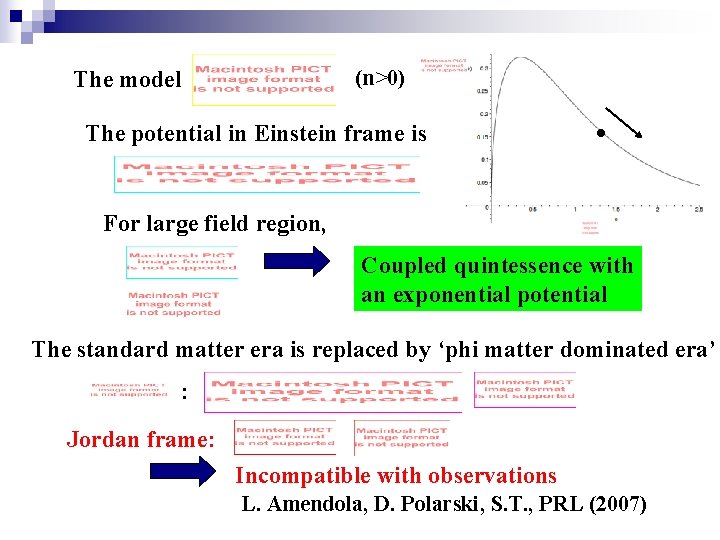
(n>0) The model The potential in Einstein frame is . For large field region, Coupled quintessence with an exponential potential The standard matter era is replaced by ‘phi matter dominated era’ : Jordan frame: Incompatible with observations L. Amendola, D. Polarski, S. T. , PRL (2007)
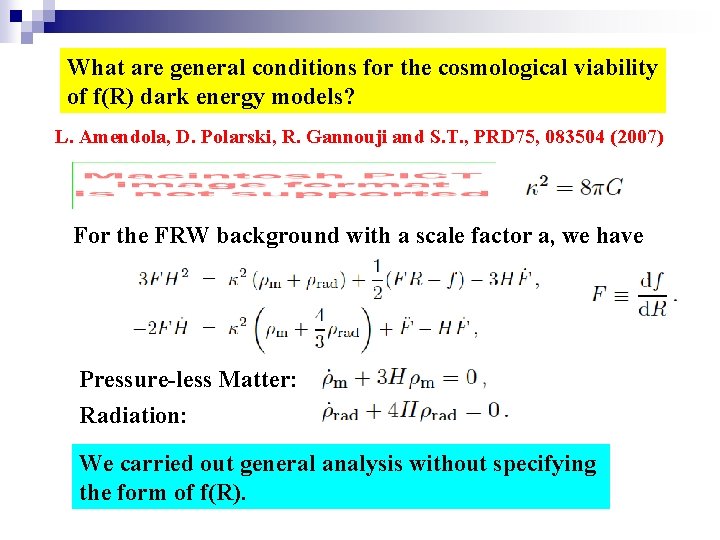
What are general conditions for the cosmological viability of f(R) dark energy models? L. Amendola, D. Polarski, R. Gannouji and S. T. , PRD 75, 083504 (2007) For the FRW background with a scale factor a, we have Pressure-less Matter: Radiation: We carried out general analysis without specifying the form of f(R).
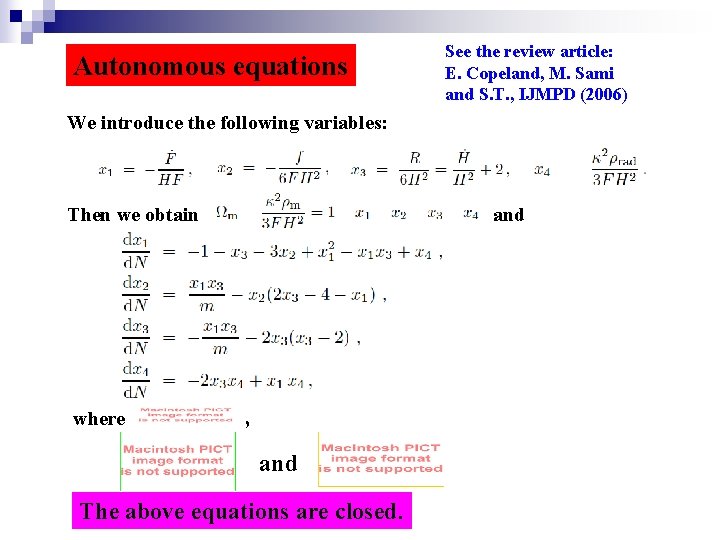
Autonomous equations See the review article: E. Copeland, M. Sami and S. T. , IJMPD (2006) We introduce the following variables: Then we obtain where and , and The above equations are closed.
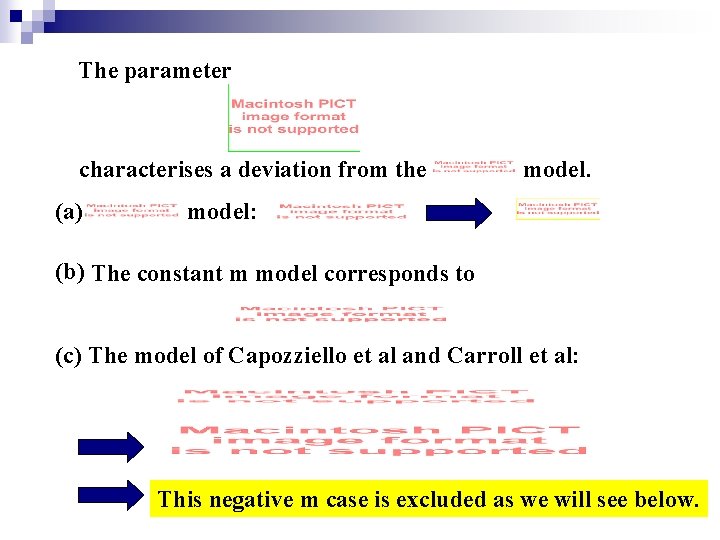
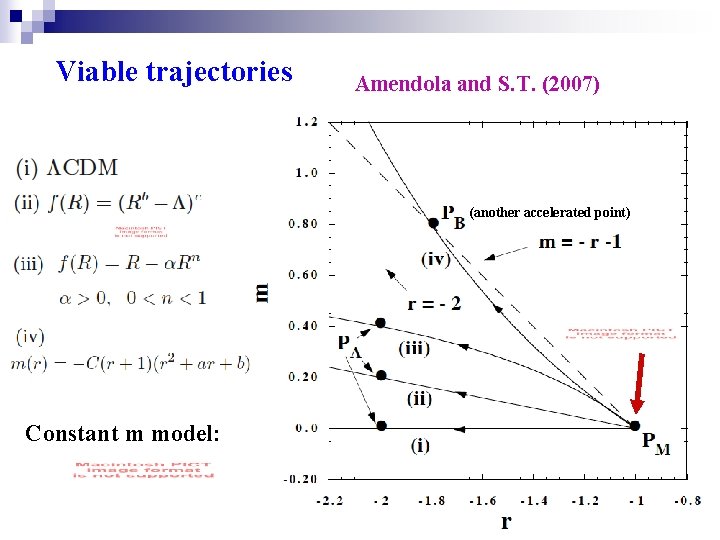
The parameter characterises a deviation from the (a) model: (b) The constant m model corresponds to (c) The model of Capozziello et al and Carroll et al: This negative m case is excluded as we will see below.
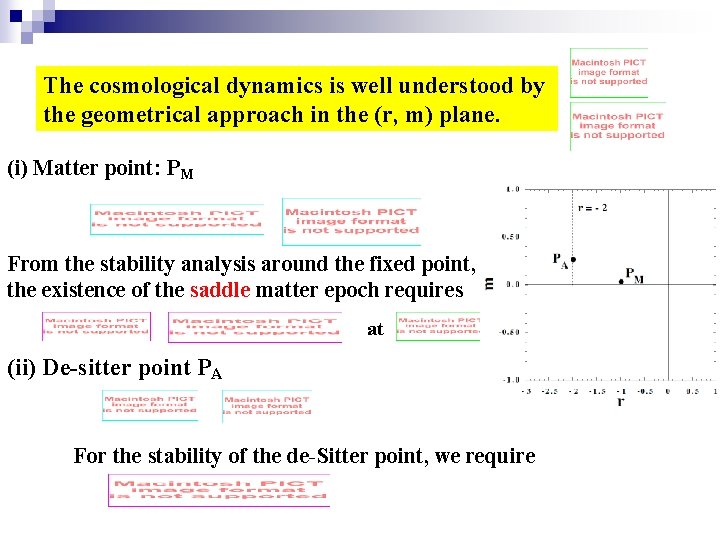
The cosmological dynamics is well understood by the geometrical approach in the (r, m) plane. (i) Matter point: P M From the stability analysis around the fixed point, the existence of the saddle matter epoch requires at (ii) De-sitter point PA For the stability of the de-Sitter point, we require
Viable trajectories Amendola and S. T. (2007) (another accelerated point) Constant m model:
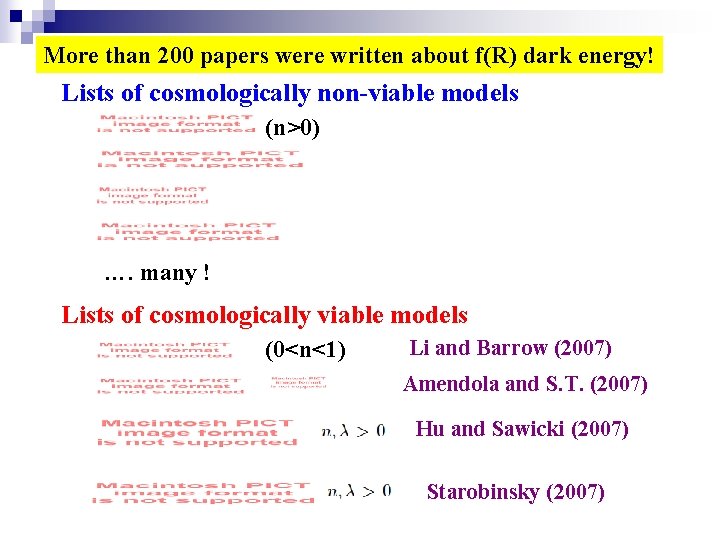
More than 200 papers were written about f(R) dark energy! Lists of cosmologically non-viable models (n>0) …. many ! Lists of cosmologically viable models (0<n<1) Li and Barrow (2007) Amendola and S. T. (2007) Hu and Sawicki (2007) Starobinsky (2007)
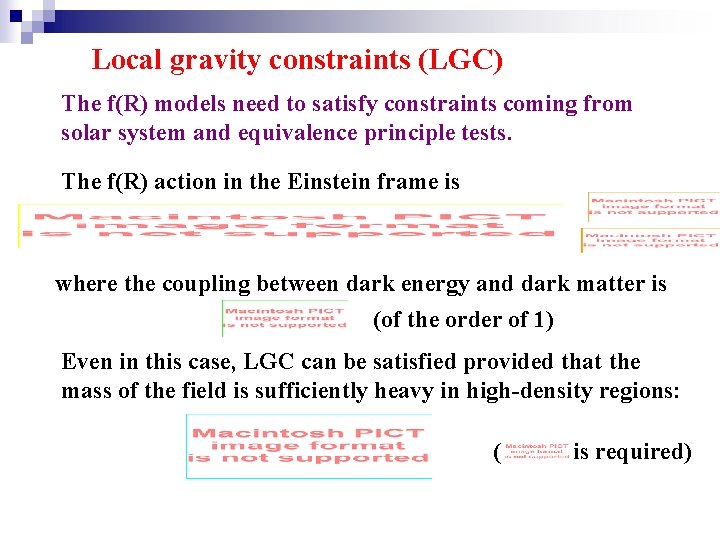
Local gravity constraints (LGC) The f(R) models need to satisfy constraints coming from solar system and equivalence principle tests. The f(R) action in the Einstein frame is where the coupling between dark energy and dark matter is (of the order of 1) Even in this case, LGC can be satisfied provided that the mass of the field is sufficiently heavy in high-density regions: ( is required)
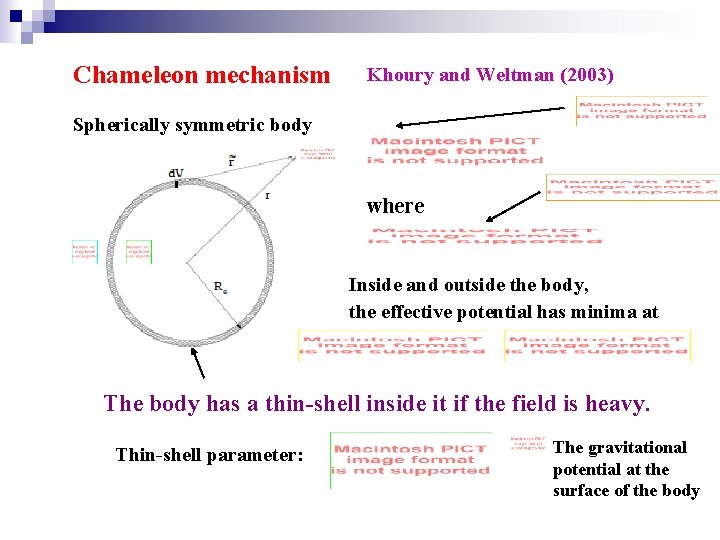
Chameleon mechanism Khoury and Weltman (2003) Spherically symmetric body where Inside and outside the body, the effective potential has minima at The body has a thin-shell inside it if the field is heavy. Thin-shell parameter: The gravitational potential at the surface of the body
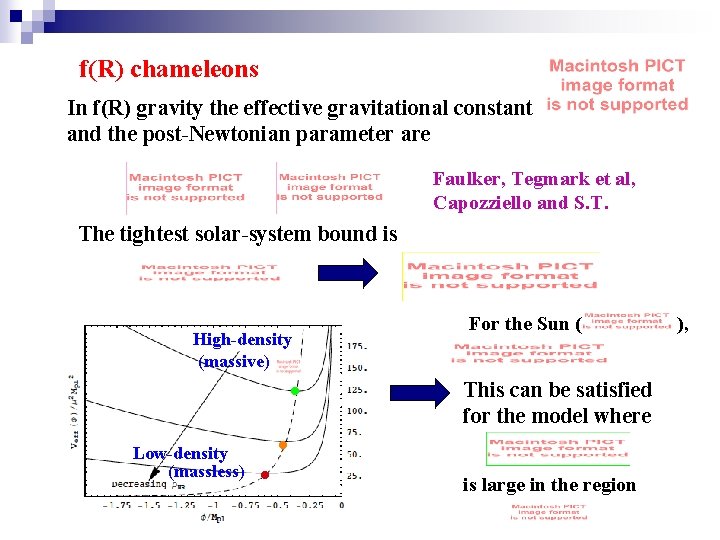
f(R) chameleons In f(R) gravity the effective gravitational constant and the post-Newtonian parameter are Faulker, Tegmark et al, Capozziello and S. T. The tightest solar-system bound is High-density (massive) Low-density (massless) . . . For the Sun ( This can be satisfied for the model where is large in the region ),
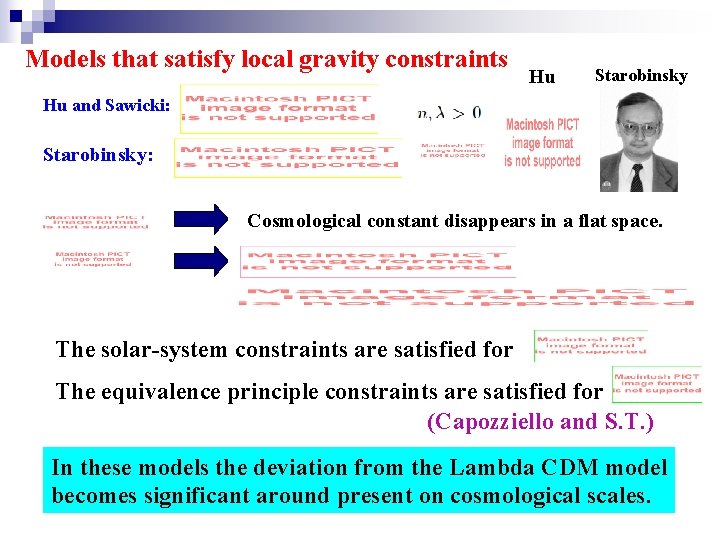
Models that satisfy local gravity constraints Hu Starobinsky Hu and Sawicki: Starobinsky: Cosmological constant disappears in a flat space. The solar-system constraints are satisfied for The equivalence principle constraints are satisfied for (Capozziello and S. T. ) In these models the deviation from the Lambda CDM model becomes significant around present on cosmological scales.
Observational signatures of viable f(R) models To confront with SN Ia observations, we write the equations in the form: present value where This satisfies The equation of state of dark energy is
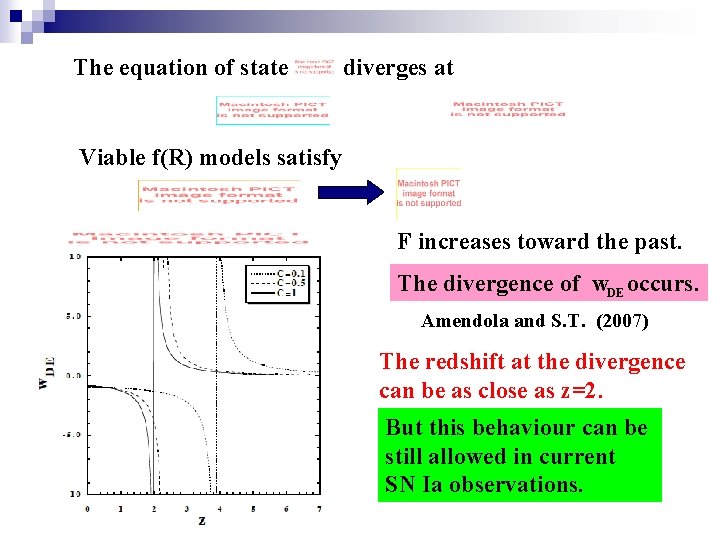
The equation of state diverges at Viable f(R) models satisfy F increases toward the past. The divergence of w. DE occurs. Amendola and S. T. (2007) The redshift at the divergence can be as close as z=2. But this behaviour can be still allowed in current SN Ia observations.
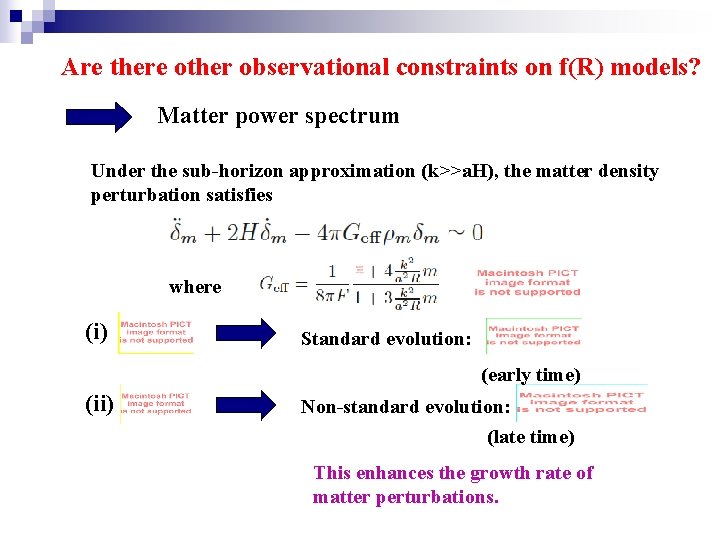
Are there other observational constraints on f(R) models? Matter power spectrum Under the sub-horizon approximation (k>>a. H), the matter density perturbation satisfies where (i) Standard evolution: (early time) (ii) Non-standard evolution: (late time) This enhances the growth rate of matter perturbations.
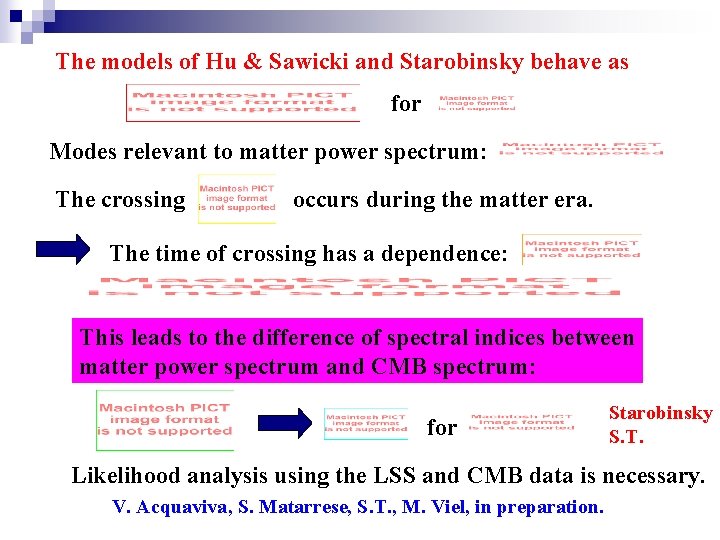
The models of Hu & Sawicki and Starobinsky behave as for Modes relevant to matter power spectrum: The crossing occurs during the matter era. The time of crossing has a dependence: This leads to the difference of spectral indices between matter power spectrum and CMB spectrum: for Starobinsky S. T. Likelihood analysis using the LSS and CMB data is necessary. V. Acquaviva, S. Matarrese, S. T. , M. Viel, in preparation.
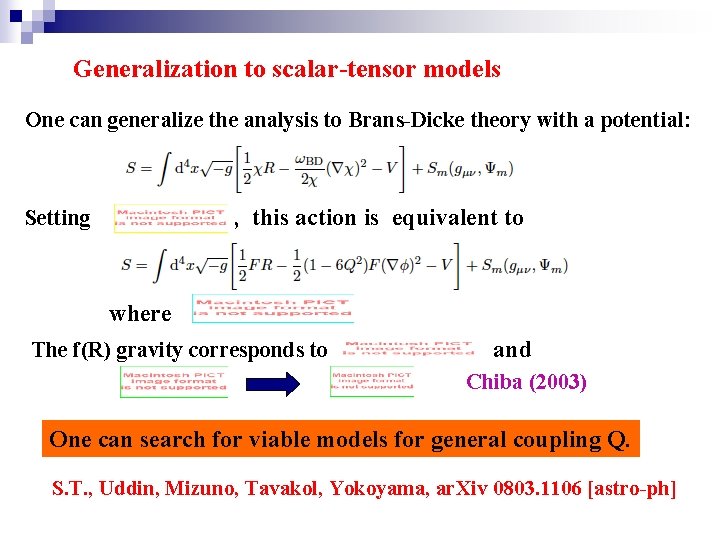
Generalization to scalar-tensor models One can generalize the analysis to Brans-Dicke theory with a potential: , this action is equivalent to Setting where The f(R) gravity corresponds to and Chiba (2003) One can search for viable models for general coupling Q. S. T. , Uddin, Mizuno, Tavakol, Yokoyama, ar. Xiv 0803. 1106 [astro-ph]
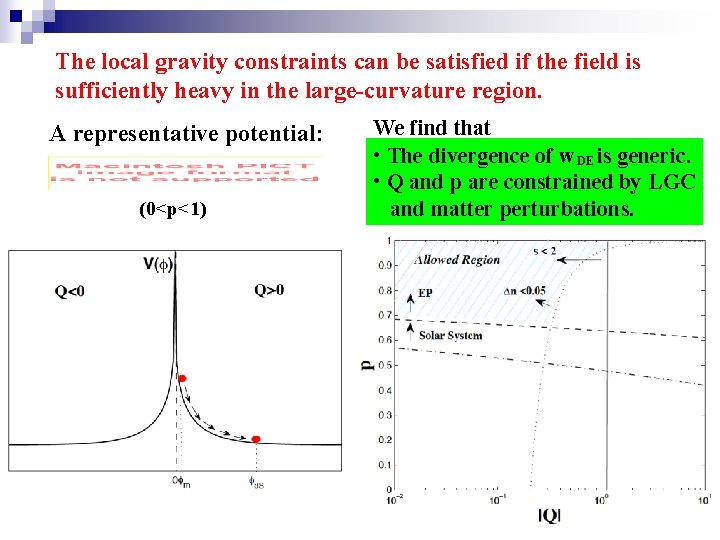
The local gravity constraints can be satisfied if the field is sufficiently heavy in the large-curvature region. A representative potential: (0<p<1) We find that • The divergence of w DE is generic. • Q and p are constrained by LGC and matter perturbations.
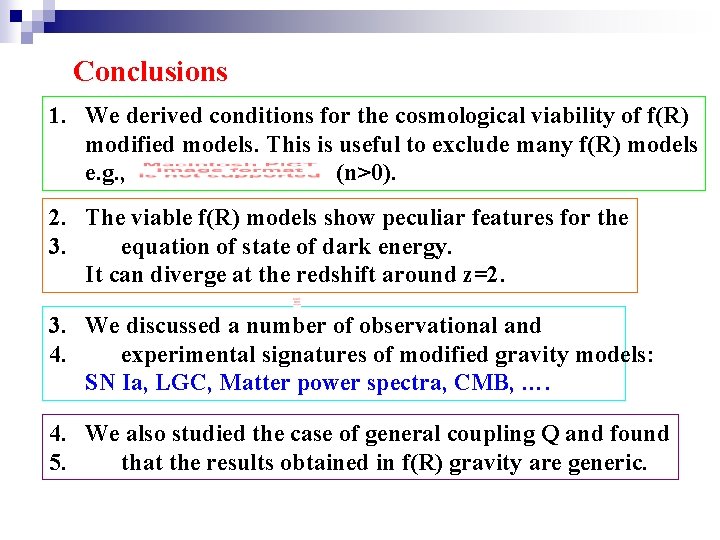
Conclusions 1. We derived conditions for the cosmological viability of f(R) modified models. This is useful to exclude many f(R) models e. g. , (n>0). 2. The viable f(R) models show peculiar features for the 3. equation of state of dark energy. It can diverge at the redshift around z=2. 3. We discussed a number of observational and 4. experimental signatures of modified gravity models: SN Ia, LGC, Matter power spectra, CMB, …. 4. We also studied the case of general coupling Q and found 5. that the results obtained in f(R) gravity are generic.