D 7 Taxol a chiral auxiliary case study


- Slides: 15
D 7 Taxol® – a chiral auxiliary case study (HL) Option D HL
Chirality � When a molecule contains a carbon atom bonded to four different groups, it is said to be chiral and two mirror images (known as enantiomers) exist. � These enantiomers can behave very differently in the body as a result of their different shapes. E. g. one enantiomer can combine with a specific protein because its functional groups are in correct position.
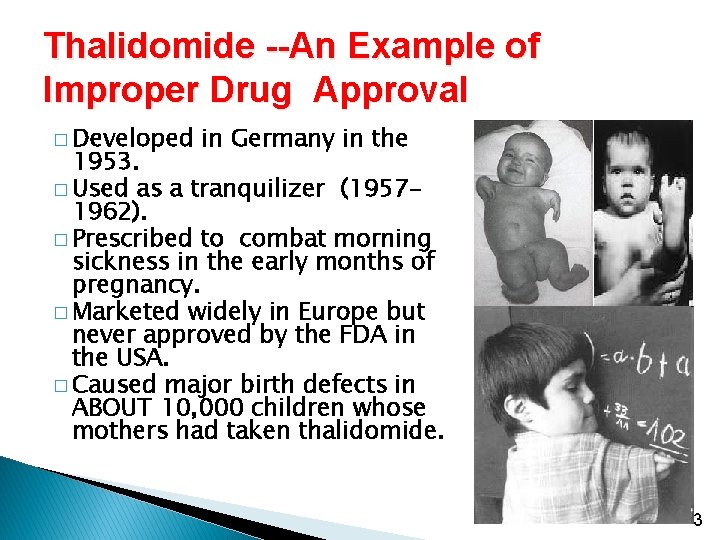
Thalidomide --An Example of Improper Drug Approval � Developed in Germany in the 1953. � Used as a tranquilizer (19571962). � Prescribed to combat morning sickness in the early months of pregnancy. � Marketed widely in Europe but never approved by the FDA in the USA. � Caused major birth defects in ABOUT 10, 000 children whose mothers had taken thalidomide. 3
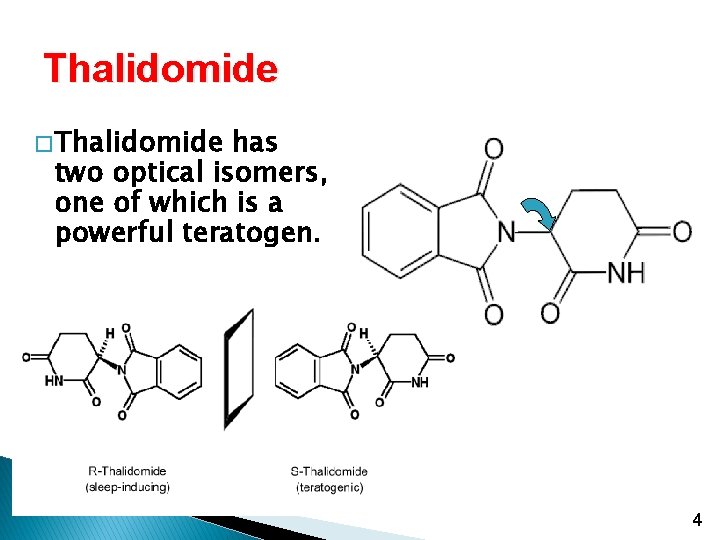
Thalidomide � Thalidomide has two optical isomers, one of which is a powerful teratogen. Chiral Carbon 4
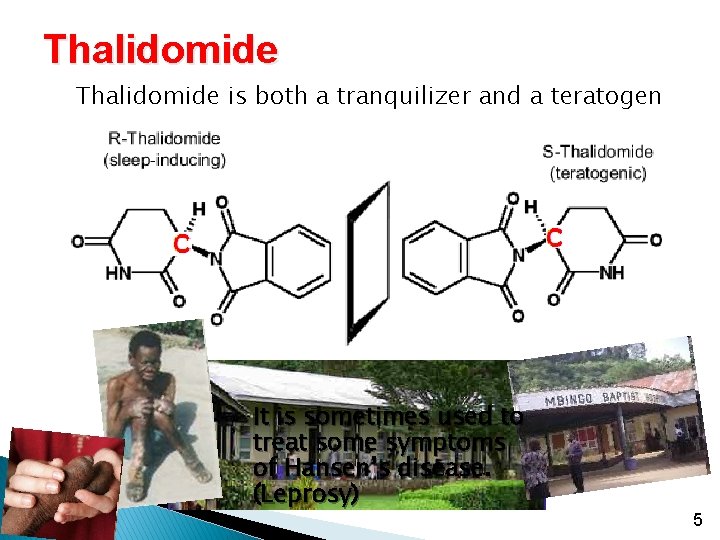
Thalidomide is both a tranquilizer and a teratogen It is sometimes used to treat some symptoms of Hansen’s disease. (Leprosy) 5
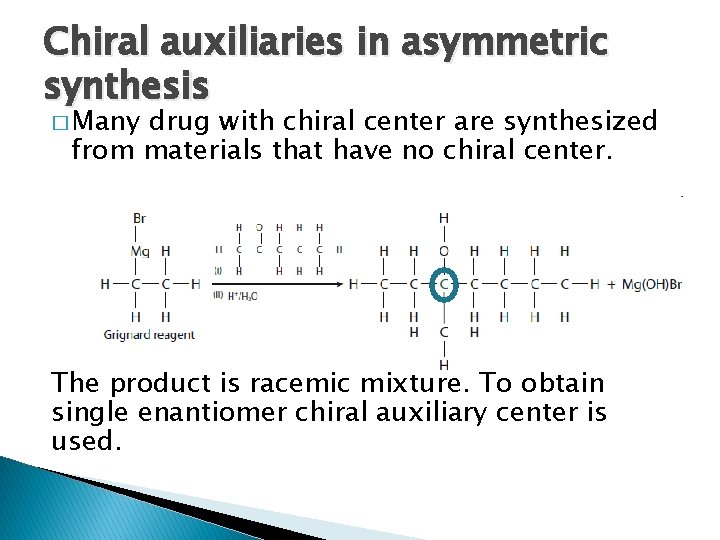
Chiral auxiliaries in asymmetric synthesis � Many drug with chiral center are synthesized from materials that have no chiral center. The product is racemic mixture. To obtain single enantiomer chiral auxiliary center is used.
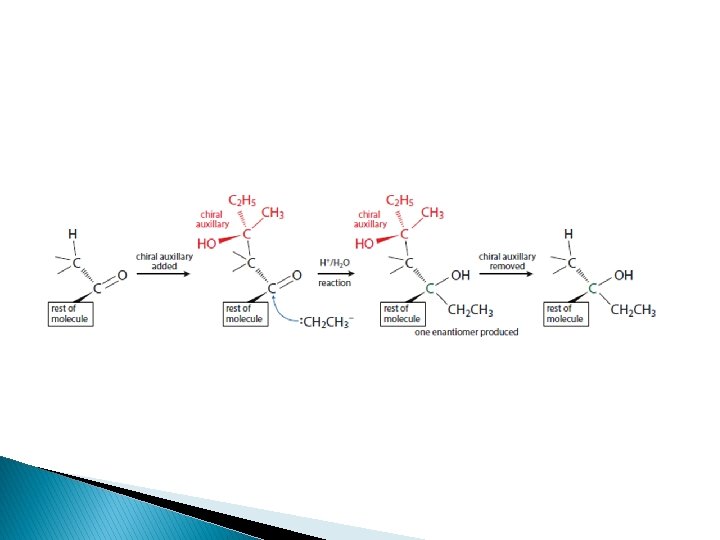
Chiral Auxiliary �A chiral auxiliary is one enantiomer of an optically active substance that is temporarily incorporated into a non-chiral molecule to produce a single enantiomer of a product in an organic synthesis reaction. � Chiral auxiliary allows reagent to approach from the one side of the molecule, so forcing the reaction to produce only one type of enantiomer. � Once reaction is complete chiral auxiliary is removed
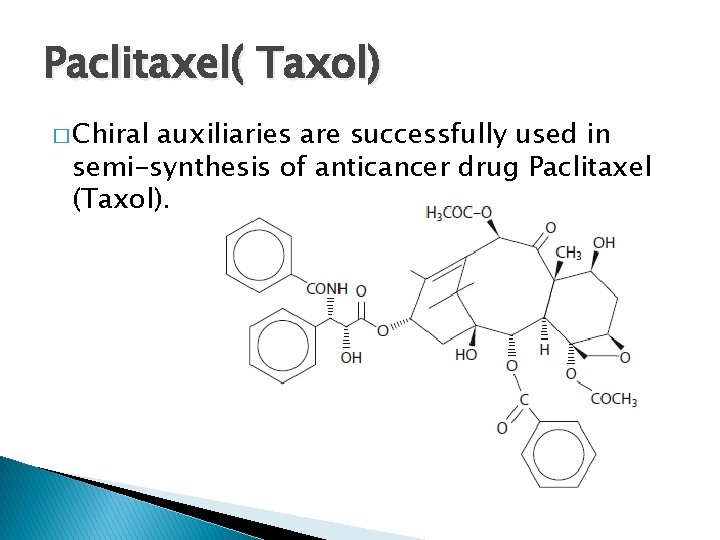
Paclitaxel( Taxol) � Chiral auxiliaries are successfully used in semi-synthesis of anticancer drug Paclitaxel (Taxol).
Paclitaxel in Chemotherapy � Paclitaxel is used to treat several forms of cancer – mainly breast, ovarian and lung cancer. It is usually given intravenously as part of a course of chemotherapy to treat cancer. Paclitaxel acts by preventing cell division – it does this by binding to microtubules in the cytoplasm, preventing them from breaking down during cell division.
Paclitaxel-Source and Synthesis � Paclitaxel was originally obtained from Pacific yew tree bark – however, it took the bark from more than one tree to provide enough paclitaxel to treat just one patient and so semi-synthetic processes were developed that involved making paclitaxel from another natural product derived from the needles of yew trees. � Semi-synthesis of the drug allowed it to be made on a larger scale and reduced the environmental impact – extracting the drug from its natural source results in killing of the trees. � Nowadays paclitaxel is also made by fermentation using plant cell cultures.
Using a polarimeter to distinguish between enantiomers � Optically active enantiomers can be distinguished using polarimeter, because they rotate plane polarized light in opposite directions � A simple polarimeter consists of a source of light (usually a sodium lamp producing one specific wavelength), two polarising filters, a sample tube and a scale to measure the degree of rotation of the plane-polarised light
Simple Polarimeter
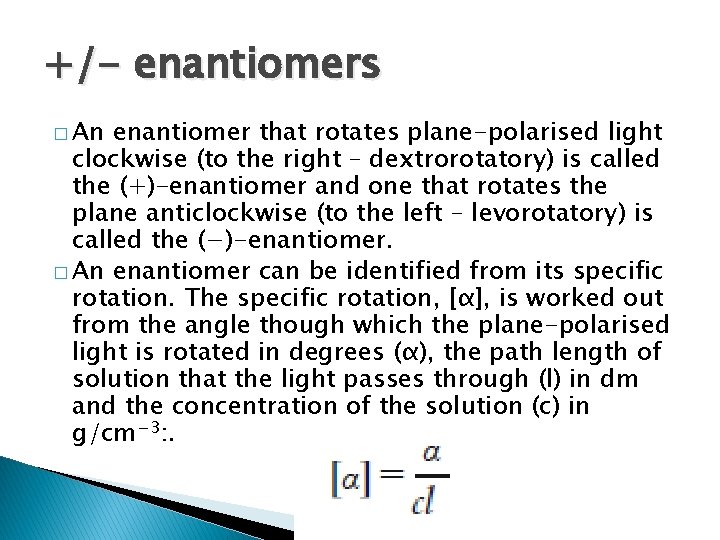
+/- enantiomers � An enantiomer that rotates plane-polarised light clockwise (to the right – dextrorotatory) is called the (+)-enantiomer and one that rotates the plane anticlockwise (to the left – levorotatory) is called the (−)-enantiomer. � An enantiomer can be identified from its specific rotation. The specific rotation, [α], is worked out from the angle though which the plane-polarised light is rotated in degrees (α), the path length of solution that the light passes through (l) in dm and the concentration of the solution (c) in g/cm− 3: .
Nature of Science � Science is both systematic and creative. Systematic screening of a large number of plant extracts identified paclitaxel as a possible anticancer drug. When the demand for paclitaxel exceeded the supply from natural sources scientists had to develop ways of making this important drug. A great deal of creativity was involved in designing ways of making paclitaxel.