
Stereochemistry of organic compounds Molecules in three dimensions
- Slides: 85
Stereochemistry of organic compounds Molecules in three dimensions
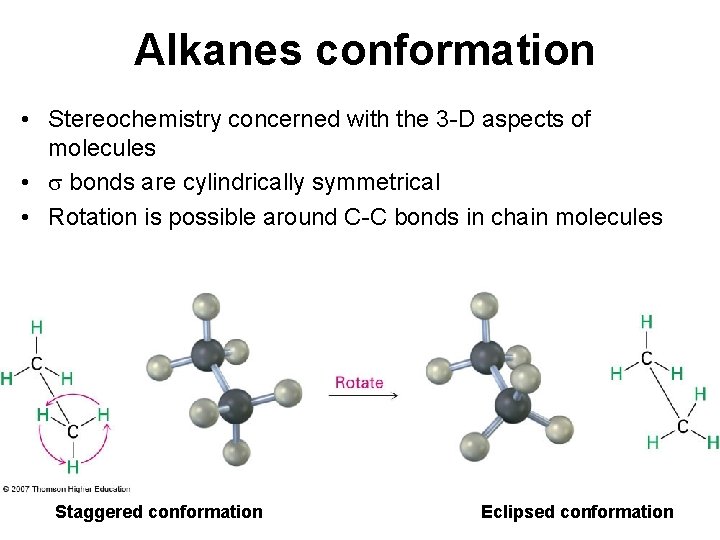
Alkanes conformation • Stereochemistry concerned with the 3 -D aspects of molecules • bonds are cylindrically symmetrical • Rotation is possible around C-C bonds in chain molecules Staggered conformation Eclipsed conformation
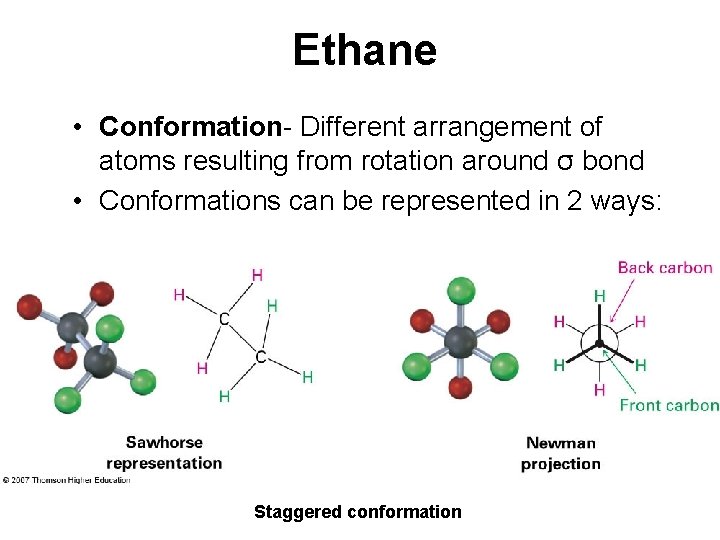
Ethane • Conformation- Different arrangement of atoms resulting from rotation around σ bond • Conformations can be represented in 2 ways: Staggered conformation
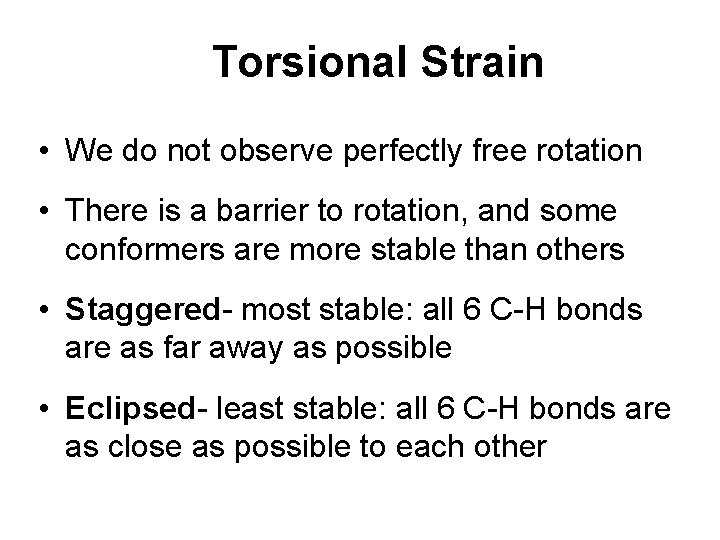
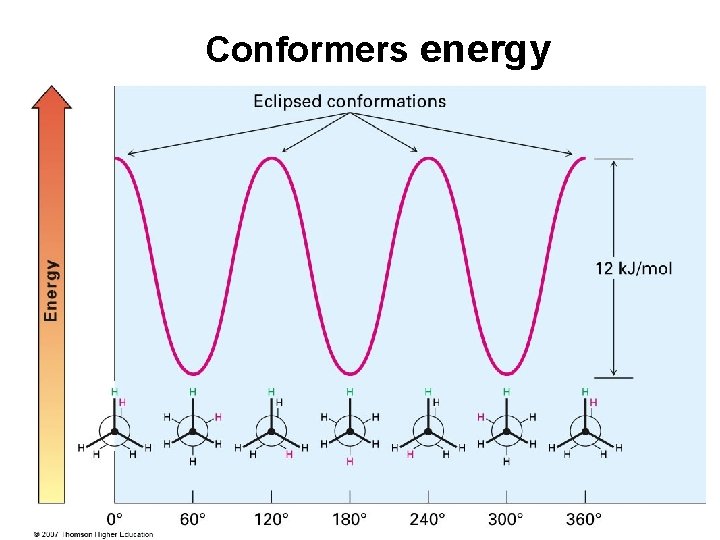
Torsional Strain • We do not observe perfectly free rotation • There is a barrier to rotation, and some conformers are more stable than others • Staggered- most stable: all 6 C-H bonds are as far away as possible • Eclipsed- least stable: all 6 C-H bonds are as close as possible to each other
Conformers energy
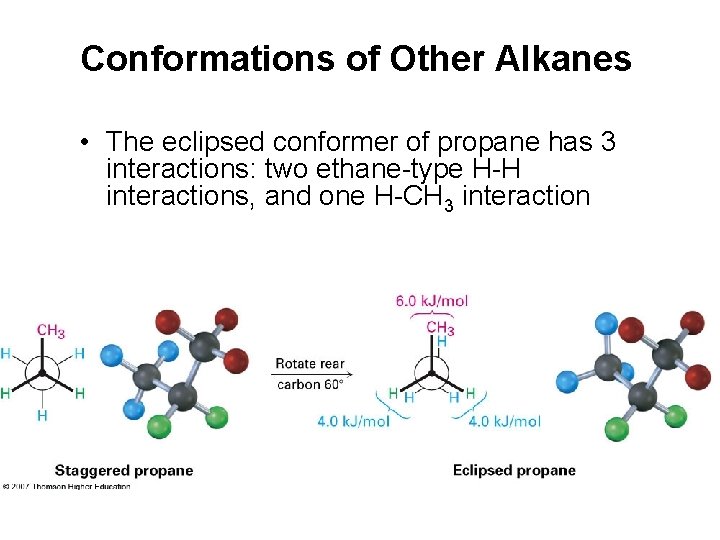
Conformations of Other Alkanes • The eclipsed conformer of propane has 3 interactions: two ethane-type H-H interactions, and one H-CH 3 interaction
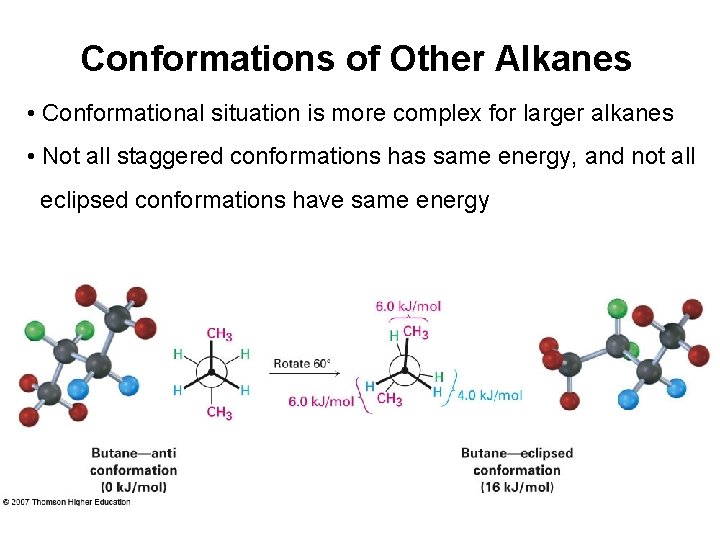
Conformations of Other Alkanes • Conformational situation is more complex for larger alkanes • Not all staggered conformations has same energy, and not all eclipsed conformations have same energy
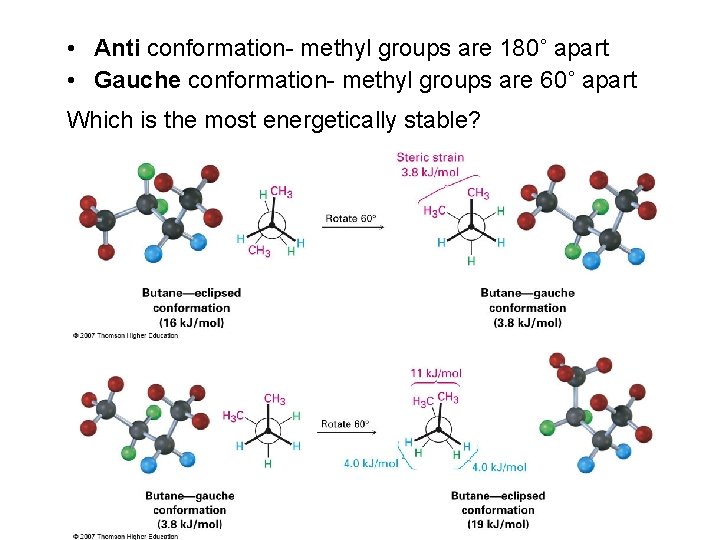
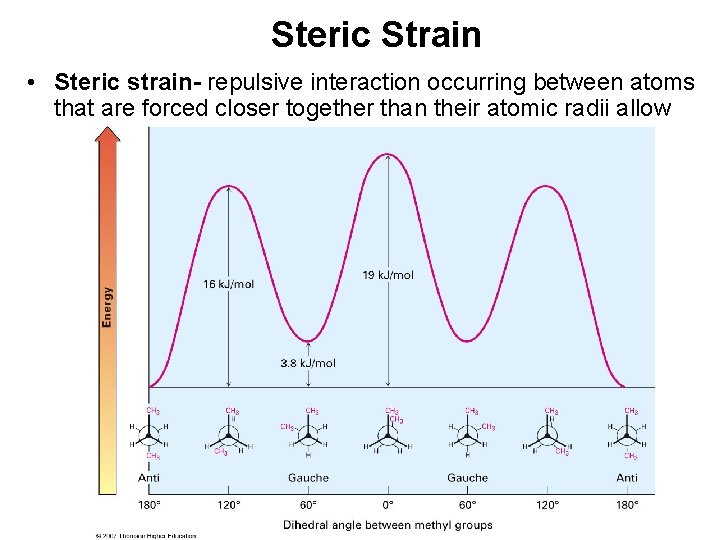
• Anti conformation- methyl groups are 180˚ apart • Gauche conformation- methyl groups are 60˚ apart Which is the most energetically stable?
Steric Strain • Steric strain- repulsive interaction occurring between atoms that are forced closer together than their atomic radii allow
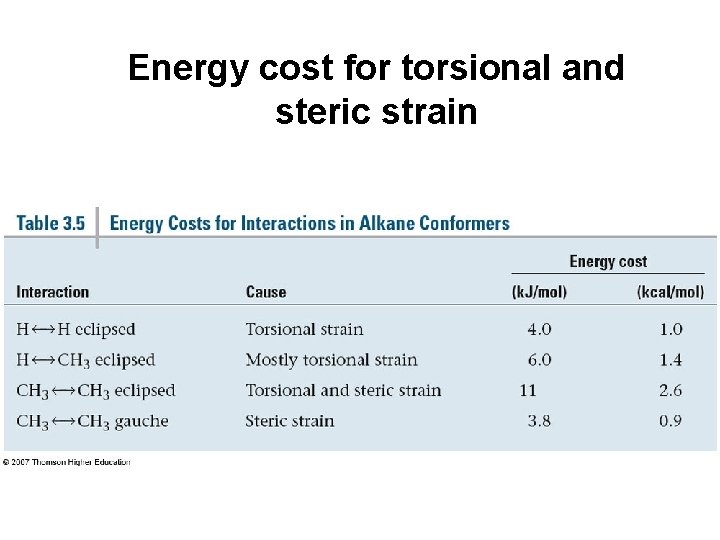
Energy cost for torsional and steric strain
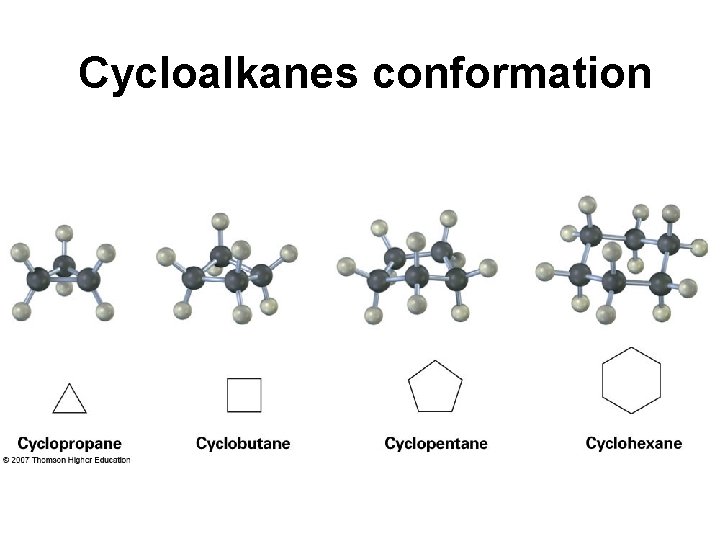
Cycloalkanes conformation
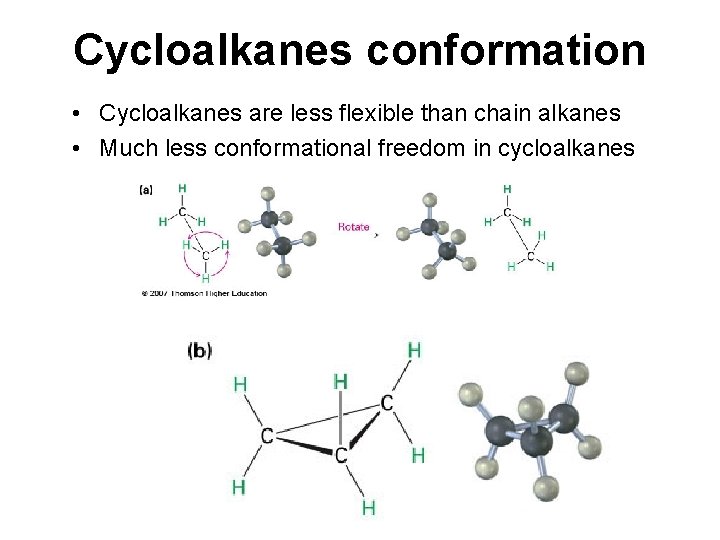
Cycloalkanes conformation • Cycloalkanes are less flexible than chain alkanes • Much less conformational freedom in cycloalkanes
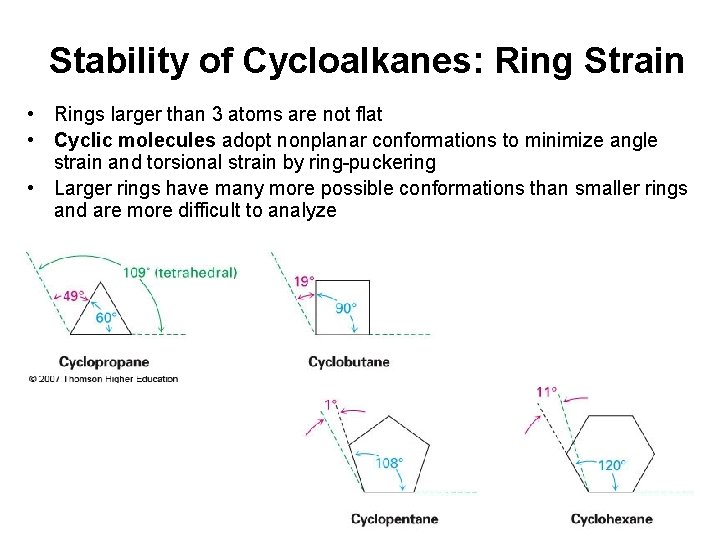
Stability of Cycloalkanes: Ring Strain • Rings larger than 3 atoms are not flat • Cyclic molecules adopt nonplanar conformations to minimize angle strain and torsional strain by ring-puckering • Larger rings have many more possible conformations than smaller rings and are more difficult to analyze
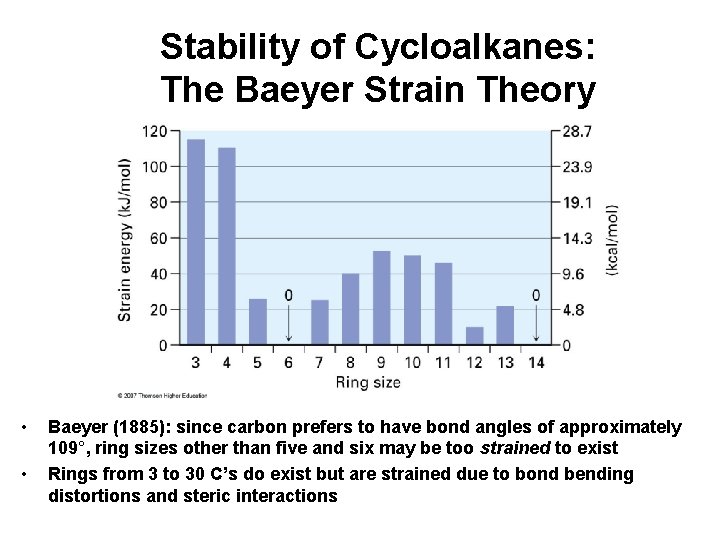
Stability of Cycloalkanes: The Baeyer Strain Theory • • Baeyer (1885): since carbon prefers to have bond angles of approximately 109°, ring sizes other than five and six may be too strained to exist Rings from 3 to 30 C’s do exist but are strained due to bond bending distortions and steric interactions
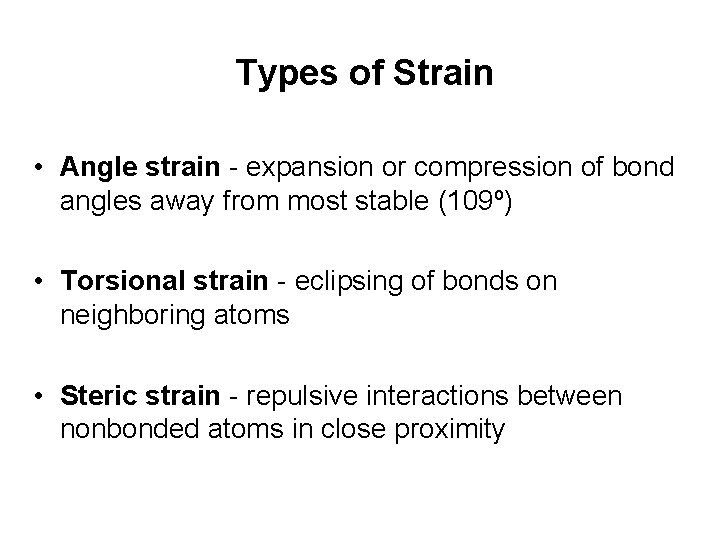
Types of Strain • Angle strain - expansion or compression of bond angles away from most stable (109º) • Torsional strain - eclipsing of bonds on neighboring atoms • Steric strain - repulsive interactions between nonbonded atoms in close proximity
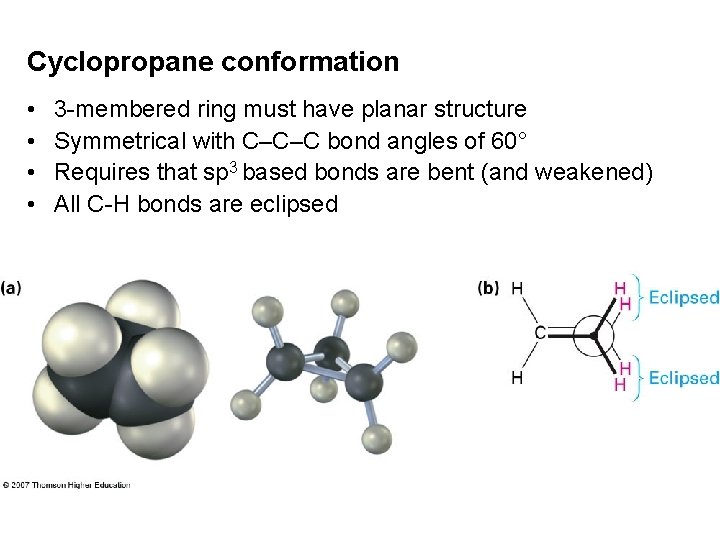
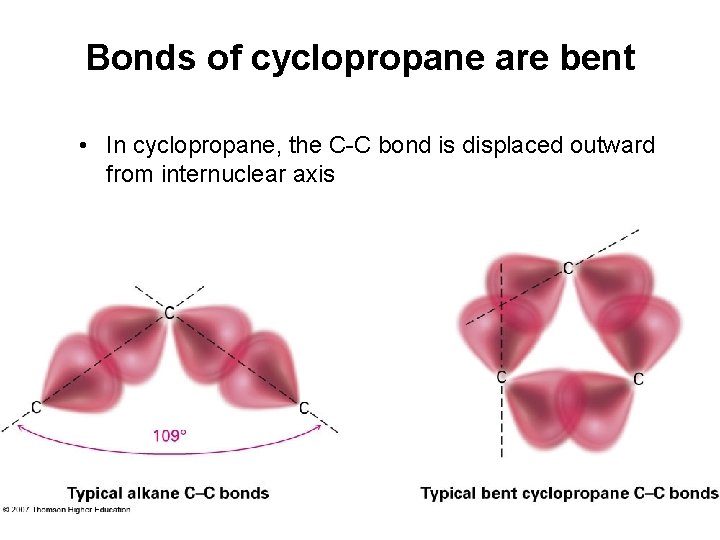
Cyclopropane conformation • • 3 -membered ring must have planar structure Symmetrical with C–C–C bond angles of 60° Requires that sp 3 based bonds are bent (and weakened) All C-H bonds are eclipsed
Bonds of cyclopropane are bent • In cyclopropane, the C-C bond is displaced outward from internuclear axis
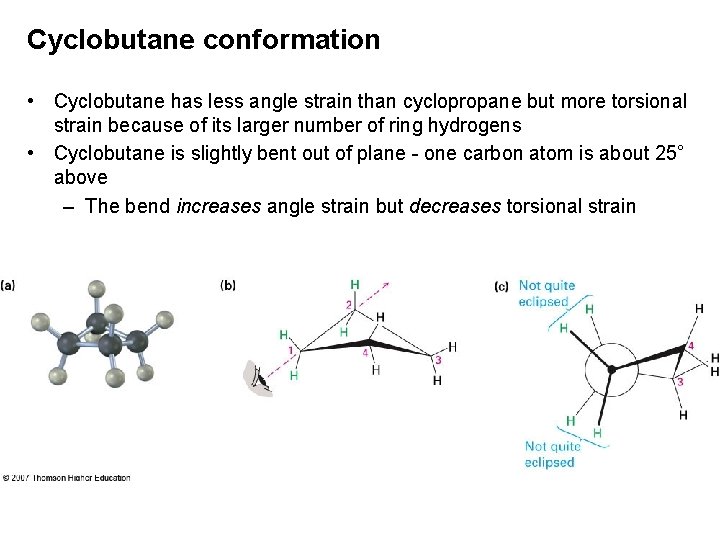
Cyclobutane conformation • Cyclobutane has less angle strain than cyclopropane but more torsional strain because of its larger number of ring hydrogens • Cyclobutane is slightly bent out of plane - one carbon atom is about 25° above – The bend increases angle strain but decreases torsional strain
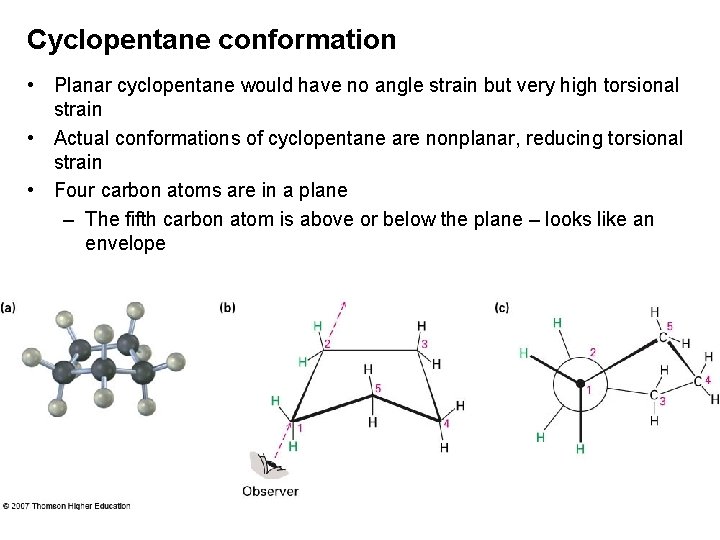
Cyclopentane conformation • Planar cyclopentane would have no angle strain but very high torsional strain • Actual conformations of cyclopentane are nonplanar, reducing torsional strain • Four carbon atoms are in a plane – The fifth carbon atom is above or below the plane – looks like an envelope
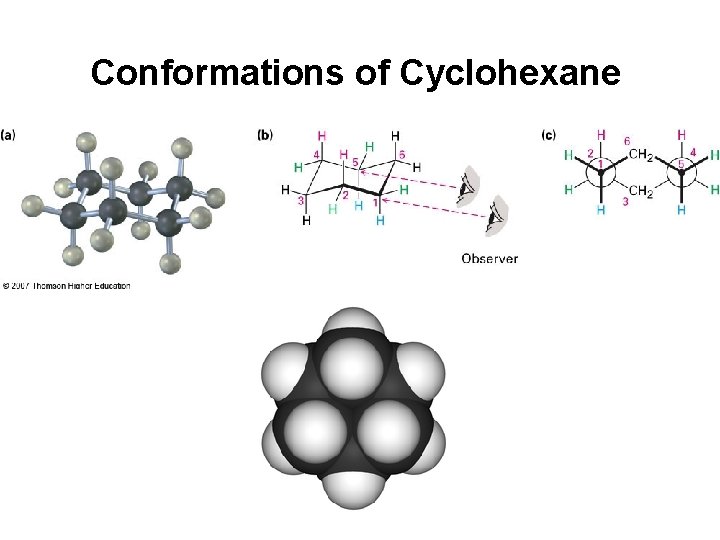
Conformations of Cyclohexane • Substituted cyclohexanes occur widely in nature • The cyclohexane ring is free of angle strain and torsional strain • The conformation has alternating atoms in a common plane and tetrahedral angles between all carbons • This is called a chair conformation
Conformations of Cyclohexane
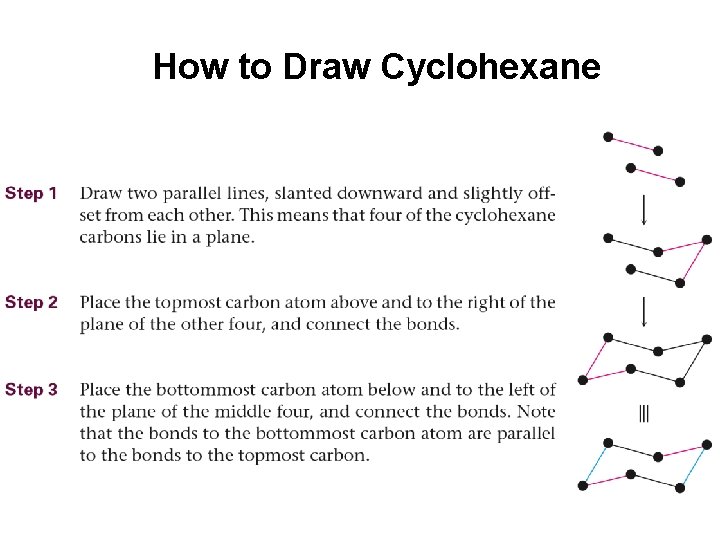
How to Draw Cyclohexane
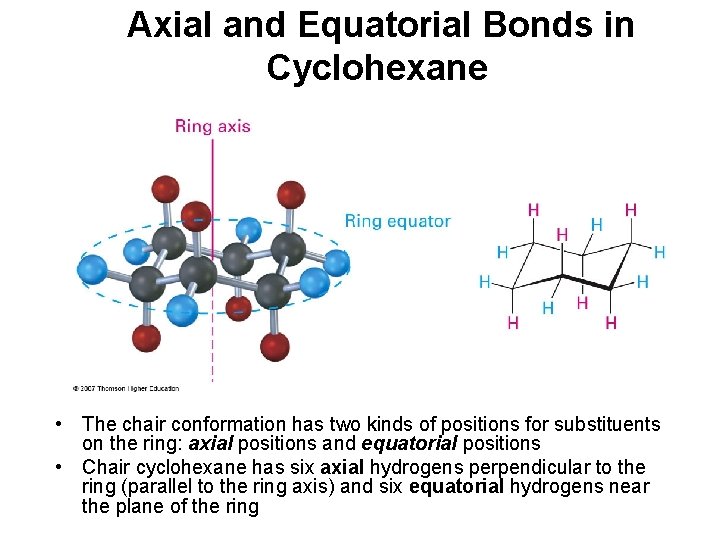
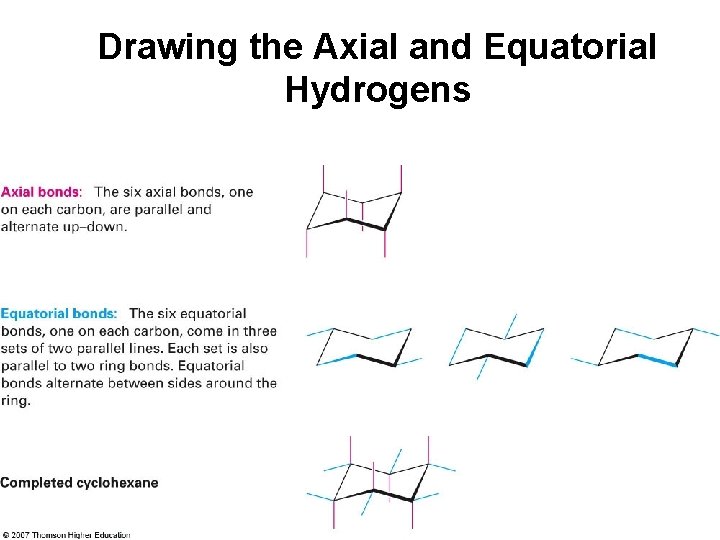
Axial and Equatorial Bonds in Cyclohexane • The chair conformation has two kinds of positions for substituents on the ring: axial positions and equatorial positions • Chair cyclohexane has six axial hydrogens perpendicular to the ring (parallel to the ring axis) and six equatorial hydrogens near the plane of the ring
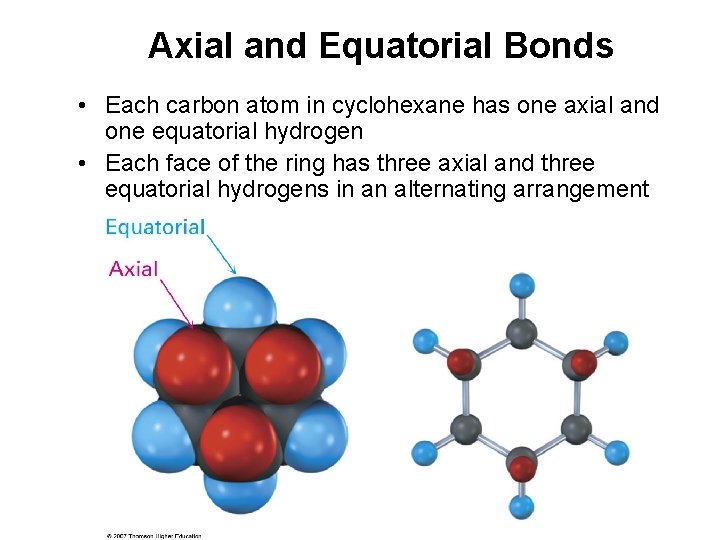
Axial and Equatorial Bonds • Each carbon atom in cyclohexane has one axial and one equatorial hydrogen • Each face of the ring has three axial and three equatorial hydrogens in an alternating arrangement
Drawing the Axial and Equatorial Hydrogens
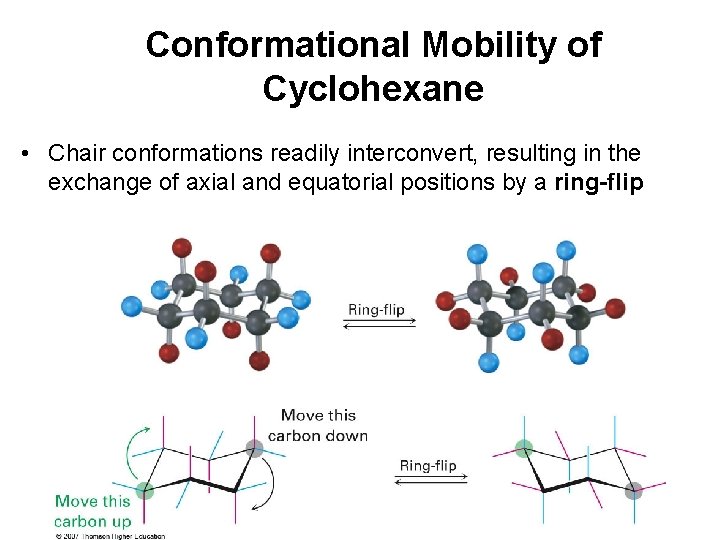
Conformational Mobility of Cyclohexane • Chair conformations readily interconvert, resulting in the exchange of axial and equatorial positions by a ring-flip
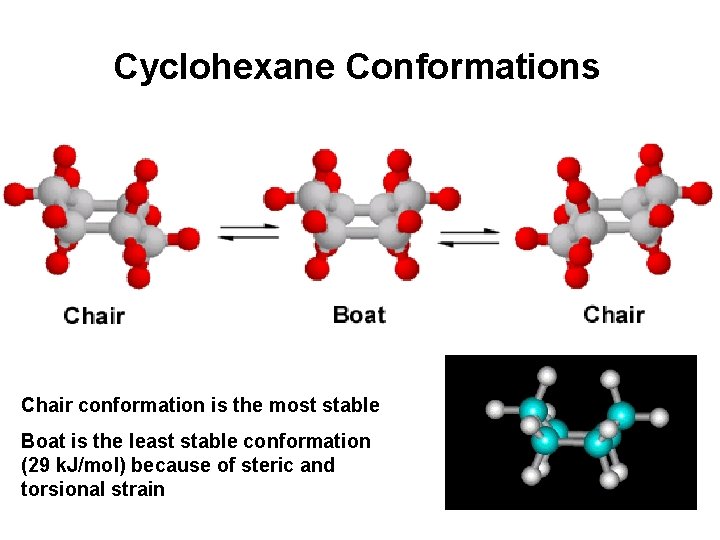
Cyclohexane Conformations Chair conformation is the most stable Boat is the least stable conformation (29 k. J/mol) because of steric and torsional strain
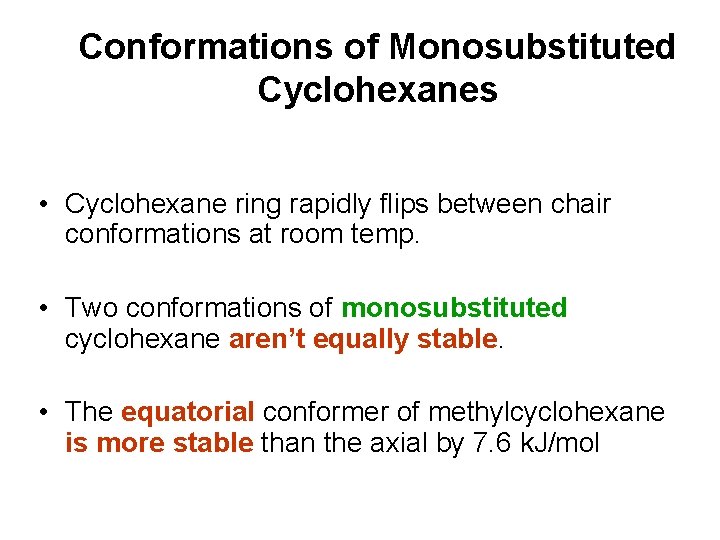
Conformations of Monosubstituted Cyclohexanes • Cyclohexane ring rapidly flips between chair conformations at room temp. • Two conformations of monosubstituted cyclohexane aren’t equally stable. • The equatorial conformer of methylcyclohexane is more stable than the axial by 7. 6 k. J/mol
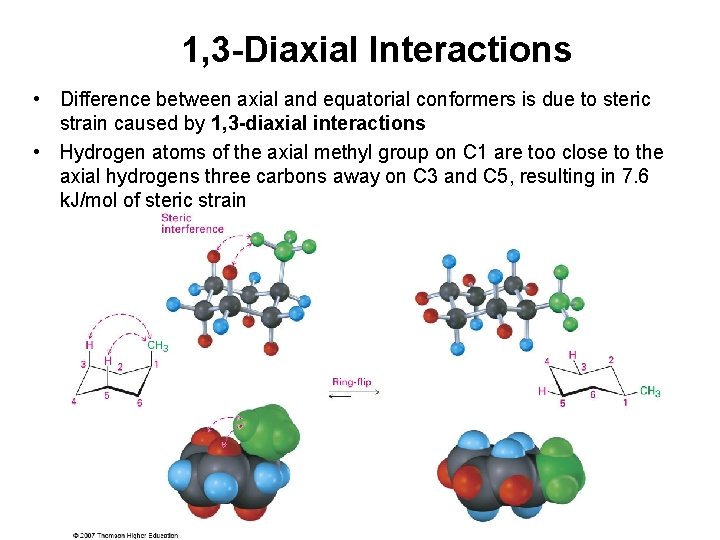
1, 3 -Diaxial Interactions • Difference between axial and equatorial conformers is due to steric strain caused by 1, 3 -diaxial interactions • Hydrogen atoms of the axial methyl group on C 1 are too close to the axial hydrogens three carbons away on C 3 and C 5, resulting in 7. 6 k. J/mol of steric strain
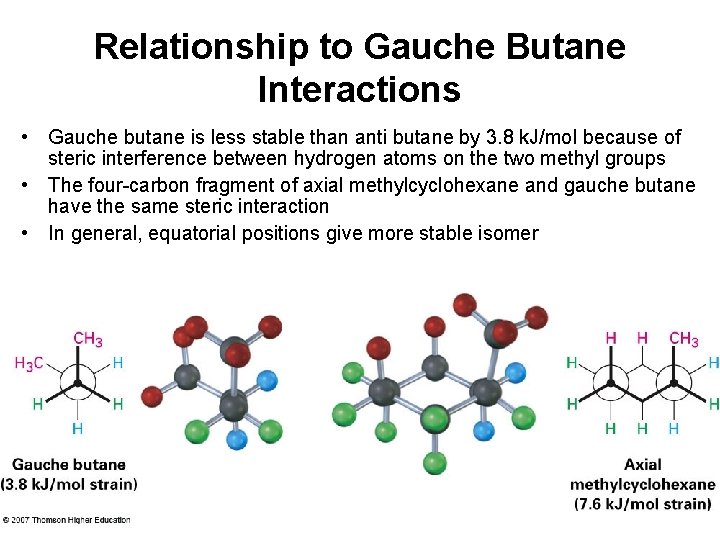
Relationship to Gauche Butane Interactions • Gauche butane is less stable than anti butane by 3. 8 k. J/mol because of steric interference between hydrogen atoms on the two methyl groups • The four-carbon fragment of axial methylcyclohexane and gauche butane have the same steric interaction • In general, equatorial positions give more stable isomer
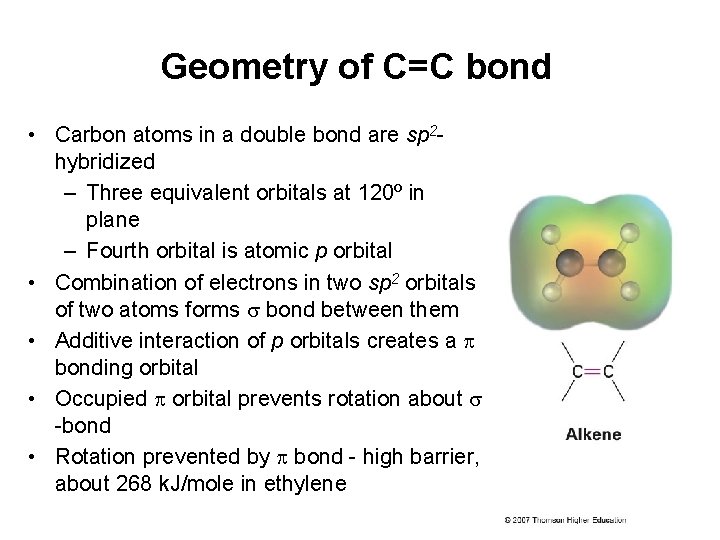
Geometry of C=C bond • Carbon atoms in a double bond are sp 2 hybridized – Three equivalent orbitals at 120º in plane – Fourth orbital is atomic p orbital • Combination of electrons in two sp 2 orbitals of two atoms forms bond between them • Additive interaction of p orbitals creates a bonding orbital • Occupied orbital prevents rotation about -bond • Rotation prevented by bond - high barrier, about 268 k. J/mole in ethylene
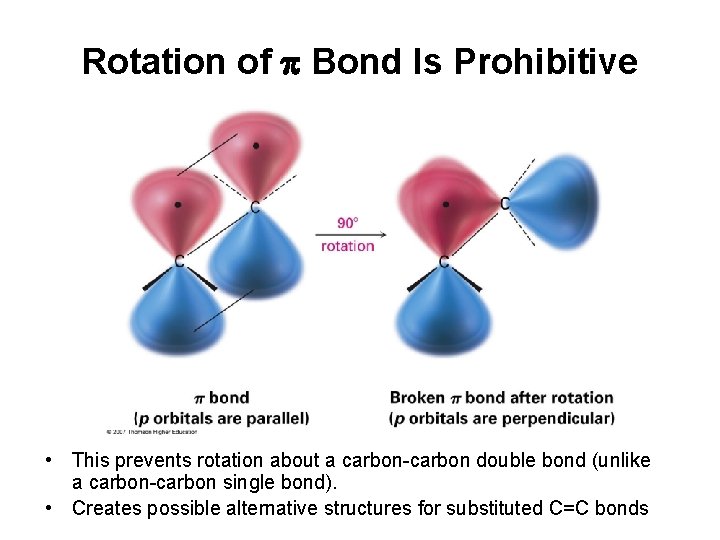
Rotation of Bond Is Prohibitive • This prevents rotation about a carbon-carbon double bond (unlike a carbon-carbon single bond). • Creates possible alternative structures for substituted C=C bonds
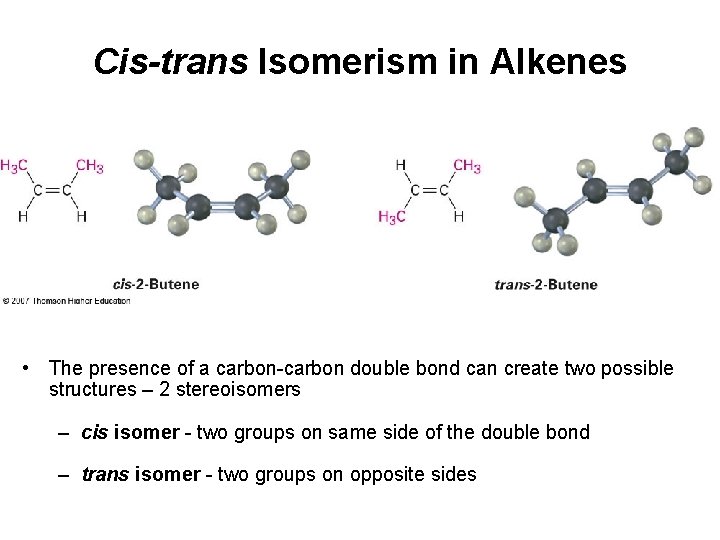
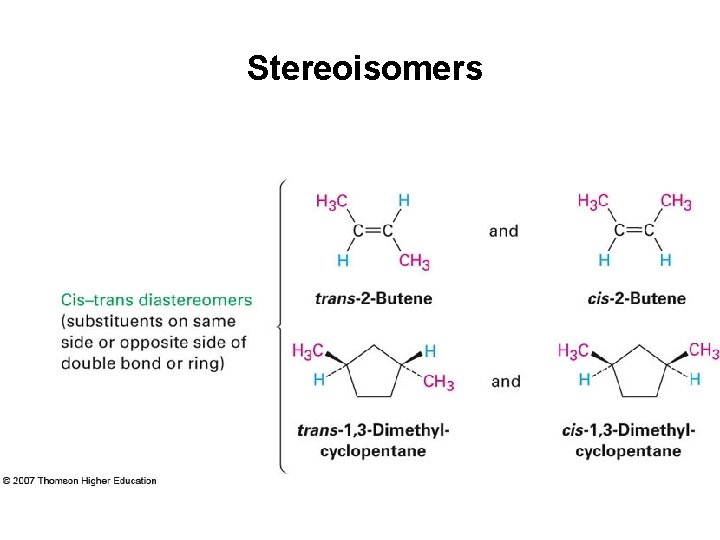
Cis-trans Isomerism in Alkenes • The presence of a carbon-carbon double bond can create two possible structures – 2 stereoisomers – cis isomer - two groups on same side of the double bond – trans isomer - two groups on opposite sides
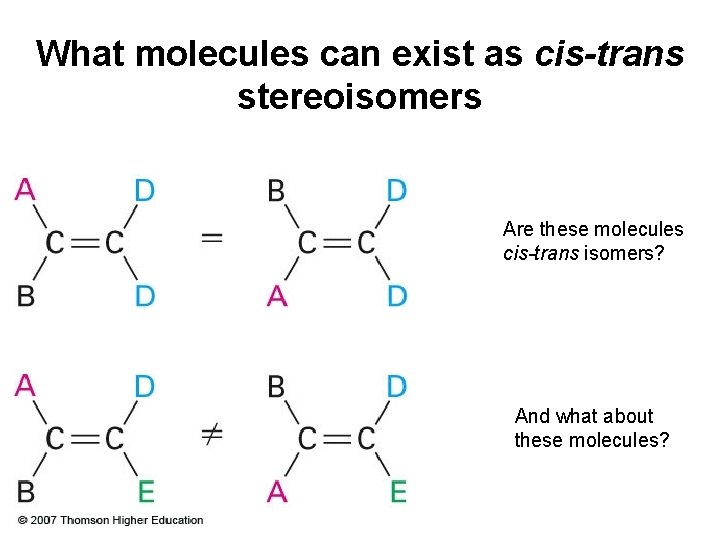
What molecules can exist as cis-trans stereoisomers Are these molecules cis-trans isomers? And what about these molecules?
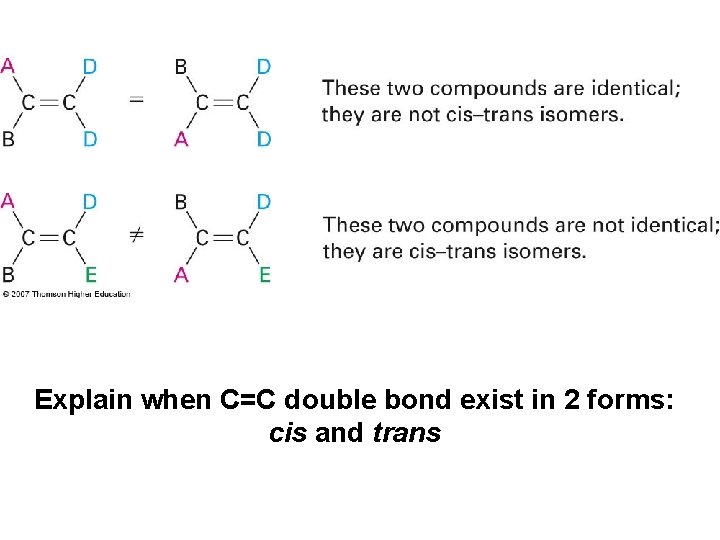
Explain when C=C double bond exist in 2 forms: cis and trans
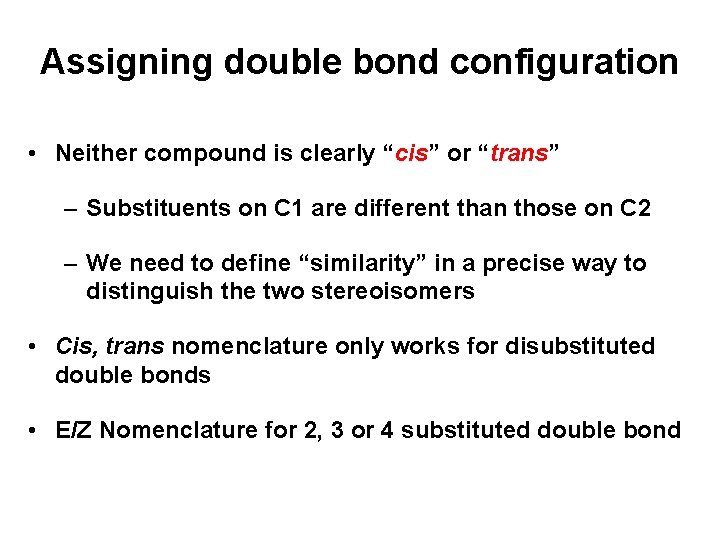
Assigning double bond configuration • Neither compound is clearly “cis” or “trans” – Substituents on C 1 are different than those on C 2 – We need to define “similarity” in a precise way to distinguish the two stereoisomers • Cis, trans nomenclature only works for disubstituted double bonds • E/Z Nomenclature for 2, 3 or 4 substituted double bond
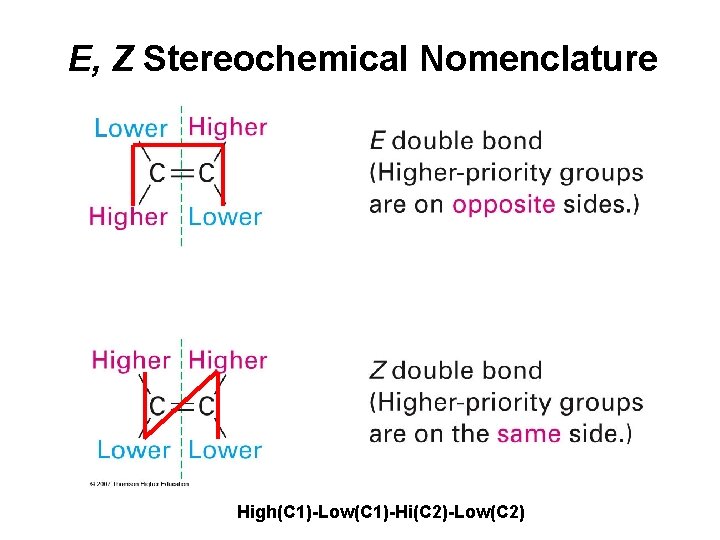
E, Z Stereochemical Nomenclature High(C 1)-Low(C 1)-Hi(C 2)-Low(C 2)
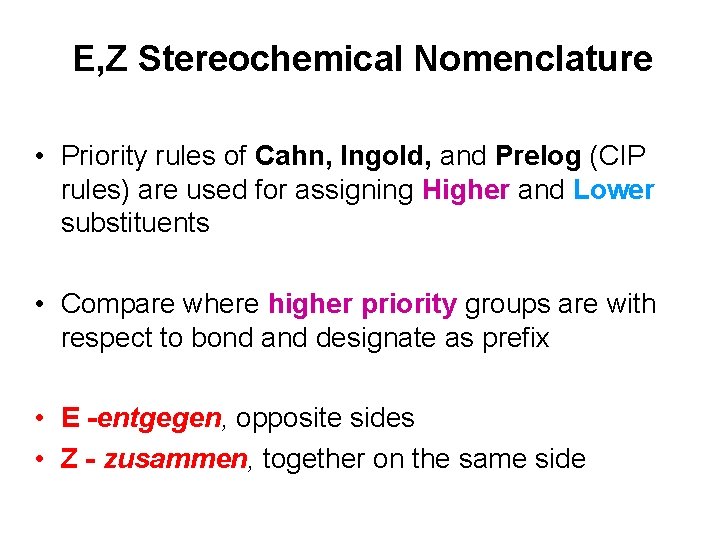
E, Z Stereochemical Nomenclature • Priority rules of Cahn, Ingold, and Prelog (CIP rules) are used for assigning Higher and Lower substituents • Compare where higher priority groups are with respect to bond and designate as prefix • E -entgegen, opposite sides • Z - zusammen, together on the same side
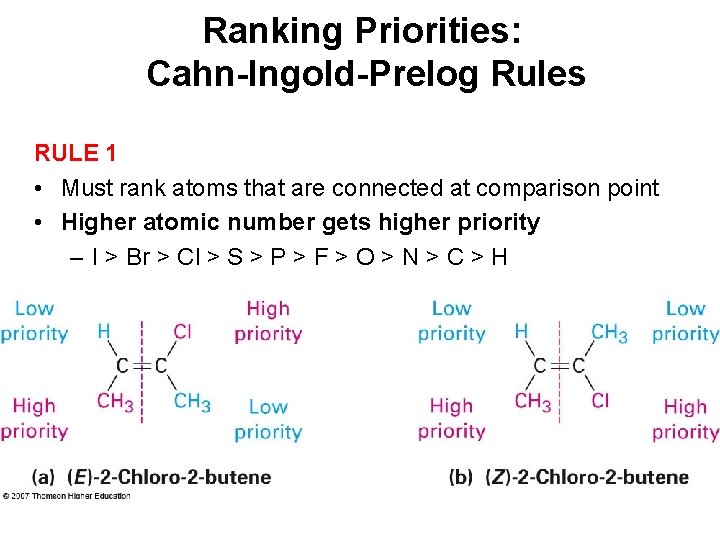
Ranking Priorities: Cahn-Ingold-Prelog Rules RULE 1 • Must rank atoms that are connected at comparison point • Higher atomic number gets higher priority – I > Br > Cl > S > P > F > O > N > C > H
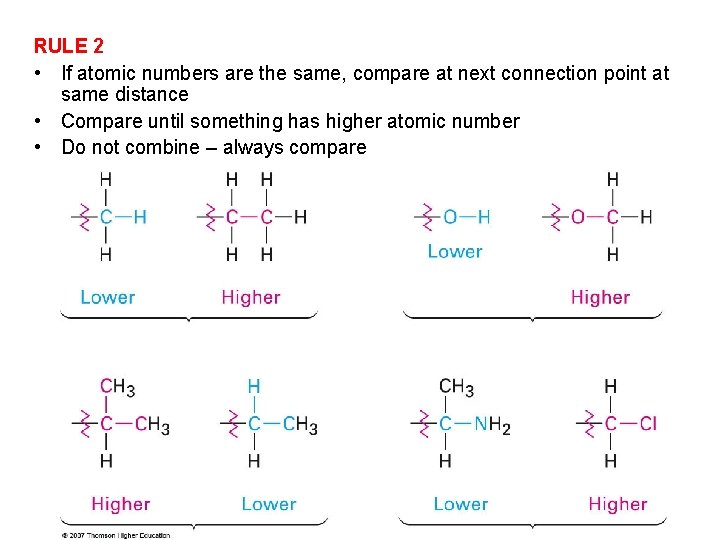
RULE 2 • If atomic numbers are the same, compare at next connection point at same distance • Compare until something has higher atomic number • Do not combine – always compare
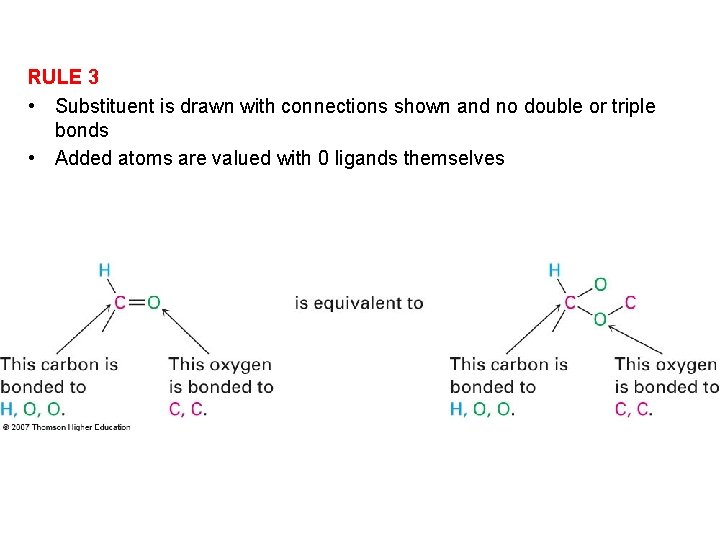
RULE 3 • Substituent is drawn with connections shown and no double or triple bonds • Added atoms are valued with 0 ligands themselves
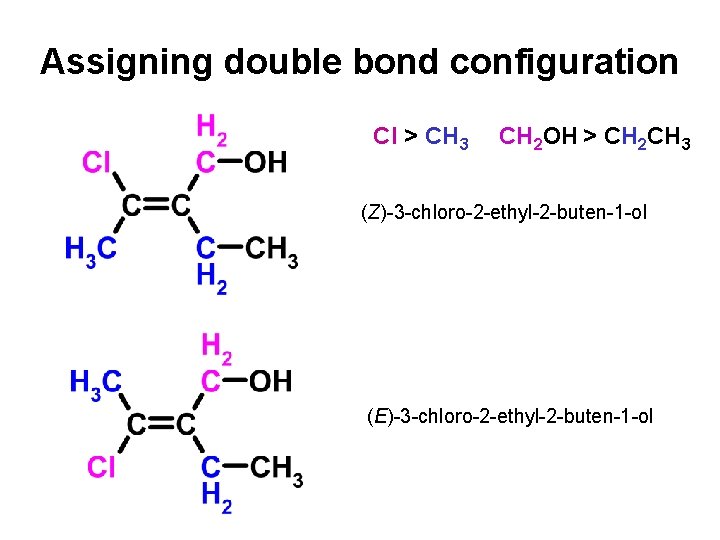
Assigning double bond configuration Cl > CH 3 CH 2 OH > CH 2 CH 3 (Z)-3 -chloro-2 -ethyl-2 -buten-1 -ol (E)-3 -chloro-2 -ethyl-2 -buten-1 -ol
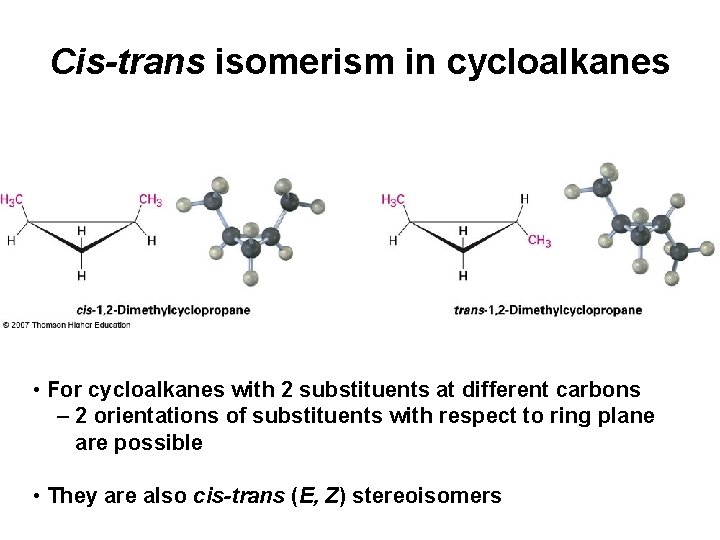
Cis-trans isomerism in cycloalkanes • For cycloalkanes with 2 substituents at different carbons – 2 orientations of substituents with respect to ring plane are possible • They are also cis-trans (E, Z) stereoisomers
Chirality
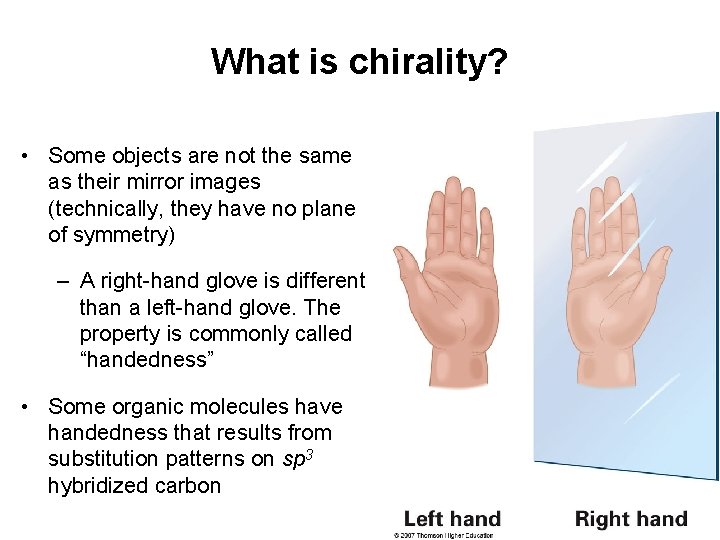
What is chirality? • Some objects are not the same as their mirror images (technically, they have no plane of symmetry) – A right-hand glove is different than a left-hand glove. The property is commonly called “handedness” • Some organic molecules have handedness that results from substitution patterns on sp 3 hybridized carbon
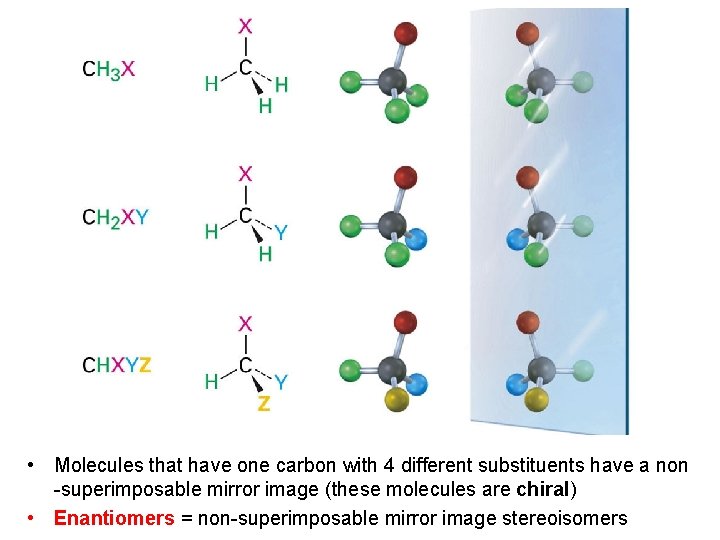
• Molecules that have one carbon with 4 different substituents have a non -superimposable mirror image (these molecules are chiral) • Enantiomers = non-superimposable mirror image stereoisomers
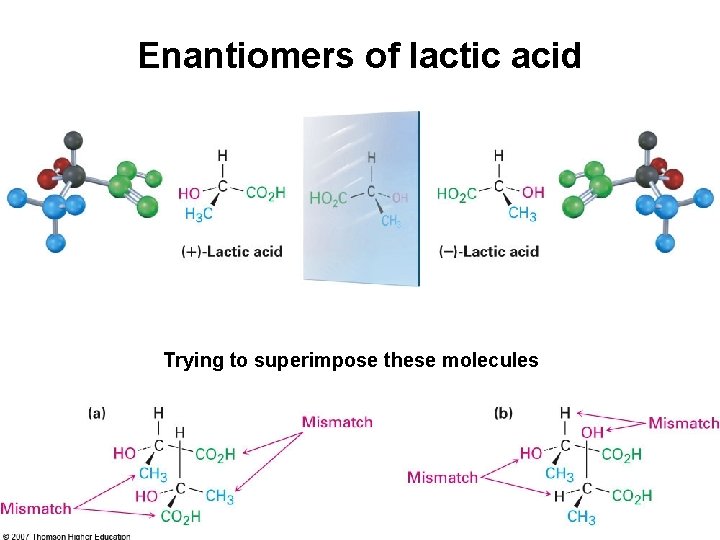
Enantiomers of lactic acid Trying to superimpose these molecules
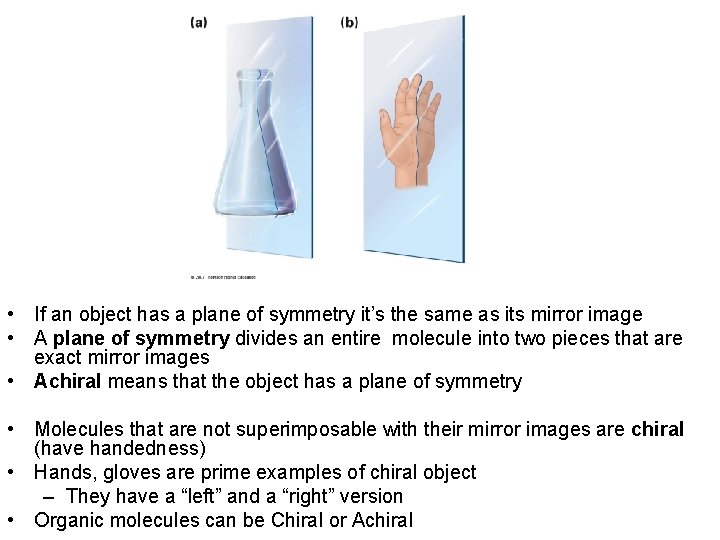
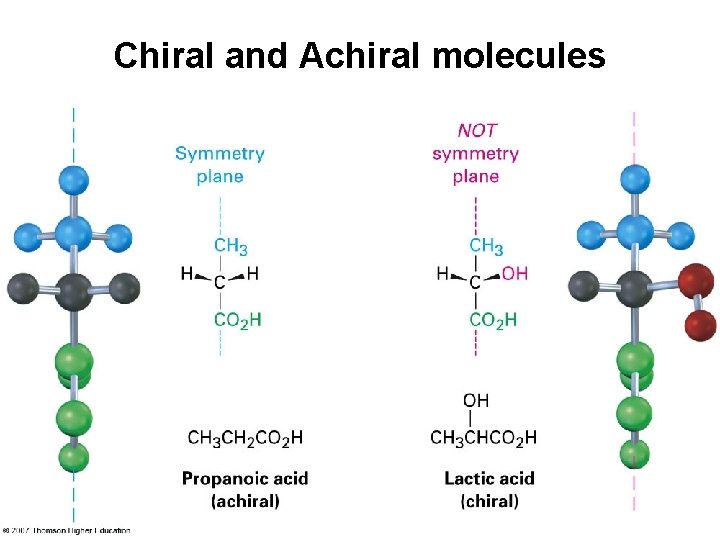
• If an object has a plane of symmetry it’s the same as its mirror image • A plane of symmetry divides an entire molecule into two pieces that are exact mirror images • Achiral means that the object has a plane of symmetry • Molecules that are not superimposable with their mirror images are chiral (have handedness) • Hands, gloves are prime examples of chiral object – They have a “left” and a “right” version • Organic molecules can be Chiral or Achiral
Chiral and Achiral molecules
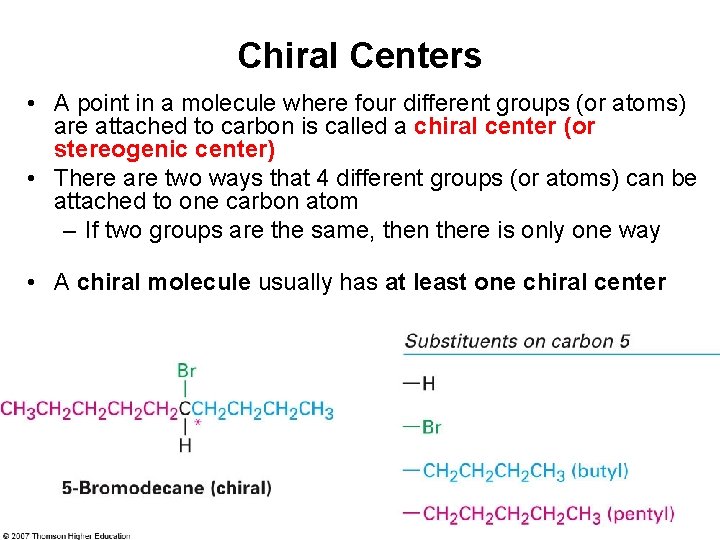
Chiral Centers • A point in a molecule where four different groups (or atoms) are attached to carbon is called a chiral center (or stereogenic center) • There are two ways that 4 different groups (or atoms) can be attached to one carbon atom – If two groups are the same, then there is only one way • A chiral molecule usually has at least one chiral center
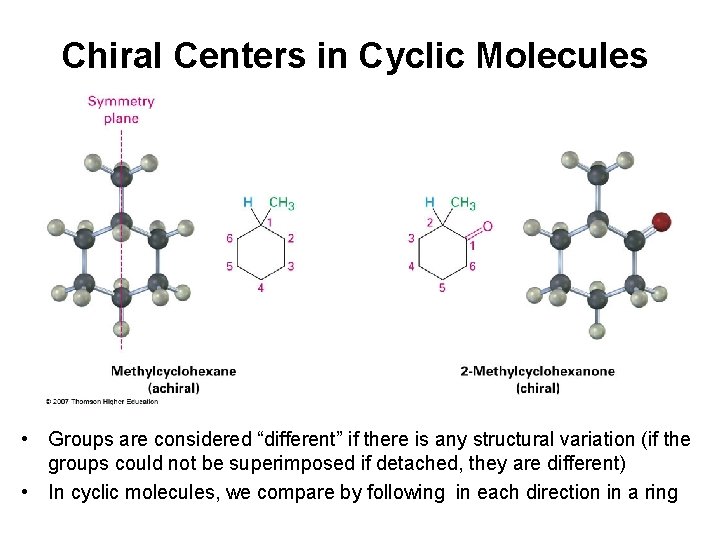
Chiral Centers in Cyclic Molecules • Groups are considered “different” if there is any structural variation (if the groups could not be superimposed if detached, they are different) • In cyclic molecules, we compare by following in each direction in a ring
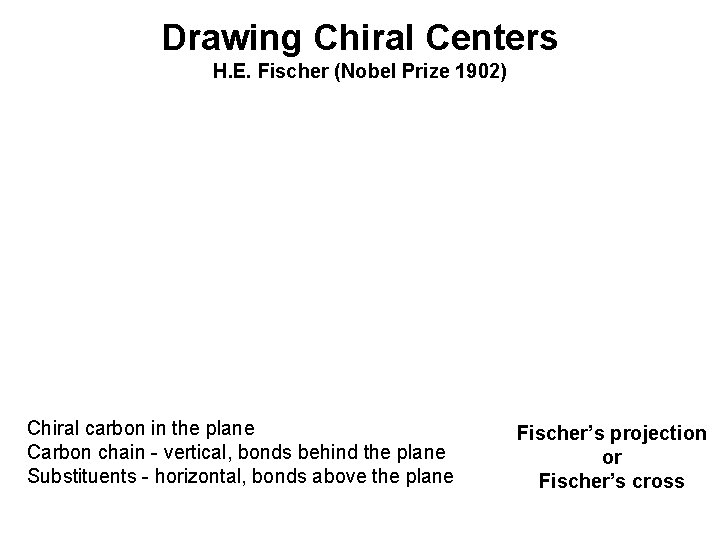
Drawing Chiral Centers H. E. Fischer (Nobel Prize 1902) Chiral carbon in the plane Carbon chain - vertical, bonds behind the plane Substituents - horizontal, bonds above the plane Fischer’s projection or Fischer’s cross
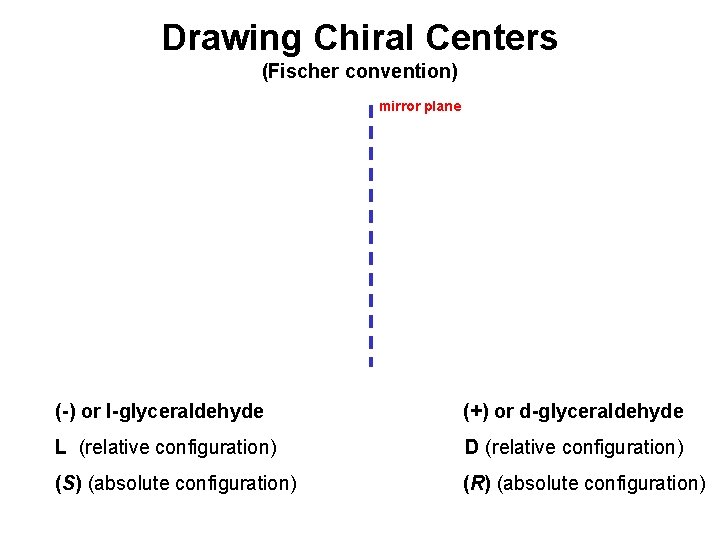
Drawing Chiral Centers (Fischer convention) mirror plane (-) or l-glyceraldehyde (+) or d-glyceraldehyde L (relative configuration) D (relative configuration) (S) (absolute configuration) (R) (absolute configuration)
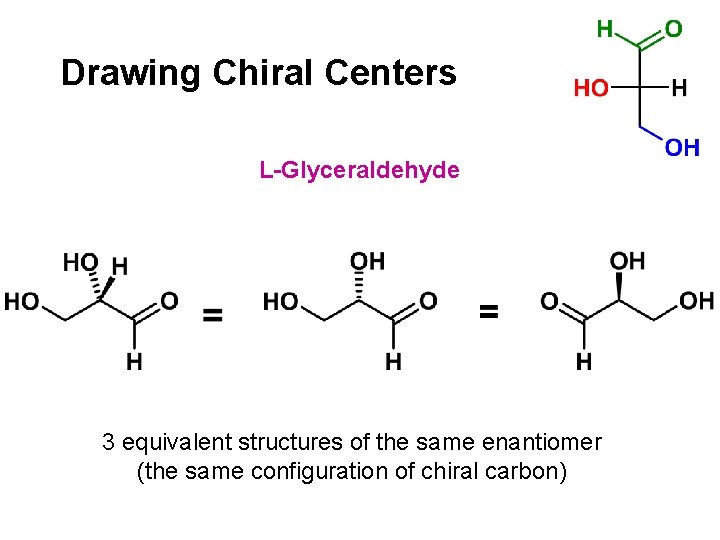
Drawing Chiral Centers L-Glyceraldehyde 3 equivalent structures of the same enantiomer (the same configuration of chiral carbon)
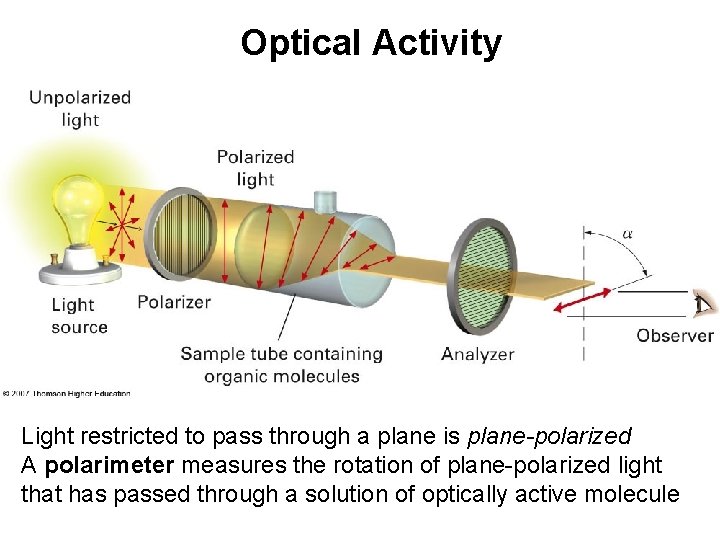
Optical Activity Light restricted to pass through a plane is plane-polarized A polarimeter measures the rotation of plane-polarized light that has passed through a solution of optically active molecule
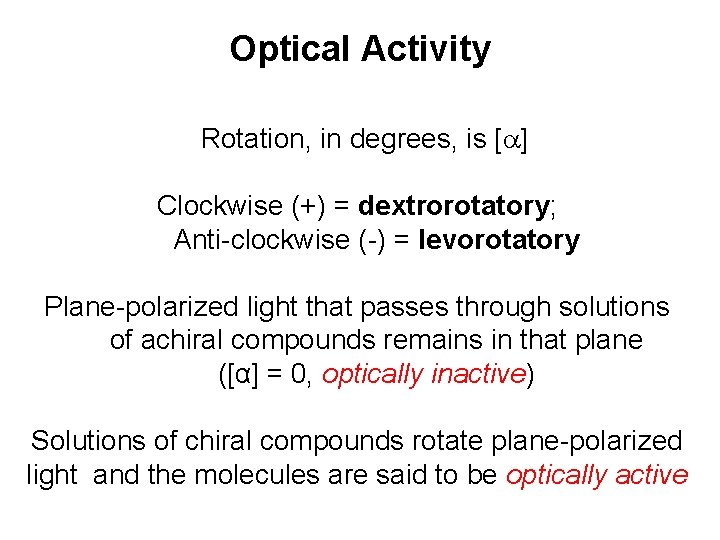
Optical Activity Rotation, in degrees, is [ ] Clockwise (+) = dextrorotatory; Anti-clockwise (-) = levorotatory Plane-polarized light that passes through solutions of achiral compounds remains in that plane ([α] = 0, optically inactive) Solutions of chiral compounds rotate plane-polarized light and the molecules are said to be optically active
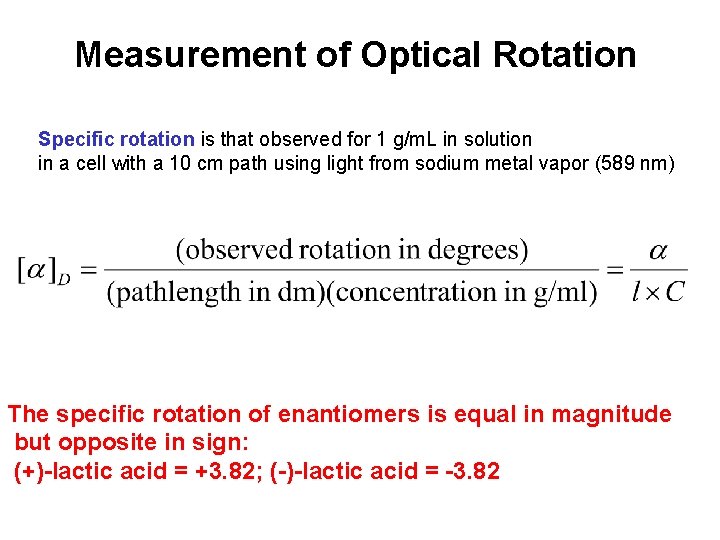
Measurement of Optical Rotation Specific rotation is that observed for 1 g/m. L in solution in a cell with a 10 cm path using light from sodium metal vapor (589 nm) The specific rotation of enantiomers is equal in magnitude but opposite in sign: (+)-lactic acid = +3. 82; (-)-lactic acid = -3. 82
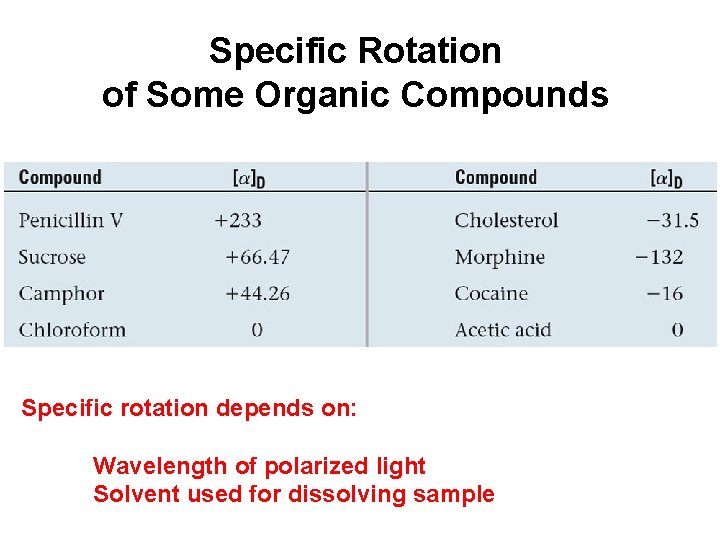
Specific Rotation of Some Organic Compounds Specific rotation depends on: Wavelength of polarized light Solvent used for dissolving sample
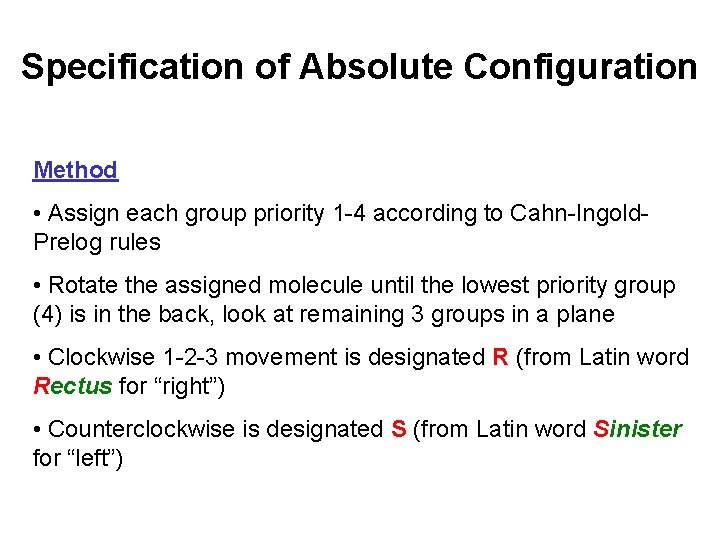
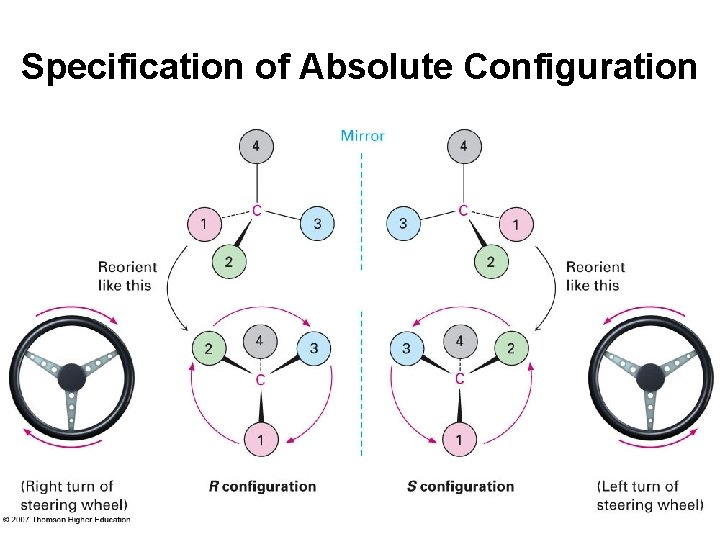
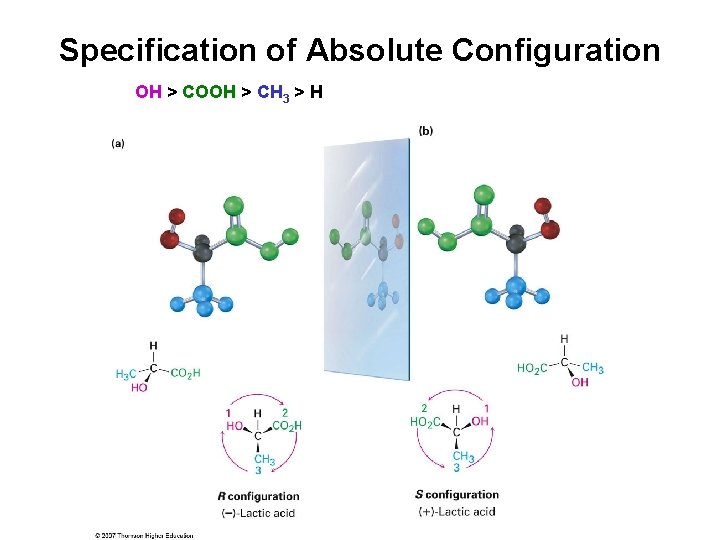
Specification of Absolute Configuration Method • Assign each group priority 1 -4 according to Cahn-Ingold. Prelog rules • Rotate the assigned molecule until the lowest priority group (4) is in the back, look at remaining 3 groups in a plane • Clockwise 1 -2 -3 movement is designated R (from Latin word Rectus for “right”) • Counterclockwise is designated S (from Latin word Sinister for “left”)
Specification of Absolute Configuration
Specification of Absolute Configuration OH > COOH > CH 3 > H
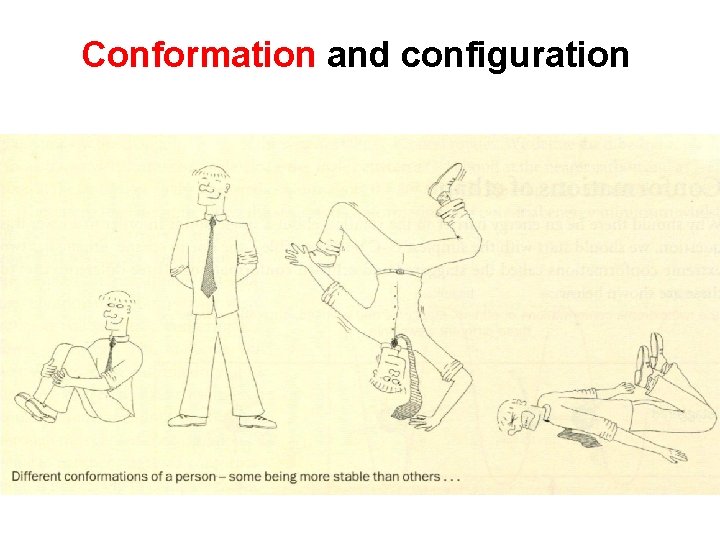
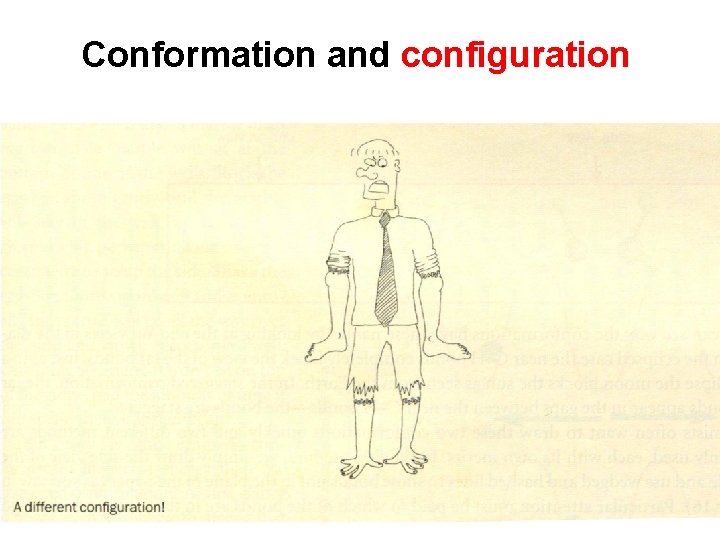
Conformation and configuration • Structures that can be interconverted simply by rotation about single bonds are conformations of the same molecule • Structures that can be interconverted only by breaking one or more bonds have different configurations, and are stereoisomers
Conformation and configuration
Conformation and configuration
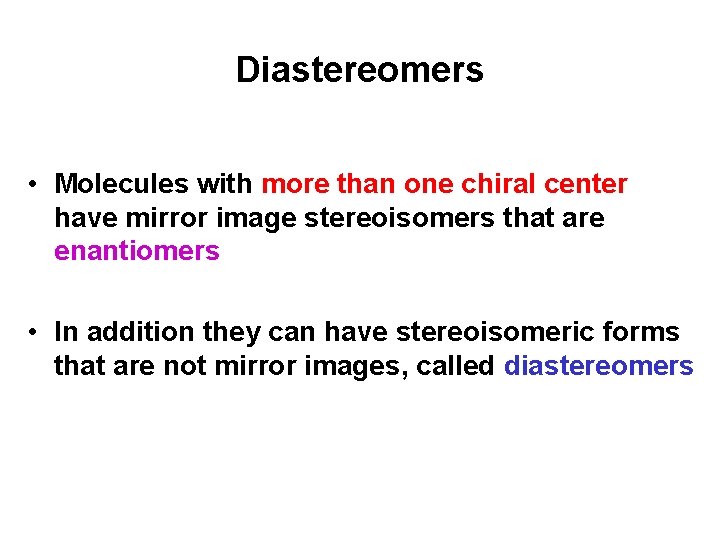
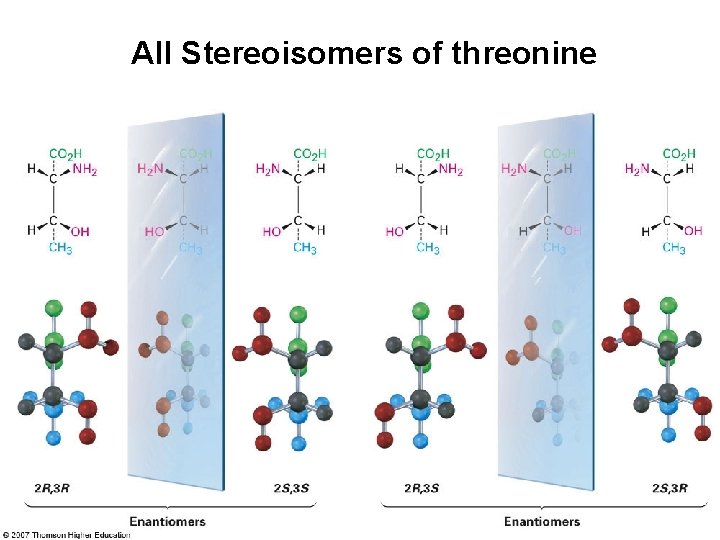
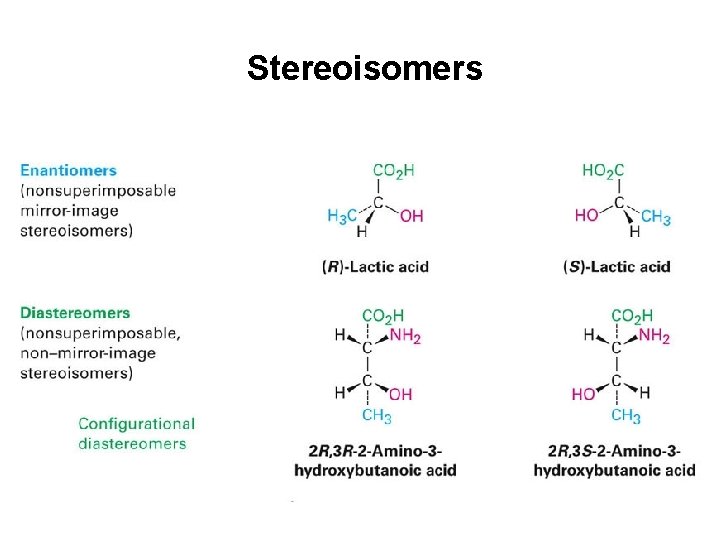
Diastereomers • Molecules with more than one chiral center have mirror image stereoisomers that are enantiomers • In addition they can have stereoisomeric forms that are not mirror images, called diastereomers
All Stereoisomers of threonine
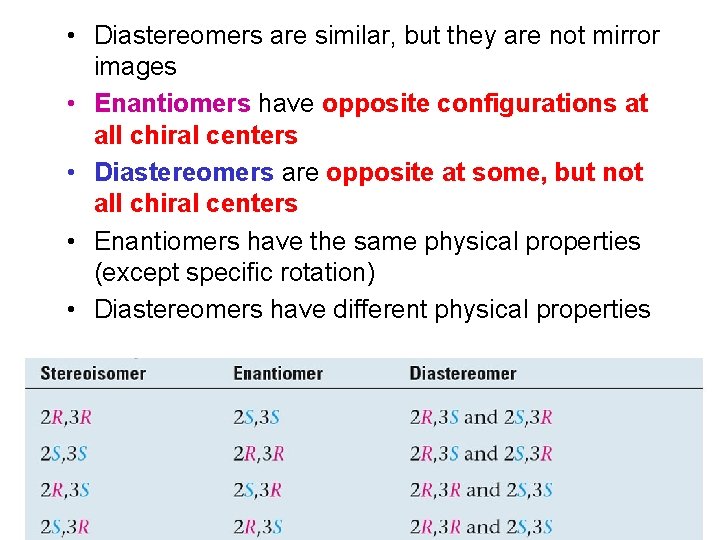
• Diastereomers are similar, but they are not mirror images • Enantiomers have opposite configurations at all chiral centers • Diastereomers are opposite at some, but not all chiral centers • Enantiomers have the same physical properties (except specific rotation) • Diastereomers have different physical properties
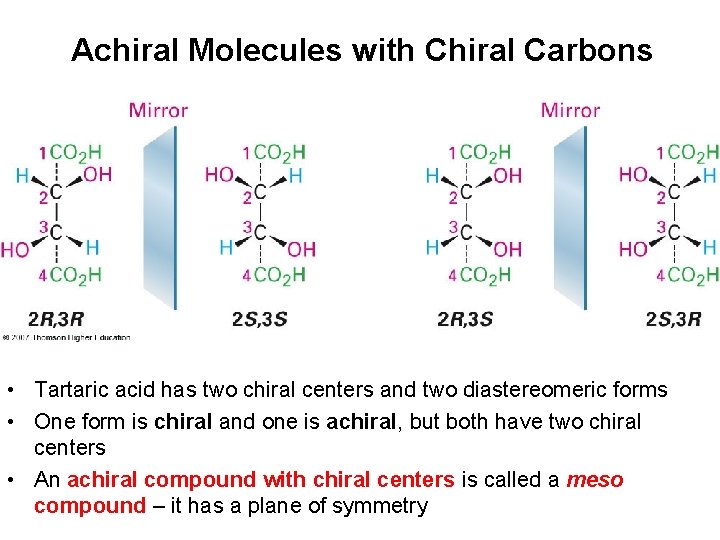
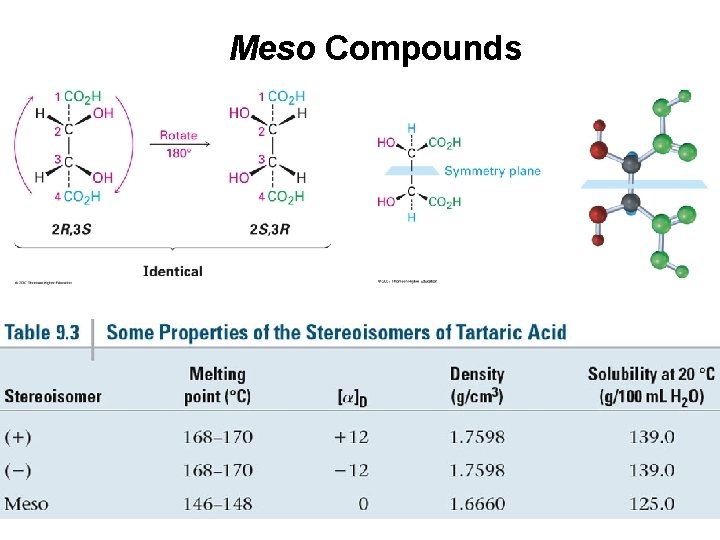
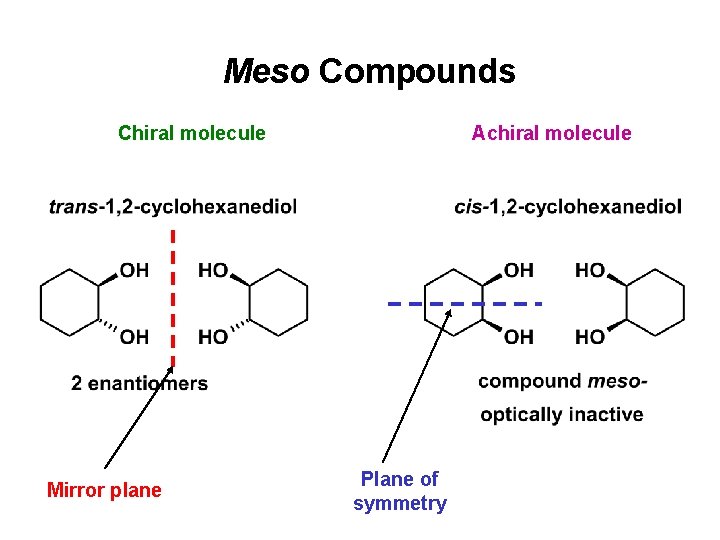
Achiral Molecules with Chiral Carbons • Tartaric acid has two chiral centers and two diastereomeric forms • One form is chiral and one is achiral, but both have two chiral centers • An achiral compound with chiral centers is called a meso compound – it has a plane of symmetry
Meso Compounds
Meso Compounds Chiral molecule Mirror plane Achiral molecule Plane of symmetry
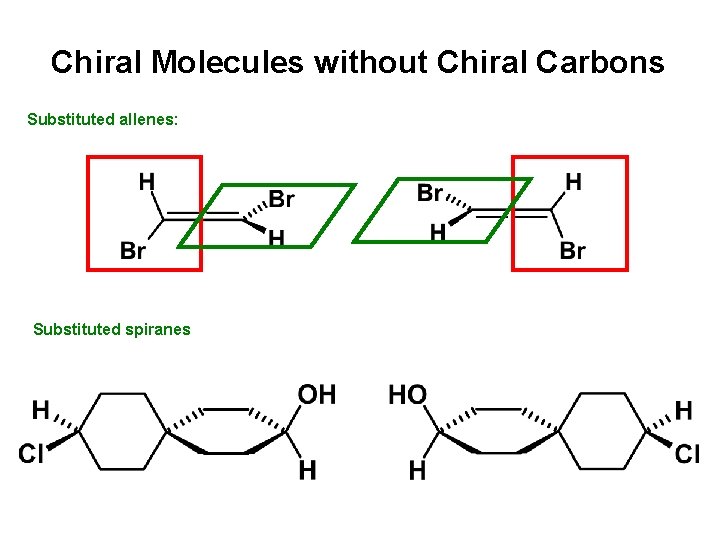
Chiral Molecules without Chiral Carbons Substituted allenes: Substituted spiranes
Chiral Molecules without Chiral Carbons Ortho-substituted biphenyl compounds
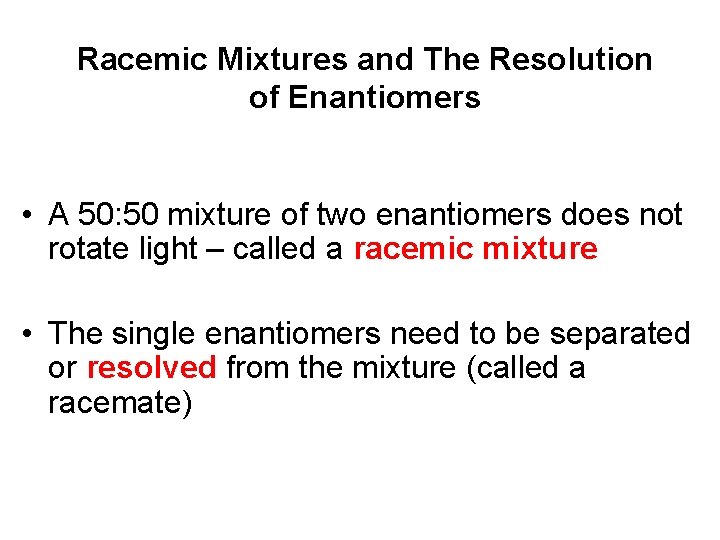
Racemic Mixtures and The Resolution of Enantiomers • A 50: 50 mixture of two enantiomers does not rotate light – called a racemic mixture • The single enantiomers need to be separated or resolved from the mixture (called a racemate)
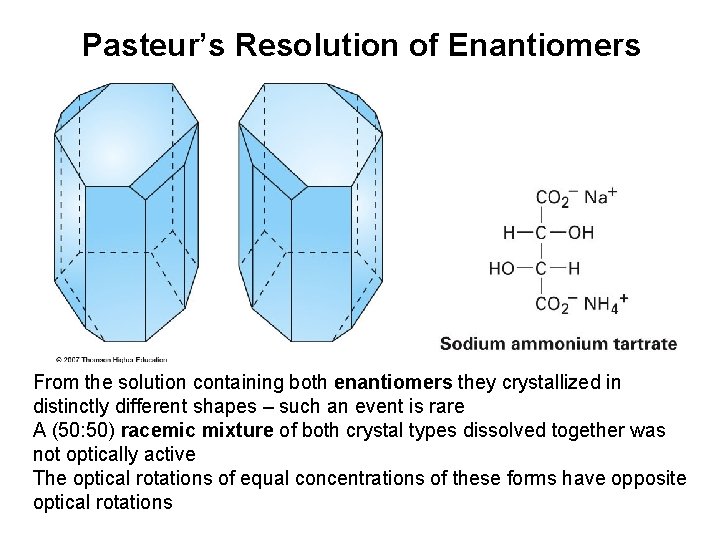
Pasteur’s Resolution of Enantiomers From the solution containing both enantiomers they crystallized in distinctly different shapes – such an event is rare A (50: 50) racemic mixture of both crystal types dissolved together was not optically active The optical rotations of equal concentrations of these forms have opposite optical rotations
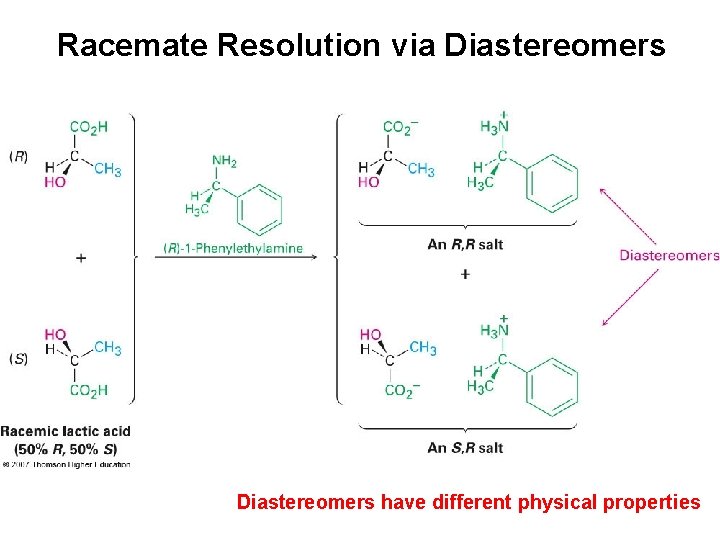
Racemate Resolution via Diastereomers have different physical properties
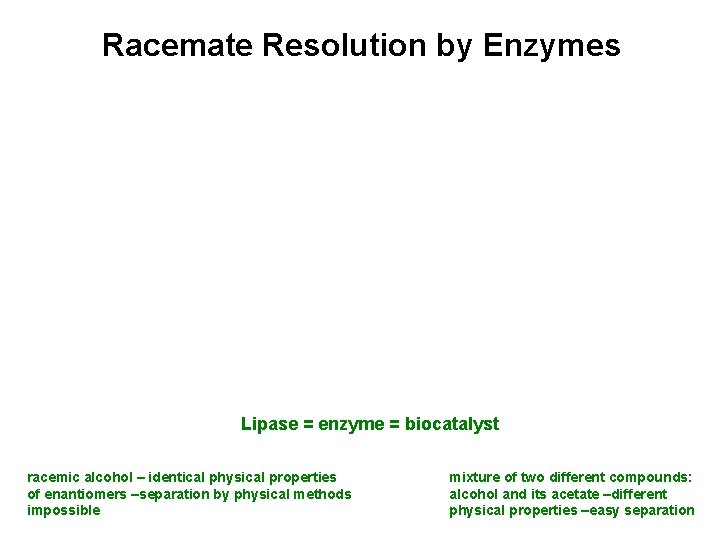
Racemate Resolution by Enzymes Lipase = enzyme = biocatalyst racemic alcohol – identical physical properties of enantiomers –separation by physical methods impossible mixture of two different compounds: alcohol and its acetate –different physical properties –easy separation
Chirality in Nature
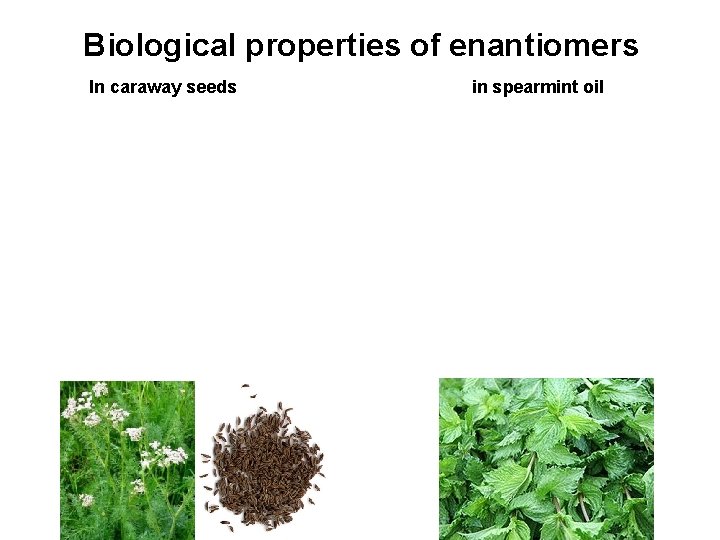
Biological properties of enantiomers In caraway seeds in spearmint oil
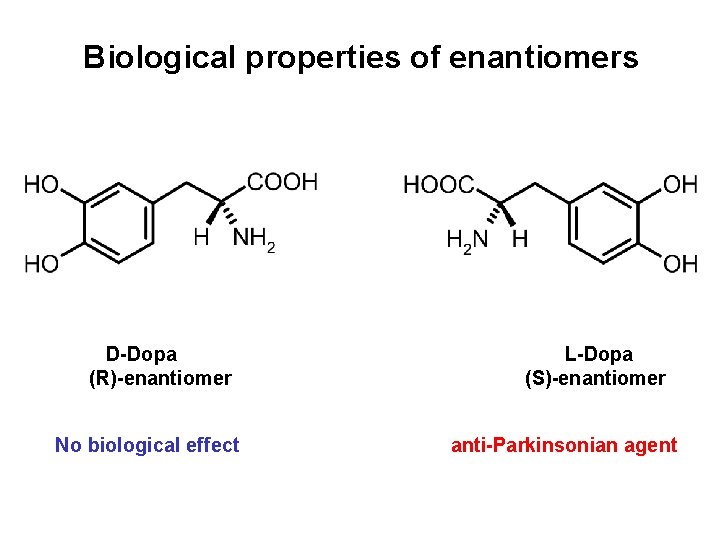
Biological properties of enantiomers D-Dopa (R)-enantiomer No biological effect L-Dopa (S)-enantiomer anti-Parkinsonian agent
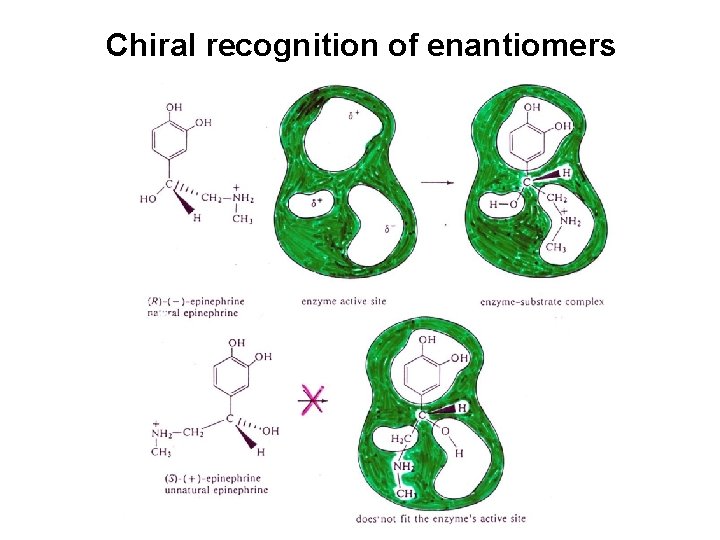
Chiral recognition of enantiomers
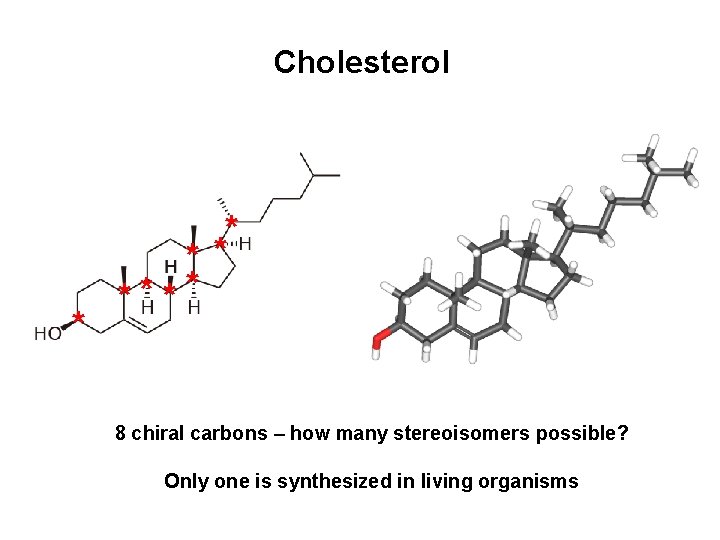
Cholesterol * * ** **** 8 chiral carbons – how many stereoisomers possible? Only one is synthesized in living organisms
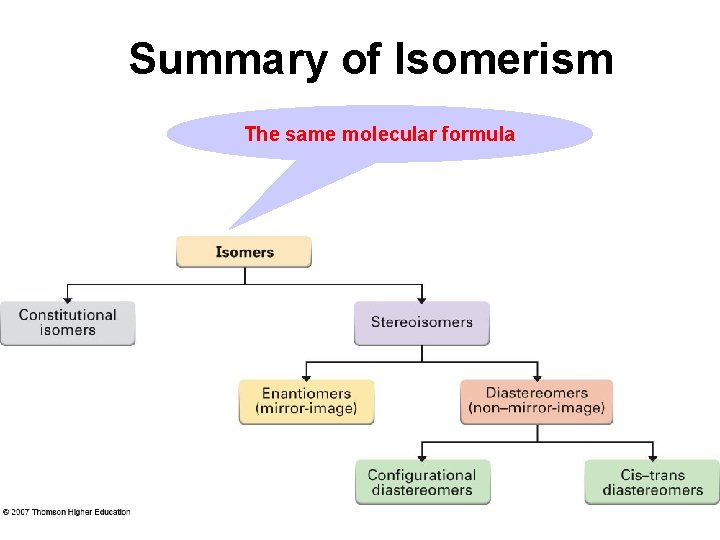
Summary of Isomerism The same molecular formula
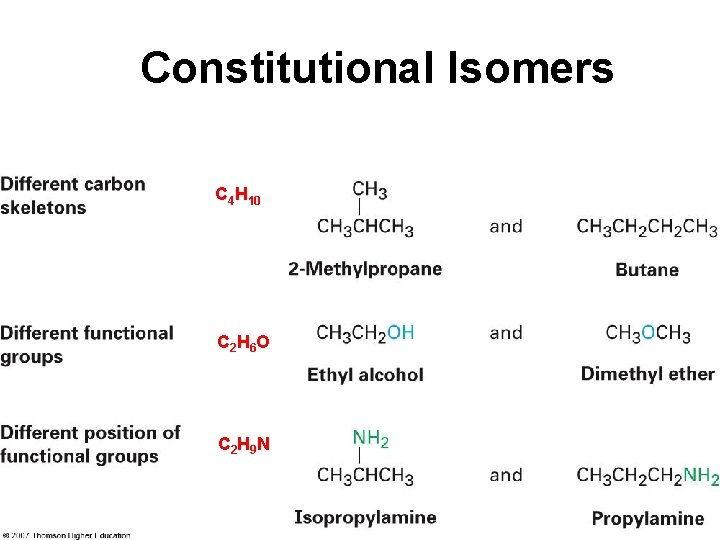
Constitutional Isomers C 4 H 10 C 2 H 6 O C 2 H 9 N
Stereoisomers
Stereoisomers