CS 5100 Advanced Computer Architecture Dynamic Scheduling Prof
- Slides: 44
CS 5100 Advanced Computer Architecture Dynamic Scheduling Prof. Chung-Ta King Department of Computer Science National Tsing Hua University, Taiwan (Slides are from textbook, Prof. Hsien-Hsin Lee, Prof. Yasun Hsu) National Tsing Hua University
About This Lecture • Goal: - To understand the basic concepts of dynamic scheduling and the Tomasulo algorithm • Outline: - Overcoming data hazards with dynamic scheduling (Sec. 3. 4) - Dynamic scheduling: examples and algorithm (Sec. 3. 5) National Tsing Hua University 1
Maximum ILP What make a sequence of code to have the highest ILP? • Data dependence • Control dependence • Can a compiler give you such code? National Tsing Hua University 2
Compiler Has Its Limitations • Even though compiler can see a lot of ILP, it still outputs sequential code for conventional processors (next page) - Many ILP lost in code generation • Code targeting one processor may not be optimized for another with a different microarchitecture • A lot of information unavailable at compile time, e. g. branch direction and target, pointer addresses, … National Tsing Hua University 3
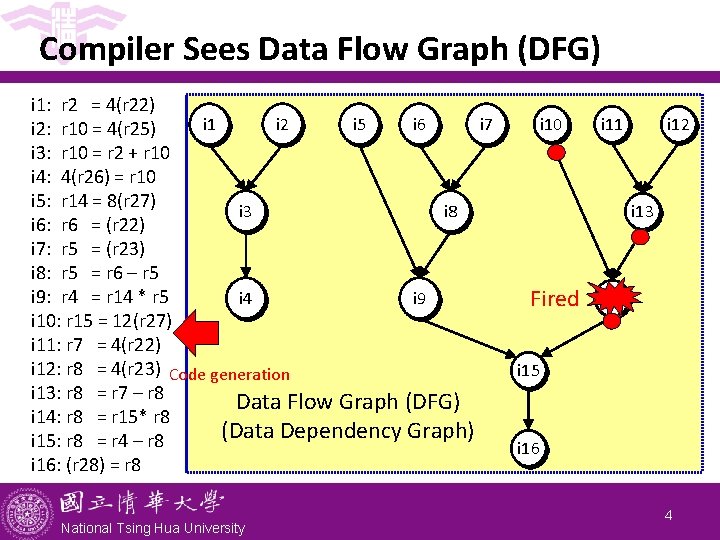
Compiler Sees Data Flow Graph (DFG) i 1: r 2 = 4(r 22) i 1 i 2 i 5 i 6 i 7 i 2: r 10 = 4(r 25) i 3: r 10 = r 2 + r 10 i 4: 4(r 26) = r 10 i 5: r 14 = 8(r 27) i 3 i 8 i 6: r 6 = (r 22) i 7: r 5 = (r 23) i 8: r 5 = r 6 – r 5 i 9: r 4 = r 14 * r 5 i 4 i 9 i 10: r 15 = 12(r 27) i 11: r 7 = 4(r 22) i 12: r 8 = 4(r 23) Code generation i 13: r 8 = r 7 – r 8 Data Flow Graph (DFG) i 14: r 8 = r 15* r 8 (Data Dependency Graph) i 15: r 8 = r 4 – r 8 i 16: (r 28) = r 8 National Tsing Hua University i 10 i 11 i 12 i 13 Fired i 14 i 15 i 16 4
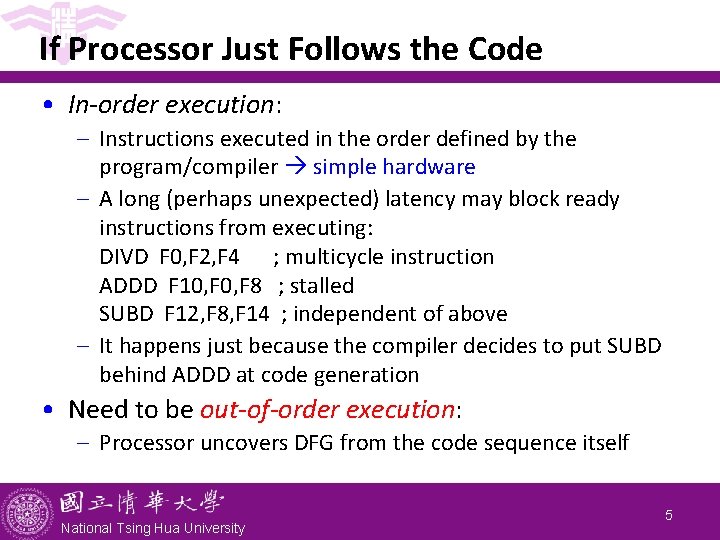
If Processor Just Follows the Code • In-order execution: - Instructions executed in the order defined by the program/compiler simple hardware - A long (perhaps unexpected) latency may block ready instructions from executing: DIVD F 0, F 2, F 4 ; multicycle instruction ADDD F 10, F 8 ; stalled SUBD F 12, F 8, F 14 ; independent of above - It happens just because the compiler decides to put SUBD behind ADDD at code generation • Need to be out-of-order execution: - Processor uncovers DFG from the code sequence itself National Tsing Hua University 5
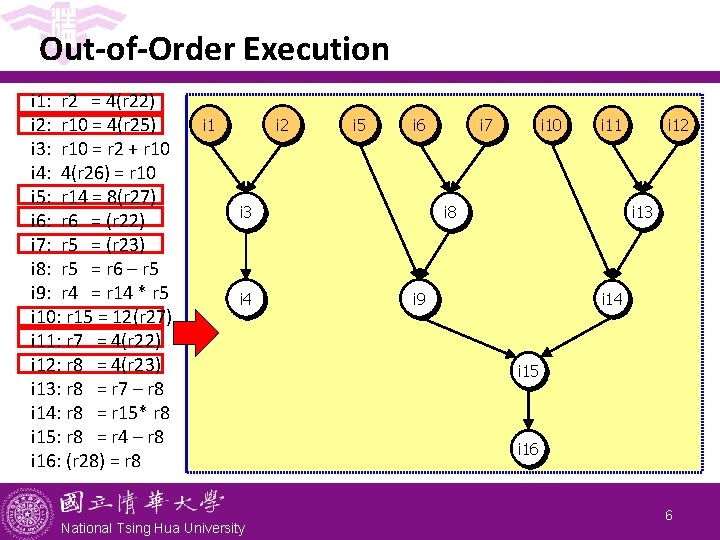
Out-of-Order Execution i 1: r 2 = 4(r 22) i 2: r 10 = 4(r 25) i 3: r 10 = r 2 + r 10 i 4: 4(r 26) = r 10 i 5: r 14 = 8(r 27) i 6: r 6 = (r 22) i 7: r 5 = (r 23) i 8: r 5 = r 6 – r 5 i 9: r 4 = r 14 * r 5 i 10: r 15 = 12(r 27) i 11: r 7 = 4(r 22) i 12: r 8 = 4(r 23) i 13: r 8 = r 7 – r 8 i 14: r 8 = r 15* r 8 i 15: r 8 = r 4 – r 8 i 16: (r 28) = r 8 i 1 i 2 i 5 i 6 i 3 i 4 National Tsing Hua University i 10 i 7 i 11 i 8 i 12 i 13 i 14 i 9 i 15 i 16 6
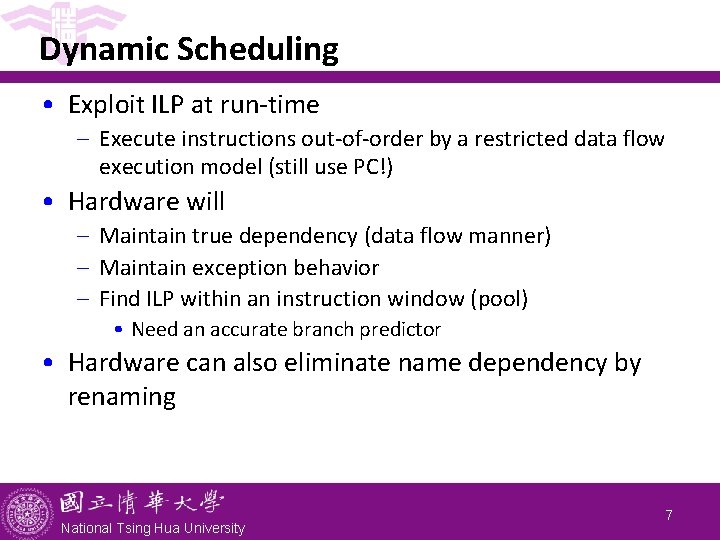
Dynamic Scheduling • Exploit ILP at run-time - Execute instructions out-of-order by a restricted data flow execution model (still use PC!) • Hardware will - Maintain true dependency (data flow manner) - Maintain exception behavior - Find ILP within an instruction window (pool) • Need an accurate branch predictor • Hardware can also eliminate name dependency by renaming National Tsing Hua University 7
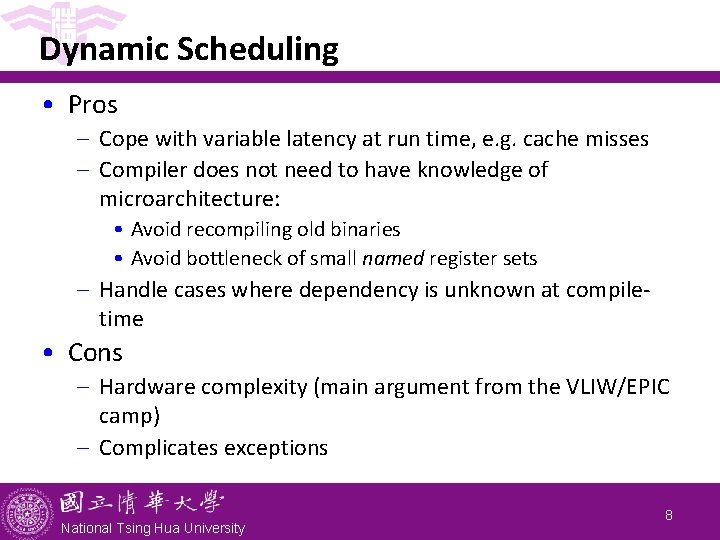
Dynamic Scheduling • Pros - Cope with variable latency at run time, e. g. cache misses - Compiler does not need to have knowledge of microarchitecture: • Avoid recompiling old binaries • Avoid bottleneck of small named register sets - Handle cases where dependency is unknown at compiletime • Cons - Hardware complexity (main argument from the VLIW/EPIC camp) - Complicates exceptions National Tsing Hua University 8
Out-of-Order (OOO) Execution • OOO execution out-of-order completion - Begin execution as soon as operands are available - Complete execution as soon as output operand generated • OOO execution out-of-order retirement (commitment, write result) - Machine state is not changed until instruction commits - No (speculative) instructions are allowed to retire until they are confirmed to be on the right path • Fetch, decode, issue (i. e. front-end) are still done in the program order National Tsing Hua University 9
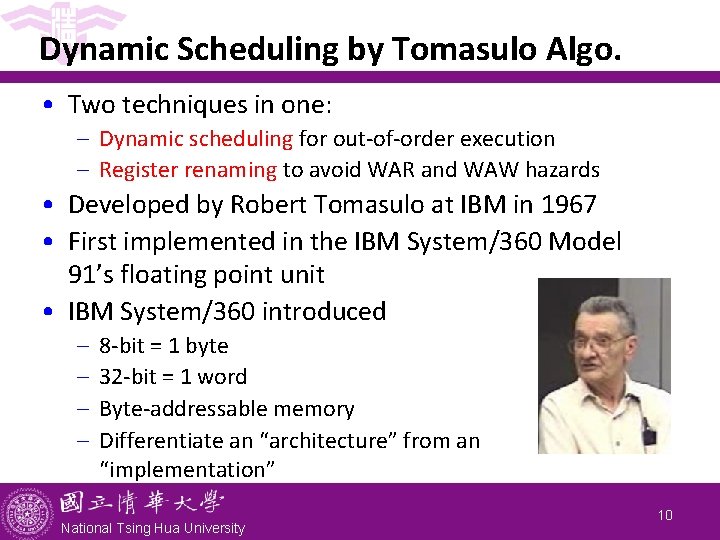
Dynamic Scheduling by Tomasulo Algo. • Two techniques in one: - Dynamic scheduling for out-of-order execution - Register renaming to avoid WAR and WAW hazards • Developed by Robert Tomasulo at IBM in 1967 • First implemented in the IBM System/360 Model 91’s floating point unit • IBM System/360 introduced - 8 -bit = 1 byte 32 -bit = 1 word Byte-addressable memory Differentiate an “architecture” from an “implementation” National Tsing Hua University 10
Problems with IBM 360/91 ISA • 2 register specifiers/instruction in IBM 360 - e. g. MULTD F 2, F 0 // F 2 F 0 - Make WAW and WAR much worse • 4 FP registers in IBM 360 ISA - Instructions can only see and use 4 FP registers architecture visible registers - Make compiler difficult to allocate registers, e. g. need to reuse registers, creating name dependences • Memory-to-register and FP operations - Long and variable instruction execution time National Tsing Hua University 11
Motivation for Tomasulo Algorithm • Cope with only 4 FP registers - Use more internal, architecture invisible registers (virtual registers) to break name dependences reg. renaming • High FP performance without specialized compilers - Hardware detects data dependences via registers used - Hardware schedules instruction execution following DFG • Overcome long memory and FP delays - OOO execution to allow instruction execution overlapped • Support execution of multiple iterations of a loop - Even if loop branches can be predicted perfectly, still need to handle name dependence across iterations National Tsing Hua University 12
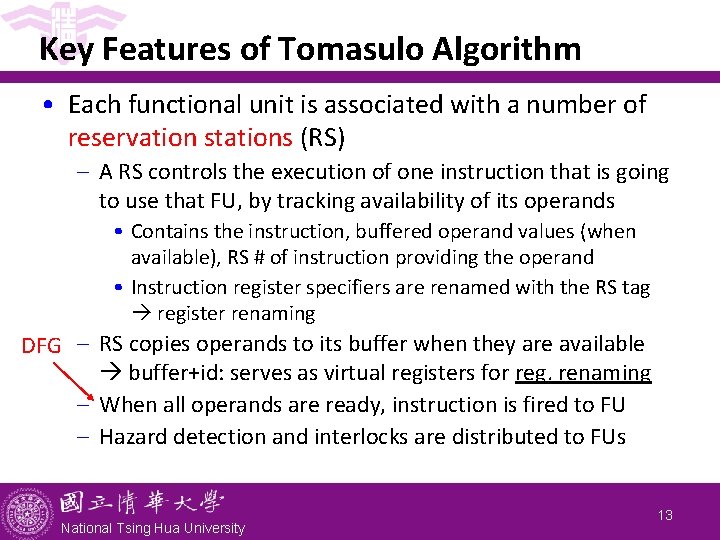
Key Features of Tomasulo Algorithm • Each functional unit is associated with a number of reservation stations (RS) - A RS controls the execution of one instruction that is going to use that FU, by tracking availability of its operands • Contains the instruction, buffered operand values (when available), RS # of instruction providing the operand • Instruction register specifiers are renamed with the RS tag register renaming DFG - RS copies operands to its buffer when they are available buffer+id: serves as virtual registers for reg. renaming - When all operands are ready, instruction is fired to FU - Hazard detection and interlocks are distributed to FUs National Tsing Hua University 13
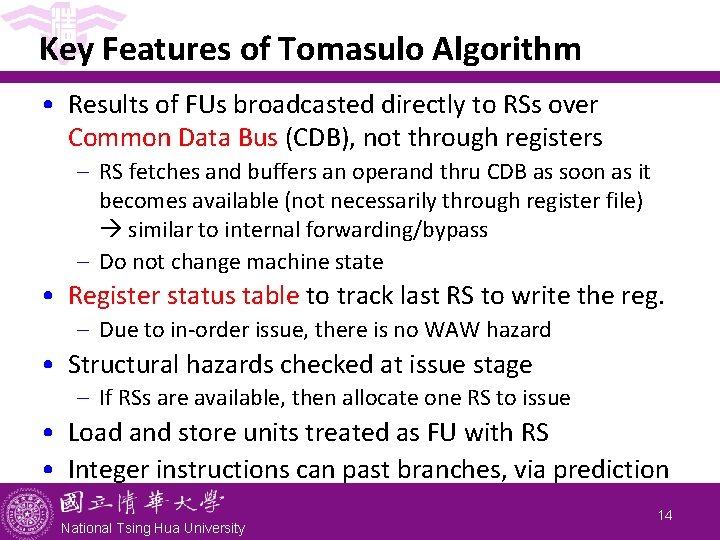
Key Features of Tomasulo Algorithm • Results of FUs broadcasted directly to RSs over Common Data Bus (CDB), not through registers - RS fetches and buffers an operand thru CDB as soon as it becomes available (not necessarily through register file) similar to internal forwarding/bypass - Do not change machine state • Register status table to track last RS to write the reg. - Due to in-order issue, there is no WAW hazard • Structural hazards checked at issue stage - If RSs are available, then allocate one RS to issue • Load and store units treated as FU with RS • Integer instructions can past branches, via prediction National Tsing Hua University 14
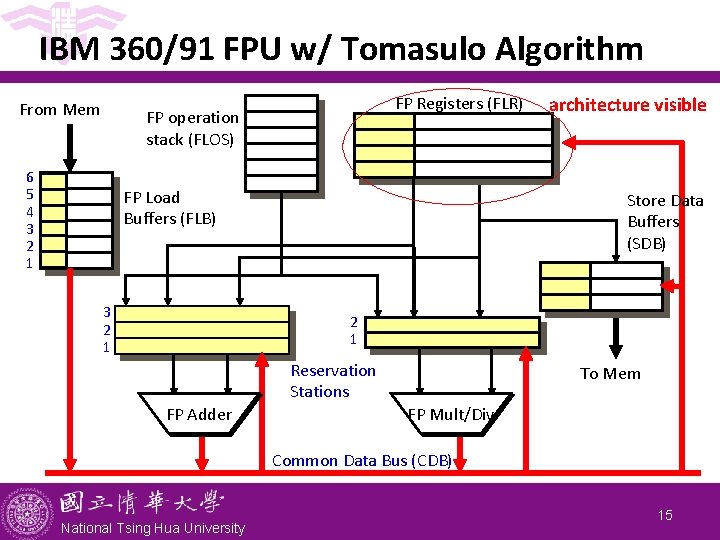
IBM 360/91 FPU w/ Tomasulo Algorithm From Mem FP Registers (FLR) FP operation stack (FLOS) 6 5 4 3 2 1 FP Load Buffers (FLB) 3 2 1 architecture visible Store Data Buffers (SDB) 2 1 Reservation Stations FP Adder To Mem FP Mult/Div Common Data Bus (CDB) National Tsing Hua University 15
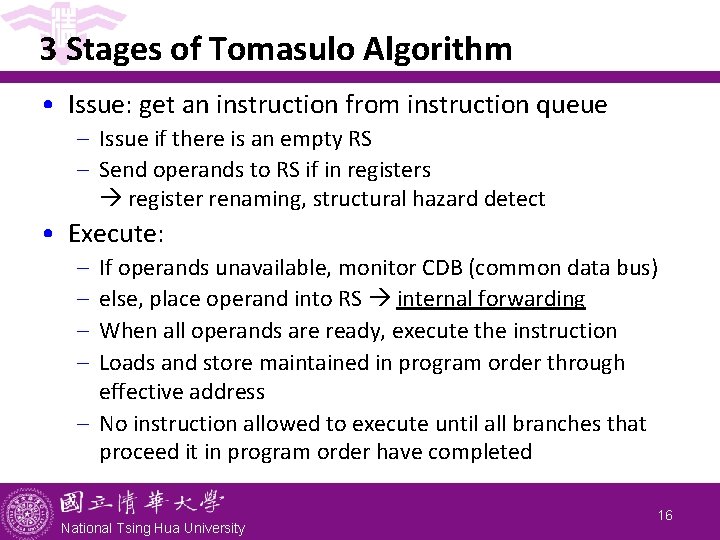
3 Stages of Tomasulo Algorithm • Issue: get an instruction from instruction queue - Issue if there is an empty RS - Send operands to RS if in registers register renaming, structural hazard detect • Execute: - If operands unavailable, monitor CDB (common data bus) else, place operand into RS internal forwarding When all operands are ready, execute the instruction Loads and store maintained in program order through effective address - No instruction allowed to execute until all branches that proceed it in program order have completed National Tsing Hua University 16
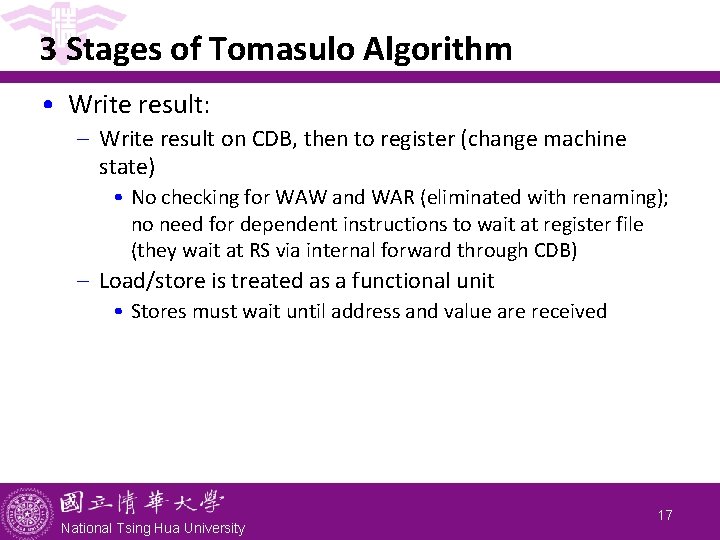
3 Stages of Tomasulo Algorithm • Write result: - Write result on CDB, then to register (change machine state) • No checking for WAW and WAR (eliminated with renaming); no need for dependent instructions to wait at register file (they wait at RS via internal forward through CDB) - Load/store is treated as a functional unit • Stores must wait until address and value are received National Tsing Hua University 17
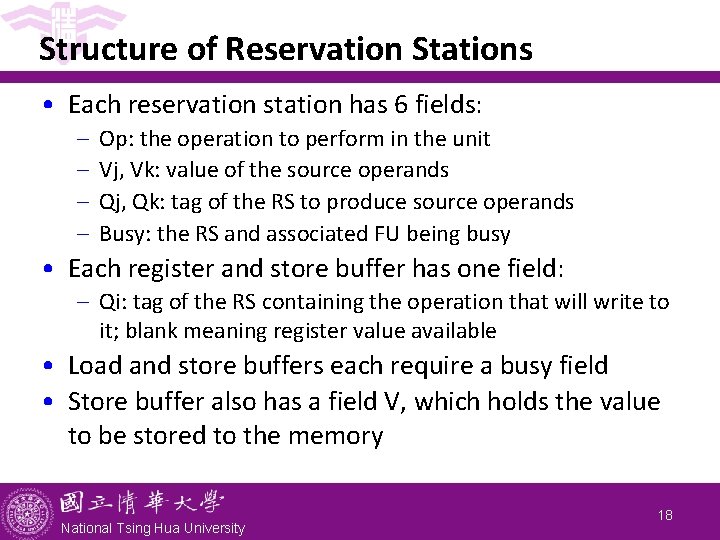
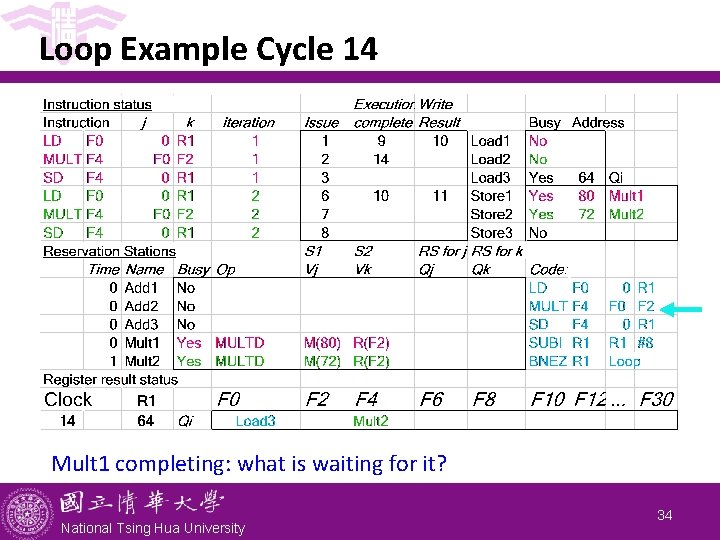
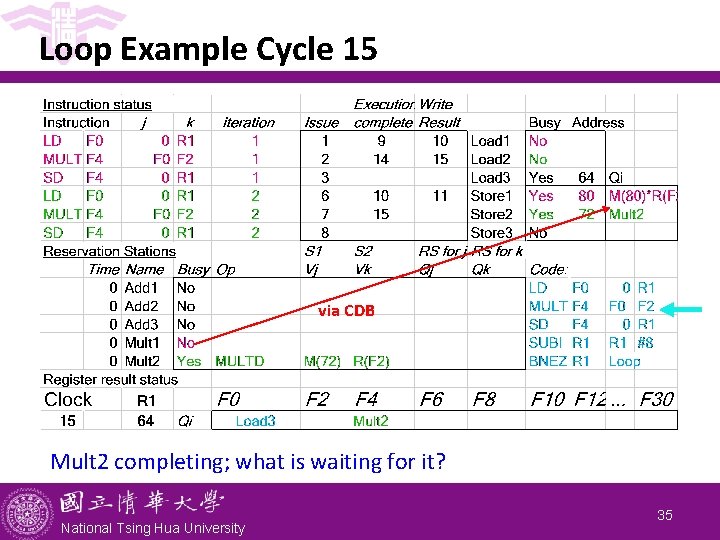
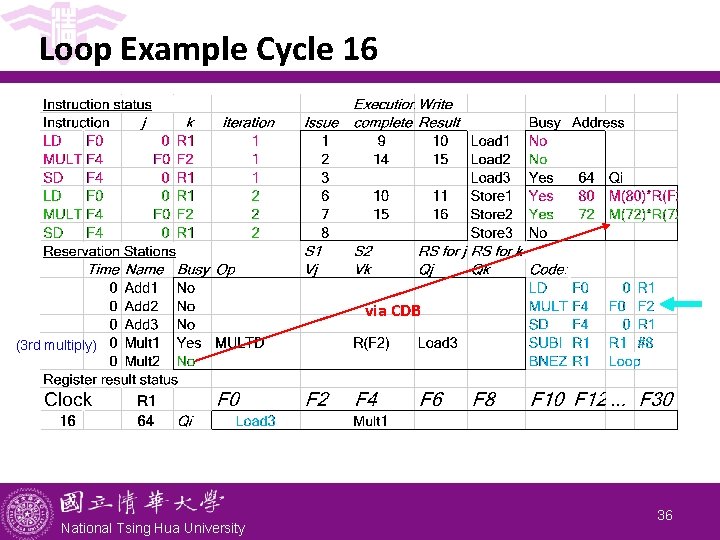
Structure of Reservation Stations • Each reservation station has 6 fields: - Op: the operation to perform in the unit Vj, Vk: value of the source operands Qj, Qk: tag of the RS to produce source operands Busy: the RS and associated FU being busy • Each register and store buffer has one field: - Qi: tag of the RS containing the operation that will write to it; blank meaning register value available • Load and store buffers each require a busy field • Store buffer also has a field V, which holds the value to be stored to the memory National Tsing Hua University 18
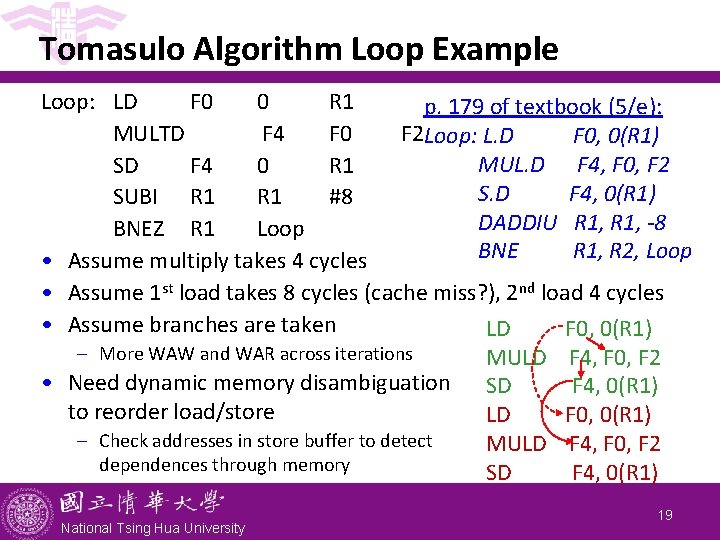
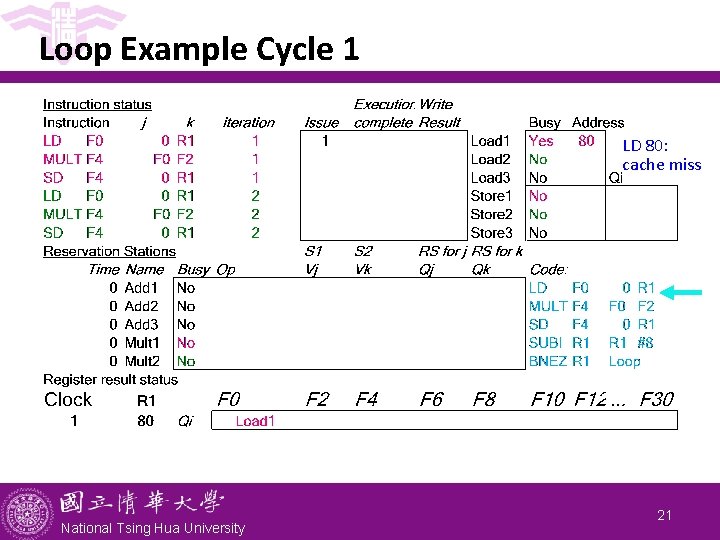
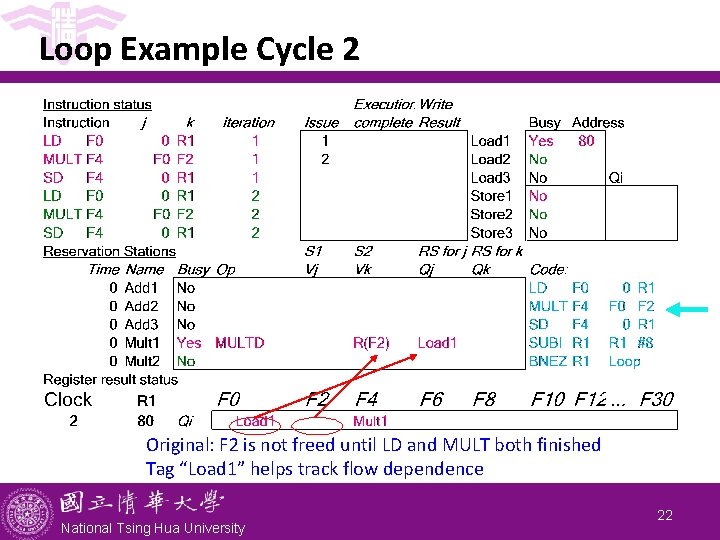
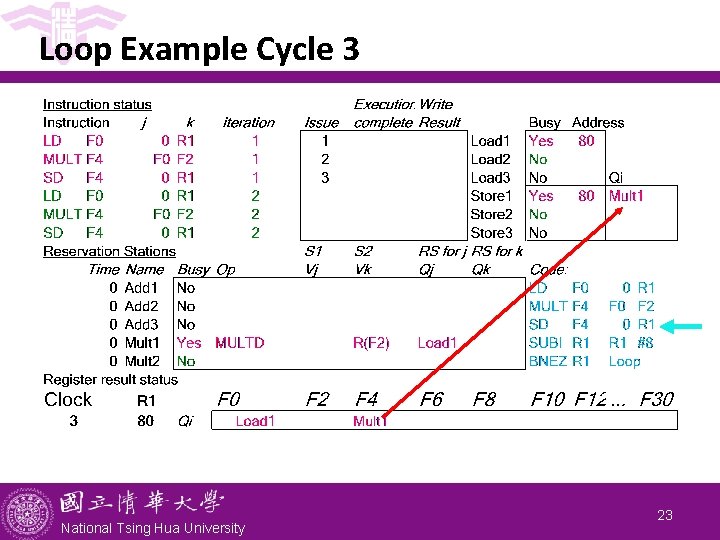
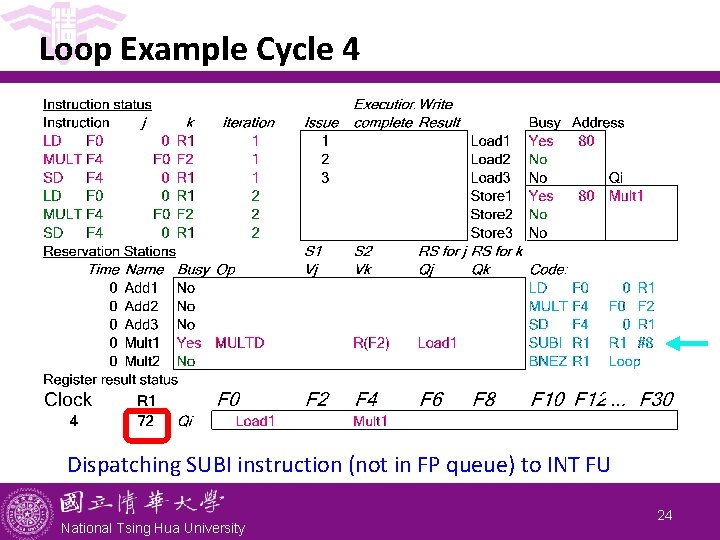
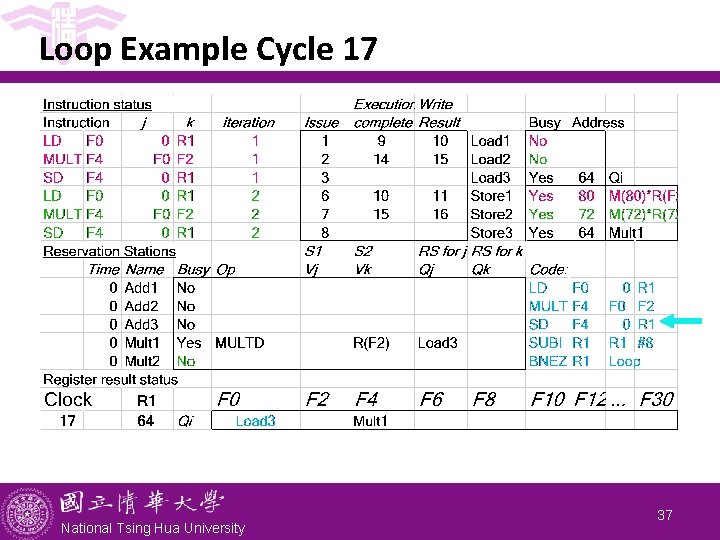
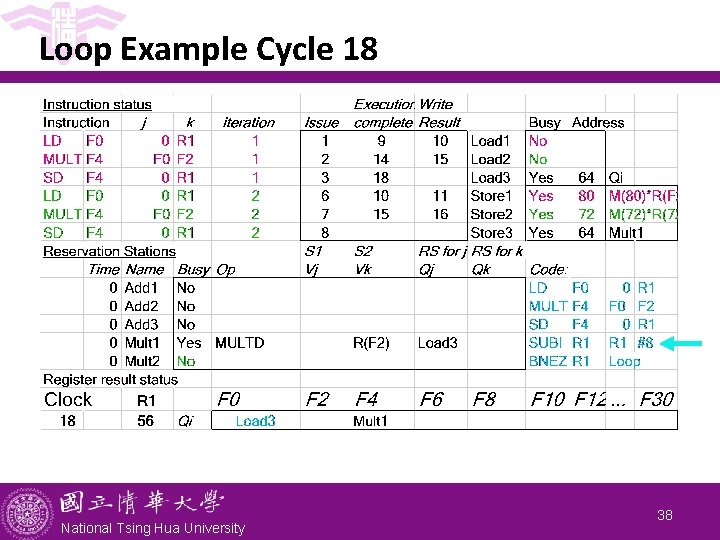
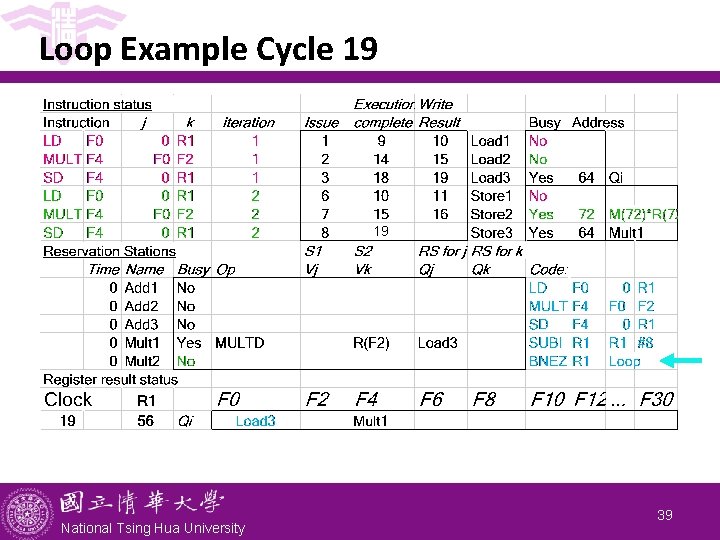
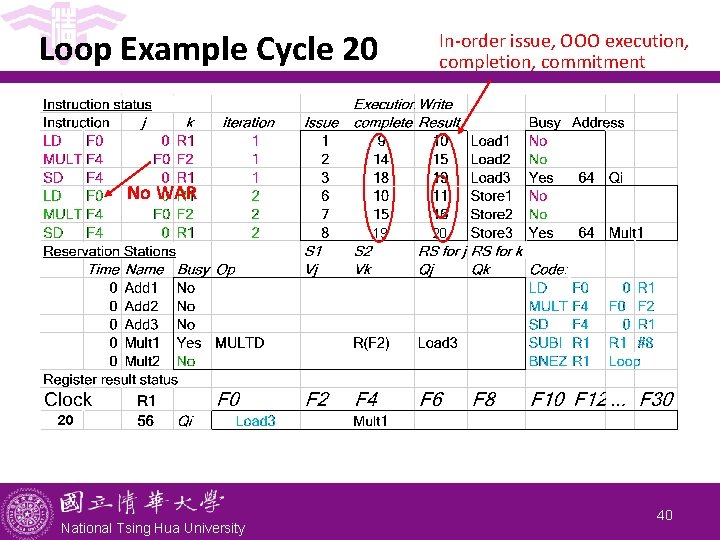
Tomasulo Algorithm Loop Example Loop: LD F 0 0 R 1 p. 179 of textbook (5/e): MULTD F 4 F 0 F 2 Loop: L. D F 0, 0(R 1) MUL. D F 4, F 0, F 2 SD F 4 0 R 1 S. D F 4, 0(R 1) SUBI R 1 #8 DADDIU R 1, -8 BNEZ R 1 Loop BNE R 1, R 2, Loop • Assume multiply takes 4 cycles • Assume 1 st load takes 8 cycles (cache miss? ), 2 nd load 4 cycles • Assume branches are taken LD F 0, 0(R 1) - More WAW and WAR across iterations MULD F 4, F 0, F 2 • Need dynamic memory disambiguation SD F 4, 0(R 1) to reorder load/store LD F 0, 0(R 1) - Check addresses in store buffer to detect MULD F 4, F 0, F 2 dependences through memory SD F 4, 0(R 1) National Tsing Hua University 19
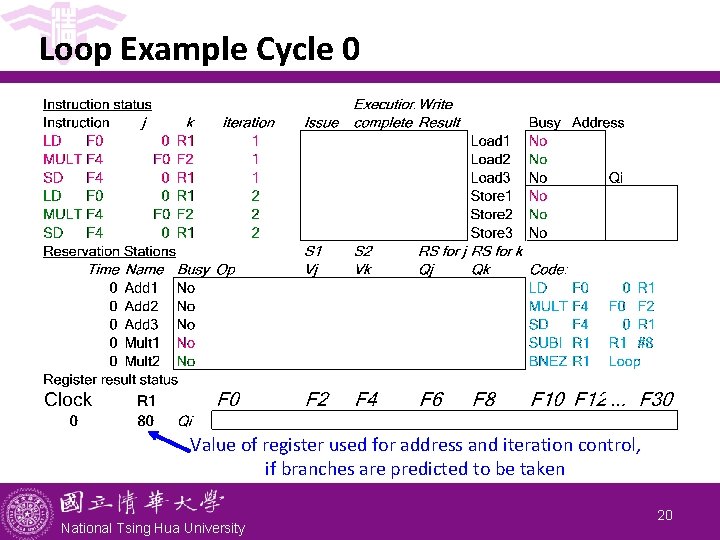
Loop Example Cycle 0 Value of register used for address and iteration control, if branches are predicted to be taken National Tsing Hua University 20
Loop Example Cycle 1 LD 80: cache miss National Tsing Hua University 21
Loop Example Cycle 2 Original: F 2 is not freed until LD and MULT both finished Tag “Load 1” helps track flow dependence National Tsing Hua University 22
Loop Example Cycle 3 National Tsing Hua University 23
Loop Example Cycle 4 Dispatching SUBI instruction (not in FP queue) to INT FU National Tsing Hua University 24
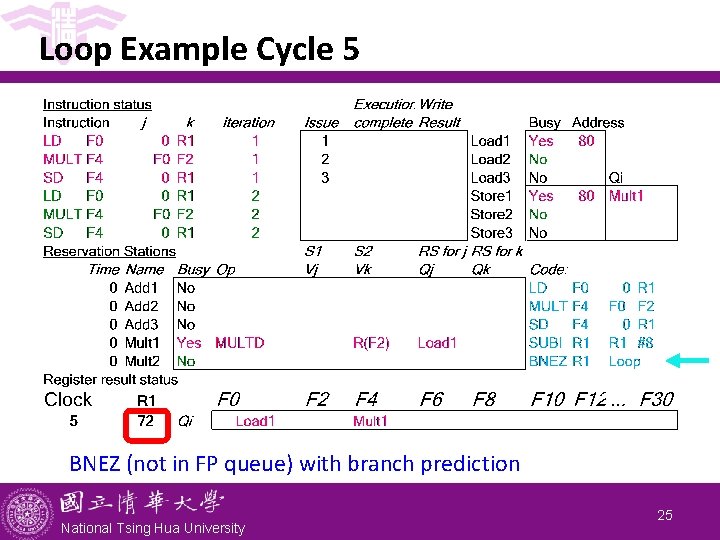
Loop Example Cycle 5 BNEZ (not in FP queue) with branch prediction National Tsing Hua University 25
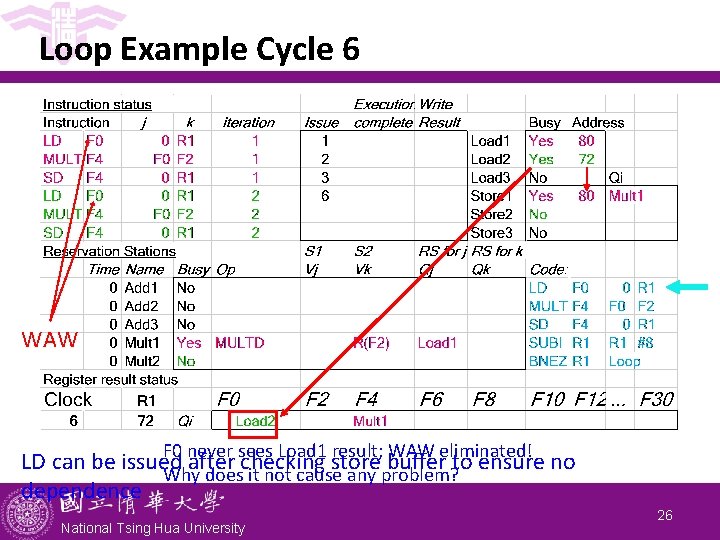
Loop Example Cycle 6 WAW F 0 never sees Load 1 result; WAW eliminated! LD can be issued after checking store buffer to ensure no Why does it not cause any problem? dependence National Tsing Hua University 26
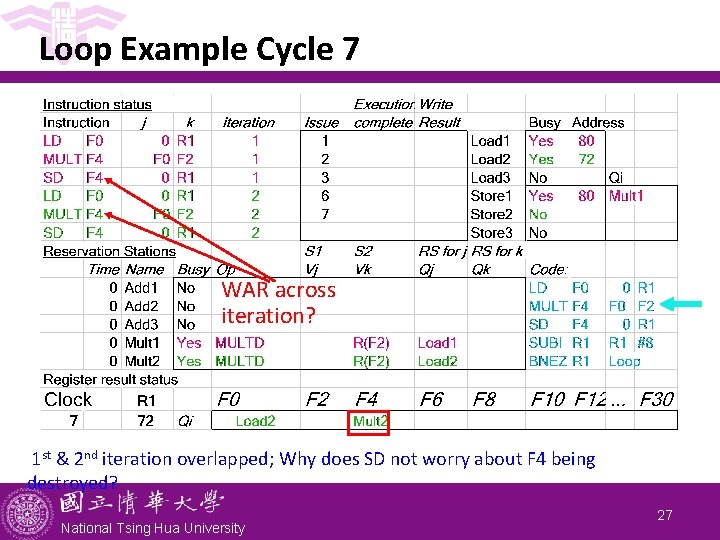
Loop Example Cycle 7 WAR across iteration? 1 st & 2 nd iteration overlapped; Why does SD not worry about F 4 being destroyed? National Tsing Hua University 27
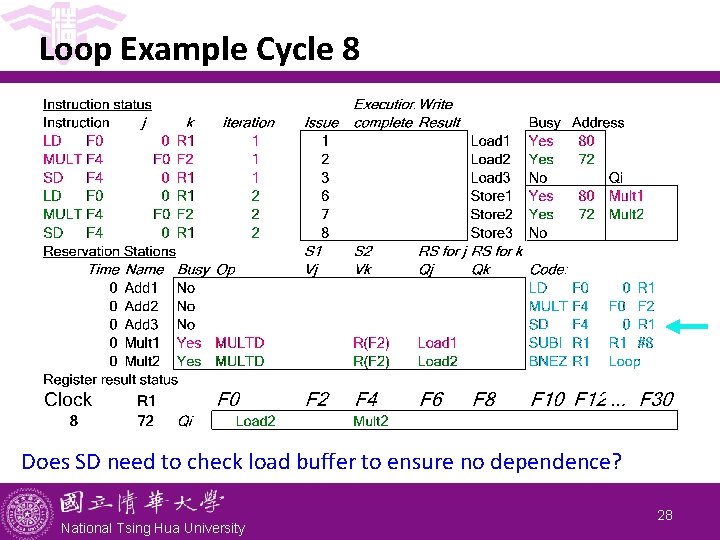
Loop Example Cycle 8 Does SD need to check load buffer to ensure no dependence? National Tsing Hua University 28
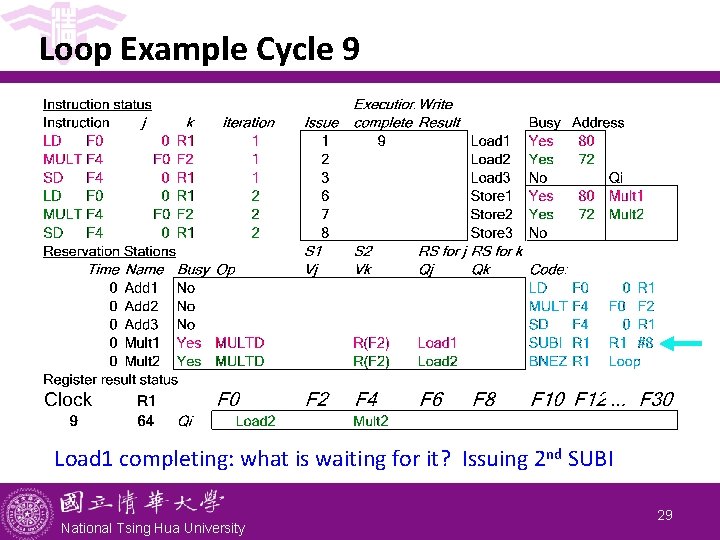
Loop Example Cycle 9 Load 1 completing: what is waiting for it? Issuing 2 nd SUBI National Tsing Hua University 29
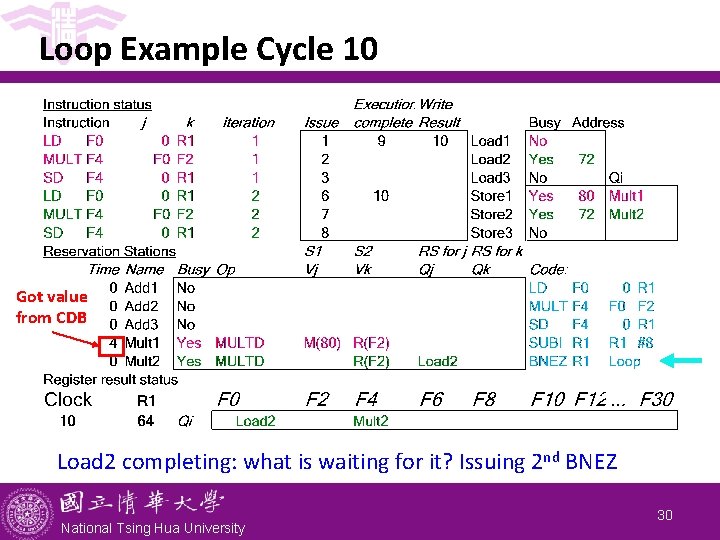
Loop Example Cycle 10 Got value from CDB Load 2 completing: what is waiting for it? Issuing 2 nd BNEZ National Tsing Hua University 30
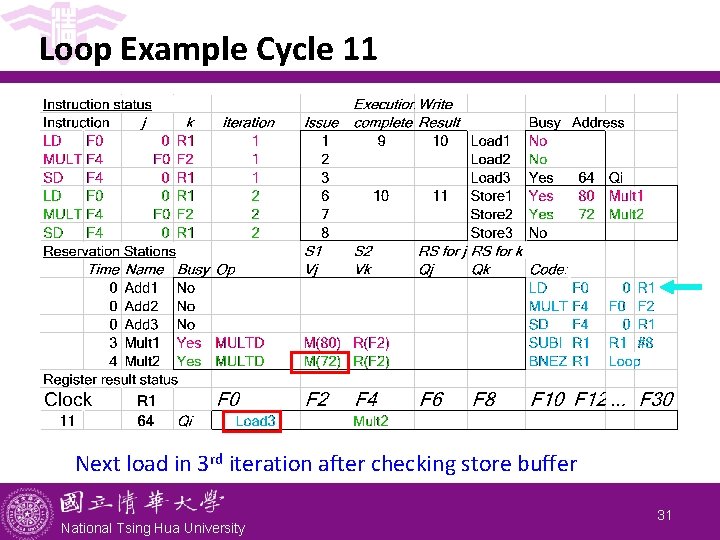
Loop Example Cycle 11 Next load in 3 rd iteration after checking store buffer National Tsing Hua University 31
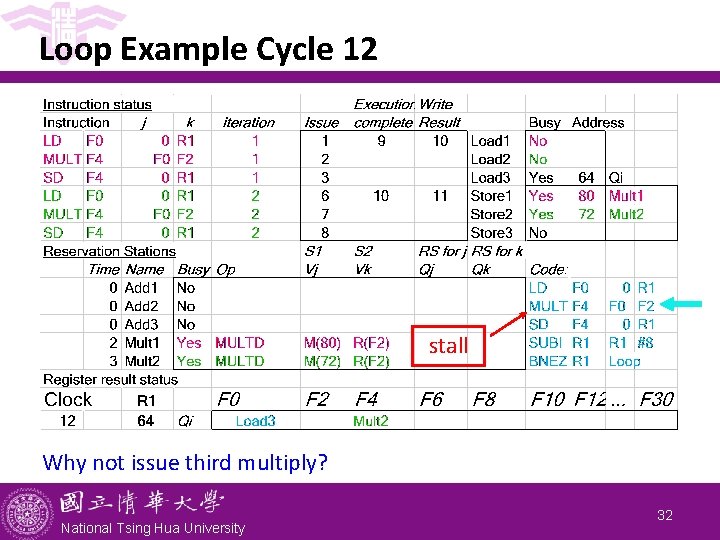
Loop Example Cycle 12 stall Why not issue third multiply? National Tsing Hua University 32
Loop Example Cycle 13 Why not issue third store? National Tsing Hua University 33
Loop Example Cycle 14 Mult 1 completing: what is waiting for it? National Tsing Hua University 34
Loop Example Cycle 15 via CDB Mult 2 completing; what is waiting for it? National Tsing Hua University 35
Loop Example Cycle 16 via CDB (3 rd multiply) National Tsing Hua University 36
Loop Example Cycle 17 National Tsing Hua University 37
Loop Example Cycle 18 National Tsing Hua University 38
Loop Example Cycle 19 19 National Tsing Hua University 39
Loop Example Cycle 20 In-order issue, OOO execution, completion, commitment No WAR 19 20 20 National Tsing Hua University 40
Dependences through Memory in LD/ST • 2 step process for both LD & ST: - 1 st step: Calculate effective address and place into separate L or S buffers in program order - 2 nd step: Access memory unit and the rest • ST can update memory when it reaches write-result stage and whenever data is available • Order between ST and LD can be OOO and cause hazard • Hazard detection (dynamic mem. disambiguation) - LD: Check its address with addresses in store buffers; if match, delay sending LD to load buffer until store is done - ST: Same as LD but check both load and store buffers (to avoid that the 2 nd store may move ahead of the 1 st store if they are to the same address) National Tsing Hua University 41
Load Bypassing and Load Forwarding • Bypassing: when load address does not match addresses of preceding stores, load is allowed to move ahead of these stores in the store buffer • Forwarding: If load address matches address of a store, to-be-stored data can be forwarded to load (RAW) - If multiple preceding stores in store buffer that alias with the load, must determine which store is the most recent - To avoid port contention, an additional read port is needed in the store buffer to forward data to load. The original read port is used to transfer data to data cache National Tsing Hua University 42
Summary of Tomasulo Algorithm • Distributed hazard detect and execute control: - Distributed RSs; depends on RS availability not FU - CDB broadcasts operands and releases multiple pending instructions (through associative tag matching) • Internal forwarding without going through registers • Eliminate WAR and WAW no need to check - Register renaming through RSs - Copy operands into RS when available no WAR - Last of successive writes actually write to reg. no WAW • Load and store units are treated as FUs • Build data flow graph on the fly • Complex H/W for control, associative store, BCD National Tsing Hua University 43