CRYOGENIC TREATMENT OF MATERIALS Phoenix Testing And Consultancy



- Slides: 28
CRYOGENIC TREATMENT OF MATERIALS Phoenix Testing And Consultancy Services, Pune C-6 , T-204 PAVANA INDUSTRIAL COMPLEX, MIDC BHOSARI, PUNE -26 Email: ptcspune@gmail. com (M) 9850302676, 09923808082
CRYOGENICS �DEALS WITH EFFECT OF LOW TEMPERATURE ON MATERIALS �CRYOGENICS STARTS WHERE THE REFRIGERATION ENDS �PROCESSING TEMPERATURE IS BELOW -150°C �IT’S AN ADD-ON PROCESS TO CONVENTIONAL HEAT TREATMENT
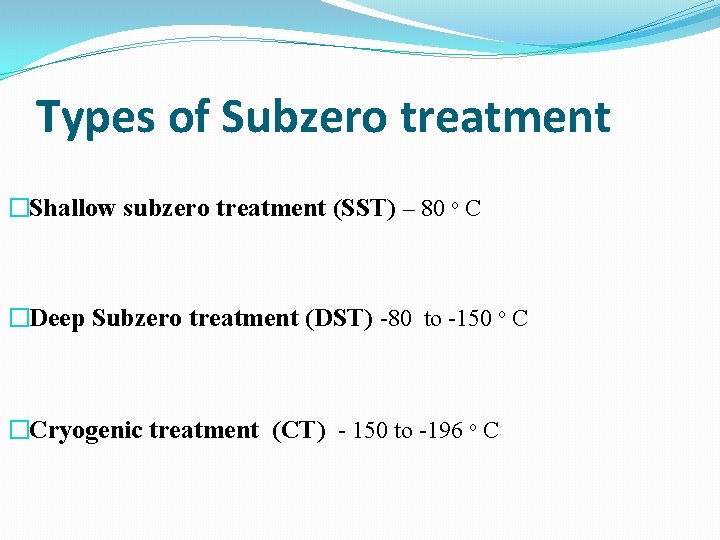
Types of Subzero treatment �Shallow subzero treatment (SST) – 80 o C �Deep Subzero treatment (DST) -80 to -150 o C �Cryogenic treatment (CT) - 150 to -196 o C
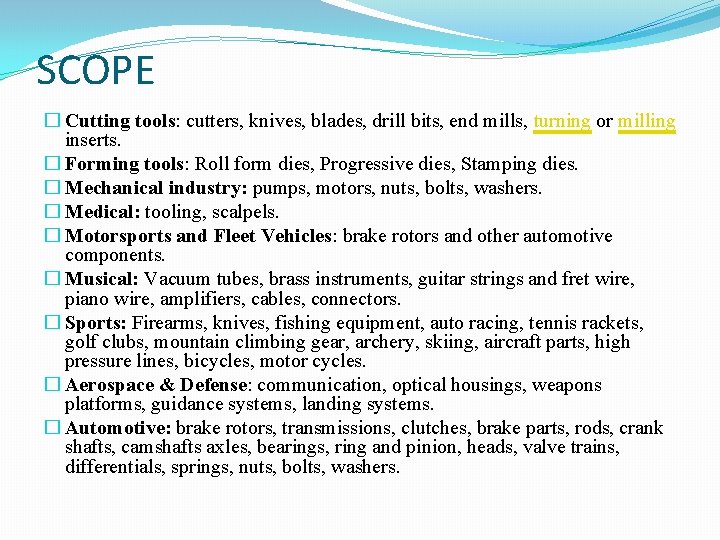
SCOPE � Cutting tools: cutters, knives, blades, drill bits, end mills, turning or milling inserts. � Forming tools: Roll form dies, Progressive dies, Stamping dies. � Mechanical industry: pumps, motors, nuts, bolts, washers. � Medical: tooling, scalpels. � Motorsports and Fleet Vehicles: brake rotors and other automotive components. � Musical: Vacuum tubes, brass instruments, guitar strings and fret wire, piano wire, amplifiers, cables, connectors. � Sports: Firearms, knives, fishing equipment, auto racing, tennis rackets, golf clubs, mountain climbing gear, archery, skiing, aircraft parts, high pressure lines, bicycles, motor cycles. � Aerospace & Defense: communication, optical housings, weapons platforms, guidance systems, landing systems. � Automotive: brake rotors, transmissions, clutches, brake parts, rods, crank shafts, camshafts axles, bearings, ring and pinion, heads, valve trains, differentials, springs, nuts, bolts, washers.
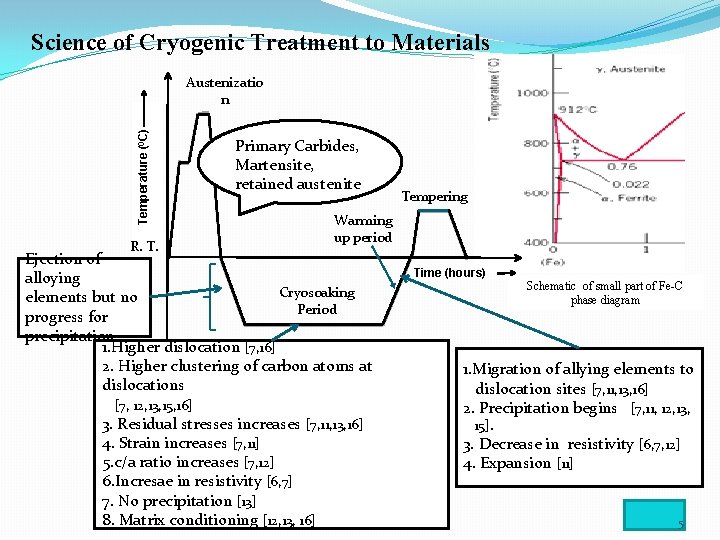
Science of Cryogenic Treatment to Materials Temperature (0 C) Austenizatio n R. T. Primary Carbides, Martensite, retained austenite Tempering Warming up period Ejection of alloying Cryosoaking elements but no Period progress for precipitation. 1. Higher dislocation [7, 16] 2. Higher clustering of carbon atoms at dislocations [7, 12, 13, 15, 16] 3. Residual stresses increases [7, 11, 13, 16] 4. Strain increases [7, 11] 5. c/a ratio increases [7, 12] 6. Incresae in resistivity [6, 7] 7. No precipitation [13] 8. Matrix conditioning [12, 13, 16] Time (hours) Schematic of small part of Fe-C phase diagram 1. Migration of allying elements to dislocation sites [7, 11, 13, 16] 2. Precipitation begins [7, 11, 12, 13, 15]. 3. Decrease in resistivity [6, 7, 12] 4. Expansion [11] 5
Some interesting features �The process converts just the retained austenite to martensite, it transforms a maximum of 17 percent of the material. The hardness increases about the same amount, which equates to just 1 or 2 points on the Rockwell hardness scale �Brake Rotors. Automobiles that get a lot of severe use, such as ambulances, police cars, and taxi cabs, go through brake rotors in a hurry
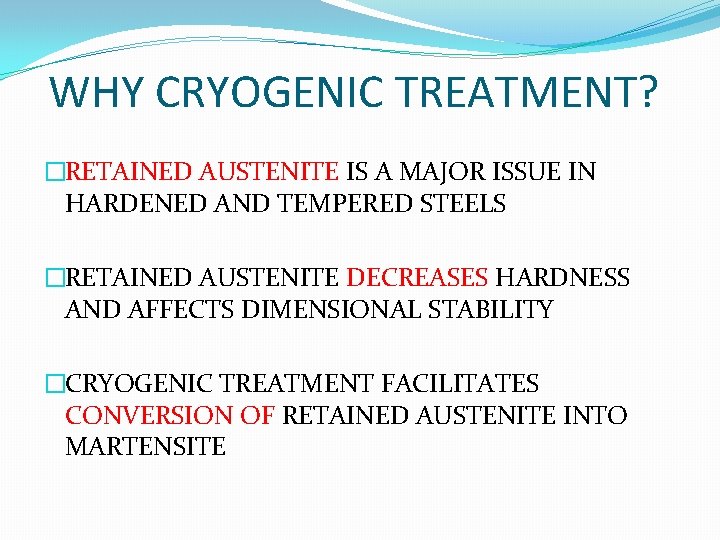
WHY CRYOGENIC TREATMENT? �RETAINED AUSTENITE IS A MAJOR ISSUE IN HARDENED AND TEMPERED STEELS �RETAINED AUSTENITE DECREASES HARDNESS AND AFFECTS DIMENSIONAL STABILITY �CRYOGENIC TREATMENT FACILITATES CONVERSION OF RETAINED AUSTENITE INTO MARTENSITE
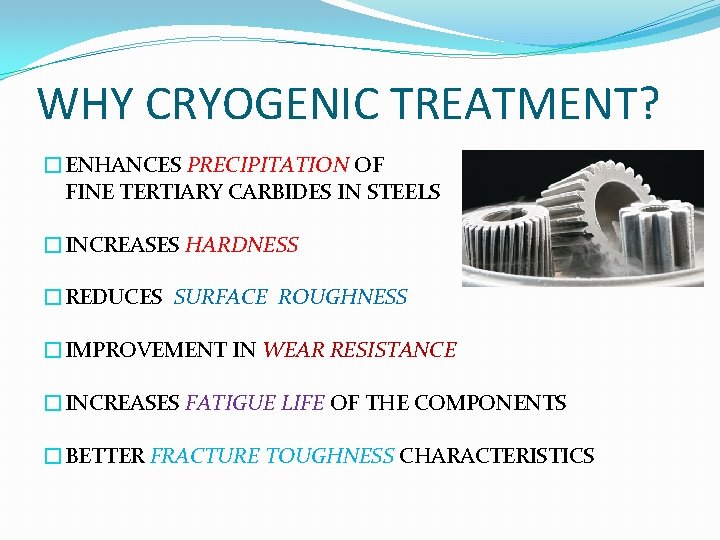
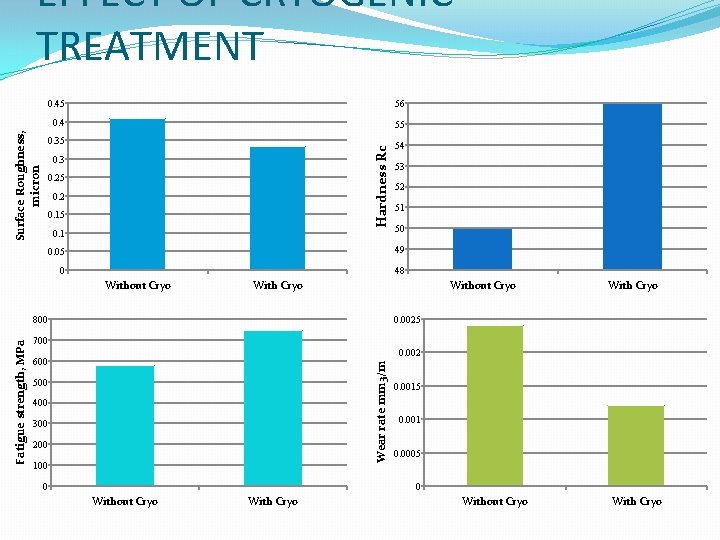
WHY CRYOGENIC TREATMENT? �ENHANCES PRECIPITATION OF FINE TERTIARY CARBIDES IN STEELS �INCREASES HARDNESS �REDUCES SURFACE ROUGHNESS �IMPROVEMENT IN WEAR RESISTANCE �INCREASES FATIGUE LIFE OF THE COMPONENTS �BETTER FRACTURE TOUGHNESS CHARACTERISTICS
Why Cryogenic treatment? �Direct Saving in cost ( Life improvement from 20% to 400%) �Saving of Setting time of system �Consistency of quality/ Uninterrupted process �Multi tasking of manpower
SCIENCE OF CRYOGENIC AND METALLURGY
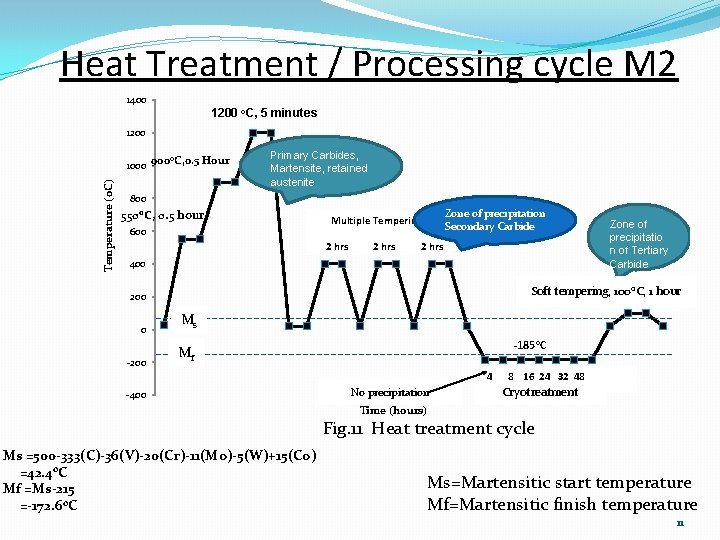
Heat Treatment / Processing cycle M 2 1400 1200 o. C, 5 minutes 1200 Temperature (o. C) 1000 900 o. C, 0. 5 Hour Primary Carbides, Martensite, retained austenite 800 550 o. C, 0. 5 hour 600 Zone of precipitation Secondary Carbide Multiple Tempering 2 hrs 400 Soft tempering, 100 o. C, 1 hour 200 0 -200 Zone of precipitatio n of Tertiary Carbide Ms -185 o. C Mf 4 -400 No precipitation 8 16 24 32 48 Cryotreatment Time (hours) Fig. 11 Heat treatment cycle Ms =500 -333(C)-36(V)-20(Cr)-11(Mo)-5(W)+15(Co) =42. 40 C Mf =Ms-215 =-172. 60 C Ms=Martensitic start temperature Mf=Martensitic finish temperature 11
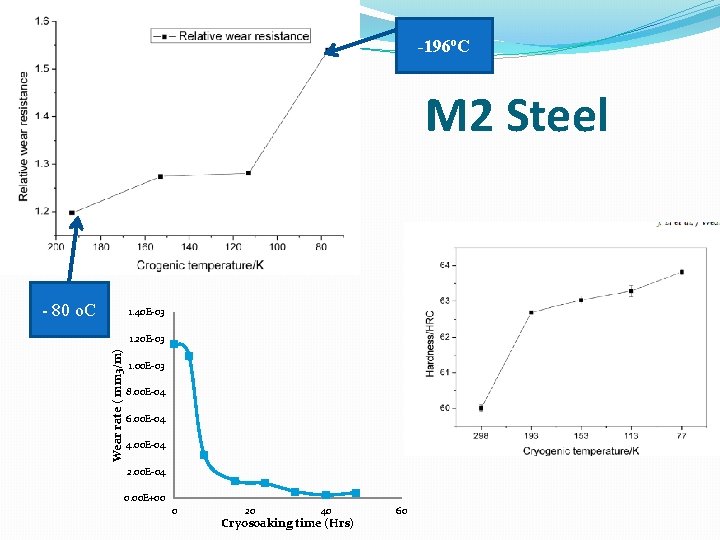
-196 o. C M 2 Steel - 80 o. C 1. 40 E-03 Wear rate ( mm 3/m) 1. 20 E-03 1. 00 E-03 8. 00 E-04 6. 00 E-04 4. 00 E-04 2. 00 E-04 0. 00 E+00 0 20 40 Cryosoaking time (Hrs) 60
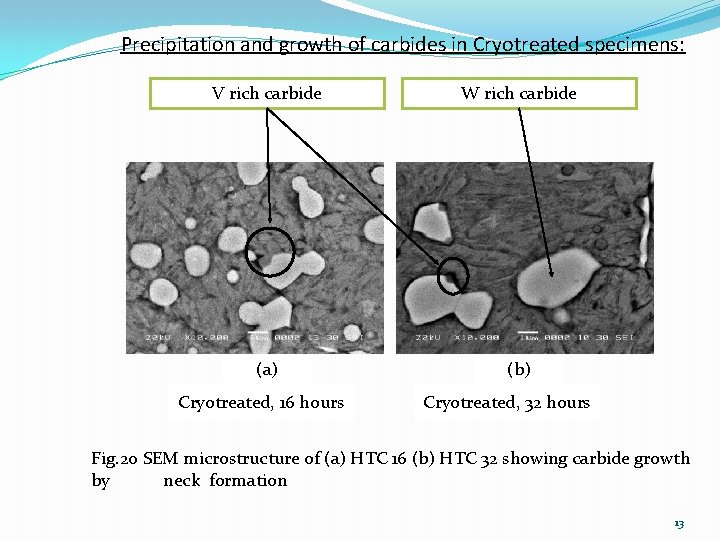
Precipitation and growth of carbides in Cryotreated specimens: V rich carbide W rich carbide (a) (b) Cryotreated, 16 hours Cryotreated, 32 hours Fig. 20 SEM microstructure of (a) HTC 16 (b) HTC 32 showing carbide growth by neck formation 13
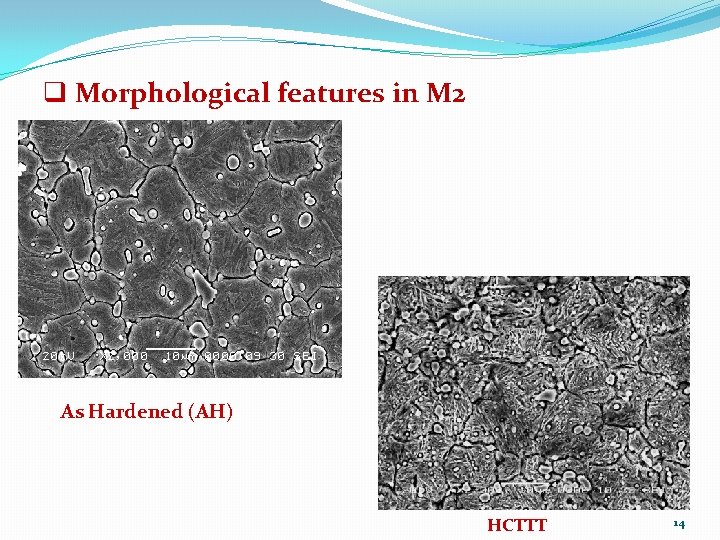
q Morphological features in M 2 As Hardened (AH) HCTTT 14
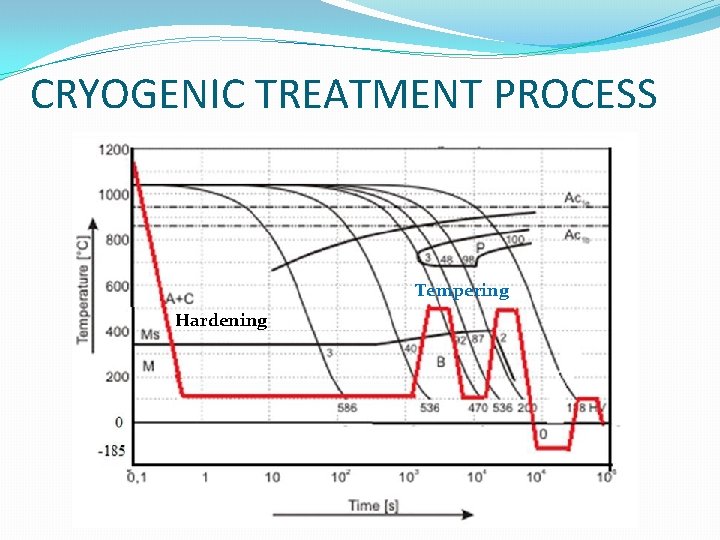
CRYOGENIC TREATMENT PROCESS Tempering Hardening
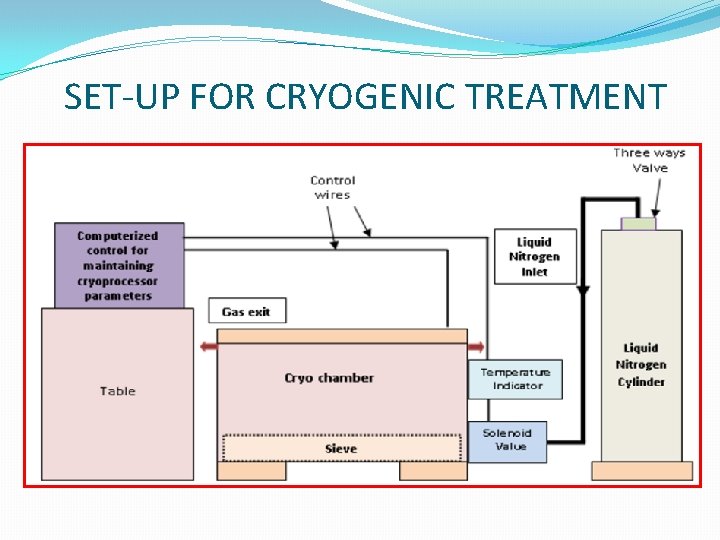
SET-UP FOR CRYOGENIC TREATMENT
0. 45 56 0. 4 55 0. 35 54 Hardness Rc Surface Roughness, micron EFFECT OF CRYOGENIC TREATMENT 0. 3 0. 25 0. 2 0. 15 0. 1 52 51 50 0. 05 49 0 48 Without Cryo 800 With Cryo 0. 0025 700 0. 002 600 Wear rate mm 3/m Fatigue strength, MPa 53 500 400 300 200 100 0 0. 0015 0. 001 0. 0005 0 Without Cryo With Cryo
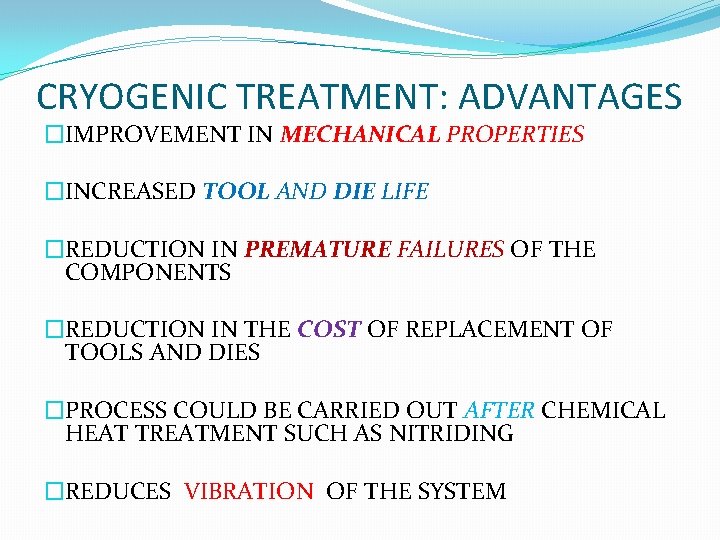
CRYOGENIC TREATMENT: ADVANTAGES �IMPROVEMENT IN MECHANICAL PROPERTIES �INCREASED TOOL AND DIE LIFE �REDUCTION IN PREMATURE FAILURES OF THE COMPONENTS �REDUCTION IN THE COST OF REPLACEMENT OF TOOLS AND DIES �PROCESS COULD BE CARRIED OUT AFTER CHEMICAL HEAT TREATMENT SUCH AS NITRIDING �REDUCES VIBRATION OF THE SYSTEM
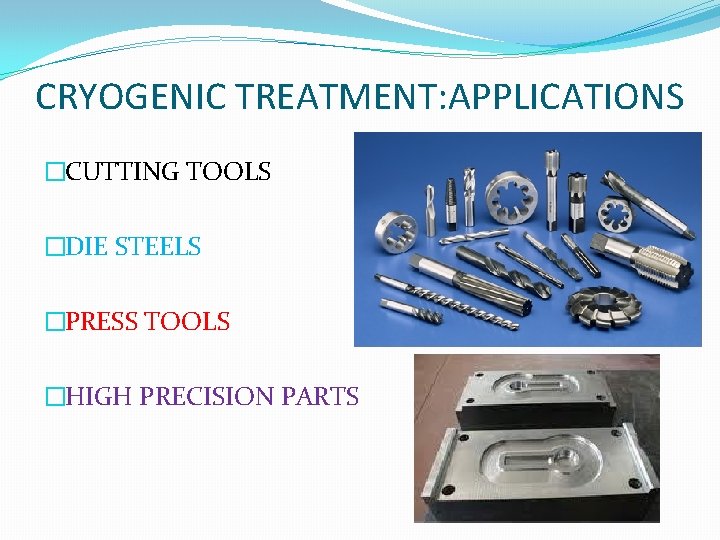
CRYOGENIC TREATMENT: APPLICATIONS �CUTTING TOOLS �DIE STEELS �PRESS TOOLS �HIGH PRECISION PARTS
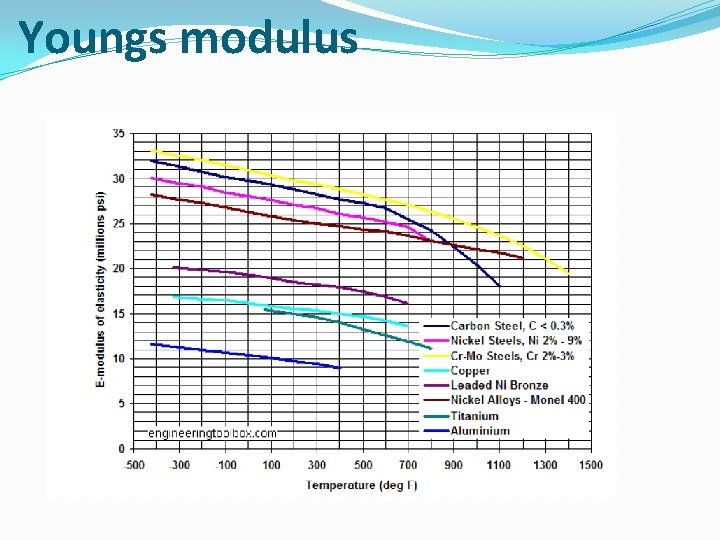
Youngs modulus
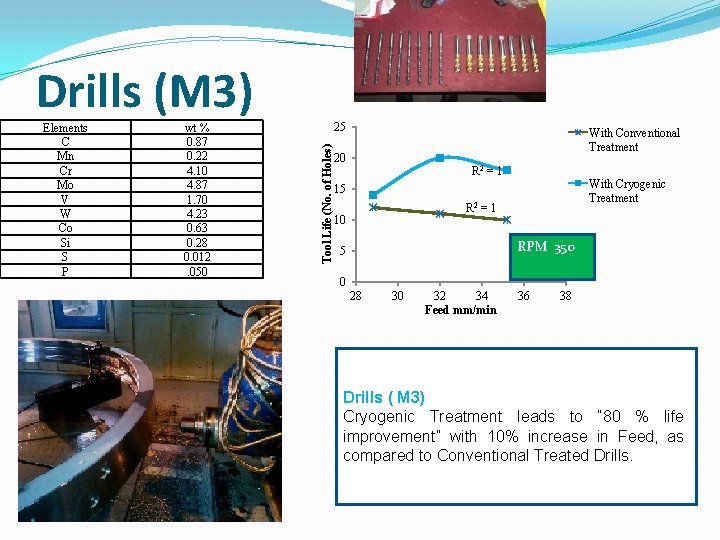
Drills (M 3) wt % 0. 87 0. 22 4. 10 4. 87 1. 70 4. 23 0. 63 0. 28 0. 012. 050 25 Tool Life (No. of Holes) Elements C Mn Cr Mo V W Co Si S P With Conventional Treatment 20 R 2 = 1 With Cryogenic Treatment 15 R 2 = 1 10 RPM 350 5 0 28 30 32 34 Feed mm/min 36 38 Drills ( M 3) Cryogenic Treatment leads to “ 80 % life improvement” with 10% increase in Feed, as compared to Conventional Treated Drills.
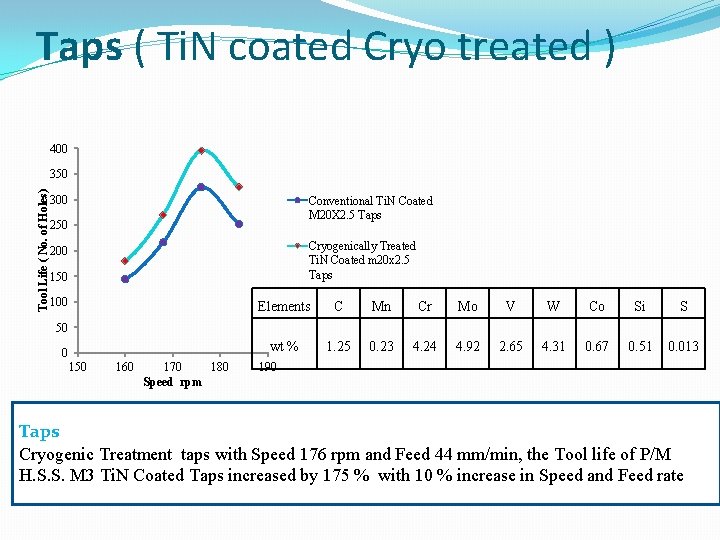
Taps ( Ti. N coated Cryo treated ) 400 Tool Life ( No. of Holes) 350 300 Conventional Ti. N Coated M 20 X 2. 5 Taps 250 Cryogenically Treated Ti. N Coated m 20 x 2. 5 Taps 200 150 100 Elements C Mn Cr Mo V W Co Si S wt % 1. 25 0. 23 4. 24 4. 92 2. 65 4. 31 0. 67 0. 51 0. 013 50 0 150 160 170 180 Speed rpm 190 Taps Cryogenic Treatment taps with Speed 176 rpm and Feed 44 mm/min, the Tool life of P/M H. S. S. M 3 Ti. N Coated Taps increased by 175 % with 10 % increase in Speed and Feed rate
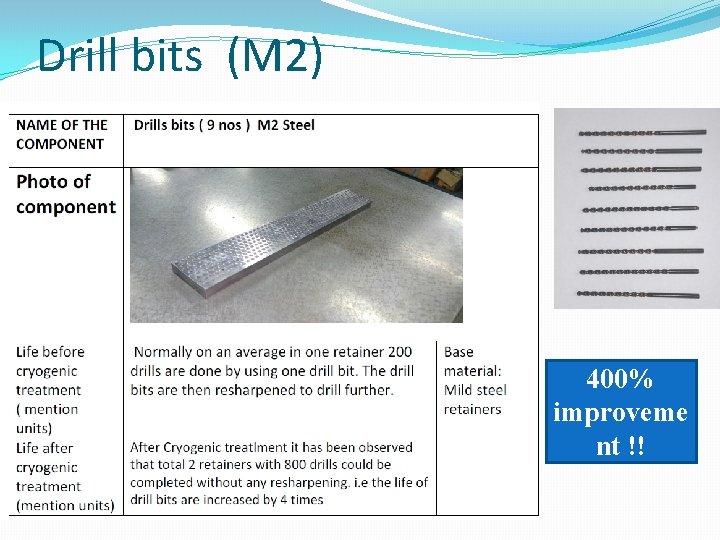
Drill bits (M 2) 400% improveme nt !!
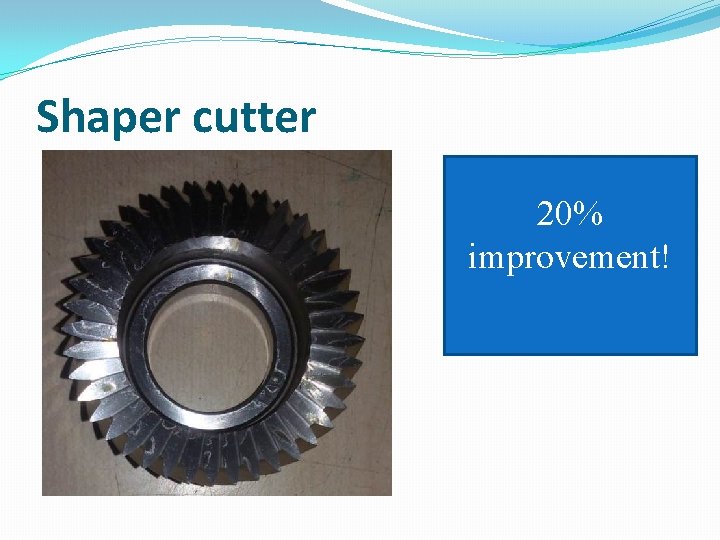
Shaper cutter 20% improvement!
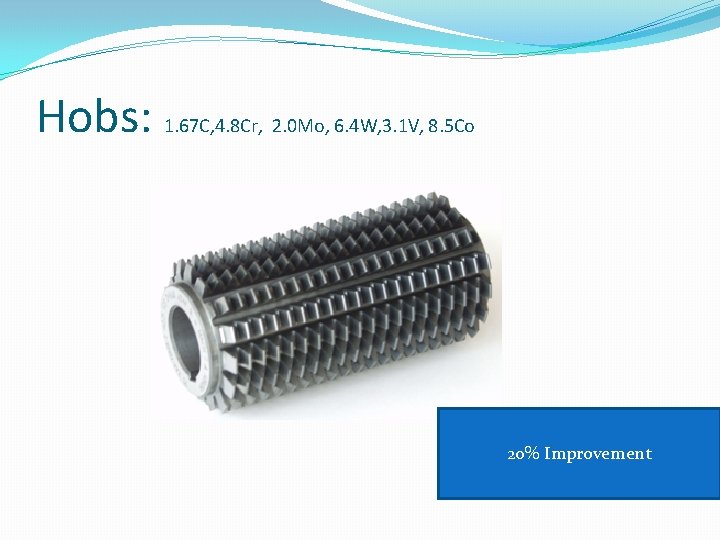
Hobs: 1. 67 C, 4. 8 Cr, 2. 0 Mo, 6. 4 W, 3. 1 V, 8. 5 Co 20% Improvement
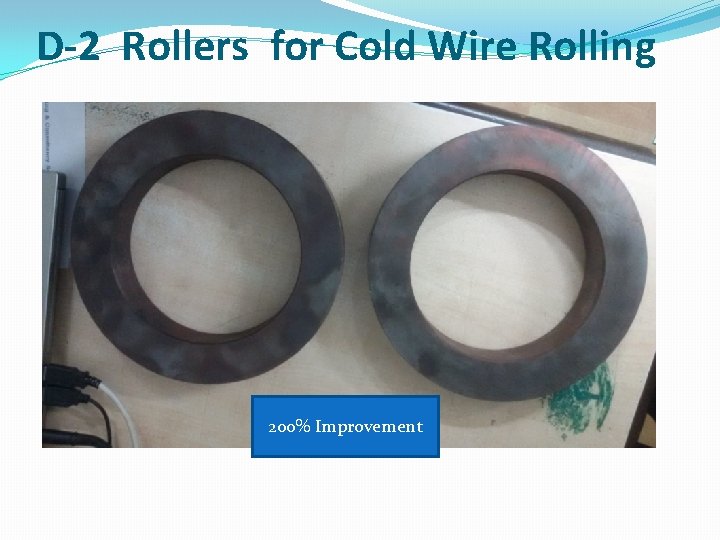
D-2 Rollers for Cold Wire Rolling 200% Improvement
Suggestions to end users Any deviation in Hardened and Tempered heat treatment condition of the steel, it is likely to respond poorly to cryogenic treatment and hence its resultant properties. So USER must ensure that prior treatment MUST be as per SOP of that steels to derive full benefit of Cryogenic treatment.
Thanking you