Crime and Deviance Assignment 2 Official Statistics and




- Slides: 41
Crime and Deviance: Assignment 2 - Official Statistics and Theories
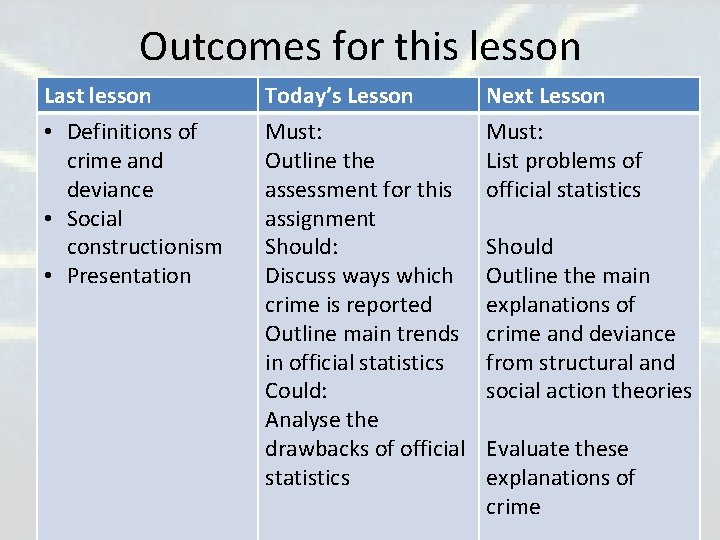
Outcomes for this lesson Last lesson • Definitions of crime and deviance • Social constructionism • Presentation Today’s Lesson Must: Outline the assessment for this assignment Should: Discuss ways which crime is reported Outline main trends in official statistics Could: Analyse the drawbacks of official statistics Next Lesson Must: List problems of official statistics Should Outline the main explanations of crime and deviance from structural and social action theories Evaluate these explanations of crime
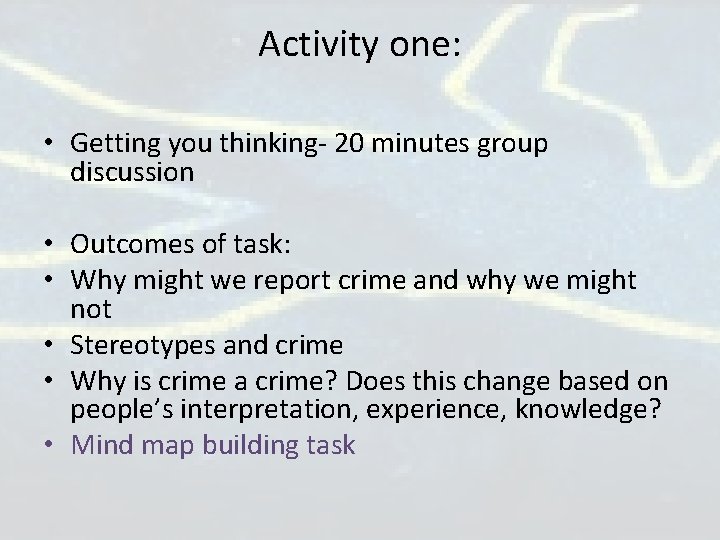
Activity one: • Getting you thinking- 20 minutes group discussion • Outcomes of task: • Why might we report crime and why we might not • Stereotypes and crime • Why is crime a crime? Does this change based on people’s interpretation, experience, knowledge? • Mind map building task
In order to understand- why people commit crime, we first need to know: • Who commits crime? • What sorts of crime are committed?
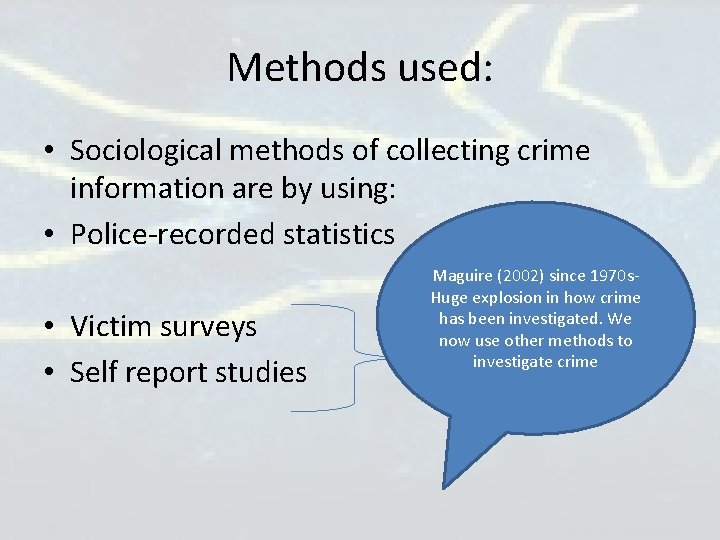
Methods used: • Sociological methods of collecting crime information are by using: • Police-recorded statistics • Victim surveys • Self report studies Maguire (2002) since 1970 s. Huge explosion in how crime has been investigated. We now use other methods to investigate crime
Police recorded statistics: • Date back to 1805 - general info on court proceedings and convictions • 1857: data about crimes reported to and recorded by the police were added. • This gave an oversight at government level • Today- published every 6 months by the Home Office • 1. what is good about having an oversight of crime? • 2. what is good about having data from such a long time ago?
What is ‘ police recorded statistics’ • The police recorded crime statistics are a measure of the amount of crime which is reported to and recorded by the 43 Home Office forces and the British Transport Police. The recorded crime statistics do not include crimes that have not been reported to the police or that the police decide not to record. Police recording practice is governed by Home Office Counting Rules for Recorded Crime and the National Crime Recording Standard (Secretary of State, 2006) • Q: Anything worrying about the above? Take 5 minutes to chat to your neighbour about this.
The statistics • Page 24 -26 Q: What are the main findings? • The national crime recording standard (NCRS) is a standard for recording crime in accordance with the law – Hand-out • https: //www. youtube. com/watch? v=Z 4 Zv. LYc. Eqvk
The main findings • 14% decrease in overall crime compared to previous year (includes violence, theft and criminal damage ) • 3. 7 million crimes reported (lowest numbers since introduction of crime recording • increase of 20% in all sexual offences for the year ending March 2014 compared with the previous year (up from 53, 620 to 64, 200
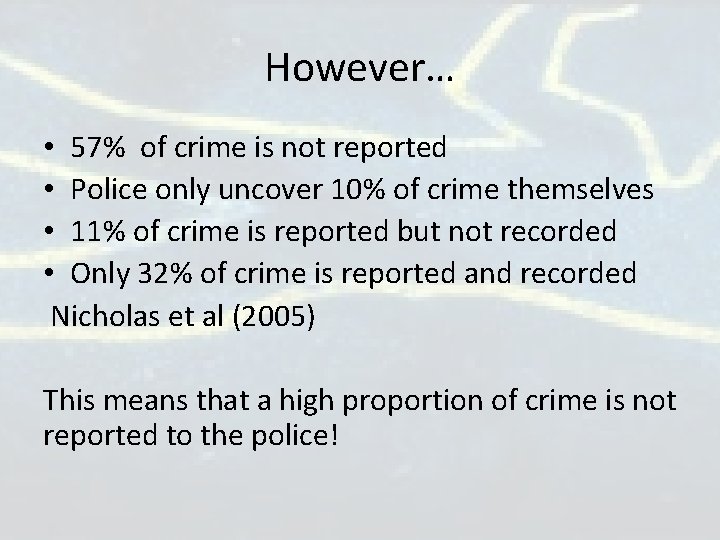
However… • 57% of crime is not reported • Police only uncover 10% of crime themselves • 11% of crime is reported but not recorded • Only 32% of crime is reported and recorded Nicholas et al (2005) This means that a high proportion of crime is not reported to the police!
What affects statistics • What kinds of things could affect reporting of crime? • Group mind map • Handout : page 268 figure 5. 6
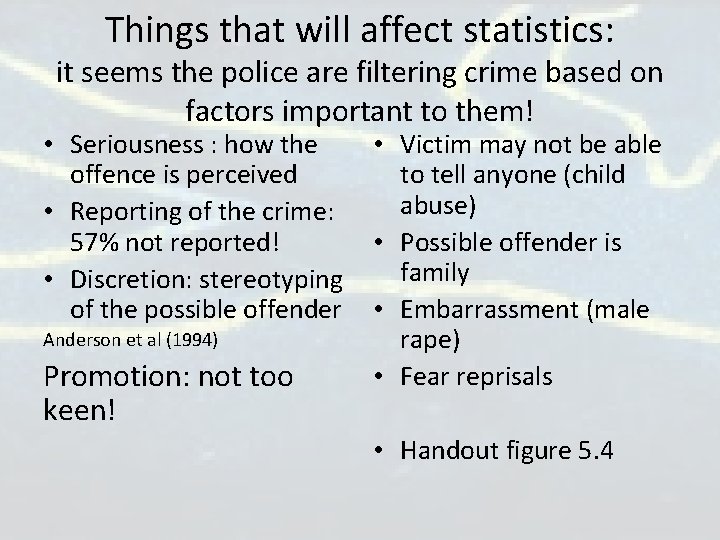
Things that will affect statistics: it seems the police are filtering crime based on factors important to them! • Seriousness : how the offence is perceived • Reporting of the crime: 57% not reported! • Discretion: stereotyping of the possible offender Anderson et al (1994) Promotion: not too keen! • Victim may not be able to tell anyone (child abuse) • Possible offender is family • Embarrassment (male rape) • Fear reprisals • Handout figure 5. 4
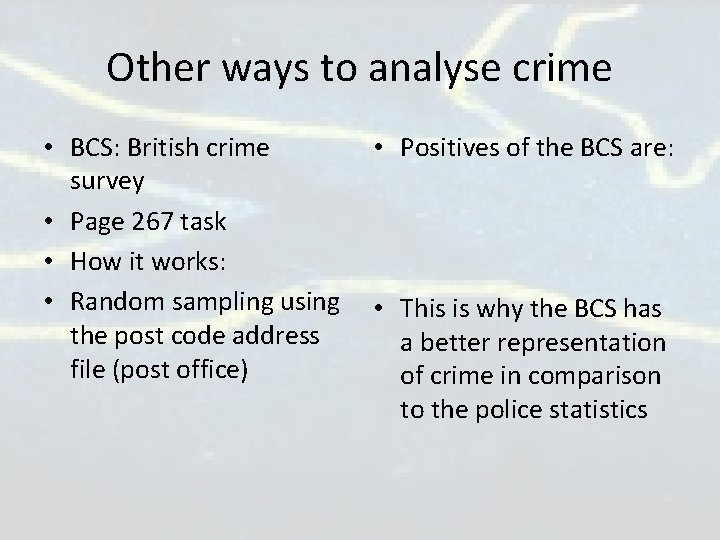
Other ways to analyse crime • BCS: British crime survey • Page 267 task • How it works: • Random sampling using the post code address file (post office) • Positives of the BCS are: • This is why the BCS has a better representation of crime in comparison to the police statistics
Negatives of the BCS
To sum up: Handout page 270
Theories of crime and deviance
Last lesson This lesson Next lesson Finished off: Official statistics Looked at BCS Must: List the approaches under the structural theory of crime and deviance Should: Explain how each one views crime and deviance Finish off Structural theories Could: compare and contrast these approaches Move onto Left and right realism
Hand-out : overview of perspectives Criteria 2. 1 of unit • Structural- Functionalism and Marxism • Social Action • Left and right realist • The assessment
Structural theories: Functionalism Tend to concentrate on Official statistics ‘Makes the assumption that societies exist because they are based on fundamental agreement about basic values. We all share beliefs about what constitutes good and bad behaviour’ (Moore et al, 2003) Handout : figure 2. 1
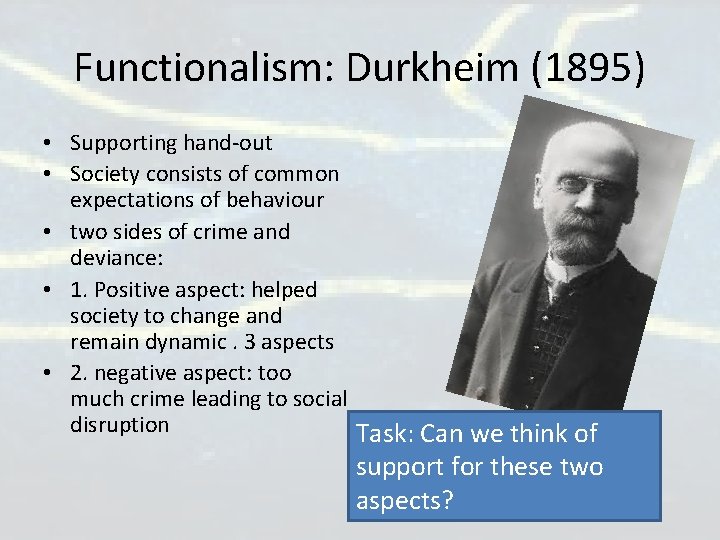
Functionalism: Durkheim (1895) • Supporting hand-out • Society consists of common expectations of behaviour • two sides of crime and deviance: • 1. Positive aspect: helped society to change and remain dynamic. 3 aspects • 2. negative aspect: too much crime leading to social disruption Task: Can we think of support for these two aspects?
Positive aspects of crime: 1 Reaffirming the boundaries • Basis of society was a set of shared beliefs: collective conscience • This sets boundaries : actions that are acceptable and those that are not • Sometimes boundaries are unclear and they change over time • Confusion over boundaries of acceptable and unacceptable behaviour • Its in the Clarifying of boundaries which is where limited amount of crime takes place! • The law/ police make it clear to society what the current boundaries are : publicity and drama needs to be generated , hence public courts.
2. Changing values • The publicity reaffirms social values of right or wrong • Sometimes the law is unjust and there is a public outcry • This leads to changing laws which leads to changing values Task: Can you think of any cases to support this?
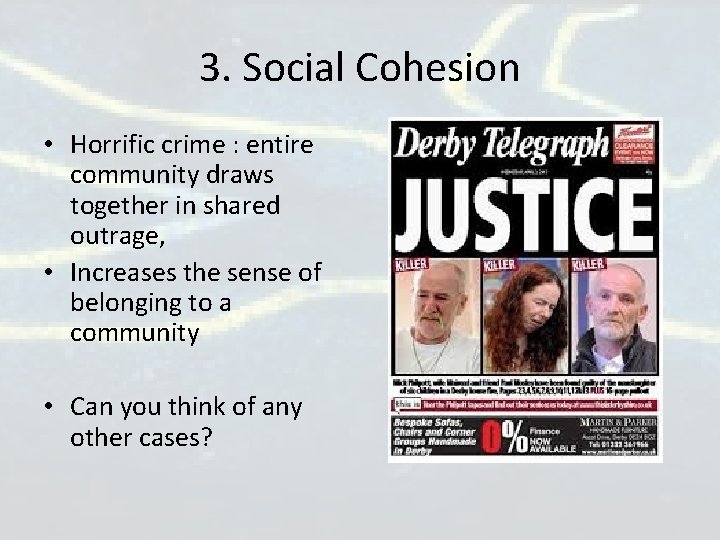
3. Social Cohesion • Horrific crime : entire community draws together in shared outrage, • Increases the sense of belonging to a community • Can you think of any other cases?
Negative Aspects: Too much crime has negative consequences Collective conscience (people sharing common values) may be weakened in times of great social change People may be freed from social control imposed by the CC, they then might start to look after their own needs and wants rather then adhering to social values Anomie Led to research by • Merton • Hirschi
Anomie • Later adapted by Merton (1938) • Original idea was too vague • Strain Theory • Hand-out p 247 • 1. summarise this theory • What is wrong with this theory
Hirschi (1969) • Asked the question • ‘ Why DON’T people commit crime? ’ • Crime occurs when people’s attachment to society is weakened • Depends on social bonds that hold people in check • Four crucial bonds • Attachment – care about other peoples’ opinions and wishes • Commitment- personal investments we make and what we have to lose • Involvement-how busy are we? Time • Belief- strength of sense to obey Conclusion: greater the person’s attachment to society, the lower their level of crime
The family • Agency of socialisation • The bonds Hirschi talks about • The collective conscience what Durkheim talks about • Cambridge study in delinquent behaviour • Handout: By Farrington and West 1990
The study Longitutional study 411 ‘working class’ males Born in 1953 until their late 30 s Findings are: Extent of offending: by 25, 1/3 recorded offenders • Concentration of offending: less then 6% of total sample for over 50% of all convictions • •
Conclusion • Consistent correlation between family traits and offending • Offenders come from homes with poor parenting- especially when father had convictions • Come from poorer, single parent families • Thus crime is in families not partaking in society norms and values…
For example • Society is driven towards Meritocracy • If you cannot fail to be a part of this social value and norm, then you become frowned upon (unemployment= benefit fraud) • Then you stop sharing in the collective conscience • Turn to crime to improve own circumstance (Anomie) • Hence also why crime runs in families…
Conclusion of functionalist explanations of crime and deviance • • • Its necessary Both positive and negative Weakening of collective conscience Confusion of boundaries Attachment and Social bonds to the society How family affects these bonds
Breadth and depth advice • There is lots of research into crime and deviance from a functionalist perspective • This is just a snippet! • For example: • Etzioni (famous in USA) • Erikson : developed Durkheim's ideas on the positive aspect of crime • More depth into Merton (he said alot!)
Marxist theory of crime and deviance Traditional Marxist approach focussed on four areas: 1. The manipulation of the basic values and morality of a society 2. The process of law creation 3. The enforcement of law 4. Individual motivation
1. Manipulation of basic values and morals of society • Through socialisation: • Persuaded as children and onwards to accept the demands of the capitalist society • These demands become the values and morals • Definition of what is criminal reflects the dominant social values (those of the ruling class) • Task: any support for this recently? • Article handout: • Next read Handout page 70
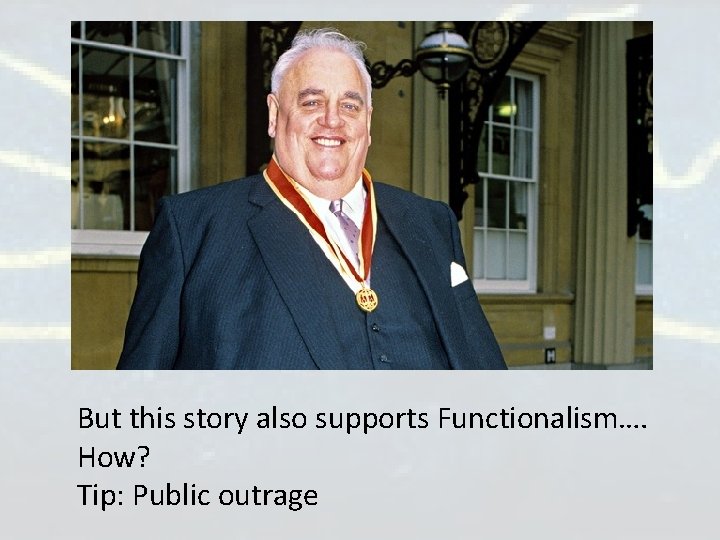
But this story also supports Functionalism…. How? Tip: Public outrage
Reasons for this manipulation • Law is only applied to the less powerful people but who are many… Why is this? • The sanctions are harsher… Why? • criminals are more likely be drawn from the working class, ethnic groups, young, and those in inner city areas…. • Therefore crime is because of shared beliefs, standards, values and morals of these groups: resulting in scapegoating…
Have a look at ‘the process of Law creation • What kind of examples can we use to support Marxism?
An example. . Are there any more? • The powerful Tax evasion • The rest of us… • Sanctions for not paying council tax
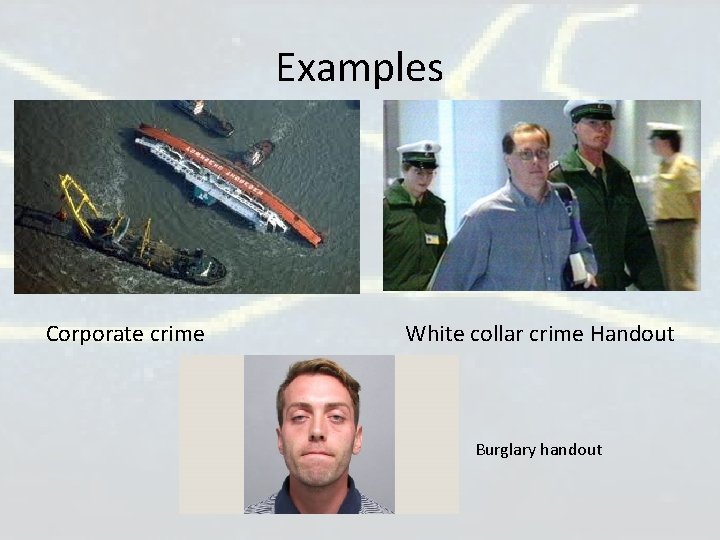
3. Law enforcement: handout P 73 • Different ways law is • Different sentencing enforced depending on types of crime • Street crime is more pursued then white • Financial crimes have collar (high social class lower sentences (if they crimes) are even reported to police!) compared to • WCC less likely to be burglary and property reported as it is dealt theft. with privately compared to lower social class • Example: Herold of the crimes free
Examples Corporate crime White collar crime Handout Burglary handout
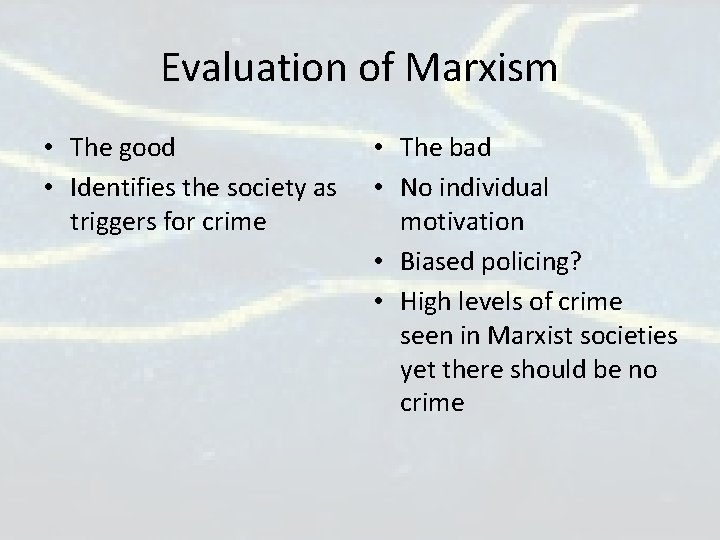
Evaluation of Marxism • The good • Identifies the society as triggers for crime • The bad • No individual motivation • Biased policing? • High levels of crime seen in Marxist societies yet there should be no crime