EMOS European Master in Official Statistics Working Group
- Slides: 22
EMOS – European Master in Official Statistics Working Group European Statistical System – Learning and Development Framework & Human Resources Management Luxembourg, 8 May 2015 Markus Zwick Eurostat
New Developments • Use of big data, open data, cloud data and data from administrative sources • Standardisation of processes, products and methods, with increased use of new technologies such as cloud computing • Use of warehouse data and less tailor-made products • Statistical audit and labelling of official statistics Eurostat
Change of the statistician profile: the i. Statistician Competences • Analytical and computing skills • Delivering quality and ethical analyses • Process management skills • Communication skills • Developing analytical expertise The i. Statistician will be a team with specialized member skills Eurostat
Eurostat activities Classical activities • Eurostat Learning and Development Programme • ESTP – European Statistical Training Programme New approaches • YPSILON – Young Professional Statisticians Induction and Learning Offer for Newcomers • EMOS – European Master in Official Statistics • International cooperation in statistical training Eurostat
EMOS "The main goal of this project is to establish a quality label for university 'European Official Statistics' programmes that meet agreed standards in education. University programmes that are benchmarked to these standards become members of the 'European Official Statistics' network. " Ex-Ante Evaluation Document for the project, May 2011. 5 Eurostat
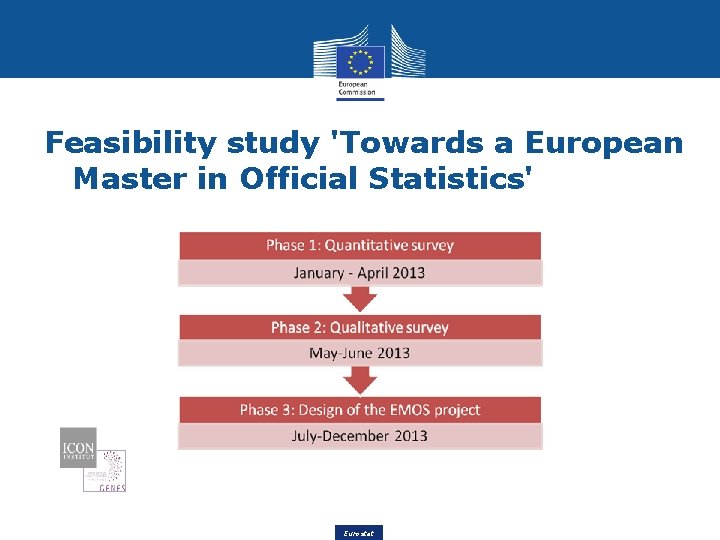
Feasibility study 'Towards a European Master in Official Statistics' Eurostat
Eurostat
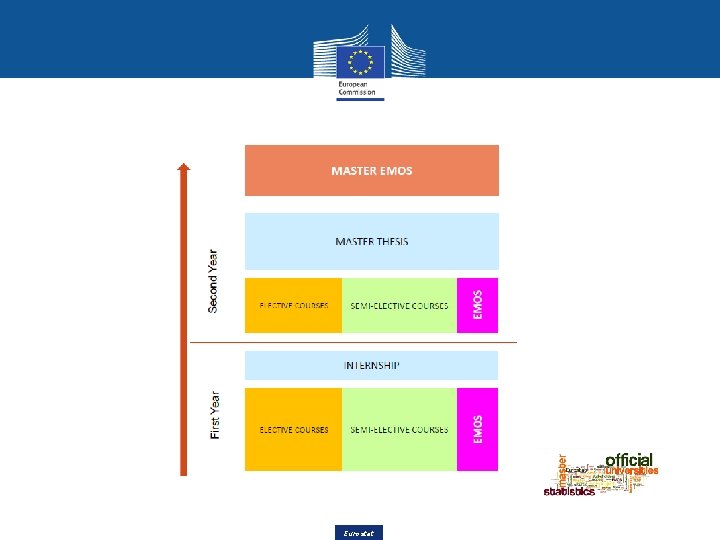
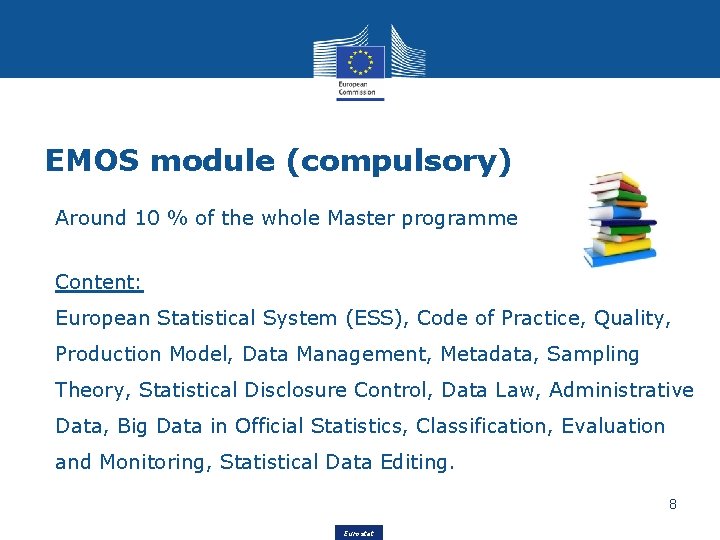
EMOS module (compulsory) Around 10 % of the whole Master programme Content: European Statistical System (ESS), Code of Practice, Quality, Production Model, Data Management, Metadata, Sampling Theory, Statistical Disclosure Control, Data Law, Administrative Data, Big Data in Official Statistics, Classification, Evaluation and Monitoring, Statistical Data Editing. 8 Eurostat
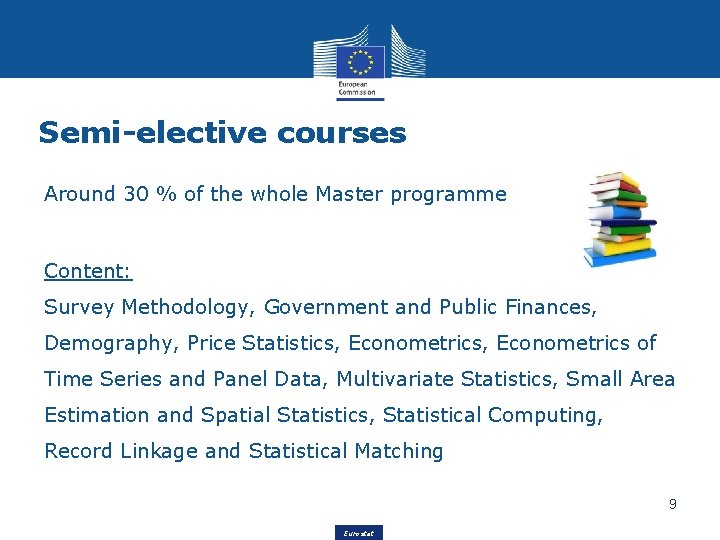
Semi-elective courses Around 30 % of the whole Master programme Content: Survey Methodology, Government and Public Finances, Demography, Price Statistics, Econometrics of Time Series and Panel Data, Multivariate Statistics, Small Area Estimation and Spatial Statistics, Statistical Computing, Record Linkage and Statistical Matching 9 Eurostat
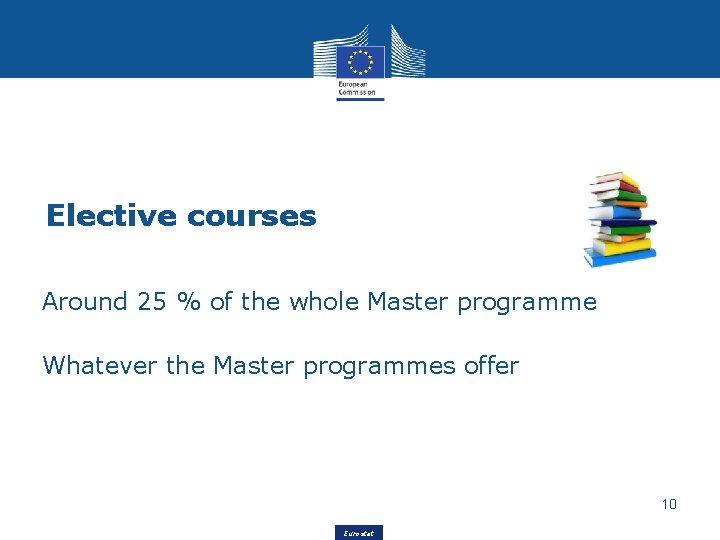
Elective courses Around 25 % of the whole Master programme Whatever the Master programmes offer 10 Eurostat
Master thesis and internships • The internship should have a weight of around 10% of the credits of a Master programme. Given that 2 ECTS credits require 50 to 60 hours of work, an internship will last six to eight weeks. • The Master thesis should have a weight of approx. 25 % of the credits and a strong link to topics of Official Statistics. 11 Eurostat
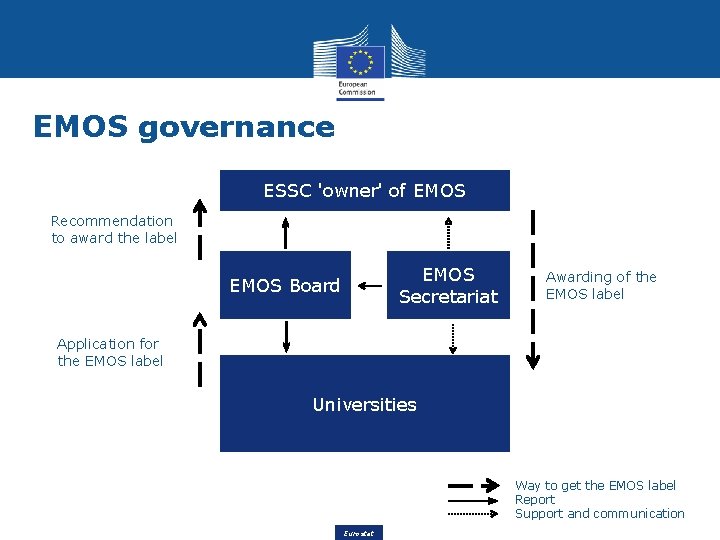
EMOS governance ESSC 'owner' of EMOS Recommendation to award the label EMOS Secretariat EMOS Board Awarding of the EMOS label Application for the EMOS label Universities Way to get the EMOS label Report Support and communication Eurostat
EMOS Board: mandate • Assess the applications for the EMOS label and make proposals for award to the ESSC • Presents an annual report and working plan to the ESSC and the universities • Monitors the quality of the Master programmes • Further development of EMOS Eurostat
EMOS Board: member • NSIs: Finland, Italy, Romania, Netherlands, Poland Eurostat • Private members: Mojca Bavdaž (University of Ljubljana), Gindrutė Kasnauskienė (Vilnius University), Csilla Obádovics (University of West Hungary), Ralf Münnich (University of Trier), Pedro M. P. Simões Coelho (University of Lisbon), Alain Trognon (University of Paris) • ESAC: Maurizio Vichi (University of Rome) • Central Banks Jens Mehrhof (German Central Bank) Eurostat
1 st EMOS Call for Interest • Adoption of the EMOS concept by the ESSC in May 2014 • EMOS Call for Interest with deadline 15 September • 22 universities from 13 European countries participated • Evaluation of the request by the EMOS GExp • 16 programmes from 15 universities passed successful the pre-selection 15 Eurostat
Criteria for EMOS membership Eligibility criteria • The programme is an accredited Master programme in an EU Member State, EU candidate country or EFTA country. • The Master programme is in line with the Bologna process and the European Credit Transfer and Accumulation System (ECTS) or equivalent. 16 Eurostat
Criteria for EMOS membership Selection criteria • The Master programme is organised in line with the EMOS curriculum • The university has set up a collaboration scheme with the respective National Statistical Office or other statistical authorities with regard to internships and other support. • The university holds adequate teaching capacity and qualifications for the Master programme. • Adequate infrastructure is assigned to the programme, e. g. premises, IT equipment. 17 Eurostat
Criteria for EMOS membership Additional assets Though not taken into account in the selection decision, the following are considered assets: • effective quality assurance system; • cooperation with higher education institutions at an international level or participation in national networks. 18 Eurostat
The 1 st EMOS Call for Application • EMOS workshop on 11 and 12 December with the successful pre-selected universities, the GExp and the EMOS Board • EMOS Call for Application with deadline 27 February • 15 programmes from 14 universities participated • Evaluation of the request by the EMOS Board • Recommendation of 12 programmes to the ESSC for labelling with the EMOS label 19 Eurostat
Procedures of the evaluation by the EMOS Board • EMOS Board meeting on 19 and 20 March 2016 • Three evaluation rounds • In the first round each 5 EMOS Board members evaluated 5 applications • In the second round the whole EMOS Board assessed unclear requests • In the third round all requests were discussed in the plenary and decided by the full EMOS Board • Member with an own request or potential conflict of interest was out of the room during the discussions of the respective application 20 Eurostat
Roadmap • ESSC meeting on 20 and 21 May 2015 • Integration of the experience from the first EMOS Call for the second Call • 4 th EMOS Workshop on 15 and 16 October 2015 • ESSC meeting on 11 and 12 May 2016 • EMOS Evaluation in 2017 21 Eurostat
Thank you for your attention! http: //www. cros-portal. eu/content/emos Follow us on Twitter: https: //twitter. com/Estat. Emos ESTAT-EMOS@ec. europa. eu 22 Eurostat