
The implication of Big Data for Official Statistics
The implication of Big Data for Official Statistics Diego Zardetto Istat THE CONTRACTOR IS ACTING UNDER A FRAMEWORK CONTRACT CONCLUDED WITH THE COMMISSION Eurostat
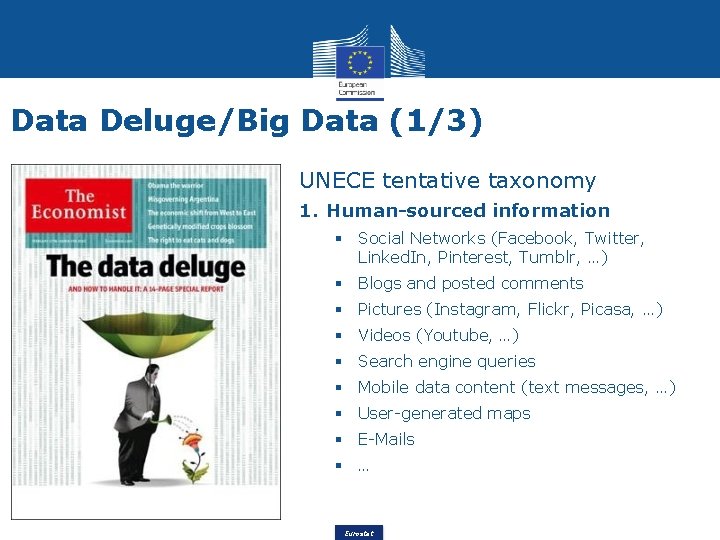
Data Deluge/Big Data (1/3) UNECE tentative taxonomy 1. Human-sourced information Social Networks (Facebook, Twitter, Linked. In, Pinterest, Tumblr, …) Blogs and posted comments Pictures (Instagram, Flickr, Picasa, …) Videos (Youtube, …) Search engine queries Mobile data content (text messages, …) User-generated maps E-Mails … Eurostat
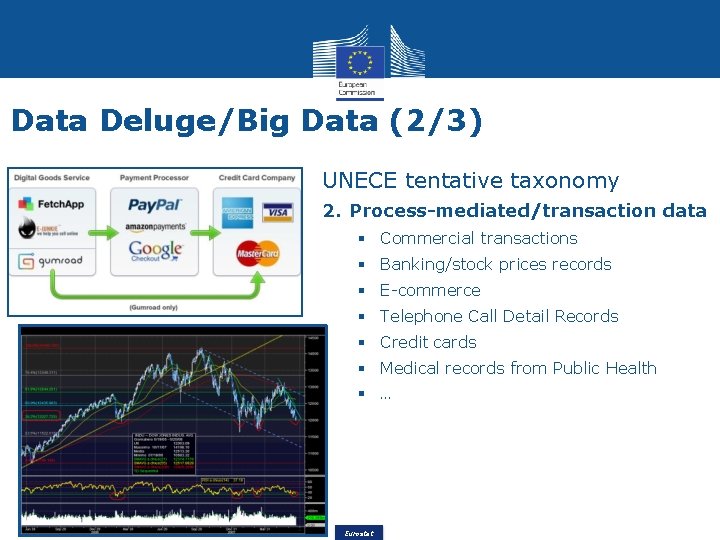
Data Deluge/Big Data (2/3) UNECE tentative taxonomy 2. Process-mediated/transaction data Commercial transactions Banking/stock prices records E-commerce Telephone Call Detail Records Credit cards Medical records from Public Health … Eurostat
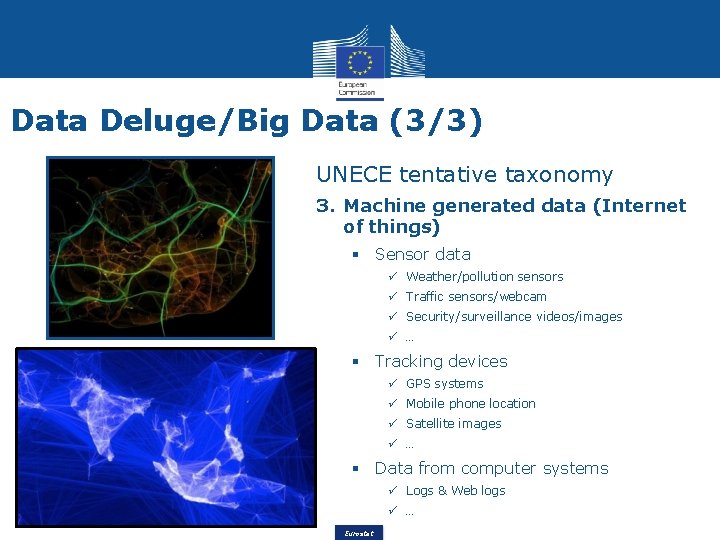
Data Deluge/Big Data (3/3) UNECE tentative taxonomy 3. Machine generated data (Internet of things) Sensor data Weather/pollution sensors Traffic sensors/webcam Security/surveillance videos/images … Tracking devices GPS systems Mobile phone location Satellite images … Data from computer systems Logs & Web logs … Eurostat
Why do Big Data look so appealing to NSIs? Possible answer(s): the reactive side Competitive pressure • Private sector may take advantage of Big Data and produce more and more statistics that attempt to beat official statistics on timeliness and relevance The “Official Statistics” trademark could slowly lose reputation and relevance unless NSIs get on board Funding constraints • Economic crisis (2009 -20? ? ) urges organizations to look for ways to increase efficiency and cut costs Being traditional data collection so cost-intensive, interest in alternative data sources and Big Data is growing Eurostat
Why do Big Data look so appealing to NSIs? Possible answer(s): the active side Improving quality of traditional statistics • Providing new auxiliary information that NSIs could exploit to Build and maintain better sampling frames Design better samples Build better Calibration estimators Soften nonresponse bias further Reducing respondents’ burden Potential for discovering new knowledge New well-being indicators Agriculture and environment statistics New measures of consumers’ confidence Consumer behavior beyond HBS Eurostat
Inference in the Official Statistics Realm Outline Official Statistics traditional paradigm • Top-down: data are planned • Traditional inference approaches Design based survey sampling theory Model-assisted approach Model based inference The need of a new paradigm to deal with Big Data • Bottom-up: data are already there • Exploratory analysis / Knowledge discovery approach Algorithmic inference: data mining techniques, machine learning, … Big Data bring plenty of methodological issues and pitfalls Eurostat

Official Statistics traditional approach (1/2) Information needs / Hypotheses Design data collection Collect data Prepare data Analyze data Obtain information / Confirm or reject hypotheses Eurostat
Official Statistics traditional approach (2/2) Top-down paradigm Emphasis on • Planning the data to be later analyzed since the beginning Target population, Units Variables, Definitions, Classifications, Questionnaires Lists and registers to reach units Methods to select units (randomization), … • Targeting analysis to specific information needs / hypotheses Model interpretability perceived as a must Statisticians always aspire to understand “how” something is going on, sometimes even to guess “why” it is going on • Using probability theory as a firm ground to achieve rigorous results in estimation/prediction Eurostat
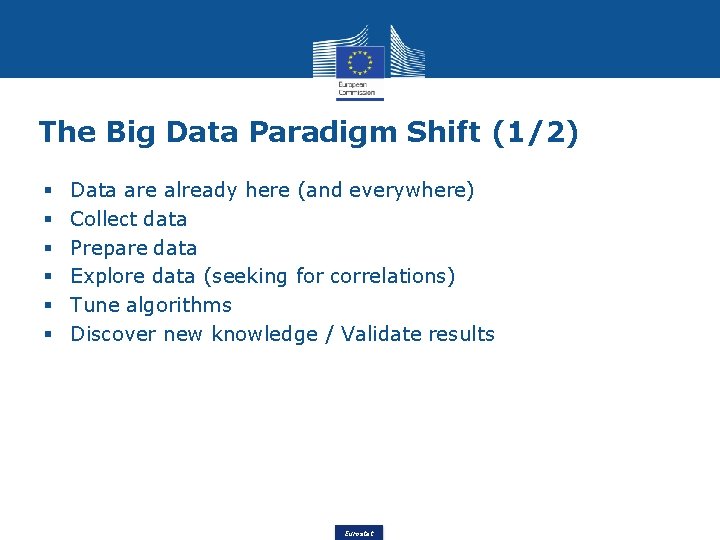
The Big Data Paradigm Shift (1/2) Data are already here (and everywhere) Collect data Prepare data Explore data (seeking for correlations) Tune algorithms Discover new knowledge / Validate results Eurostat
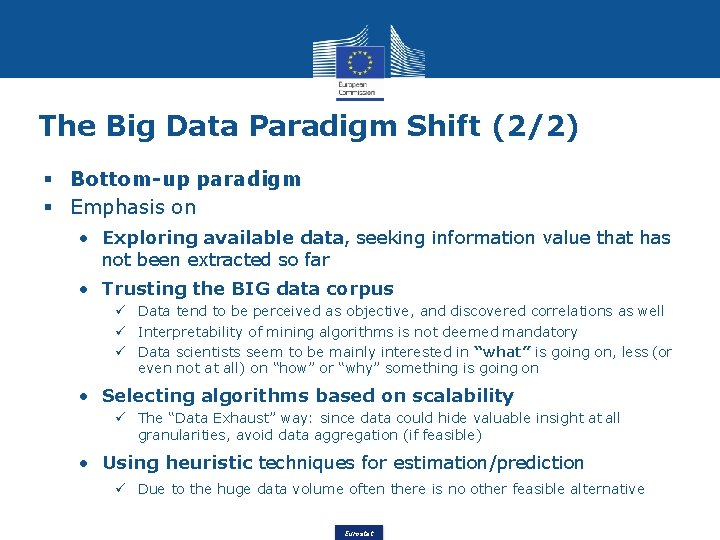
The Big Data Paradigm Shift (2/2) Bottom-up paradigm Emphasis on • Exploring available data, seeking information value that has not been extracted so far • Trusting the BIG data corpus Data tend to be perceived as objective, and discovered correlations as well Interpretability of mining algorithms is not deemed mandatory Data scientists seem to be mainly interested in “what” is going on, less (or even not at all) on “how” or “why” something is going on • Selecting algorithms based on scalability The “Data Exhaust” way: since data could hide valuable insight at all granularities, avoid data aggregation (if feasible) • Using heuristic techniques for estimation/prediction Due to the huge data volume often there is no other feasible alternative Eurostat
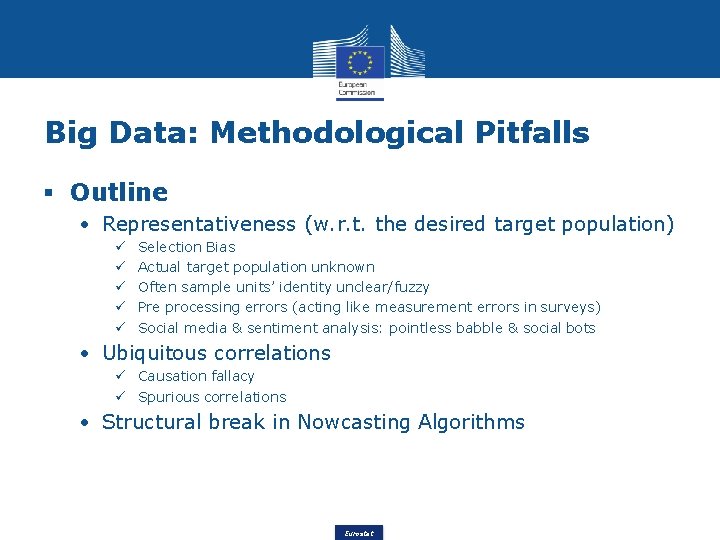
Big Data: Methodological Pitfalls Outline • Representativeness (w. r. t. the desired target population) Selection Bias Actual target population unknown Often sample units’ identity unclear/fuzzy Pre processing errors (acting like measurement errors in surveys) Social media & sentiment analysis: pointless babble & social bots • Ubiquitous correlations Causation fallacy Spurious correlations • Structural break in Nowcasting Algorithms Eurostat
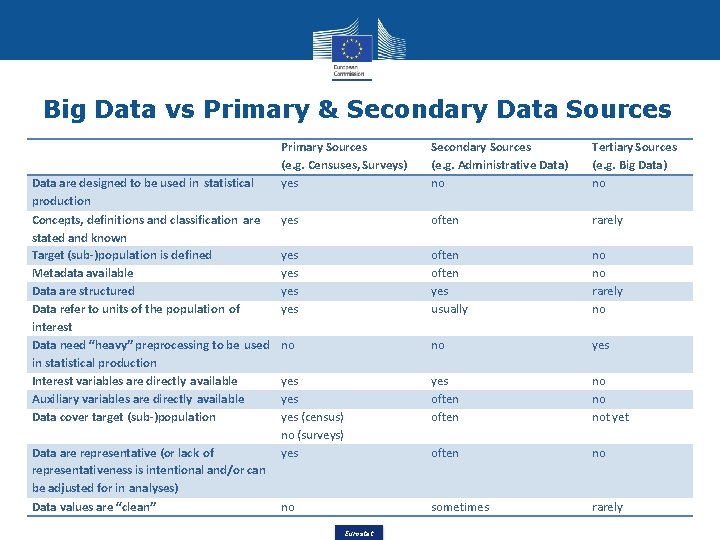
Big Data vs Primary & Secondary Data Sources Data are designed to be used in statistical production Concepts, definitions and classification are stated and known Target (sub-)population is defined Metadata available Data are structured Data refer to units of the population of interest Data need “heavy” preprocessing to be used in statistical production Interest variables are directly available Auxiliary variables are directly available Data cover target (sub-)population Data are representative (or lack of representativeness is intentional and/or can be adjusted for in analyses) Data values are “clean” Primary Sources (e. g. Censuses, Surveys) yes Secondary Sources (e. g. Administrative Data) no Tertiary Sources (e. g. Big Data) no yes often rarely yes yes often yes usually no no rarely no no no yes yes (census) no (surveys) yes often no no not yet often no no sometimes rarely Eurostat

Big Data: why traditional inference methods cannot succeed The computational complexity barrier • Examples: Matrix inversion (ubiquitous: least squares estimators, GLM maximum-likelihood via Newton-Raphson algorithm) O(n^3) • Most traditional algorithm difficult to parallelize (for achieving Hadoop / Map. Reduce scalability) • … Extreme sensitivity to erroneous data / outliers • Big data are noisy and unstructured But due to huge volume cannot apply thorough procedures for Editing & Imputation / Outlier detection Eurostat
Implications (1/2) Current methods in Official Statistics (e. g. design based and model assisted survey sampling theory, regression theory, generalized linear models, small area estimation methods, …) hinge upon specific features of NSI’ traditional data, namely • small amounts of high quality data These methods: • are extremely sensitive to outliers and erroneous data (which explains the tremendous effort put by NSIs in data checking and cleaning activities) • typically exhibit high computational complexity (power-behavior is the rule, a feature that hinders their scalability on huge amounts of data) Synthesis: NSIs’ statistical methods and Big Data are poles apart, at present Diagnosis: in order to let Big Data gain ground in Official Statistics, NSIs will have to undertake some radical paradigm shift in statistical methodology Eurostat
Implications (2/2) Despite it is far from obvious how to translate such awareness into actual proposals, we deem new candidate methods should be: 1. more robust (i. e. more tolerant towards both erroneous data and departures from model assumptions), perhaps at the price of some accuracy loss 2. less demanding in terms of a clear and complete understanding of obtained results in the light of an explicit statistical model (think of Artificial Neural Networks, Support Vector Machines, Classification and Regression Trees, Random Forests, …) 3. based on approximate (rather than exact) optimization techniques, which: are able to cope with noisy objective functions (as implied by low quality input data) typically ensure the mandatory scalability requirement inherent in Big Data processing, thanks to their implicit parallelism (think of stochastic metaheuristics like, e. g. , Evolutionary Algorithms, Ant Colonies, Swarm Particles, …) Eurostat
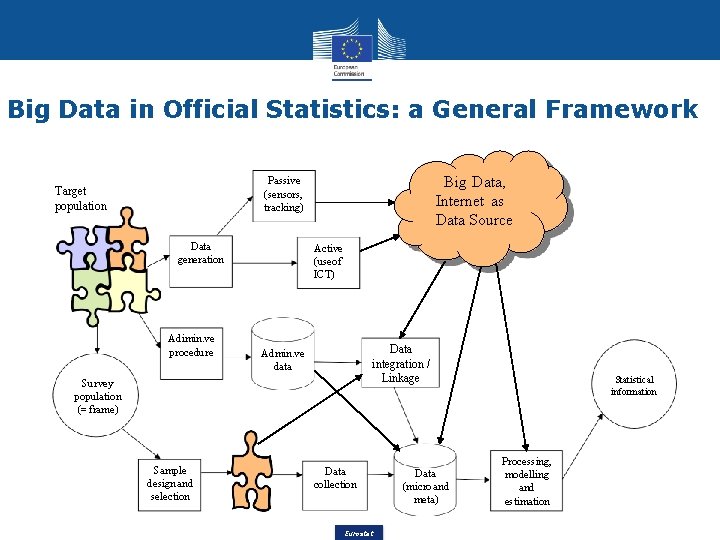
Big Data in Official Statistics: a General Framework Big Data, Internet as Data Source Passive (sensors, tracking) Target population Data generation Adimin. ve procedure Active (useof ICT) Data integration / Linkage Admin. ve data Survey population (= frame) Sample design and selection Data collection Eurostat Data (micro and meta) Statistical information Processing, modelling and estimation
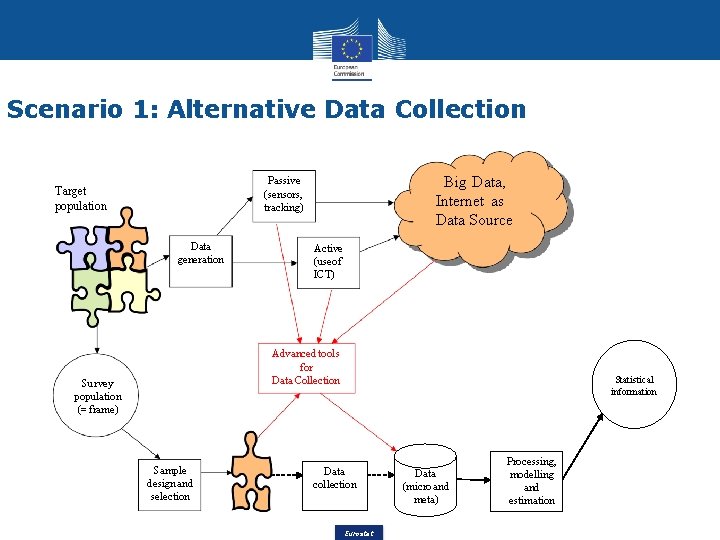
Scenario 1: Alternative Data Collection Big Data, Internet as Data Source Passive (sensors, tracking) Target population Data generation Active (useof ICT) Advanced tools for Data Collection Survey population (= frame) Sample design and selection Statistical information Data collection Eurostat Data (micro and meta) Processing, modelling and estimation
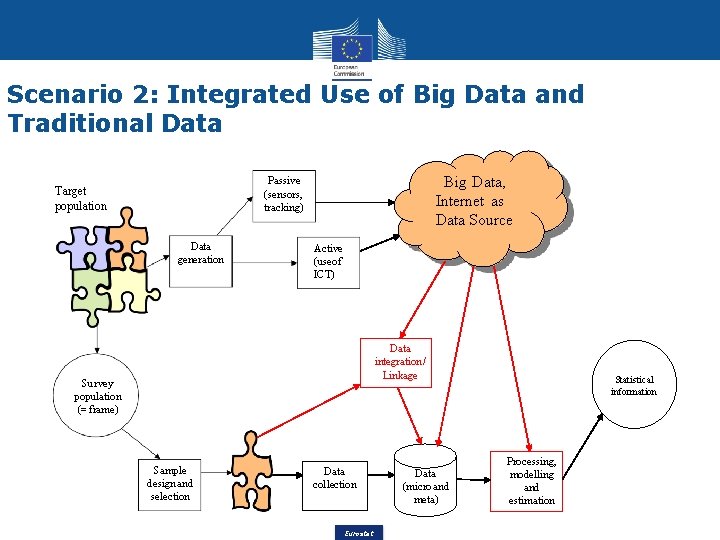
Scenario 2: Integrated Use of Big Data and Traditional Data Big Data, Internet as Data Source Passive (sensors, tracking) Target population Data generation Active (useof ICT) Data integration / Linkage Survey population (= frame) Sample design and selection Data collection Eurostat Data (micro and meta) Statistical information Processing, modelling and estimation
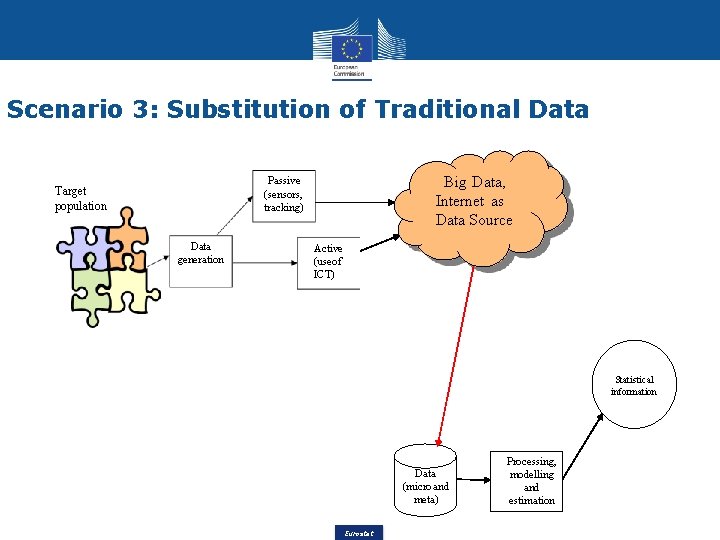
Scenario 3: Substitution of Traditional Data Big Data, Internet as Data Source Passive (sensors, tracking) Target population Data generation Active (useof ICT) Statistical information Data (micro and meta) Eurostat Processing, modelling and estimation
![Tentative Bibliography (1/2) [ECOSOC] “Report of the Global Working Group on Big data for](http://slidetodoc.com/presentation_image_h/210b9ef74102b98dbb8fd368c3698355/image-21.jpg "Tentative Bibliography (1/2) [ECOSOC] “Report of the Global Working Group on Big data for")
Tentative Bibliography (1/2) [ECOSOC] “Report of the Global Working Group on Big data for official statistics”, United Nations Economic and Social Council, Statistical Commission, session 46, 2015 3 -6 Mar u http: //unstats. un. org/unsd/statcom/doc 15/2015 -4 -Big. Data. pdf [Eurostat] “Big data – an opportunity or a threat to official statistics? ”, United Nations Economic and Social Council, Statistical Commission, plenary session 62, 2014 9 -11 Apr u http: //www. unece. org/fileadmin/DAM/stats/documents/ece/ces/2014/32 -Eurostat-Big_Data. pdf [Bureau of the Conference of European Statisticians] “In-depth review of big data”, Conference of European Statisticians, Paris, 2014 Apr 9 -11 u http: //www. unece. org/fileadmin/DAM/stats/documents/ece/ces/2014/7 -In-depth_review_of_big_data. pdf [HLG] “What does Big Data mean for Official Statistics? ”, United Nations Economic Commission for Europe, 2013 Mar 10 u http: //www 1. unece. org/stat/platform/pages/viewpage. action? page. Id=77170622 [ECOSOC] “Big data and modernization of statistical systems”, United Nations Economic and Social Council, Statistical Commission, session 45, 2014 4 -7 Mar u http: //unstats. un. org/unsd/statcom/doc 14/2014 -11 -Big. Data-E. pdf [American Association for Public Opinion Research] “AAPOR Report on Big Data”, 2015 Feb u http: //www. aapor. org/AAPORKentico/AAPOR_Main/media/Task-Force-Reports/Big. Data. Task. Force. Report_FINAL_2_12_15. pdf Eurostat
![Tentative Bibliography (2/2) [P. R. del Castillo] “Reflections on the Use Of Big Data](http://slidetodoc.com/presentation_image_h/210b9ef74102b98dbb8fd368c3698355/image-22.jpg "Tentative Bibliography (2/2) [P. R. del Castillo] “Reflections on the Use Of Big Data")
Tentative Bibliography (2/2) [P. R. del Castillo] “Reflections on the Use Of Big Data for Statistical Production”, CROS portal, 2013 May u http: //cros-portal. eu/sites/default/files/Reflections. Use. Big. Data. Statistical. Production_0. pdf [P. Daas et al. ] “Big Data as a Source of Statistical Information”, The Survey Statistician, 2014 Jan u http: //isi. cbs. nl/iass/N 69. pdf [P. Daas et al. ] “Big Data and Official Statistics”, NTTS conference, Brussels, Belgium, 2013 Mar u http: //www. cros-portal. eu/sites/default/files/NTTS 2013 full. Paper_76. pdf [M. Scannapieco et al. ] “Placing Big Data in Official Statistics: A Big Challenge? ”, NTTS conference, Brussels, Belgium, 2013 Mar u http: //cros-portal. eu/sites/default/files/NTTS 2013 full. Paper_214. pdf [B. Buelens et al. ] “Shifting paradigms in official statistics: from design-based to model-based to algorithmic inference”, Discussion paper, Statistics Netherlands, 2012 u http: //www. cbs. nl/NR/rdonlyres/A 94 F 8139 -3 DEE-45 E 3 -AE 38 -772 F 8869 DD 8 C/0/201218 x 10 pub. pdf [L. Breiman] “Statistical modeling: The two cultures”, Statistical Science, Vol. 16, No. 3, 2001 u http: //www. uni-leipzig. de/~strimmer/lab/courses/ss 09/current-topics/download/breiman 2001. pdf [Xiang et al. ] “Scalable Matrix Inversion Using Map. Reduce”, HPDC’ 14 Proceedings of the 23 rd international symposium on High-performance parallel and distributed computing, 2014 Jun u https: //cs. uwaterloo. ca/~ashraf/pubs/hpdc 14 matrix. pdf Eurostat
- Slides: 22