Cotman Housing Dunstan Hall Norwich 4 th May
- Slides: 36
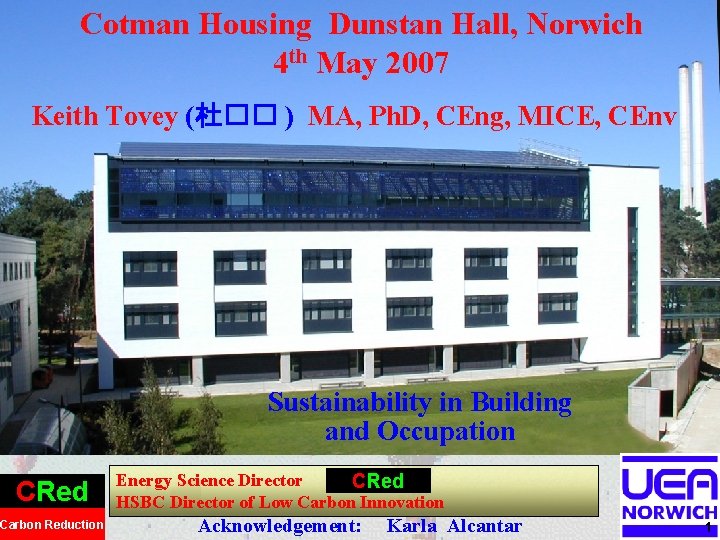
Cotman Housing Dunstan Hall, Norwich 4 th May 2007 Keith Tovey (杜�� ) MA, Ph. D, CEng, MICE, CEnv Sustainability in Building and Occupation CRed Energy Science Director CRed HSBC Director of Low Carbon Innovation Carbon Reduction Acknowledgement: Karla Alcantar 1
Sustainability in Building and Occupation • • Background • Issues of Sustainable Building Construction – Thermal Performance – Renewable Energy – Life Cycle analyses – Integration of Design – Future Proofing Buildings • Management of Building Energy Use • Behaviour of the Occupants • Conclusions 2
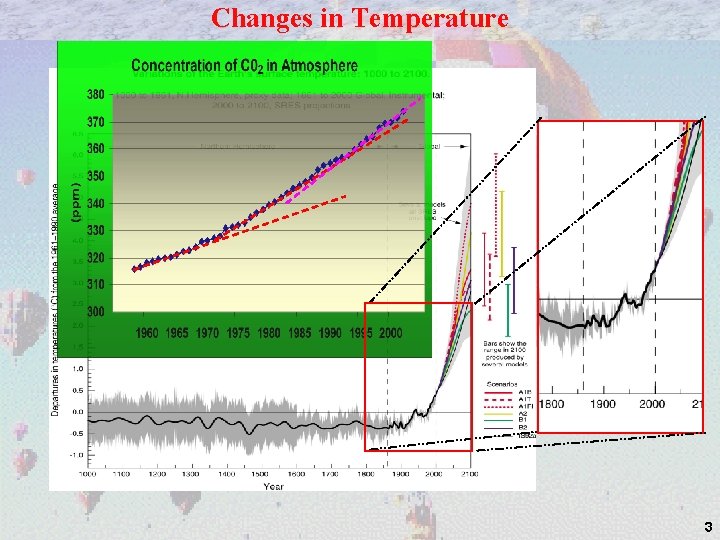
Changes in Temperature 3
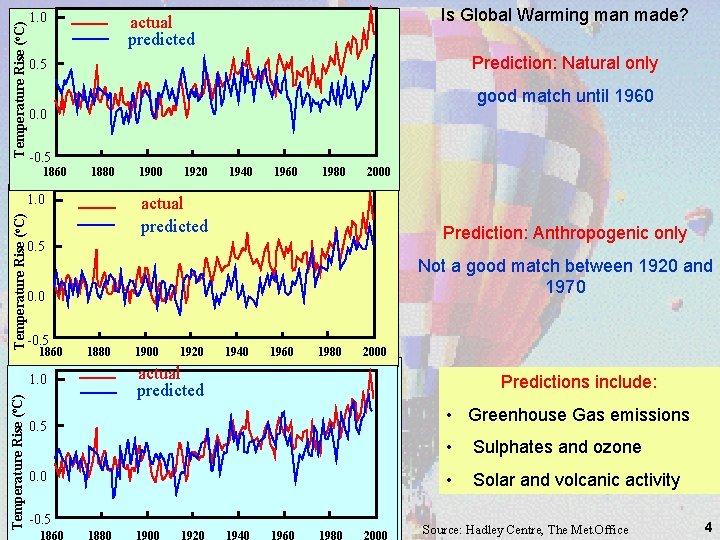
Temperature Rise (o. C) 1. 0 Prediction: Natural only 0. 5 good match until 1960 0. 0 -0. 5 1860 1880 Temperature Rise (o. C) 1. 0 1900 1920 1940 1960 1980 2000 actual predicted Prediction: Anthropogenic only 0. 5 Not a good match between 1920 and 1970 0. 0 -0. 5 1860 1880 1900 1920 1940 1960 1980 2000 actual predicted 1. 0 Temperature Rise (o. C) Is Global Warming man made? actual predicted Predictions include: Prediction: Gas Natural and • Greenhouse emissions Anthropogenic • Sulphates and ozone Generally a good match • Solar and volcanic activity 0. 5 0. 0 -0. 5 1860 1880 1900 1920 1940 1960 1980 2000 Source: Hadley Centre, The Met. Office 4
Sustainability in Building and Occupation • Background • Issues of Sustainable Building Construction – Thermal Performance issues • Future Proofing Buildings - Fabric Cooling? – Renewable Energy and Integration of Design – Life Cycle issues • Management of Building Energy Use • Behaviour of the Occupants • Conclusions 5
Thermal Performance Issues: Future Proofing • Thermal performance has improved with better insulation. • With better fabric insulation, ventilation can represent up to 80+% of heating energy requirements. • Careful design of ventilation is needed • lower capital costs vs lower environmental running costs. • Are ESCO’s a way forward? • Provide optional environmentally efficient systems within all new buildings. • Improved control – Smart (Sub) Metering • Is traditional Cost Benefit Analysis the correct way to appraise low carbon systems? 6
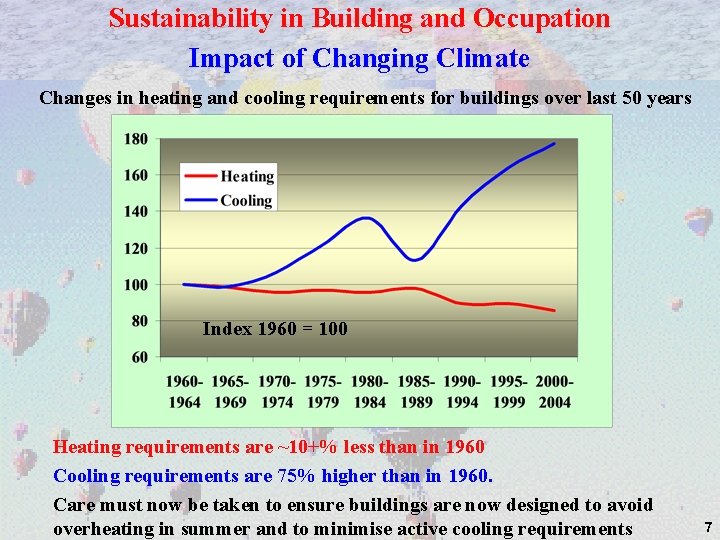
Sustainability in Building and Occupation Impact of Changing Climate Changes in heating and cooling requirements for buildings over last 50 years Index 1960 = 100 Heating requirements are ~10+% less than in 1960 Cooling requirements are 75% higher than in 1960. Care must now be taken to ensure buildings are now designed to avoid overheating in summer and to minimise active cooling requirements 7
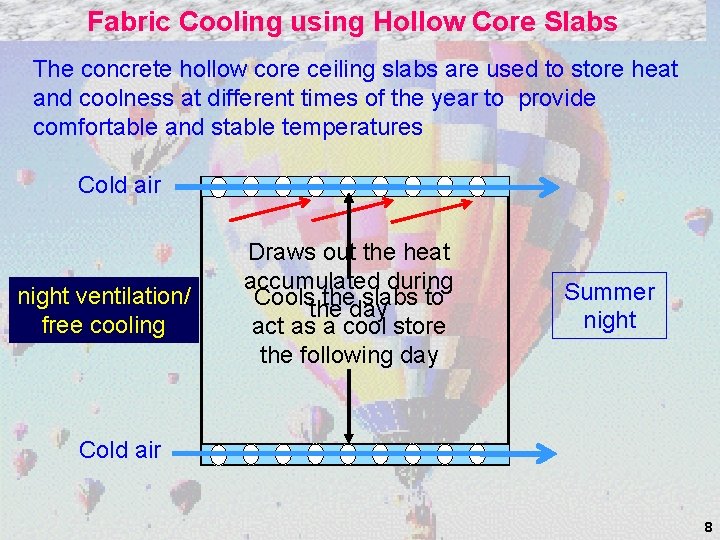
Fabric Cooling using Hollow Core Slabs The concrete hollow core ceiling slabs are used to store heat and coolness at different times of the year to provide comfortable and stable temperatures Cold air night ventilation/ free cooling Draws out the heat accumulated during Cools the slabs to the day act as a cool store the following day Summer night Cold air 8
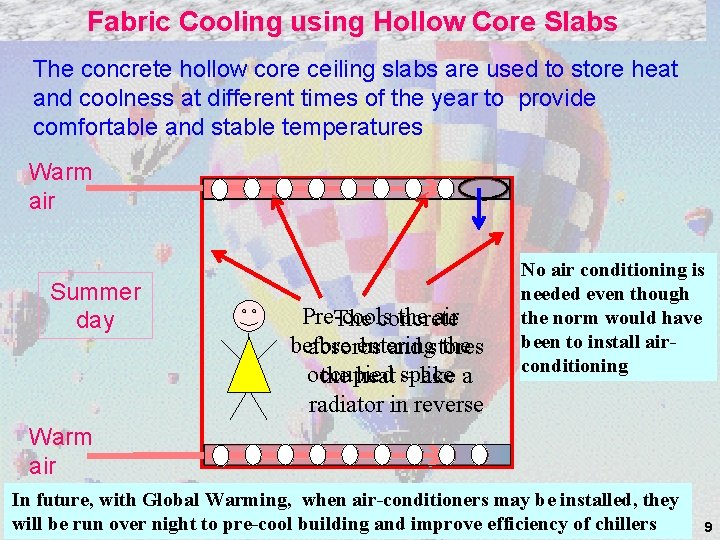
Fabric Cooling using Hollow Core Slabs The concrete hollow core ceiling slabs are used to store heat and coolness at different times of the year to provide comfortable and stable temperatures Warm air Summer day Pre-cools the air The concrete before entering the absorbs and stores occupied the heat space – like a radiator in reverse No air conditioning is needed even though the norm would have been to install airconditioning Warm air In future, with Global Warming, when air-conditioners may be installed, they will be run over night to pre-cool building and improve efficiency of chillers 9
Heat Pumps: A solution for a Low Carbon Future • Ground Source Heat Pumps are an effective route to low carbon heating – can save 50 – 60% of carbon emissions. • Work most efficiently with under floor heating. • Can be used with fabric pre-cooling in summer with very modest air-conditioning • Can be to provide some inter-seasonal heat store – i. e. reject heat in summer to acquifer/ground – recover during winter. There is ~ 3 months thermal lag in peak temperature in ground corresponding with early heating season use, and much improved coefficients of performance. 10
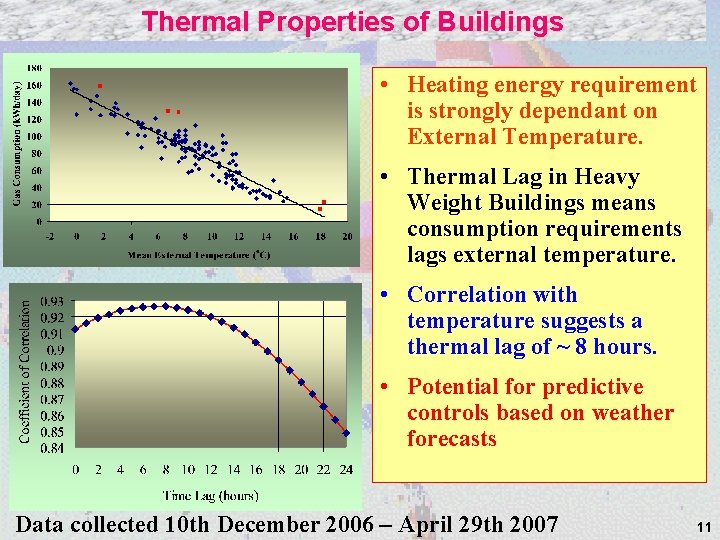
Thermal Properties of Buildings • Heating energy requirement is strongly dependant on External Temperature. • Thermal Lag in Heavy Weight Buildings means consumption requirements lags external temperature. • Correlation with temperature suggests a thermal lag of ~ 8 hours. • Potential for predictive controls based on weather forecasts Data collected 10 th December 2006 – April 29 th 2007 11
Sustainability in Building and Occupation • Background • Issues of Sustainable Building Construction – Thermal Performance issues • Future Proofing Buildings - Fabric Cooling? – Renewable Energy and Integration of Design – Life Cycle issues • Management of Building Energy Use • Behaviour of the Occupants • Conclusions 12
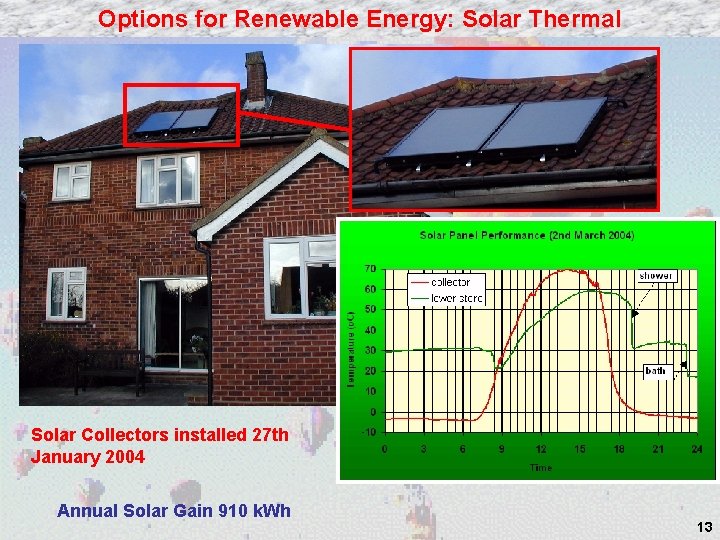
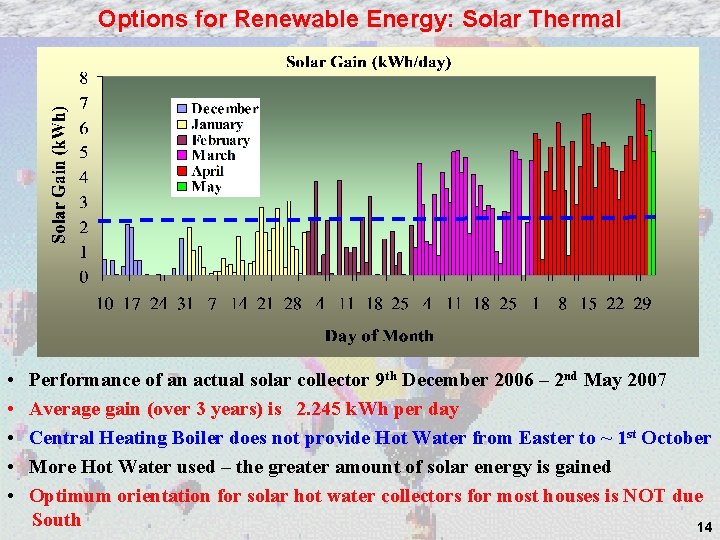
Options for Renewable Energy: Solar Thermal Solar Collectors installed 27 th January 2004 Annual Solar Gain 910 k. Wh 13
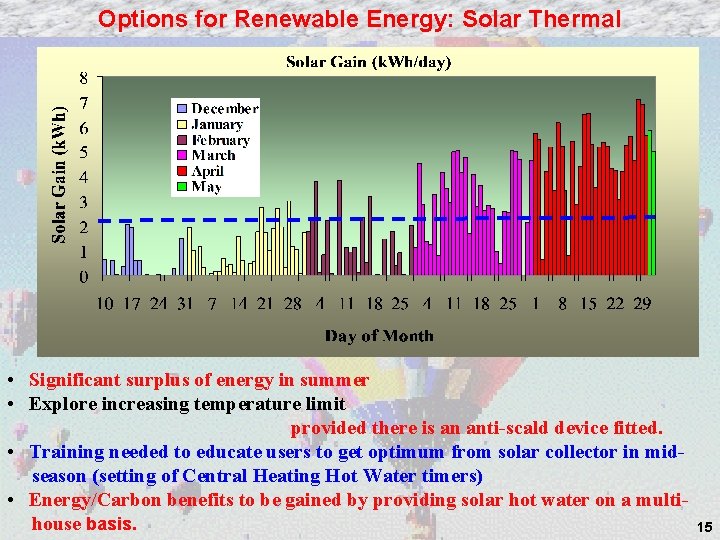
Options for Renewable Energy: Solar Thermal • • • Performance of an actual solar collector 9 th December 2006 – 2 nd May 2007 Average gain (over 3 years) is 2. 245 k. Wh per day Central Heating Boiler does not provide Hot Water from Easter to ~ 1 st October More Hot Water used – the greater amount of solar energy is gained Optimum orientation for solar hot water collectors for most houses is NOT due South 14
Options for Renewable Energy: Solar Thermal • Significant surplus of energy in summer • Explore increasing temperature limit provided there is an anti-scald device fitted. • Training needed to educate users to get optimum from solar collector in midseason (setting of Central Heating Hot Water timers) • Energy/Carbon benefits to be gained by providing solar hot water on a multihouse basis. 15
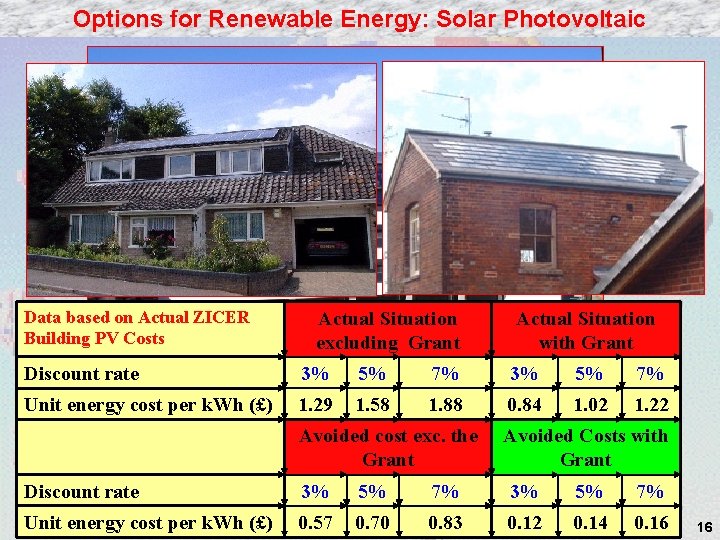
Options for Renewable Energy: Solar Photovoltaic Data based on Actual ZICER Building PV Costs Actual Situation excluding Grant Actual Situation with Grant Discount rate 3% 5% 7% Unit energy cost per k. Wh (£) 1. 29 1. 58 1. 88 0. 84 1. 02 1. 22 Avoided cost exc. the Grant Avoided Costs with Grant Discount rate 3% 5% 7% Unit energy cost per k. Wh (£) 0. 57 0. 70 0. 83 0. 12 0. 14 0. 16 16
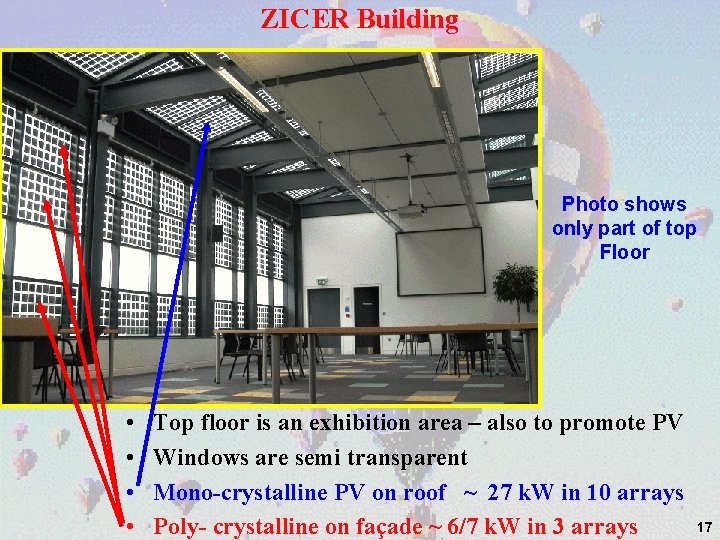
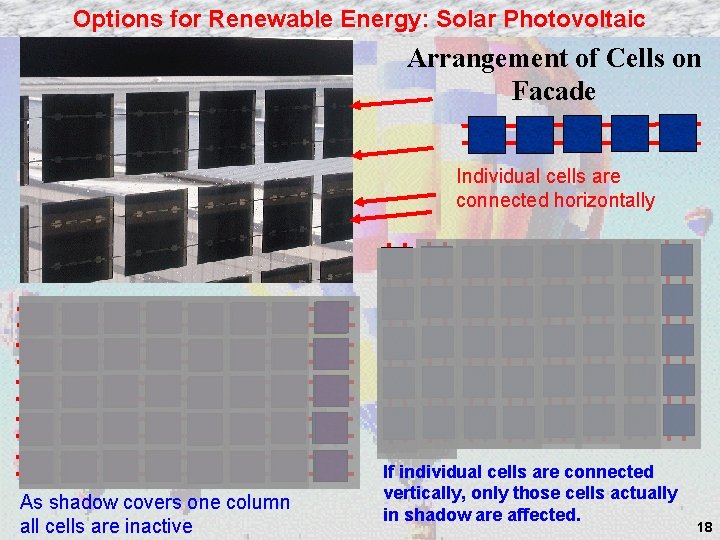
ZICER Building Photo shows only part of top Floor • • Top floor is an exhibition area – also to promote PV Windows are semi transparent Mono-crystalline PV on roof ~ 27 k. W in 10 arrays Poly- crystalline on façade ~ 6/7 k. W in 3 arrays 17
Options for Renewable Energy: Solar Photovoltaic Arrangement of Cells on Facade Individual cells are connected horizontally As shadow covers one column all cells are inactive If individual cells are connected vertically, only those cells actually in shadow are affected. 18
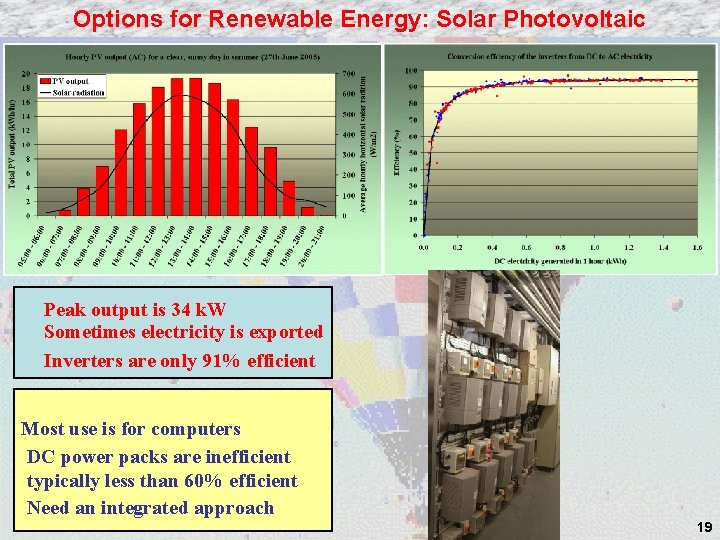
Options for Renewable Energy: Solar Photovoltaic Peak output is 34 k. W Sometimes electricity is exported Inverters are only 91% efficient Most use is for computers DC power packs are inefficient typically less than 60% efficient Need an integrated approach 19
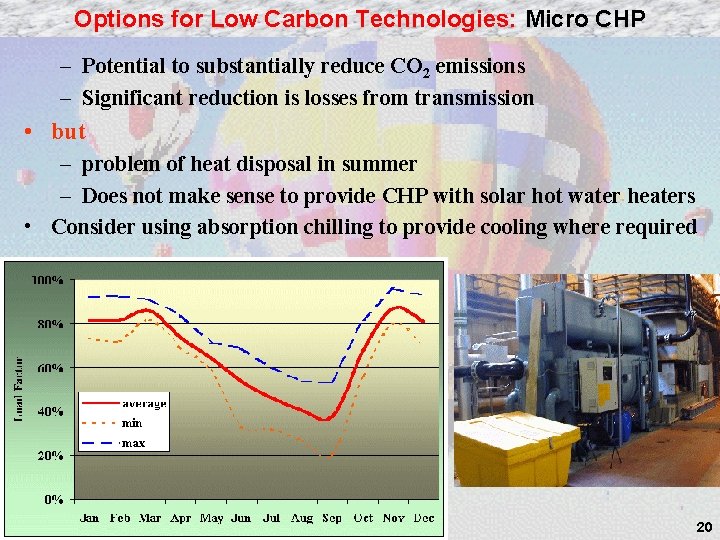
Options for Low Carbon Technologies: Micro CHP – Potential to substantially reduce CO 2 emissions – Significant reduction is losses from transmission • but – problem of heat disposal in summer – Does not make sense to provide CHP with solar hot water heaters • Consider using absorption chilling to provide cooling where required 20
Sustainability in Building and Occupation • Background • Issues of Sustainable Building Construction – Thermal Performance issues • Future Proofing Buildings - Fabric Cooling? – Renewable Energy and Integration of Design – Life Cycle issues • Management of Building Energy Use • Behaviour of the Occupants • Conclusions 21
Sustainability in Building and Occupation • Life Cycle Issues – an issue in Sustainability – Does local sourcing of materials necessarily lead to a low carbon construction? – In case of PV it emits LESS CO 2 if cells are manufactured in Spain and transported to UK! – despite the transport!!!! – Need to be aware of how fuel mix used for generation of electricity affects CO 2. • UK ~ 0. 52 kg/k. Wh, Spain ~ 0. 46 kg/k. Wh • France ~ 0. 06 kg/k. Wh • To what extent does embodied carbon from construction and demolition affect total carbon emission? – Example: ZICER Building 22
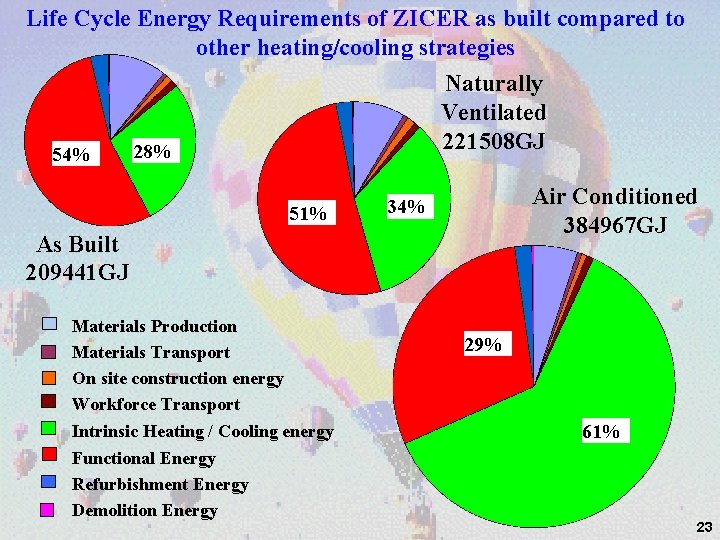
Life Cycle Energy Requirements of ZICER as built compared to other heating/cooling strategies 54% Naturally Ventilated 221508 GJ 28% 51% Air Conditioned 384967 GJ 34% As Built 209441 GJ Materials Production Materials Transport On site construction energy Workforce Transport Intrinsic Heating / Cooling energy Functional Energy Refurbishment Energy Demolition Energy 29% 61% 23
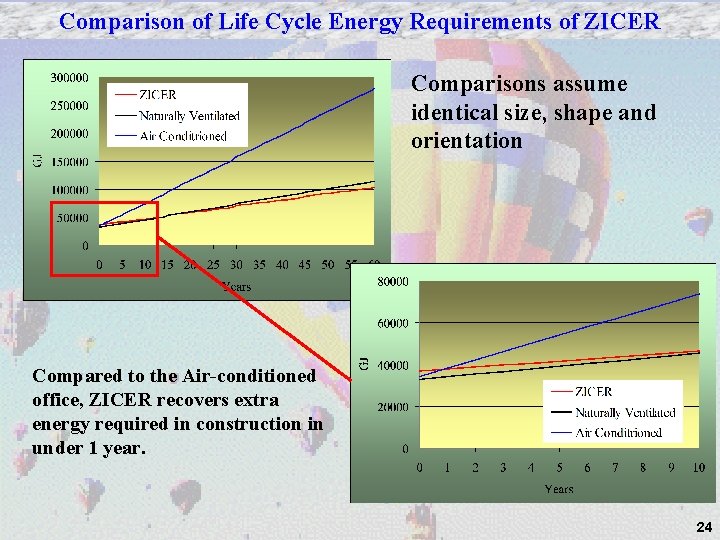
Comparison of Life Cycle Energy Requirements of ZICER Comparisons assume identical size, shape and orientation Compared to the Air-conditioned office, ZICER recovers extra energy required in construction in under 1 year. 24
Sustainability in Building and Occupation • Background • Issues of Sustainable Building Construction – Thermal Performance – – Renewable Energy Life Cycle analyses Integration of Design Future Proofing Buildings • Management of Building Energy Use • Behaviour of the Occupants • Conclusions 25
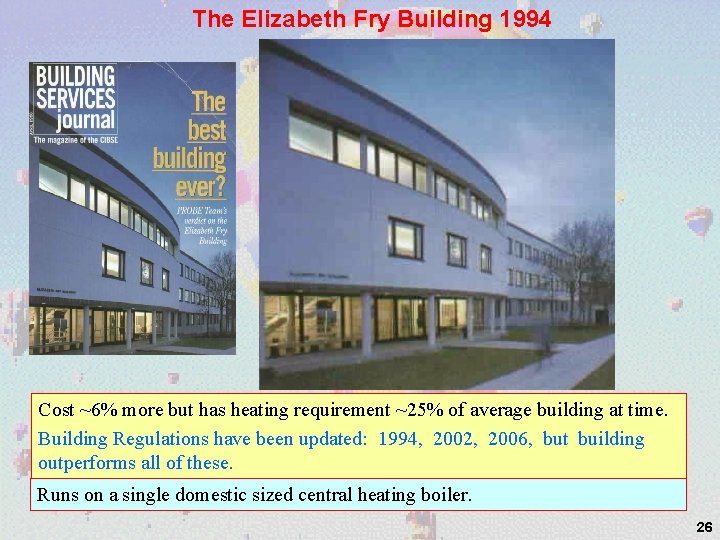
The Elizabeth Fry Building 1994 Cost ~6% more but has heating requirement ~25% of average building at time. Building Regulations have been updated: 1994, 2002, 2006, but building outperforms all of these. Runs on a single domestic sized central heating boiler. 26
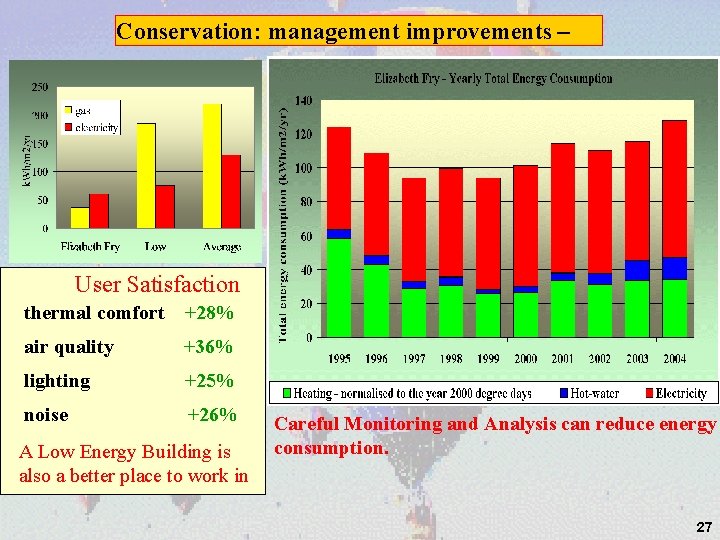
Conservation: management improvements – User Satisfaction thermal comfort +28% air quality +36% lighting +25% noise +26% A Low Energy Building is also a better place to work in Careful Monitoring and Analysis can reduce energy consumption. 27
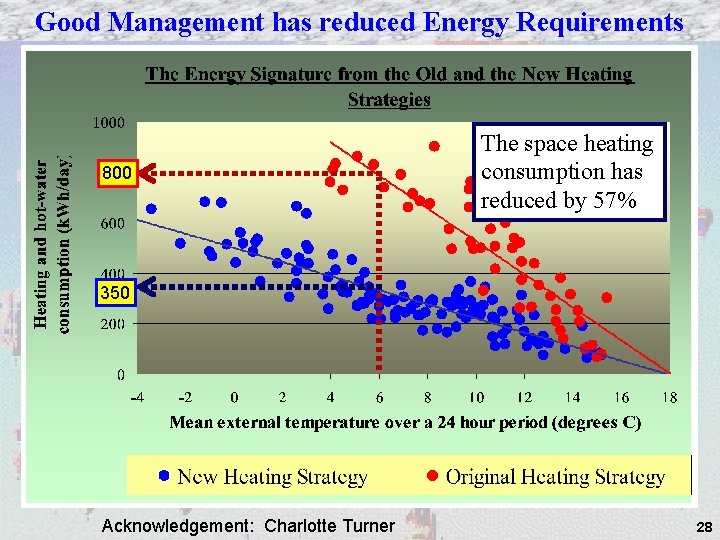
Good Management has reduced Energy Requirements 800 The space heating consumption has reduced by 57% 350 Acknowledgement: Charlotte Turner 28
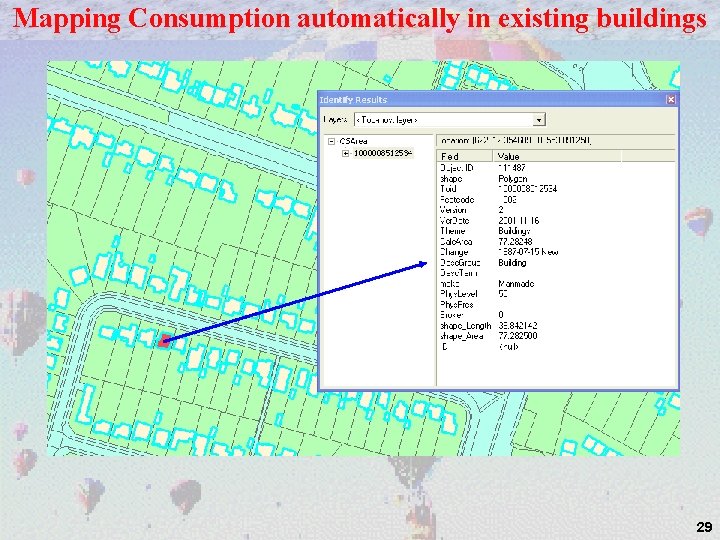
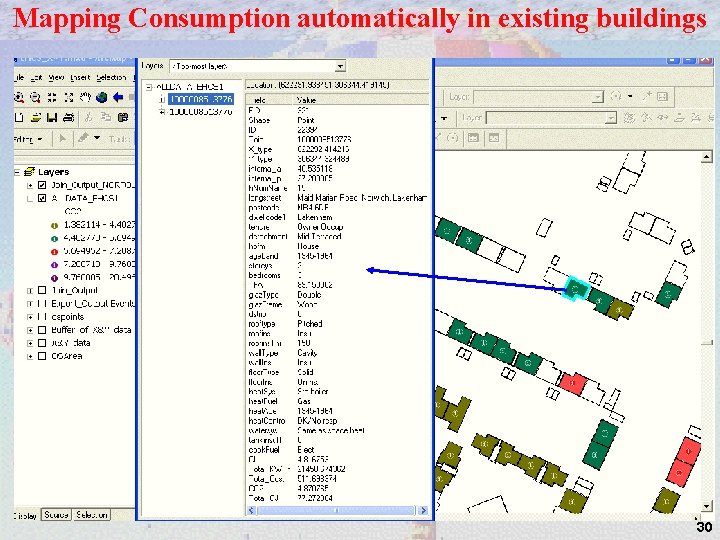
Mapping Consumption automatically in existing buildings Storeys = 2 & options 29
Mapping Consumption automatically in existing buildings 30
Sustainability in Building and Occupation • Background • Issues of Sustainable Building Construction – Thermal Performance – – Renewable Energy Life Cycle analyses Integration of Design Future Proofing Buildings • Management of Building Energy Use • Behaviour of the Occupants • Conclusions 31
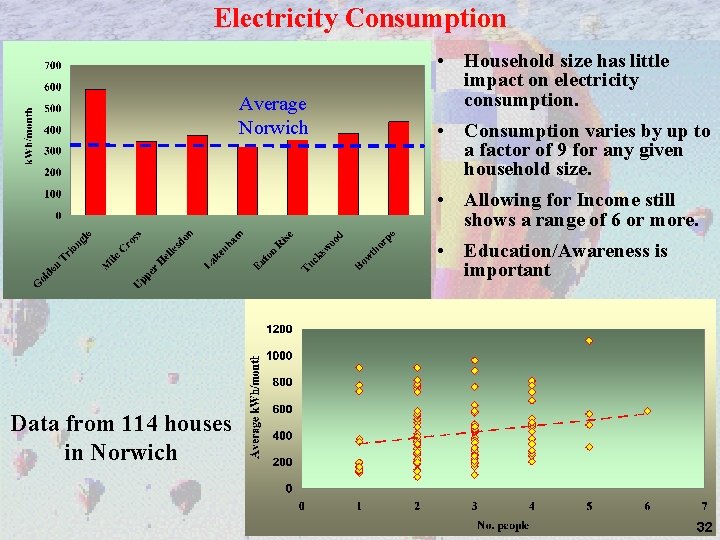
Electricity Consumption Average Norwich • Household size has little impact on electricity consumption. • Consumption varies by up to a factor of 9 for any given household size. • Allowing for Income still shows a range of 6 or more. • Education/Awareness is important Data from 114 houses in Norwich 32
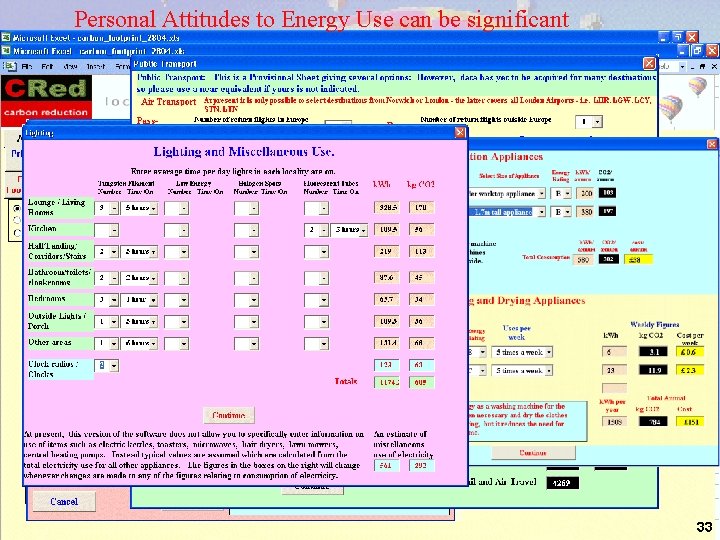
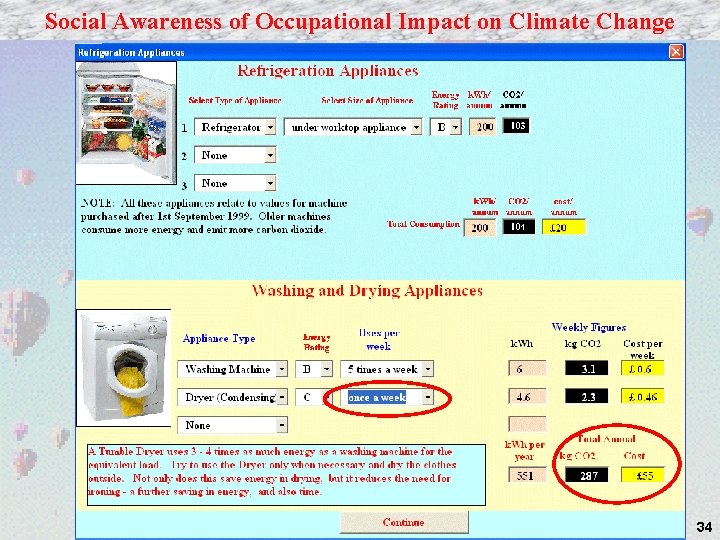
Personal Attitudes to Energy Use can be significant 33
Social Awareness of Occupational Impact on Climate Change 34
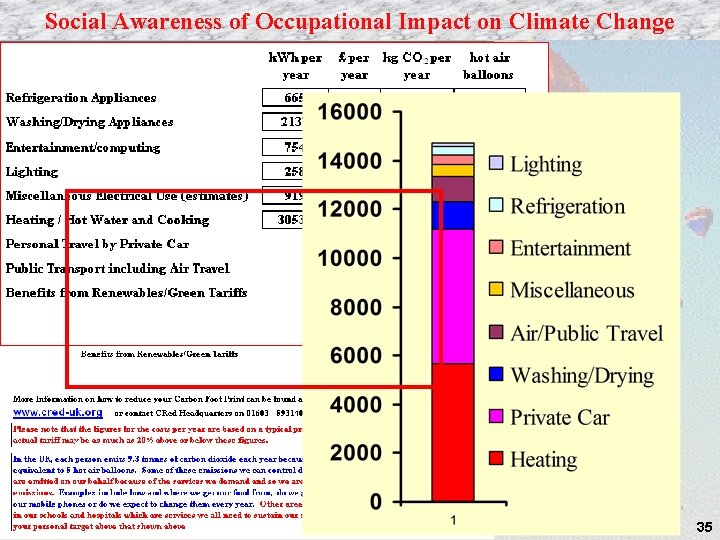
Social Awareness of Occupational Impact on Climate Change 35
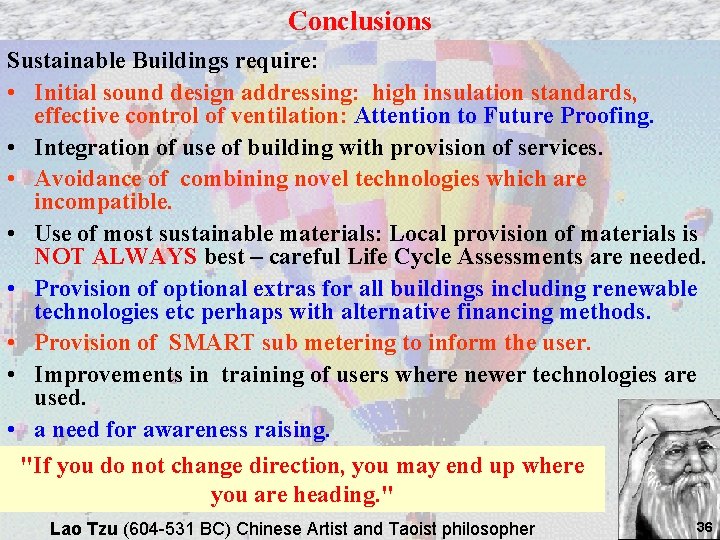
Conclusions Sustainable Buildings require: • Initial sound design addressing: high insulation standards, effective control of ventilation: Attention to Future Proofing. • Integration of use of building with provision of services. • Avoidance of combining novel technologies which are incompatible. • Use of most sustainable materials: Local provision of materials is NOT ALWAYS best – careful Life Cycle Assessments are needed. • Provision of optional extras for all buildings including renewable technologies etc perhaps with alternative financing methods. • Provision of SMART sub metering to inform the user. • Improvements in training of users where newer technologies are used. • a need for awareness raising. "If you do not change direction, you may end up where you are heading. " Lao Tzu (604 -531 BC) Chinese Artist and Taoist philosopher 36