Copyright Protection of Digital Image 2006 1 11
- Slides: 35
Copyright Protection of Digital Image 2006. 1. 11. Sung-Ho Bae baesh@tit. ac. kr Tongmyong University of information technology
Contents u Introduction u Generic Watermarking Scheme and Purpose u Watermarking Requirements u Watermarking Properties and Techniques u Attacks of Watermarked Image u Application Field of Watermarking u Image Watermarking Techniques u Summary
Introduction(1) ▣ Digital technologies present new threats for Intellectual properties and contents : ◈Easy access to information ◈Modification/falsification facilities ◈Redistribution facilities ◈Perfect copies ▣ Methods that prevent unauthorized access to copyrighted digital contents are required in wide ranges of applications -3 -
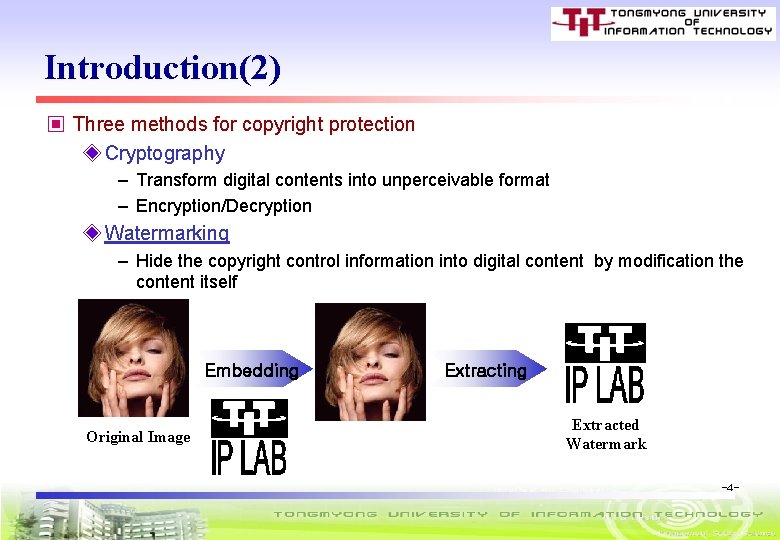
Introduction(2) ▣ Three methods for copyright protection ◈ Cryptography – Transform digital contents into unperceivable format – Encryption/Decryption ◈ Watermarking – Hide the copyright control information into digital content by modification the content itself Embedding Original Image Extracting Extracted Watermark -4 -
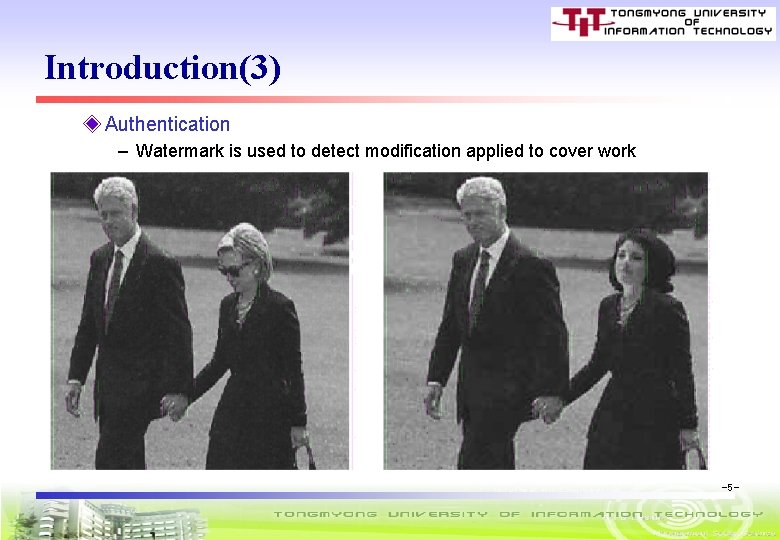
Introduction(3) ◈ Authentication – Watermark is used to detect modification applied to cover work -5 -
Introduction(4) ▣ Steganography vs. Watermarking ◈Steganography – Covert point-to-point communication between two parties – Interpreted to means of information hiding in other information – Example : sending a message to a spy by marking certain letters in a newspapers using invisible ink ◈Watermarking – Has the additional requirement of robustness against possible attacks -6 -
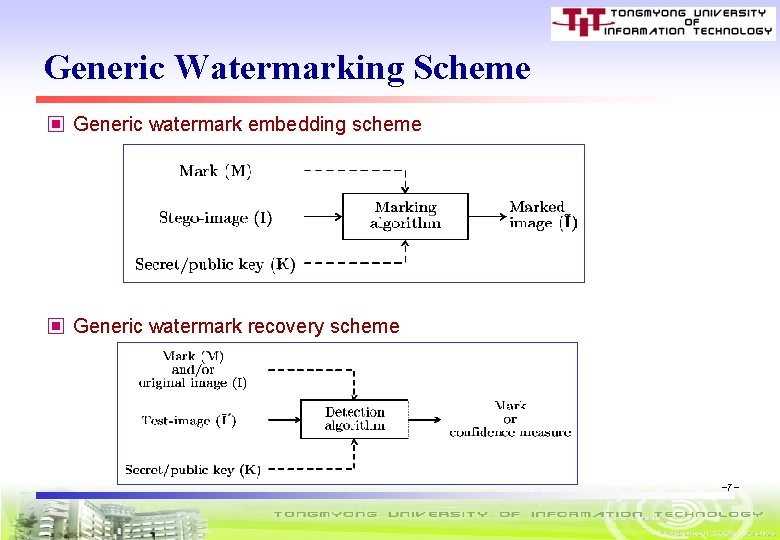
Generic Watermarking Scheme ▣ Generic watermark embedding scheme ▣ Generic watermark recovery scheme -7 -
Watermarking History ▣ Watermarks are used to keep track of paper provenance and thus format and quality identification in the art of handmade papermaking nearly 700 years ago ◈ 1993 – First use of the term “Watermark” – Tirkel et al. , “Electronic watermark”, DICTA 1993 ◈ 1993 -1994 – First papers on digital watermarking ◈ 1995 – First special session on image watermarking at NSIP’ 95, Neos Marmaras, Greece. ◈ 1995 – One of the first image watermarking algorithms – “Patchwork algorithm”, Kaskalis, Pitas, Bender et al -8 -
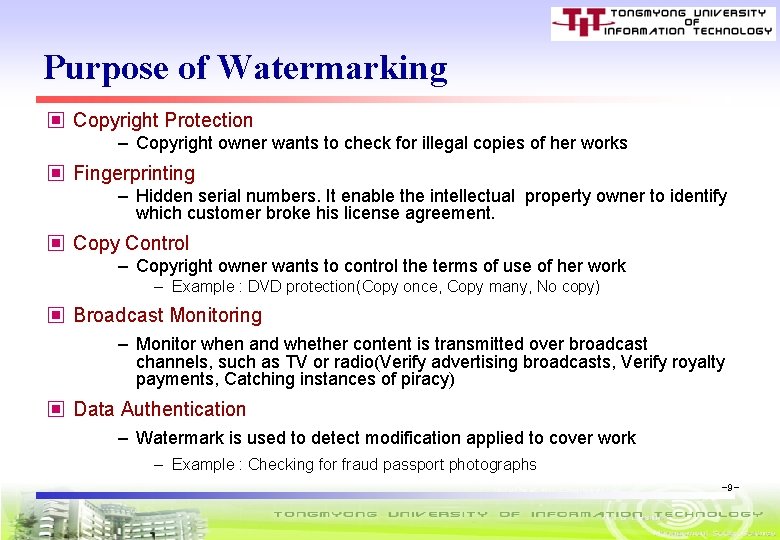
Purpose of Watermarking ▣ Copyright Protection – Copyright owner wants to check for illegal copies of her works ▣ Fingerprinting – Hidden serial numbers. It enable the intellectual property owner to identify which customer broke his license agreement. ▣ Copy Control – Copyright owner wants to control the terms of use of her work – Example : DVD protection(Copy once, Copy many, No copy) ▣ Broadcast Monitoring – Monitor when and whether content is transmitted over broadcast channels, such as TV or radio(Verify advertising broadcasts, Verify royalty payments, Catching instances of piracy) ▣ Data Authentication – Watermark is used to detect modification applied to cover work – Example : Checking for fraud passport photographs -9 -
Watermarking Requirements(1) ▣ Perceptual transparency ◈ Watermarked content has the same subjective quality as the original contents ▣ Robustness ◈ Nobody is able to remove, alter, or damage the watermark without a secret key ▣ Security ◈ Secret key determines the value of watermark and the locations where the watermark is embedded ▣ Payload of the watermark ◈ Amount of information to be embedded ▣ Capacity ◈ Multiple watermark can be embedded/extracted -10 -
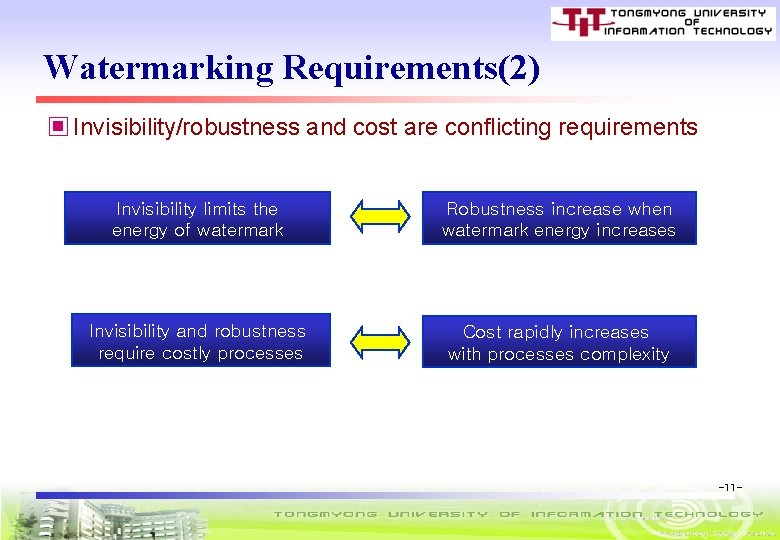
Watermarking Requirements(2) ▣ Invisibility/robustness and cost are conflicting requirements Invisibility limits the energy of watermark Robustness increase when watermark energy increases Invisibility and robustness require costly processes Cost rapidly increases with processes complexity -11 -
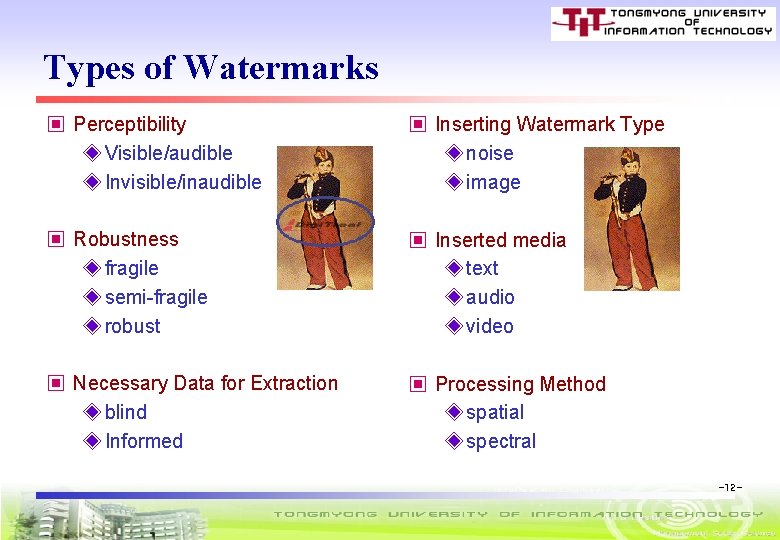
Types of Watermarks ▣ Perceptibility ◈ Visible/audible ◈ Invisible/inaudible ▣ Inserting Watermark Type ◈ noise ◈ image ▣ Robustness ◈ fragile ◈ semi-fragile ◈ robust ▣ Inserted media ◈ text ◈ audio ◈ video ▣ Necessary Data for Extraction ◈ blind ◈ Informed ▣ Processing Method ◈ spatial ◈ spectral -12 -
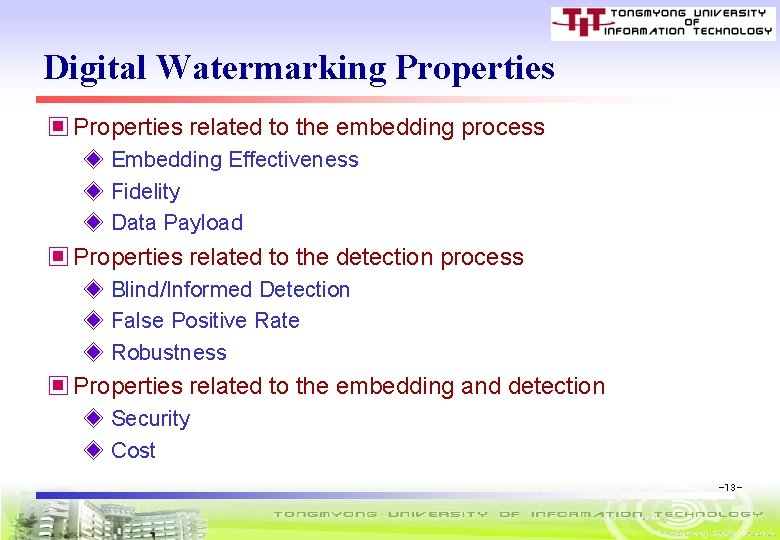
Digital Watermarking Properties ▣ Properties related to the embedding process ◈ Embedding Effectiveness ◈ Fidelity ◈ Data Payload ▣ Properties related to the detection process ◈ Blind/Informed Detection ◈ False Positive Rate ◈ Robustness ▣ Properties related to the embedding and detection ◈ Security ◈ Cost -13 -
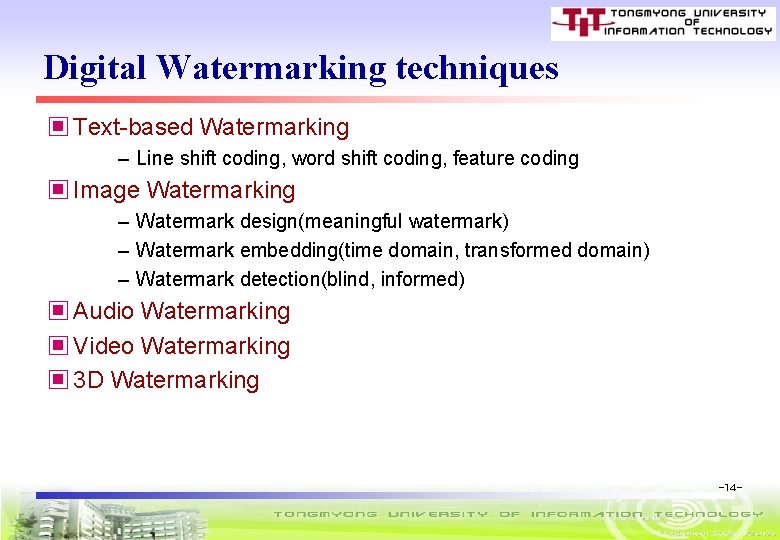
Digital Watermarking techniques ▣ Text-based Watermarking – Line shift coding, word shift coding, feature coding ▣ Image Watermarking – Watermark design(meaningful watermark) – Watermark embedding(time domain, transformed domain) – Watermark detection(blind, informed) ▣ Audio Watermarking ▣ Video Watermarking ▣ 3 D Watermarking -14 -
Image Watermarking techniques ▣ Spatial-domain techniques ▣ Transform-domain techniques ◈DCT-based ◈DFT-based ◈Wavelet-based ◈Other transforms ▣ Compressed stream-domain techniques ◈Watermarking MPEG bit streams -15 -
Levels of Robustness ▣ Spatial-domain watermarks ◈Watermark embedded in lower order bit planes ◈Transparent mark ◈Visually pleasing, not robust to compression ▣ Transform-domain watermarks ◈Watermark added to frequency coefficients ◈Watermark location and strength based on perceptual rules ▣ Watermark insertion based on utilizing formal HVS model in order to provide the strongest watermark while guaranteeing transparency -16 -
Attacks of Watermarked Image ▣ Unintentional Attacks ◈ A/D, D/A conversion, resampling ◈ Cropping ◈ Compression ◈ Geometric distortions(Synchronization) ◈ Additive noise ▣ Intentional Attacks ◈ IBM attack ◈ Collusion ▣ Software for Attacks ◈ Checkmark ◈ Stir. Mark ◈ AIIAmark -17 -
Removal attacks ▣ Remove the watermark from host image or decrease its relative energy ◈Mean/median/Gaussian filtering, Wiener-Lee filtering ◈Averaging N instances of the same image, bearing different watermarks ◈Lossy compression (JPEG, JPEG 2000) ◈Sharpening, Contrast enhancement (histogram equalization) ◈Gamma correction, Color quantization/subsampling ◈Additive/multiplicative noise : Gaussian, uniform, or salt-pepper ◈Multiple watermarking -18 -
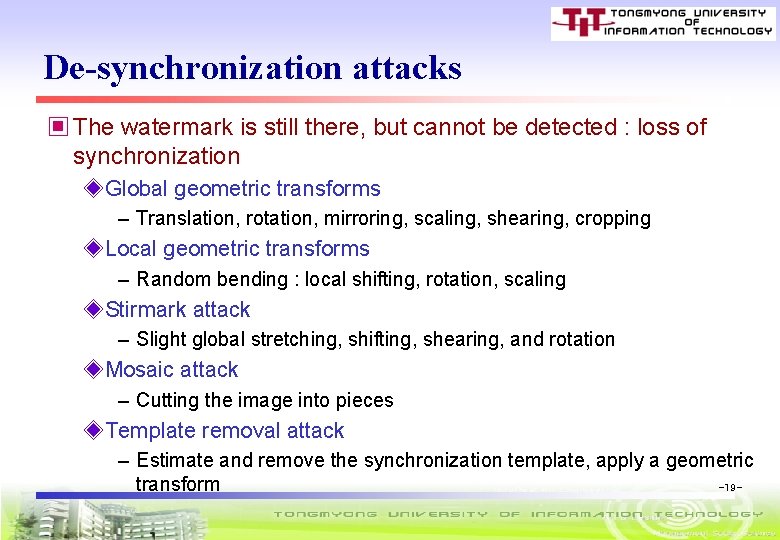
De-synchronization attacks ▣ The watermark is still there, but cannot be detected : loss of synchronization ◈Global geometric transforms – Translation, rotation, mirroring, scaling, shearing, cropping ◈Local geometric transforms – Random bending : local shifting, rotation, scaling ◈Stirmark attack – Slight global stretching, shifting, shearing, and rotation ◈Mosaic attack – Cutting the image into pieces ◈Template removal attack – Estimate and remove the synchronization template, apply a geometric -19 transform
Protocol attacks ▣ Attacks that try to render the watermarking concept unreliable ◈Copy attack : estimate the watermark from one image and embed it to other image ◈IBM attack : Creation of a fake original by adding a watermark in watermarked image. The attacker can claim that he has both the original and watermarked image. -20 -
Application Field of Watermarking(1) ▣ Application field in technological side ◈Copyright and contents protection ◈Authentication and integrity verification ◈Digital contents tracking ◈Security(e. g. passport photos) ◈Metadata tagging(annotation) ◈Usage control ◈Secret communication ◈And many more -21 -
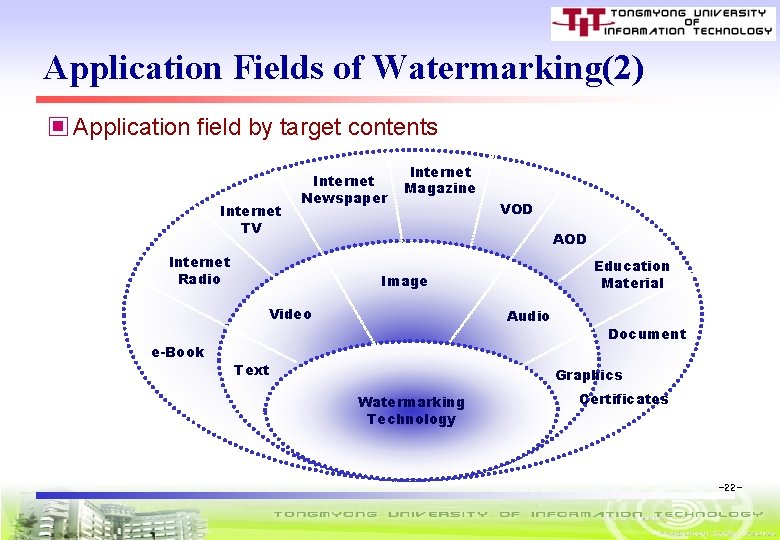
Application Fields of Watermarking(2) ▣ Application field by target contents Internet TV Internet Newspaper Internet Radio Internet Magazine AOD Education Material Image Video e-Book VOD Audio Text Document Graphics Watermarking Technology Certificates -22 -
Companies ▣ Digimarc ◈ Image watermark ▣ Bluespike ◈ Giovanni still image watermark ▣ ARIS ◈ Audio watermark ▣ Media. Sec ▣ Signafy ▣ Signum ▣ Intertrust ◈ DRM ▣ IBM ▣ HP ▣ NEC ▣ ▣ Mark. Any Digital-Innotech Seal. Tronic Technology Digi. Treal Technology -23 -
Related Sites ▣ Watermarking and data hiding ◈ http: //www-nt. e-technik. unierlangen. de/~hartung/watermarkinglinks. html ▣ Watermarking. World ◈ http: //www. watermarkingworld. org/ ▣ Digital Copyright Protection & Digital Watermarking Technology ◈ http: //www-sal. cs. uiuc. edu/~l-qiao/watermarking. html ▣ Imprimatur ◈ http: //www. imprimatur. net ▣ Digimarc’s extractor ◈ http: //www. digimarc. com ▣ KAIST’s KAIMark ◈ http: //www. digital-innotech. com ▣ Mark. Any’s MAIM ◈ http: //www. markany. com -24 -
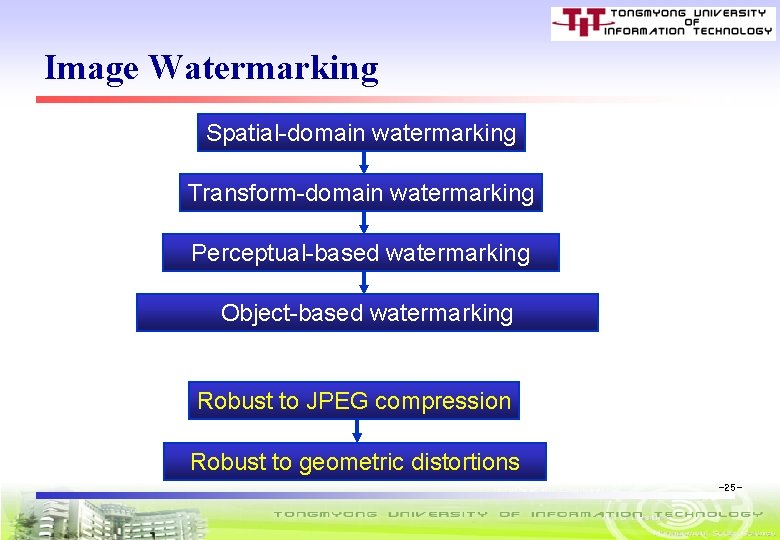
Image Watermarking Spatial-domain watermarking Transform-domain watermarking Perceptual-based watermarking Object-based watermarking Robust to JPEG compression Robust to geometric distortions -25 -
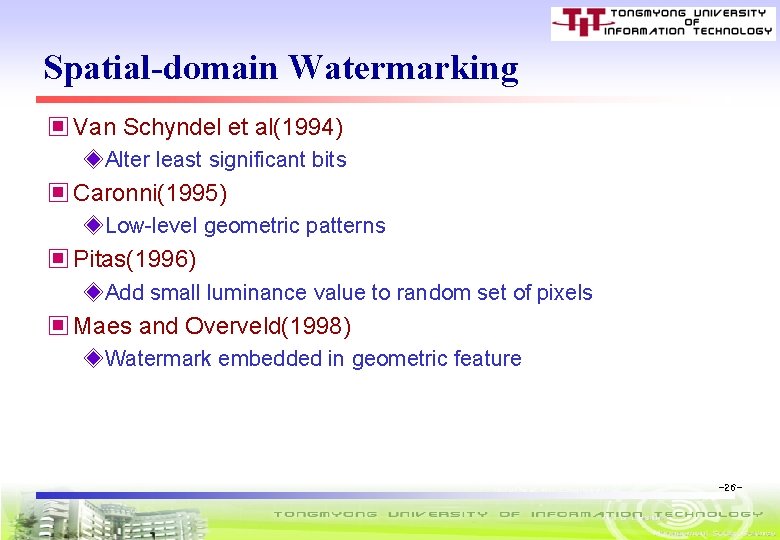
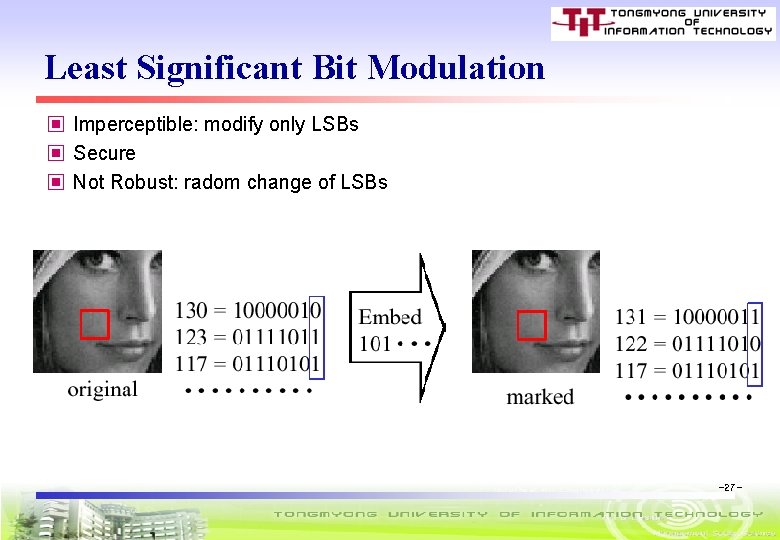
Spatial-domain Watermarking ▣ Van Schyndel et al(1994) ◈Alter least significant bits ▣ Caronni(1995) ◈Low-level geometric patterns ▣ Pitas(1996) ◈Add small luminance value to random set of pixels ▣ Maes and Overveld(1998) ◈Watermark embedded in geometric feature -26 -
Least Significant Bit Modulation ▣ Imperceptible: modify only LSBs ▣ Secure ▣ Not Robust: radom change of LSBs -27 -
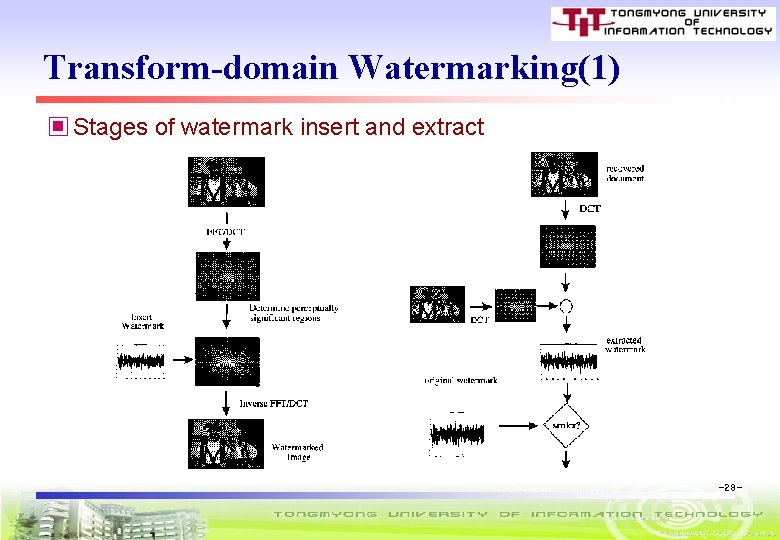
Transform-domain Watermarking(1) ▣ Stages of watermark insert and extract -28 -
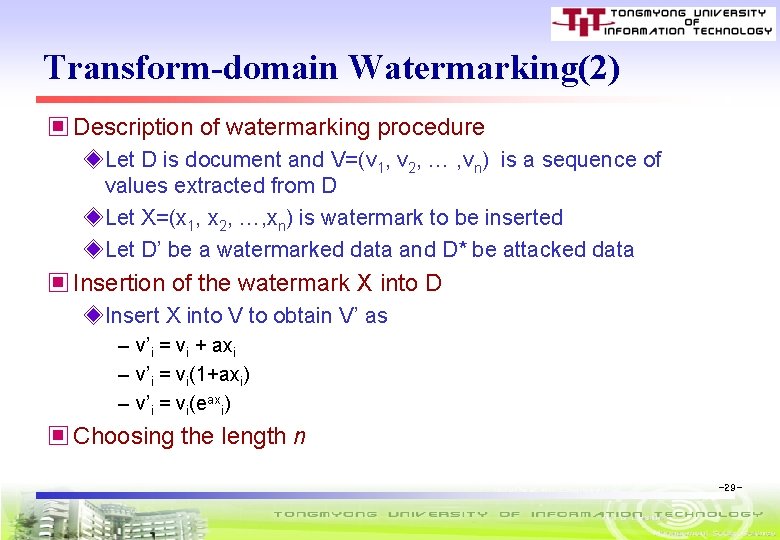
Transform-domain Watermarking(2) ▣ Description of watermarking procedure ◈Let D is document and V=(v 1, v 2, … , vn) is a sequence of values extracted from D ◈Let X=(x 1, x 2, …, xn) is watermark to be inserted ◈Let D’ be a watermarked data and D* be attacked data ▣ Insertion of the watermark X into D ◈Insert X into V to obtain V’ as – v’i = vi + axi – v’i = vi(1+axi) – v’i = vi(eaxi) ▣ Choosing the length n -29 -
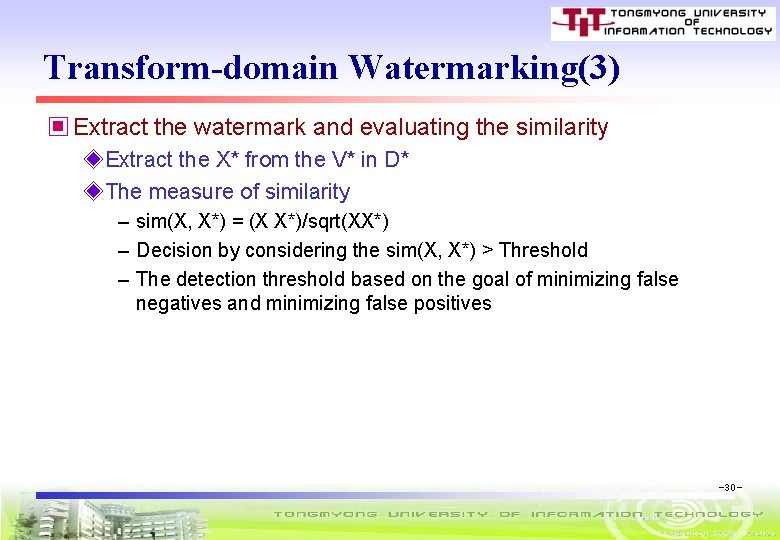
Transform-domain Watermarking(3) ▣ Extract the watermark and evaluating the similarity ◈Extract the X* from the V* in D* ◈The measure of similarity – sim(X, X*) = (X X*)/sqrt(XX*) – Decision by considering the sim(X, X*) > Threshold – The detection threshold based on the goal of minimizing false negatives and minimizing false positives -30 -
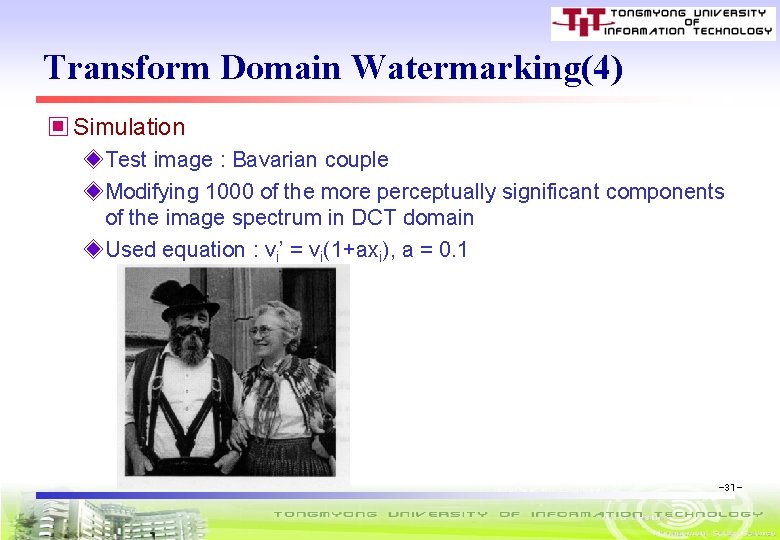
Transform Domain Watermarking(4) ▣ Simulation ◈Test image : Bavarian couple ◈Modifying 1000 of the more perceptually significant components of the image spectrum in DCT domain ◈Used equation : vi’ = vi(1+axi), a = 0. 1 -31 -
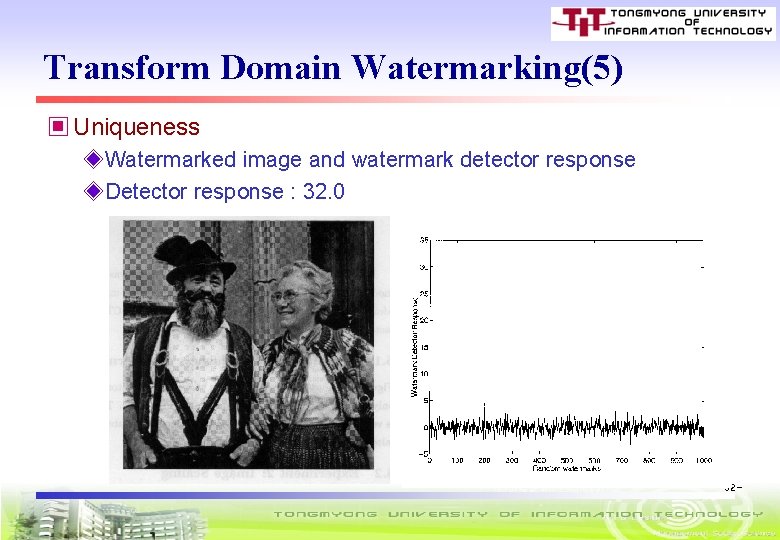
Transform Domain Watermarking(5) ▣ Uniqueness ◈Watermarked image and watermark detector response ◈Detector response : 32. 0 -32 -
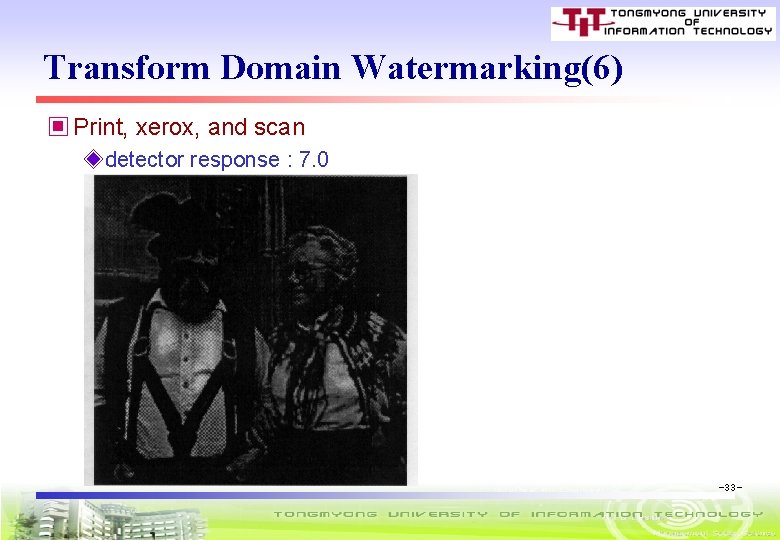
Transform Domain Watermarking(6) ▣ Print, xerox, and scan ◈detector response : 7. 0 -33 -
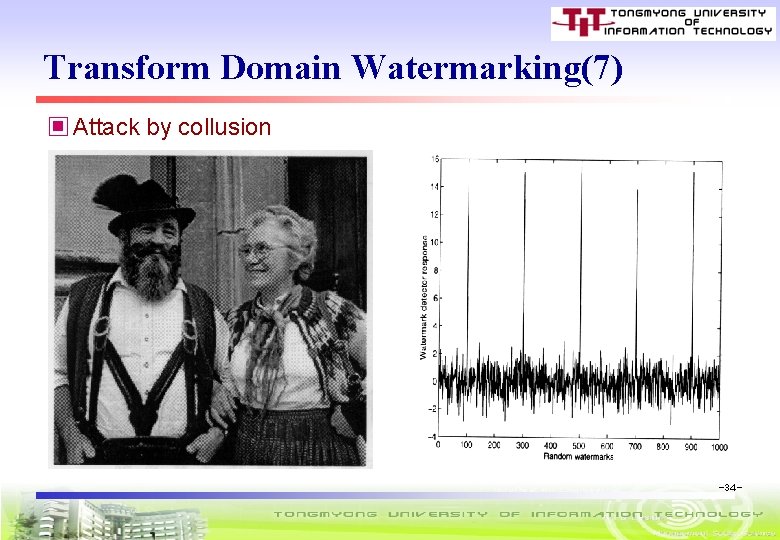
Transform Domain Watermarking(7) ▣ Attack by collusion -34 -
Summary ▣ Open problems ◈Is digital watermarking the solution for copyright protection? Since no watermarking algorithm resists all the attacks ◈Is there a better way to solve the problem of intellectual property protection of digital contents? Nothing But many research areas related to watermarking must be studied -35 -