COMMUNICATION Communication Dr Atef J Ismail COMMUNICATION Communicating
- Slides: 30
COMMUNICATION Communication Dr. Atef J Ismail
COMMUNICATION �Communicating clearly, effectively and successfully is critical for the nurse manager. �-Therapeutic communication skills, not sufficient in a complex management environment. � Communication is the lubricant of organization. Communication Dr. Atef J Ismail 2
�Use successful techniques of communication to express, ideas (verbally and in writing & able to listen accurately to others. �Success of management strategies depends upon effective communication because managers work through others. Communication Dr. Atef J Ismail 3
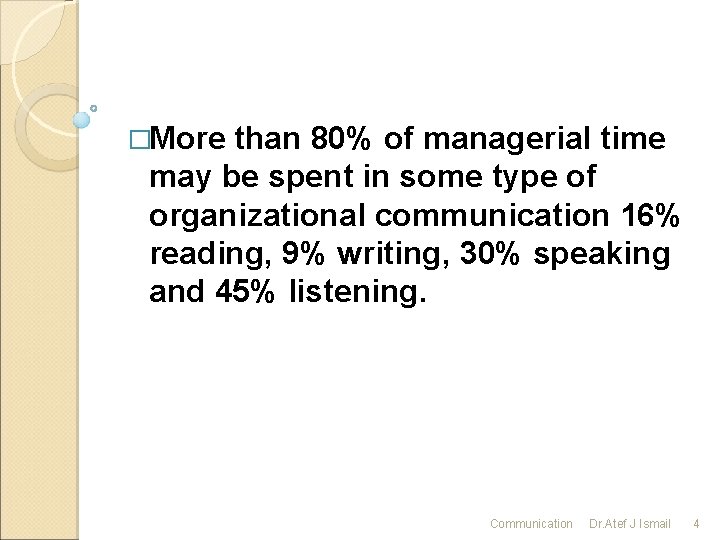
�More than 80% of managerial time may be spent in some type of organizational communication 16% reading, 9% writing, 30% speaking and 45% listening. Communication Dr. Atef J Ismail 4
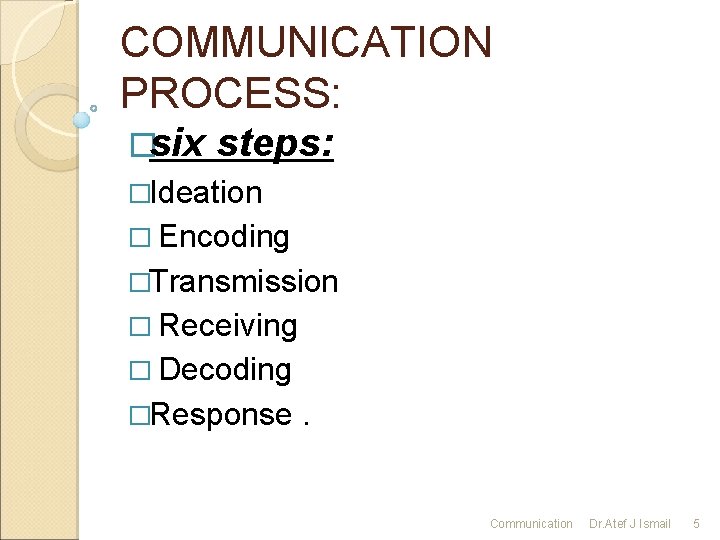
COMMUNICATION PROCESS: �six steps: �Ideation � Encoding �Transmission � Receiving � Decoding �Response. Communication Dr. Atef J Ismail 5
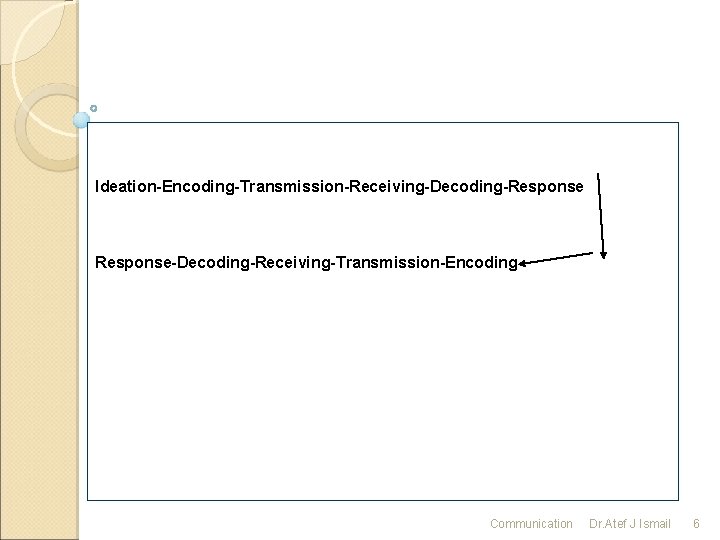
Ideation-Encoding-Transmission-Receiving-Decoding-Response-Decoding-Receiving-Transmission-Encoding Communication Dr. Atef J Ismail 6
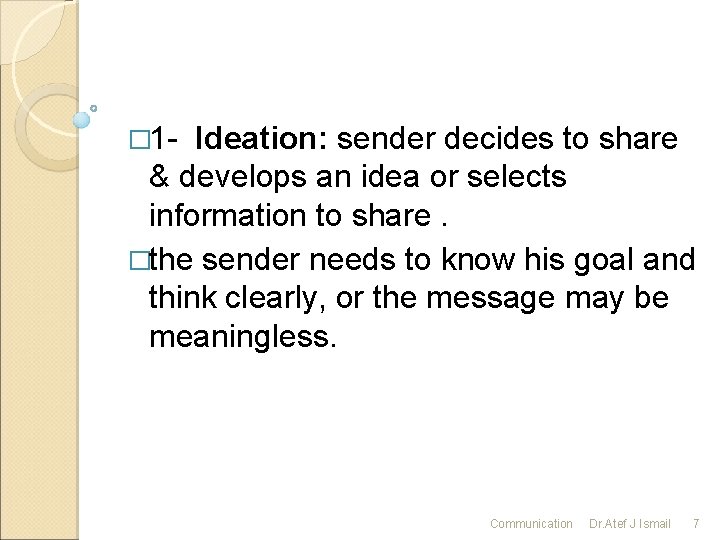
� 1 - Ideation: sender decides to share & develops an idea or selects information to share. �the sender needs to know his goal and think clearly, or the message may be meaningless. Communication Dr. Atef J Ismail 7
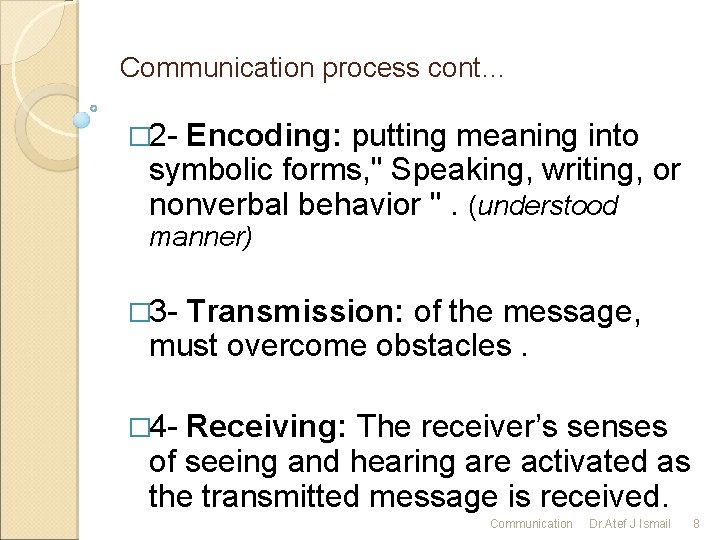
Communication process cont… � 2 - Encoding: putting meaning into symbolic forms, " Speaking, writing, or nonverbal behavior ". (understood manner) � 3 - Transmission: of the message, must overcome obstacles. � 4 - Receiving: The receiver’s senses of seeing and hearing are activated as the transmitted message is received. Communication Dr. Atef J Ismail 8
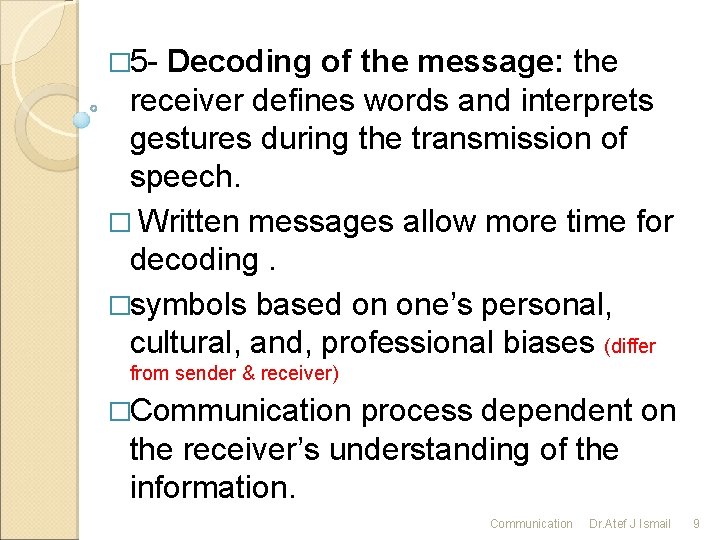
� 5 - Decoding of the message: the receiver defines words and interprets gestures during the transmission of speech. � Written messages allow more time for decoding. �symbols based on one’s personal, cultural, and, professional biases (differ from sender & receiver) �Communication process dependent on the receiver’s understanding of the information. Communication Dr. Atef J Ismail 9
� 6 - Response or feedback: sender must know that the message has been received and accurately interpreted. Communication Dr. Atef J Ismail 10
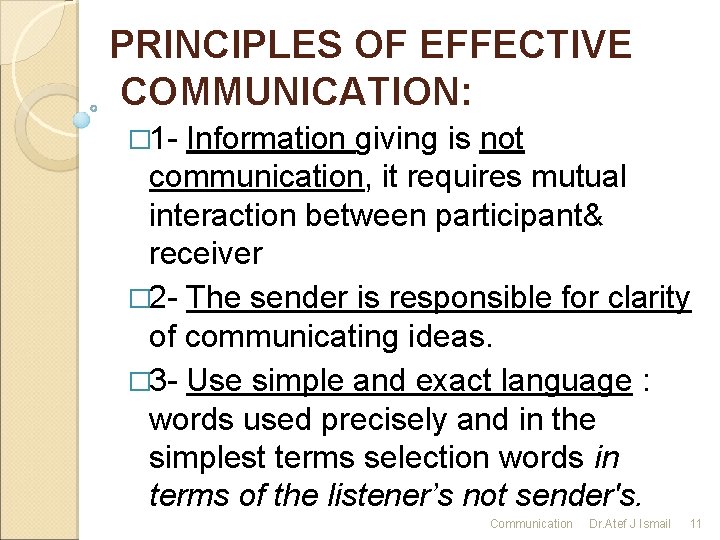
PRINCIPLES OF EFFECTIVE COMMUNICATION: � 1 - Information giving is not communication, it requires mutual interaction between participant& receiver � 2 - The sender is responsible for clarity of communicating ideas. � 3 - Use simple and exact language : words used precisely and in the simplest terms selection words in terms of the listener’s not sender's. Communication Dr. Atef J Ismail 11
� 4 - Feedback should be encouraged. � 5 - The sender must have credibility (say what you mean and mean what you say). 6 - Acknowledgment of others is essential. � 7 - Direct channels of communication is the best e. g. Face-to-face communication is preferable to written and phone communication. (you can read body Language &facial expression) Communication Dr. Atef J Ismail 12
� Incongruence between what is actually said and the nonverbal message , listener will believe the nonverbal message = (difficult communication). Communication Dr. Atef J Ismail 13
COMMUNICATION SYSTEMS �Communication channels by manager: downward, upward, lateral, Diagonal grapevine. � 1 - DOWNWARD COMMUNICATION: �From the superior to the subordinate. � primarily directive and helps coordinate the activities of different levels. �includes oral and written indoctrination education. Communication Dr. Atef J Ismail 14
DOWNWARD COMMUNICATION cont… � 1. 2. 3. 4. 5. 6. Common forms of downward communication: Employee handbooks Operating manuals Job description sheets. Performance appraisal interviews. Employee counseling. letters. (Contributes to greater subordinate dissatisfaction than upward communication) Communication Dr. Atef J Ismail 15
2 - UPWARD COMMUNICATION (COMMUNICATION WITH SUPERORS). �encourage delegation of authority. �provides a means for motivating and satisfying personnel. �supervisor summarize information and passes it upward to the next level. �Accurate upward communication effective in problem solving. Communication Dr. Atef J Ismail 16
*Common upward communication include: 1. Face-to-face discussion. 2. Staff meetings. 3. Written reports. 4. Suggestion boxes 5. Counseling, 6. Democratic management in general. Communication Dr. Atef J Ismail 17
3 - LATERAL COMMUNICATION OR HORIZONTAL COMMUNICATION. �Departments or personnel on the same level of the hierarchy to coordinate activities. �Communication with other health care personnel. �Committees, conferences, and meetings facilitate horizontal communication �Usually follows formal channels. Communication Dr. Atef J Ismail 18
4 - DIAGONAL COMMUNICATION: �Between individuals or departments not on the same level of the hierarchy. �Informal in nature. �Multidirectional communication (all directions at the same times). Communication Dr. Atef J Ismail 19
5 - THE GRAPEVINE COMMUNICATION: �Informal methods of communication. �grapevine transmits information much faster than the formal channels because it uses cluster chain pathways, involving three or four individuals at a time instead of going from one person to another. Communication Dr. Atef J Ismail 20
�Grapevine information is often fragmentary and incomplete. �The individual dose not have to answer to his/her superior for misinforming others. �Managers can learn much by listening to the grapevine using informal channels to pass on correct information. Communication Dr. Atef J Ismail 21
BARRIERS TO COMMUNICATION � � � 1 -Gender : (medical doctor & female nurse) The male role is active and vital, while the female role is passive and compliant. Differences in genders and in power and status, continue to affect the types and quality of communication 2 -Making a value judgment about the value of a message. 3 -Lack of clarity : (e. g. : too fast or too slow) resulting from inadequate vocabulary lead to the faulty transmission of ideas. 4 -Subordinates will not report problems if Communication Dr. Atef J Ismail 22 it viewed as a weakness in their
BARRIERS TO COMMUNICATION cont…. � � � 5 -Time pressures also barriers that prevent communication. 6 -Advice – giving response: only when requested as a conclusion of conversation. 7 - Discounting of other’s experience. 8 -Diagnosing, psychoanalytic response tell others what they feel If the Dx is wrong, the speaker feels pressed. — If the Dx is right the speaker may feel exposed or cornered). 9 -Warning, admonishing, commanding Communication Dr. Atef J Ismail 23 response.
WORKING WITH PHYSICIANS (COMMUNICATION WITH DOCTORS). �often difficult for nurse manager because of the nature of the physician/nurse relationship. �The historical R/S of “superior and subordinates”. �Gender: male physician and female nurses �Today’s nurse managers are role models and leaders for establishing nurse-physician relationship on their Communication Dr. Atef J Ismail 24
Strategies support collaborations between nurses &doctors: A- It is necessary to view the physician as a nursing service customer. B- Establish committee composed of equal membership of nurses and physicians. � In the meetings, identify problems, develop mutually satisfactory solutions. � Emphasize similarities and quality care. Communication Dr. Atef J Ismail 25
C - Actively listen to. physician complaints as customer complaints. D- Stop blaming physicians for comm. problems. E- Build your staff's clinical competence and credibility. F- Consider your self & your staff as partners with physicians in health care. G- Respect the physicians as persons and (expect they respect you). Communication Dr. Atef J Ismail 26
H - Use every opportunity to your staff’s contact with doctors: “Remember that limited interactions contribute to poor communication”. I- Serve as a role model to your staff: in nurse – physician communication. J- Support your staff in participating in collaborative efforts by words and by action. Communication Dr. Atef J Ismail 27
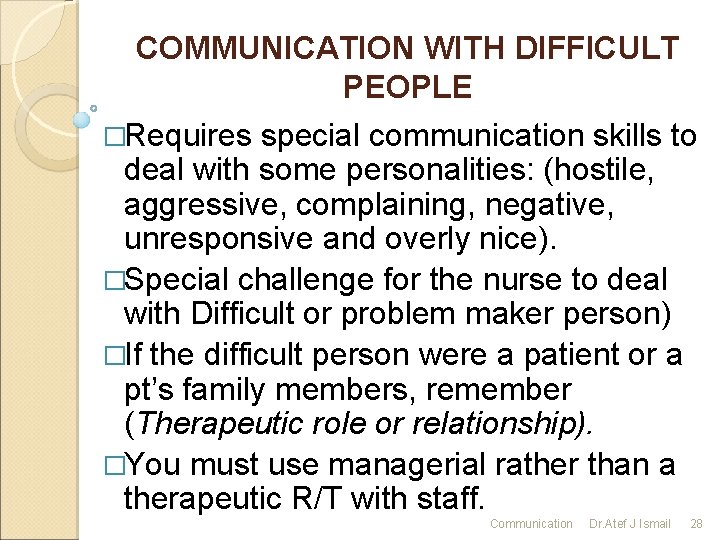
COMMUNICATION WITH DIFFICULT PEOPLE �Requires special communication skills to deal with some personalities: (hostile, aggressive, complaining, negative, unresponsive and overly nice). �Special challenge for the nurse to deal with Difficult or problem maker person) �If the difficult person were a patient or a pt’s family members, remember (Therapeutic role or relationship). �You must use managerial rather than a therapeutic R/T with staff. Communication Dr. Atef J Ismail 28
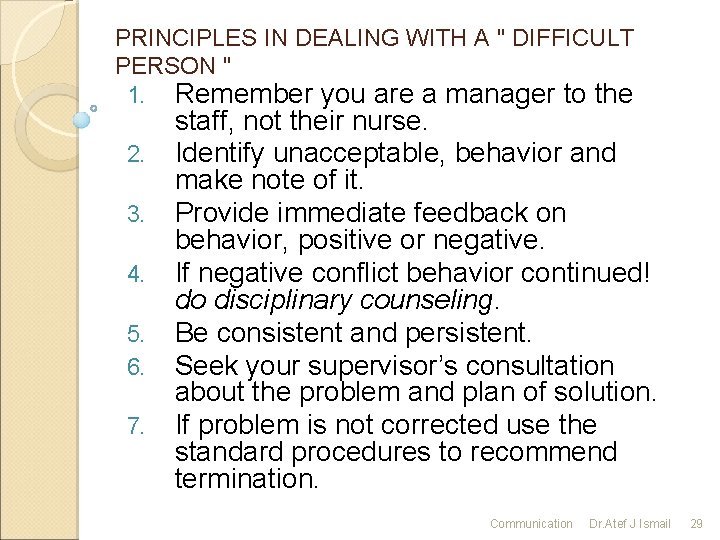
PRINCIPLES IN DEALING WITH A " DIFFICULT PERSON " 1. Remember you are a manager to the 2. 3. 4. 5. 6. 7. staff, not their nurse. Identify unacceptable, behavior and make note of it. Provide immediate feedback on behavior, positive or negative. If negative conflict behavior continued! do disciplinary counseling. Be consistent and persistent. Seek your supervisor’s consultation about the problem and plan of solution. If problem is not corrected use the standard procedures to recommend termination. Communication Dr. Atef J Ismail 29
The end Thank you Communication Dr. Atef J Ismail 30