Codes for Correcting Tandem Repeats Johan Chrisnata Nanyang


- Slides: 23
Codes for Correcting Tandem Repeats Johan Chrisnata, Nanyang Technological University, Singapore ar. Xiv: 1707. 03956 Joint work with ● Yeow Meng Chee, ● Han Mao Kiah, ● Tuan Thanh Nguyen.
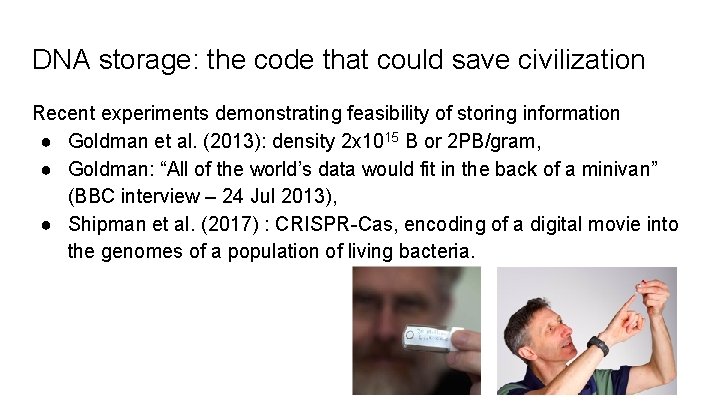
DNA storage: the code that could save civilization Recent experiments demonstrating feasibility of storing information ● Goldman et al. (2013): density 2 x 10¹⁵ B or 2 PB/gram, ● Goldman: “All of the world’s data would fit in the back of a minivan” (BBC interview – 24 Jul 2013), ● Shipman et al. (2017) : CRISPR-Cas, encoding of a digital movie into the genomes of a population of living bacteria.
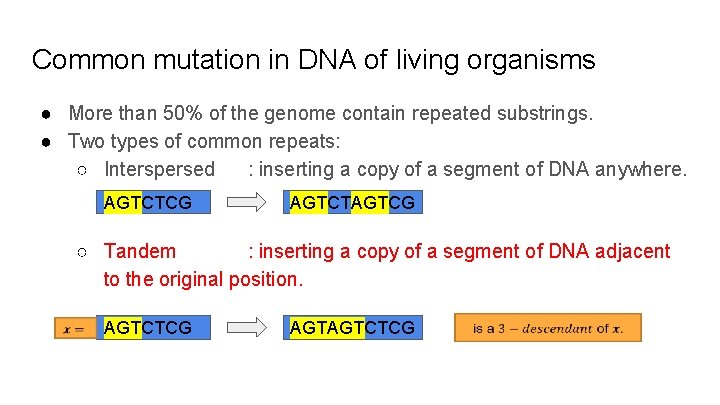
Common mutation in DNA of living organisms ● More than 50% of the genome contain repeated substrings. ● Two types of common repeats: ○ Interspersed : inserting a copy of a segment of DNA anywhere. AGTCTCG AGTCTAGTCG ○ Tandem : inserting a copy of a segment of DNA adjacent to the original position. AGTCTCG AGTAGTCTCG
Decoding tandem repeats by deduplication abcc Codeword … aaabbbccc Received word Decoded
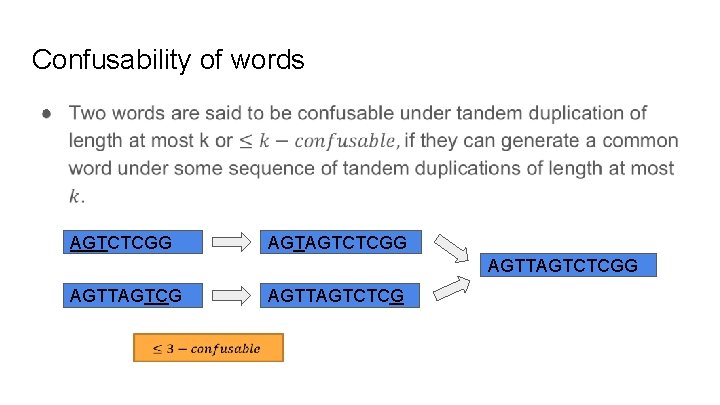
Confusability of words ● AGTCTCGG AGTTAGTCTCGG AGTTAGTCG AGTTAGTCTCG
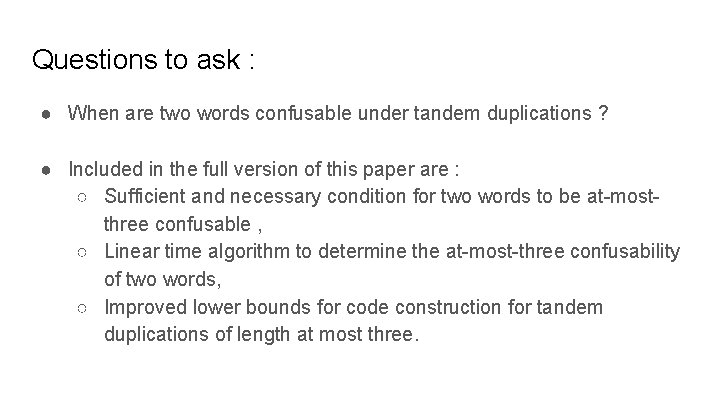
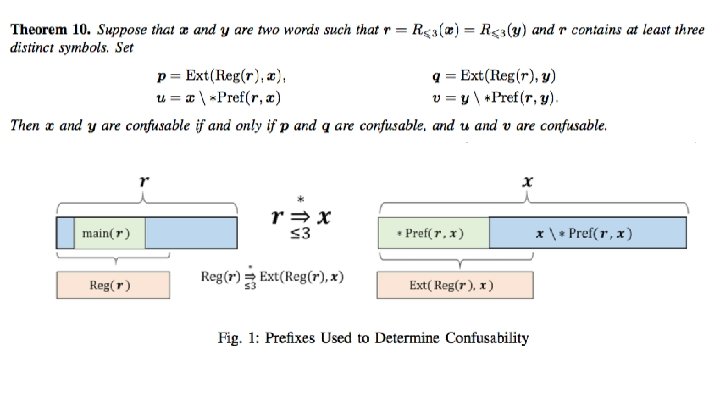
Questions to ask : ● When are two words confusable under tandem duplications ? ● Included in the full version of this paper are : ○ Sufficient and necessary condition for two words to be at-mostthree confusable , ○ Linear time algorithm to determine the at-most-three confusability of two words, ○ Improved lower bounds for code construction for tandem duplications of length at most three.
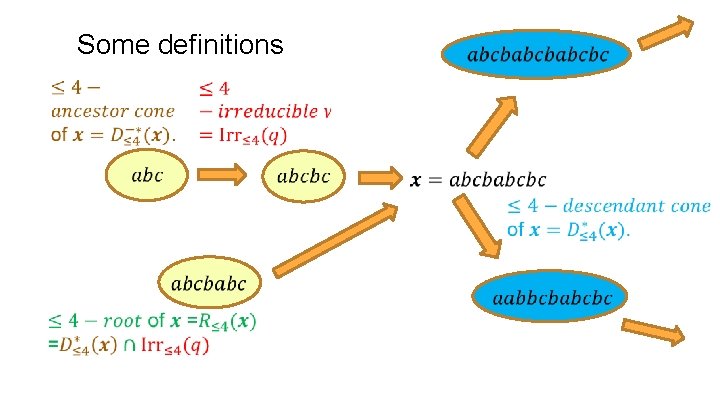
Some definitions
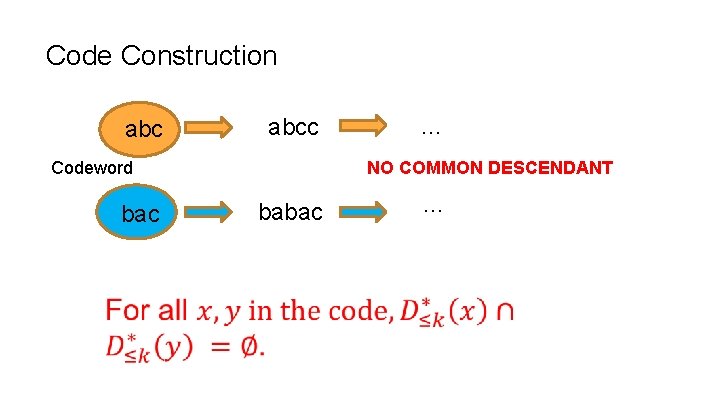
Code Construction abcc Codeword bac … NO COMMON DESCENDANT babac …
PROPERTIES OF TANDEM DUPLICATION
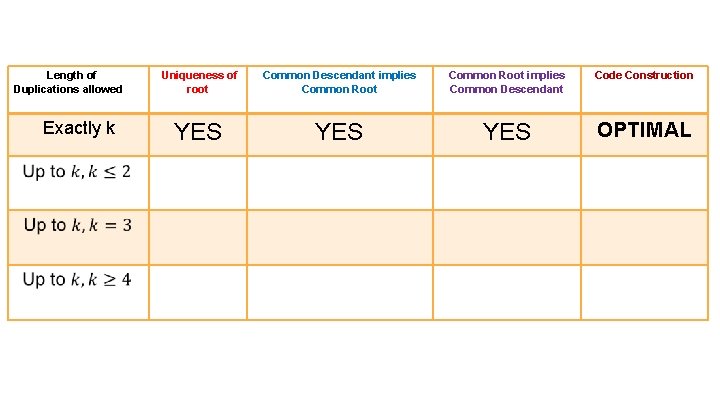
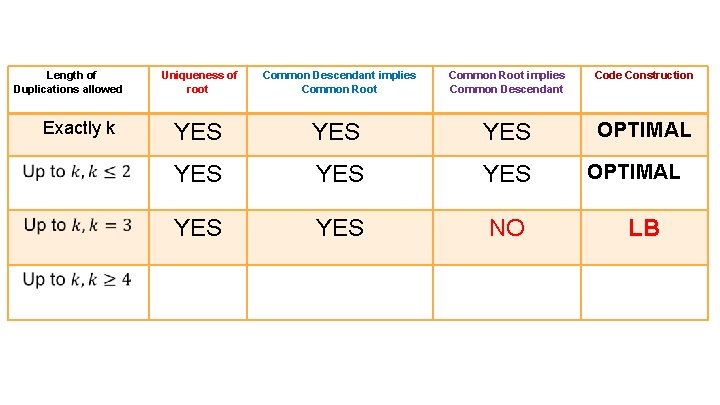
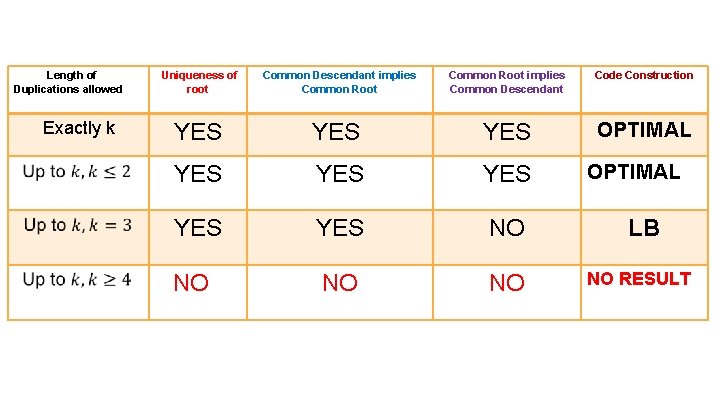
Length of Duplications allowed Exactly k Uniqueness of root YES Common Descendant implies Common Root implies Common Descendant Code Construction YES OPTIMAL
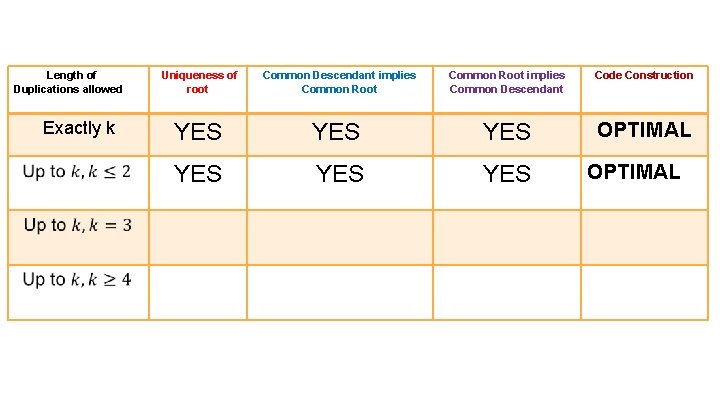
Length of Duplications allowed Uniqueness of root Exactly k YES Common Descendant implies Common Root implies Common Descendant Code Construction YES OPTIMAL YES OPTIMAL
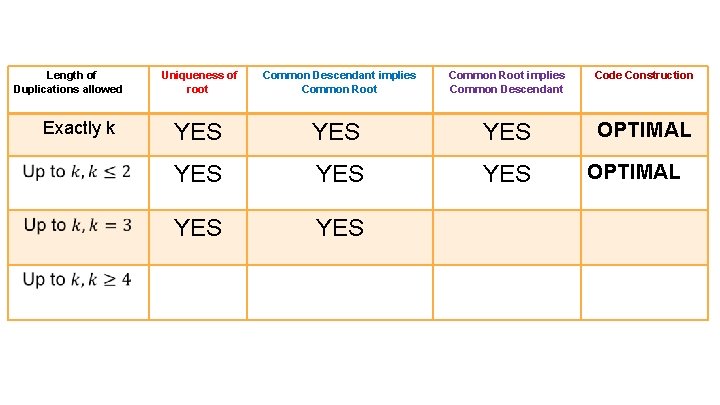
Length of Duplications allowed Uniqueness of root Exactly k Common Root implies Common Descendant Code Construction YES OPTIMAL YES YES YES Common Descendant implies Common Root OPTIMAL
Length of Duplications allowed Uniqueness of root Exactly k Common Root implies Common Descendant Code Construction YES OPTIMAL YES YES YES NO YES Common Descendant implies Common Root OPTIMAL LB
Length of Duplications allowed Uniqueness of root Common Root implies Common Descendant Code Construction YES OPTIMAL YES YES YES NO NO Exactly k YES Common Descendant implies Common Root OPTIMAL LB NO RESULT
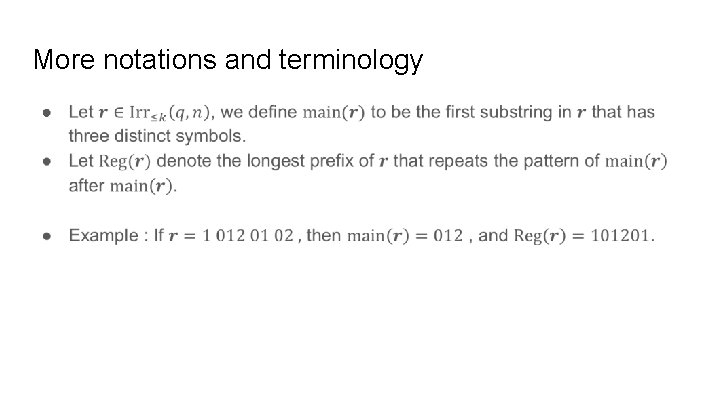
More notations and terminology ●
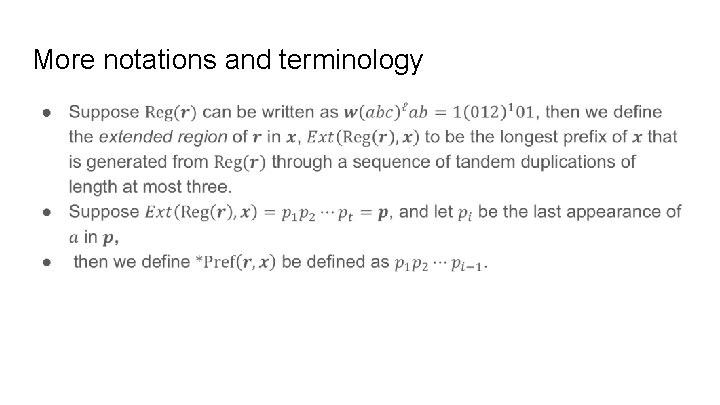
More notations and terminology ●
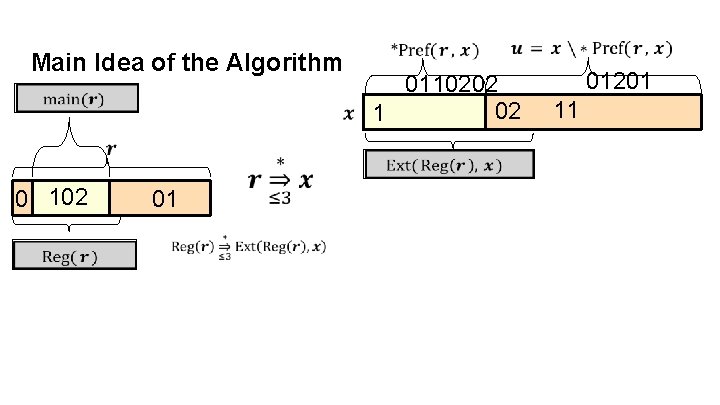
Main Idea of the Algorithm 0110202 02 1 102 0 01201 11
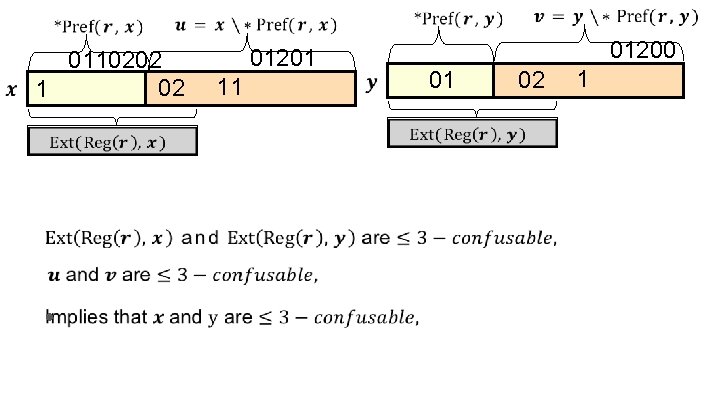
0110202 02 1 01201 11 01 ● 02 01200 1
Thank You