
MAC 1105 Module 6 Composite Functions and Inverse

- Slides: 30
MAC 1105 Module 6 Composite Functions and Inverse Functions Rev. S 08
Learning Objectives Upon completing this module, you should be able to: 1. 2. 3. 4. 5. 6. 7. Perform arithmetic operations on functions. Perform composition of functions. Calculate inverse operations. Identity one-to-one functions. Use horizontal line test to determine if a graph represents a one-to-one function. Find inverse functions symbolically. Use other representations to find inverse functions. Rev. S 08 http: //faculty. valenciacc. edu/ashaw/ Click link to download other modules. 2
Composite Functions and Inverse Functions There are two major topics in this module: - Combining Functions; Composite Functions Inverse Functions Rev. S 08 http: //faculty. valenciacc. edu/ashaw/ Click link to download other modules. 3
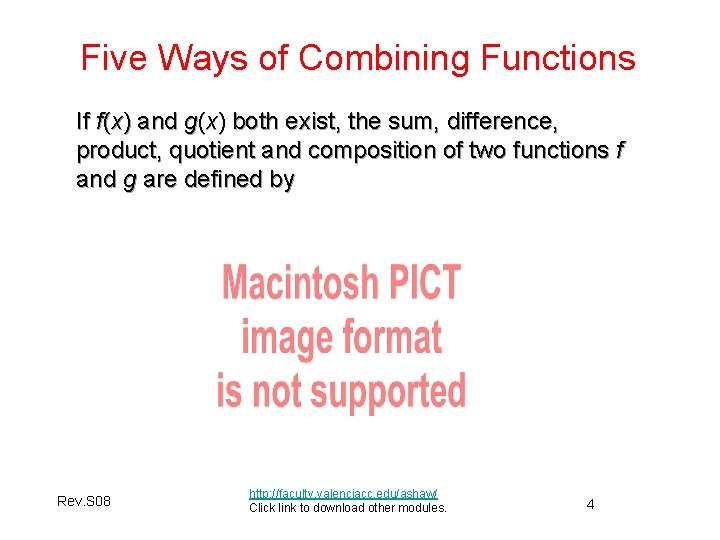
Five Ways of Combining Functions If f(x) and g(x) both exist, the sum, difference, product, quotient and composition of two functions f and g are defined by Rev. S 08 http: //faculty. valenciacc. edu/ashaw/ Click link to download other modules. 4
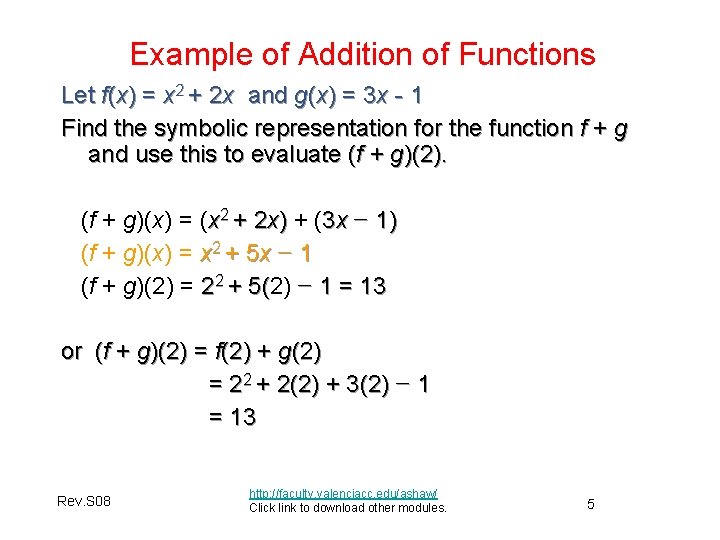
Example of Addition of Functions Let f(x) = x 2 + 2 x and g(x) = 3 x - 1 Find the symbolic representation for the function f + g and use this to evaluate (f + g)(2). (f + g)(x) = (x 2 + 2 x) + (3 x − 1) (f + g)(x) = x 2 + 5 x − 1 (f + g)(2) = 22 + 5(2) 5( − 1 = 13 or (f + g)(2) = f(2) + g(2) = 22 + 2(2) + 3(2) − 1 = 13 Rev. S 08 http: //faculty. valenciacc. edu/ashaw/ Click link to download other modules. 5
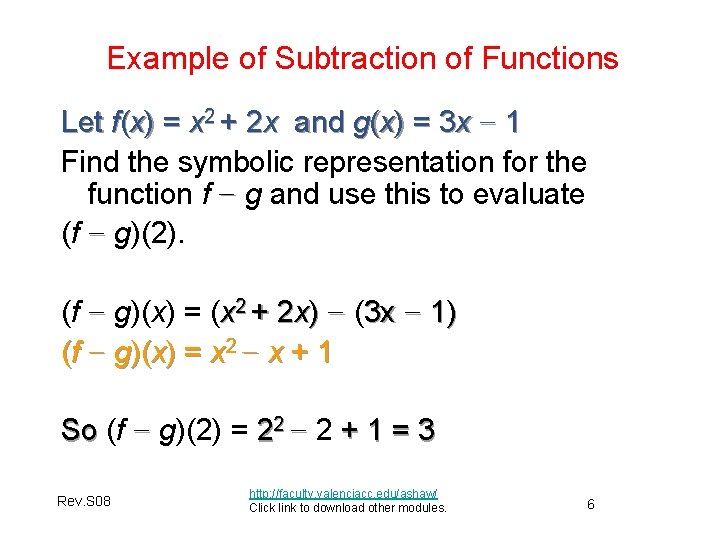
Example of Subtraction of Functions Let f(x) = x 2 + 2 x and g(x) = 3 x − 1 Find the symbolic representation for the function f − g and use this to evaluate (f − g)(2). (f − g)(x) = (x 2 + 2 x) − (3 x − 1) (f − g)(x) = x 2 − x + 1 So (f − g)(2) = 22 − 2 + 1 = 3 Rev. S 08 http: //faculty. valenciacc. edu/ashaw/ Click link to download other modules. 6
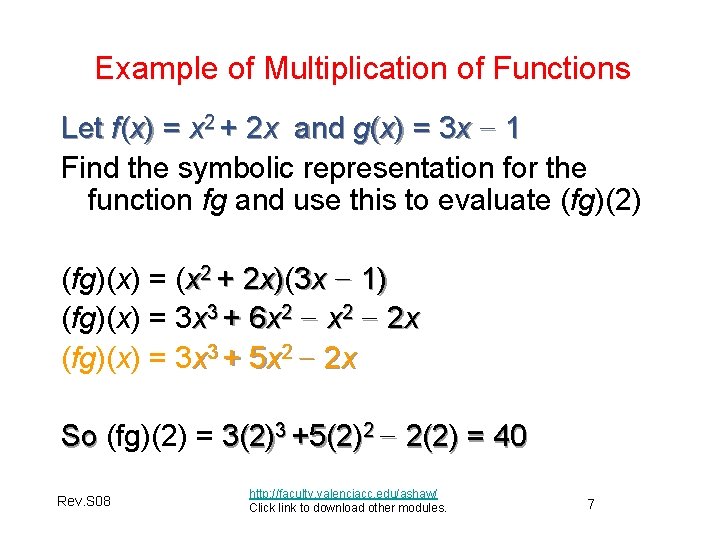
Example of Multiplication of Functions Let f(x) = x 2 + 2 x and g(x) = 3 x − 1 Find the symbolic representation for the function fg and use this to evaluate (fg)(2) (fg)(x) = (x 2 + 2 x)(3 x − 1) (fg)(x) = 3 x 3 + 6 x 2 − 2 x (fg)(x) = 3 x 3 + 5 x 2 − 2 x So (fg)(2) = 3(2)3 +5(2)2 − 2(2) = 40 Rev. S 08 http: //faculty. valenciacc. edu/ashaw/ Click link to download other modules. 7
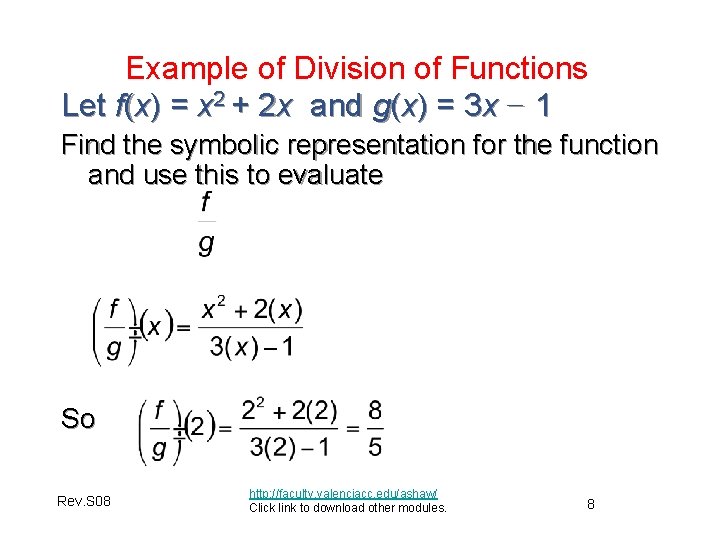
Example of Division of Functions Let f(x) = x 2 + 2 x and g(x) = 3 x − 1 Find the symbolic representation for the function and use this to evaluate So Rev. S 08 http: //faculty. valenciacc. edu/ashaw/ Click link to download other modules. 8
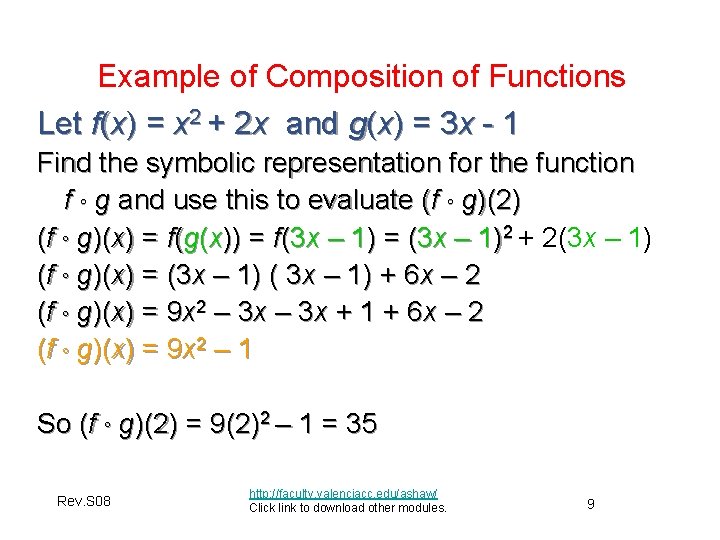
Example of Composition of Functions Let f(x) = x 2 + 2 x and g(x) = 3 x - 1 Find the symbolic representation for the function f ° g and use this to evaluate (f ° g)(2) (f ° g)(x) = f(g(x)) = f(3 x – 1) = (3 x – 1)2 + 2(3 x – 1) (f ° g)(x) = (3 x – 1) ( 3 x – 1) + 6 x – 2 (f ° g)(x) = 9 x 2 – 3 x + 1 + 6 x – 2 (f ° g)(x) = 9 x 2 – 1 So (f ° g)(2) = 9(2)2 – 1 = 35 Rev. S 08 http: //faculty. valenciacc. edu/ashaw/ Click link to download other modules. 9
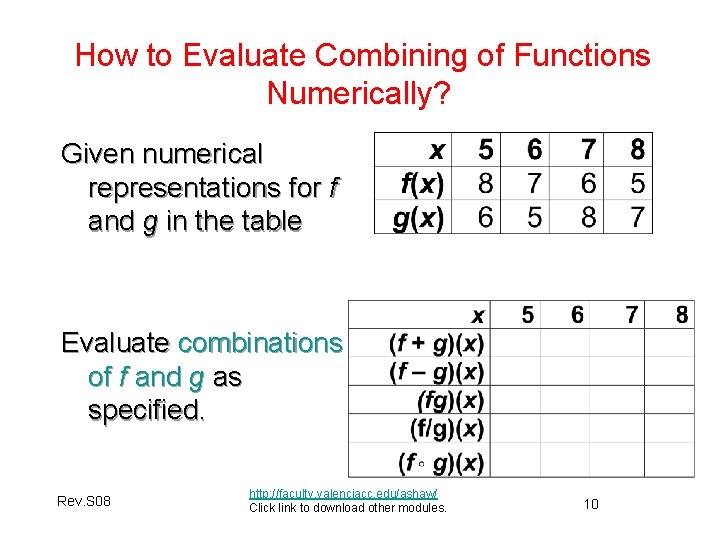
How to Evaluate Combining of Functions Numerically? Given numerical representations for f and g in the table Evaluate combinations of f and g as specified. Rev. S 08 http: //faculty. valenciacc. edu/ashaw/ Click link to download other modules. 10
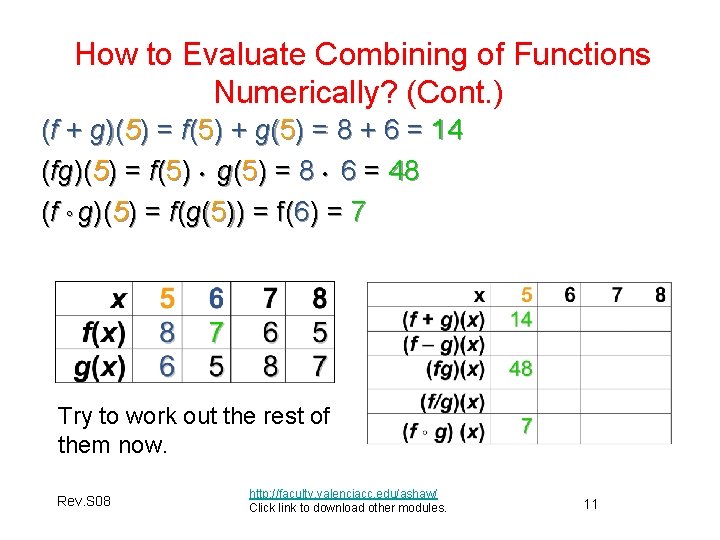
How to Evaluate Combining of Functions Numerically? (Cont. ) (f + g)(5) = f(5) + g(5) = 8 + 6 = 14 (fg)(5) = f(5) • g(5) = 8 • 6 = 48 (f ° g)(5) = f(g(5)) = f(6) = 7 Try to work out the rest of them now. Rev. S 08 http: //faculty. valenciacc. edu/ashaw/ Click link to download other modules. 11
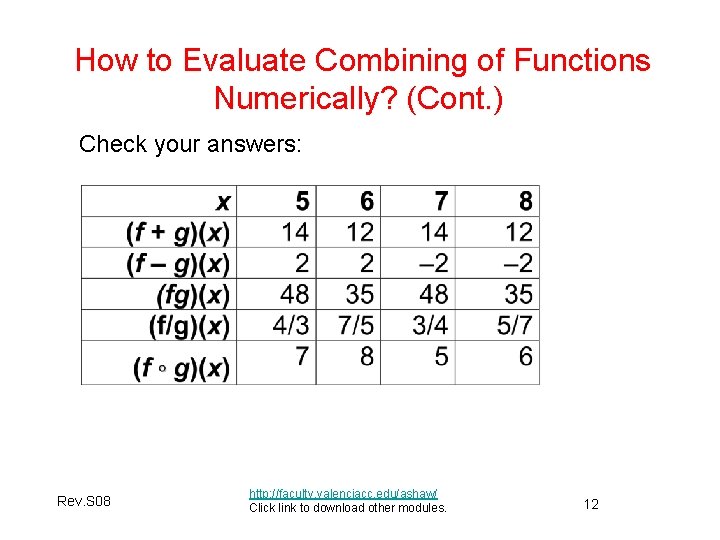
How to Evaluate Combining of Functions Numerically? (Cont. ) Check your answers: Rev. S 08 http: //faculty. valenciacc. edu/ashaw/ Click link to download other modules. 12
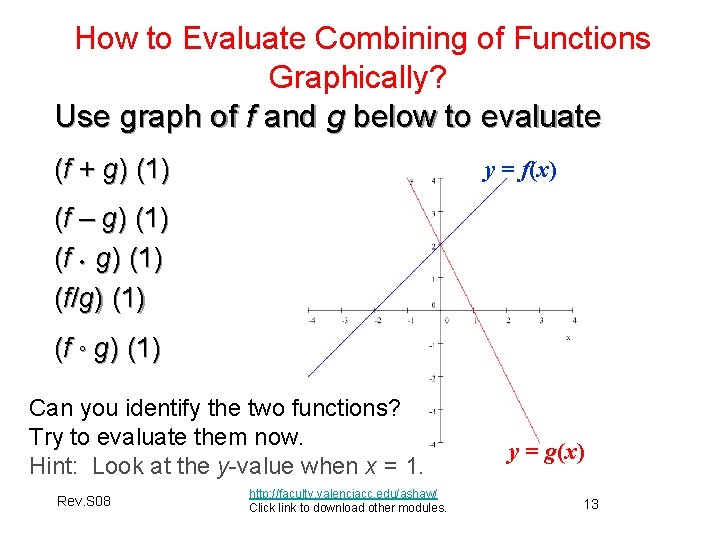
How to Evaluate Combining of Functions Graphically? Use graph of f and g below to evaluate (f + g) (1) y = f(x) (f – g) (1) (f • g) (1) (f/g) (1) (f ° g) (1) Can you identify the two functions? Try to evaluate them now. Hint: Look at the y-value when x = 1. Rev. S 08 http: //faculty. valenciacc. edu/ashaw/ Click link to download other modules. y = g(x) 13
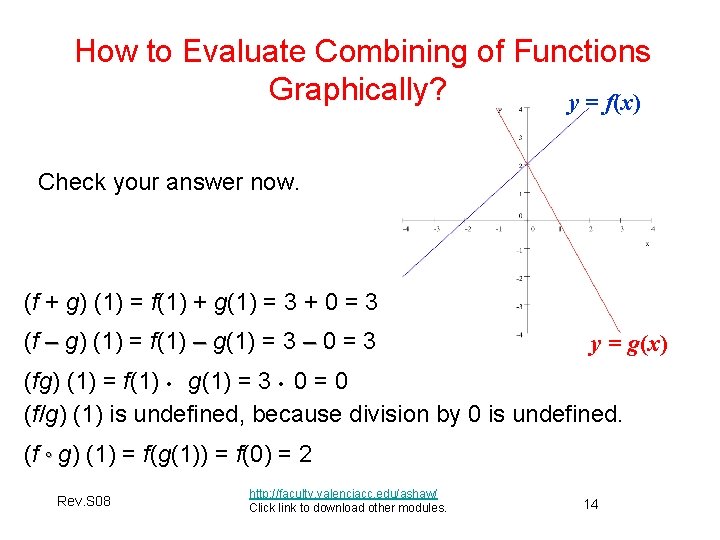
How to Evaluate Combining of Functions Graphically? y = f(x) Check your answer now. (f + g) (1) = f(1) + g(1) = 3 + 0 = 3 (f – g) (1) = f(1) – g(1) = 3 – 0 = 3 y = g(x) (fg) (1) = f(1) • g(1) = 3 • 0 = 0 (f/g) (1) is undefined, because division by 0 is undefined. (f ° g) (1) = f(g(1)) = f(0) = 2 Rev. S 08 http: //faculty. valenciacc. edu/ashaw/ Click link to download other modules. 14
Next, Let’s Look at Inverse Functions and Their Representations. Rev. S 08 http: //faculty. valenciacc. edu/ashaw/ Click link to download other modules. 15
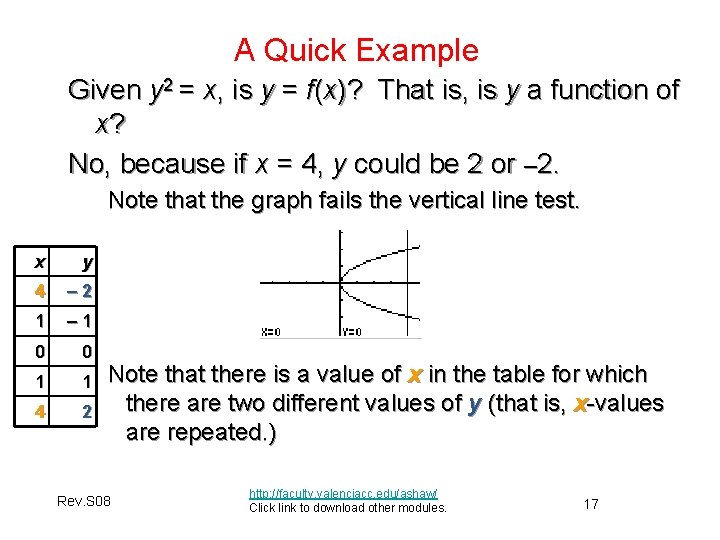
A Quick Review on Function • y = f(x) means that given an input x, there is just one corresponding output y. • Graphically, this means that the graph passes the vertical line test. • Numerically, this means that in a table of values for y = f(x) there are no x-values repeated. Rev. S 08 http: //faculty. valenciacc. edu/ashaw/ Click link to download other modules. 16
A Quick Example Given y 2 = x, is y = f(x)? That is, is y a function of x? No, because if x = 4, y could be 2 or – 2. Note that the graph fails the vertical line test. x y 4 – 2 1 – 1 0 0 1 1 4 2 Note that there is a value of x in the table for which there are two different values of y (that is, x-values are repeated. ) Rev. S 08 http: //faculty. valenciacc. edu/ashaw/ Click link to download other modules. 17
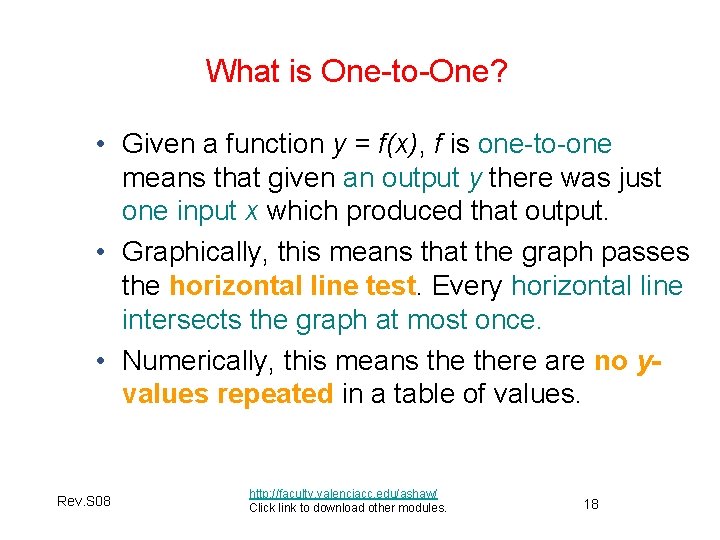
What is One-to-One? • Given a function y = f(x), f is one-to-one means that given an output y there was just one input x which produced that output. • Graphically, this means that the graph passes the horizontal line test. Every horizontal line intersects the graph at most once. • Numerically, this means there are no yvalues repeated in a table of values. Rev. S 08 http: //faculty. valenciacc. edu/ashaw/ Click link to download other modules. 18
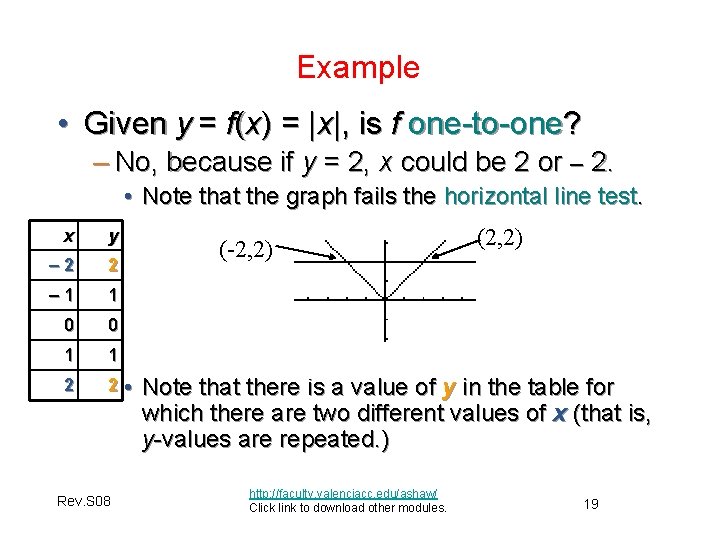
Example • Given y = f(x) = |x|, is f one-to-one? – No, because if y = 2, x could be 2 or – 2. • Note that the graph fails the horizontal line test. x y – 2 2 – 1 1 0 0 1 1 2 2 • Rev. S 08 (-2, 2) (2, 2) Note that there is a value of y in the table for which there are two different values of x (that is, y-values are repeated. ) http: //faculty. valenciacc. edu/ashaw/ Click link to download other modules. 19
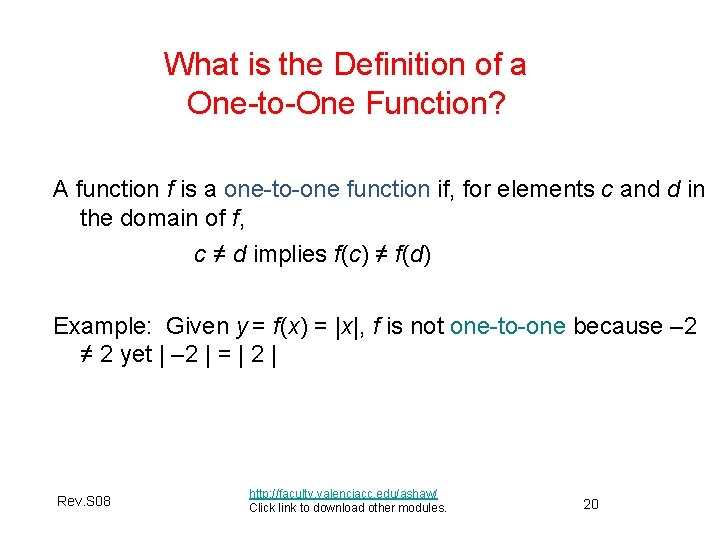
What is the Definition of a One-to-One Function? A function f is a one-to-one function if, for elements c and d in the domain of f, c ≠ d implies f(c) ≠ f(d) Example: Given y = f(x) = |x|, f is not one-to-one because – 2 ≠ 2 yet | – 2 | = | 2 | Rev. S 08 http: //faculty. valenciacc. edu/ashaw/ Click link to download other modules. 20
What is an Inverse Function? f -1 is a symbol for the inverse of the function f, not to be confused with the reciprocal. If f -1(x) does NOT mean 1/ f(x), what does it mean? y = f -1(x) means that x = f(y) Note that y = f -1(x) is pronounced “y equals f inverse of x. ” Rev. S 08 http: //faculty. valenciacc. edu/ashaw/ Click link to download other modules. 21
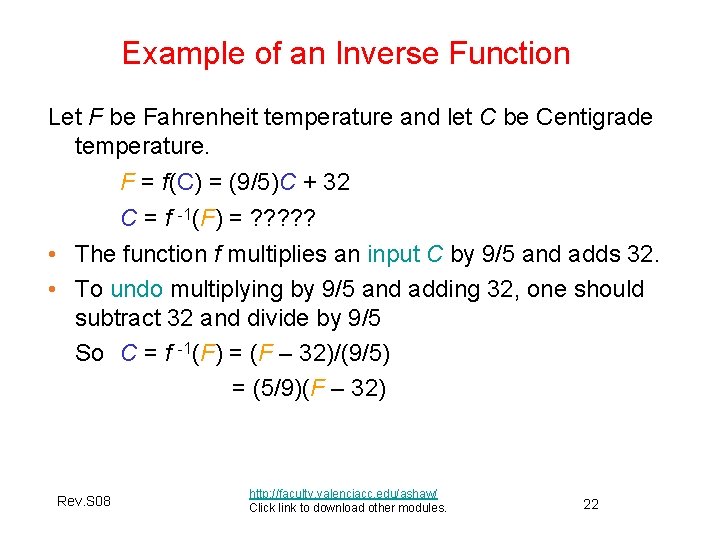
Example of an Inverse Function Let F be Fahrenheit temperature and let C be Centigrade temperature. F = f(C) = (9/5)C + 32 C = f -1(F) = ? ? ? • The function f multiplies an input C by 9/5 and adds 32. • To undo multiplying by 9/5 and adding 32, one should subtract 32 and divide by 9/5 So C = f -1(F) = (F – 32)/(9/5) = (5/9)(F – 32) Rev. S 08 http: //faculty. valenciacc. edu/ashaw/ Click link to download other modules. 22
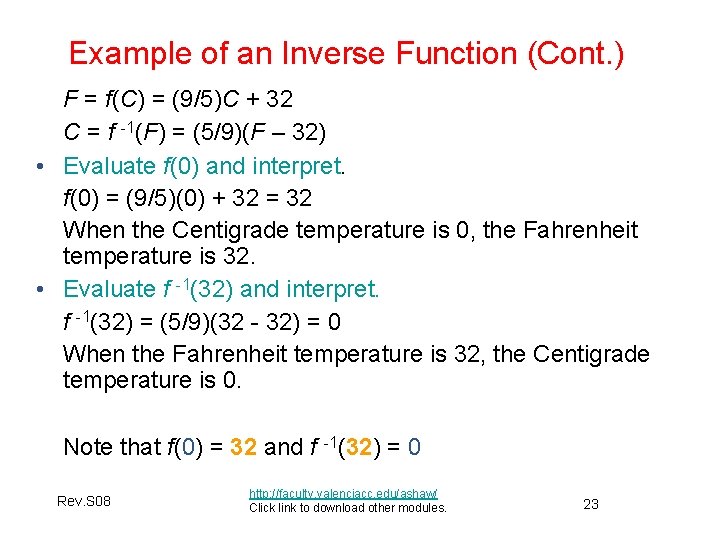
Example of an Inverse Function (Cont. ) F = f(C) = (9/5)C + 32 C = f -1(F) = (5/9)(F – 32) • Evaluate f(0) and interpret. f(0) = (9/5)(0) + 32 = 32 When the Centigrade temperature is 0, the Fahrenheit temperature is 32. • Evaluate f -1(32) and interpret. f -1(32) = (5/9)(32 - 32) = 0 When the Fahrenheit temperature is 32, the Centigrade temperature is 0. Note that f(0) = 32 and f -1(32) = 0 Rev. S 08 http: //faculty. valenciacc. edu/ashaw/ Click link to download other modules. 23
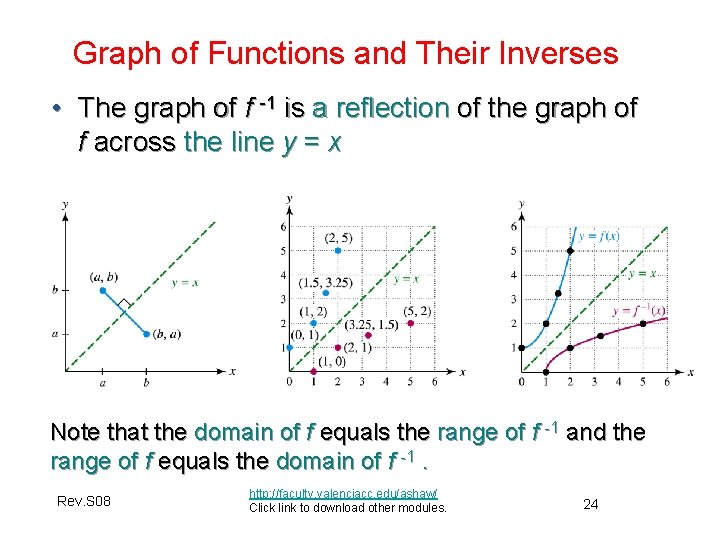
Graph of Functions and Their Inverses • The graph of f -1 is a reflection of the graph of f across the line y = x Note that the domain of f equals the range of f -1 and the range of f equals the domain of f -1. Rev. S 08 http: //faculty. valenciacc. edu/ashaw/ Click link to download other modules. 24
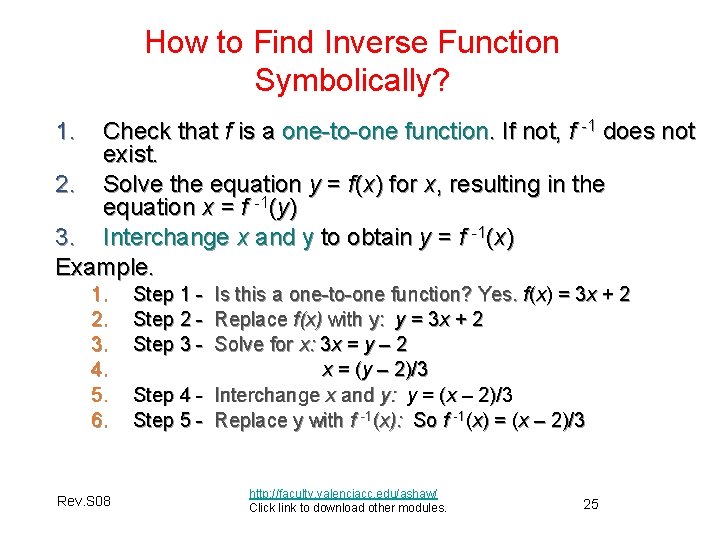
How to Find Inverse Function Symbolically? 1. Check that f is a one-to-one function. If not, f -1 does not exist. 2. Solve the equation y = f(x) for x, resulting in the equation x = f -1(y) 3. Interchange x and y to obtain y = f -1(x) Example. 1. 2. 3. 4. 5. 6. Rev. S 08 Step 1 Step 2 Step 3 - Is this a one-to-one function? Yes. f(x) = 3 x + 2 Replace f(x) with y: y = 3 x + 2 Solve for x: 3 x = y – 2 x = (y – 2)/3 Step 4 - Interchange x and y: y = (x – 2)/3 Step 5 - Replace y with f -1(x): So f -1(x) = (x – 2)/3 http: //faculty. valenciacc. edu/ashaw/ Click link to download other modules. 25
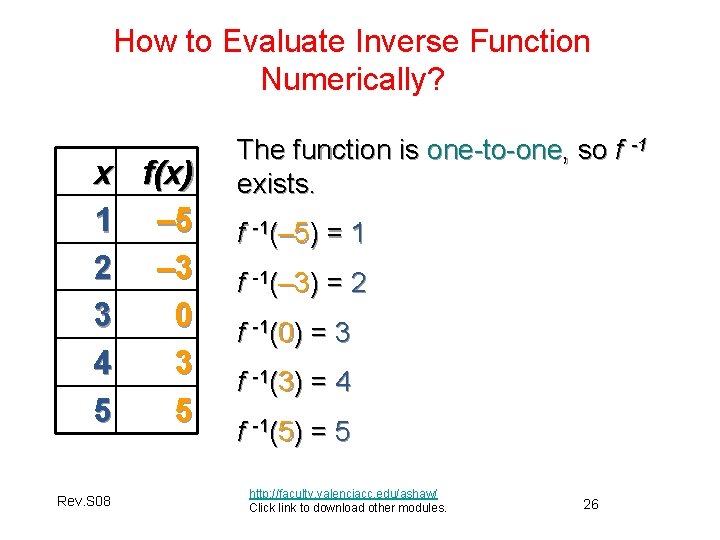
How to Evaluate Inverse Function Numerically? x f(x) 1 – 5 2 – 3 3 0 4 3 5 5 Rev. S 08 The function is one-to-one, so f -1 exists. f -1(– 5) = 1 f -1(– 3) = 2 f -1(0) = 3 f -1(3) = 4 f -1(5) = 5 http: //faculty. valenciacc. edu/ashaw/ Click link to download other modules. 26
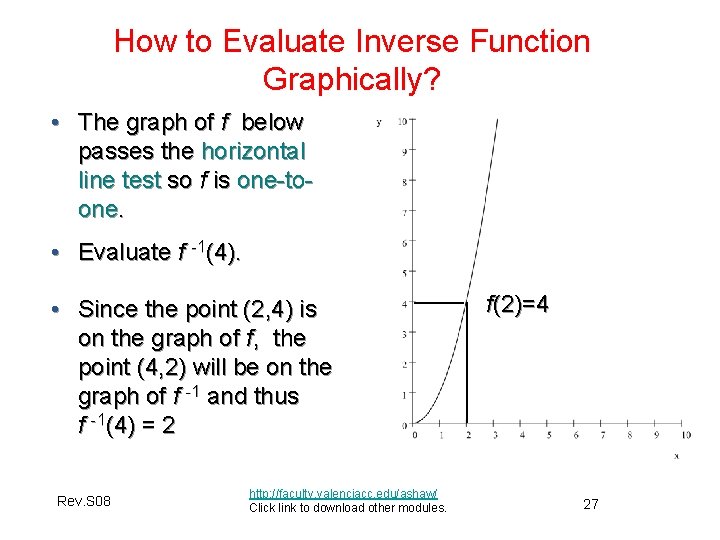
How to Evaluate Inverse Function Graphically? • The graph of f below passes the horizontal line test so f is one-toone. • Evaluate f -1(4). • Since the point (2, 4) is on the graph of f, the point (4, 2) will be on the graph of f -1 and thus f -1(4) = 2 Rev. S 08 http: //faculty. valenciacc. edu/ashaw/ Click link to download other modules. f(2)=4 27
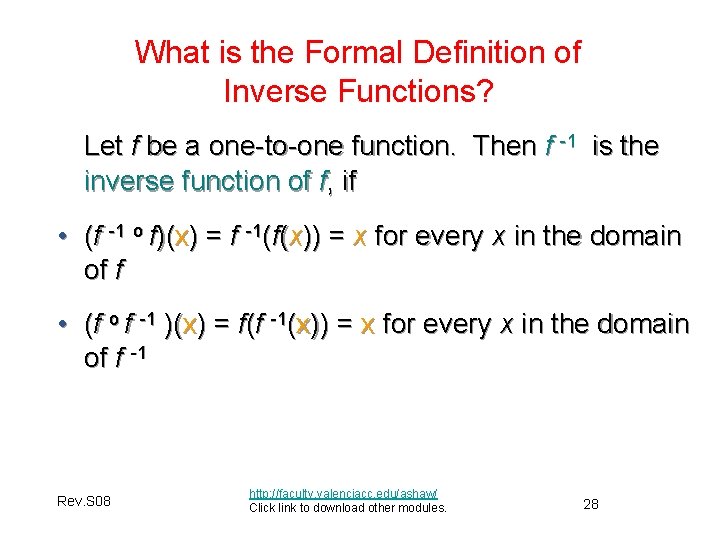
What is the Formal Definition of Inverse Functions? Let f be a one-to-one function. Then f -1 is the inverse function of f, if • (f -1 o f)(x) = f -1(f(x)) = x for every x in the domain of f • (f o f -1 )(x) = f(f -1(x)) = x for every x in the domain of f -1 Rev. S 08 http: //faculty. valenciacc. edu/ashaw/ Click link to download other modules. 28
What have we learned? We have learned to: 1. 2. 3. 4. 5. 6. 7. Perform arithmetic operations on functions. Perform composition of functions. Calculate inverse operations. Identity one-to-one functions. Use horizontal line test to determine if a graph represents a one-to-one function. Find inverse functions symbolically. Use other representations to find inverse functions. Rev. S 08 http: //faculty. valenciacc. edu/ashaw/ Click link to download other modules. 29
Credit Some of these slides have been adapted/modified in part/whole from the slides of the following textbook: • Rockswold, Gary, Precalculus with Modeling and Visualization, 3 th Edition Rev. S 08 http: //faculty. valenciacc. edu/ashaw/ Click link to download other modules. 30