Cloud Security in the Federal Sector Fed RAMP
- Slides: 22
Cloud Security in the Federal Sector: Fed. RAMP (Federal Risk and Authorization Management Program) Orus Dearman, Senior Manager Grant Thornton LLP 1 © Grant Thornton LLP. All rights reserved.
Agenda • Federal Adoption and Regulation of Cloud Services o Introduction o Cloud computing: the push for adoption in the Federal sector o Fed. RAMP – elements, governance, and process o Fed. RAMP – efficiencies and shortcomings • Questions Many thanks to Kurt Garbars, Senior Agency Information Security Officer, GSA, and Chair, Cloud Computing Security Working Group, for the content of some of these slides… 2 © Grant Thornton LLP. All rights reserved.
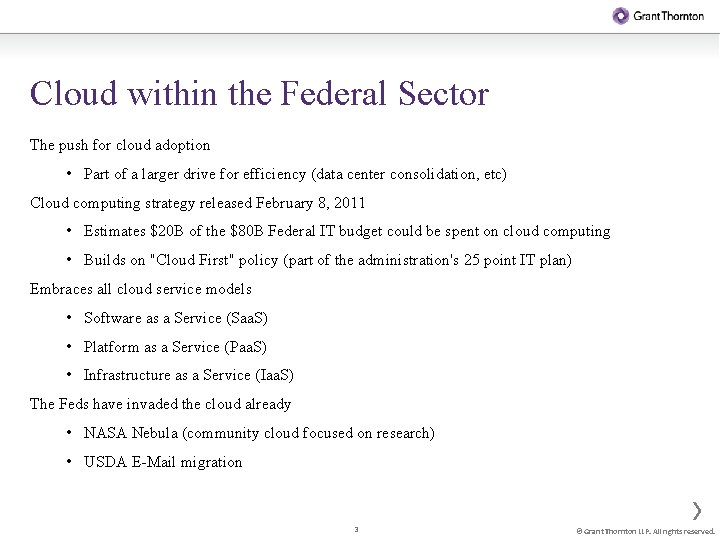
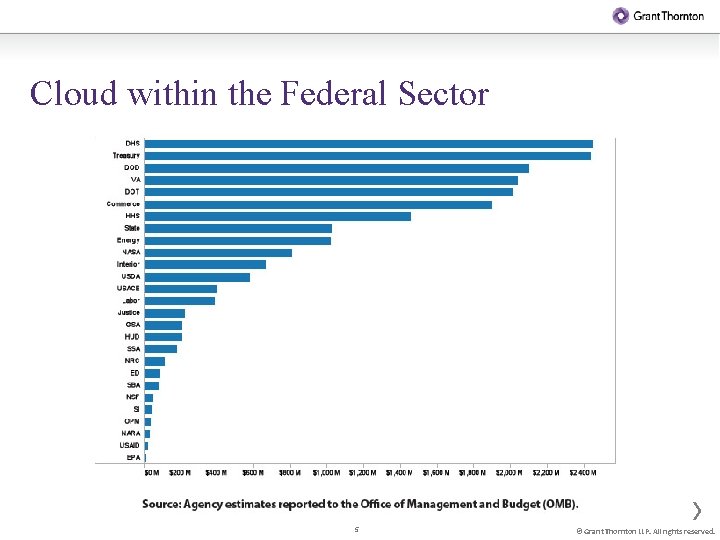
Cloud within the Federal Sector The push for cloud adoption • Part of a larger drive for efficiency (data center consolidation, etc) Cloud computing strategy released February 8, 2011 • Estimates $20 B of the $80 B Federal IT budget could be spent on cloud computing • Builds on "Cloud First" policy (part of the administration's 25 point IT plan) Embraces all cloud service models • Software as a Service (Saa. S) • Platform as a Service (Paa. S) • Infrastructure as a Service (Iaa. S) The Feds have invaded the cloud already • NASA Nebula (community cloud focused on research) • USDA E-Mail migration 3 © Grant Thornton LLP. All rights reserved.
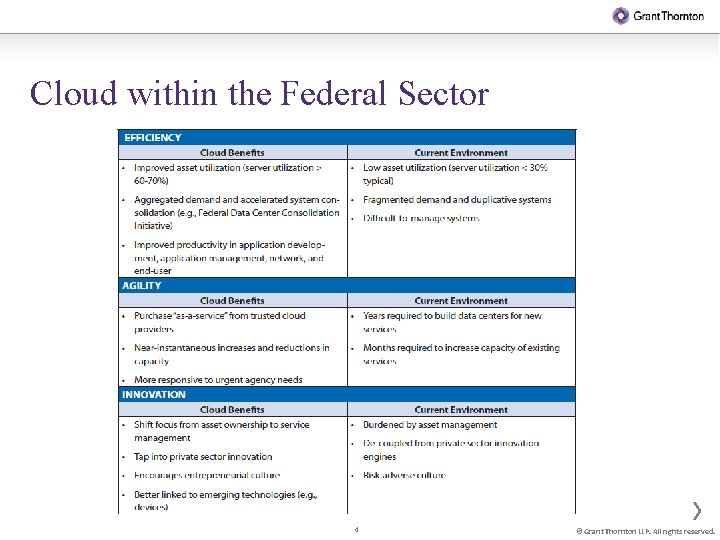
Cloud within the Federal Sector 4 © Grant Thornton LLP. All rights reserved.
Cloud within the Federal Sector 5 © Grant Thornton LLP. All rights reserved.
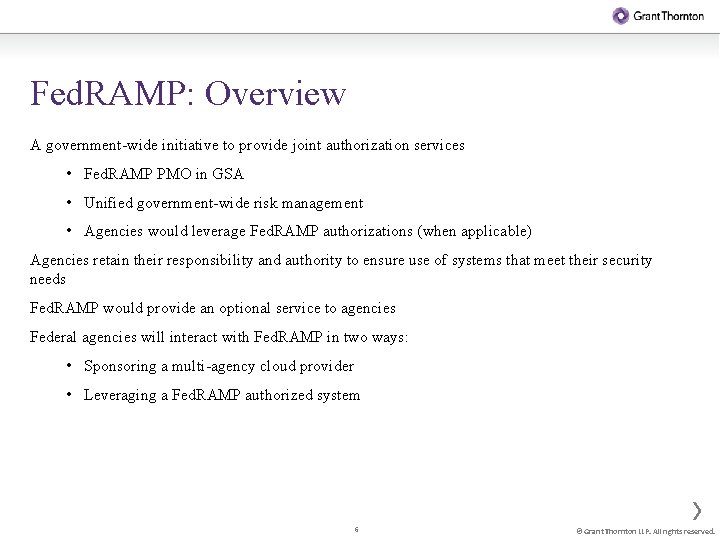
Fed. RAMP: Overview A government-wide initiative to provide joint authorization services • Fed. RAMP PMO in GSA • Unified government-wide risk management • Agencies would leverage Fed. RAMP authorizations (when applicable) Agencies retain their responsibility and authority to ensure use of systems that meet their security needs Fed. RAMP would provide an optional service to agencies Federal agencies will interact with Fed. RAMP in two ways: • Sponsoring a multi-agency cloud provider • Leveraging a Fed. RAMP authorized system 6 © Grant Thornton LLP. All rights reserved.
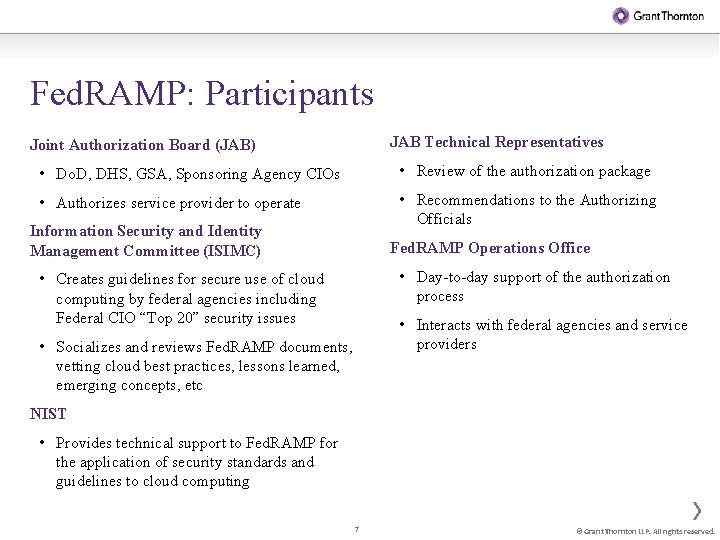
Fed. RAMP: Participants JAB Technical Representatives Joint Authorization Board (JAB) • Do. D, DHS, GSA, Sponsoring Agency CIOs • Review of the authorization package • Authorizes service provider to operate • Recommendations to the Authorizing Officials Information Security and Identity Management Committee (ISIMC) Fed. RAMP Operations Office • Day-to-day support of the authorization process • Creates guidelines for secure use of cloud computing by federal agencies including Federal CIO “Top 20” security issues • Socializes and reviews Fed. RAMP documents, vetting cloud best practices, lessons learned, emerging concepts, etc • Interacts with federal agencies and service providers NIST • Provides technical support to Fed. RAMP for the application of security standards and guidelines to cloud computing 7 © Grant Thornton LLP. All rights reserved.
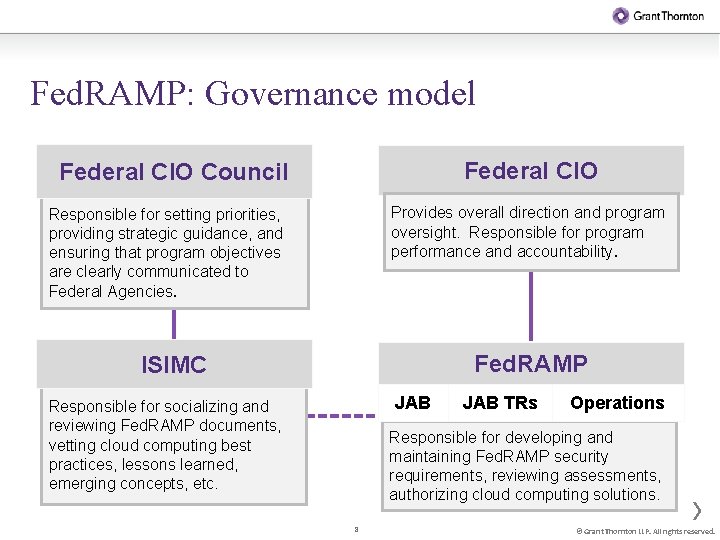
Fed. RAMP: Governance model Federal CIO Council Provides overall direction and program oversight. Responsible for program performance and accountability. Responsible for setting priorities, providing strategic guidance, and ensuring that program objectives are clearly communicated to Federal Agencies. Fed. RAMP ISIMC JAB Responsible for socializing and reviewing Fed. RAMP documents, vetting cloud computing best practices, lessons learned, emerging concepts, etc. JAB TRs Operations Responsible for developing and maintaining Fed. RAMP security requirements, reviewing assessments, authorizing cloud computing solutions. 8 © Grant Thornton LLP. All rights reserved.
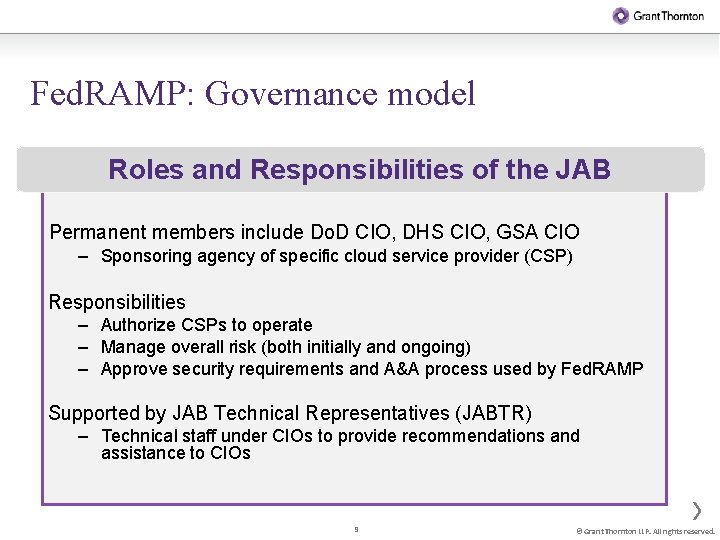
Fed. RAMP: Governance model Roles and Responsibilities of the JAB Permanent members include Do. D CIO, DHS CIO, GSA CIO – Sponsoring agency of specific cloud service provider (CSP) Responsibilities – Authorize CSPs to operate – Manage overall risk (both initially and ongoing) – Approve security requirements and A&A process used by Fed. RAMP Supported by JAB Technical Representatives (JABTR) – Technical staff under CIOs to provide recommendations and assistance to CIOs 9 © Grant Thornton LLP. All rights reserved.
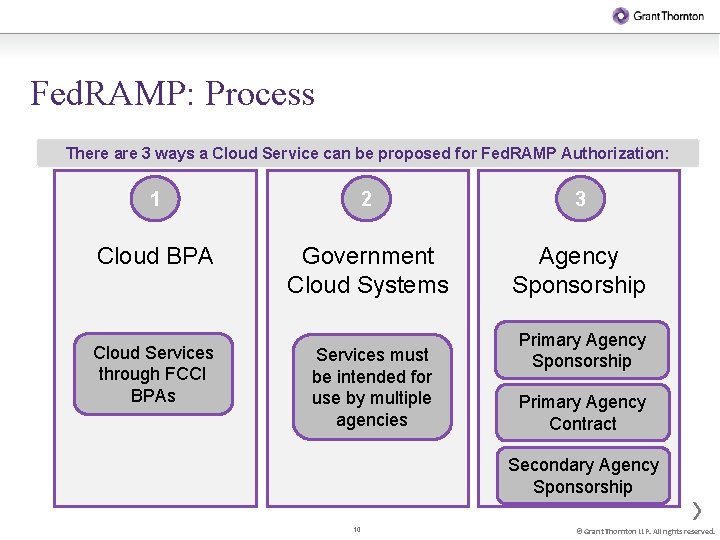
Fed. RAMP: Process There are 3 ways a Cloud Service can be proposed for Fed. RAMP Authorization: 1 2 3 Cloud BPA Government Cloud Systems Agency Sponsorship Cloud Services through FCCI BPAs Services must be intended for use by multiple agencies Primary Agency Sponsorship Primary Agency Contract Secondary Agency Sponsorship 10 © Grant Thornton LLP. All rights reserved.
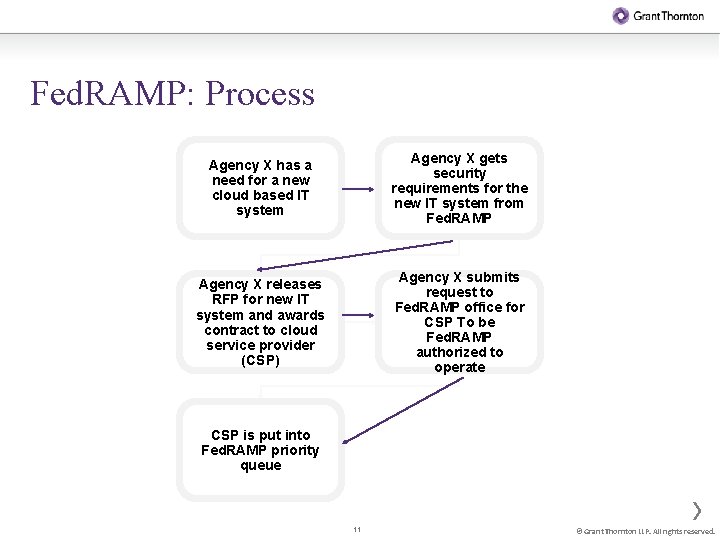
Fed. RAMP: Process Agency X has a need for a new cloud based IT system Agency X gets security requirements for the new IT system from Fed. RAMP Agency X releases RFP for new IT system and awards contract to cloud service provider (CSP) Agency X submits request to Fed. RAMP office for CSP To be Fed. RAMP authorized to operate CSP is put into Fed. RAMP priority queue 11 © Grant Thornton LLP. All rights reserved.
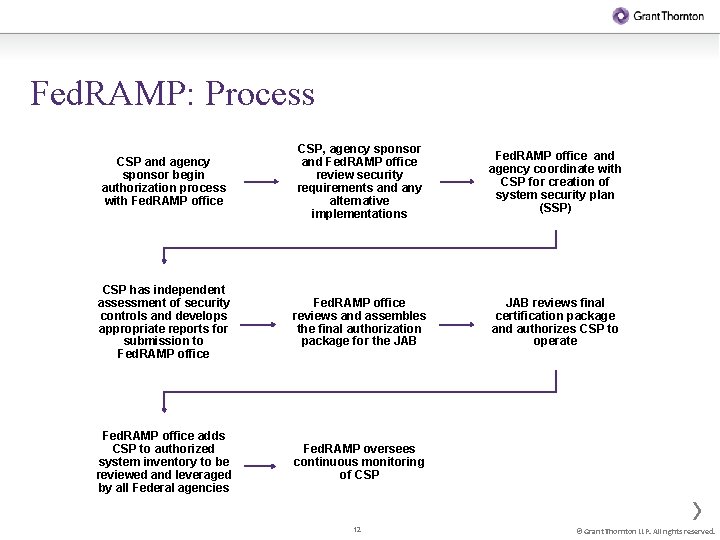
Fed. RAMP: Process CSP and agency sponsor begin authorization process with Fed. RAMP office CSP, agency sponsor and Fed. RAMP office review security requirements and any alternative implementations Fed. RAMP office and agency coordinate with CSP for creation of system security plan (SSP) CSP has independent assessment of security controls and develops appropriate reports for submission to Fed. RAMP office reviews and assembles the final authorization package for the JAB reviews final certification package and authorizes CSP to operate Fed. RAMP office adds CSP to authorized system inventory to be reviewed and leveraged by all Federal agencies Fed. RAMP oversees continuous monitoring of CSP 12 © Grant Thornton LLP. All rights reserved.
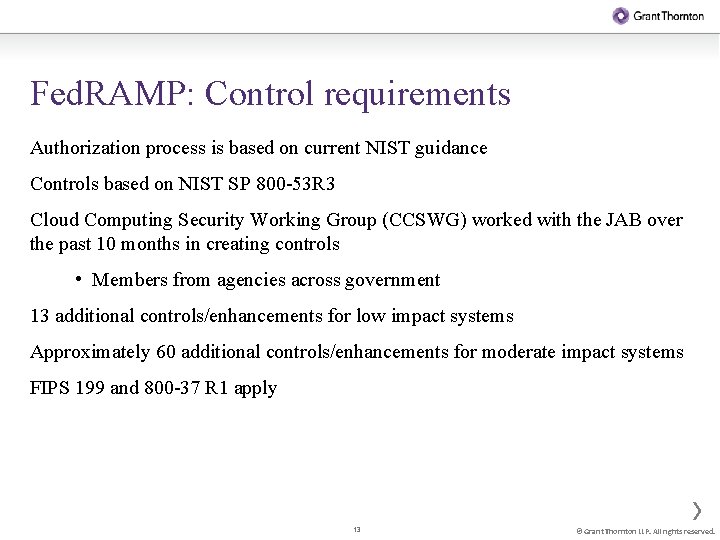
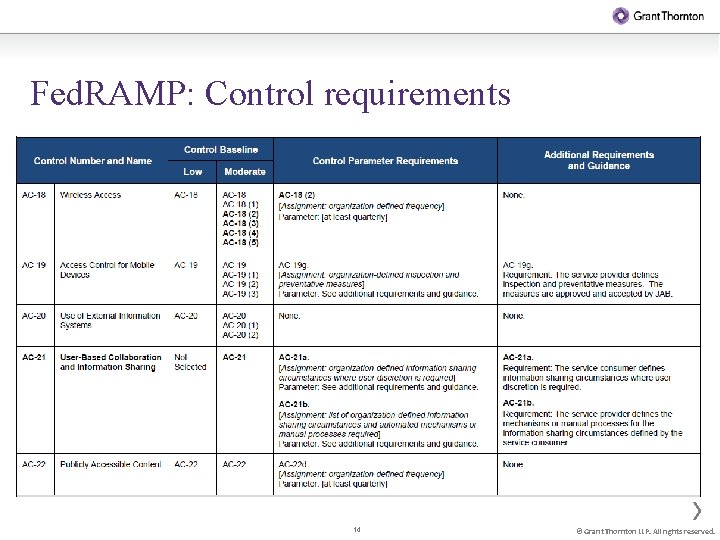
Fed. RAMP: Control requirements Authorization process is based on current NIST guidance Controls based on NIST SP 800 -53 R 3 Cloud Computing Security Working Group (CCSWG) worked with the JAB over the past 10 months in creating controls • Members from agencies across government 13 additional controls/enhancements for low impact systems Approximately 60 additional controls/enhancements for moderate impact systems FIPS 199 and 800 -37 R 1 apply 13 © Grant Thornton LLP. All rights reserved.
Fed. RAMP: Control requirements 14 © Grant Thornton LLP. All rights reserved.
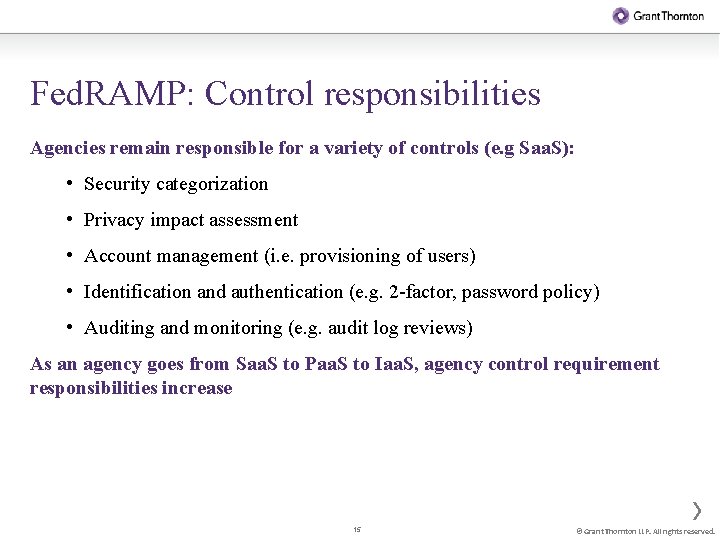
Fed. RAMP: Control responsibilities Agencies remain responsible for a variety of controls (e. g Saa. S): • Security categorization • Privacy impact assessment • Account management (i. e. provisioning of users) • Identification and authentication (e. g. 2 -factor, password policy) • Auditing and monitoring (e. g. audit log reviews) As an agency goes from Saa. S to Paa. S to Iaa. S, agency control requirement responsibilities increase 15 © Grant Thornton LLP. All rights reserved.
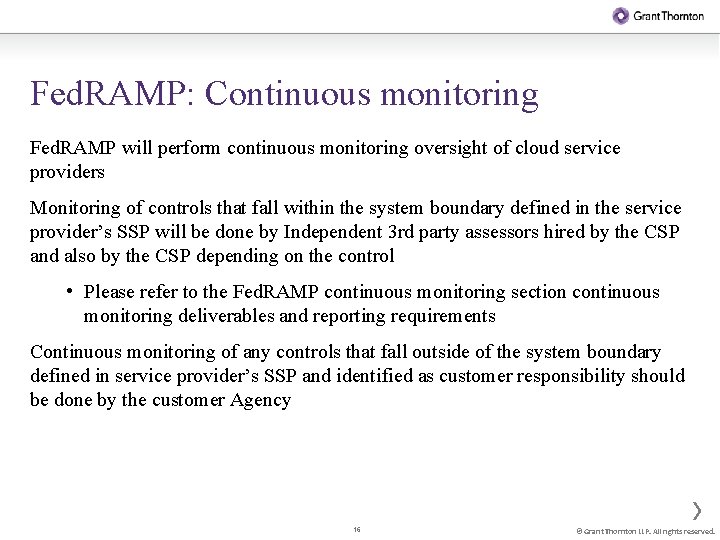
Fed. RAMP: Continuous monitoring Fed. RAMP will perform continuous monitoring oversight of cloud service providers Monitoring of controls that fall within the system boundary defined in the service provider’s SSP will be done by Independent 3 rd party assessors hired by the CSP and also by the CSP depending on the control • Please refer to the Fed. RAMP continuous monitoring section continuous monitoring deliverables and reporting requirements Continuous monitoring of any controls that fall outside of the system boundary defined in service provider’s SSP and identified as customer responsibility should be done by the customer Agency 16 © Grant Thornton LLP. All rights reserved.
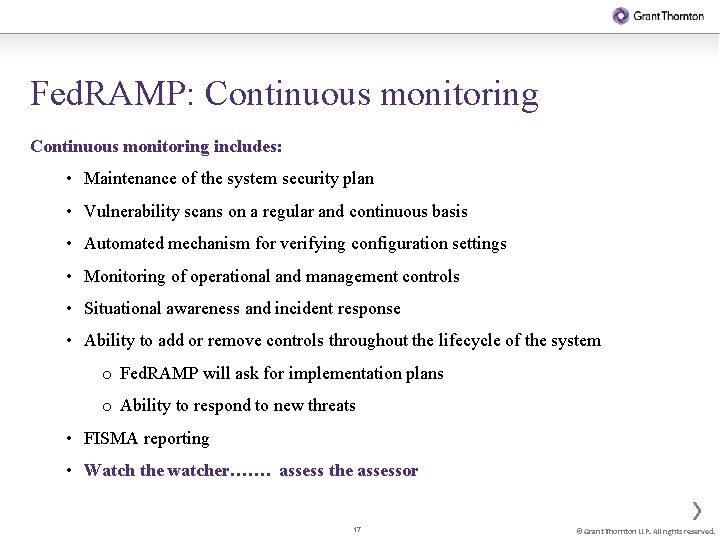
Fed. RAMP: Continuous monitoring includes: • Maintenance of the system security plan • Vulnerability scans on a regular and continuous basis • Automated mechanism for verifying configuration settings • Monitoring of operational and management controls • Situational awareness and incident response • Ability to add or remove controls throughout the lifecycle of the system o Fed. RAMP will ask for implementation plans o Ability to respond to new threats • FISMA reporting • Watch the watcher……. assess the assessor 17 © Grant Thornton LLP. All rights reserved.
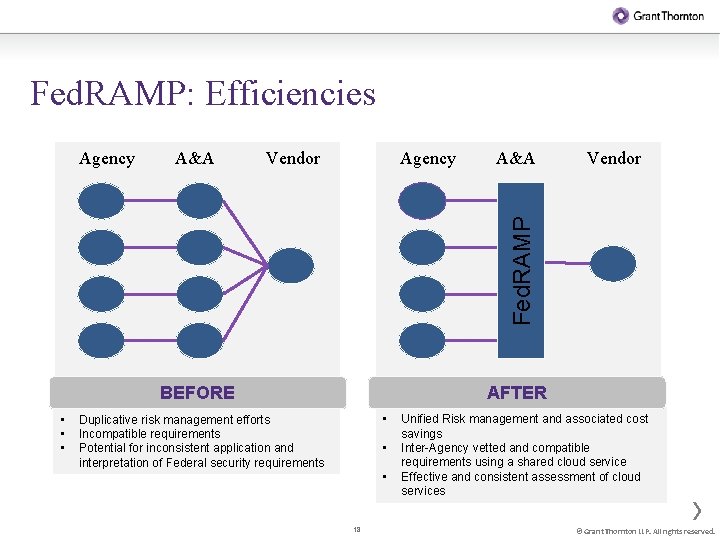
Fed. RAMP: Efficiencies A&A Vendor Agency A&A Vendor Fed. RAMP Agency BEFORE • • • AFTER • Duplicative risk management efforts Incompatible requirements Potential for inconsistent application and interpretation of Federal security requirements • • 18 Unified Risk management and associated cost savings Inter-Agency vetted and compatible requirements using a shared cloud service Effective and consistent assessment of cloud services © Grant Thornton LLP. All rights reserved.
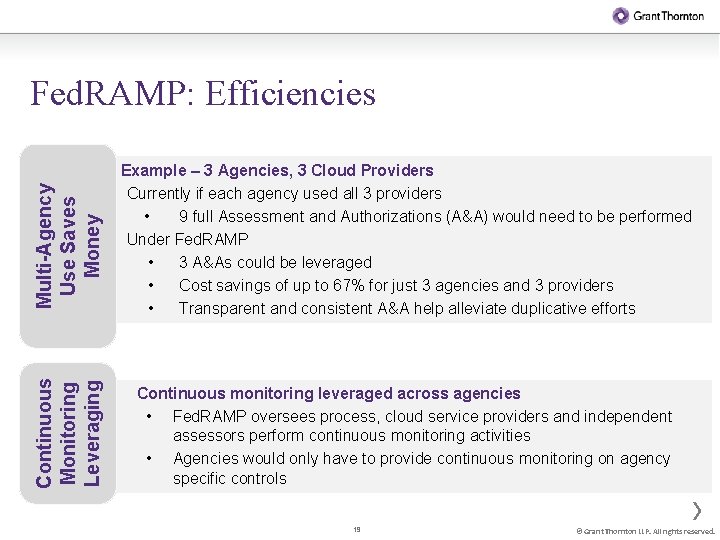
Continuous Monitoring Leveraging Multi-Agency Use Saves Money Fed. RAMP: Efficiencies Example – 3 Agencies, 3 Cloud Providers • Currently if each agency used all 3 providers • 9 full Assessment and Authorizations (A&A) would need to be performed • Under Fed. RAMP • 3 A&As could be leveraged • Cost savings of up to 67% for just 3 agencies and 3 providers • Transparent and consistent A&A help alleviate duplicative efforts • Continuous monitoring leveraged across agencies • Fed. RAMP oversees process, cloud service providers and independent assessors perform continuous monitoring activities • Agencies would only have to provide continuous monitoring on agency specific controls 19 © Grant Thornton LLP. All rights reserved.
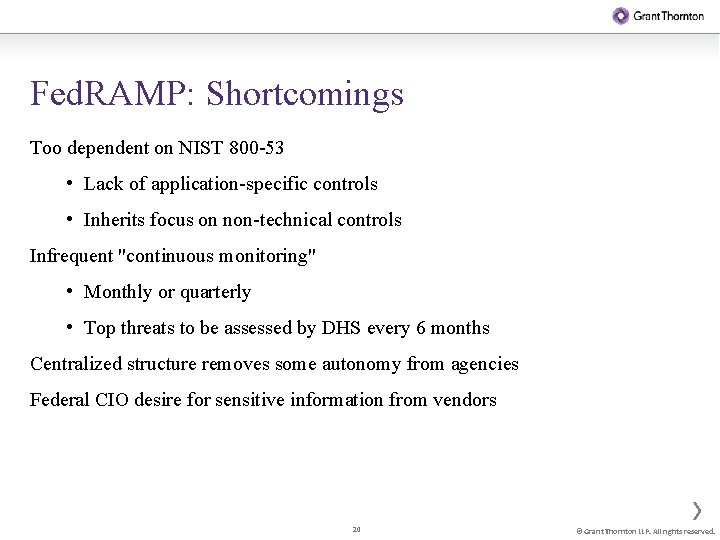
Fed. RAMP: Shortcomings Too dependent on NIST 800 -53 • Lack of application-specific controls • Inherits focus on non-technical controls Infrequent "continuous monitoring" • Monthly or quarterly • Top threats to be assessed by DHS every 6 months Centralized structure removes some autonomy from agencies Federal CIO desire for sensitive information from vendors 20 © Grant Thornton LLP. All rights reserved.
Questions, answers, discussion Orus Dearman, Senior Manager Grant Thornton LLP Mc. Lean, VA T 703. 637. 4133 E Orus. Dearman@us. gt. com 21 © Grant Thornton LLP. All rights reserved.
© Grant Thornton LLP All rights reserved U. S. member firm of Grant Thornton International Ltd This presentation is the work of Grant Thornton LLP, the U. S. member firm of Grant Thornton International Ltd, and is in all respects subject to negotiation, agreement and signing of specific contracts. The information contained within this document is intended only for the entity or person to which it is addressed and contains confidential and/or proprietary material. Dissemination to third-parties, copying or use of this information is strictly prohibited without the prior written consent of Grant Thornton LLP. 22