CHEMICAL MEASUREMENTS METRIC SYSTEM CHAPTER 2 2 1


- Slides: 53
CHEMICAL MEASUREMENTS METRIC SYSTEM
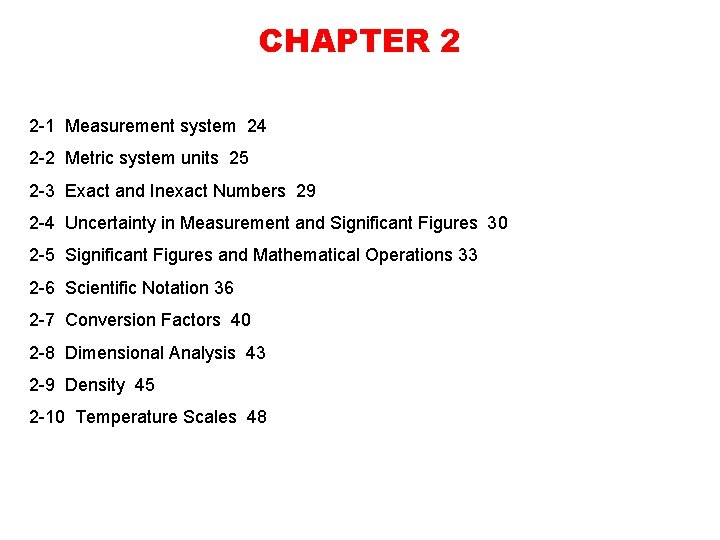
CHAPTER 2 2 -1 Measurement system 24 2 -2 Metric system units 25 2 -3 Exact and Inexact Numbers 29 2 -4 Uncertainty in Measurement and Significant Figures 30 2 -5 Significant Figures and Mathematical Operations 33 2 -6 Scientific Notation 36 2 -7 Conversion Factors 40 2 -8 Dimensional Analysis 43 2 -9 Density 45 2 -10 Temperature Scales 48
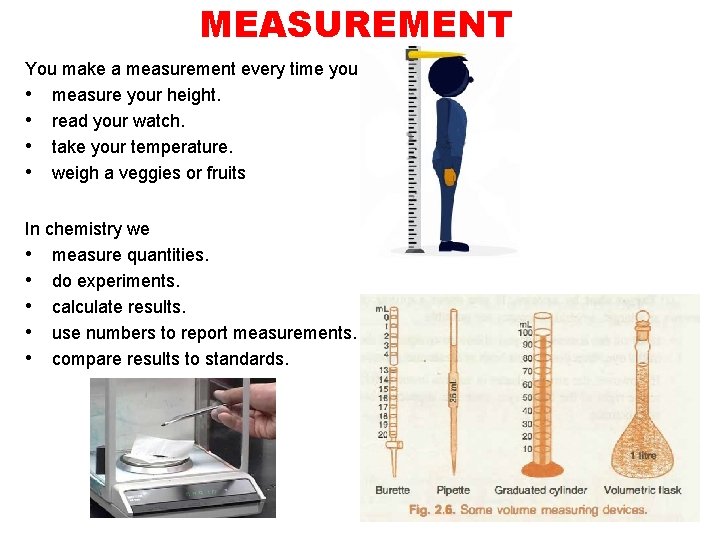
MEASUREMENT You make a measurement every time you • measure your height. • read your watch. • take your temperature. • weigh a veggies or fruits In chemistry we • measure quantities. • do experiments. • calculate results. • use numbers to report measurements. • compare results to standards.
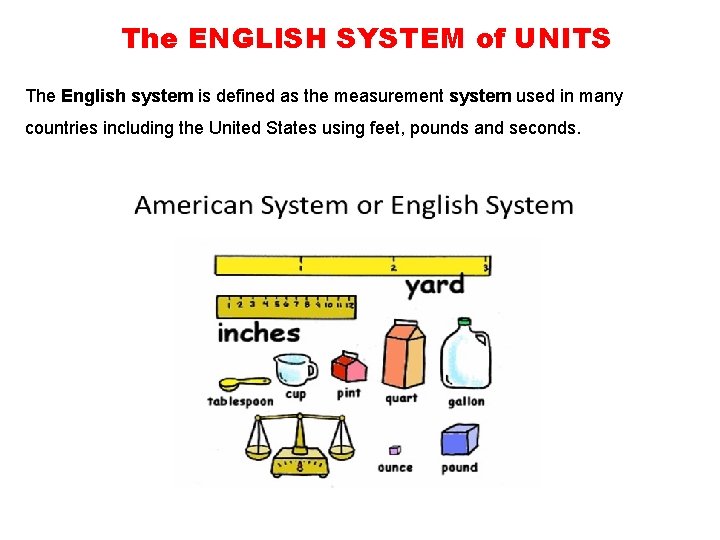
The ENGLISH SYSTEM of UNITS The English system is defined as the measurement system used in many countries including the United States using feet, pounds and seconds.
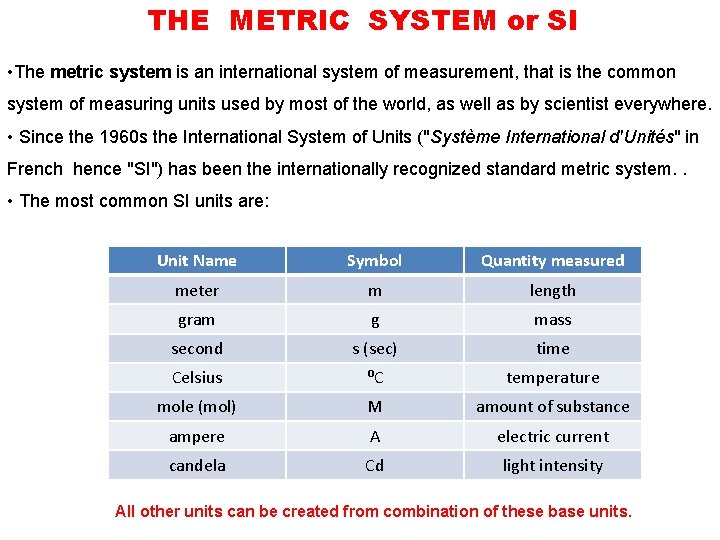
THE METRIC SYSTEM or SI • The metric system is an international system of measurement, that is the common system of measuring units used by most of the world, as well as by scientist everywhere. • Since the 1960 s the International System of Units ("Système International d'Unités" in French hence "SI") has been the internationally recognized standard metric system. . • The most common SI units are: Unit Name Symbol Quantity measured meter m length gram g mass second s (sec) time Celsius ⁰C temperature mole (mol) M amount of substance ampere A electric current candela Cd light intensity All other units can be created from combination of these base units.
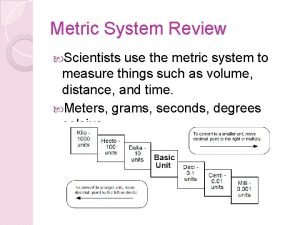
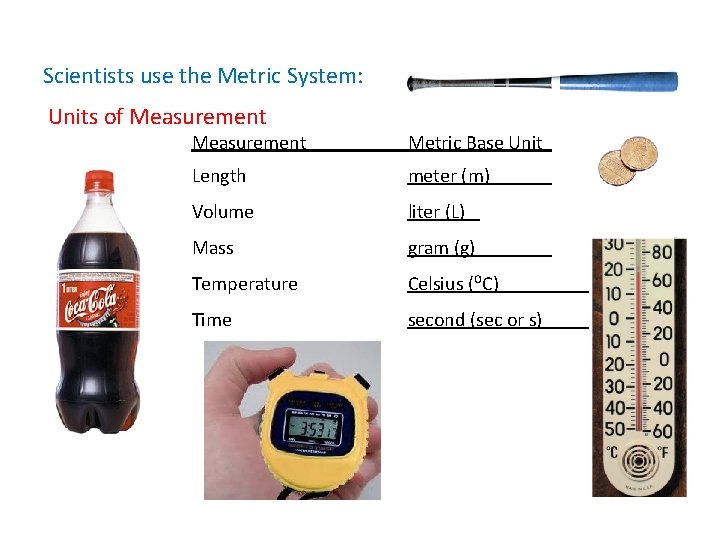
Scientists use the Metric System: Units of Measurement Metric Base Unit Length meter (m) Volume liter (L) Mass gram (g) Temperature Celsius (⁰C) Time second (sec or s)
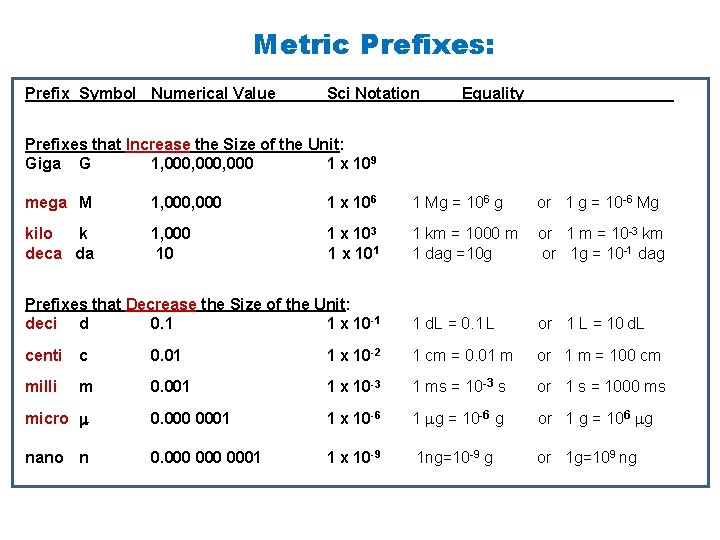
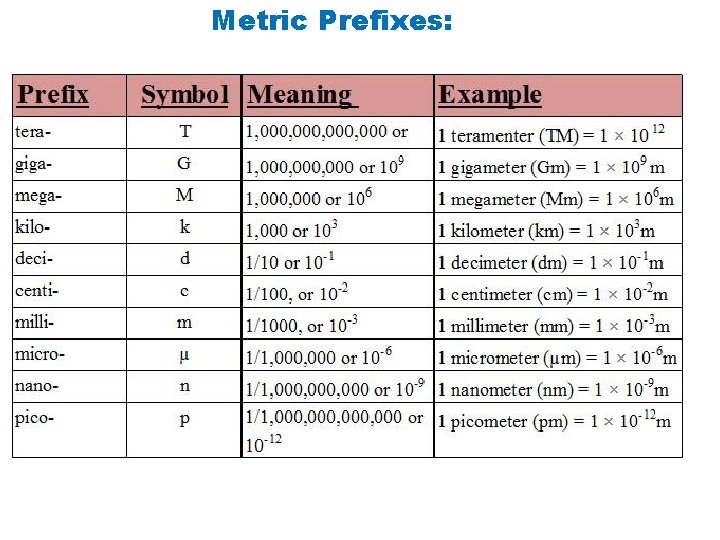
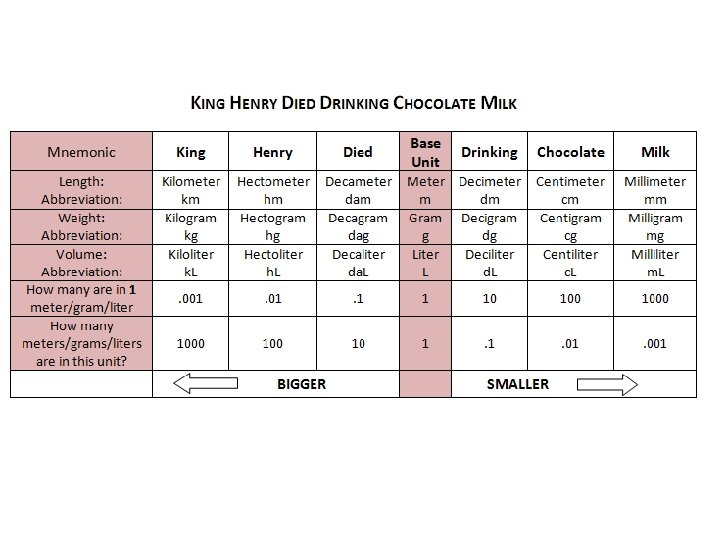
Metric Prefixes: Prefix Symbol Numerical Value Sci Notation Equality Prefixes that Increase the Size of the Unit: Giga G 1, 000, 000 1 x 10⁹ mega M 1, 000 1 x 10⁶ 1 Mg = 106 g or 1 g = 10 -6 Mg kilo k 1, 000 1 x 10³ 1 km = 1000 m deca da 10 1 x 10 1 1 dag =10 g or 1 m = 10 -3 km or 1 g = 10 -1 dag Prefixes that Decrease the Size of the Unit: deci d 0. 1 1 x 10 -1 1 d. L = 0. 1 L or 1 L = 10 d. L centi c 0. 01 1 x 10 -2 1 cm = 0. 01 m or 1 m = 100 cm milli m 0. 001 1 x 10 -3 1 ms = 10 -3 s or 1 s = 1000 ms micro 0. 0001 1 x 10 -6 1 mg = 10 -6 g or 1 g = 106 mg nano n 0. 000 0001 1 x 10 -9 1 ng=10 -9 g or 1 g=109 ng
Metric Prefixes:
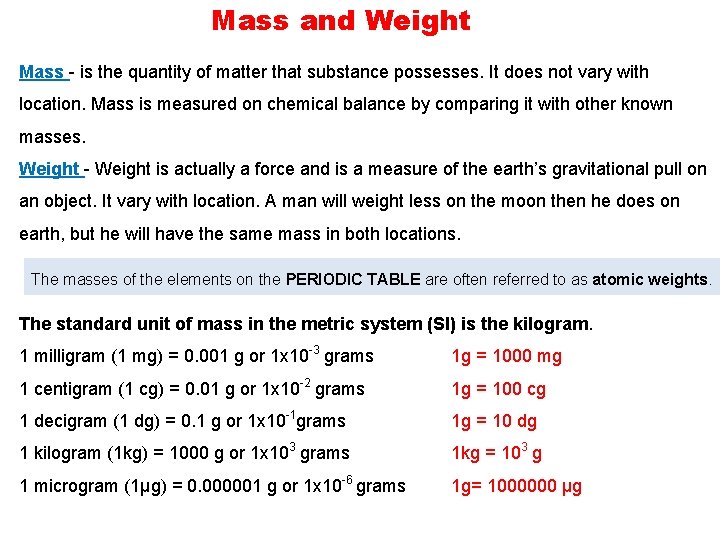
Mass and Weight Mass - is the quantity of matter that substance possesses. It does not vary with location. Mass is measured on chemical balance by comparing it with other known masses. Weight - Weight is actually a force and is a measure of the earth’s gravitational pull on an object. It vary with location. A man will weight less on the moon then he does on earth, but he will have the same mass in both locations. The masses of the elements on the PERIODIC TABLE are often referred to as atomic weights. The standard unit of mass in the metric system (SI) is the kilogram. 1 milligram (1 mg) = 0. 001 g or 1 x 10 -3 grams 1 g = 1000 mg 1 centigram (1 cg) = 0. 01 g or 1 x 10 -2 grams 1 g = 100 cg 1 decigram (1 dg) = 0. 1 g or 1 x 10 -1 grams 1 g = 10 dg 1 kilogram (1 kg) = 1000 g or 1 x 10³ grams 1 kg = 103 g 1 microgram (1μg) = 0. 000001 g or 1 x 10 -6 grams 1 g= 1000000 μg
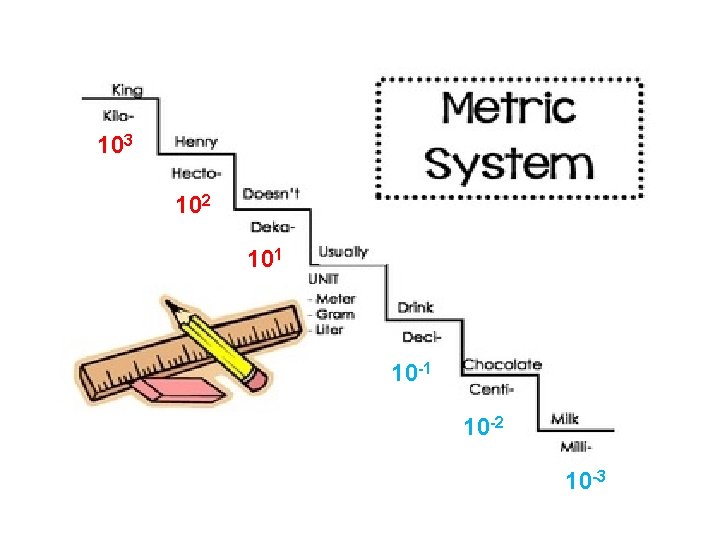
103 102 101 10 -2 10 -3
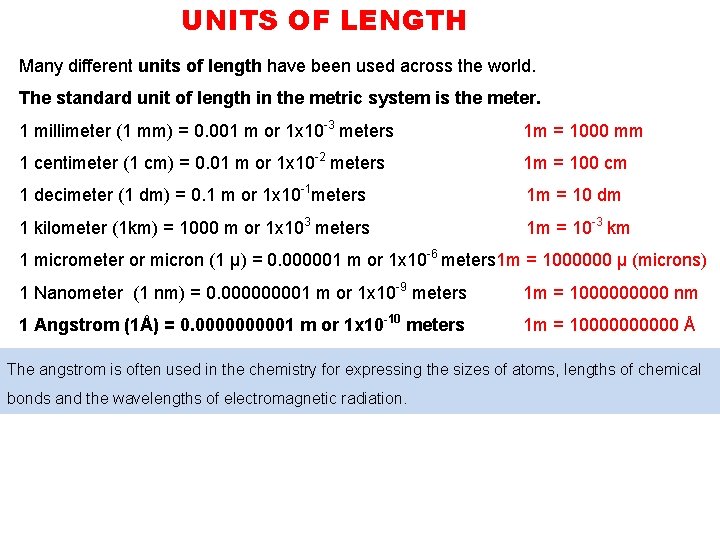
UNITS OF LENGTH Many different units of length have been used across the world. The standard unit of length in the metric system is the meter. 1 millimeter (1 mm) = 0. 001 m or 1 x 10 -3 meters 1 m = 1000 mm 1 centimeter (1 cm) = 0. 01 m or 1 x 10 -2 meters 1 m = 100 cm 1 decimeter (1 dm) = 0. 1 m or 1 x 10 -1 meters 1 m = 10 dm 1 kilometer (1 km) = 1000 m or 1 x 10³ meters 1 m = 10 -3 km 1 micrometer or micron (1 μ) = 0. 000001 m or 1 x 10 -6 meters 1 m = 1000000 μ (microns) 1 Nanometer (1 nm) = 0. 00001 m or 1 x 10 -9 meters 1 m = 100000 nm 1 Angstrom (1Å) = 0. 000001 m or 1 x 10 -10 meters 1 m = 100000 Å The angstrom is often used in the chemistry for expressing the sizes of atoms, lengths of chemical bonds and the wavelengths of electromagnetic radiation.
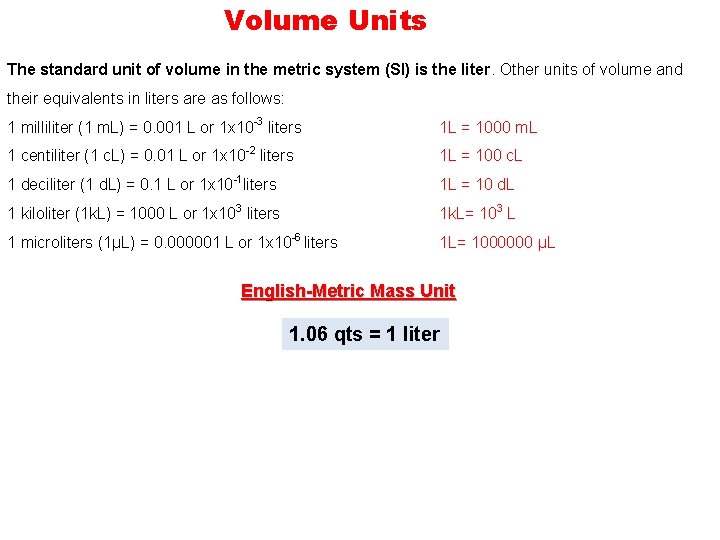
Volume Units The standard unit of volume in the metric system (SI) is the liter. Other units of volume and their equivalents in liters are as follows: 1 milliliter (1 m. L) = 0. 001 L or 1 x 10 -3 liters 1 L = 1000 m. L 1 centiliter (1 c. L) = 0. 01 L or 1 x 10 -2 liters 1 L = 100 c. L 1 deciliter (1 d. L) = 0. 1 L or 1 x 10 -1 liters 1 L = 10 d. L 1 kiloliter (1 k. L) = 1000 L or 1 x 10³ liters 1 k. L= 103 L 1 microliters (1μL) = 0. 000001 L or 1 x 10 -6 liters 1 L= 1000000 μL English-Metric Mass Unit 1. 06 qts = 1 liter
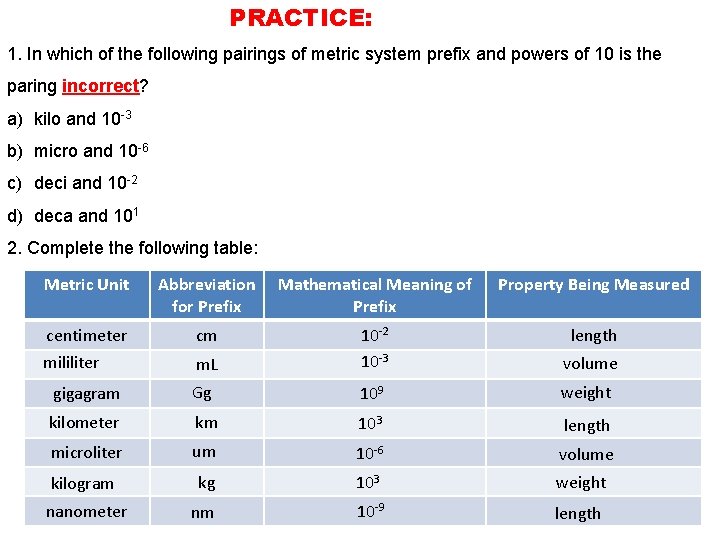
PRACTICE: 1. In which of the following pairings of metric system prefix and powers of 10 is the paring incorrect? a) kilo and 10 -3 b) micro and 10 -6 c) deci and 10 -2 d) deca and 101 2. Complete the following table: Metric Unit Abbreviation for Prefix Mathematical Meaning of Prefix Property Being Measured centimeter cm length mililiter m. L 10 -2 10 -3 volume gigagram Gg 109 weight kilometer km 103 length microliter um 10 -6 volume kilogram kg 103 weight nanometer nm 10 -9 length
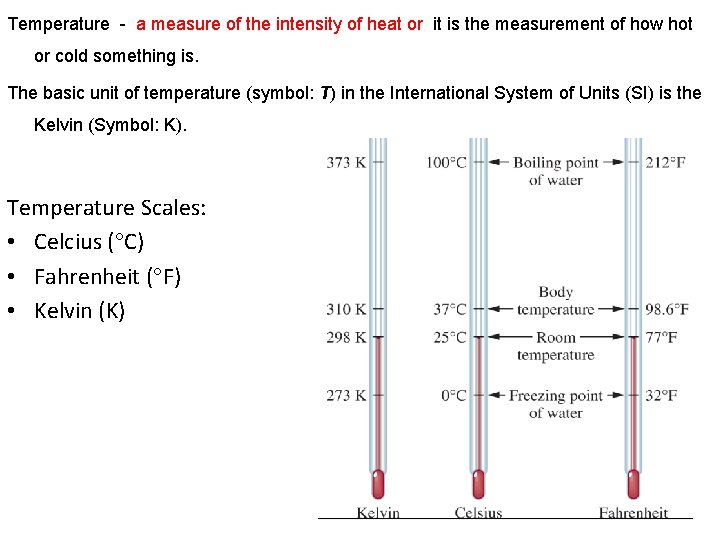
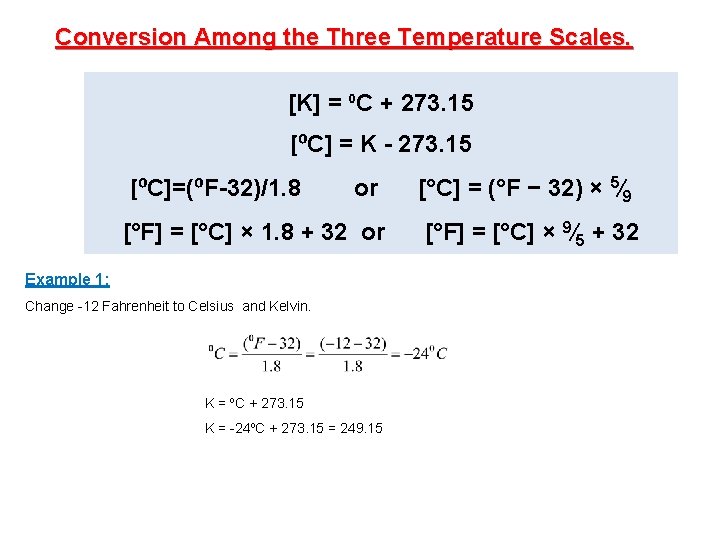
Temperature - a measure of the intensity of heat or it is the measurement of how hot or cold something is. The basic unit of temperature (symbol: T) in the International System of Units (SI) is the Kelvin (Symbol: K). Temperature Scales: • Celcius ( C) • Fahrenheit ( F) • Kelvin (K)
Conversion Among the Three Temperature Scales. [K] = ⁰C + 273. 15 [⁰C] = K - 273. 15 [⁰C]=(⁰F-32)/1. 8 or [°C] = (°F − 32) × 5⁄9 [°F] = [°C] × 1. 8 + 32 or [°F] = [°C] × 9⁄5 + 32 Example 1: Change -12 Fahrenheit to Celsius and Kelvin. K = ⁰C + 273. 15 K = -24⁰C + 273. 15 = 249. 15
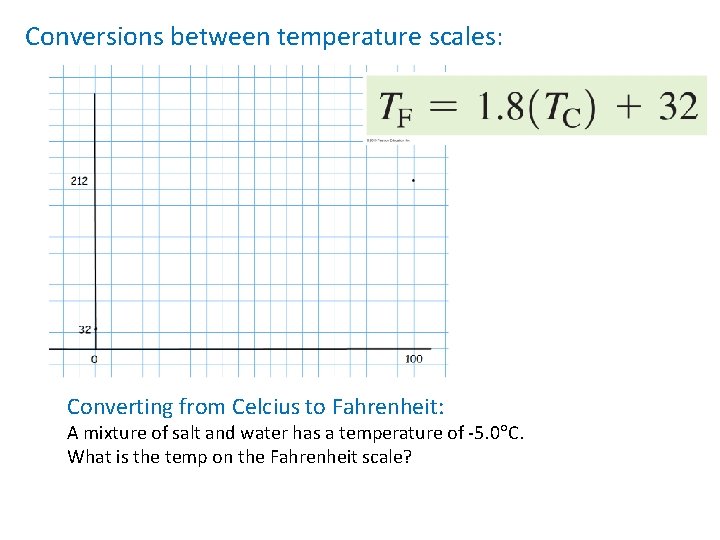
Conversions between temperature scales: Converting from Celcius to Fahrenheit: A mixture of salt and water has a temperature of -5. 0 C. What is the temp on the Fahrenheit scale?
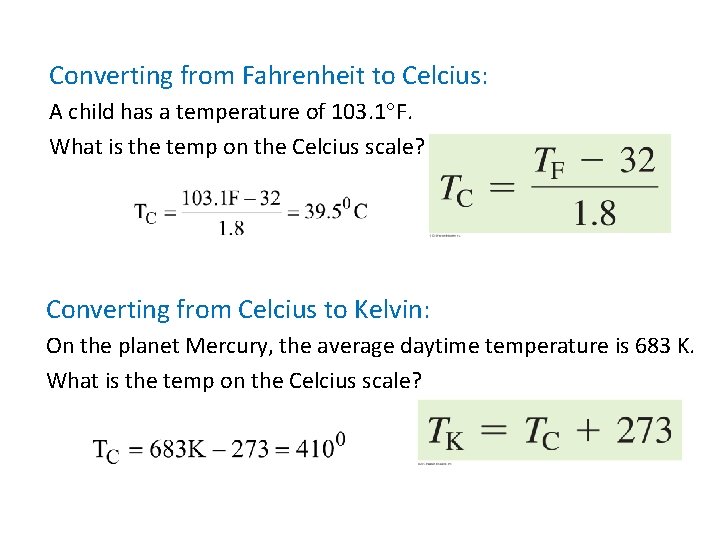
Converting from Fahrenheit to Celcius: A child has a temperature of 103. 1 F. What is the temp on the Celcius scale? Converting from Celcius to Kelvin: On the planet Mercury, the average daytime temperature is 683 K. What is the temp on the Celcius scale?
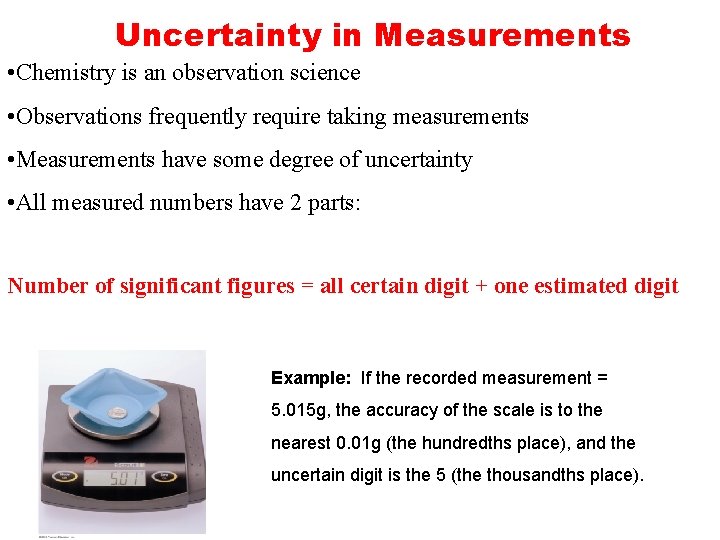
Uncertainty in Measurements • Chemistry is an observation science • Observations frequently require taking measurements • Measurements have some degree of uncertainty • All measured numbers have 2 parts: Number of significant figures = all certain digit + one estimated digit Example: If the recorded measurement = 5. 015 g, the accuracy of the scale is to the nearest 0. 01 g (the hundredths place), and the uncertain digit is the 5 (the thousandths place).
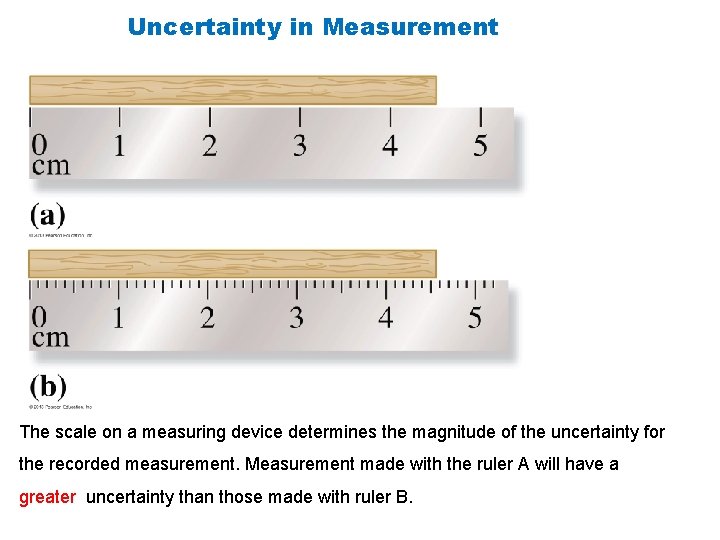
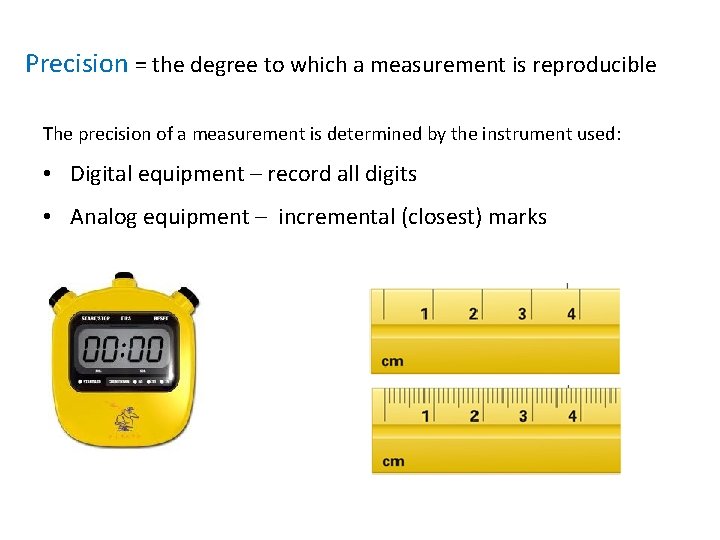
Uncertainty in Measurement The scale on a measuring device determines the magnitude of the uncertainty for the recorded measurement. Measurement made with the ruler A will have a greater uncertainty than those made with ruler B.
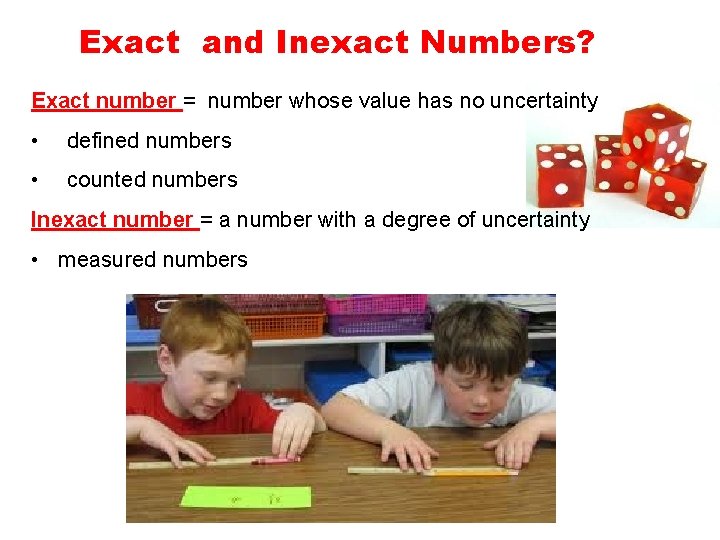
Exact and Inexact Numbers? Exact number = number whose value has no uncertainty • defined numbers • counted numbers Inexact number = a number with a degree of uncertainty • measured numbers
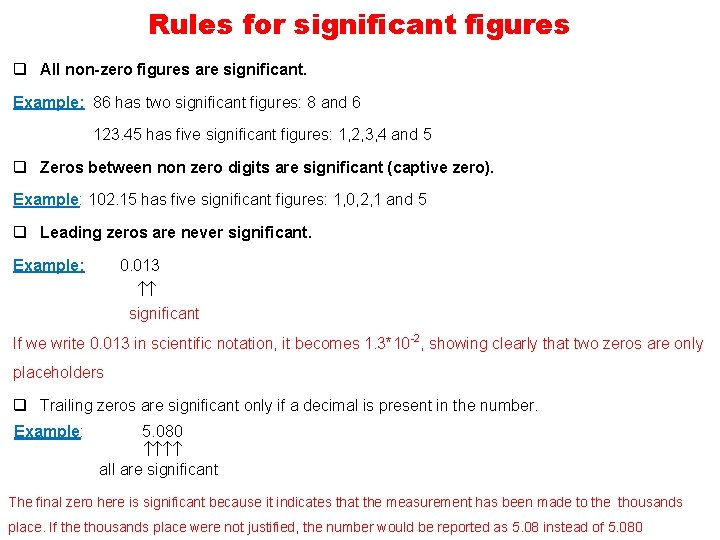
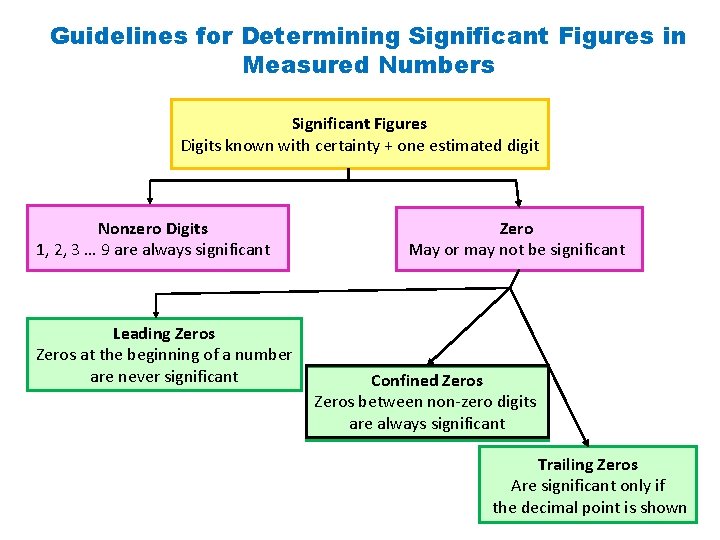
Rules for significant figures q All non-zero figures are significant. Example: 86 has two significant figures: 8 and 6 123. 45 has five significant figures: 1, 2, 3, 4 and 5 q Zeros between non zero digits are significant (captive zero). Example: 102. 15 has five significant figures: 1, 0, 2, 1 and 5 q Leading zeros are never significant. Example: 0. 013 significant If we write 0. 013 in scientific notation, it becomes 1. 3*10 -2, showing clearly that two zeros are only placeholders q Trailing zeros are significant only if a decimal is present in the number. Example: 5. 080 all are significant The final zero here is significant because it indicates that the measurement has been made to the thousands place. If the thousands place were not justified, the number would be reported as 5. 08 instead of 5. 080
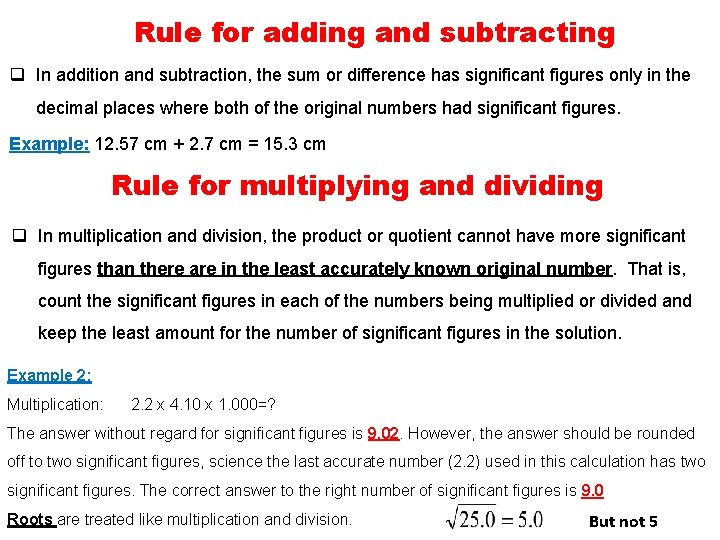
Rule for adding and subtracting q In addition and subtraction, the sum or difference has significant figures only in the decimal places where both of the original numbers had significant figures. Example: 12. 57 cm + 2. 7 cm = 15. 3 cm Rule for multiplying and dividing q In multiplication and division, the product or quotient cannot have more significant figures than there are in the least accurately known original number. That is, count the significant figures in each of the numbers being multiplied or divided and keep the least amount for the number of significant figures in the solution. Example 2: Multiplication: 2. 2 x 4. 10 x 1. 000=? The answer without regard for significant figures is 9. 02. However, the answer should be rounded off to two significant figures, science the last accurate number (2. 2) used in this calculation has two significant figures. The correct answer to the right number of significant figures is 9. 0 Roots are treated like multiplication and division. But not 5
Guidelines for Determining Significant Figures in Measured Numbers Significant Figures Digits known with certainty + one estimated digit Nonzero Digits 1, 2, 3 … 9 are always significant Leading Zeros at the beginning of a number are never significant Zero May or may not be significant Confined Zeros between non-zero digits are always significant Trailing Zeros Are significant only if the decimal point is shown
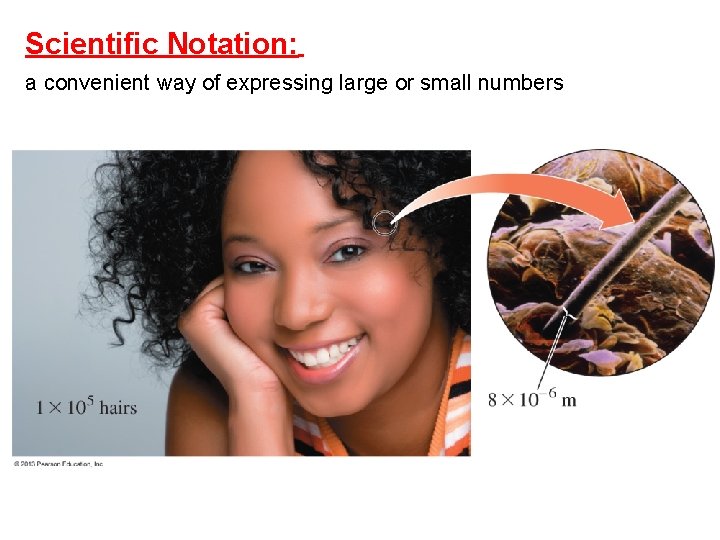
Scientific Notation: a convenient way of expressing large or small numbers
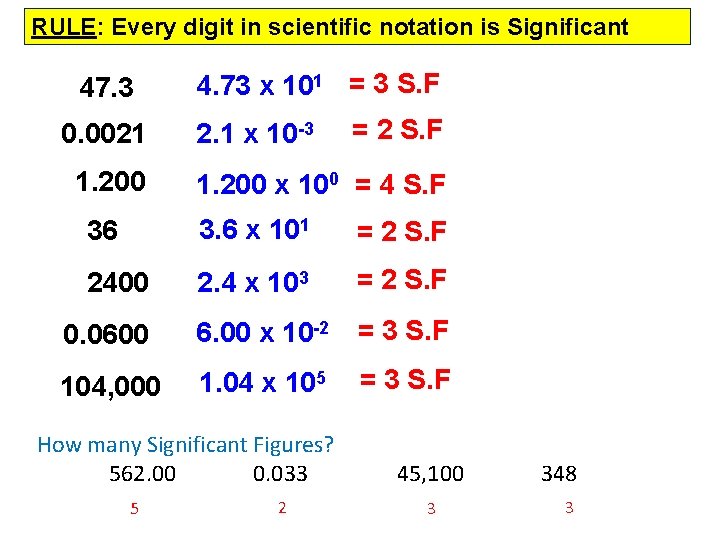
RULE: Every digit in scientific notation is Significant 47. 3 0. 0021 1. 200 4. 73 x 101 = 3 S. F 2. 1 x 10 -3 = 2 S. F 1. 200 x 100 = 4 S. F 36 3. 6 x 101 = 2 S. F 2400 2. 4 x 103 = 2 S. F 0. 0600 6. 00 x 10 -2 = 3 S. F 104, 000 1. 04 x 105 = 3 S. F How many Significant Figures? 562. 00 0. 033 5 2 45, 100 3 348 3
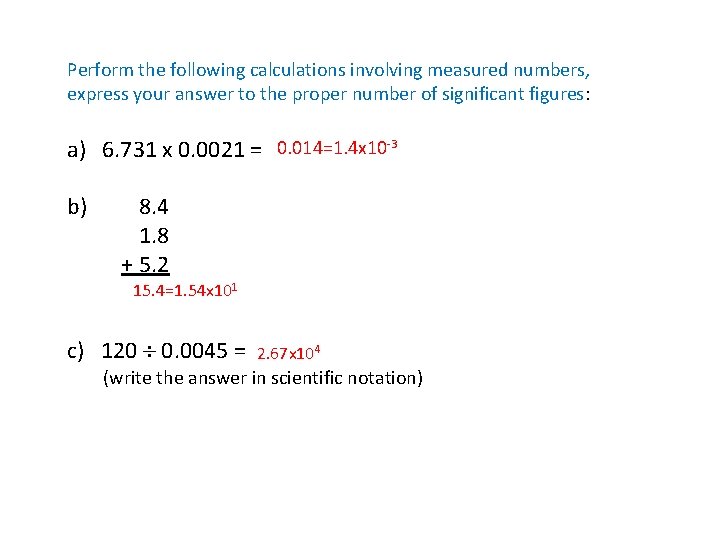
Perform the following calculations involving measured numbers, express your answer to the proper number of significant figures: a) 6. 731 x 0. 0021 = 0. 014=1. 4 x 10 -3 b) 8. 4 1. 8 + 5. 2 15. 4=1. 54 x 101 c) 120 0. 0045 = 2. 67 x 104 (write the answer in scientific notation)
Precision = the degree to which a measurement is reproducible The precision of a measurement is determined by the instrument used: • Digital equipment – record all digits • Analog equipment – incremental (closest) marks
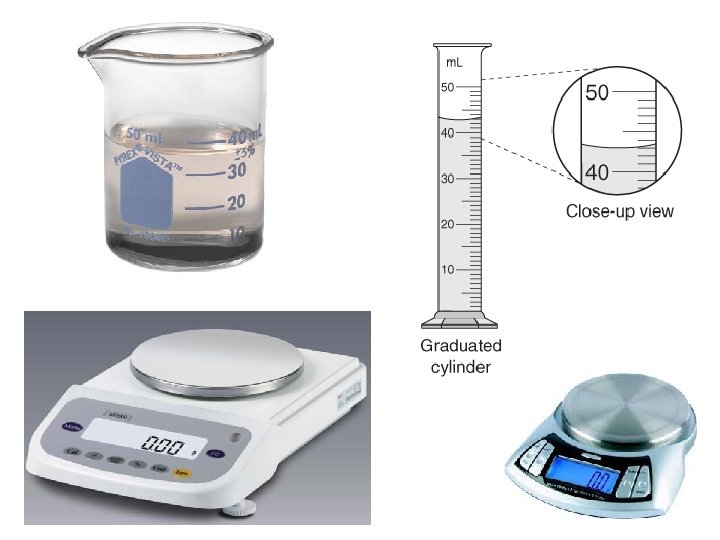
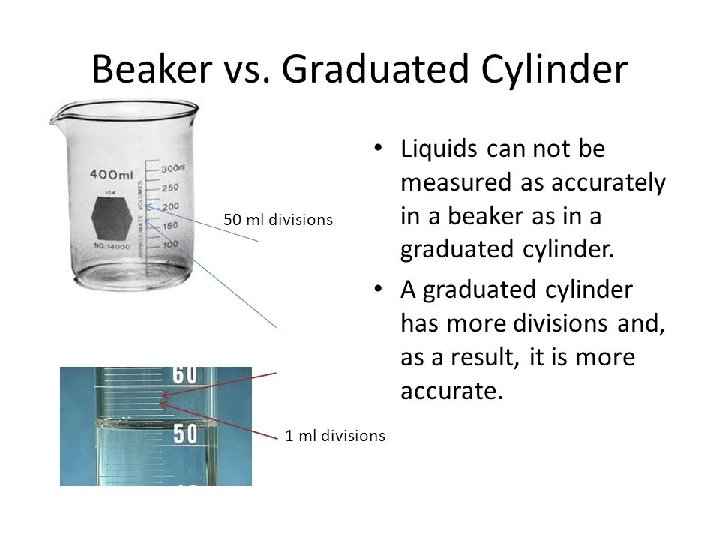
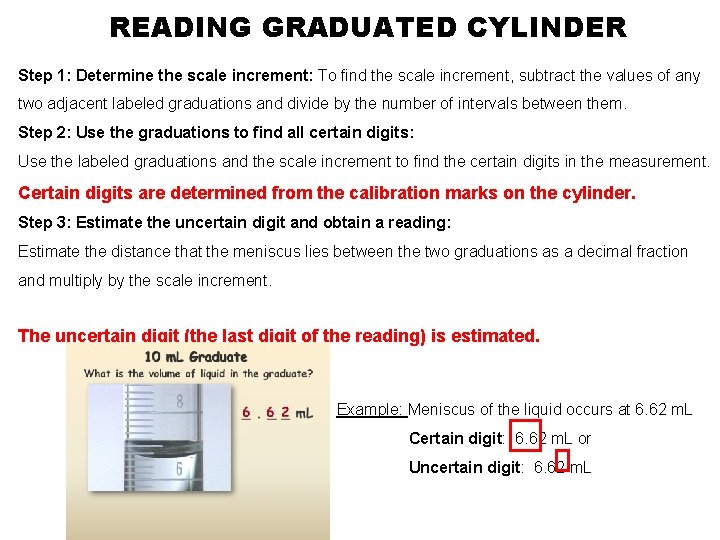
READING GRADUATED CYLINDER Step 1: Determine the scale increment: To find the scale increment, subtract the values of any two adjacent labeled graduations and divide by the number of intervals between them. Step 2: Use the graduations to find all certain digits: Use the labeled graduations and the scale increment to find the certain digits in the measurement. Certain digits are determined from the calibration marks on the cylinder. Step 3: Estimate the uncertain digit and obtain a reading: Estimate the distance that the meniscus lies between the two graduations as a decimal fraction and multiply by the scale increment. The uncertain digit (the last digit of the reading) is estimated. Example: Meniscus of the liquid occurs at 6. 62 m. L Certain digit: 6. 62 m. L or Uncertain digit: 6. 62 m. L
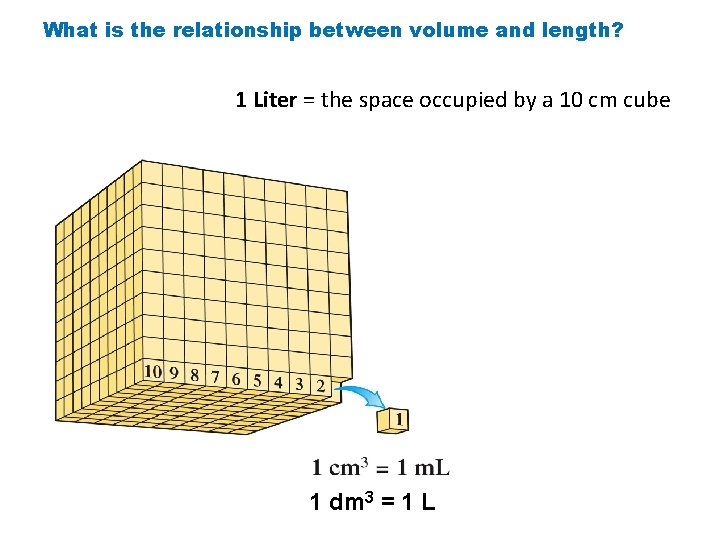
What is the relationship between volume and length? 1 Liter = the space occupied by a 10 cm cube 1 dm 3 = 1 L
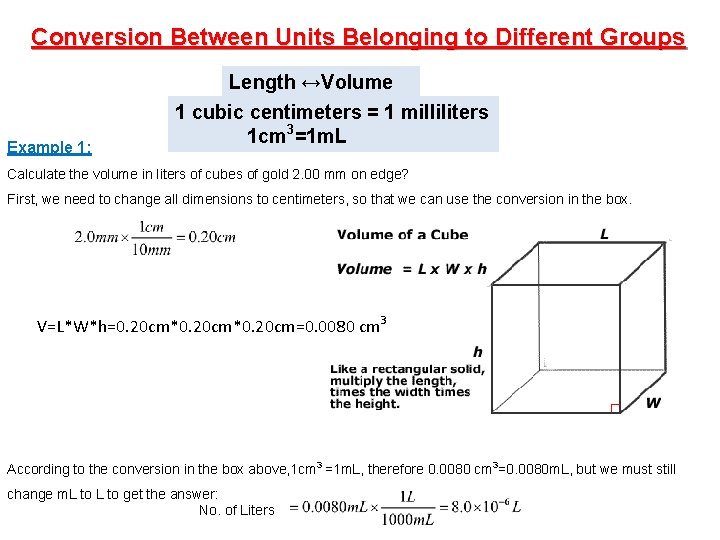
Conversion Between Units Belonging to Different Groups Example 1: Length ↔Volume 1 cubic centimeters = 1 milliliters 1 cm 3=1 m. L Calculate the volume in liters of cubes of gold 2. 00 mm on edge? First, we need to change all dimensions to centimeters, so that we can use the conversion in the box. V=L*W*h=0. 20 cm*0. 20 cm=0. 0080 cm 3 According to the conversion in the box above, 1 cm 3 =1 m. L, therefore 0. 0080 cm 3=0. 0080 m. L, but we must still change m. L to get the answer: No. of Liters
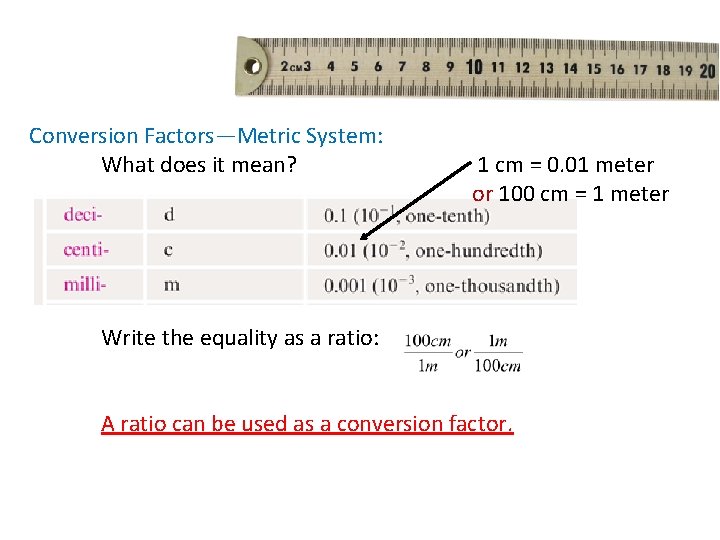
Conversion Factors—Metric System: What does it mean? 1 cm = 0. 01 meter or 100 cm = 1 meter Write the equality as a ratio: A ratio can be used as a conversion factor.
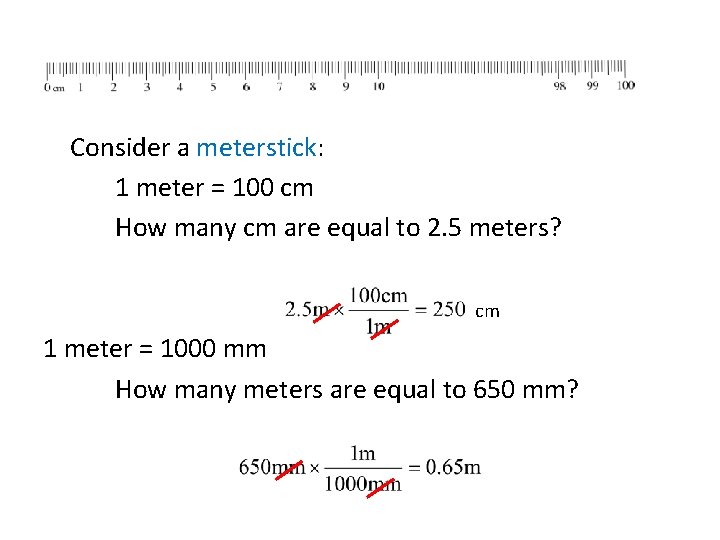
Consider a meterstick: 1 meter = 100 cm How many cm are equal to 2. 5 meters? cm 1 meter = 1000 mm How many meters are equal to 650 mm?
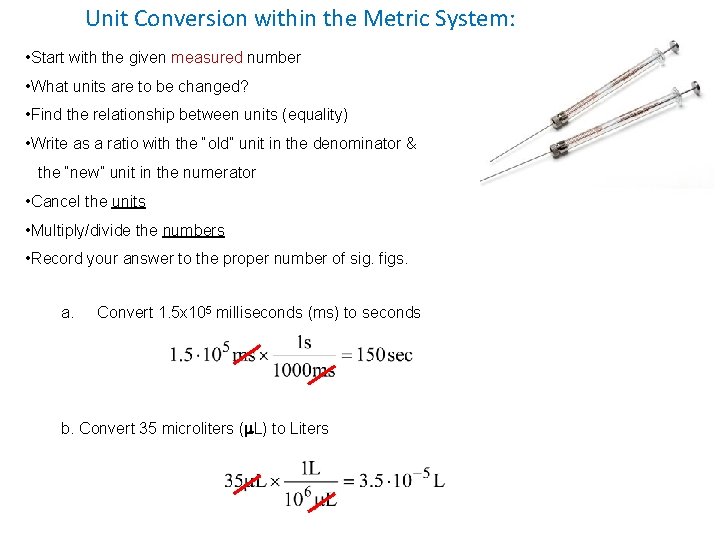
Unit Conversion within the Metric System: • Start with the given measured number • What units are to be changed? • Find the relationship between units (equality) • Write as a ratio with the “old” unit in the denominator & the “new” unit in the numerator • Cancel the units • Multiply/divide the numbers • Record your answer to the proper number of sig. figs. a. Convert 1. 5 x 10⁵ milliseconds (ms) to seconds b. Convert 35 microliters ( L) to Liters
Unit Conversion within the Metric System: c. Convert 2130 decagrams (dag) to kilograms (kg) d. Convert 2130 decigrams (dg) to kilograms (kg) (d-)deci ← gram → deca (da-) 10 -1 ← gram → 101 So 1 dag = 10 g or 1 g = 0. 1 dag 1 dg = 0. 1 g or 1 g = 10 dg
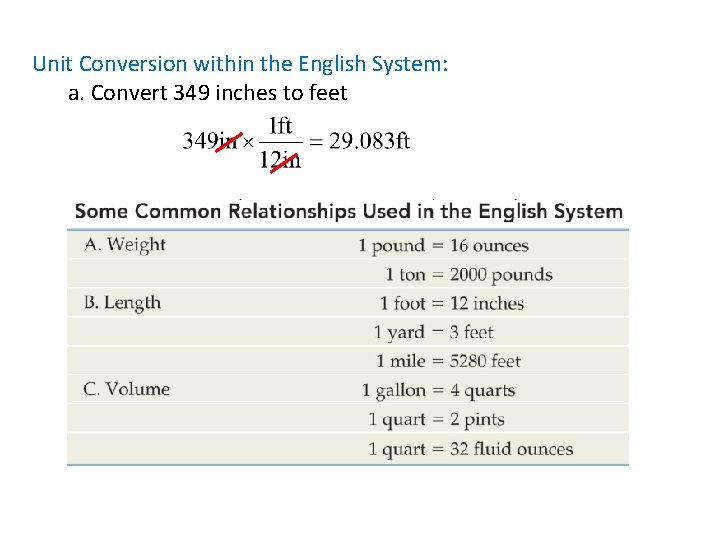
Unit Conversion within the English System: a. Convert 349 inches to feet
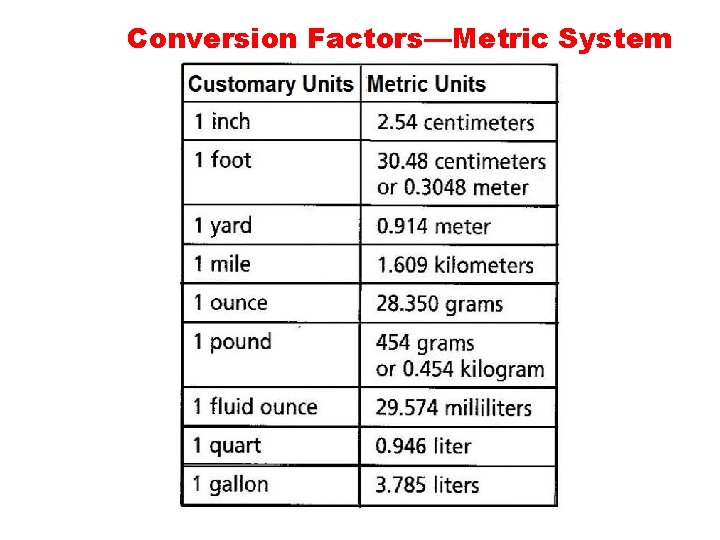
Conversion Factors—Metric System
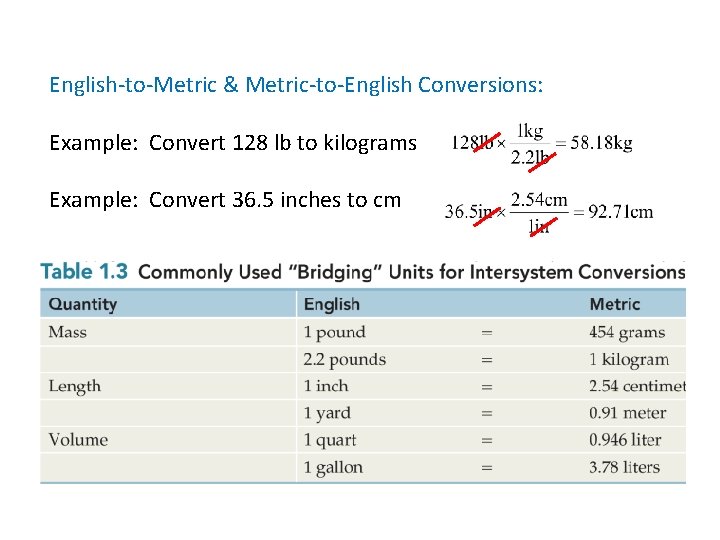
English-to-Metric & Metric-to-English Conversions: Example: Convert 128 lb to kilograms Example: Convert 36. 5 inches to cm
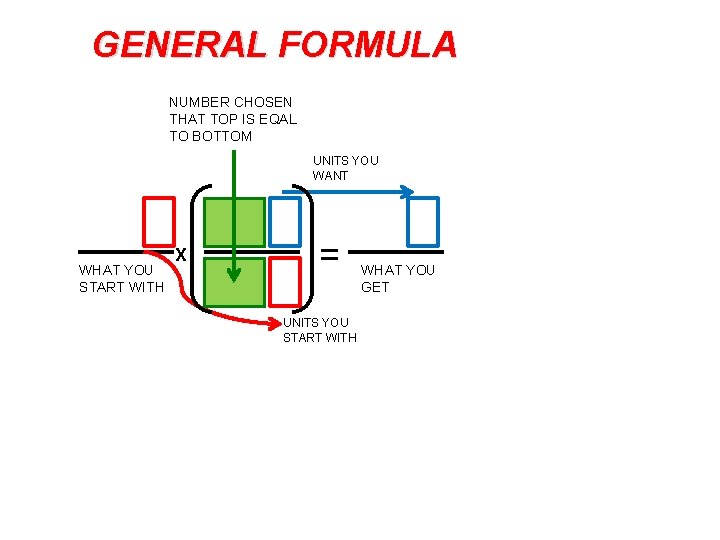
GENERAL FORMULA NUMBER CHOSEN THAT TOP IS EQAL TO BOTTOM UNITS YOU WANT WHAT YOU START WITH X = UNITS YOU START WITH WHAT YOU GET
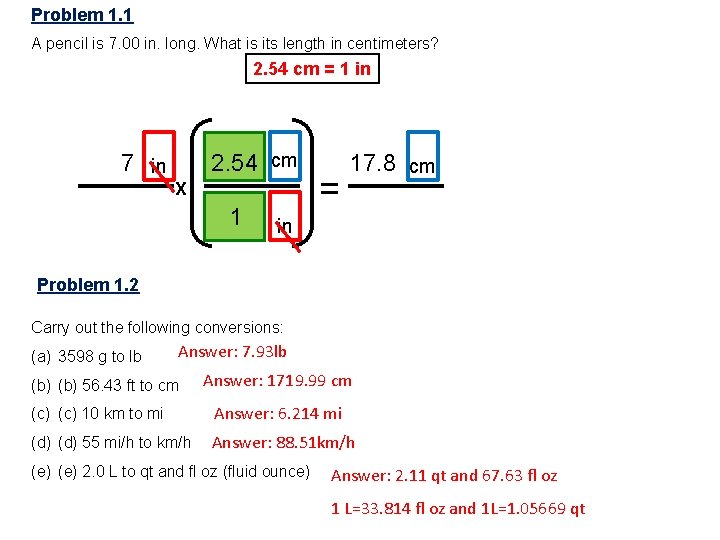
Problem 1. 1 A pencil is 7. 00 in. long. What is its length in centimeters? 2. 54 cm = 1 in 2. 54 cm 7 in X 1 = 17. 8 cm in Problem 1. 2 Carry out the following conversions: (a) 3598 g to lb Answer: 7. 93 lb (b) 56. 43 ft to cm Answer: 1719. 99 cm (c) 10 km to mi Answer: 6. 214 mi (d) 55 mi/h to km/h Answer: 88. 51 km/h (e) 2. 0 L to qt and fl oz (fluid ounce) Answer: 2. 11 qt and 67. 63 fl oz 1 L=33. 814 fl oz and 1 L=1. 05669 qt
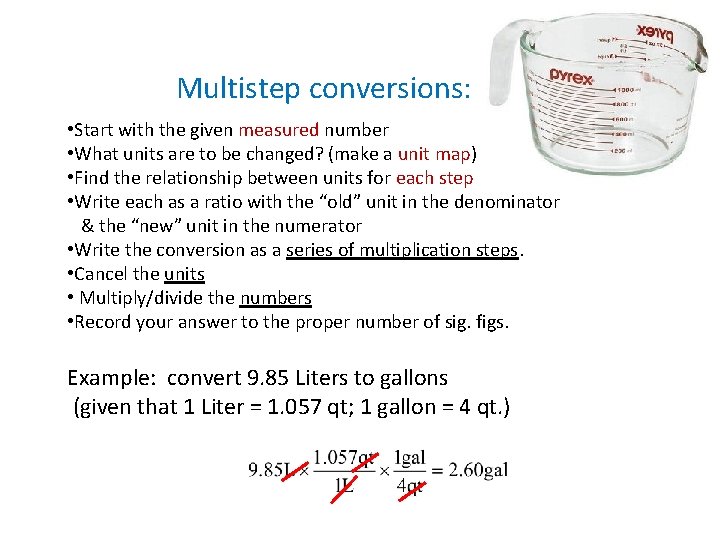
Multistep conversions: • Start with the given measured number • What units are to be changed? (make a unit map) • Find the relationship between units for each step • Write each as a ratio with the “old” unit in the denominator & the “new” unit in the numerator • Write the conversion as a series of multiplication steps. • Cancel the units • Multiply/divide the numbers • Record your answer to the proper number of sig. figs. Example: convert 9. 85 Liters to gallons (given that 1 Liter = 1. 057 qt; 1 gallon = 4 qt. )
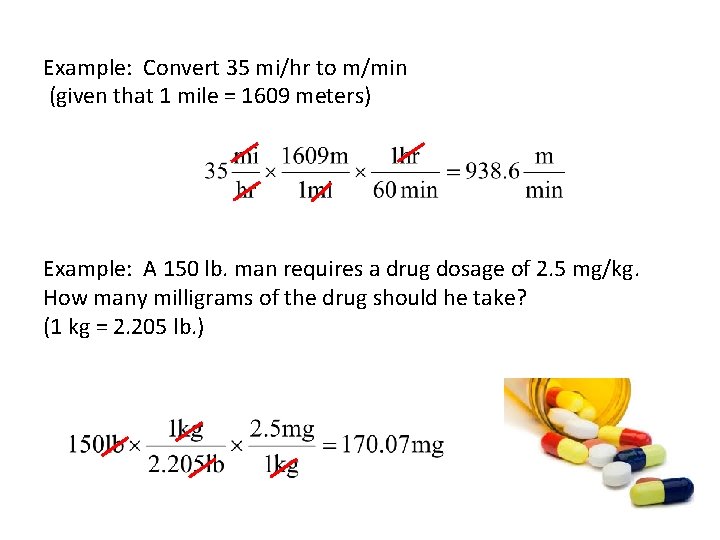
Example: Convert 35 mi/hr to m/min (given that 1 mile = 1609 meters) Example: A 150 lb. man requires a drug dosage of 2. 5 mg/kg. How many milligrams of the drug should he take? (1 kg = 2. 205 lb. )
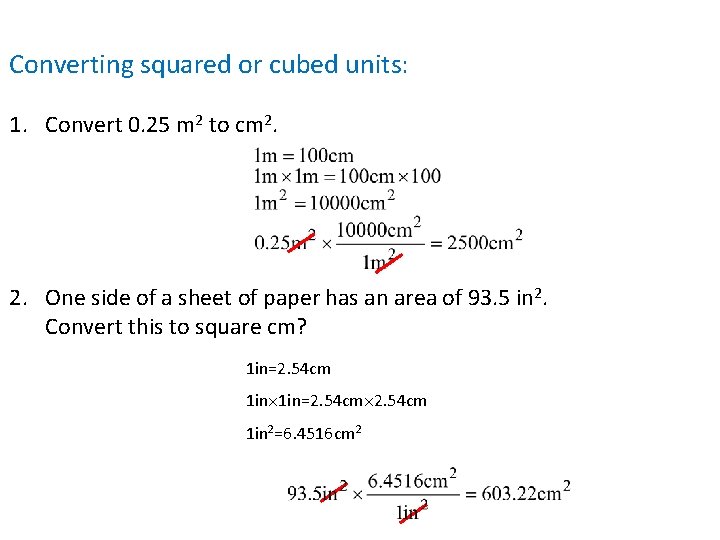
Converting squared or cubed units: 1. Convert 0. 25 m 2 to cm 2. One side of a sheet of paper has an area of 93. 5 in 2. Convert this to square cm? 1 in=2. 54 cm 1 in 2=6. 4516 cm 2
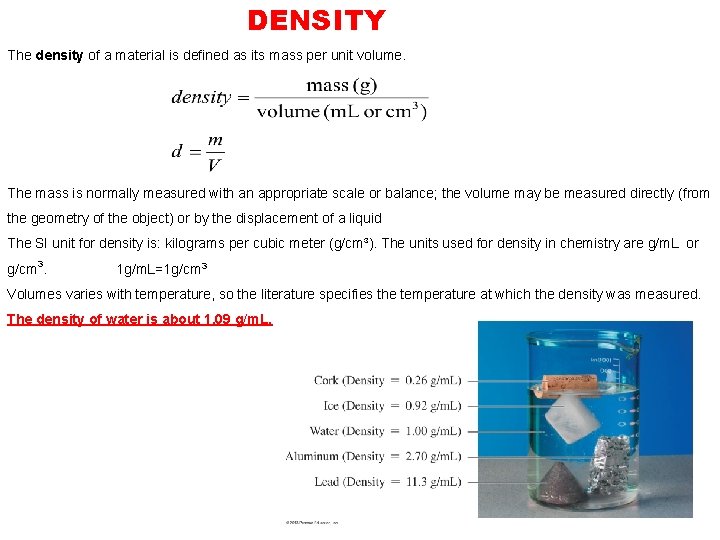
DENSITY The density of a material is defined as its mass per unit volume. The mass is normally measured with an appropriate scale or balance; the volume may be measured directly (from the geometry of the object) or by the displacement of a liquid The SI unit for density is: kilograms per cubic meter (g/cm³). The units used for density in chemistry are g/m. L or g/cm 3. 1 g/m. L=1 g/cm 3 Volumes varies with temperature, so the literature specifies the temperature at which the density was measured. The density of water is about 1. 09 g/m. L.
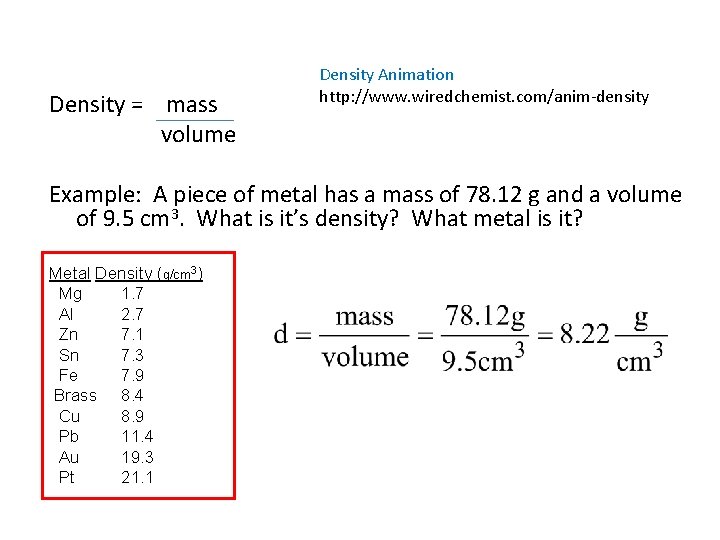
Density = mass volume Density Animation http: //www. wiredchemist. com/anim-density Example: A piece of metal has a mass of 78. 12 g and a volume of 9. 5 cm 3. What is it’s density? What metal is it? Metal Density (g/cm 3) Mg 1. 7 Al 2. 7 Zn 7. 1 Sn 7. 3 Fe 7. 9 Brass 8. 4 Cu 8. 9 Pb 11. 4 Au 19. 3 Pt 21. 1
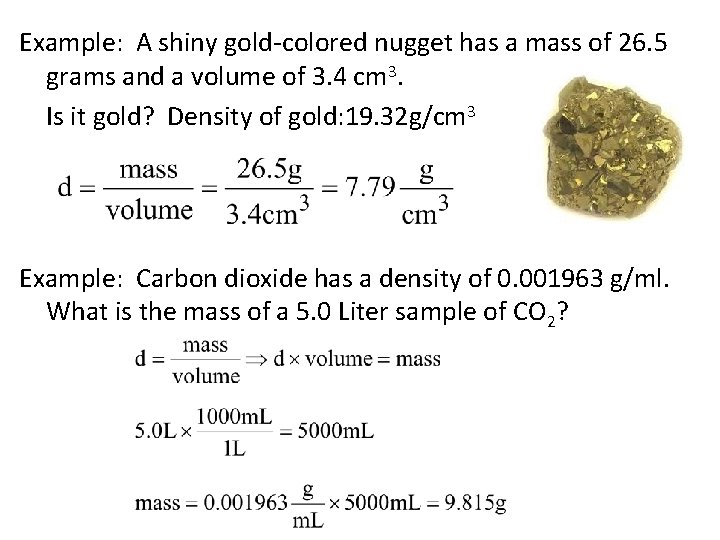
Example: A shiny gold-colored nugget has a mass of 26. 5 grams and a volume of 3. 4 cm 3. Is it gold? Density of gold: 19. 32 g/cm 3 Example: Carbon dioxide has a density of 0. 001963 g/ml. What is the mass of a 5. 0 Liter sample of CO 2?
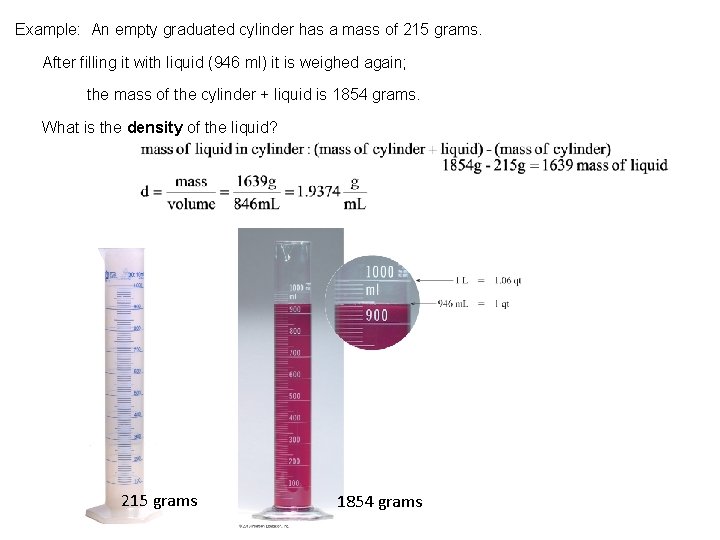
Example: An empty graduated cylinder has a mass of 215 grams. After filling it with liquid (946 ml) it is weighed again; the mass of the cylinder + liquid is 1854 grams. What is the density of the liquid? 215 grams 1854 grams
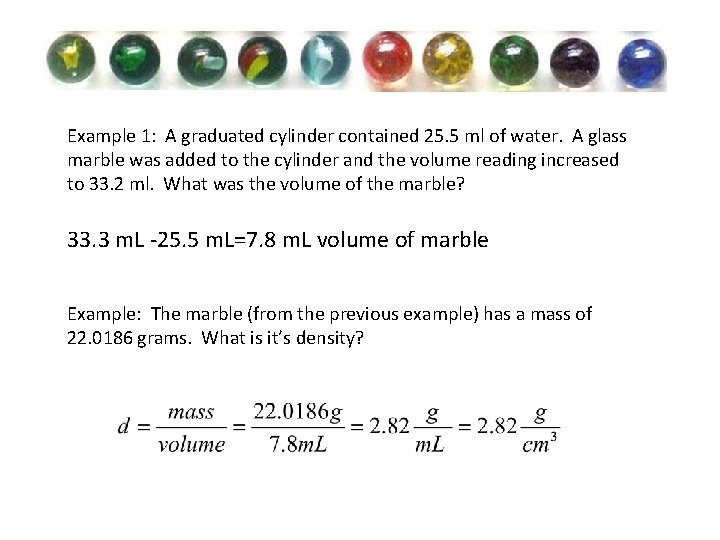
Example 1: A graduated cylinder contained 25. 5 ml of water. A glass marble was added to the cylinder and the volume reading increased to 33. 2 ml. What was the volume of the marble? 33. 3 m. L -25. 5 m. L=7. 8 m. L volume of marble Example: The marble (from the previous example) has a mass of 22. 0186 grams. What is it’s density?
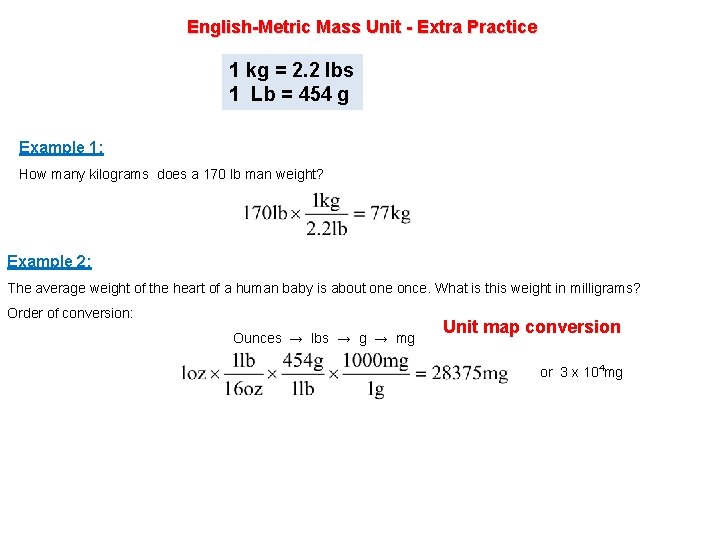
English-Metric Mass Unit - Extra Practice 1 kg = 2. 2 lbs 1 Lb = 454 g Example 1: How many kilograms does a 170 lb man weight? Example 2: The average weight of the heart of a human baby is about one once. What is this weight in milligrams? Order of conversion: Ounces → lbs → g → mg Unit map conversion or 3 x 10⁴ mg
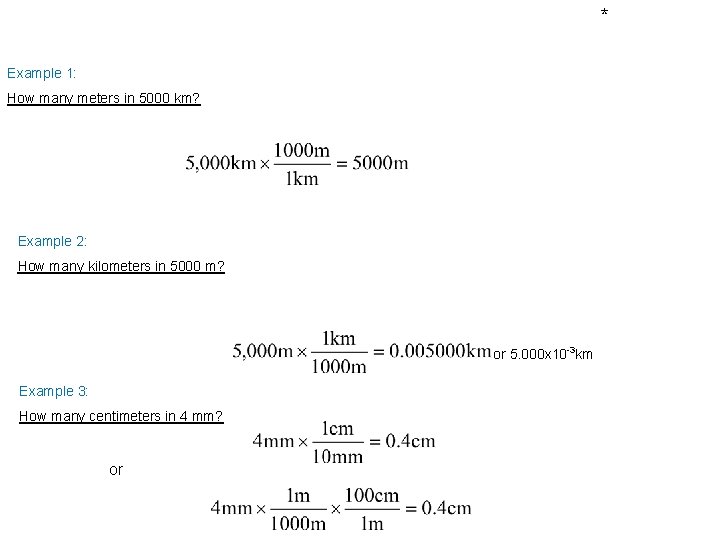
* Example 1: How many meters in 5000 km? Example 2: How many kilometers in 5000 m? or 5. 000 x 10 -3 km Example 3: How many centimeters in 4 mm? or
Laws of exponents: https: //www. mathsisfun. com/exponent. html https: //www. khanacademy. org/math/pre-algebra-exponentsradicals/pre-algebra-exponents/v/introduction-to-exponents http: //www. math. com/school/subject 2/lessons/S 2 U 2 L 2 DP. html Scientific notation: http: //www. chemteam. info/Sig. Figs/Scientific-Notation. html https: //www. chem. fsu. edu/chemlab/chm 1020 c/lecture%202/04. php http: //www. dummies. com/education/math/algebra/how-to-writenumbers-in-scientific-notation/ Multiplying and dividing in scientific notation: Multiplying & dividing in scientific notation (video) | Khan Academy https: //www. khanacademy. org/math/pre-algebra-exponents -radicals/pre-algebra-computing-scientific-notation/v/multiplying-anddividing-in-scientific-notation