Chapter 9 Care Coordination and Continuity in Health
- Slides: 35
Chapter 9 Care Coordination and Continuity in Health Care Settings and the Community Copyright © 2011 Wolters Kluwer Health | Lippincott Williams & Wilkins
Role of the Nurse in Community-Based Care • Provide continuity of care when patient moves from one level of care to another or from one setting to another. • Provide interventions to promote health. • Manage acute or chronic illness. • Promote self-care. Copyright © 2015 Wolters Kluwer • All Rights Reserved
Qualities of the Community-Based Nurse • Knowledgeable and skilled • Independent in making decisions • Accountable Copyright © 2015 Wolters Kluwer • All Rights Reserved
Roles of the Community-Based Nurse • Patient advocate • Coordinator of services • Patient and family educator Copyright © 2015 Wolters Kluwer • All Rights Reserved
Continuity of Care • Process by which health care providers give appropriate, uninterrupted care and facilitate the patient’s transition between different settings and levels of care • Ensures a smooth transition between ambulatory or acute care and home health care or other types of health care settings in the patient’s community. • Depends on excellent communication as patients move from one caregiver or health care site to another. Copyright © 2015 Wolters Kluwer • All Rights Reserved
ISBARQ Method of Patient Hand-off • I – Introduction • S – Situation • B - Background • A – Assessment • R – Recommendation • Q - Question and answer Copyright © 2015 Wolters Kluwer • All Rights Reserved
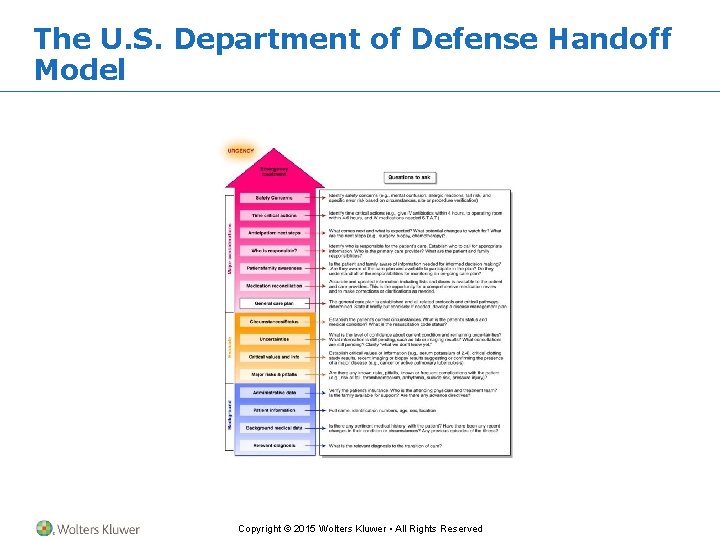
The U. S. Department of Defense Handoff Model Copyright © 2015 Wolters Kluwer • All Rights Reserved
Question A nurse is handing off a patient to a nurse in an extendedcare facility using the ISBARQ framework of communication. Which step is performed correctly? A. The nurse introduces the patient to the new nurse. B. The nurse discusses the patient’s background. C. The nurse assesses the patient’s vital signs. D. The nurse questions the patient about comfort level. Copyright © 2015 Wolters Kluwer • All Rights Reserved
Answer B. The nurse discusses the patient’s background. Rationale: During ISBARQ, the nurse initiates introductions for the people involved in the handoff, explains the patient situation and background, gives the current provider’s assessment of the situation, identifies pending lab results and what needs to be done over the next few hours, and provides an opportunity for questions and answers. Copyright © 2015 Wolters Kluwer • All Rights Reserved
Care Coordination • Care transition: a continuous process in which a patient's care shifts from being provided in one setting of care to another • Central responsibility of all health care professionals, and especially nurses • Aim: – Link patients with resources in the community to enhance their well-being – Improve information exchange – Reduce fragmentation and duplication of services Copyright © 2015 Wolters Kluwer • All Rights Reserved
Vulnerable Populations • People with disabilities or multiple chronic conditions • People with mental illnesses or substance abuse • Cultural, racial and ethnic minorities • The rural and urban poor (poverty and homelessness) • Undocumented immigrants Copyright © 2015 Wolters Kluwer • All Rights Reserved
Establishing an Effective Nurse–Patient Relationship • Reduce anxiety through therapeutic communication, teaching, and acceptance. • Remember that the patient has concerns and needs other than medical ones. • Communicate with the patient as an individual. • Take time to learn about the patient being admitted. • Provide for family participation in all aspects of care. Copyright © 2015 Wolters Kluwer • All Rights Reserved
Question Tell whether the following statement is true or false. In same-day surgery clinics, screening tests and teaching take place upon admission to the clinic. A. True B. False Copyright © 2015 Wolters Kluwer • All Rights Reserved
Answer: B. False Rationale: In same-day surgery clinics, screening tests and teaching take place prior to admission to the clinic. Copyright © 2015 Wolters Kluwer • All Rights Reserved
Admission to Ambulatory Care Setting • Patient receives health care services but does not remain overnight. • In most offices and clinics, patients complete a short health history. • In same-day surgery facilities, screening tests, teaching, and admission take place before patients enter the setting. Copyright © 2015 Wolters Kluwer • All Rights Reserved
Admission to the Hospital • Admission sheet becomes part of the medical record. • Bracelet is placed on wrist of patient. • A nursing interview and physical assessment are conducted. • A room is prepared for patient. Copyright © 2015 Wolters Kluwer • All Rights Reserved
Information Obtained on the Admission Sheet • Name, address, and date of birth of patient • Gender and marital status • Name of admitting physician • Name of nearest relative • Occupation and employer • Financial status for health care payment • Religious preference • Date and time of admission/admitting diagnosis • Identification number Copyright © 2015 Wolters Kluwer • All Rights Reserved
Preparing a Room for a Patient • Position and open the bed. • Assemble necessary equipment and supplies. • Assemble special equipment and supplies. • Adjust the physical environment of the room. Copyright © 2015 Wolters Kluwer • All Rights Reserved
Transfer Within Hospital Setting • Move patient’s personal belongs to a new room. • Transfer patient chart, Kardex, care plan, and medications. • Notify other hospital departments of the move. • Give verbal report to the nurse in the new area. Copyright © 2015 Wolters Kluwer • All Rights Reserved
Information Included in Verbal Report • Patient name and age • Physicians and admitting diagnosis • Surgical procedure, if applicable • Current condition and manifestation • Allergies, medications, and treatments • Necessary laboratory data and special equipment • Nursing care priorities • Existence of advance directives Copyright © 2015 Wolters Kluwer • All Rights Reserved
Question Tell whether the following statement is true or false. When transferring a patient to a long-term care facility, the original chart, which is a legal document, remains at the hospital. A. True B. False Copyright © 2015 Wolters Kluwer • All Rights Reserved
Answer: A. True Rationale: When transferring a patient to a long-term care facility, the original chart, which is a legal document, remains at the hospital. Copyright © 2015 Wolters Kluwer • All Rights Reserved
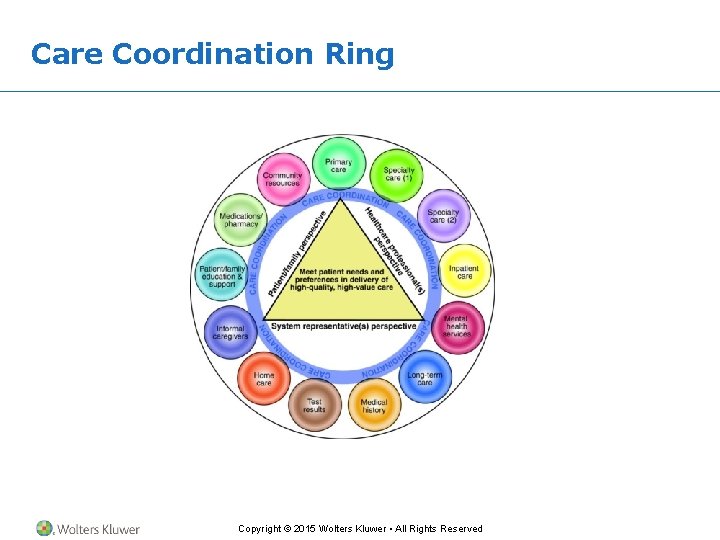
Care Coordination Ring Copyright © 2015 Wolters Kluwer • All Rights Reserved
Transferring a Patient to a Long-Term Facility • A copy of the medical record is usually sent with the patient. – The original record, which is a legal document, remains at the hospital. • Detailed assessment and care plan is sent. • Patient’s belongings, prescriptions, and appointment cards are sent to the facility with the patient. • The nurse often provides a verbal report to the new nurse. Copyright © 2015 Wolters Kluwer • All Rights Reserved
Essential Components of Discharge Planning • Assess strengths and limitations of the patient, family, or support person. • Assess the environment. • Implement and coordinate the plan of care. • Consider individual, family, and community resources. • Evaluate effectiveness of care. Copyright © 2015 Wolters Kluwer • All Rights Reserved
Question Tell whether the following statement is true or false. Planning for discharge begins when the patient receives discharge orders from the physician in charge of care. A. True B. False Copyright © 2015 Wolters Kluwer • All Rights Reserved
Answer: B. False Rationale: Planning for discharge begins on admission when information about the patient is collected and documented. Copyright © 2015 Wolters Kluwer • All Rights Reserved
Criteria for Formal Discharge Plan and Referrals • Lack of knowledge of treatment plan • Social isolation • Recently diagnosed chronic disease • Major surgery • Prolonged recuperation • Emotional or mental instability • Complex home health care regimen • Financial difficulties • Lack of available or appropriate referral sources • Terminal illness Copyright © 2015 Wolters Kluwer • All Rights Reserved
Guidelines for Discharge Planning • Assess and identify health care needs. • Set goals with patient. • Teach patient and family. • Provide home health care referrals. • Evaluate discharge planning effectiveness. Copyright © 2015 Wolters Kluwer • All Rights Reserved
Question Which statement accurately describes part of the process involved when a patient leaves AMA? A. The patient is not legally free to leave without being discharged. B. The patient leaving AMA must sign a form releasing the nurse from legal responsibility for health status. C. After signing the form, the patient should be informed of any possible risks involved with leaving AMA. D. The patient’s signature must be witnessed, and the form becomes part of the patient’s record. Copyright © 2015 Wolters Kluwer • All Rights Reserved
Answer: D. The patient’s signature must be witnessed, and the form becomes part of the patient’s record. Rationale: A patient is legally free to leave the hospital against medical advice (AMA). The patient must sign a form releasing the physician and health care institution from legal responsibility and should be informed of any risks prior to signing the form. Copyright © 2015 Wolters Kluwer • All Rights Reserved
Leaving AMA • Patient is legally free to leave. • Choice carries a risk for increased illness or complications. • Patient must sign a release form. • Patient is informed of risks prior to signing form. • Patient’s signature must be witnessed. • Form becomes part of medical record. Copyright © 2015 Wolters Kluwer • All Rights Reserved
Types of Home Health Care Agencies • Official or public agencies • Voluntary or private not-for-profit agencies • Private, proprietary agencies • Institution-based agencies Copyright © 2015 Wolters Kluwer • All Rights Reserved
Examples of Home Health Care Services • High-technology pharmacy services • Skilled professional/paraprofessional services • Custodial services • Home medical services • Community support services Copyright © 2015 Wolters Kluwer • All Rights Reserved
Phases of the Home Visit • Pre-entry phase – The referral nurse collects patient data. – The nurse reviews the data and schedules visit. – The nurse evaluates safety issues. • Entry phase – The nurse identifies needs and determines interventions. – The nurse teaches the patient and caregivers. – The nurse documents care given in the home. Copyright © 2015 Wolters Kluwer • All Rights Reserved