
Understanding HCC Coding in Homebased Primary Care RICHARD
Understanding HCC Coding in Home-based Primary Care RICHARD O. SCHAMP MD CHIEF EXECUTIVE OFFICER GEORGE W. BRETT MD CHIEF MEDICAL OFFICER ©AAHCM 1

Presenter: Richard Schamp, MD Family Medicine & Geriatrics x 30 yrs (rural PA with active home care practice, then urban St. Louis) • Clinical Professor of FM & Geriatrics at Saint Louis University School of Medicine – started home visit program for residents & students • Medical Director experience: Hospice, Home Health, Long Term Care and PACE Disclosures • CEO of Capstone Performance Systems -- support organizations/providers that care for vulnerable patients • Risk Adjustment training for providers, Managed Care & PACE organizations x 10 yrs • ©AAHCM 2

©AAHCM 3
Objectives for Today • • Discuss the Risk Adjustment methodology and relevance to home-based primary care practice Understand how complete and accurate documentation and coding supports good patient care Introduction to Official Coding Guidelines and comments on ICD-10 Tips for accurate and complete documentation and coding of common conditions seen in typical home-based primary care practice ©AAHCM 4

Disclaimer • NEVER submit false data or data (codes) that are not supported by documentation • ALWAYS seek to be complete and accurate • NEVER attempt to game the system • ALWAYS attempt to systemize your game Honesty is the best Policy ©AAHCM 5
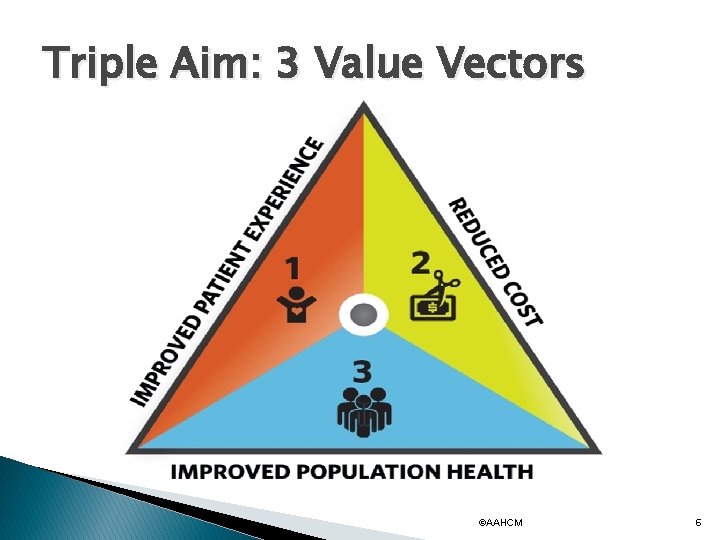
Triple Aim: 3 Value Vectors ©AAHCM 6
Quality vs. Quantity � Value-based compensation � Healthcare is shifting from FFS model to pay -for-performance methods � Payers will reward value and care coordination- rather than volume and duplication � HHS testing and expanding new healthcare payment models ©AAHCM 7
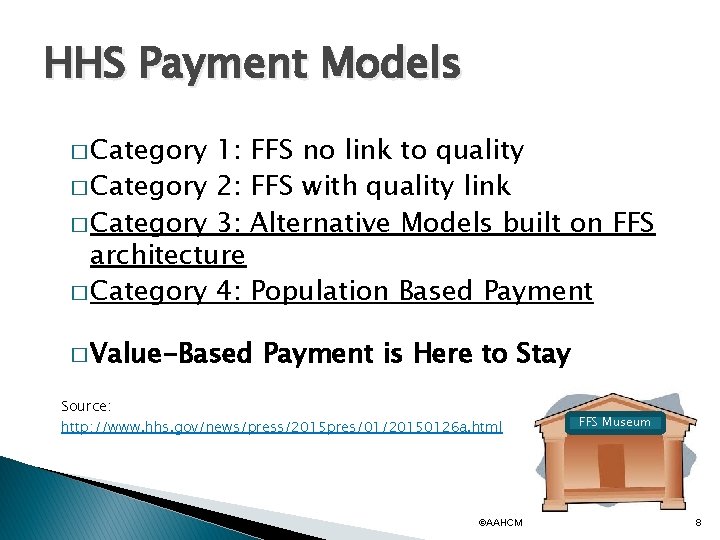
HHS Payment Models � Category 1: FFS no link to quality � Category 2: FFS with quality link � Category 3: Alternative Models built on FFS architecture � Category 4: Population Based Payment � Value-Based Payment is Here to Stay Source: http: //www. hhs. gov/news/press/2015 pres/01/20150126 a. html ©AAHCM FFS Museum 8
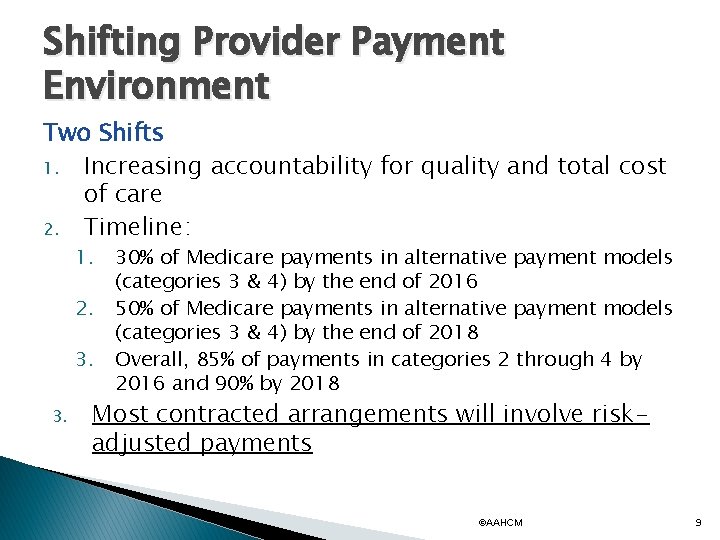
Shifting Provider Payment Environment Two Shifts 1. Increasing accountability for quality and total cost of care 2. Timeline: 1. 2. 3. 3. 30% of Medicare payments in alternative payment models (categories 3 & 4) by the end of 2016 50% of Medicare payments in alternative payment models (categories 3 & 4) by the end of 2018 Overall, 85% of payments in categories 2 through 4 by 2016 and 90% by 2018 Most contracted arrangements will involve riskadjusted payments ©AAHCM 9
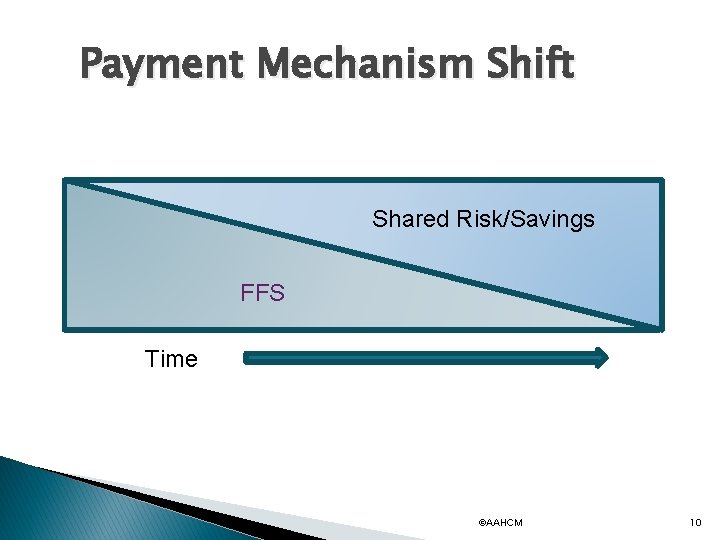
Payment Mechanism Shift Shared Risk/Savings FFS Time ©AAHCM 10

How does this make you feel so far? ©AAHCM 11
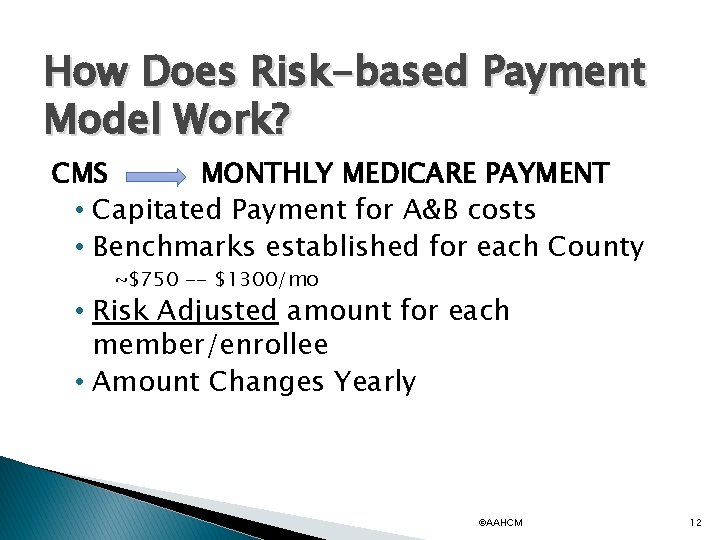
How Does Risk-based Payment Model Work? CMS MONTHLY MEDICARE PAYMENT • Capitated Payment for A&B costs • Benchmarks established for each County ~$750 -- $1300/mo • Risk Adjusted amount for each member/enrollee • Amount Changes Yearly ©AAHCM 12
Significance to Providers • Traditional: seriousness and severity of patient care indicated by E&M CPT® codes • Higher level E&M codes identify serious encounters • utilizing more medical decision making • reimbursed at a higher rate • In Risk Adjustment scenarios, these CPT® codes have no significance • Instead, diagnosis codes communicate the seriousness of medical decision-making Risk-adjusted Plans are paid based on ICD-9 Codes, based on DIAGNOSES, not on procedures. ©AAHCM 13
Significance to Providers � Documenting involves three main points: ① Identify diagnosis as a current problem as opposed to a previous condition ② Choose specific ICD-9 diagnosis code and ③ Support the diagnosis fully by documentation ©AAHCM 14
ICD-9 (10) is its own Language • • Medicare pays based on severity of illness for each enrollee ICD-9 is the specific language that is used to inform CMS the extent and severity of disease present • Like any language, ICD-9 must be spoken properly. • Failure to document and code correctly can lead to ◦ underpayment for your plan; i. e. , Lost Revenue ◦ overpayment and violations of the False Claims Act ©AAHCM 15

Risk Adjustment and The False Claims Act � The False Claims Act prohibits: a) knowingly presenting (or causing to be presented) to the federal government a false or fraudulent claim for payment or approval; and b) knowingly concealing or knowingly and improperly avoiding or decreasing an obligation to pay or transmit money or property to the Government. 31 U. S. C. § 3729(a)(1) ©AAHCM 16

The False Claims Act • Any person who violates the FCA is liable for a civil penalty of up to $11, 000 for each violation, plus three times the amount of the damages sustained by the United States. 31 U. S. C. § 3729(a)(1) ©AAHCM 17
Improper Upcoding • • • Coding from a problem list (not current problems) Submitting diagnoses (e. g. cachexia) with no support in medical records for existence in that year. Claiming current treatment for conditions better characterized by “history of. ” (e. g. acute stroke) Submitting diagnostic codes from Labs/Radiology Rpts/Rx’s without further documentation Improperly linking complications and conditions to increase risk score (e. g. linking diabetes and CKD without proper documentation) • Targeted Coding: Pressuring coders to focus on high value diagnoses (e. g. malnutrition, Major Depression) ©AAHCM 18
ICD-10 • The ICD-10 transition date is October 1, 2015. Get ready now for ICD-10. • You don’t have to use 68, 000 codes. As you do now, your practice will use a very small subset of the codes. • You will look up ICD-10 codes just like you look up ICD-9. Alphabetic index and electronic tools available to help with code selection. • Outpatient procedure codes aren’t changing. Transition to ICD-10 does not affect the use of CPT for outpatient coding. • All FFS providers can conduct testing before ICD-10 transition. Contact Medicare Administrative Contractor for details about testing plans. ©AAHCM 19
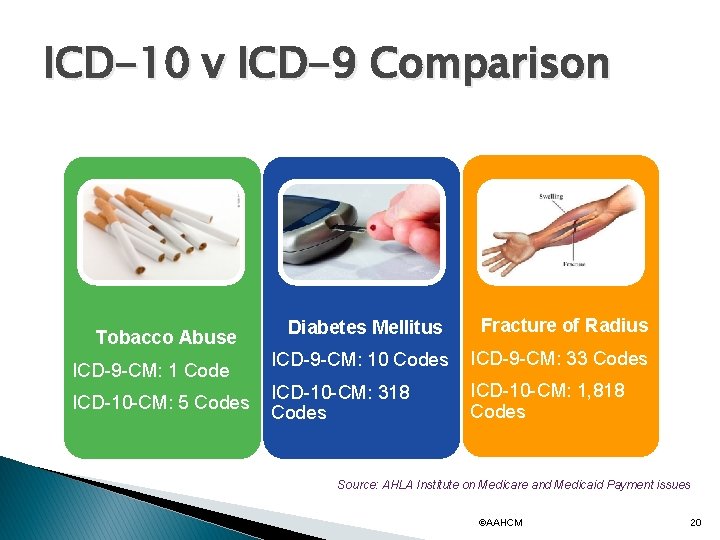
ICD-10 v ICD-9 Comparison Tobacco Abuse ICD-9 -CM: 1 Code ICD-10 -CM: 5 Codes Diabetes Mellitus Fracture of Radius ICD-9 -CM: 10 Codes ICD-9 -CM: 33 Codes ICD-10 -CM: 318 Codes ICD-10 -CM: 1, 818 Codes Source: AHLA Institute on Medicare and Medicaid Payment issues ©AAHCM 20
Coder’s Employment Relief Act? � Between ICD-10 and the changes associated with changing payment models, medical coding has never been more valuable. � Should your practice use a coder? ◦ Depends on provider interest, skills and time ◦ Out-sourcing coder is an option ◦ Fresh models bring fresh scrutiny – compliance with rules and regulations supported by coder/audits ©AAHCM 21

“Close Enough for Gummint Work” Doesn’t Cut it Anymore ©AAHCM 22
Under the Hood of RA � How does the Risk Adjustment Model work? � What are the key characteristics of the Model? � How is a risk score calculated? � How much impact does a risk score have? � How does incomplete documentation affect it? ©AAHCM 23
Big Picture of Risk Adjustment • • RA is a mathematical model designed for more accurate payments to Medicare Advantage and other capitated health plans Payment based upon health status of enrollees plus demographic data. Designed to predict illness costs covered by Parts A and B (Part C) Sicker members generate higher payments (to cover the costs of care) ©AAHCM 24
Big Picture of Risk Adjustment • • In March 2002, CMS chose CMS Hierarchical Condition Category Model (“CMS-HCC Model”) groups similar serious chronic medical conditions with similar costs of treatment into Hierarchical Condition Categories (HCCs), each with a “risk score” RA methodology has two inputs: ◦ Demographics ◦ Diagnoses • • One output = HCCs (driving risk scores) MA Plans and most other models (except PACE / ESRD) use Version 22 (79 HCCs) for 2016 payments ©AAHCM 25
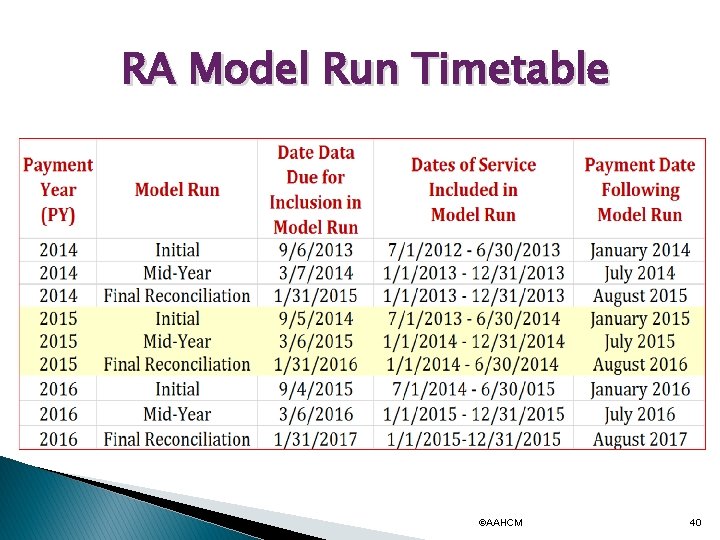
CMS HCC Model is Prospective • • CURRENT demographics and diagnoses predict FUTURE expenses. Ultimately, payment in a given year is based on diagnoses submitted the PREVIOUS year. ICD-9 codes for dates of service in CY 2015 will be basis of payment in CY 2016 (Health Exchanges use a concurrent model. ) ©AAHCM 26
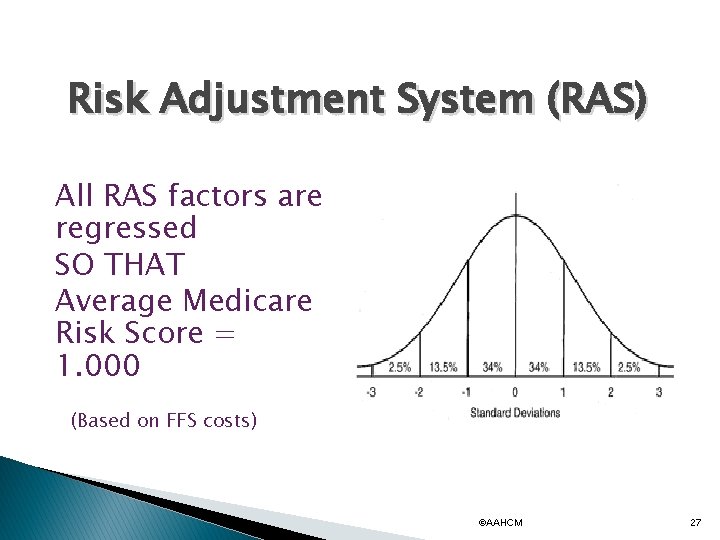
Risk Adjustment System (RAS) All RAS factors are regressed SO THAT Average Medicare Risk Score = 1. 000 (Based on FFS costs) ©AAHCM 27
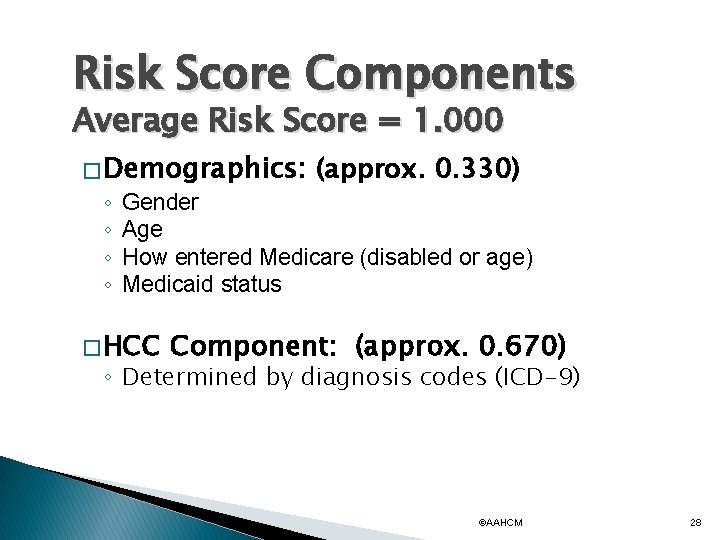
Risk Score Components Average Risk Score = 1. 000 � Demographics: ◦ ◦ (approx. 0. 330) Gender Age How entered Medicare (disabled or age) Medicaid status � HCC Component: (approx. 0. 670) ◦ Determined by diagnosis codes (ICD-9) ©AAHCM 28
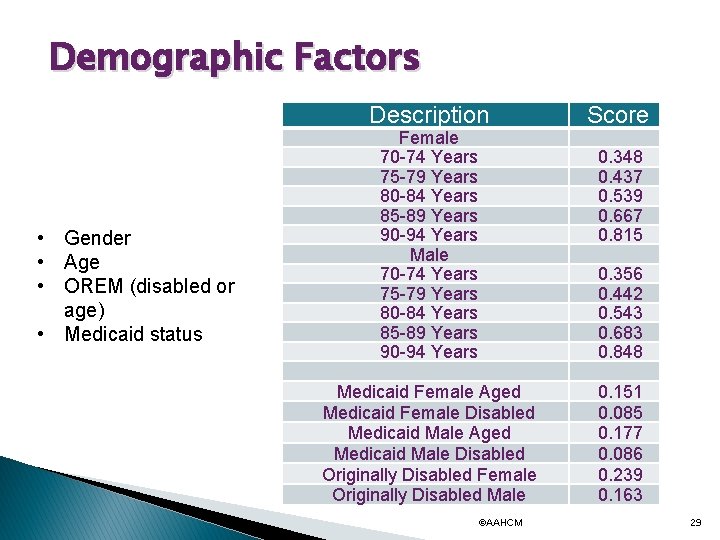
Demographic Factors Description • Gender • Age • OREM (disabled or age) • Medicaid status Female 70 -74 Years 75 -79 Years 80 -84 Years 85 -89 Years 90 -94 Years Medicaid Female Aged Medicaid Female Disabled Medicaid Male Aged Medicaid Male Disabled Originally Disabled Female Originally Disabled Male ©AAHCM Score 0. 348 0. 437 0. 539 0. 667 0. 815 0. 356 0. 442 0. 543 0. 683 0. 848 0. 151 0. 085 0. 177 0. 086 0. 239 0. 163 29
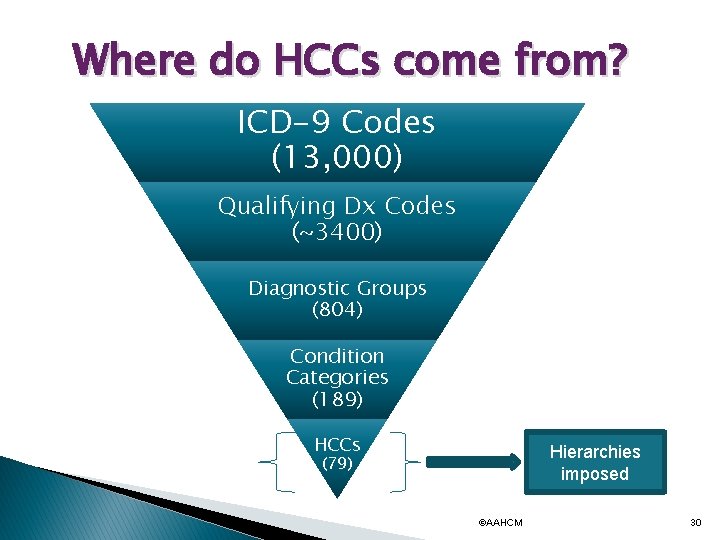
Where do HCCs come from? ICD-9 Codes (13, 000) Qualifying Dx Codes (~3400) Diagnostic Groups (804) Condition Categories (189) HCCs Hierarchies imposed (79) ©AAHCM 30
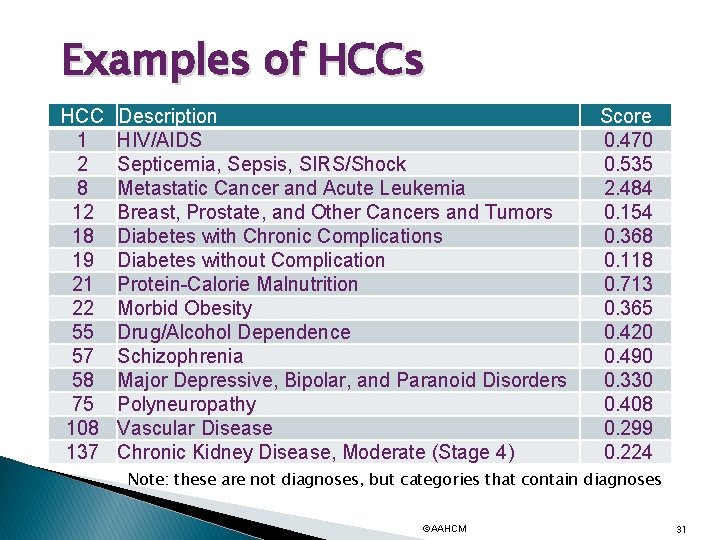
Examples of HCCs HCC 1 2 8 12 18 19 21 22 55 57 58 75 108 137 Description HIV/AIDS Septicemia, Sepsis, SIRS/Shock Metastatic Cancer and Acute Leukemia Breast, Prostate, and Other Cancers and Tumors Diabetes with Chronic Complications Diabetes without Complication Protein-Calorie Malnutrition Morbid Obesity Drug/Alcohol Dependence Schizophrenia Major Depressive, Bipolar, and Paranoid Disorders Polyneuropathy Vascular Disease Chronic Kidney Disease, Moderate (Stage 4) Score 0. 470 0. 535 2. 484 0. 154 0. 368 0. 118 0. 713 0. 365 0. 420 0. 490 0. 330 0. 408 0. 299 0. 224 Note: these are not diagnoses, but categories that contain diagnoses ©AAHCM 31
HCC Model Characteristics � Hierarchical ◦ Payment based on more severe form of disease when less severe form is also present in reporting period (e. g. , PVD vs PVD w/complications) � Interactive ◦ When certain diseases coexist, the model assigns additional payment to recognize higher morbidity and costs than just adding the separate conditions � Additive ◦ When unrelated diseases co-exist, the risk factors are added together The HCC model rewards: specificity and completeness ©AAHCM 32
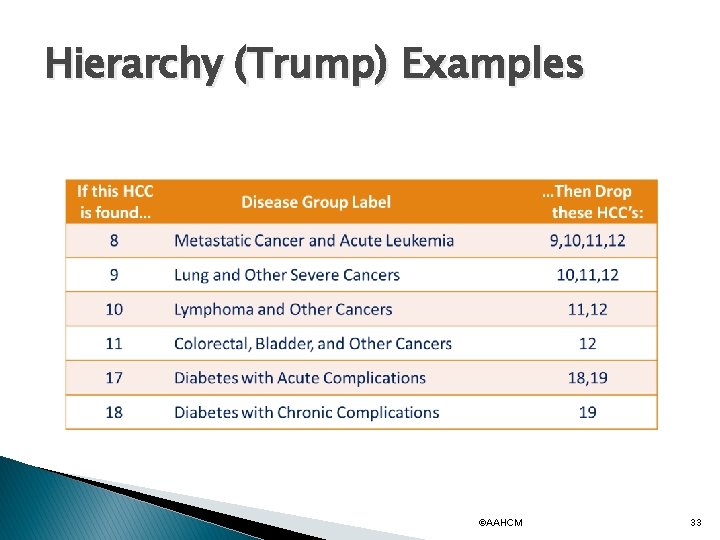
Hierarchy (Trump) Examples ©AAHCM 33
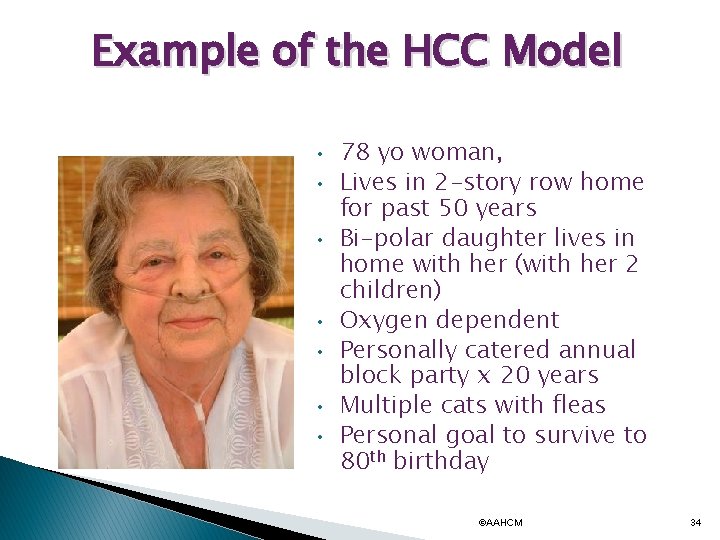
Example of the HCC Model • • 78 yo woman, Lives in 2 -story row home for past 50 years Bi-polar daughter lives in home with her (with her 2 children) Oxygen dependent Personally catered annual block party x 20 years Multiple cats with fleas Personal goal to survive to 80 th birthday ©AAHCM 34
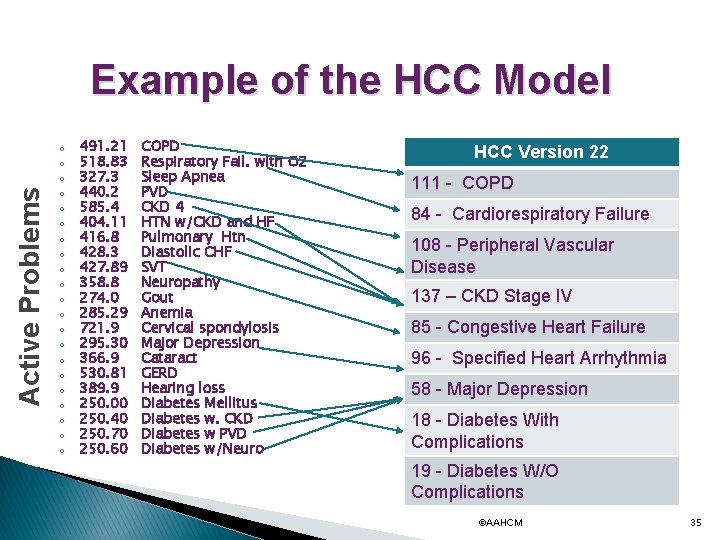
Example of the HCC Model Active Problems o o o o o o 491. 21 518. 83 327. 3 440. 2 585. 4 404. 11 416. 8 428. 3 427. 89 358. 8 274. 0 285. 29 721. 9 295. 30 366. 9 530. 81 389. 9 250. 00 250. 40 250. 70 250. 60 COPD Respiratory Fail. with O 2 Sleep Apnea PVD CKD 4 HTN w/CKD and HF Pulmonary Htn Diastolic CHF SVT Neuropathy Gout Anemia Cervical spondylosis Major Depression Cataract GERD Hearing loss Diabetes Mellitus Diabetes w. CKD Diabetes w PVD Diabetes w/Neuro HCC Version 22 111 - COPD 84 - Cardiorespiratory Failure 108 - Peripheral Vascular Disease 137 – CKD Stage IV 85 - Congestive Heart Failure 96 - Specified Heart Arrhythmia 58 - Major Depression 18 - Diabetes With Complications 19 - Diabetes W/O Complications ©AAHCM 35
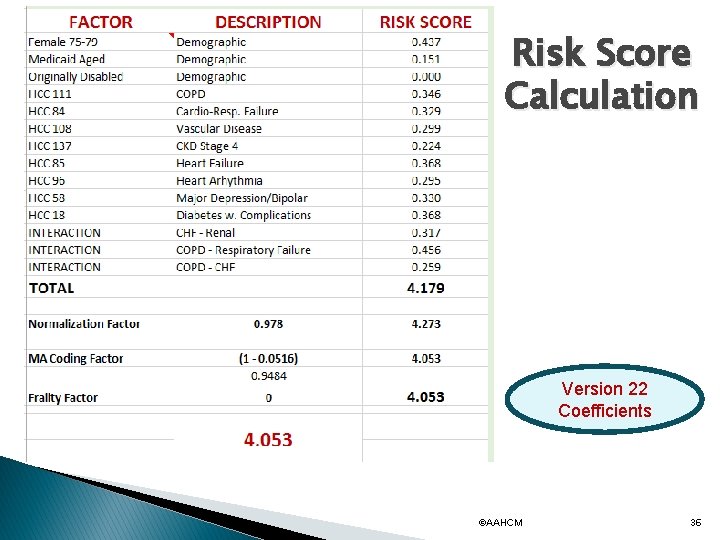
Risk Score Calculation Version 22 Coefficients ©AAHCM 36
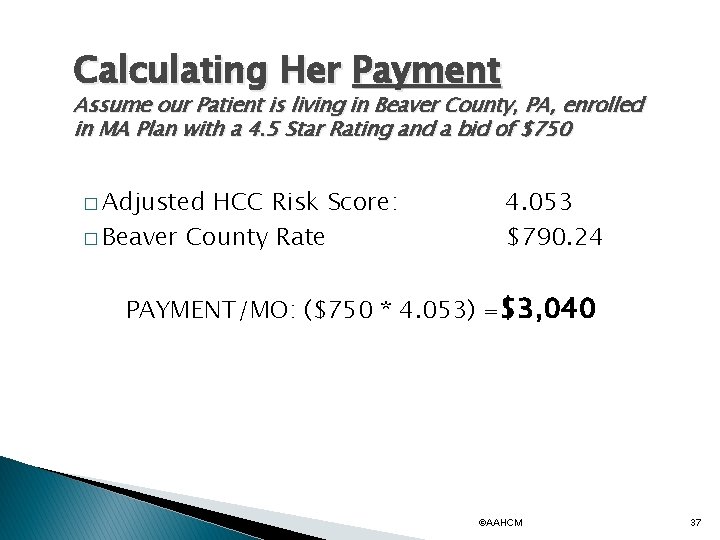
Calculating Her Payment Assume our Patient is living in Beaver County, PA, enrolled in MA Plan with a 4. 5 Star Rating and a bid of $750 � Adjusted HCC Risk Score: � Beaver County Rate 4. 053 $790. 24 PAYMENT/MO: ($750 * 4. 053) =$3, 040 ©AAHCM 37
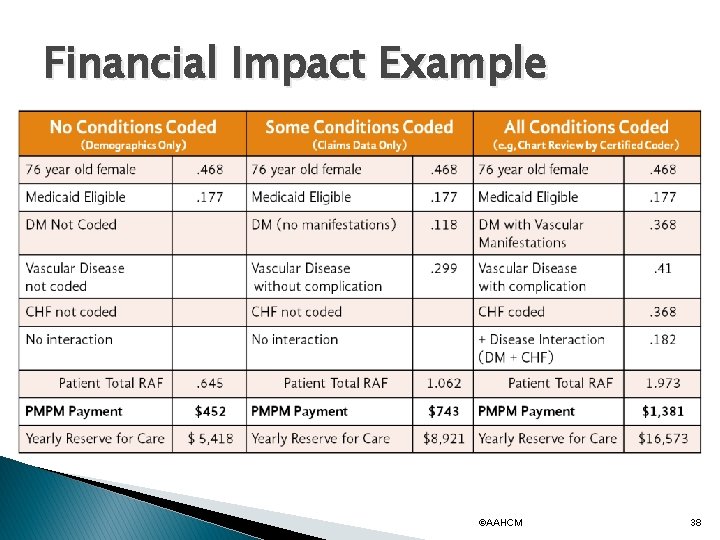
Financial Impact Example ©AAHCM 38
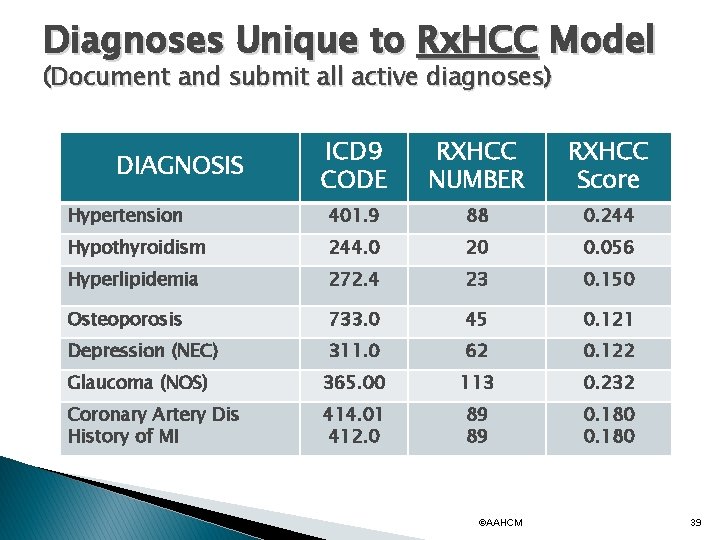
Diagnoses Unique to Rx. HCC Model (Document and submit all active diagnoses) ICD 9 CODE RXHCC NUMBER RXHCC Score Hypertension 401. 9 88 0. 244 Hypothyroidism 244. 0 20 0. 056 Hyperlipidemia 272. 4 23 0. 150 Osteoporosis 733. 0 45 0. 121 Depression (NEC) 311. 0 62 0. 122 Glaucoma (NOS) 365. 00 113 0. 232 Coronary Artery Dis History of MI 414. 01 412. 0 89 89 0. 180 DIAGNOSIS ©AAHCM 39
RA Model Run Timetable ©AAHCM 40
Practical Matter – need to submit ALL diagnoses/year � Only room for 4 codes on paper claim (or 8 if file electronically) � Key – maintain good active problem list and track which are submitted in calendar year � Annual assessment is another way – the MA plan collects the diagnoses on separate form and submits (no limit) � MA Plan may perform chart review and collect codes (no limit) ©AAHCM 41
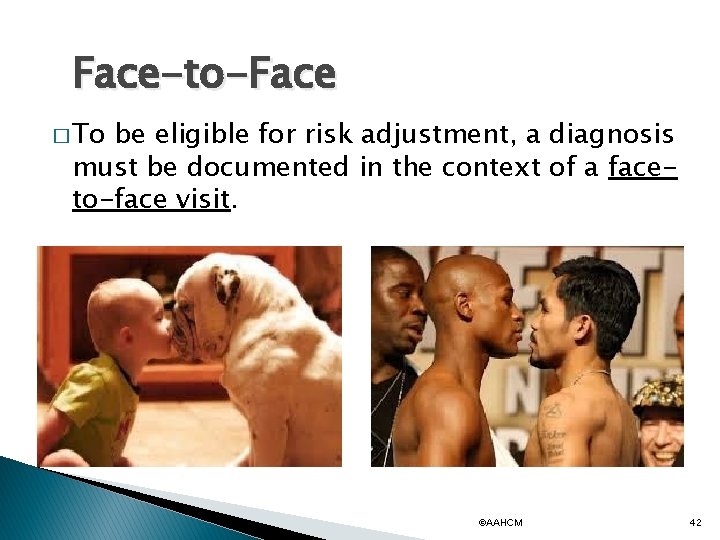
Face-to-Face � To be eligible for risk adjustment, a diagnosis must be documented in the context of a faceto-face visit. ©AAHCM 42
Documentation Guidelines � What are CMS expectations for medical records? � How do Official Coding Guidelines impact us? � Which common documentation pitfalls? ©AAHCM 43
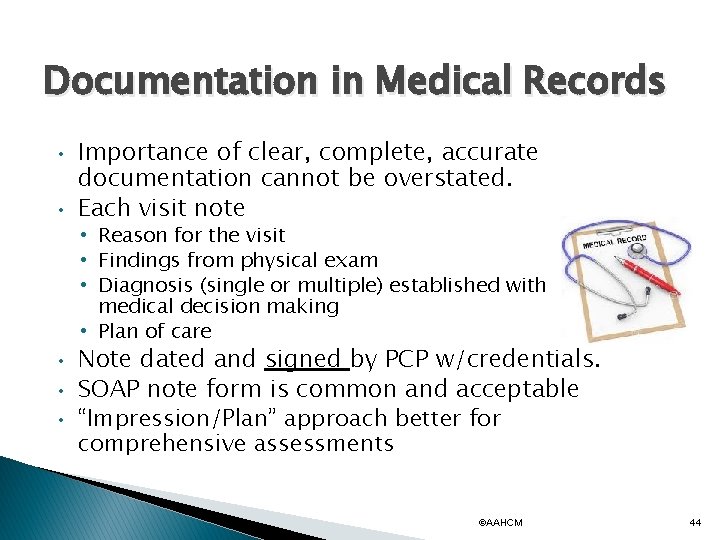
Documentation in Medical Records • • Importance of clear, complete, accurate documentation cannot be overstated. Each visit note • Reason for the visit • Findings from physical exam • Diagnosis (single or multiple) established with medical decision making • Plan of care • • • Note dated and signed by PCP w/credentials. SOAP note form is common and acceptable “Impression/Plan” approach better for comprehensive assessments ©AAHCM 44

Question 1 � The following assessment is found in a note: � What is/are the proper code(s) for the assessment above? a) b) c) d) 305. 1, 272. 4, 401. 9, 250. 00 272. 4, 401. 9 ©AAHCM 45
Answer 1 1. Answer: d) 401. 9 Rationale: � � The HTN is only code that can be obtained from this example. Positive history of smoking cannot translate to tobacco dependence (it must be stated), so 305. 1 is incorrect. Diabetes is questionable due to legibility, so not coded. The cholesterol is listed as “↑ chol”. (Cannot code from arrows) This example illustrates coding clinic rules on up and down arrows, illegible notes, and clinical documentation specificity. ©AAHCM 46
Problem Lists � Problem list should be maintained to include: ◦ Each condition and the start date. ◦ The end date if the condition no longer exists. ◦ The reason why the patient is disabled (Medicare beneficiary and under 65 years). Current (active) problem list important ◦ Other providers can know patient’s condition ◦ Reminder to address each chronic condition at least once a year ©AAHCM 47
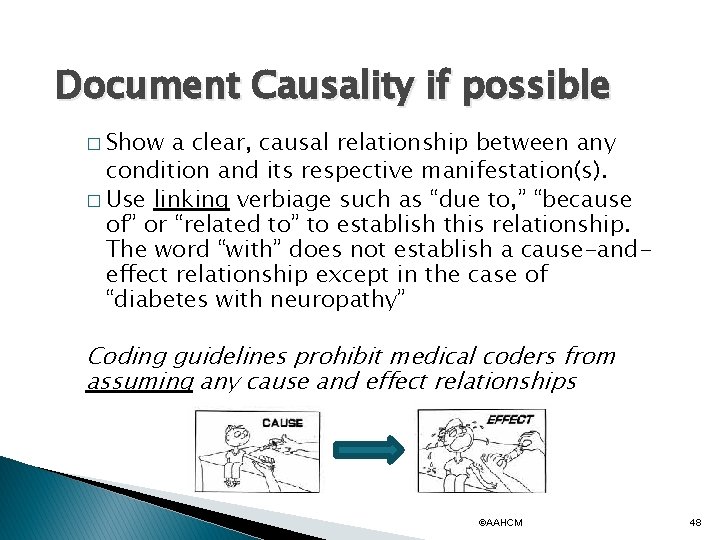
Document Causality if possible � Show a clear, causal relationship between any condition and its respective manifestation(s). � Use linking verbiage such as “due to, ” “because of” or “related to” to establish this relationship. The word “with” does not establish a cause-andeffect relationship except in the case of “diabetes with neuropathy” Coding guidelines prohibit medical coders from assuming any cause and effect relationships ©AAHCM 48
Documentation Critical in Capturing Risk Adjustment Data Official ICD-9 Coding Guidelines � Diagnosis may only coded when explicitly spelled out in medical record � Medical record documentation that supports each coded diagnosis must be obtainable � Must demonstrate adherence to coding guidelines http: //www. cdc. gov/nchs/icd 9 cm_addenda_guidelines. htm ©AAHCM 49
Official Coding Guidelines Mantra #1 - All conditions documented by a PCP that co-exist at the time of the encounter/visit, and require or affect patient care or management should be coded. • • Do not continue to code conditions that were previously treated and no longer exist. History codes may be used as secondary codes IF the historical condition or family history has an impact on current care or influences treatment (V 10 -V 19 are not in HCC model but are important). ©AAHCM 50
Official Coding Guidelines Mantra #2 - Documentation should reflect medical decision-making Examples: ◦ DM currently stable on medication ◦ Condition worsening - medications adjusted ◦ Reviewed history and use of inhaler w/patient ◦ Condition improving ◦ Interpret test results/confirm diagnosis in note ©AAHCM 51
Put MEAT in your notes Monitored: current or planned Evaluated: testing, physical finding or symptom Assessed: conclusion that describes diagnosis Treated: medications, exercise, advice, diet, etc Best if each problem/diagnosis is addressed explicitly with an “Impression/Plan” format, instead of SOAP format for complex patients. ©AAHCM 52
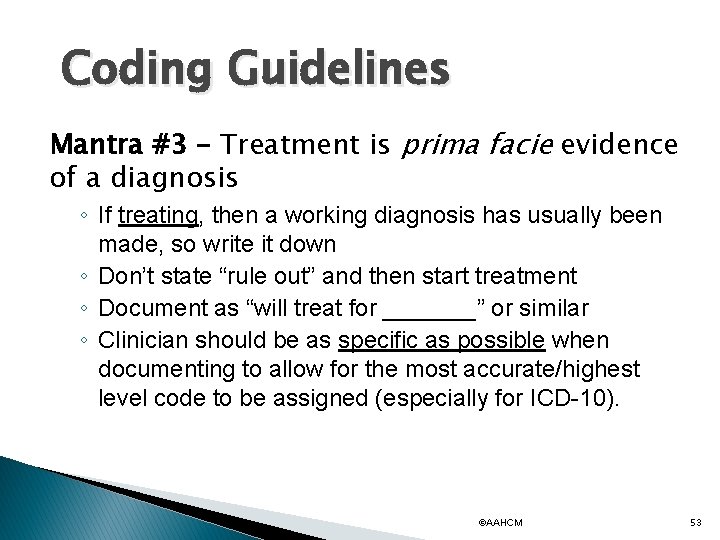
Coding Guidelines Mantra #3 – Treatment is prima facie evidence of a diagnosis ◦ If treating, then a working diagnosis has usually been made, so write it down ◦ Don’t state “rule out” and then start treatment ◦ Document as “will treat for _______” or similar ◦ Clinician should be as specific as possible when documenting to allow for the most accurate/highest level code to be assigned (especially for ICD-10). ©AAHCM 53
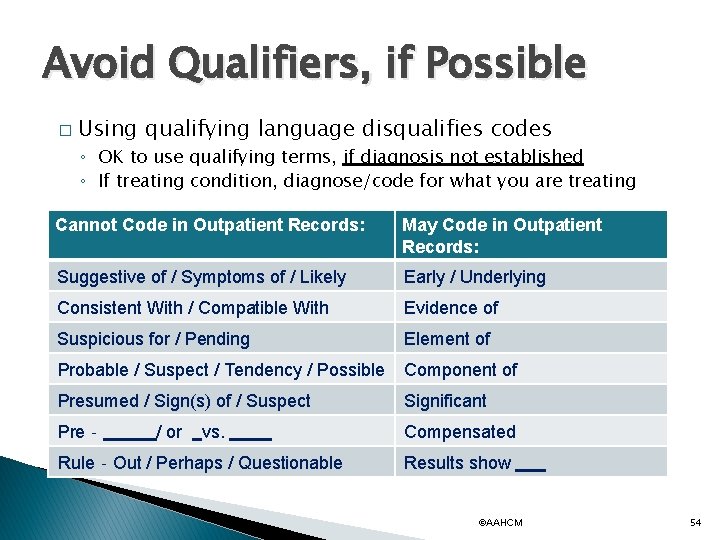
Avoid Qualifiers, if Possible � Using qualifying language disqualifies codes ◦ OK to use qualifying terms, if diagnosis not established ◦ If treating condition, diagnose/code for what you are treating Cannot Code in Outpatient Records: May Code in Outpatient Records: Suggestive of / Symptoms of / Likely Early / Underlying Consistent With / Compatible With Evidence of Suspicious for / Pending Element of Probable / Suspect / Tendency / Possible Component of Presumed / Sign(s) of / Suspect Significant Pre‐ Compensated / or vs. Rule‐Out / Perhaps / Questionable Results show ©AAHCM 54
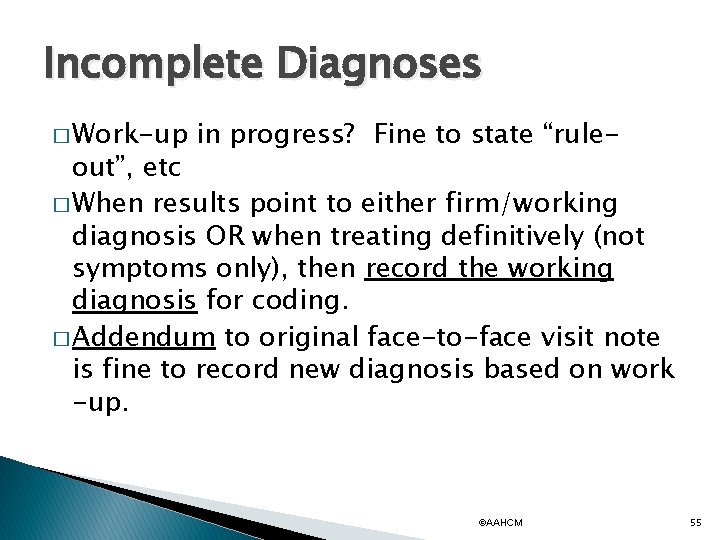
Incomplete Diagnoses � Work-up in progress? Fine to state “rule- out”, etc � When results point to either firm/working diagnosis OR when treating definitively (not symptoms only), then record the working diagnosis for coding. � Addendum to original face-to-face visit note is fine to record new diagnosis based on work -up. ©AAHCM 55
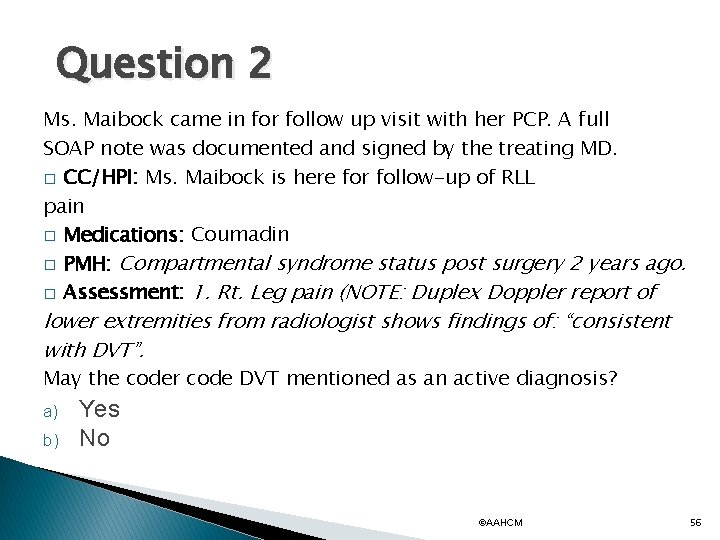
Question 2 Ms. Maibock came in for follow up visit with her PCP. A full SOAP note was documented and signed by the treating MD. � CC/HPI: Ms. Maibock is here for follow-up of RLL pain � Medications: Coumadin � PMH: Compartmental syndrome status post surgery 2 years ago. � Assessment: 1. Rt. Leg pain (NOTE: Duplex Doppler report of lower extremities from radiologist shows findings of: “consistent with DVT”. May the coder code DVT mentioned as an active diagnosis? a) b) Yes No ©AAHCM 56
Answer 2 2. Answer: b) No Rationale: A Coding Clinic* ruling states that any diagnosis described as “consistent with” cannot be coded as active or current as a specific diagnosis is not being made with this wording choice. This example highlights the rules around coding unspecific diagnoses when described as “consistent with”. *The Coding Clinic (a department within the AHA‐ American Hospital Association) issues rulings on diagnosis coding. ©AAHCM 57
Specificity Matters • • Diagnosis specificity is paramount. E. g. , “chronic” can change the chosen diagnosis code (and its risk score value) • Chronic Renal Disease vs. Renal insufficiency Hepatitis B vs. Hepatitis B Bronchitis vs. Bronchitis cor pulmonale vs. cor pulmonale ©AAHCM 58
“Status” Conditions Evaluate and document chronic quiescent conditions, such as: o Amputation, toe loss (V-code) (Z 89. 4 xxx) o Ostomy (V-code) (Z 93. x) o HIV status (V-code) (B 20) o Dialysis status (V-code) (Z 99. 2) Each of these triggers an HCC. ©AAHCM 59
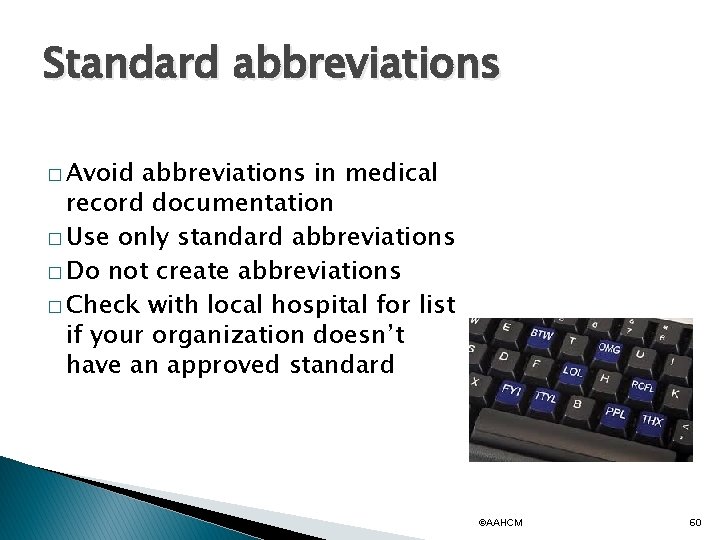
Standard abbreviations � Avoid abbreviations in medical record documentation � Use only standard abbreviations � Do not create abbreviations � Check with local hospital for list if your organization doesn’t have an approved standard ©AAHCM 60
Use “history of” only when appropriate � Per ICD-9 -CM guidelines, the term “history of” means the patient no longer has the condition � Examples: ◦ “history of congestive heart failure” to indicate compensated congestive heart failure ◦ “history of atrial fibrillation” to indicate atrial fibrillation controlled by medication � Avoid using the words “history of” to document a current condition ©AAHCM 61
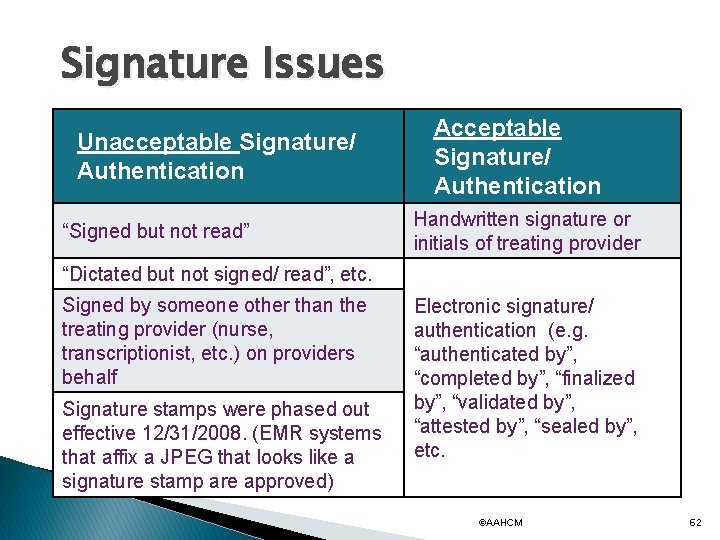
Signature Issues Unacceptable Signature/ Authentication “Signed but not read” Acceptable Signature/ Authentication Handwritten signature or initials of treating provider “Dictated but not signed/ read”, etc. Signed by someone other than the treating provider (nurse, transcriptionist, etc. ) on providers behalf Signature stamps were phased out effective 12/31/2008. (EMR systems that affix a JPEG that looks like a signature stamp are approved) Electronic signature/ authentication (e. g. “authenticated by”, “completed by”, “finalized by”, “validated by”, “attested by”, “sealed by”, etc. ©AAHCM 62

EHR Shortcuts � Beware “copy and paste” without updates � Auditors are not stupid ©AAHCM 63
Common Documentation and Coding Issues in Home-based Primary Care • • Diabetes & complications Vascular Disease Chronic Kidney Disease Chronic Heart Failure • • Malnutrition Stroke & Sequela Major Depression Dependencies ©AAHCM 64
Documenting Diabetes Mellitus • There are two HCC’s for Chronic Diabetes Mellitus ◦ Uncomplicated �HCC 19 (Community) 0. 182 ◦ Complicated �HCC 18 (Community) 0. 368 • • Most patients with diabetes for a long time have complications Evaluating and documenting diabetic complications does increase revenue, and is just plain Good Medicine. ©AAHCM 65
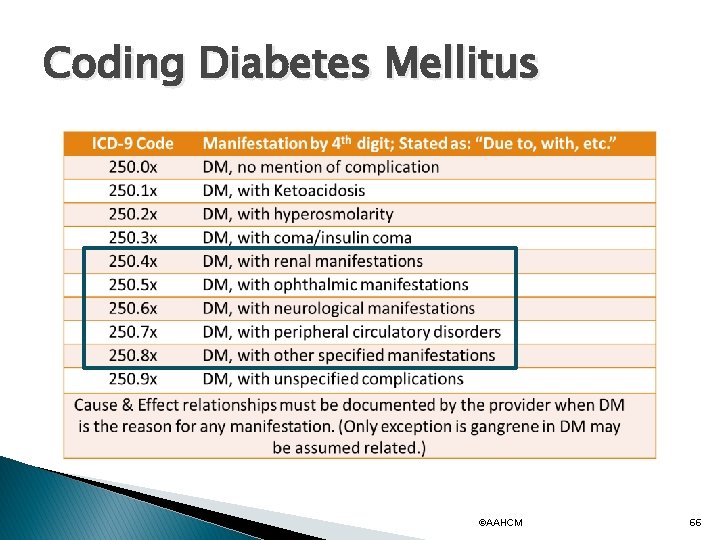
Coding Diabetes Mellitus ©AAHCM 66
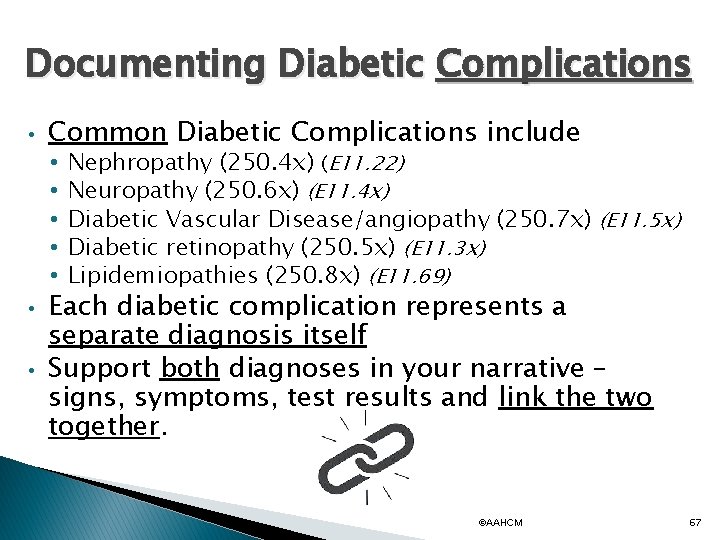
Documenting Diabetic Complications • Common Diabetic Complications include • • Nephropathy (250. 4 x) (E 11. 22) Neuropathy (250. 6 x) (E 11. 4 x) Diabetic Vascular Disease/angiopathy (250. 7 x) (E 11. 5 x) Diabetic retinopathy (250. 5 x) (E 11. 3 x) Lipidemiopathies (250. 8 x) (E 11. 69) Each diabetic complication represents a separate diagnosis itself Support both diagnoses in your narrative – signs, symptoms, test results and link the two together. ©AAHCM 67
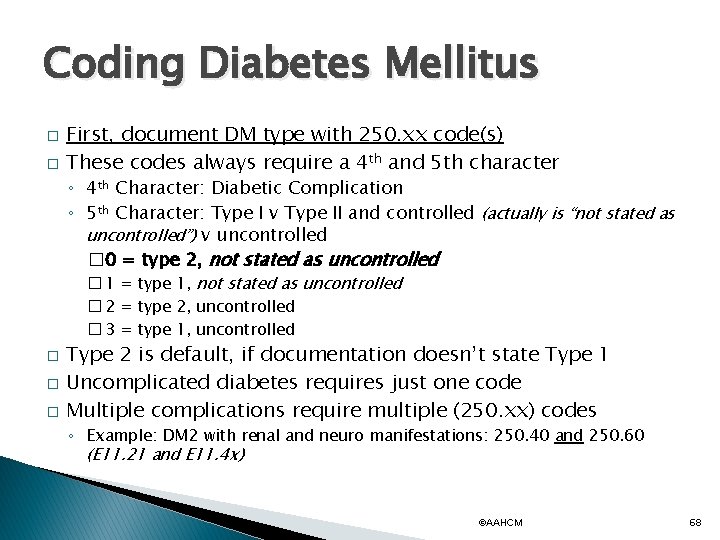
Coding Diabetes Mellitus � � First, document DM type with 250. xx code(s) These codes always require a 4 th and 5 th character ◦ 4 th Character: Diabetic Complication ◦ 5 th Character: Type I v Type II and controlled (actually is “not stated as uncontrolled”) v uncontrolled � 0 = type 2, not stated as uncontrolled � 1 = type 1, not stated as uncontrolled � 2 = type 2, uncontrolled � 3 = type 1, uncontrolled � � � Type 2 is default, if documentation doesn’t state Type 1 Uncomplicated diabetes requires just one code Multiple complications require multiple (250. xx) codes ◦ Example: DM 2 with renal and neuro manifestations: 250. 40 and 250. 60 (E 11. 21 and E 11. 4 x) ©AAHCM 68
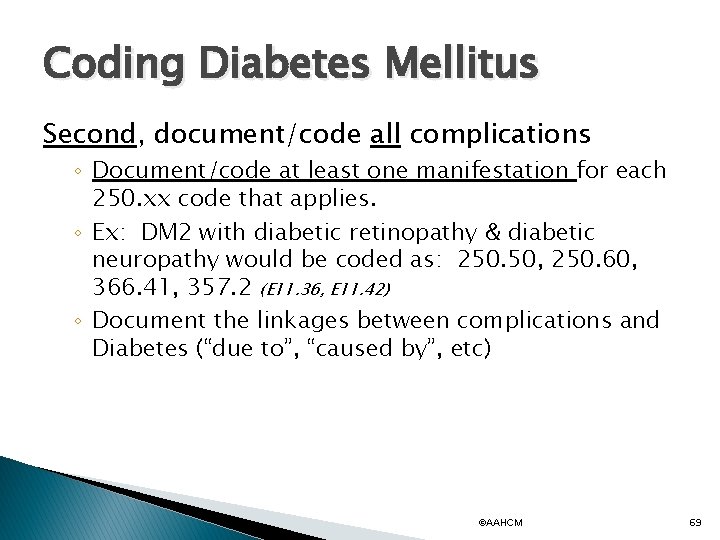
Coding Diabetes Mellitus Second, document/code all complications ◦ Document/code at least one manifestation for each 250. xx code that applies. ◦ Ex: DM 2 with diabetic retinopathy & diabetic neuropathy would be coded as: 250. 50, 250. 60, 366. 41, 357. 2 (E 11. 36, E 11. 42) ◦ Document the linkages between complications and Diabetes (“due to”, “caused by”, etc) ©AAHCM 69
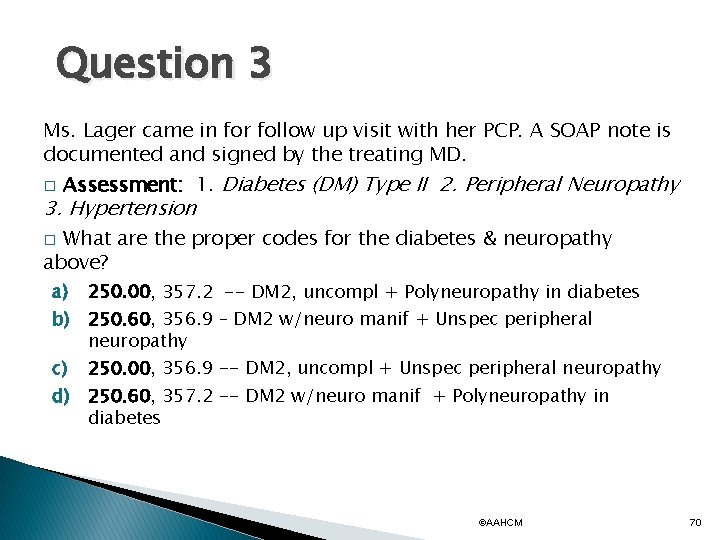
Question 3 Ms. Lager came in for follow up visit with her PCP. A SOAP note is documented and signed by the treating MD. � Assessment: 1. Diabetes (DM) Type II 2. Peripheral Neuropathy 3. Hypertension What are the proper codes for the diabetes & neuropathy above? � a) 250. 00, 357. 2 b) 250. 60, 356. 9 neuropathy c) 250. 00, 356. 9 d) 250. 60, 357. 2 diabetes -- DM 2, uncompl + Polyneuropathy in diabetes – DM 2 w/neuro manif + Unspec peripheral -- DM 2, uncompl + Unspec peripheral neuropathy -- DM 2 w/neuro manif + Polyneuropathy in ©AAHCM 70
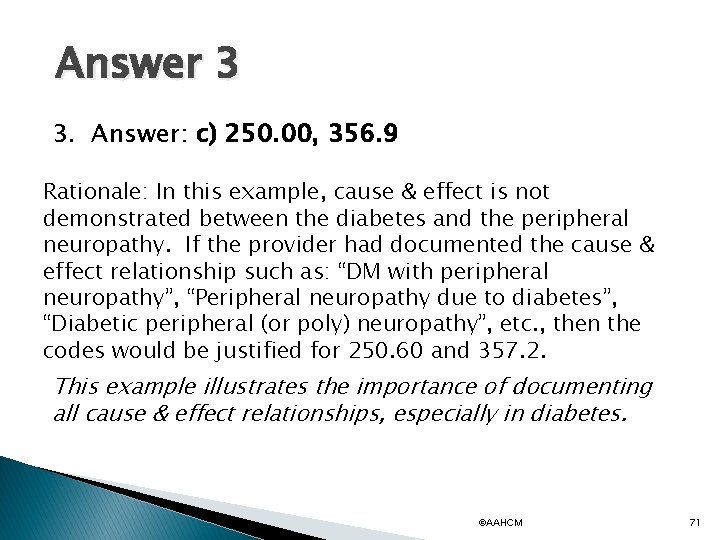
Answer 3 3. Answer: c) 250. 00, 356. 9 Rationale: In this example, cause & effect is not demonstrated between the diabetes and the peripheral neuropathy. If the provider had documented the cause & effect relationship such as: “DM with peripheral neuropathy”, “Peripheral neuropathy due to diabetes”, “Diabetic peripheral (or poly) neuropathy”, etc. , then the codes would be justified for 250. 60 and 357. 2. This example illustrates the importance of documenting all cause & effect relationships, especially in diabetes. ©AAHCM 71
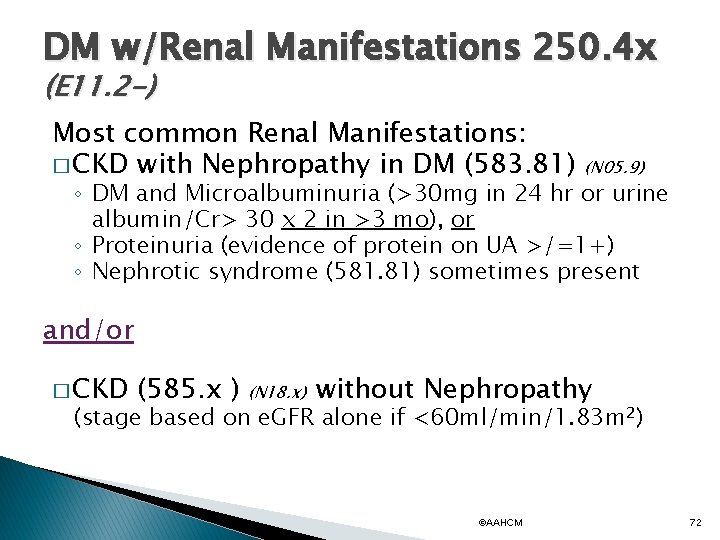
DM w/Renal Manifestations 250. 4 x (E 11. 2 -) Most common Renal Manifestations: � CKD with Nephropathy in DM (583. 81) (N 05. 9) ◦ DM and Microalbuminuria (>30 mg in 24 hr or urine albumin/Cr> 30 x 2 in >3 mo), or ◦ Proteinuria (evidence of protein on UA >/=1+) ◦ Nephrotic syndrome (581. 81) sometimes present and/or � CKD (585. x ) (N 18. x) without Nephropathy (stage based on e. GFR alone if <60 ml/min/1. 83 m 2) ©AAHCM 72

CKD Documentation & Coding � CKD 1 -2 � CKD 3 -5 ◦ e. GFR> 60, requires documented evidence of renal disease ◦ document microalbuminuria, polycystic kidney, hydronephrosis, etc. ◦ e. GFR <60 is presumed CKD (at least stage 3) � If >70 y/o, use Cockcroft-Gault equation (age, ideal wt, Cr) vs lab report (MDRD: age, gender, race Cr, BUN, Albumin) Example: 79 y/o BM, Cr 1. 4, BUN 20, Alb 4. 0 �MDRD = 63 but CG = 53 � Don’t forget about Renal Hyperparathyroidism (588. 81) – common in CKD 3 or worse – order PTH DX e. GFR ICD-9 CKD I CKD 2 CKD 3 90+ 60 -89 30 -59 585. 1 585. 2 585. 3 CKD 4 CKD 5 ESRD CKD unspecified ©AAHCM 15 -29 585. 4 0 -15 585. 5 Dialysi 585. 6 s NOS 585. 9 73
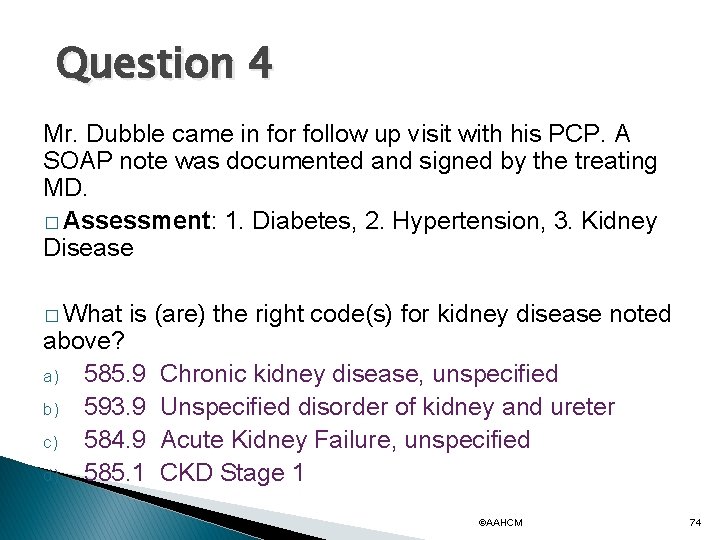
Question 4 Mr. Dubble came in for follow up visit with his PCP. A SOAP note was documented and signed by the treating MD. � Assessment: 1. Diabetes, 2. Hypertension, 3. Kidney Disease � What is (are) the right code(s) for kidney disease noted above? a) 585. 9 b) 593. 9 c) 584. 9 d) 585. 1 Chronic kidney disease, unspecified Unspecified disorder of kidney and ureter Acute Kidney Failure, unspecified CKD Stage 1 ©AAHCM 74
Answer 4 4. Answer: b) 593. 9 Unspecified disorder of kidney and ureter Rationale: Provider did not use specific documentation for the kidney disease. Had the provider noted it as “chronic”, then 585. 9 would be correct for unspecified. Without the description of the kidney disease, default code is 593. 9, “unspecified disorder of kidney and ureter”. This is the same default code when “chronic” is not used to describe a renal insufficiency as well. � This example covers the needed specificity in kidney disease coding. ©AAHCM 75
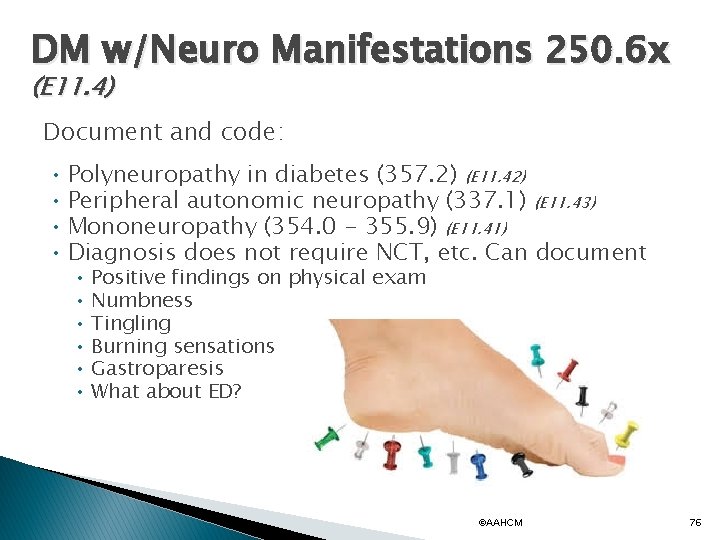
DM w/Neuro Manifestations 250. 6 x (E 11. 4) Document and code: • Polyneuropathy in diabetes (357. 2) (E 11. 42) • Peripheral autonomic neuropathy (337. 1) (E 11. 43) • Mononeuropathy (354. 0 - 355. 9) (E 11. 41) • Diagnosis does not require NCT, etc. Can document • Positive findings on physical exam • Numbness • Tingling • Burning sensations • Gastroparesis • What about ED? ©AAHCM 76
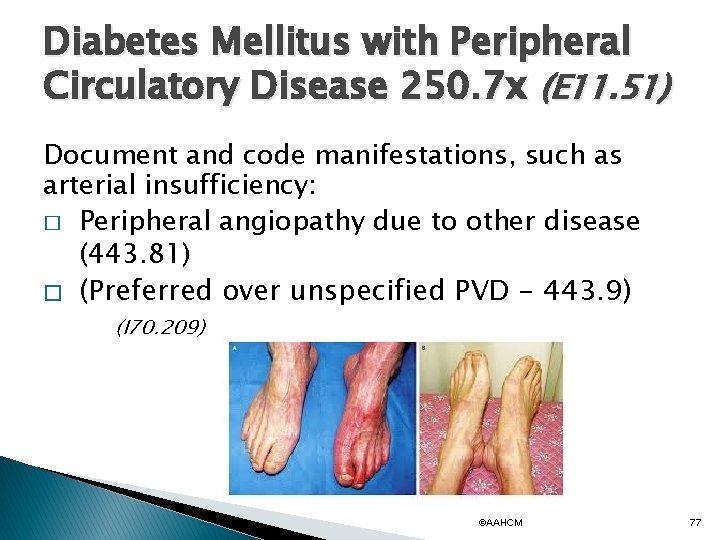
Diabetes Mellitus with Peripheral Circulatory Disease 250. 7 x (E 11. 51) Document and code manifestations, such as arterial insufficiency: � Peripheral angiopathy due to other disease (443. 81) � (Preferred over unspecified PVD - 443. 9) (I 70. 209) ©AAHCM 77
Documenting Vascular Disease � Easy to diagnose, but over-looked, since not symptomatic in early/middle stages. Look for: ◦ Claudication if present ◦ Diminished pedal pulses common (avoid documenting pulse “present” or “palpable” – use gradations like“+2” ◦ Other stigmata � � � Ankle-Brachial Index (ABI) is preferred diagnostic study if claudication or other manifestations absent Document ulceration/gangrene if present. Also Large vessel disease – AAA, atherosclerotic aorta, etc ◦ May be discovered on CXR, for example ◦ Is usually being treated (risk factor modification) ◦ So, add to assessment/problem list ©AAHCM 78
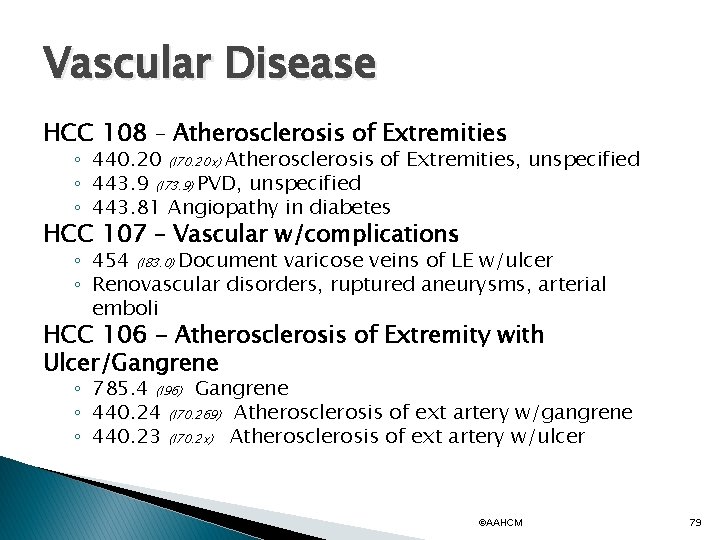
Vascular Disease HCC 108 – Atherosclerosis of Extremities ◦ 440. 20 (I 70. 20 x) Atherosclerosis of Extremities, unspecified ◦ 443. 9 (I 73. 9) PVD, unspecified ◦ 443. 81 Angiopathy in diabetes HCC 107 – Vascular w/complications ◦ 454 (I 83. 0) Document varicose veins of LE w/ulcer ◦ Renovascular disorders, ruptured aneurysms, arterial emboli HCC 106 - Atherosclerosis of Extremity with Ulcer/Gangrene ◦ 785. 4 (I 96) Gangrene ◦ 440. 24 (I 70. 269) Atherosclerosis of ext artery w/gangrene ◦ 440. 23 (I 70. 2 x) Atherosclerosis of ext artery w/ulcer ©AAHCM 79
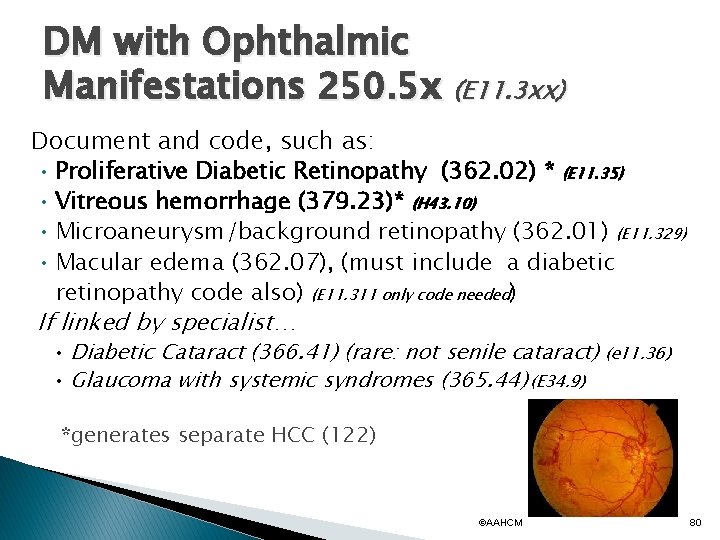
DM with Ophthalmic Manifestations 250. 5 x (E 11. 3 xx) Document and code, such as: • Proliferative Diabetic Retinopathy (362. 02) * (E 11. 35) • Vitreous hemorrhage (379. 23)* (H 43. 10) • Microaneurysm/background retinopathy (362. 01) (E 11. 329) • Macular edema (362. 07), (must include a diabetic retinopathy code also) (E 11. 311 only code needed) If linked by specialist… • Diabetic Cataract (366. 41) (rare: not senile cataract) • Glaucoma with systemic syndromes (365. 44) (E 34. 9) (e 11. 36) *generates separate HCC (122) ©AAHCM 80
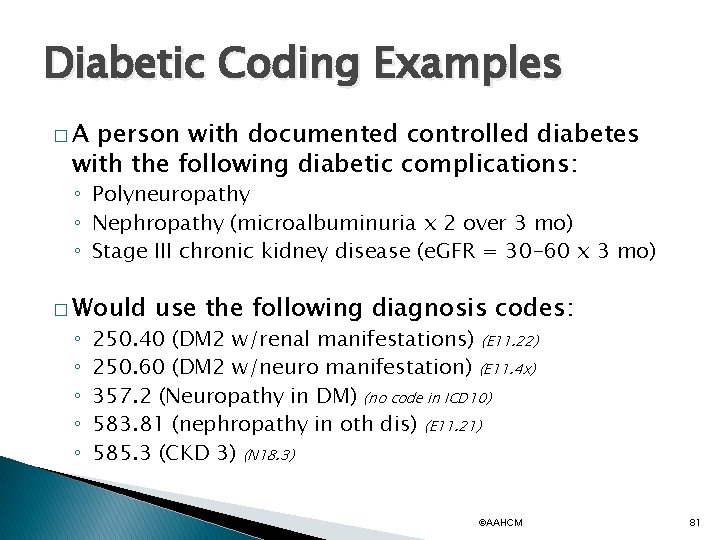
Diabetic Coding Examples �A person with documented controlled diabetes with the following diabetic complications: ◦ Polyneuropathy ◦ Nephropathy (microalbuminuria x 2 over 3 mo) ◦ Stage III chronic kidney disease (e. GFR = 30 -60 x 3 mo) � Would ◦ ◦ ◦ use the following diagnosis codes: 250. 40 (DM 2 w/renal manifestations) (E 11. 22) 250. 60 (DM 2 w/neuro manifestation) (E 11. 4 x) 357. 2 (Neuropathy in DM) (no code in ICD 10) 583. 81 (nephropathy in oth dis) (E 11. 21) 585. 3 (CKD 3) (N 18. 3) ©AAHCM 81
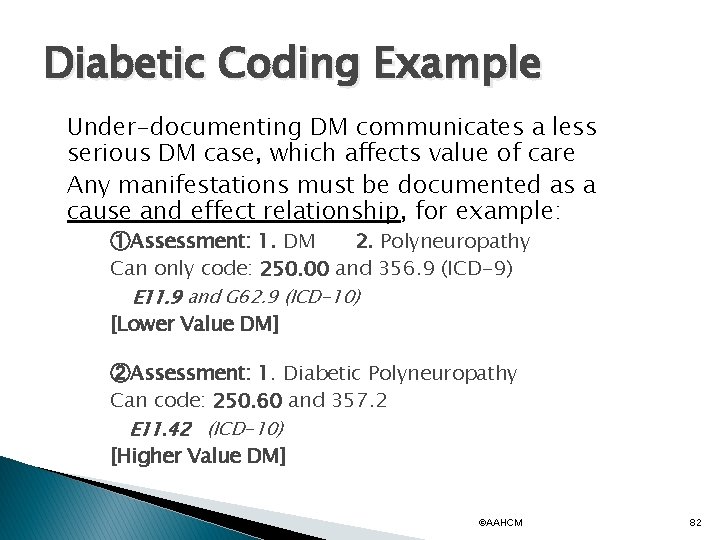
Diabetic Coding Example Under-documenting DM communicates a less serious DM case, which affects value of care Any manifestations must be documented as a cause and effect relationship, for example: ①Assessment: 1. DM 2. Polyneuropathy Can only code: 250. 00 and 356. 9 (ICD-9) E 11. 9 and G 62. 9 (ICD-10) [Lower Value DM] ②Assessment: 1. Diabetic Polyneuropathy Can code: 250. 60 and 357. 2 E 11. 42 (ICD-10) [Higher Value DM] ©AAHCM 82
Chronic Heart Failure � Many new patients have quiescent disease � Develop high index of suspicion for CHF ◦ Clue: May be on diuretic, ACEI, Beta-blocker, etc ◦ Abnormal EKG should prompt echocardiogram �EF and PA Pressure �Diastolic dysfunction is common ◦ (Normal EKG =high predictive value for normal Echo) � Remember: Stage B CHF = anatomic changes without symptoms; e. g. , ◦ ◦ Non-valvular AF LVH, wall motion abnormalities Diastolic dysfunction Elevated PA Pressure ©AAHCM 83
Ischemic Cardiomyopathy � Clinicians use this term to refer to CHF from various forms of coronary artery disease ◦ 414. xx (I 25. 89) “Other forms of Ischemic Heart Disease. ” ◦ 414. 8 (I 25. 5): Ischemic Cardiomyopathy ◦ Also includes Chronic Coronary Insufficiency, and Chronic Ischemia, myocardial � This Presents a Problem: None of the ICD 9 414. xx (I 25. x) codes map to the HCC 85 CHF. ©AAHCM 84
Documenting Ischemic Cardiomyopathy � Does the patient have history/evidence of coronary artery disease (CAD) or old MI? � Does the participant have evidence of CHF documented? � In your medical opinion, is CHF a result from the CAD? � If “yes” to all three, then document and code BOTH ◦ 414. 8 (I 25. 5) Ischemic Cardiomyopathy (Genotype) ◦ 428. xx (I 50. xx) Heart Failure (Phenotype) ©AAHCM 85
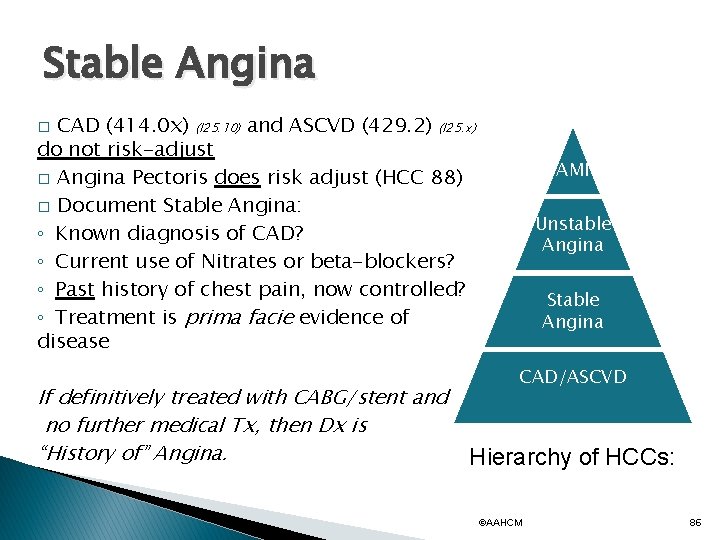
Stable Angina CAD (414. 0 x) (I 25. 10) and ASCVD (429. 2) (I 25. x) do not risk-adjust � Angina Pectoris does risk adjust (HCC 88) � Document Stable Angina: ◦ Known diagnosis of CAD? ◦ Current use of Nitrates or beta-blockers? ◦ Past history of chest pain, now controlled? ◦ Treatment is prima facie evidence of disease � If definitively treated with CABG/stent and no further medical Tx, then Dx is “History of” Angina. AMI Unstable Angina Stable Angina CAD/ASCVD Hierarchy of HCCs: ©AAHCM 86
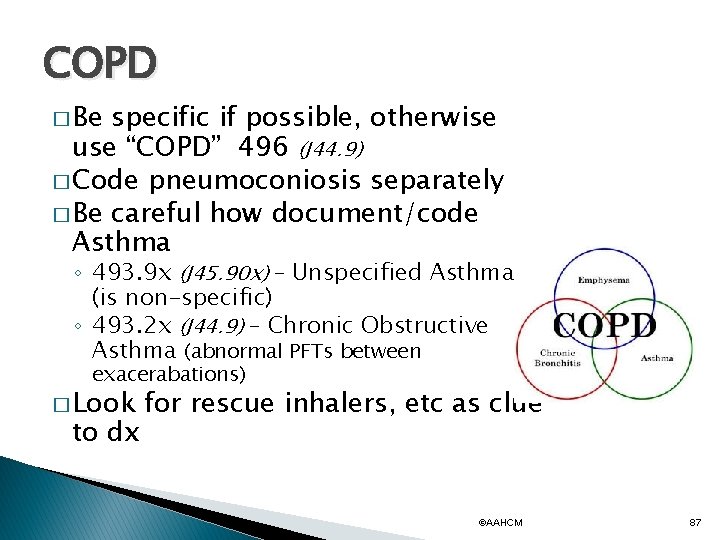
COPD � Be specific if possible, otherwise use “COPD” 496 (J 44. 9) � Code pneumoconiosis separately � Be careful how document/code Asthma ◦ 493. 9 x (J 45. 90 x) – Unspecified Asthma (is non-specific) ◦ 493. 2 x (J 44. 9) – Chronic Obstructive Asthma (abnormal PFTs between exacerabations) � Look to dx for rescue inhalers, etc as clue ©AAHCM 87
Respiratory Failure � TWO types – Hypercapnic or Hypoxemic � If requiring continuous O 2 (hypoxemic) then also document Chronic Resp Failure (518. 83) ◦ Oxygen dependence (>15 hrs/day) ◦ Document Hypoxemia at rest (not only with exercise or sleep) ◦ Usually CHF or COPD as etiology � ICD 10 Respiratory failure (NEC) (J 96. xx) ◦ Acute and Chronic Resp Failure map to the same HCC ◦ Can designate Hypoxia (J 96. 11) vs Hypercapnia (J 96. 12) ©AAHCM 88
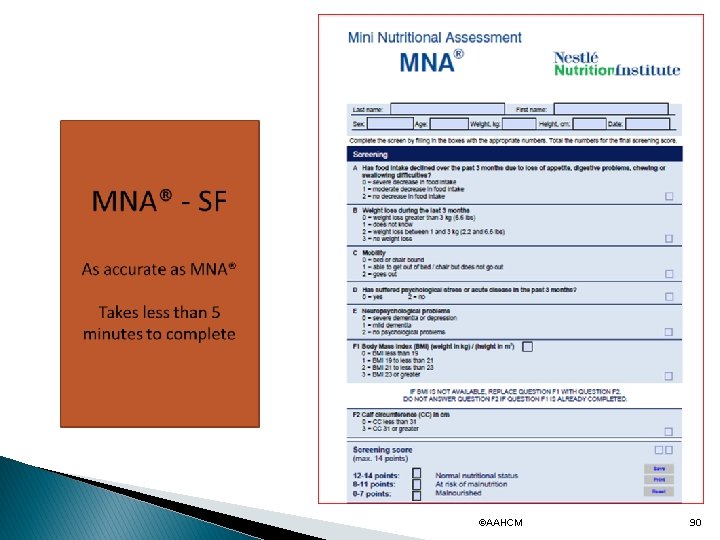
Nutritional Diagnoses Malnutrition generally under-diagnosed ◦ No clear diagnostic criteria for community-dwelling elders ◦ Acute hospitalization often causes malnutrition ◦ Common with end-stage conditions like COPD, CA, Dementia ◦ Are you treating it with supplements, etc? � Mini-Nutritional Assessment (MNA®) to screen or diagnose for malnutrition ©AAHCM 89
©AAHCM 90
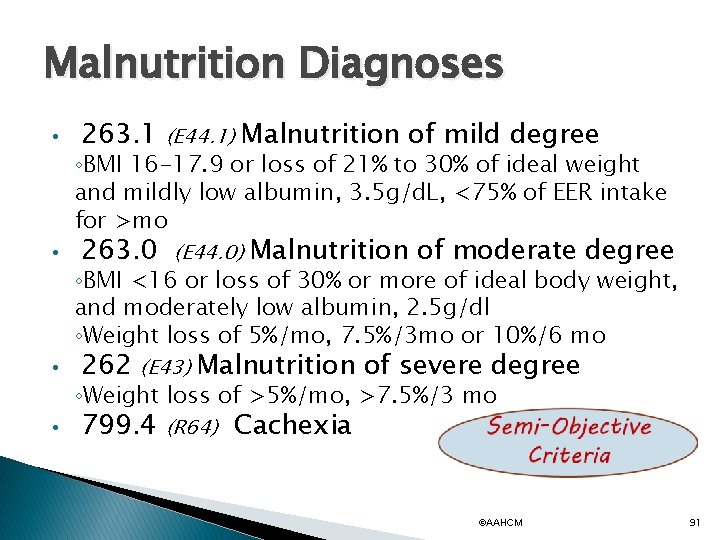
Malnutrition Diagnoses • • 263. 1 (E 44. 1) Malnutrition of mild degree ◦BMI 16 -17. 9 or loss of 21% to 30% of ideal weight and mildly low albumin, 3. 5 g/d. L, <75% of EER intake for >mo 263. 0 (E 44. 0) Malnutrition of moderate degree ◦BMI <16 or loss of 30% or more of ideal body weight, and moderately low albumin, 2. 5 g/dl ◦Weight loss of 5%/mo, 7. 5%/3 mo or 10%/6 mo 262 (E 43) Malnutrition of severe degree ◦Weight loss of >5%/mo, >7. 5%/3 mo 799. 4 (R 64) Cachexia ©AAHCM 91
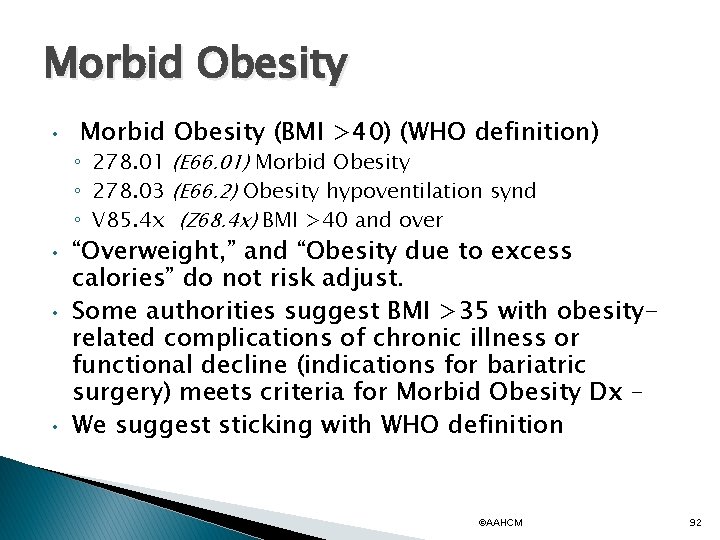
Morbid Obesity • Morbid Obesity (BMI >40) (WHO definition) ◦ 278. 01 (E 66. 01) Morbid Obesity ◦ 278. 03 (E 66. 2) Obesity hypoventilation synd ◦ V 85. 4 x (Z 68. 4 x) BMI >40 and over • • • “Overweight, ” and “Obesity due to excess calories” do not risk adjust. Some authorities suggest BMI >35 with obesityrelated complications of chronic illness or functional decline (indications for bariatric surgery) meets criteria for Morbid Obesity Dx – We suggest sticking with WHO definition ©AAHCM 92
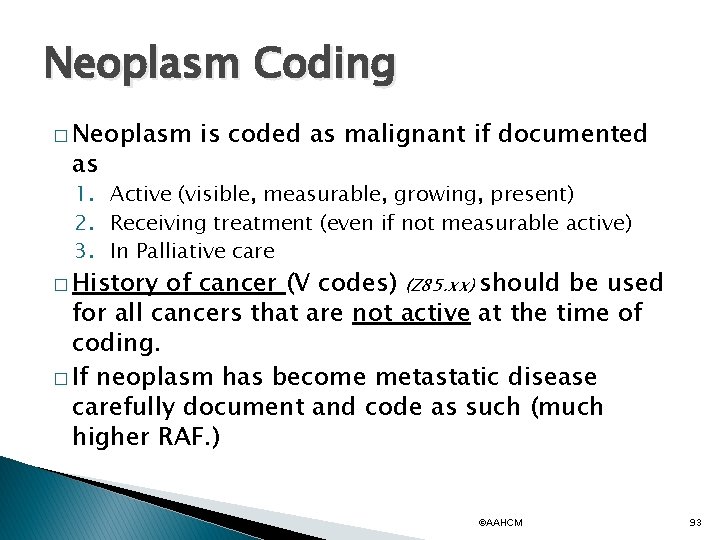
Neoplasm Coding � Neoplasm as is coded as malignant if documented 1. Active (visible, measurable, growing, present) 2. Receiving treatment (even if not measurable active) 3. In Palliative care � History of cancer (V codes) (Z 85. xx) should be used for all cancers that are not active at the time of coding. � If neoplasm has become metastatic disease carefully document and code as such (much higher RAF. ) ©AAHCM 93
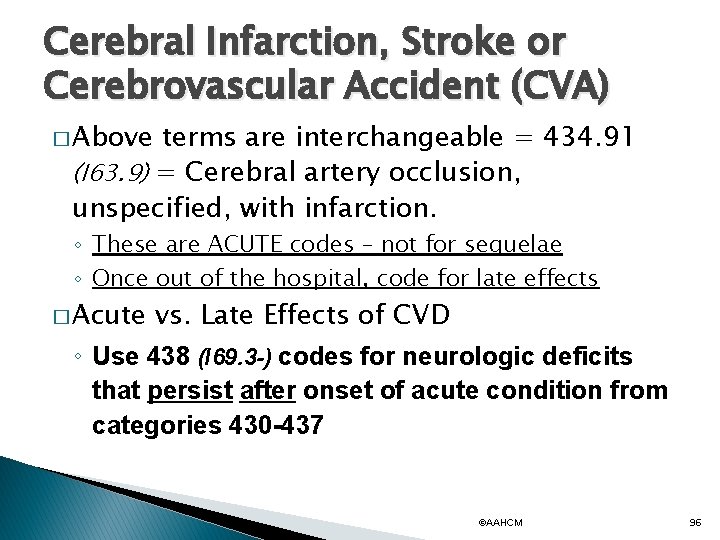
Cerebral Infarction, Stroke or Cerebrovascular Accident (CVA) � Above terms are interchangeable = 434. 91 (I 63. 9) = Cerebral artery occlusion, unspecified, with infarction. ◦ These are ACUTE codes – not for sequelae ◦ Once out of the hospital, code for late effects � Acute vs. Late Effects of CVD ◦ Use 438 (I 69. 3 -) codes for neurologic deficits that persist after onset of acute condition from categories 430 -437 ©AAHCM 96
Late Effect If appropriate, document presence of “plegia” or “paresis” modified with “mono” or “hemi” ◦ If associated with a CVA, document association. ◦ If associated with Cerebral Hemorrhage, subarachnoid hemorrhage ◦ If present but not due to known cerebral event, document as such ◦ All of these conditions Risk Adjust (HCC 103 or HCC 104) � “Weakness” and “Gait abnormality” are symptoms, not diagnoses and code to different ICD 9 codes that do not risk adjust. ©AAHCM 97
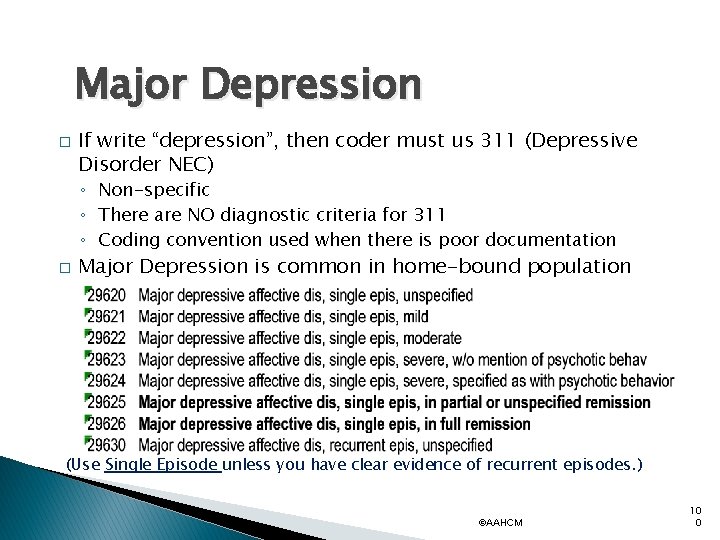
Major Depression � If write “depression”, then coder must us 311 (Depressive Disorder NEC) ◦ Non-specific ◦ There are NO diagnostic criteria for 311 ◦ Coding convention used when there is poor documentation � Major Depression is common in home-bound population (Use Single Episode unless you have clear evidence of recurrent episodes. ) ©AAHCM 10 0
Finally, Know the “Rules of the Road” ◦ Become familiar with the coding conventions and follow all instructions related to specific codes. ◦ Be aware of “includes” and “excludes” instructions and inclusion terms, as well as “use additional code” and other code-related instruction in the Official ICD -9 -CM Guidelines for Coding and Reporting. ◦ If use ICD code book, locate the code first in the alphabetic index, then verify the code in the tabular index. (Reliance on only the alphabetic index or tabular index can lead to coding errors. ) ◦ American Hospital Association Coding Clinic is approved resource for clarification of ICD-9 -CM. ©AAHCM 10 2
Summary � � � Accurate risk adjusted payment relies on diagnosis documentation completeness and specificity Accurate medical record documentation is essential as it leads to accurate ICD-9 coding Document and submit all relevant codes annually at least Prepare for ICD-10 and increased specificity Consider coding assistance ©AAHCM 10 3
Helpful Websites CSSC operations- Customer Service & Support Center -◦ RAPS information and Prescription Drug Information Center www. csscoperations. com Official Guidelines for Coding and Reporting � http: //www. cdc. gov/nchs/data/icd 9 cm_guidelines_2 012. pdf Medicare Advantage Website: ◦ www. cms. gov/Medicare/Health. Plans/Medicare. Advtg. Spec. Rate. Stats ©AAHCM 10 4
Questions Capstone Performance Systems Richard O. Schamp MD, Chief Executive Officer George W. Brett MD, Chief Medical Officer 6255 San Bonita Ave. Saint Louis, MO 63105 314 -477 -3685 rschamp@cpstn. com gbrett@cpstn. com ©AAHCM 10 5
- Slides: 100