Chapter 6 Mechanical Properties ISSUES TO ADDRESS Stress
- Slides: 32
Chapter 6: Mechanical Properties ISSUES TO ADDRESS. . . • Stress and strain: What are they and why are they used instead of load and deformation? • Elastic behavior: When loads are small, how much deformation occurs? What materials deform least? • Plastic behavior: At what point does permanent deformation occur? What materials are most resistant to permanent deformation? • Toughness and ductility: What are they and how do we measure them? Chapter 6 - 1
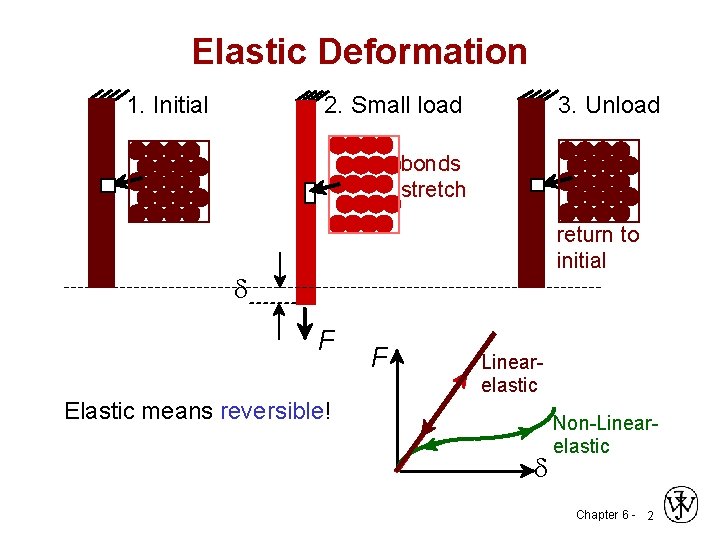
Elastic Deformation 1. Initial 3. Unload 2. Small load bonds stretch return to initial d F F Linearelastic Elastic means reversible! d Non-Linearelastic Chapter 6 - 2
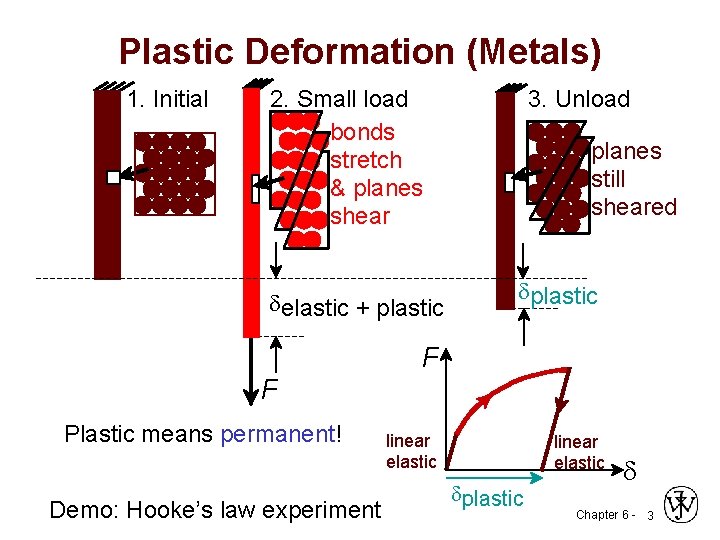
Plastic Deformation (Metals) 1. Initial 2. Small load bonds stretch & planes shear delastic + plastic 3. Unload planes still sheared dplastic F F Plastic means permanent! Demo: Hooke’s law experiment linear elastic dplastic d Chapter 6 - 3
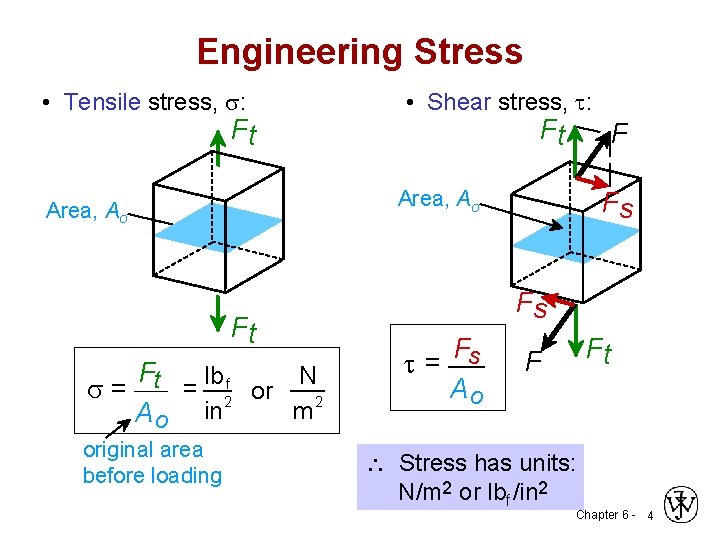
Engineering Stress • Tensile stress, : Ft Ft F Area, Ao Ft Ft lb f N = 2 or = 2 in m Ao original area before loading • Shear stress, t: Fs Fs Fs t= Ao Ft F Stress has units: N/m 2 or lbf /in 2 Chapter 6 - 4
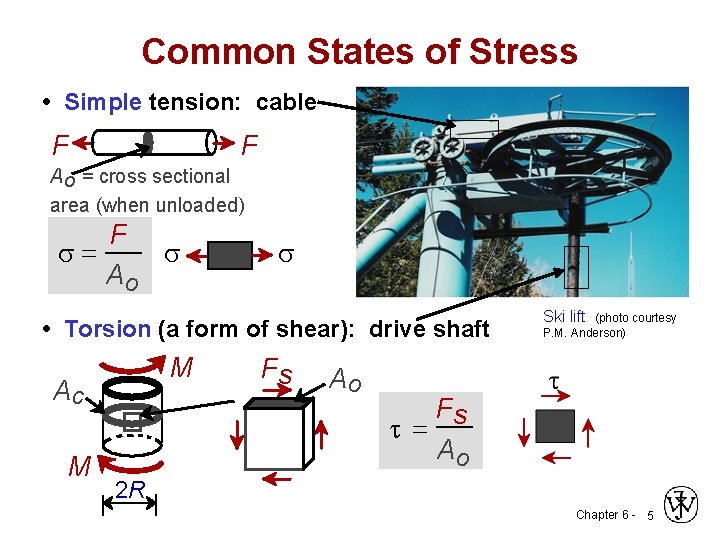
Common States of Stress • Simple tension: cable F F A o = cross sectional area (when unloaded) F = Ao • Torsion (a form of shear): drive shaft M Ac M Fs Ao Ski lift (photo courtesy P. M. Anderson) Fs t = Ao 2 R Chapter 6 - 5
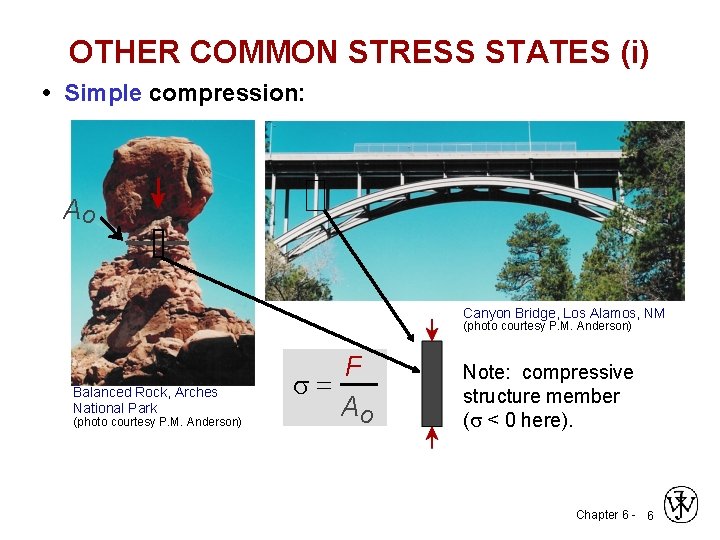
OTHER COMMON STRESS STATES (i) • Simple compression: Ao Canyon Bridge, Los Alamos, NM (photo courtesy P. M. Anderson) Balanced Rock, Arches National Park (photo courtesy P. M. Anderson) F = Ao Note: compressive structure member ( < 0 here). Chapter 6 - 6
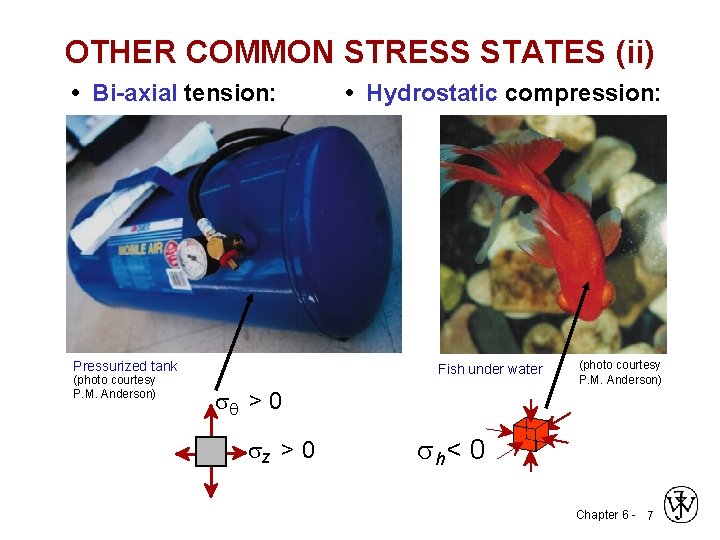
OTHER COMMON STRESS STATES (ii) • Bi-axial tension: Pressurized tank (photo courtesy P. M. Anderson) • Hydrostatic compression: Fish under water q > 0 z > 0 (photo courtesy P. M. Anderson) h< 0 Chapter 6 - 7
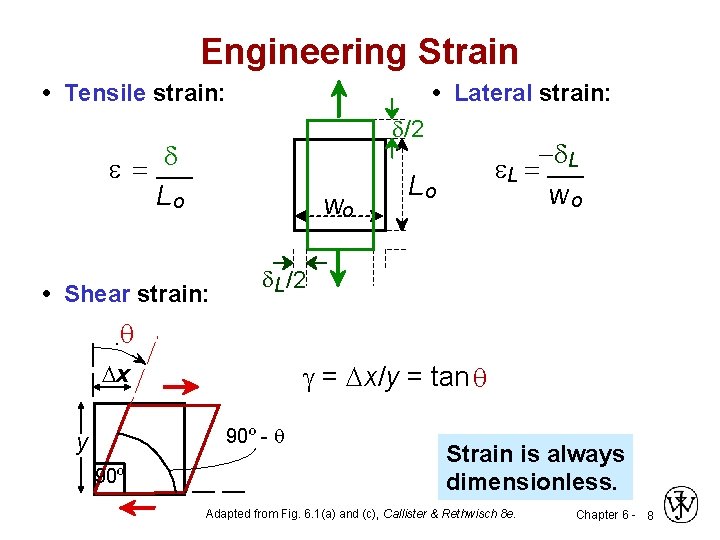
Engineering Strain • Tensile strain: • Lateral strain: d/2 = d Lo wo • Shear strain: -d. L L = wo Lo d. L /2 q g = x/y = tan q x 90º - q y 90º Strain is always dimensionless. Adapted from Fig. 6. 1(a) and (c), Callister & Rethwisch 8 e. Chapter 6 - 8
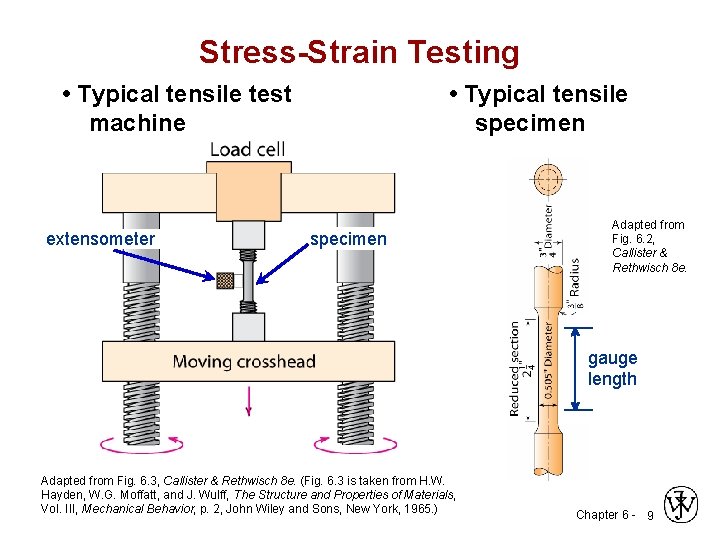
Stress-Strain Testing • Typical tensile test machine extensometer • Typical tensile specimen Adapted from Fig. 6. 2, Callister & Rethwisch 8 e. gauge length Adapted from Fig. 6. 3, Callister & Rethwisch 8 e. (Fig. 6. 3 is taken from H. W. Hayden, W. G. Moffatt, and J. Wulff, The Structure and Properties of Materials, Vol. III, Mechanical Behavior, p. 2, John Wiley and Sons, New York, 1965. ) Chapter 6 - 9
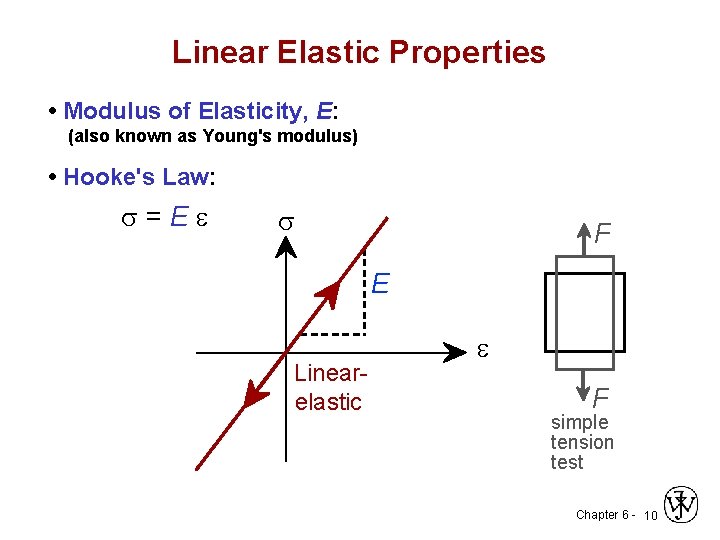
Linear Elastic Properties • Modulus of Elasticity, E: (also known as Young's modulus) • Hooke's Law: =E F E Linearelastic F simple tension test Chapter 6 - 10
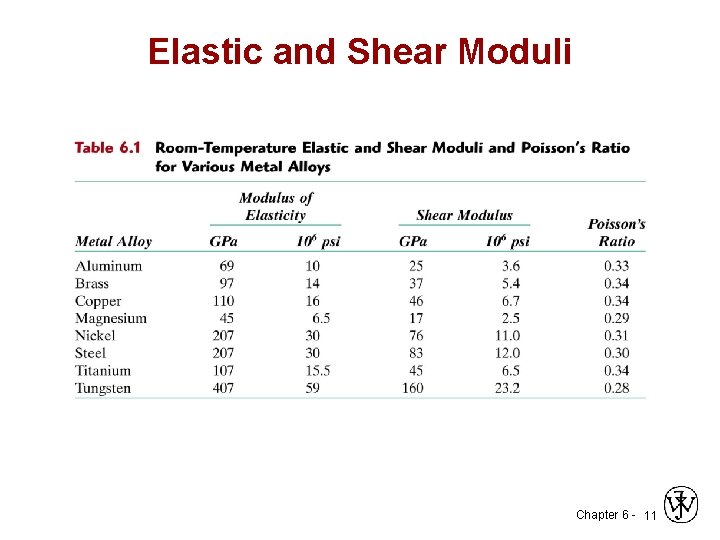
Elastic and Shear Moduli Chapter 6 - 11
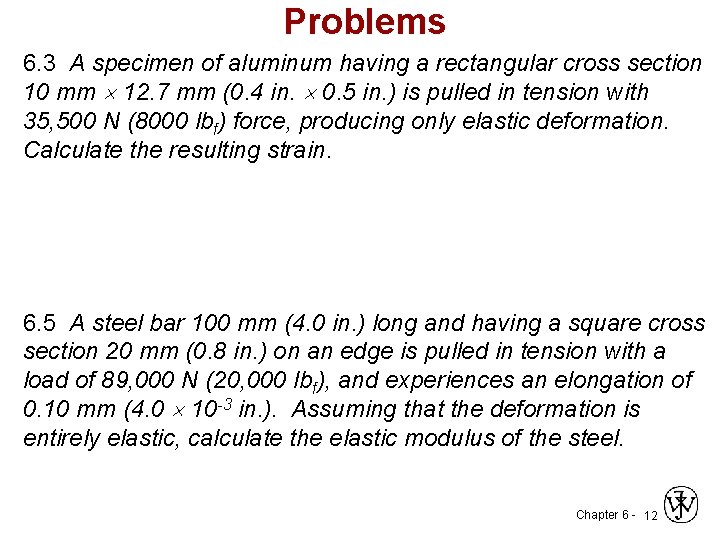
Problems 6. 3 A specimen of aluminum having a rectangular cross section 10 mm 12. 7 mm (0. 4 in. 0. 5 in. ) is pulled in tension with 35, 500 N (8000 lbf) force, producing only elastic deformation. Calculate the resulting strain. 6. 5 A steel bar 100 mm (4. 0 in. ) long and having a square cross section 20 mm (0. 8 in. ) on an edge is pulled in tension with a load of 89, 000 N (20, 000 lbf), and experiences an elongation of 0. 10 mm (4. 0 10 -3 in. ). Assuming that the deformation is entirely elastic, calculate the elastic modulus of the steel. Chapter 6 - 12
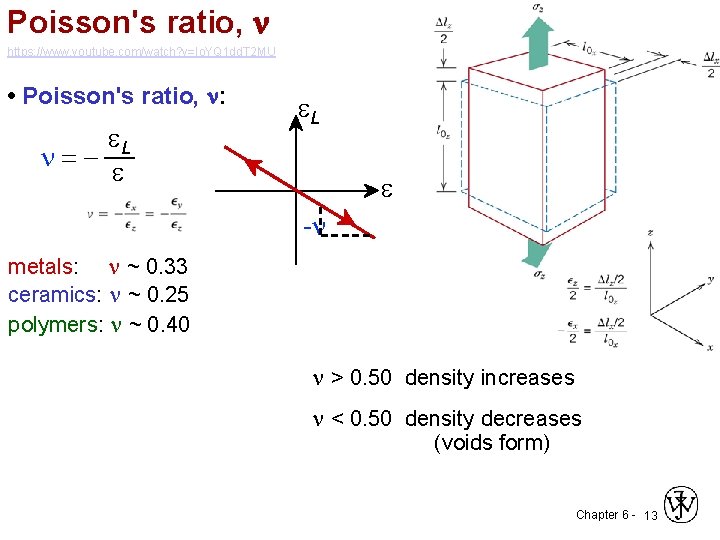
Poisson's ratio, n https: //www. youtube. com/watch? v=Io. YQ 1 dd. T 2 MU • Poisson's ratio, n: L = L - metals: ~ 0. 33 ceramics: ~ 0. 25 polymers: ~ 0. 40 > 0. 50 density increases < 0. 50 density decreases (voids form) Chapter 6 - 13
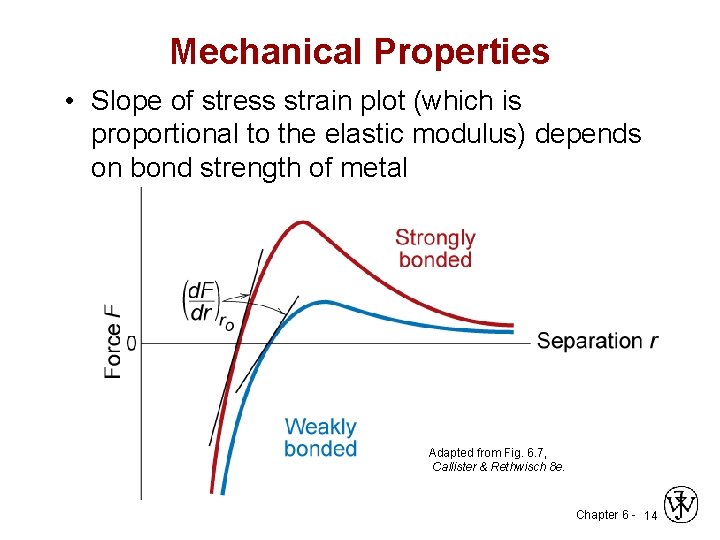
Mechanical Properties • Slope of stress strain plot (which is proportional to the elastic modulus) depends on bond strength of metal Adapted from Fig. 6. 7, Callister & Rethwisch 8 e. Chapter 6 - 14
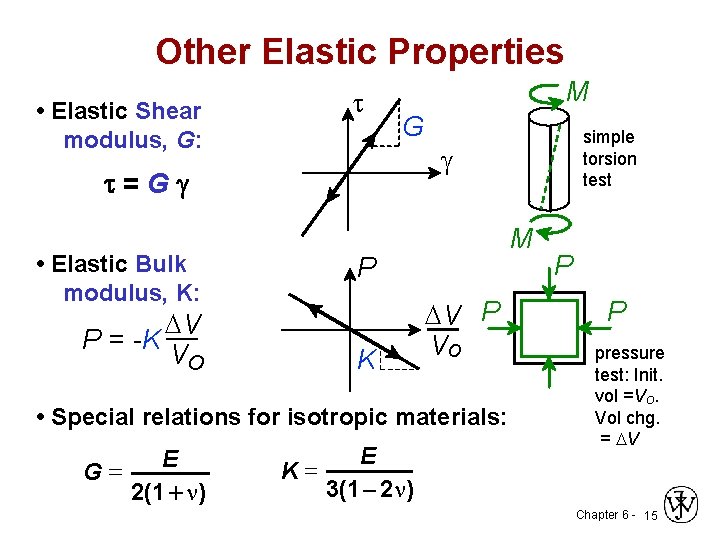
Other Elastic Properties • Elastic Shear modulus, G: t M G t=Gg • Elastic Bulk modulus, K: V P = -K Vo g M P K V P Vo • Special relations for isotropic materials: E G= 2(1 + ) E K= 3(1 - 2 ) simple torsion test P P pressure test: Init. vol =Vo. Vol chg. = V Chapter 6 - 15
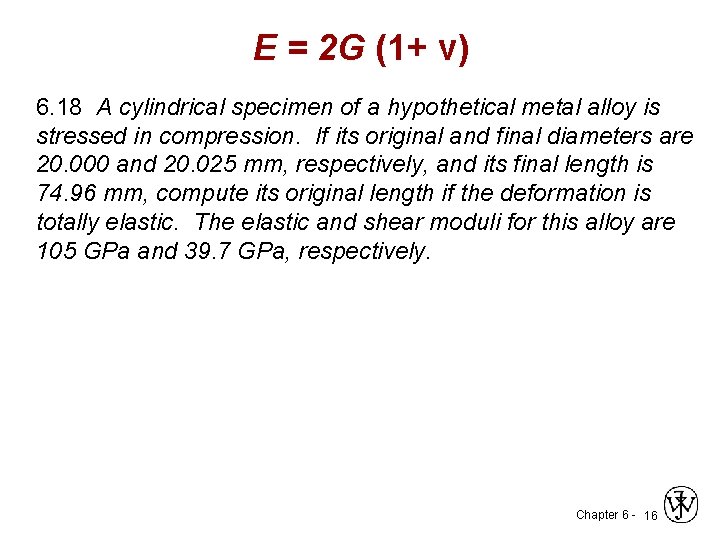
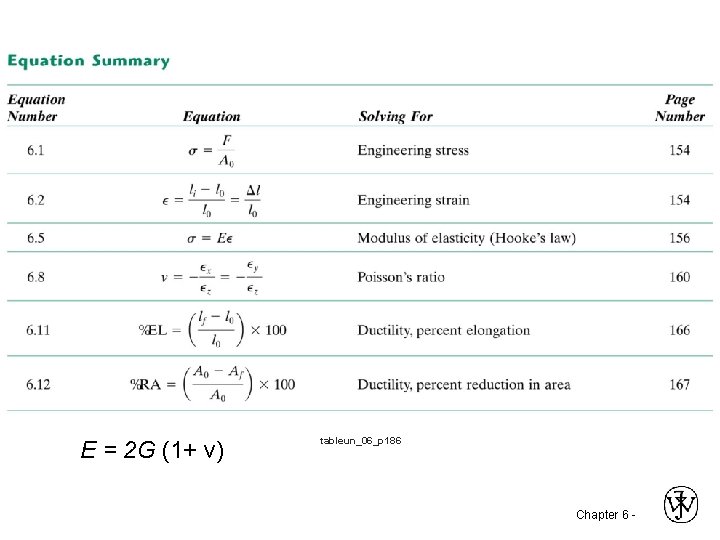
E = 2 G (1+ ν) 6. 18 A cylindrical specimen of a hypothetical metal alloy is stressed in compression. If its original and final diameters are 20. 000 and 20. 025 mm, respectively, and its final length is 74. 96 mm, compute its original length if the deformation is totally elastic. The elastic and shear moduli for this alloy are 105 GPa and 39. 7 GPa, respectively. Chapter 6 - 16
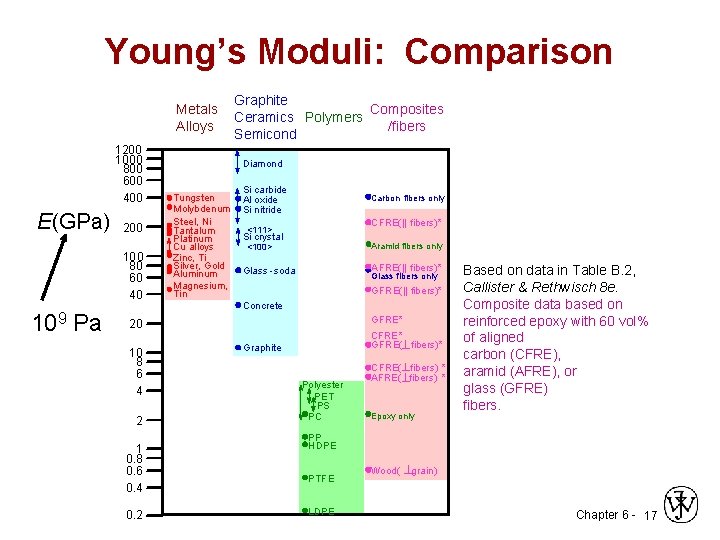
Young’s Moduli: Comparison Metals Alloys 1200 1000 800 600 400 E(GPa) 200 100 80 60 40 109 Pa Graphite Composites Ceramics Polymers /fibers Semicond Diamond Tungsten Molybdenum Steel, Ni Tantalum Platinum Cu alloys Zinc, Ti Silver, Gold Aluminum Magnesium, Tin Si carbide Al oxide Si nitride Carbon fibers only CFRE(|| fibers)* <111> Si crystal Aramid fibers only <100> AFRE(|| fibers)* Glass -soda Glass fibers only GFRE(|| fibers)* Concrete GFRE* 20 10 8 6 4 2 1 0. 8 0. 6 0. 4 0. 2 CFRE* GFRE( fibers)* Graphite Polyester PET PS PC CFRE( fibers) * AFRE( fibers) * Epoxy only Based on data in Table B. 2, Callister & Rethwisch 8 e. Composite data based on reinforced epoxy with 60 vol% of aligned carbon (CFRE), aramid (AFRE), or glass (GFRE) fibers. PP HDPE PTFE LDPE Wood( grain) Chapter 6 - 17
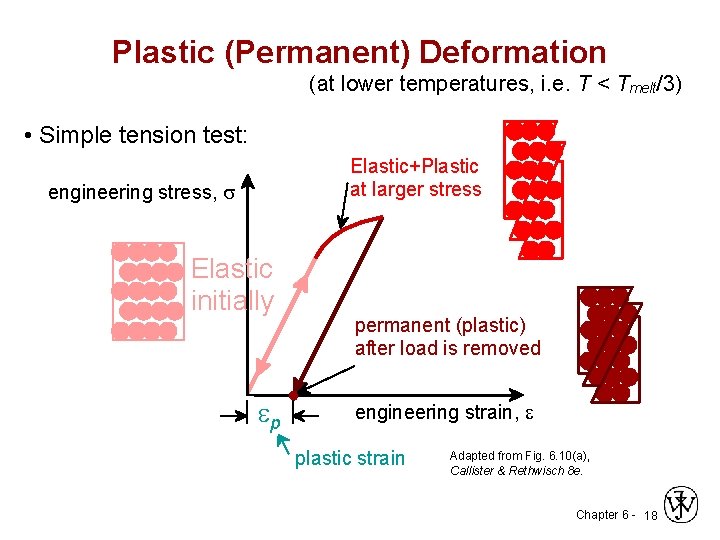
Plastic (Permanent) Deformation (at lower temperatures, i. e. T < Tmelt/3) • Simple tension test: Elastic+Plastic at larger stress engineering stress, Elastic initially p permanent (plastic) after load is removed engineering strain, plastic strain Adapted from Fig. 6. 10(a), Callister & Rethwisch 8 e. Chapter 6 - 18
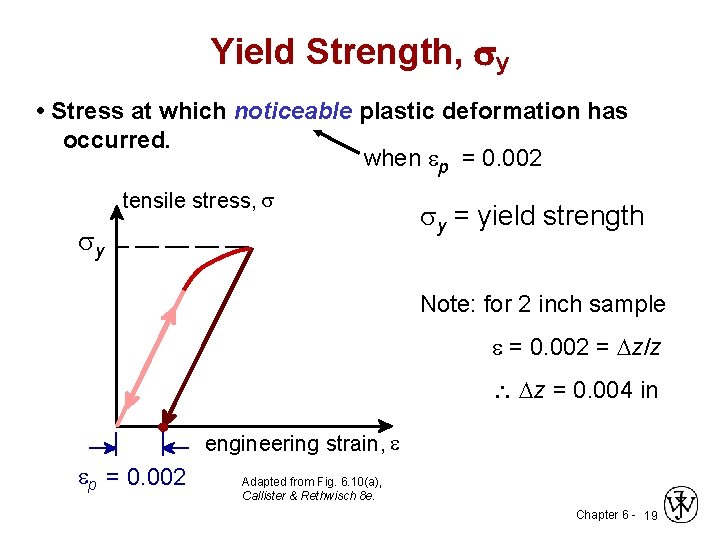
Yield Strength, y • Stress at which noticeable plastic deformation has occurred. when p = 0. 002 tensile stress, y y = yield strength Note: for 2 inch sample = 0. 002 = z/z z = 0. 004 in engineering strain, p = 0. 002 Adapted from Fig. 6. 10(a), Callister & Rethwisch 8 e. Chapter 6 - 19
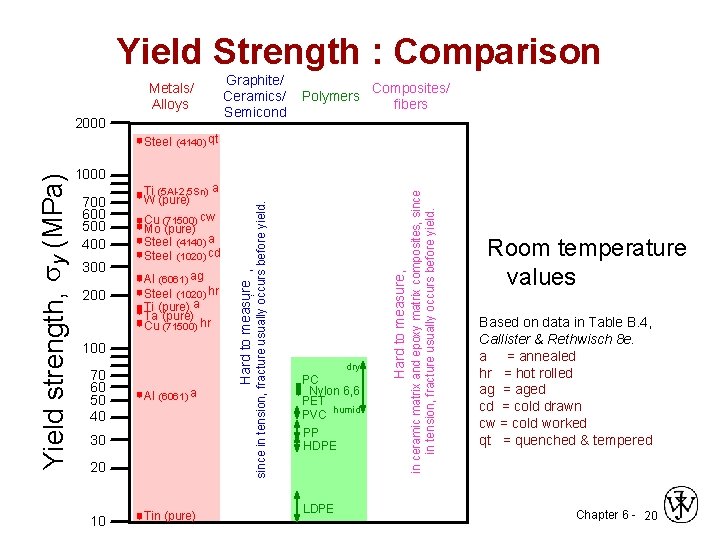
Yield Strength : Comparison Metals/ Alloys 2000 Graphite/ Ceramics/ Semicond Polymers Composites/ fibers 200 Al (6061) ag Steel (1020) hr Ti (pure) a Ta (pure) Cu (71500) hr 100 70 60 50 40 Al (6061) a 30 20 10 Tin (pure) ¨ dry PC Nylon 6, 6 PET PVC humid PP HDPE LDPE Hard to measure, 300 in ceramic matrix and epoxy matrix composites, since in tension, fracture usually occurs before yield. 700 600 500 400 Ti (5 Al-2. 5 Sn) a W (pure) Cu (71500) cw Mo (pure) Steel (4140) a Steel (1020) cd since in tension, fracture usually occurs before yield. 1000 Hard to measure , Yield strength, y (MPa) Steel (4140) qt Room temperature values Based on data in Table B. 4, Callister & Rethwisch 8 e. a = annealed hr = hot rolled ag = aged cd = cold drawn cw = cold worked qt = quenched & tempered Chapter 6 - 20
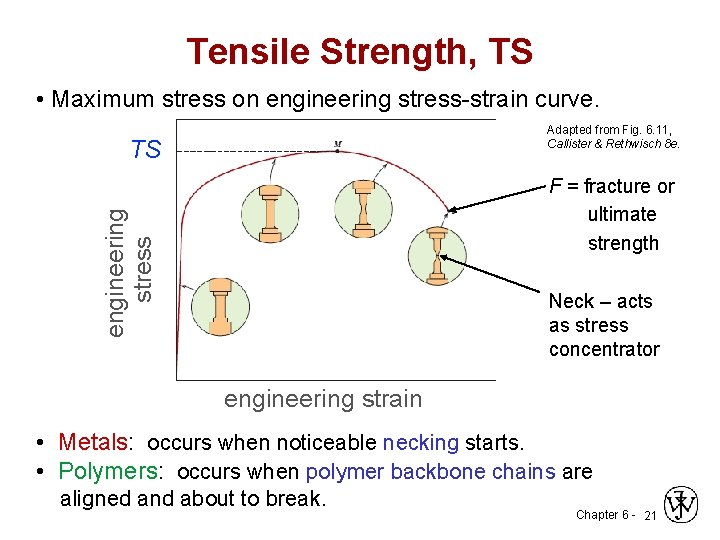
Tensile Strength, TS • Maximum stress on engineering stress-strain curve. Adapted from Fig. 6. 11, Callister & Rethwisch 8 e. TS F = fracture or ultimate strength engineering stress y Typical response of a metal Neck – acts as stress concentrator strain engineering strain • Metals: occurs when noticeable necking starts. • Polymers: occurs when polymer backbone chains are aligned and about to break. Chapter 6 - 21
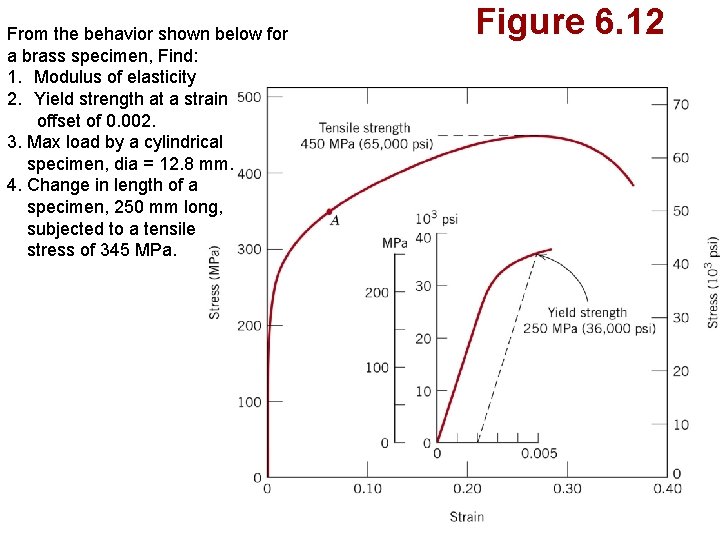
From the behavior shown below for a brass specimen, Find: 1. Modulus of elasticity 2. Yield strength at a strain offset of 0. 002. 3. Max load by a cylindrical specimen, dia = 12. 8 mm. 4. Change in length of a specimen, 250 mm long, subjected to a tensile stress of 345 MPa. Figure 6. 12 Chapter 6 - 22
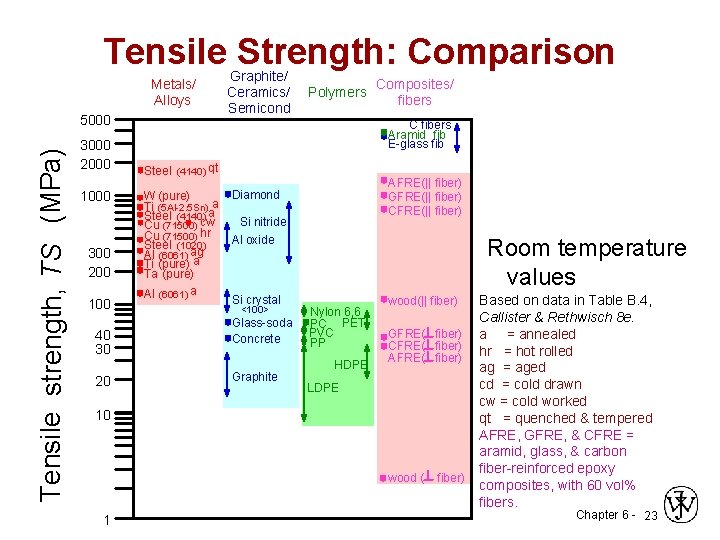
Tensile Strength: Comparison Metals/ Alloys Tensile strength, TS (MPa) 5000 3000 2000 1000 300 200 100 40 30 20 Graphite/ Ceramics/ Semicond Polymers Composites/ fibers C fibers Aramid fib E-glass fib Steel (4140) qt W (pure) Ti (5 Al-2. 5 Sn)aa Steel (4140) Cu (71500) cw Cu (71500) hr Steel (1020) Al (6061) ag Ti (pure) a Ta (pure) Al (6061) a AFRE(|| fiber) GFRE(|| fiber) CFRE(|| fiber) Diamond Si nitride Al oxide Si crystal <100> Glass-soda Concrete Graphite Room temperature values Nylon 6, 6 PC PET PVC PP HDPE wood(|| fiber) GFRE( fiber) CFRE( fiber) AFRE( fiber) LDPE 10 wood ( 1 fiber) Based on data in Table B. 4, Callister & Rethwisch 8 e. a = annealed hr = hot rolled ag = aged cd = cold drawn cw = cold worked qt = quenched & tempered AFRE, GFRE, & CFRE = aramid, glass, & carbon fiber-reinforced epoxy composites, with 60 vol% fibers. Chapter 6 - 23
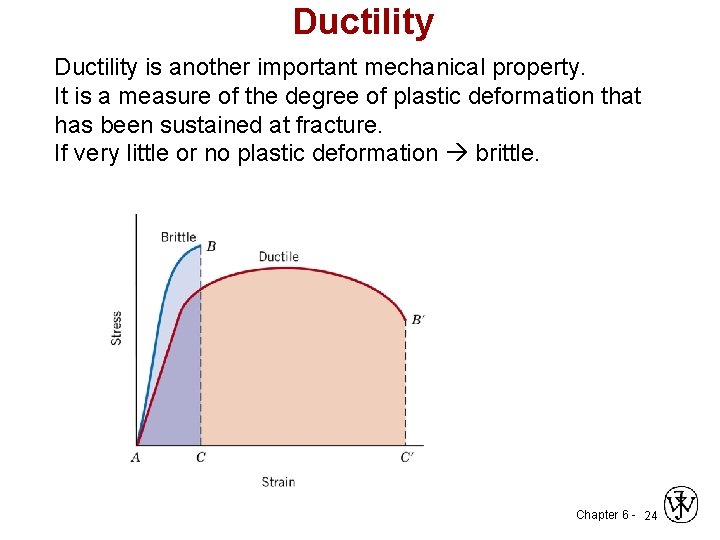
Ductility is another important mechanical property. It is a measure of the degree of plastic deformation that has been sustained at fracture. If very little or no plastic deformation brittle. Chapter 6 - 24
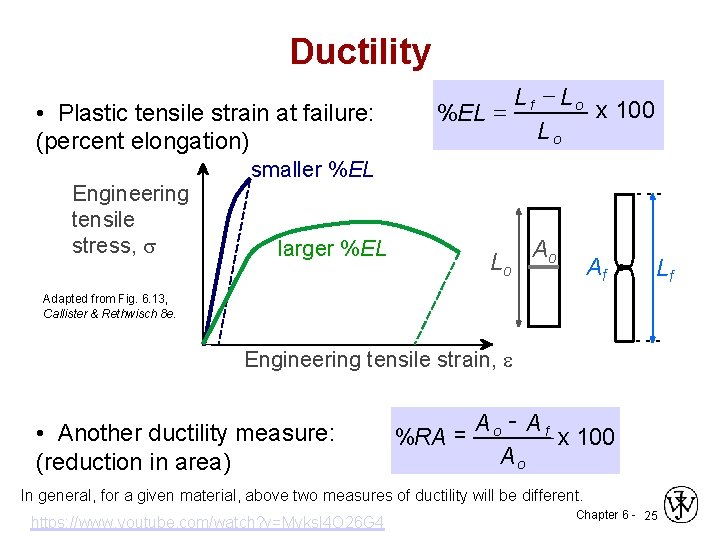
Ductility • Plastic tensile strain at failure: (percent elongation) Engineering tensile stress, Lf - Lo x 100 %EL = Lo smaller %EL larger %EL Lo Ao Af Lf Adapted from Fig. 6. 13, Callister & Rethwisch 8 e. Engineering tensile strain, • Another ductility measure: (reduction in area) %RA = Ao - Af x 100 Ao In general, for a given material, above two measures of ductility will be different. https: //www. youtube. com/watch? v=Myks. I 4 O 26 G 4 Chapter 6 - 25
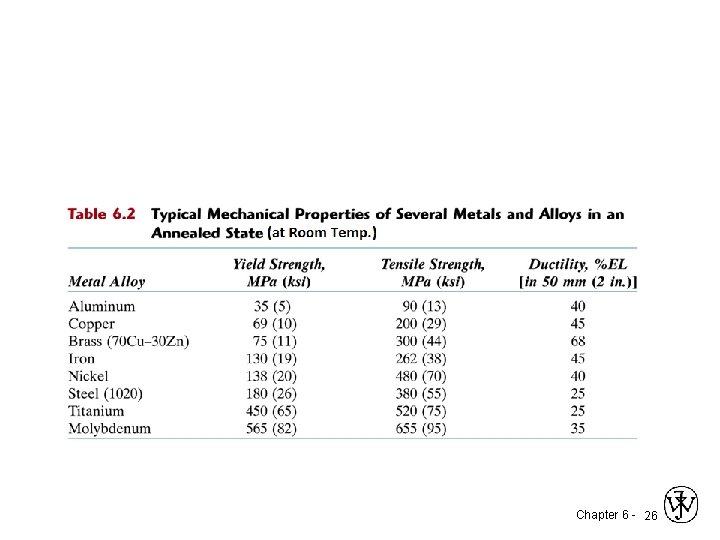
Chapter 6 - 26
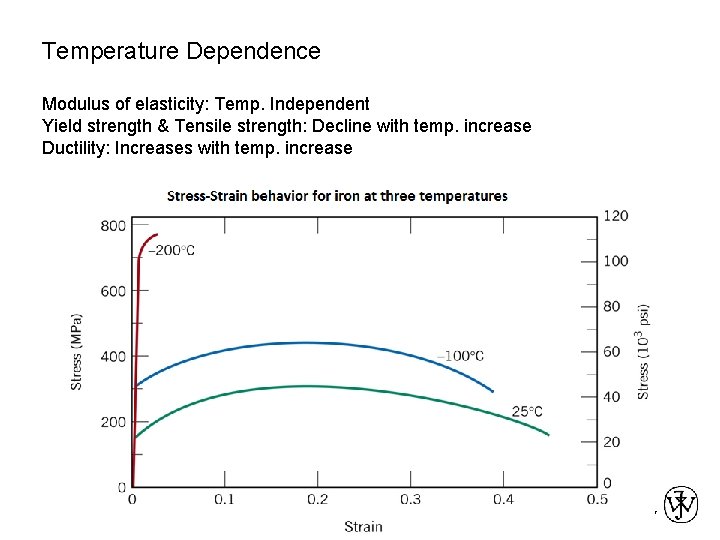
Temperature Dependence Modulus of elasticity: Temp. Independent Yield strength & Tensile strength: Decline with temp. increase Ductility: Increases with temp. increase Chapter 6 - 27
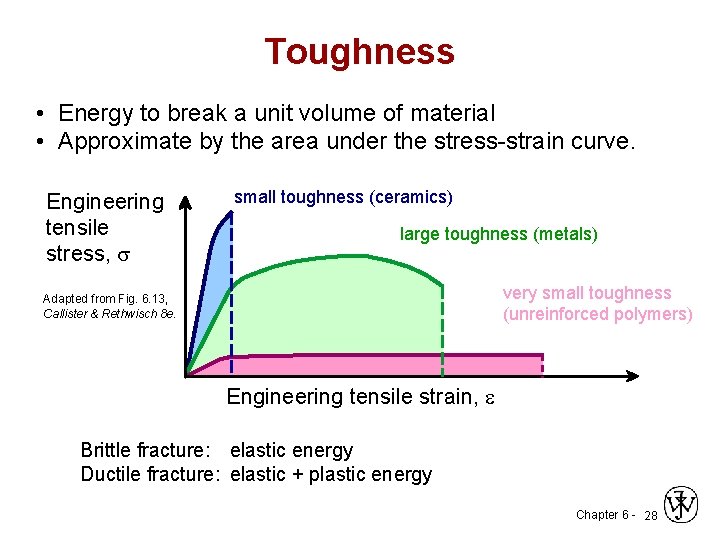
Toughness • Energy to break a unit volume of material • Approximate by the area under the stress-strain curve. Engineering tensile stress, small toughness (ceramics) large toughness (metals) very small toughness (unreinforced polymers) Adapted from Fig. 6. 13, Callister & Rethwisch 8 e. Engineering tensile strain, Brittle fracture: elastic energy Ductile fracture: elastic + plastic energy Chapter 6 - 28
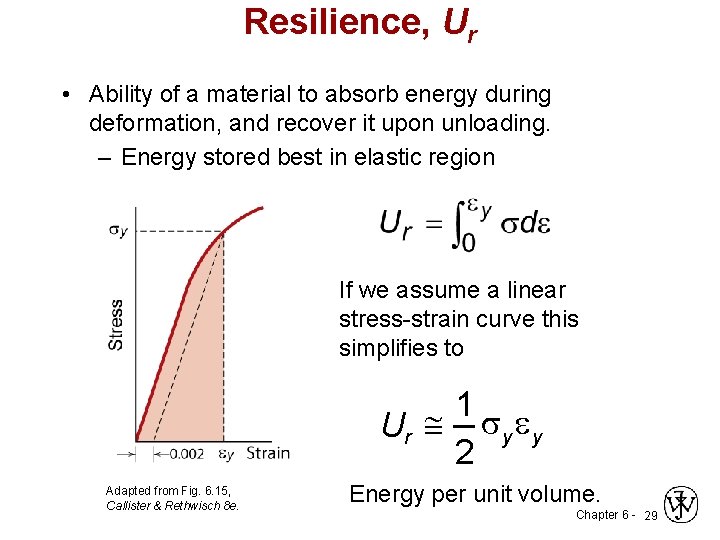
Resilience, Ur • Ability of a material to absorb energy during deformation, and recover it upon unloading. – Energy stored best in elastic region If we assume a linear stress-strain curve this simplifies to 1 Ur @ y y 2 Adapted from Fig. 6. 15, Callister & Rethwisch 8 e. Energy per unit volume. Chapter 6 - 29
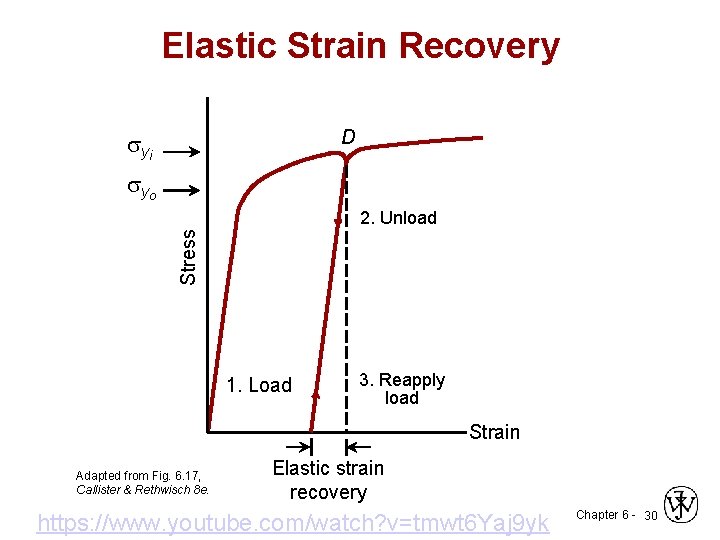
Elastic Strain Recovery D yi yo Stress 2. Unload 1. Load 3. Reapply load Strain Adapted from Fig. 6. 17, Callister & Rethwisch 8 e. Elastic strain recovery https: //www. youtube. com/watch? v=tmwt 6 Yaj 9 yk Chapter 6 - 30
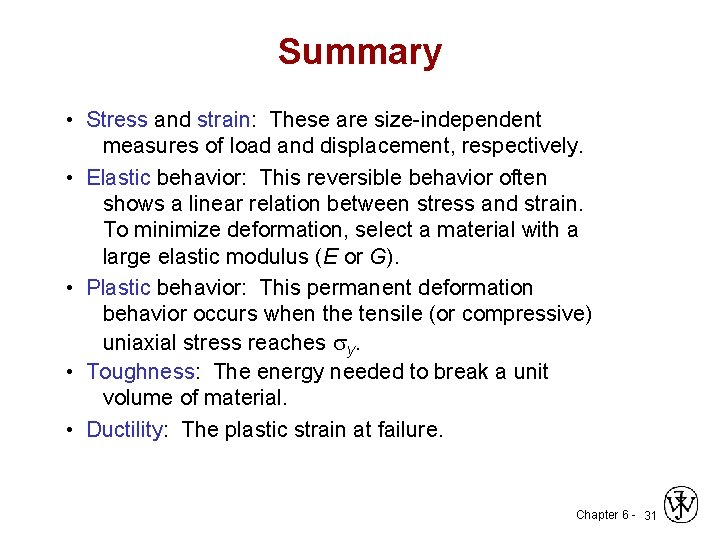
Summary • Stress and strain: These are size-independent measures of load and displacement, respectively. • Elastic behavior: This reversible behavior often shows a linear relation between stress and strain. To minimize deformation, select a material with a large elastic modulus (E or G). • Plastic behavior: This permanent deformation behavior occurs when the tensile (or compressive) uniaxial stress reaches y. • Toughness: The energy needed to break a unit volume of material. • Ductility: The plastic strain at failure. Chapter 6 - 31
E = 2 G (1+ ν) tableun_06_p 186 Chapter 6 -