
Geography Chapter 20 Todays Issues Africa European colonialism

- Slides: 25
Geography Chapter 20 Today’s Issues: Africa European colonialism of the 1800 s has left most of today’s independent African nations with economic, health, educational, and political problems. Next Copyright © by Houghton Mifflin Harcourt Publishing Company
Geography Chapter 20 Today’s Issues: Africa SECTION 1 Economic Development SECTION 2 Health Care Case Study Effects of Colonialism Previous Copyright © by Houghton Mifflin Harcourt Publishing Company Next
Geography Chapter 20 Section-1 Economic Development • Africa’s history of colonization has had long-term effects on its economy. • Barriers to African economic development include illiteracy, foreign debt, and a lack of manufacturing industries. Previous Copyright © by Houghton Mifflin Harcourt Publishing Company Next
Geography Chapter 20 Section-1 Economic Development Africa’s Economy Today A History of Problems • Most countries do little manufacturing − sell raw materials to industrialized countries • European colonizers exploited Africa’s resources, people − millions sold into slavery or died from harsh working conditions • Land was mined, drilled; environment was ignored • All this has limited Africa’s economic growth, political stability Previous Copyright © by Houghton Mifflin Harcourt Publishing Company Continued… Next
Geography Chapter 20 Africa’s Economy Today {continued} Africa’s Economic Status • Most African countries are worse off today than in 1960 − average incomes have decreased − worldwide: accounts for 1% of total GNP, 1. 5% of exports • Lack crucial infrastructure (roads, airports, railroads, ports) • Little access to computers or high technology Previous Copyright © by Houghton Mifflin Harcourt Publishing Company Next
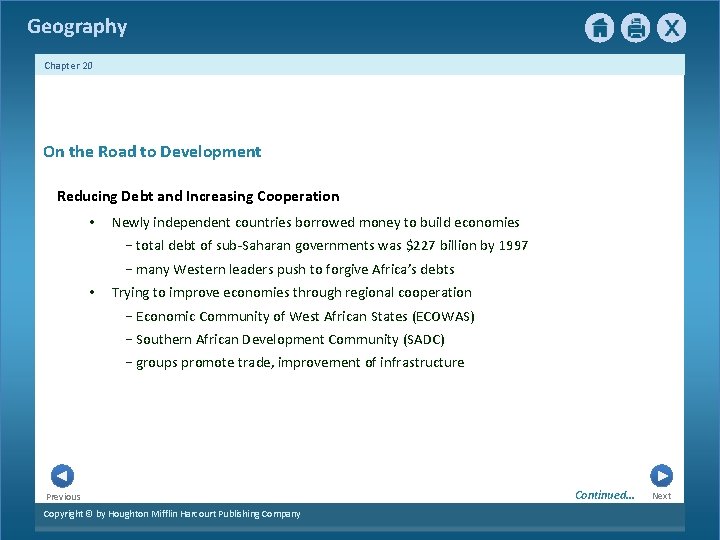
Geography Chapter 20 On the Road to Development Reducing Debt and Increasing Cooperation • Newly independent countries borrowed money to build economies − total debt of sub-Saharan governments was $227 billion by 1997 − many Western leaders push to forgive Africa’s debts • Trying to improve economies through regional cooperation − Economic Community of West African States (ECOWAS) − Southern African Development Community (SADC) − groups promote trade, improvement of infrastructure Previous Copyright © by Houghton Mifflin Harcourt Publishing Company Continued… Next
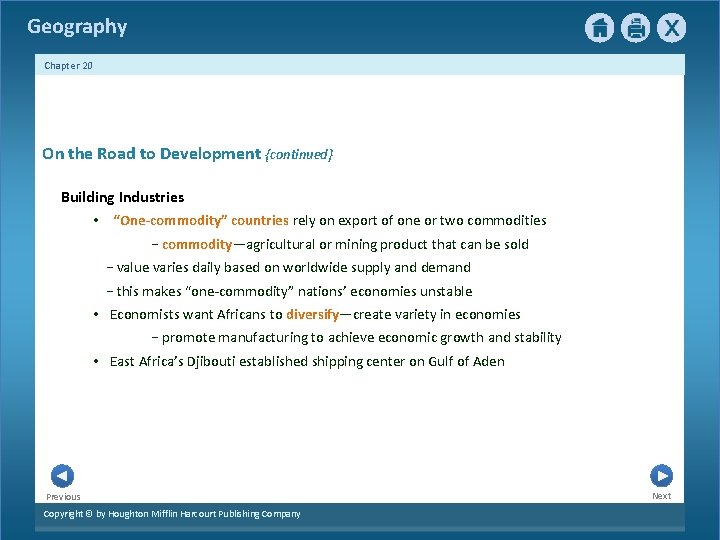
Geography Chapter 20 On the Road to Development {continued} Building Industries • “One-commodity” countries rely on export of one or two commodities − commodity—agricultural or mining product that can be sold − value varies daily based on worldwide supply and demand − this makes “one-commodity” nations’ economies unstable • Economists want Africans to diversify—create variety in economies − promote manufacturing to achieve economic growth and stability • East Africa’s Djibouti established shipping center on Gulf of Aden Previous Copyright © by Houghton Mifflin Harcourt Publishing Company Next
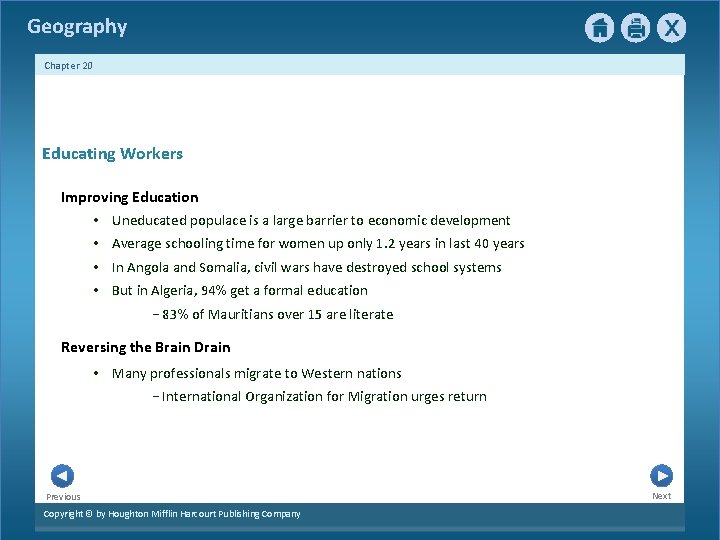
Geography Chapter 20 Educating Workers Improving Education • Uneducated populace is a large barrier to economic development • Average schooling time for women up only 1. 2 years in last 40 years • In Angola and Somalia, civil wars have destroyed school systems • But in Algeria, 94% get a formal education − 83% of Mauritians over 15 are literate Reversing the Brain Drain • Many professionals migrate to Western nations − International Organization for Migration urges return Previous Copyright © by Houghton Mifflin Harcourt Publishing Company Next
Geography Chapter 20 Section-2 Health Care • Epidemic diseases are killing Africa’s people in huge numbers. • African nations and countries around the world are using a variety of methods, including education, to eradicate disease. Previous Copyright © by Houghton Mifflin Harcourt Publishing Company Next
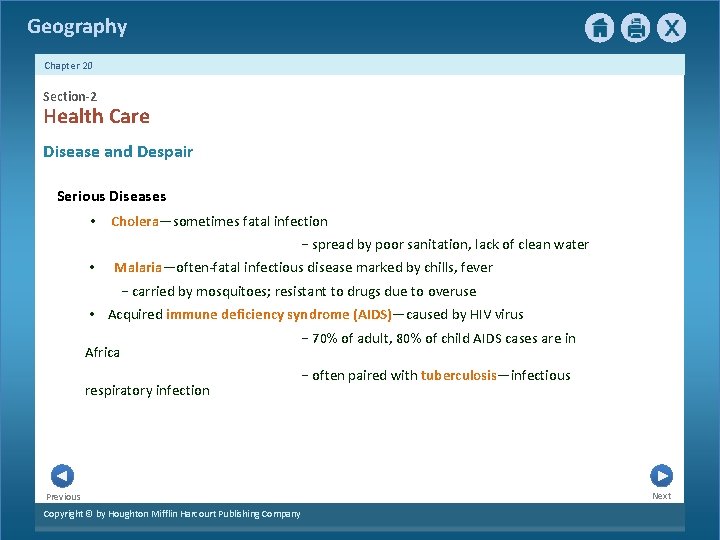
Geography Chapter 20 Section-2 Health Care Disease and Despair Serious Diseases • Cholera—sometimes fatal infection − spread by poor sanitation, lack of clean water • Malaria—often-fatal infectious disease marked by chills, fever − carried by mosquitoes; resistant to drugs due to overuse • Acquired immune deficiency syndrome (AIDS)—caused by HIV virus Africa respiratory infection Previous Copyright © by Houghton Mifflin Harcourt Publishing Company − 70% of adult, 80% of child AIDS cases are in − often paired with tuberculosis—infectious Next
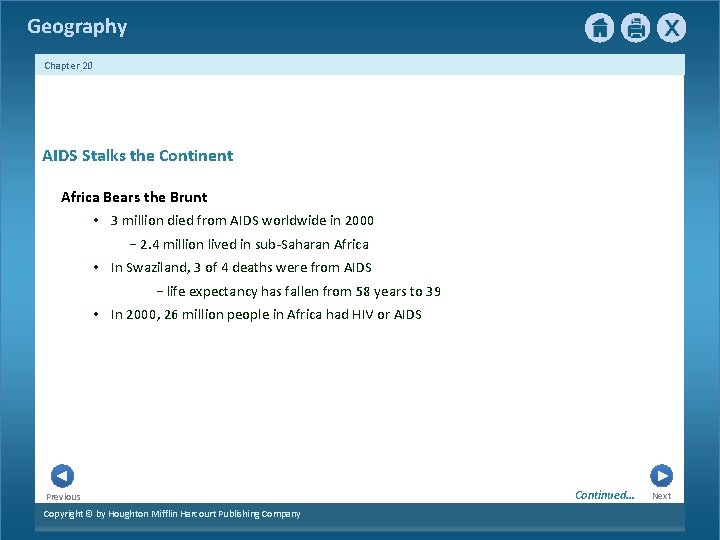
Geography Chapter 20 AIDS Stalks the Continent Africa Bears the Brunt • 3 million died from AIDS worldwide in 2000 − 2. 4 million lived in sub-Saharan Africa • In Swaziland, 3 of 4 deaths were from AIDS − life expectancy has fallen from 58 years to 39 • In 2000, 26 million people in Africa had HIV or AIDS Previous Copyright © by Houghton Mifflin Harcourt Publishing Company Continued… Next
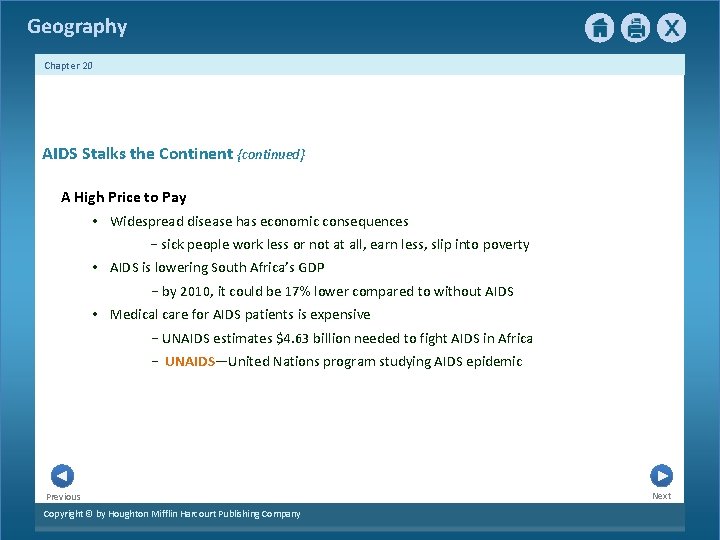
Geography Chapter 20 AIDS Stalks the Continent {continued} A High Price to Pay • Widespread disease has economic consequences − sick people work less or not at all, earn less, slip into poverty • AIDS is lowering South Africa’s GDP − by 2010, it could be 17% lower compared to without AIDS • Medical care for AIDS patients is expensive − UNAIDS estimates $4. 63 billion needed to fight AIDS in Africa − UNAIDS—United Nations program studying AIDS epidemic Previous Copyright © by Houghton Mifflin Harcourt Publishing Company Next
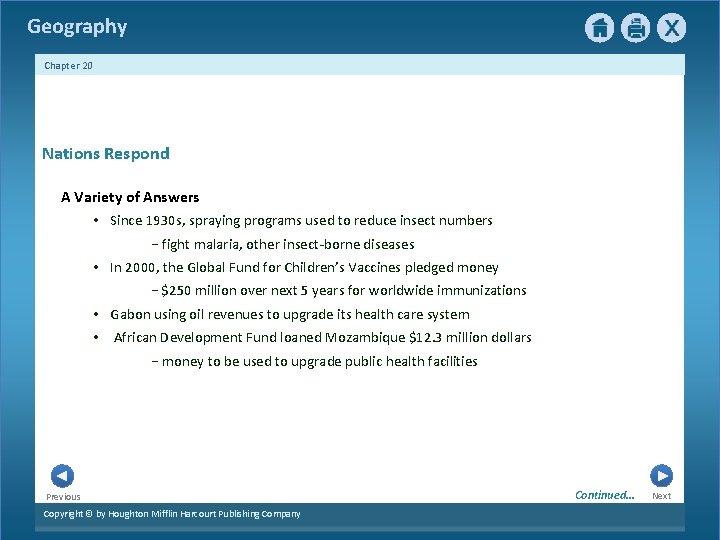
Geography Chapter 20 Nations Respond A Variety of Answers • Since 1930 s, spraying programs used to reduce insect numbers − fight malaria, other insect-borne diseases • In 2000, the Global Fund for Children’s Vaccines pledged money − $250 million over next 5 years for worldwide immunizations • Gabon using oil revenues to upgrade its health care system • African Development Fund loaned Mozambique $12. 3 million dollars − money to be used to upgrade public health facilities Previous Copyright © by Houghton Mifflin Harcourt Publishing Company Continued… Next
Geography Chapter 20 Nations Respond {continued} Strategies Against AIDS • South Africa, Brazil work together on AIDS prevention, care − Brazil has public health policies to fight AIDS, other diseases − Brazil’s policies are considered a model for developing nations Previous Copyright © by Houghton Mifflin Harcourt Publishing Company Continued… Next
Geography Chapter 20 Nations Respond {continued} Success Stories • Uganda and Senegal have reduced spread of HIV − in 1997, Uganda offers same-day HIV tests, education programs − infection rates among 15 to 24 year olds have dropped 50% • Senegal controls spread of AIDS with intensive education program − infection rates have been below 2% since mid- 1980 s • UNAIDS says HIV infection rates in sub-Saharan Africa are down − 1999– 2000: dropped by 200, 000 cases, but figure may be misleading Previous Copyright © by Houghton Mifflin Harcourt Publishing Company Next
Geography Chapter 20 Case Study Effects of Colonialism How can African nations bring peace and stability to their people? BACKGROUND • Early 19 th century Africa was home to great empires, rich cultures • By the end of the 19 th century—poverty and violence • Many of Africa’s problems stem from European colonialism Previous Copyright © by Houghton Mifflin Harcourt Publishing Company Next
Geography Chapter 20 Case Study Effects of Colonialism Colonizing Africa Europeans in Africa • Portuguese establish coastal trading stations in the 1400 s • By mid-1800 s, Europeans seek Africa’s rich natural resources − need raw materials for industrial economies, markets to sell goods • Berlin Conference (1884 -85) sets rules for dividing up Africa Previous Copyright © by Houghton Mifflin Harcourt Publishing Company Continued… Next
Geography Chapter 20 Case Study Nations Respond {continued} Europeans in Africa • European control begins to fade in 20 th century − most countries gain independence in 1960 s • Long-term damage to cultural and ethnic boundaries, economy Previous Copyright © by Houghton Mifflin Harcourt Publishing Company Next
Geography Chapter 20 Case Study Challenges of Independence Colonial Transition • Departing Europeans did not leave Africa with stable governments − newly established nations suffered dictators and civil wars • Europeans did not understand Africa’s ethnic diversity − drew country boundaries combining historical enemies Previous Copyright © by Houghton Mifflin Harcourt Publishing Company Continued… Next
Geography Chapter 20 Case Study Challenges of Independence {continued} Colonial Transition • Germany and Belgium aggravated historically tense ethnic relations − Rwanda, Burundi include Hutu, Tutsi groups; war erupts in 1990 s − this ethnic conflict took the lives of hundreds of thousands Previous Copyright © by Houghton Mifflin Harcourt Publishing Company Continued… Next
Geography Chapter 20 Case Study Challenges of Independence {continued} Colonial Transition • Colonial boundaries create problems for many African governments − difficult to get different ethnic groups to cooperate • Dictators like Mobutu Sese Seko became common − Mobutu ruled what is now the Democratic Republic of the Congo • Many Africans have no experience living in democratic governments Previous Copyright © by Houghton Mifflin Harcourt Publishing Company Continued… Next
Geography Chapter 20 Case Study Challenges of Independence {continued} Cause for Hope • Primary goal is to establish democratic traditions − political stability needed for peace and prosperity • Some progress is being made, for example in South Africa − white minority government yielded power to black majority in 1994 − ended decades of government-sanctioned racial discrimination Previous Copyright © by Houghton Mifflin Harcourt Publishing Company Continued… Next
Geography Chapter 20 Case Study Challenges of Independence {continued} Cause for Hope • In 2001, Ghana peacefully elected a new president − a change from the coups, assassinations of previous governments Previous Copyright © by Houghton Mifflin Harcourt Publishing Company Next
Geography Chapter 20 This is the end of the chapter presentation of lecture notes. Click the HOME or EXIT button. Previous Copyright © by Houghton Mifflin Harcourt Publishing Company Next
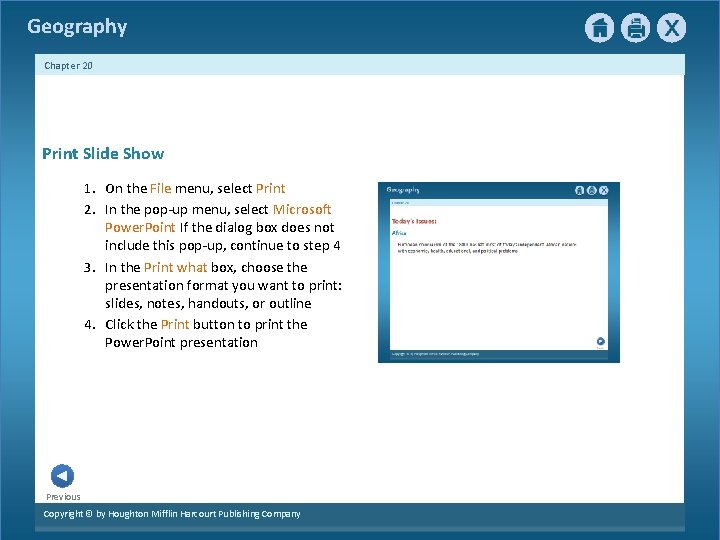
Geography Chapter 20 Print Slide Show 1. On the File menu, select Print 2. In the pop-up menu, select Microsoft Power. Point If the dialog box does not include this pop-up, continue to step 4 3. In the Print what box, choose the presentation format you want to print: slides, notes, handouts, or outline 4. Click the Print button to print the Power. Point presentation Previous Copyright © by Houghton Mifflin Harcourt Publishing Company